1 Corinthians, Chapter 2 (Codex Alexandrinus)
Introduction
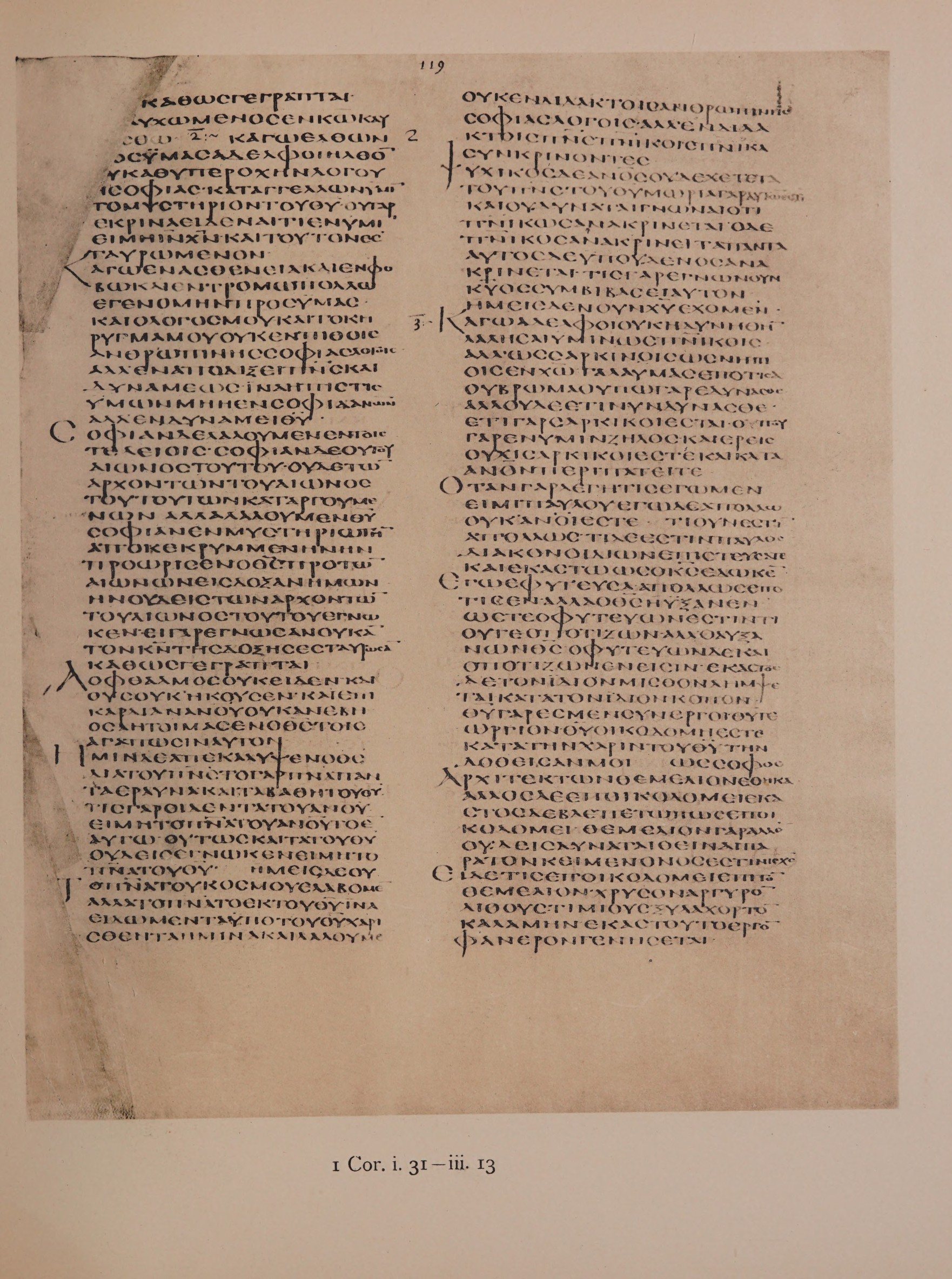
1 Corinthians 2 from Codex Alexandrinus (GA 02), a fifth-century Greek Bible held by the British Library (Royal MS 1 D. VIII). In the New Testament it is the chief witness to the Byzantine text in the Gospels and to the Alexandrian text in the rest of the New Testament. Its New Testament volume lacks Matthew 1:1-25:5, John 6:50-8:52 and 2 Corinthians 4:13-12:6.
This entry meets the strict three-criteria standard of the Theosis Library:
- Manuscript scan: the actual page(s) of Codex Alexandrinus containing this passage (folio 119r), reproduced from the British Museum's 1909 photographic facsimile edited by F. G. Kenyon, as digitised by the Getty Research Institute for the Internet Archive. The facsimile prints the verse range beneath each plate; that printed range was read for every page used and agrees with the INTF's NTVMR verse-level page index (CC BY 4.0). The page for each section now comes from the NTVMR transcription itself, which records the page and column on which every verse is written.
- Original text: the manuscript's own text, from a diplomatic transcription (see Greek text below), with Tischendorf's 8th critical edition (1869) for comparison.
- English translation: the King James Version (1611), retrieved verbatim from the public-domain bible-api.com endpoint.
Greek text: a diplomatic transcription of Codex Alexandrinus made by the Institut für Neutestamentliche Textforschung (INTF), Münster, for the New Testament Virtual Manuscript Room (NTVMR), published under a Creative Commons Attribution 4.0 licence. It gives the letters as the first scribe wrote them: no accents or breathings, the scribe's own spelling, and the sacred names in their contracted form (θς for θεος, ις for ιησους, κς for κυριος; the overline is not reproduced). Corrections by later hands are not shown. Letters in square brackets are not legible on the page and were restored by the transcribers, a dot under a letter marks an uncertain reading, and [...] marks text lost to damage. Beneath each section, for comparison, is Tischendorf's 8th critical edition (1869). Where the two differ, the transcription is what the manuscript says. Each section is shown with the page on which the transcription places its verses.
How was this verified? (Provenance)
Where on the image
Page from the NTVMR transcription (docID 20002): verses 1-7 on fol. 119r (facsimile leaf 199), col. 1.
1καγω ελθων [πρ]ος υμας αδελφοι ηλθον [ο]υ καθ υπεροχην λογου η̣ σοφιας · καταγγελλων υμιν το μυστηριον του θυ · 2ου γαρ εκρινα ειδεναι τι εν υμιν ει μη ιν χν · και τουτον εσταυρωμενον · 3κ̣αγω εν ασθενεια και εν φοβω και εν τρομω πολλω εγενομην προς υμας · 4και ο λογος μου και το κηρυγμα μου ουκ εν πιθοις ανθρωπινης σοφιας λογοις · αλλ εν αποδιξει πνς και δυναμεως · 5ινα η πιστις υμων μη η εν σοφια ανων αλλ εν δυναμει θυ · 6σοφιαν δε λαλουμεν εν τοις τελειοις · σοφιαν δε ου του αιωνος τουτου · ουδε των αρχοντων του αιωνος τουτου των καταργουμενων · 7αλλα λαλουμεν θυ σοφιαν εν μυστηριω την αποκεκρυμμενην ην προωρισεν ο θς προ των αιωνων εις δοξαν ημων
Compare: Tischendorf 8th edition (1869)
1Κἀγὼ ἐλθὼν πρὸς ὑμᾶς, ἀδελφοί, ἦλθον οὐ καθ’ ὑπεροχὴν λόγου ἢ σοφίας καταγγέλλων ὑμῖν τὸ μαρτύριον τοῦ θεοῦ. 2οὐ γὰρ ἔκρινά εἰδέναι τι ἐν ὑμῖν εἰ μὴ Ἰησοῦν Χριστὸν καὶ τοῦτον ἐσταυρωμένον. 3κἀγὼ ἐν ἀσθενείᾳ καὶ ἐν φόβῳ καὶ ἐν τρόμῳ πολλῷ ἐγενόμην πρὸς ὑμᾶς, 4καὶ ὁ λόγος μου καὶ τὸ κήρυγμά μου οὐκ ἐν πειθοῖς σοφίας λόγοις ἀλλ’ ἐν ἀποδείξει πνεύματος καὶ δυνάμεως, 5ἵνα ἡ πίστις ὑμῶν μὴ ᾖ ἐν σοφίᾳ ἀνθρώπων ἀλλ’ ἐν δυνάμει θεοῦ. 6Σοφίαν δὲ λαλοῦμεν ἐν τοῖς τελείοις, σοφίαν δὲ οὐ τοῦ αἰῶνος τούτου οὐδὲ τῶν ἀρχόντων τοῦ αἰῶνος τούτου τῶν καταργουμένων· 7ἀλλὰ λαλοῦμεν θεοῦ σοφίαν ἐν μυστηρίῳ, τὴν ἀποκεκρυμμένην, ἣν προώρισεν ὁ θεὸς πρὸ τῶν αἰώνων εἰς δόξαν ἡμῶν·
1And I, brethren, when I came to you, came not with excellency of speech or of wisdom, declaring unto you the testimony of God. 2For I determined not to know any thing among you, save Jesus Christ, and him crucified. 3And I was with you in weakness, and in fear, and in much trembling. 4And my speech and my preaching was not with enticing words of man’s wisdom, but in demonstration of the Spirit and of power: 5That your faith should not stand in the wisdom of men, but in the power of God. 6Howbeit we speak wisdom among them that are perfect: yet not the wisdom of this world, nor of the princes of this world, that come to nought: 7But we speak the wisdom of God in a mystery, even the hidden wisdom, which God ordained before the world unto our glory:
Where on the image
Page from the NTVMR transcription (docID 20002): verses 8-13 on fol. 119r (facsimile leaf 199), col. 1.
8ην ουδεις των αρχοντων του αιωνος τουτου εγνωκεν · ει γαρ εγνωσαν ουκ αν τον κν της δοξης εσταυρωσαν 9καθως γεγραπται · α οφθαλμος ουκ ειδεν · και ους ουκ · ηκουσεν · και επι καρδιαν ανου ουκ ανεβη οσα ητοιμασεν ο θς τοις αγαπωσιν αυτον · 10ημιν δε απεκαλυψεν ο θς δια του πνς το γαρ πνα παντα εραυνα · και τα βαθη του θυ 11τις γαρ οιδεν τα του ανου ει μη το πνα του ανου το εν αυτω · ουτως και τα του θυ ουδεις εγνωκεν ει μη το πνα του θυ · 12ημεις δε ου το πνα του κοσμου ελαβομεν αλλα το πνα το εκ του θυ · ινα ειδωμεν τα υπο του θυ χαρισθεντα ημιν 13α και λαλουμεν ουκ εν διδακτοις ανθρωπινης σοφιας λογοις · αλλ εν διδακτοις πνς πνικοις πνικα συνκρινοντες ·
Compare: Tischendorf 8th edition (1869)
8ἣν οὐδεὶς τῶν ἀρχόντων τοῦ αἰῶνος τούτου ἔγνωκεν, εἰ γὰρ ἔγνωσαν, οὐκ ἂν τὸν κύριον τῆς δόξης ἐσταύρωσαν. 9ἀλλὰ καθὼς γέγραπται· ἃ ὀφθαλμὸς οὐκ εἶδεν καὶ οὖς οὐκ ἤκουσεν καὶ ἐπὶ καρδίαν ἀνθρώπου οὐκ ἀνέβη, ἃ ἡτοίμασεν ὁ θεὸς τοῖς ἀγαπῶσιν αὐτόν. 10ἡμῖν δὲ ἀπεκάλυψεν ὁ θεὸς διὰ τοῦ πνεύματος· τὸ γὰρ πνεῦμα πάντα ἐραυνᾷ, καὶ τὰ βάθη τοῦ θεοῦ. 11τίς γὰρ οἶδεν ἀνθρώπων τὰ τοῦ ἀνθρώπου εἰ μὴ τὸ πνεῦμα τοῦ ἀνθρώπου τὸ ἐν αὐτῷ; οὕτως καὶ τὰ τοῦ θεοῦ οὐδεὶς ἔγνωκεν εἰ μὴ τὸ πνεῦμα τοῦ θεοῦ. 12ἡμεῖς δὲ οὐ τὸ πνεῦμα τοῦ κόσμου ἐλάβομεν ἀλλὰ τὸ πνεῦμα τὸ ἐκ τοῦ θεοῦ, ἵνα εἰδῶμεν τὰ ὑπὸ τοῦ θεοῦ χαρισθέντα ἡμῖν· 13ἃ καὶ λαλοῦμεν οὐκ ἐν διδακτοῖς ἀνθρωπίνης σοφίας λόγοις ἀλλ’ ἐν διδακτοῖς πνεύματος, πνευματικοῖς πνευματικὰ συνκρίνοντες.
8Which none of the princes of this world knew: for had they known it, they would not have crucified the Lord of glory. 9But as it is written, Eye hath not seen, nor ear heard, neither have entered into the heart of man, the things which God hath prepared for them that love him. 10But God hath revealed them unto us by his Spirit: for the Spirit searcheth all things, yea, the deep things of God. 11For what man knoweth the things of a man, save the spirit of man which is in him? even so the things of God knoweth no man, but the Spirit of God. 12Now we have received, not the spirit of the world, but the spirit which is of God; that we might know the things that are freely given to us of God. 13Which things also we speak, not in the words which man’s wisdom teacheth, but which the Holy Ghost teacheth; comparing spiritual things with spiritual.
Where on the image
Page from the NTVMR transcription (docID 20002): verses 14-16 on fol. 119r (facsimile leaf 199), col. 2.
14ψυχικος δε ανος ου δεχετε τα του πνς του θυ μωρια γαρ εστιν και ου δυναται γνωναι οτι πνικως ανακρινεται · 15ο δε πνικος ανακρινει τα παντα αυτος δε υπ ουδενος ανακρινεται · 16τις γαρ εγνω νουν κυ ος συμβιβασει αυτον · ημεις δε νουν χυ εχομεν ·
Compare: Tischendorf 8th edition (1869)
14ψυχικὸς δὲ ἄνθρωπος οὐ δέχεται τὰ τοῦ πνεύματος τοῦ θεοῦ, μωρία γὰρ αὐτῷ ἐστιν, καὶ οὐ δύναται γνῶναι, ὅτι πνευματικῶς ἀνακρίνεται· 15ὁ δὲ πνευματικὸς ἀνακρίνει πάντα, αὐτὸς δὲ ὑπ’ οὐδενὸς ἀνακρίνεται. 16τίς γὰρ ἔγνω νοῦν κυρίου, ὃς συμβιβάσει αὐτόν; ἡμεῖς δὲ νοῦν Χριστοῦ ἔχομεν.
14But the natural man receiveth not the things of the Spirit of God: for they are foolishness unto him: neither can he know them, because they are spiritually discerned. 15But he that is spiritual judgeth all things, yet he himself is judged of no man. 16For who hath known the mind of the Lord, that he may instruct him? But we have the mind of Christ.
Cite
Sources
- Source: Codex Alexandrinus page images + NTVMR transcription (CC BY 4.0) + Tischendorf 8th edition + KJV (holding institution)
- Critical edition: Codex Alexandrinus transcription, NTVMR (INTF Münster, CC BY 4.0); Tischendorf 8th edition for comparison
← previous · → next · v cycle view · l back to library