1 Corinthians, Chapter 7 (Codex Alexandrinus)
Introduction
1 Corinthians 7 from Codex Alexandrinus (GA 02), a fifth-century Greek Bible held by the British Library (Royal MS 1 D. VIII). In the New Testament it is the chief witness to the Byzantine text in the Gospels and to the Alexandrian text in the rest of the New Testament. Its New Testament volume lacks Matthew 1:1-25:5, John 6:50-8:52 and 2 Corinthians 4:13-12:6.
This entry meets the strict three-criteria standard of the Theosis Library:
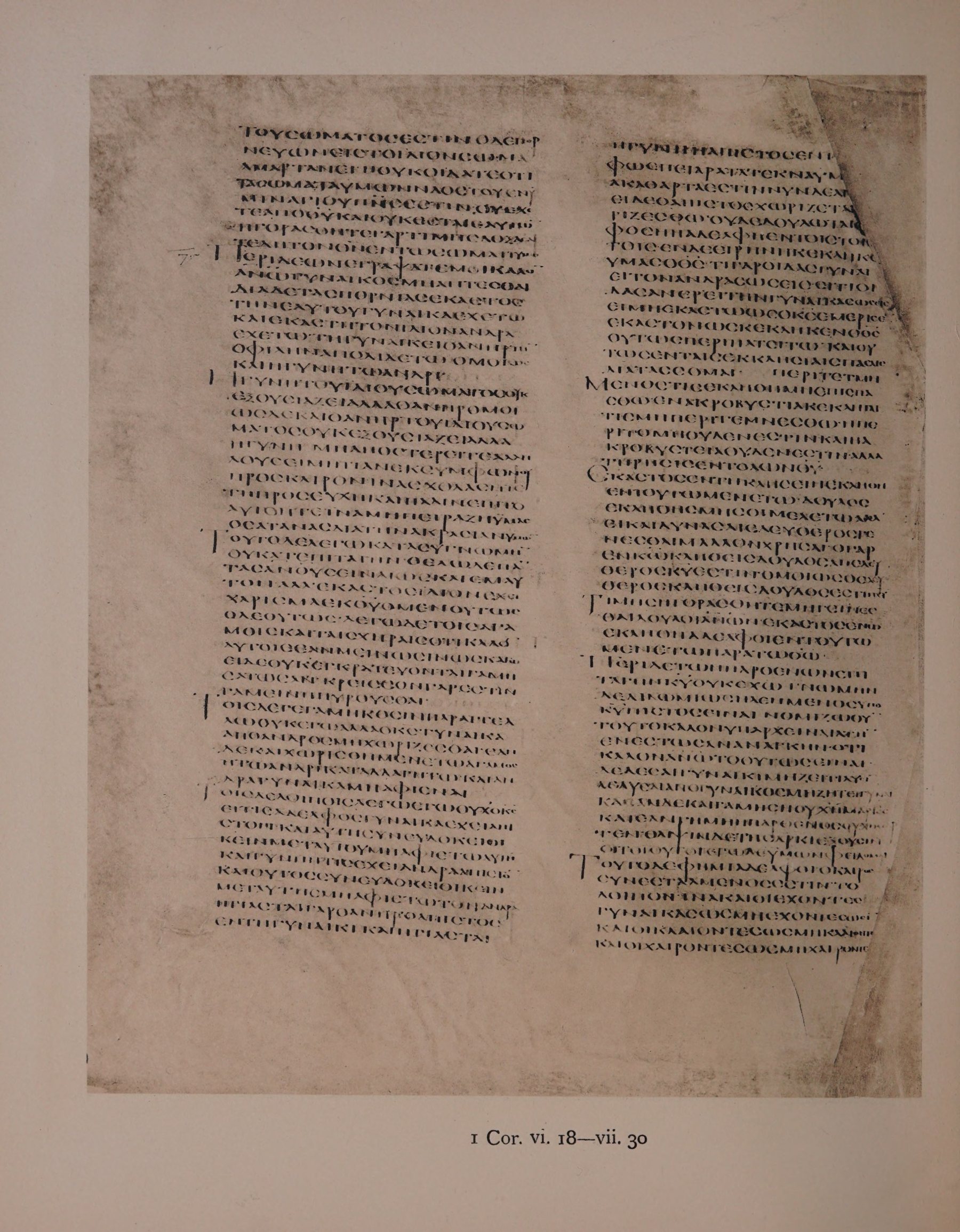
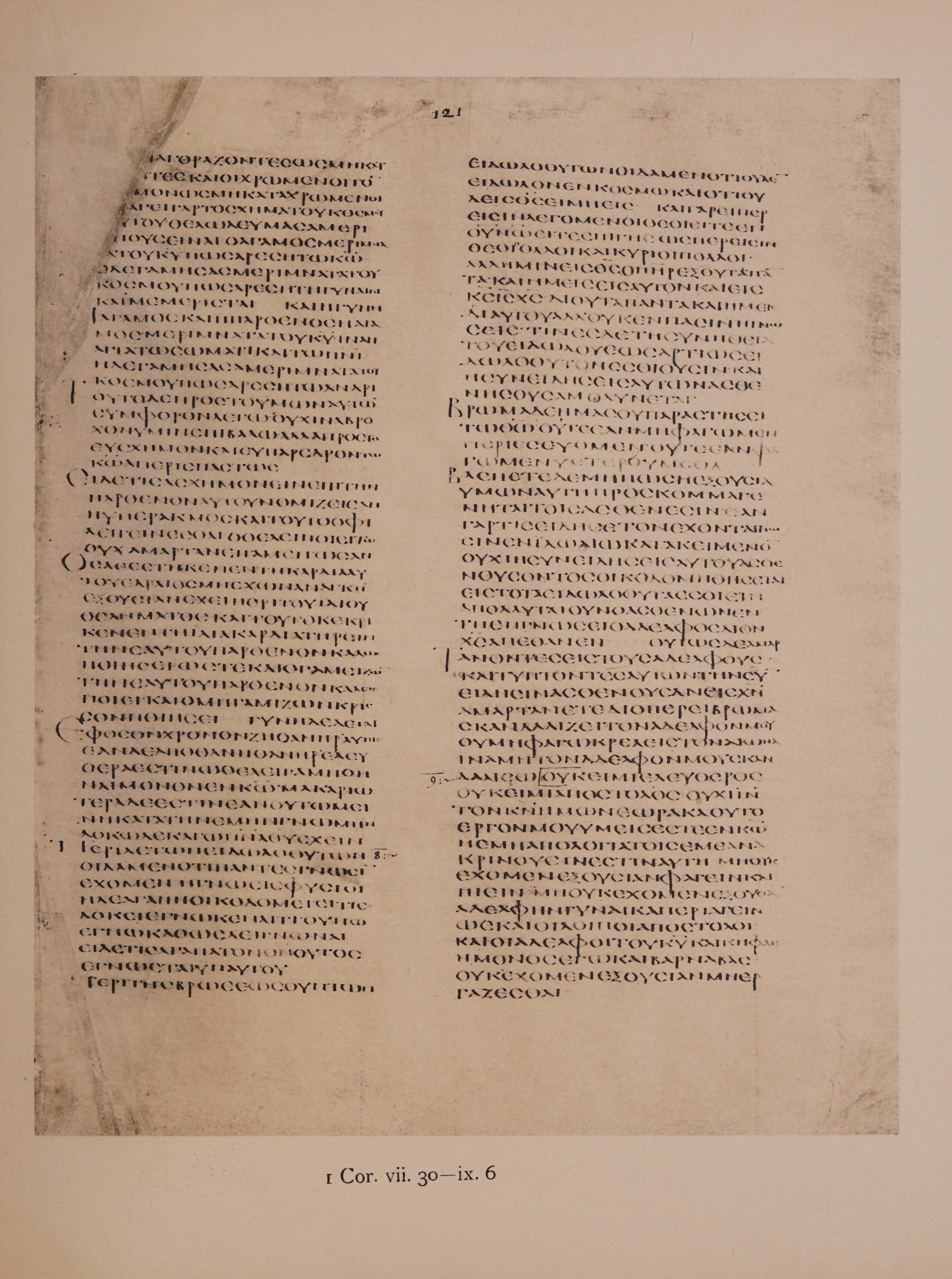
- Manuscript scan: the actual page(s) of Codex Alexandrinus containing this passage (folios 120v, 121r), reproduced from the British Museum's 1909 photographic facsimile edited by F. G. Kenyon, as digitised by the Getty Research Institute for the Internet Archive. The facsimile prints the verse range beneath each plate; that printed range was read for every page used and agrees with the INTF's NTVMR verse-level page index (CC BY 4.0). The page for each section now comes from the NTVMR transcription itself, which records the page and column on which every verse is written.
- Original text: the manuscript's own text, from a diplomatic transcription (see Greek text below), with Tischendorf's 8th critical edition (1869) for comparison.
- English translation: the King James Version (1611), retrieved verbatim from the public-domain bible-api.com endpoint.
Greek text: a diplomatic transcription of Codex Alexandrinus made by the Institut für Neutestamentliche Textforschung (INTF), Münster, for the New Testament Virtual Manuscript Room (NTVMR), published under a Creative Commons Attribution 4.0 licence. It gives the letters as the first scribe wrote them: no accents or breathings, the scribe's own spelling, and the sacred names in their contracted form (θς for θεος, ις for ιησους, κς for κυριος; the overline is not reproduced). Corrections by later hands are not shown. Letters in square brackets are not legible on the page and were restored by the transcribers, a dot under a letter marks an uncertain reading, and [...] marks text lost to damage. Beneath each section, for comparison, is Tischendorf's 8th critical edition (1869). Where the two differ, the transcription is what the manuscript says. Each section is shown with the page on which the transcription places its verses.
How was this verified? (Provenance)
Where on the image
Page from the NTVMR transcription (docID 20002): verses 1-7 on fol. 120v (facsimile leaf 202), col. 1.
1περι δε ων εγραψατε μοι καλον ανω γυναικος μη απτεσθαι 2δια δε τας πορνιας εκαστος την εαυτου γυναικα εχετω και εκαστη τον ιδιον ανδρα εχετω · 3τη γυναικει ο ανηρ την οφιλην αποδιδετω ομοιως και η γυνη τω ανδρι · 4η γυνη του ιδιου σωματος ουκ εξουσιαζει αλλα ο ανηρ ομοιως δε και ο ανηρ του ιδιου σωματος ουκ εξουσιαζει αλλα η γυνη · 5μη αποστερειτε αλληλους ει μητι αν εκ συμφωνου προς καιρον · ινα σχολασητε τη προσευχη και παλιν επι το αυτο ητε · ινα μη πειραζη υμας ο σατανας δια την ακρασιαν υμων 6τουτο δε λεγω κατα συγνωμην ου κατ επιταγην · 7θελω δε παντας ανους ειναι ως και εμαυτον · αλλ εκαστος ιδιον εχει χαρισμα εκ θυ ο μεν ουτως ο δε ουτως ·
Compare: Tischendorf 8th edition (1869)
1Περὶ δὲ ὧν ἐγράψατε, καλὸν ἀνθρώπῳ γυναικὸς μὴ ἅπτεσθαι· 2διὰ δὲ τὰς πορνείας ἕκαστος τὴν ἑαυτοῦ γυναῖκα ἐχέτω, καὶ ἑκάστη τὸν ἴδιον ἄνδρα ἐχέτω. 3τῇ γυναικὶ ὁ ἀνὴρ τὴν ὀφειλὴν ἀποδιδότω, ὁμοίως δὲ καὶ ἡ γυνὴ τῷ ἀνδρί. 4ἡ γυνὴ τοῦ ἰδίου σώματος οὐκ ἐξουσιάζει ἀλλὰ ὁ ἀνήρ· ὁμοίως δὲ καὶ ὁ ἀνὴρ τοῦ ἰδίου σώματος οὐκ ἐξουσιάζει ἀλλὰ ἡ γυνή. 5μὴ ἀποστερεῖτε ἀλλήλους, εἰ μήτι ἂν ἐκ συμφώνου πρὸς καιρὸν ἵνα σχολάσητε τῇ προσευχῇ καὶ πάλιν ἐπὶ τὸ αὐτὸ ἦτε, ἵνα μὴ πειράζῃ ὑμᾶς ὁ σατανᾶς διὰ τὴν ἀκρασίαν ὑμῶν. 6τοῦτο δὲ λέγω κατὰ συγγνώμην, οὐ κατ’ ἐπιταγήν. 7θέλω δὲ πάντας ἀνθρώπους εἶναι ὡς καὶ ἐμαυτόν· ἀλλὰ ἕκαστος ἴδιον ἔχει χάρισμα ἐκ θεοῦ, ὁ μὲν οὕτως, ὁ δὲ οὕτως.
1Now concerning the things whereof ye wrote unto me: It is good for a man not to touch a woman. 2Nevertheless, to avoid fornication, let every man have his own wife, and let every woman have her own husband. 3Let the husband render unto the wife due benevolence: and likewise also the wife unto the husband. 4The wife hath not power of her own body, but the husband: and likewise also the husband hath not power of his own body, but the wife. 5Defraud ye not one the other, except it be with consent for a time, that ye may give yourselves to fasting and prayer; and come together again, that Satan tempt you not for your incontinency. 6But I speak this by permission, and not of commandment. 7For I would that all men were even as I myself. But every man hath his proper gift of God, one after this manner, and another after that.
Where on the image
Page from the NTVMR transcription (docID 20002): verses 8-14 on fol. 120v (facsimile leaf 202), col. 1.
8λεγω δε τοις αγαμοις και ταις χηραις οτι καλον αυτοις εαν μεινωσιν ως καγω 9ει δε ουκ εγκρατευονται γαμησατωσαν · κρεισσον γαρ εστιν γαμειν η πυρουσθαι · 10τοις δε γεγαμηκοσιν παραγγελλω ουκ εγω αλλα ο κς · γυναικα απο ανδρος μη χωριζεσθαι · 11εαν δε και χωρισθη μενετω αγαμος η τω ανδρι καταλλαγητω · και ανδρα γυναικα μη αφιεναι 12τοις δε λοιποις λεγω εγω ουχ ο κς ει τις αδελφος γυναικα εχει απιστον · και αυτη συνευδοκει οικειν μετ αυτου μη αφιετω αυτην 13και γυνη ητις εχει ανδρα απιστον και ουτος συνευδοκει οικειν μετ αυτης μη αφιετω τον ανδρα · 14ηγιασται γαρ ο ανηρ ο απιστος εν τη γυναικι και ηγιασται η γυνη η απιστος εν τ̣[ω] [αδελ]φω επει αρα τα τεκνα υμ[ων] ακαθαρτα εστιν νυν δε αγ̣[ια] [εστιν]
Compare: Tischendorf 8th edition (1869)
8Λέγω δὲ τοῖς ἀγάμοις καὶ ταῖς χήραις, καλὸν αὐτοῖς ἐὰν μείνωσιν ὡς κἀγώ· 9εἰ δὲ οὐκ ἐγκρατεύονται γαμησάτωσαν· κρεῖττον γάρ ἐστιν γαμεῖν ἢ πυροῦσθαι. 10τοῖς δὲ γεγαμηκόσιν παραγγέλλω, οὐκ ἐγὼ ἀλλὰ ὁ κύριος, γυναῖκα ἀπὸ ἀνδρὸς μὴ χωρισθῆναι, 11ἐὰν δὲ καὶ χωρισθῇ, μενέτω ἄγαμος ἢ τῷ ἀνδρὶ καταλλαγήτω, καὶ ἄνδρα γυναῖκα μὴ ἀφιέναι. 12τοῖς δὲ λοιποῖς λέγω ἐγώ, οὐχ ὁ κύριος· εἴ τις ἀδελφὸς γυναῖκα ἔχει ἄπιστον, καὶ αὕτη συνευδοκεῖ οἰκεῖν μετ’ αὐτοῦ, μὴ ἀφιέτω αὐτήν· 13καὶ γυνὴ εἴ τις ἔχει ἄνδρα ἄπιστον καὶ οὗτος συνευδοκεῖ οἰκεῖν μετ’ αὐτῆς, μὴ ἀφιέτω τὸν ἄνδρα. 14ἡγίασται γὰρ ὁ ἀνὴρ ὁ ἄπιστος ἐν τῇ γυναικί, καὶ ἡγίασται ἡ γυνὴ ἡ ἄπιστος ἐν τῷ ἀδελφῷ· ἐπεὶ ἄρα τὰ τέκνα ὑμῶν ἀκάθαρτά ἐστιν, νῦν δὲ ἅγιά ἐστιν.
8I say therefore to the unmarried and widows, It is good for them if they abide even as I. 9But if they cannot contain, let them marry: for it is better to marry than to burn. 10And unto the married I command, yet not I, but the Lord, Let not the wife depart from her husband: 11But and if she depart, let her remain unmarried, or be reconciled to her husband: and let not the husband put away his wife. 12But to the rest speak I, not the Lord: If any brother hath a wife that believeth not, and she be pleased to dwell with him, let him not put her away. 13And the woman which hath an husband that believeth not, and if he be pleased to dwell with her, let her not leave him. 14For the unbelieving husband is sanctified by the wife, and the unbelieving wife is sanctified by the husband: else were your children unclean; but now are they holy.
Where on the image
Page from the NTVMR transcription (docID 20002): verses 15-22 on fol. 120v (facsimile leaf 202), col. 2.
15ει δε ο απιστος χωριζεται [χω]ριζεσθω · ου δεδουλωται ο̣ [αδελ]φος η η αδελφη εν τοις τοιο̣[υ]τοις εν δε ειρηνη κεκληκε̣[ν] υμας ο θς · 16τι γαρ οιδας γυναι ει τον ανδρα σωσεις · ει τι οιδας ανερ ει την γυναικα σωσεις 17ει μη εκαστω ως ο κς εμερισεν εκαστον ως κεκληκεν ο θς ουτως περιπατειτω · και ουτως εν ταις εκκλησιαις πασαις διατασσομαι · 18περιτετμημενος τις εκληθη μη επισπασθω · εν ακροβυστια κεκληται τις μη περιτεμνεσθω · 19η περιτομη ουδεν εστιν και η ακροβυστεια ουδεν εστιν · αλλα τηρησις εντολων θυ · 20εκαστος εν τη κλησει η εκληθη εν τουτω μενετω · 21δουλος εκληθης μη σοι μελετω αλλ ει και δυνασαι ελευθερος γενεσθαι μαλλον χρησαι · 22ο γαρ εν κω κληθεις δουλος απελευθερος κυ εστιν · ομοιως ο ελευθερος κληθεις δουλος εστιν χυ
Compare: Tischendorf 8th edition (1869)
15εἰ δὲ ὁ ἄπιστος χωρίζεται, χωριζέσθω· οὐ δεδούλωται ὁ ἀδελφὸς ἢ ἡ ἀδελφὴ ἐν τοῖς τοιούτοις· ἐν δὲ εἰρήνῃ κέκληκεν ὑμᾶς ὁ θεός. 16τί γὰρ οἶδας, γύναι, εἰ τὸν ἄνδρα σώσεις; ἢ τί οἶδας, ἄνερ, εἰ τὴν γυναῖκα σώσεις; 17εἰ μὴ ἑκάστῳ ὡς μεμέρικεν ὁ κύριος, ἕκαστον ὡς κέκληκεν ὁ θεός, οὕτως περιπατείτω· καὶ οὕτως ἐν ταῖς ἐκκλησίαις πάσαις διατάσσομαι. 18περιτετμημένος τις ἐκλήθη; μὴ ἐπισπάσθω. ἐν ἀκροβυστίᾳ κέκληταί τις; μὴ περιτεμνέσθω. 19ἡ περιτομὴ οὐδέν ἐστιν, καὶ ἡ ἀκροβυστία οὐδέν ἐστιν, ἀλλὰ τήρησις ἐντολῶν θεοῦ. 20ἕκαστος ἐν τῇ κλήσει ᾗ ἐκλήθη ἐν ταύτῃ μενέτω. 21δοῦλος ἐκλήθης; μή σοι μελέτω· ἀλλ’ εἰ καὶ δύνασαι ἐλεύθερος γενέσθαι, μᾶλλον χρῆσαι. 22ὁ γὰρ ἐν κυρίῳ κληθεὶς δοῦλος ἀπελεύθερος κυρίου ἐστίν· ὁμοίως ὁ ἐλεύθερος κληθεὶς δοῦλός ἐστιν Χριστοῦ.
15But if the unbelieving depart, let him depart. A brother or a sister is not under bondage in such cases: but God hath called us to peace. 16For what knowest thou, O wife, whether thou shalt save thy husband? or how knowest thou, O man, whether thou shalt save thy wife? 17But as God hath distributed to every man, as the Lord hath called every one, so let him walk. And so ordain I in all churches. 18Is any man called being circumcised? let him not become uncircumcised. Is any called in uncircumcision? let him not be circumcised. 19Circumcision is nothing, and uncircumcision is nothing, but the keeping of the commandments of God. 20Let every man abide in the same calling wherein he was called. 21Art thou called being a servant? care not for it: but if thou mayest be made free, use it rather. 22For he that is called in the Lord, being a servant, is the Lord’s freeman: likewise also he that is called, being free, is Christ’s servant.
Where on the image
Page from the NTVMR transcription (docID 20002): verses 23-30 on fol. 120v (facsimile leaf 202), col. 2; verse 30 continues on fol. 121r (facsimile leaf 203), col. 1 (which begins '[και] [οι] αγοραζοντες').
23τιμης ηγορασθητε μη γεινεσθαι δουλοι ανων · 24εκαστος εν ω εκληθη αδελφοι εν τουτω μενετω παρα τω θω · 25περι δε των παρθενων επιταγην κυ ουκ εχω γνωμην δε διδωμι ως ηλεημενος υπο κυ πιστος ειναι · 26νομιζω ουν τουτο καλον υπαρχειν δια την ενεστωσαν αναγκην · οτι καλον ανω το ουτως ειναι · 27δεδεσαι γυναικι μη ζειτι λυσιν [...] 28[...] 29τουτο δε φημι αδελφοι · ο καιρος συνεσταλμενος εστιν · το λοιπον · ινα και οι εχοντες γυναικας ως μη εχοντες ωσιν 30και οι κλαιοντες ως μη κλαιοντ̣ε̣[ς] και οι χαιροντες ως μη χαιροντε[ς] [και] [οι] αγοραζοντες ως μη κατ[εχον]τες ·
Compare: Tischendorf 8th edition (1869)
23τιμῆς ἠγοράσθητε· μὴ γίνεσθε δοῦλοι ἀνθρώπων. 24ἕκαστος ἐν ᾧ ἐκλήθη, ἀδελφοί, ἐν τούτῳ μενέτω παρὰ θεῷ. 25Περὶ δὲ τῶν παρθένων ἐπιταγὴν κυρίου οὐκ ἔχω, γνώμην δὲ δίδωμι ὡς ἠλεημένος ὑπὸ κυρίου πιστὸς εἶναι. 26νομίζω οὖν τοῦτο καλὸν ὑπάρχειν διὰ τὴν ἐνεστῶσαν ἀνάγκην, ὅτι καλὸν ἀνθρώπῳ τὸ οὕτως εἶναι. 27δέδεσαι γυναικί; μὴ ζήτει λύσιν· λέλυσαι ἀπὸ γυναικός; μὴ ζήτει γυναῖκα. 28ἐὰν δὲ καὶ γαμήσῃς, οὐχ ἥμαρτες· καὶ ἐὰν γήμῃ ἡ παρθένος, οὐχ ἥμαρτεν. θλῖψιν δὲ τῇ σαρκὶ ἕξουσιν οἱ τοιοῦτοι, ἐγὼ δὲ ὑμῶν φείδομαι. 29τοῦτο δέ φημι, ἀδελφοί, ὁ καιρὸς συνεσταλμένος ἐστίν· τὸ λοιπὸν ἵνα καὶ οἱ ἔχοντες γυναῖκας ὡς μὴ ἔχοντες ὦσιν, 30καὶ οἱ κλαίοντες ὡς μὴ κλαίοντες, καὶ οἱ χαίροντες ὡς μὴ χαίροντες, καὶ οἱ ἀγοράζοντες ὡς μὴ κατέχοντες,
23Ye are bought with a price; be not ye the servants of men. 24Brethren, let every man, wherein he is called, therein abide with God. 25Now concerning virgins I have no commandment of the Lord: yet I give my judgment, as one that hath obtained mercy of the Lord to be faithful. 26I suppose therefore that this is good for the present distress, I say, that it is good for a man so to be. 27Art thou bound unto a wife? seek not to be loosed. Art thou loosed from a wife? seek not a wife. 28But and if thou marry, thou hast not sinned; and if a virgin marry, she hath not sinned. Nevertheless such shall have trouble in the flesh: but I spare you. 29But this I say, brethren, the time is short: it remaineth, that both they that have wives be as though they had none; 30And they that weep, as though they wept not; and they that rejoice, as though they rejoiced not; and they that buy, as though they possessed not;
Where on the image
Page from the NTVMR transcription (docID 20002): verses 31-40 on fol. 121r (facsimile leaf 203), col. 1.
31και οι χρωμενοι τον [κοσ]μ̣ον ως μη καταχρωμενοι [παρ]α̣γει γαρ το σχημα του κοσμου [του]του · 32θελω δε υμας αμερι[μ]ν̣ους ειναι ο αγαμος μεριμνα [τ]α̣ του κυ πως αρεση τω κω 33ο̣ δε γαμησας μεριμνα τα του κοσμου πως αρεση τη γυναικι 34και μεμερισται · και η γυνη η̣ αγαμος και η παρθενος η αγαμος · μεριμνα τα του κυ · ινα η αγια τω σωματι και τω πνι · η δε γαμησασα μεριμνα τα του κοσμου πως αρεση τω ανδρι 35τουτο δε προς το υμων αυτων συμφορον λεγω · ουχ ινα βροχον υμιν επιβαλω · αλλα προς το ευσχημον και ευπαρεδρον τω κω απερισπαστως 36ει δε τις ασχημονειν επι την παρθενον αυτου νομιζει εαν η υπερακμος και τουτο οφιλει γεινεσθαι · ο θελει ποιειτω ουχ αμαρτανει γαμειτωσαν 37ος δε εστηκεν εν τη καρδια αυτου εδραιος μη εχων αναγκην εξουσιαν εχει περι του ιδιου θεληματος · και τουτο κεκρικεν εν τη ιδια καρδια τηρειν την εαυτου παρθενον καλως ποιησει · 38ωστε και ο γαμειζων την εαυτου παρθενον καλως ποιει · και ο μη γαμιζων κρισσον ποιησει · 39γυνη δεδεται εφ οσον χρονον ζη ο ανηρ αυτης εαν δε αποθανη ο ανηρ ελευθερα εστιν ω θελει γαμηθηναι μονον εν κω · 40μακαριωτερα δε εστιν εαν ουτω μεινη κατα την εμην γνωμην δοκω δε καγω πνα θυ εχειν
Compare: Tischendorf 8th edition (1869)
31καὶ οἱ χρώμενοι τὸν κόσμον ὡς μὴ καταχρώμενοι· παράγει γὰρ τὸ σχῆμα τοῦ κόσμου τούτου. 32θέλω δὲ ὑμᾶς ἀμερίμνους εἶναι. ὁ ἄγαμος μεριμνᾷ τὰ τοῦ κυρίου, πῶς ἀρέσῃ τῷ κυρίῳ· 33ὁ δὲ γαμήσας μεριμνᾷ τὰ τοῦ κόσμου, πῶς ἀρέσῃ τῇ γυναικί, 34καὶ μεμέρισται. καὶ ἡ γυνὴ καὶ ἡ παρθένος ἡ ἄγαμος μεριμνᾷ τὰ τοῦ κυρίου, ἵνα ᾖ ἁγία καὶ τῷ σώματι καὶ τῷ πνεύματι· ἡ δὲ γαμήσασα μεριμνᾷ τὰ τοῦ κόσμου, πῶς ἀρέσῃ τῷ ἀνδρί. 35τοῦτο δὲ πρὸς τὸ ὑμῶν αὐτῶν σύμφορον λέγω, οὐχ ἵνα βρόχον ὑμῖν ἐπιβάλω, ἀλλὰ πρὸς τὸ εὔσχημον καὶ εὐπάρεδρον τῷ κυρίῳ ἀπερισπάστως. 36εἰ δέ τις ἀσχημονεῖν ἐπὶ τὴν παρθένον αὐτοῦ νομίζει ἐὰν ᾖ ὑπέρακμος, καὶ οὕτως ὀφείλει γίνεσθαι, ὃ θέλει ποιείτω· οὐχ ἁμαρτάνει· γαμείτωσαν. 37ὃς δὲ ἕστηκεν ἐν τῇ καρδίᾳ αὐτοῦ ἑδραῖος, μὴ ἔχων ἀνάγκην, ἐξουσίαν δὲ ἔχει περὶ τοῦ ἰδίου θελήματος, καὶ τοῦτο κέκρικεν ἐν τῇ ἰδίᾳ καρδίᾳ, τηρεῖν τὴν ἑαυτοῦ παρθένον, καλῶς ποιήσει· 38ὥστε καὶ ὁ γαμίζων τὴν ἑαυτοῦ παρθένον καλῶς ποιεῖ, καὶ ὁ μὴ γαμίζων κρεῖσσον ποιήσει. 39γυνὴ δέδεται ἐφ’ ὅσον χρόνον ζῇ ὁ ἀνὴρ αὐτῆς· ἐὰν δὲ κοιμηθῇ ὁ ἀνήρ, ἐλευθέρα ἐστὶν ᾧ θέλει γαμηθῆναι, μόνον ἐν κυρίῳ. 40μακαριωτέρα δέ ἐστιν ἐὰν οὕτως μείνῃ, κατὰ τὴν ἐμὴν γνώμην, δοκῶ δὲ κἀγὼ πνεῦμα θεοῦ ἔχειν.
31And they that use this world, as not abusing it: for the fashion of this world passeth away. 32But I would have you without carefulness. He that is unmarried careth for the things that belong to the Lord, how he may please the Lord: 33But he that is married careth for the things that are of the world, how he may please his wife. 34There is difference also between a wife and a virgin. The unmarried woman careth for the things of the Lord, that she may be holy both in body and in spirit: but she that is married careth for the things of the world, how she may please her husband. 35And this I speak for your own profit; not that I may cast a snare upon you, but for that which is comely, and that ye may attend upon the Lord without distraction. 36But if any man think that he behaveth himself uncomely toward his virgin, if she pass the flower of her age, and need so require, let him do what he will, he sinneth not: let them marry. 37Nevertheless he that standeth stedfast in his heart, having no necessity, but hath power over his own will, and hath so decreed in his heart that he will keep his virgin, doeth well. 38So then he that giveth her in marriage doeth well; but he that giveth her not in marriage doeth better. 39The wife is bound by the law as long as her husband liveth; but if her husband be dead, she is at liberty to be married to whom she will; only in the Lord. 40But she is happier if she so abide, after my judgment: and I think also that I have the Spirit of God.
Cite
Sources
- Source: Codex Alexandrinus page images + NTVMR transcription (CC BY 4.0) + Tischendorf 8th edition + KJV (holding institution)
- Critical edition: Codex Alexandrinus transcription, NTVMR (INTF Münster, CC BY 4.0); Tischendorf 8th edition for comparison
← previous · → next · v cycle view · l back to library