1 Corinthians, Chapter 8 (Codex Alexandrinus)
Introduction
1 Corinthians 8 from Codex Alexandrinus (GA 02), a fifth-century Greek Bible held by the British Library (Royal MS 1 D. VIII). In the New Testament it is the chief witness to the Byzantine text in the Gospels and to the Alexandrian text in the rest of the New Testament. Its New Testament volume lacks Matthew 1:1-25:5, John 6:50-8:52 and 2 Corinthians 4:13-12:6.
This entry meets the strict three-criteria standard of the Theosis Library:
- Manuscript scan: the actual page(s) of Codex Alexandrinus containing this passage (folio 121r), reproduced from the British Museum's 1909 photographic facsimile edited by F. G. Kenyon, as digitised by the Getty Research Institute for the Internet Archive. The facsimile prints the verse range beneath each plate; that printed range was read for every page used and agrees with the INTF's NTVMR verse-level page index (CC BY 4.0). The page for each section now comes from the NTVMR transcription itself, which records the page and column on which every verse is written.
- Original text: the manuscript's own text, from a diplomatic transcription (see Greek text below), with Tischendorf's 8th critical edition (1869) for comparison.
- English translation: the King James Version (1611), retrieved verbatim from the public-domain bible-api.com endpoint.
Greek text: a diplomatic transcription of Codex Alexandrinus made by the Institut für Neutestamentliche Textforschung (INTF), Münster, for the New Testament Virtual Manuscript Room (NTVMR), published under a Creative Commons Attribution 4.0 licence. It gives the letters as the first scribe wrote them: no accents or breathings, the scribe's own spelling, and the sacred names in their contracted form (θς for θεος, ις for ιησους, κς for κυριος; the overline is not reproduced). Corrections by later hands are not shown. Letters in square brackets are not legible on the page and were restored by the transcribers, a dot under a letter marks an uncertain reading, and [...] marks text lost to damage. Beneath each section, for comparison, is Tischendorf's 8th critical edition (1869). Where the two differ, the transcription is what the manuscript says. Each section is shown with the page on which the transcription places its verses.
How was this verified? (Provenance)
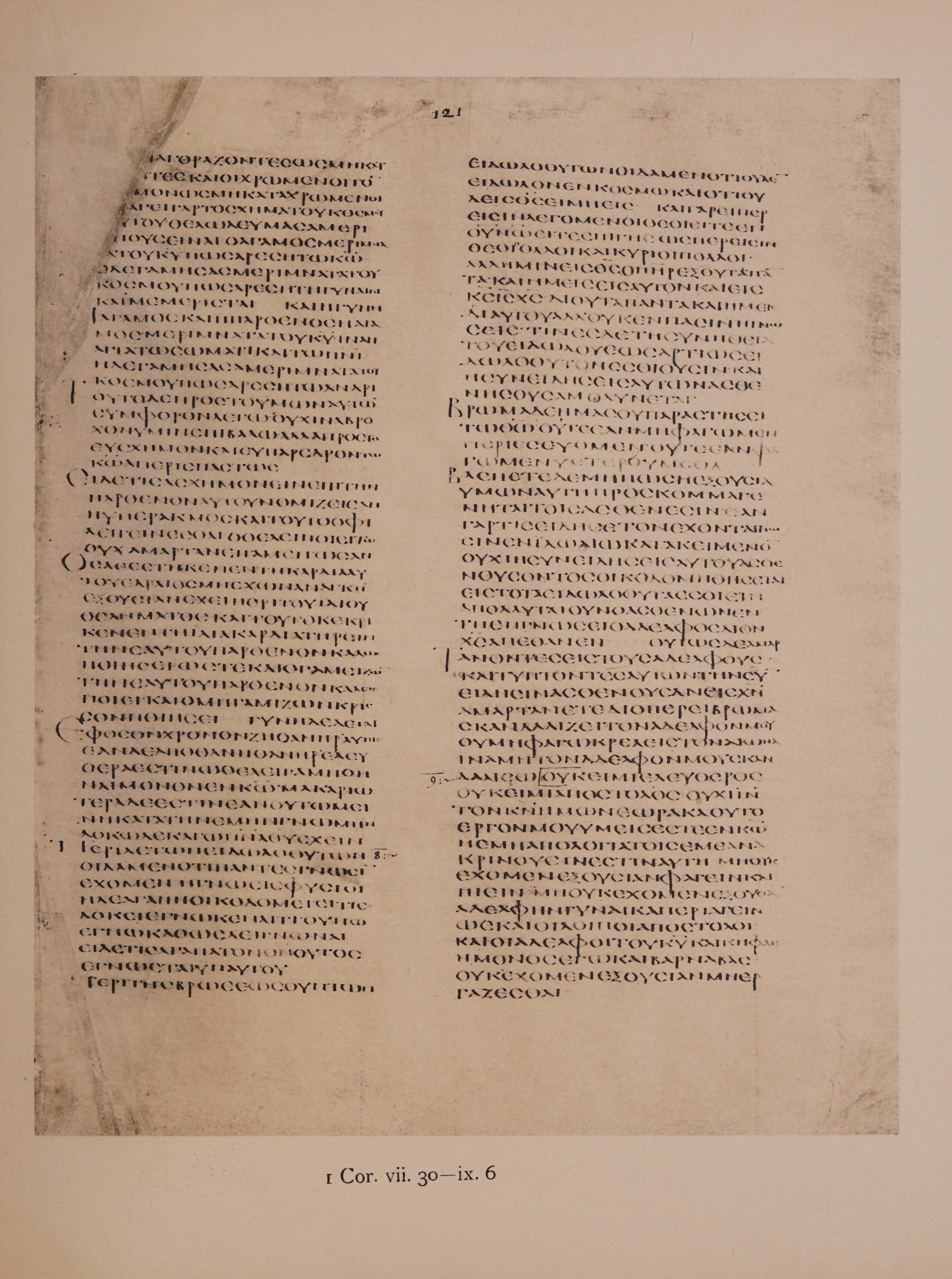
Where on the image
Page from the NTVMR transcription (docID 20002): verses 1-4 on fol. 121r (facsimile leaf 203), col. 1.
1περι δε των ειδωλοθυτων οιδαμεν οτι παντες γνωσιν εχομεν η γνωσις φυσιοι η δε αγαπη οικοδομει · 2ει τις δοκει εγνωκεναι τι · ουπω εγνω καθως δει γνωναι 3ει δε τις αγαπα τον θν ουτος εγνωσται υπ αυτου 4π̣ερι της βρωσεως ουν των ειδωλοθυτων οιδαμεν οτι ουδεν ειδωλον εν κοσμω · και οτι ουδεις θς ει μη εις ·
Compare: Tischendorf 8th edition (1869)
1Περὶ δὲ τῶν εἰδωλοθύτων, οἴδαμεν ὅτι πάντες γνῶσιν ἔχομεν. ἡ γνῶσις φυσιοῖ, ἡ δὲ ἀγάπη οἰκοδομεῖ. 2εἴ τις δοκεῖ ἐγνωκέναι τι, οὔπω ἔγνω καθὼς δεῖ γνῶναι· 3εἰ δέ τις ἀγαπᾷ τὸν θεόν, οὗτος ἔγνωσται ὑπ’ αὐτοῦ. 4περὶ τῆς βρώσεως οὖν τῶν εἰδωλοθύτων οἴδαμεν ὅτι οὐδὲν εἴδωλον ἐν κόσμῳ, καὶ ὅτι οὐδεὶς θεὸς εἰ μὴ εἷς.
1Now as touching things offered unto idols, we know that we all have knowledge. Knowledge puffeth up, but charity edifieth. 2And if any man think that he knoweth any thing, he knoweth nothing yet as he ought to know. 3But if any man love God, the same is known of him. 4As concerning therefore the eating of those things that are offered in sacrifice unto idols, we know that an idol is nothing in the world, and that there is none other God but one.
Where on the image
Page from the NTVMR transcription (docID 20002): verses 5-13 on fol. 121r (facsimile leaf 203), col. 2.
5και γαρ ειπερ εισιν λεγομενοι θεοι ειτε εν ουνω ειτε επι γης ωσπερ εισιν θεοι ολλοι και κυριοι πολλοι · 6αλλ ημιν εις θς ο πηρ εξ ου τα παντα · και ημεις εις αυτον και εις κς ις χς · δι ου τα παντα και ημεις δι αυτου 7αλλ ουκ εν πασιν η γνωσεις · τινες δε τη συνηθεια του ειδωλου εως αρτι ως ειδωλοθυτον εσθιουσιν · και η συνειδησεις αυτων ασθενης ουσα μολυνεται · 8βρωμα δε ημας ου παραστησει τω θω ουτε εαν μη φαγωμεν [...] 9βλεπετε δε μη πως η εξουσια υμων αυτη προσκομμα γενηται τοις ασθενεσιν · 10εαν γαρ τις ειδη σε τον εχοντα γνωσιν εν ιδωλιω κατακειμενον ουχι η συνειδησεις αυτου ασθενους οντος οικοδομηθησεται εις το τα ειδωλοθυτα εσθιειν 11απολλυται ουν ο ασθενων εν τη ση γνωσει ο αδελφος δι ον χς απεθανεν · 12ουτως δε αμαρτανοντες εις τους αδελφους · και τυπτοντες αυτων την συνειδησιν ασθενουσαν εις χν αμαρτανετε 13διοπερ ει βρωμα σκανδαλιζει τον αδελφον μου ου μη φαγω κρεα εις τον αιωνα ινα μη τον αδελφον μου σκανδαλισω
Compare: Tischendorf 8th edition (1869)
5καὶ γὰρ εἴπερ εἰσὶν λεγόμενοι θεοὶ εἴτε ἐν οὐρανῷ εἴτε ἐπὶ γῆς, ὥσπερ εἰσὶν θεοὶ πολλοὶ καὶ κύριοι πολλοί, 6ἀλλ’ ἡμῖν εἷς θεὸς ὁ πατήρ, ἐξ οὗ τὰ πάντα καὶ ἡμεῖς εἰς αὐτόν, καὶ εἷς κύριος Ἰησοῦς Χριστός, δι’ οὗ τὰ πάντα καὶ ἡμεῖς δι’ αὐτοῦ. 7ἀλλ’ οὐκ ἐν πᾶσιν ἡ γνῶσις· τινὲς δὲ τῇ συνηθείᾳ ἕως ἄρτι τοῦ εἰδώλου ὡς εἰδωλόθυτον ἐσθίουσιν, καὶ ἡ συνείδησις αὐτῶν ἀσθενὴς οὖσα μολύνεται. 8βρῶμα δὲ ἡμᾶς οὐ παραστήσει τῷ θεῷ· οὔτε ἐὰν φάγωμεν περισσεύομεν, οὔτε ἐὰν μὴ φάγωμεν ὑστερούμεθα. 9βλέπετε δὲ μήπως ἡ ἐξουσία ὑμῶν αὕτη πρόσκομμα γένηται τοῖς ἀσθενέσιν. 10ἐὰν γάρ τις ἴδῃ σὲ τὸν ἔχοντα γνῶσιν ἐν εἰδωλίῳ κατακείμενον, οὐχὶ ἡ συνείδησις αὐτοῦ ἀσθενοῦς ὄντος οἰκοδομηθήσεται εἰς τὸ τὰ εἰδωλόθυτα ἐσθίειν; 11ἀπόλλυται γὰρ ὁ ἀσθενῶν ἐν τῇ σῇ γνώσει, ὁ ἀδελφὸς δι’ ὃν Χριστὸς ἀπέθανεν. 12οὕτως δὲ ἁμαρτάνοντες εἰς τοὺς ἀδελφοὺς καὶ τύπτοντες αὐτῶν τὴν συνείδησιν ἀσθενοῦσαν εἰς Χριστὸν ἁμαρτάνετε. 13διόπερ εἰ βρῶμα σκανδαλίζει τὸν ἀδελφόν μου, οὐ μὴ φάγω κρέα εἰς τὸν αἰῶνα, ἵνα μὴ τὸν ἀδελφόν μου σκανδαλίσω.
5For though there be that are called gods, whether in heaven or in earth, (as there be gods many, and lords many,) 6But to us there is but one God, the Father, of whom are all things, and we in him; and one Lord Jesus Christ, by whom are all things, and we by him. 7Howbeit there is not in every man that knowledge: for some with conscience of the idol unto this hour eat it as a thing offered unto an idol; and their conscience being weak is defiled. 8But meat commendeth us not to God: for neither, if we eat, are we the better; neither, if we eat not, are we the worse. 9But take heed lest by any means this liberty of yours become a stumblingblock to them that are weak. 10For if any man see thee which hast knowledge sit at meat in the idol’s temple, shall not the conscience of him which is weak be emboldened to eat those things which are offered to idols; 11And through thy knowledge shall the weak brother perish, for whom Christ died? 12But when ye sin so against the brethren, and wound their weak conscience, ye sin against Christ. 13Wherefore, if meat make my brother to offend, I will eat no flesh while the world standeth, lest I make my brother to offend.
Cite
Sources
- Source: Codex Alexandrinus page images + NTVMR transcription (CC BY 4.0) + Tischendorf 8th edition + KJV (holding institution)
- Critical edition: Codex Alexandrinus transcription, NTVMR (INTF Münster, CC BY 4.0); Tischendorf 8th edition for comparison
← previous · → next · v cycle view · l back to library