1 Corinthians, Chapter 9 (Codex Alexandrinus)
Introduction
1 Corinthians 9 from Codex Alexandrinus (GA 02), a fifth-century Greek Bible held by the British Library (Royal MS 1 D. VIII). In the New Testament it is the chief witness to the Byzantine text in the Gospels and to the Alexandrian text in the rest of the New Testament. Its New Testament volume lacks Matthew 1:1-25:5, John 6:50-8:52 and 2 Corinthians 4:13-12:6.
This entry meets the strict three-criteria standard of the Theosis Library:
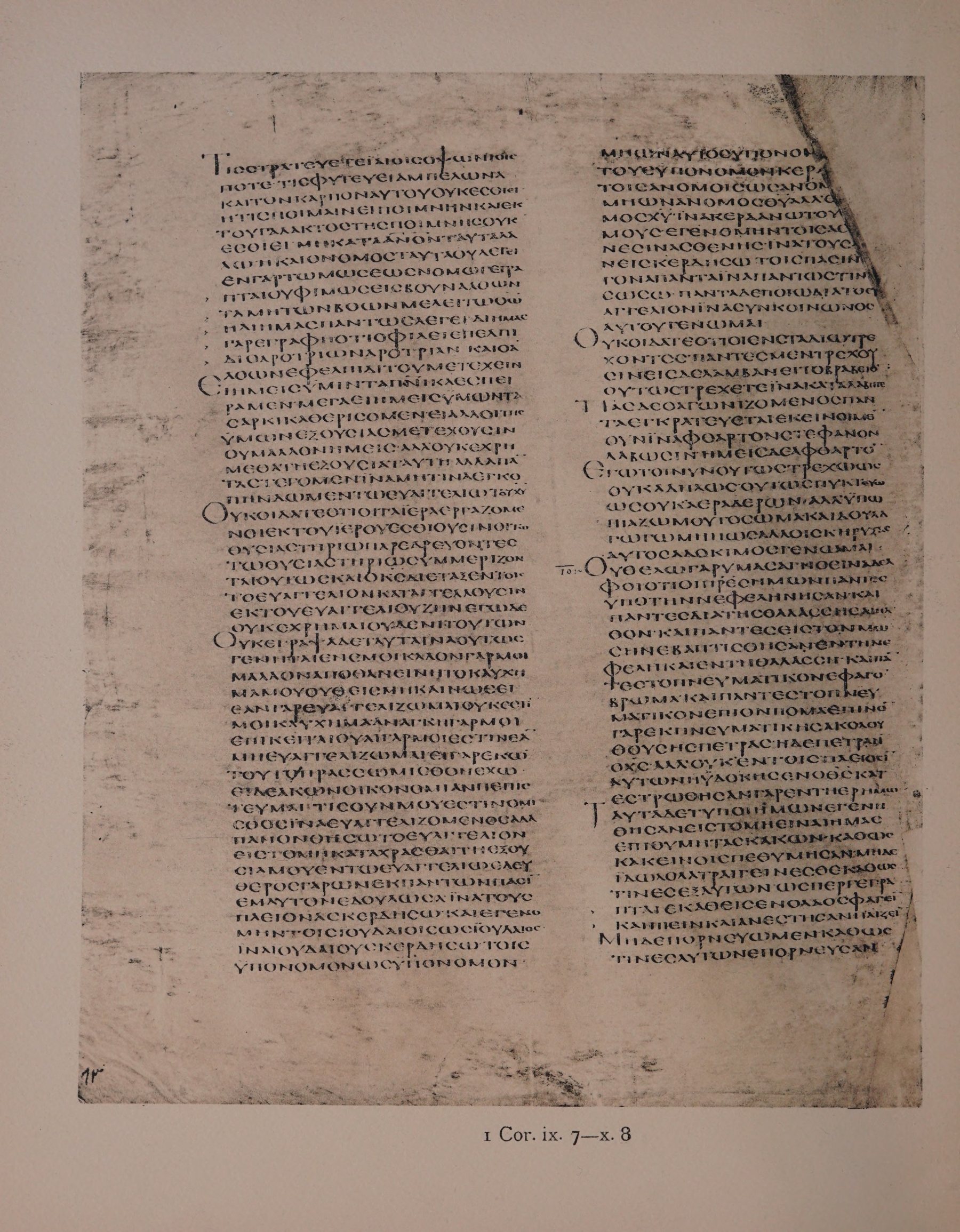
- Manuscript scan: the actual page(s) of Codex Alexandrinus containing this passage (folios 121r, 121v), reproduced from the British Museum's 1909 photographic facsimile edited by F. G. Kenyon, as digitised by the Getty Research Institute for the Internet Archive. The facsimile prints the verse range beneath each plate; that printed range was read for every page used and agrees with the INTF's NTVMR verse-level page index (CC BY 4.0). The page for each section now comes from the NTVMR transcription itself, which records the page and column on which every verse is written.
- Original text: the manuscript's own text, from a diplomatic transcription (see Greek text below), with Tischendorf's 8th critical edition (1869) for comparison.
- English translation: the King James Version (1611), retrieved verbatim from the public-domain bible-api.com endpoint.
Greek text: a diplomatic transcription of Codex Alexandrinus made by the Institut für Neutestamentliche Textforschung (INTF), Münster, for the New Testament Virtual Manuscript Room (NTVMR), published under a Creative Commons Attribution 4.0 licence. It gives the letters as the first scribe wrote them: no accents or breathings, the scribe's own spelling, and the sacred names in their contracted form (θς for θεος, ις for ιησους, κς for κυριος; the overline is not reproduced). Corrections by later hands are not shown. Letters in square brackets are not legible on the page and were restored by the transcribers, a dot under a letter marks an uncertain reading, and [...] marks text lost to damage. Beneath each section, for comparison, is Tischendorf's 8th critical edition (1869). Where the two differ, the transcription is what the manuscript says. Each section is shown with the page on which the transcription places its verses.
Manuscript note: Not written in Codex Alexandrinus: verse 2. The English is shown with a bracketed note in the Greek column.
How was this verified? (Provenance)
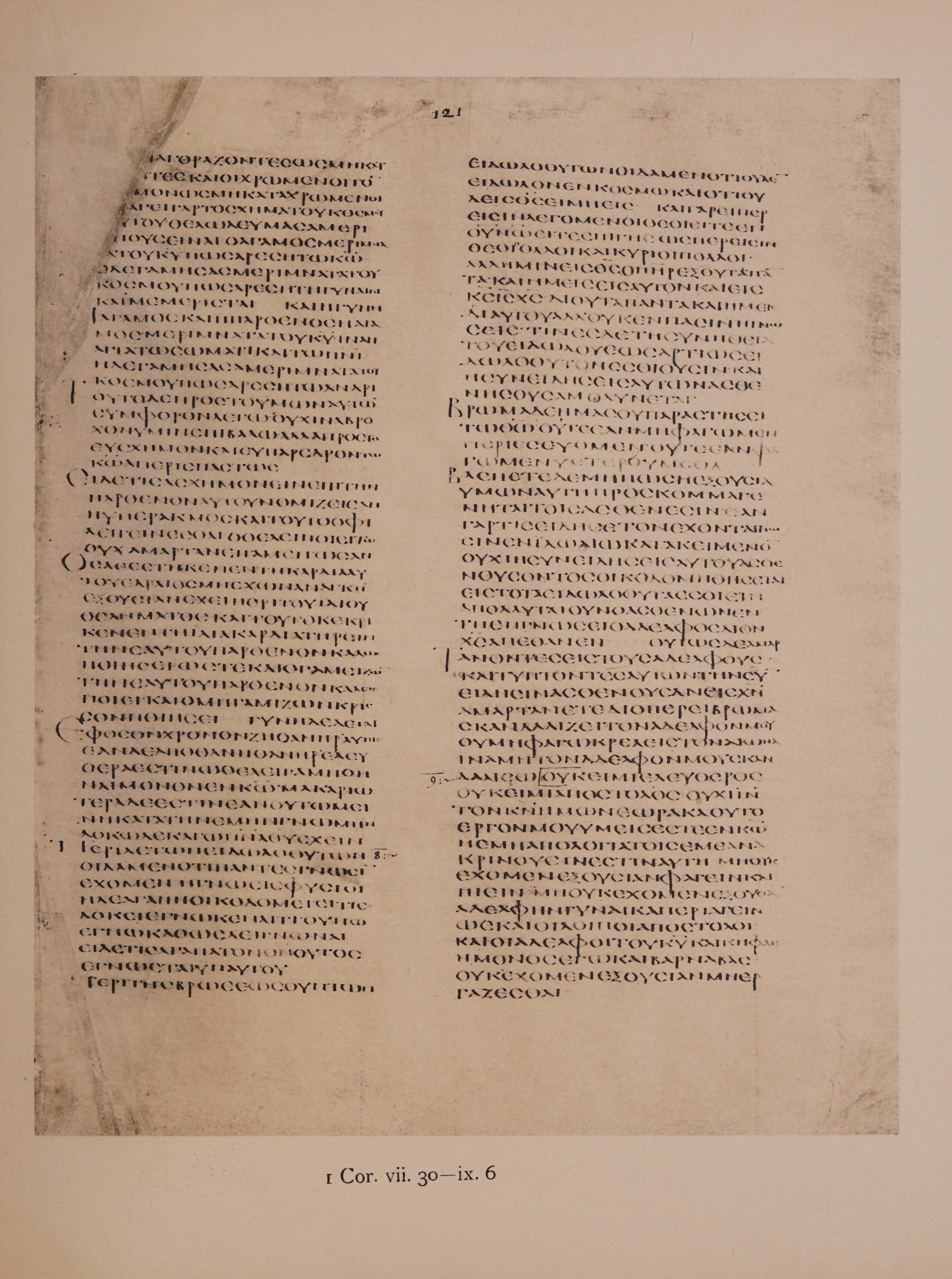
Where on the image
Page from the NTVMR transcription (docID 20002): verses 1, 3-6 on fol. 121r (facsimile leaf 203), col. 2. Verse 2 is not in Codex Alexandrinus; the NTVMR transcription (docID 20002) shows the text passing over it on fol. 121r (facsimile leaf 203), col. 2.
1ουκ ειμι ελευθερος ουκ ειμι αποστολος · ουχι ιν τον κν ημων εωρακα ου το εργον μου υμεις εστε εν κω 2[not in Codex Alexandrinus] 3η εμη απολογια τοις εμε ανακρινουσιν εστιν αυτη · 4μη ουκ εχομεν εξουσιαν φαγειν και πιειν · 5μη ουκ εχομεν εξουσιαν αδελφην γυναικα περιαγειν ως και οι λοιποι αποστολοι · και οι αδελφοι του κυ και κηφας 6η μονος εγω και βαρναβας ουκ εχομεν εξουσιαν μη εργαζεσθαι ·
Compare: Tischendorf 8th edition (1869)
1Οὐκ εἰμὶ ἐλεύθερος; οὐκ εἰμὶ ἀπόστολος; οὐχὶ Ἰησοῦν τὸν κύριον ἡμῶν ἑόρακα; οὐ τὸ ἔργον μου ὑμεῖς ἐστὲ ἐν κυρίῳ; 2εἰ ἄλλοις οὐκ εἰμὶ ἀπόστολος, ἀλλά γε ὑμῖν εἰμί· ἡ γὰρ σφραγίς μου τῆς ἀποστολῆς ὑμεῖς ἐστὲ ἐν κυρίῳ. 3ἡ ἐμὴ ἀπολογία τοῖς ἐμὲ ἀνακρίνουσίν ἐστιν αὕτη. 4μὴ οὐκ ἔχομεν ἐξουσίαν φαγεῖν καὶ πεῖν; 5μὴ οὐκ ἔχομεν ἐξουσίαν ἀδελφὴν γυναῖκα περιάγειν, ὡς καὶ οἱ λοιποὶ ἀπόστολοι καὶ οἱ ἀδελφοὶ τοῦ κυρίου καὶ Κηφᾶς; 6ἢ μόνος ἐγὼ καὶ Βαρναβᾶς οὐκ ἔχομεν ἐξουσίαν μὴ ἐργάζεσθαι;
1Am I not an apostle? am I not free? have I not seen Jesus Christ our Lord? are not ye my work in the Lord? 2If I be not an apostle unto others, yet doubtless I am to you: for the seal of mine apostleship are ye in the Lord. 3Mine answer to them that do examine me is this, 4Have we not power to eat and to drink? 5Have we not power to lead about a sister, a wife, as well as other apostles, and as the brethren of the Lord, and Cephas? 6Or I only and Barnabas, have not we power to forbear working?
Where on the image
Page from the NTVMR transcription (docID 20002): verses 7-13 on fol. 121v (facsimile leaf 204), col. 1.
7τις στρατευετε ιδιοις οψωνιοις ποτε · τις φυτευει αμπελωνα και τον καρπον αυτου ουκ εσθιει · η τις ποιμαινει ποιμνην και εκ του γαλακτος της ποιμνης ουκ εσθιει · 8μη κατα ανον ταυτα λαλω · η και ο νομος ταυτα ου λεγει 9εν γαρ τω μωσεως νομω γεγραπται ου φιμωσεις βουν αλοωντα μη των βοων μελει τω θω 10η δι ημας παντως λεγει · δι ημας γαρ εγραφη οτι οφιλει επ ελπιδι ο αροτριων αροτριαν και ο αλοων εφ ελπιδι του μετεχειν 11ει ημεις υμιν τα πνικα εσπειραμεν · μεγα ει ημεις υμων τα σαρκικα θερισομεν · 12ει αλλοι της υμων εξουσιας μετεχουσιν ου μαλλον ημεις · αλλ ουκ εχρημεθα τη εξουσια ταυτη · αλλα παντα στεγομεν · ινα μη τινα εγκοπην δωμεν τω ευαγγελιω του χυ 13ουκ οιδατε οτι οι τα ιερα εργαζομενοι εκ του ιερου εσθιουσιν · οι τω θυσιαστηριω παρεδρευοντες τω θυσιαστηριω συμμεριζονται
Compare: Tischendorf 8th edition (1869)
7τίς στρατεύεται ἰδίοις ὀψωνίοις ποτέ; τίς φυτεύει ἀμπελῶνα καὶ τὸν καρπὸν αὐτοῦ οὐκ ἐσθίει; ἢ τίς ποιμαίνει ποίμνην καὶ ἐκ τοῦ γάλακτος τῆς ποίμνης οὐκ ἐσθίει; 8μὴ κατὰ ἄνθρωπον ταῦτα λαλῶ, ἢ καὶ ὁ νόμος ταῦτα οὐ λέγει; 9ἐν γὰρ τῷ Μωϋσέως νόμῳ γέγραπται, οὐ κημώσεις βοῦν ἀλοῶντα. μὴ τῶν βοῶν μέλει τῷ θεῷ; 10ἢ δι’ ἡμᾶς πάντως λέγει; δι’ ἡμᾶς γὰρ ἐγράφη, ὅτι ὀφείλει ἐπ’ ἐλπίδι ὁ ἀροτριῶν ἀροτριᾶν, καὶ ὁ ἀλοῶν ἐπ’ ἐλπίδι τοῦ μετέχειν. 11Εἰ ἡμεῖς ὑμῖν τὰ πνευματικὰ ἐσπείραμεν, μέγα εἰ ἡμεῖς ὑμῶν τὰ σαρκικὰ θερίσομεν; 12εἰ ἄλλοι τῆς ὑμῶν ἐξουσίας μετέχουσιν, οὐ μᾶλλον ἡμεῖς; ἀλλ’ οὐκ ἐχρησάμεθα τῇ ἐξουσίᾳ ταύτῃ, ἀλλὰ πάντα στέγομεν ἵνα μή τινα ἐκκοπὴν δῶμεν τῷ εὐαγγελίῳ τοῦ Χριστοῦ. 13οὐκ οἴδατε ὅτι οἱ τὰ ἱερὰ ἐργαζόμενοι τὰ ἐκ τοῦ ἱεροῦ ἐσθίουσιν, οἱ τῷ θυσιαστηρίῳ παρεδρεύοντες τῷ θυσιαστηρίῳ συμμερίζονται;
7Who goeth a warfare any time at his own charges? who planteth a vineyard, and eateth not of the fruit thereof? or who feedeth a flock, and eateth not of the milk of the flock? 8Say I these things as a man? or saith not the law the same also? 9For it is written in the law of Moses, Thou shalt not muzzle the mouth of the ox that treadeth out the corn. Doth God take care for oxen? 10Or saith he it altogether for our sakes? For our sakes, no doubt, this is written: that he that ploweth should plow in hope; and that he that thresheth in hope should be partaker of his hope. 11If we have sown unto you spiritual things, is it a great thing if we shall reap your carnal things? 12If others be partakers of this power over you, are not we rather? Nevertheless we have not used this power; but suffer all things, lest we should hinder the gospel of Christ. 13Do ye not know that they which minister about holy things live of the things of the temple? and they which wait at the altar are partakers with the altar?
Where on the image
Page from the NTVMR transcription (docID 20002): verses 14-20 on fol. 121v (facsimile leaf 204), col. 1.
14ουτως και ο κς διεταξεν τοις το ευαγγελιον καταγγελλουσιν εκ του ευαγγελιου ζην 15εγω δε ου κεχρημαι ουδενι τουτων ουκ εγραψα δε ταυτα ινα ουτως γενηται εν εμοι · καλον γαρ μοι μαλλον αποθανειν η το καυχημα μου ουθεις μη καινωσει 16εαν γαρ ευαγγελιζωμαι ουκ εστιν μοι καυχημα · αναγκη γαρ μοι επικειται ουαι γαρ μοι εστιν εαν μη ευαγγελιζωμαι · 17ει γαρ εκων τουτο πρασσω μισθον εχω ει δε ακων οικονομιαν πεπιστευμαι · 18τις ουν μου εστιν ο μισθος ινα ευαγγελιζομενος αδαπανον θησω το ευαγγελιον εις το μη καταχρασθαι τη εξουσια μου εν τω ευαγγελιω 19ελευθερος γαρ ων εκ παντων πασιν εμαυτον εδουλωσα · ινα τους πλειονας κερδησω · 20και εγενομην τοις ιουδαιοις ως ιουδαιος ινα ιουδαιους κερδησω τοις υπο νομον ως υπο νομον · μη ων αυτος υπο νομ̣[ον] [ινα] τους υπο νομον κερδ̣[ησω]
Compare: Tischendorf 8th edition (1869)
14οὕτως καὶ ὁ κύριος διέταξεν τοῖς τὸ εὐαγγέλιον καταγγέλλουσιν ἐκ τοῦ εὐαγγελίου ζῆν. 15ἐγὼ δὲ οὐ κέχρημαι οὐδενὶ τούτων. οὐκ ἔγραψα δὲ ταῦτα ἵνα οὕτως γένηται ἐν ἐμοί, καλὸν γάρ μοι μᾶλλον ἀποθανεῖν ἤ τὸ καύχημά μου οὐδεὶς κενώσει. 16ἐὰν γὰρ εὐαγγελίζωμαι, οὐκ ἔστιν μοι καύχημα· ἀνάγκη γάρ μοι ἐπίκειται· οὐαὶ γάρ μοί ἐστιν ἐὰν μὴ εὐαγγελίζωμαι. 17εἰ γὰρ ἑκὼν τοῦτο πράσσω, μισθὸν ἔχω· εἰ δὲ ἄκων, οἰκονομίαν πεπίστευμαι. 18τίς οὖν μού ἐστιν ὁ μισθός; ἵνα εὐαγγελιζόμενος ἀδάπανον θήσω τὸ εὐαγγέλιον, εἰς τὸ μὴ καταχρήσασθαι τῇ ἐξουσίᾳ μου ἐν τῷ εὐαγγελίῳ. 19Ἐλεύθερος γὰρ ὢν ἐκ πάντων πᾶσιν ἐμαυτὸν ἐδούλωσα, ἵνα τοὺς πλείονας κερδήσω· 20καὶ ἐγενόμην τοῖς Ἰουδαίοις ὡς Ἰουδαῖος, ἵνα Ἰουδαίους κερδήσω· τοῖς ὑπὸ νόμον ὡς ὑπὸ νόμον, μὴ ὢν αὐτὸς ὑπὸ νόμον, ἵνα τοὺς ὑπὸ νόμον κερδήσω·
14Even so hath the Lord ordained that they which preach the gospel should live of the gospel. 15But I have used none of these things: neither have I written these things, that it should be so done unto me: for it were better for me to die, than that any man should make my glorying void. 16For though I preach the gospel, I have nothing to glory of: for necessity is laid upon me; yea, woe is unto me, if I preach not the gospel! 17For if I do this thing willingly, I have a reward: but if against my will, a dispensation of the gospel is committed unto me. 18What is my reward then? Verily that, when I preach the gospel, I may make the gospel of Christ without charge, that I abuse not my power in the gospel. 19For though I be free from all men, yet have I made myself servant unto all, that I might gain the more. 20And unto the Jews I became as a Jew, that I might gain the Jews; to them that are under the law, as under the law, that I might gain them that are under the law;
Where on the image
Page from the NTVMR transcription (docID 20002): verses 21-27 on fol. 121v (facsimile leaf 204), col. 2.
21τοις ανομοις ως ανομ̣[ος] μη ων ανομος θυ αλλ ε[ννο]μος χυ · ινα κερδανω του[ς] [ανο]μους · 22εγενομην τοις ασ[θε]νεσιν ασθενης · ινα τους α̣[σθε]νεις κερδησω τοις πασιν [γε]γονα παντα ινα παντως τιν[ας] σωσω · 23παντα δε ποιω δια το ευ̣αγγελιον ινα συνκοινωνος αυτου γενωμαι 24ουκ οιδατε οτι οι εν σταδιω τρεχοντες · παντες μεν τρεχουσιν εις δε λαμβανει το βραβειον · ουτως τρεχετε ινα καταλαβητε 25πας δε ο αγωνιζομενος παντα εγκρατευεται · εκεινοι μεν ουν ινα φθαρτον στεφανον λαβωσιν · ημεις δε αφθαρτον 26εγω τοινυν ουτως τρεχω ως ουκ αδηλως · ουτως πυκτευω ως ουκ αερα δερων · 27αλλ υπωπιαζω μου το σωμα · και δουλαγωγω μη πως αλλοις κηρυξας αυτος αδοκιμος γενωμαι ·
Compare: Tischendorf 8th edition (1869)
21τοῖς ἀνόμοις ὡς ἄνομος, μὴ ὢν ἄνομος θεοῦ ἀλλ’ ἔννομος Χριστοῦ, ἵνα κερδάνω τοὺς ἀνόμους· 22ἐγενόμην τοῖς ἀσθενέσιν ἀσθενής, ἵνα τοὺς ἀσθενεῖς κερδήσω· τοῖς πᾶσιν γέγονα πάντα, ἵνα πάντως τινὰς σώσω. 23πάντα δὲ ποιῶ διὰ τὸ εὐαγγέλιον, ἵνα συνκοινωνὸς αὐτοῦ γένωμαι. 24οὐκ οἴδατε ὅτι οἱ ἐν σταδίῳ τρέχοντες πάντες μὲν τρέχουσιν, εἷς δὲ λαμβάνει τὸ βραβεῖον; οὕτως τρέχετε ἵνα καταλάβητε. 25πᾶς δὲ ὁ ἀγωνιζόμενος πάντα ἐγκρατεύεται, ἐκεῖνοι μὲν οὖν ἵνα φθαρτὸν στέφανον λάβωσιν, ἡμεῖς δὲ ἄφθαρτον. 26ἐγὼ τοίνυν οὕτως τρέχω ὡς οὐκ ἀδήλως, οὕτως πυκτεύω ὡς οὐκ ἀέρα δέρων· 27ἀλλὰ ὑπωπιάζω μου τὸ σῶμα καὶ δουλαγωγῶ, μήπως ἄλλοις κηρύξας αὐτὸς ἀδόκιμος γένωμαι.
21To them that are without law, as without law, (being not without law to God, but under the law to Christ,) that I might gain them that are without law. 22To the weak became I as weak, that I might gain the weak: I am made all things to all men, that I might by all means save some. 23And this I do for the gospel’s sake, that I might be partaker thereof with you. 24Know ye not that they which run in a race run all, but one receiveth the prize? So run, that ye may obtain. 25And every man that striveth for the mastery is temperate in all things. Now they do it to obtain a corruptible crown; but we an incorruptible. 26I therefore so run, not as uncertainly; so fight I, not as one that beateth the air: 27But I keep under my body, and bring it into subjection: lest that by any means, when I have preached to others, I myself should be a castaway.
Cite
Sources
- Source: Codex Alexandrinus page images + NTVMR transcription (CC BY 4.0) + Tischendorf 8th edition + KJV (holding institution)
- Critical edition: Codex Alexandrinus transcription, NTVMR (INTF Münster, CC BY 4.0); Tischendorf 8th edition for comparison
← previous · → next · v cycle view · l back to library