1 John, Chapter 4 (Codex Alexandrinus)
Introduction
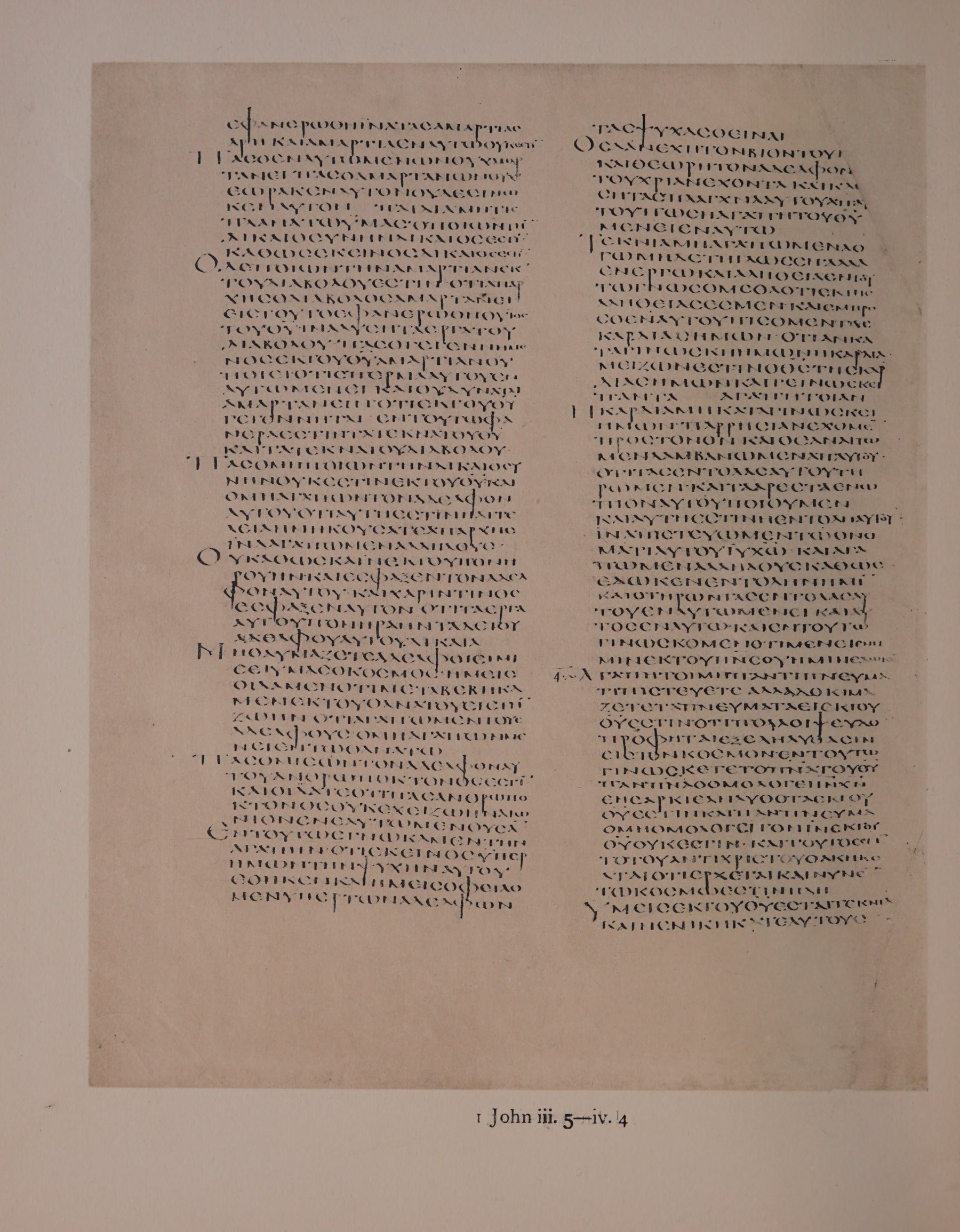
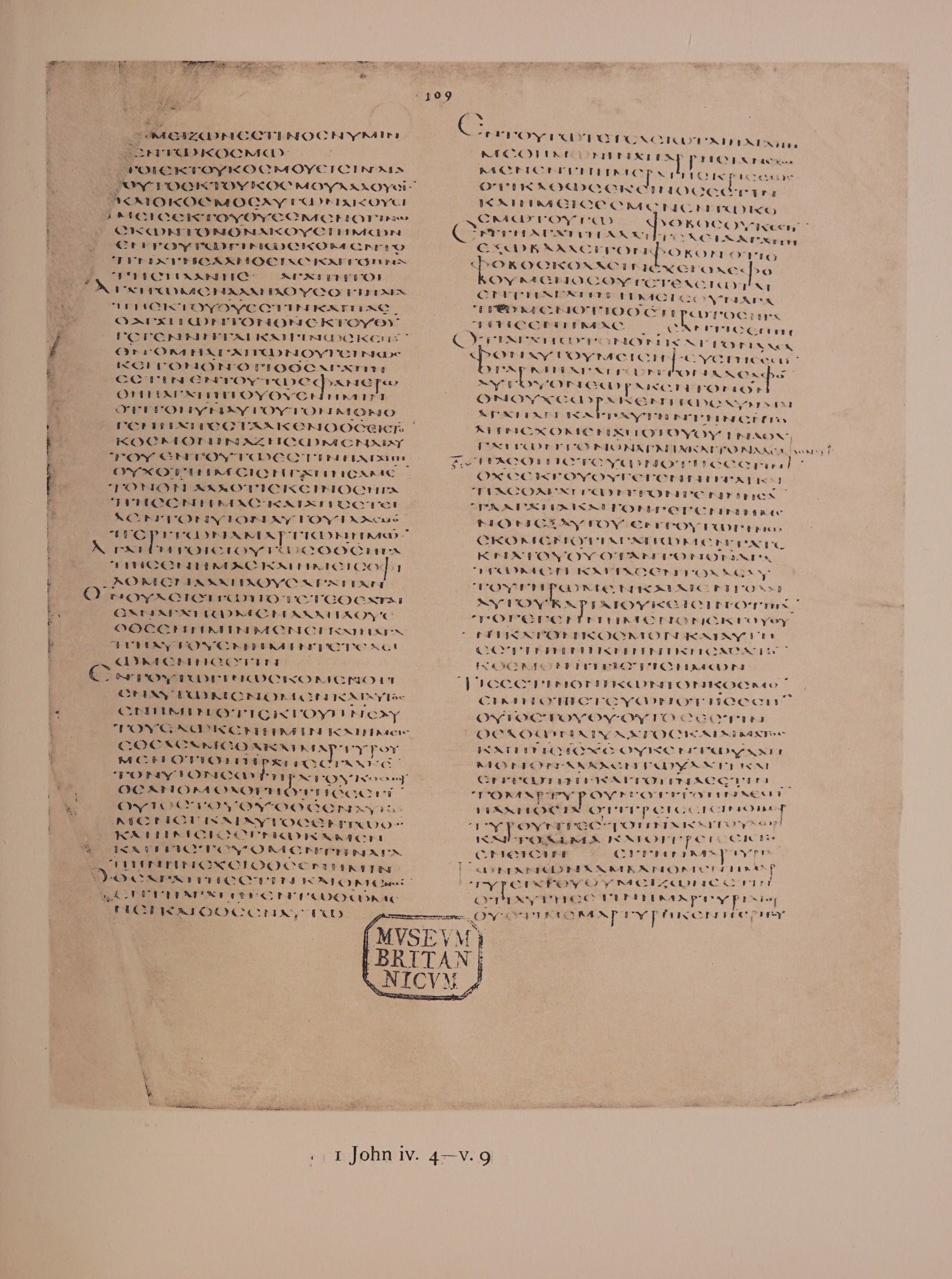
1 John 4 from Codex Alexandrinus (GA 02), a fifth-century Greek Bible held by the British Library (Royal MS 1 D. VIII). In the New Testament it is the chief witness to the Byzantine text in the Gospels and to the Alexandrian text in the rest of the New Testament. Its New Testament volume lacks Matthew 1:1-25:5, John 6:50-8:52 and 2 Corinthians 4:13-12:6.
This entry meets the strict three-criteria standard of the Theosis Library:
- Manuscript scan: the actual page(s) of Codex Alexandrinus containing this passage (folios 108v, 109r), reproduced from the British Museum's 1909 photographic facsimile edited by F. G. Kenyon, as digitised by the Getty Research Institute for the Internet Archive. The facsimile prints the verse range beneath each plate; that printed range was read for every page used and agrees with the INTF's NTVMR verse-level page index (CC BY 4.0). The page for each section now comes from the NTVMR transcription itself, which records the page and column on which every verse is written.
- Original text: the manuscript's own text, from a diplomatic transcription (see Greek text below), with Tischendorf's 8th critical edition (1869) for comparison.
- English translation: the King James Version (1611), retrieved verbatim from the public-domain bible-api.com endpoint.
Greek text: a diplomatic transcription of Codex Alexandrinus made by the Institut für Neutestamentliche Textforschung (INTF), Münster, for the New Testament Virtual Manuscript Room (NTVMR), published under a Creative Commons Attribution 4.0 licence. It gives the letters as the first scribe wrote them: no accents or breathings, the scribe's own spelling, and the sacred names in their contracted form (θς for θεος, ις for ιησους, κς for κυριος; the overline is not reproduced). Corrections by later hands are not shown. Letters in square brackets are not legible on the page and were restored by the transcribers, a dot under a letter marks an uncertain reading, and [...] marks text lost to damage. Beneath each section, for comparison, is Tischendorf's 8th critical edition (1869). Where the two differ, the transcription is what the manuscript says. Each section is shown with the page on which the transcription places its verses.
How was this verified? (Provenance)
Where on the image
Page from the NTVMR transcription (docID 20002): verses 1-4 on fol. 108v (facsimile leaf 178), col. 2; verse 4 continues on fol. 109r (facsimile leaf 179), col. 1 (which begins '[οτι] μειζων εστιν').
1αγαπητοι μη παντι πνευματι πιστευετε αλλα δοκιμαζετε τα πνευματα ει εκ του θυ εστιν · οτι πολλοι ψευδοπροφηται εξεληλυθασιν εις τον κοσμον · 2εν τουτω γινωσκετε το πνα του θυ παν πνα ο ομολογει ιν χν εν σαρκι εληλυθοτα εκ του θυ εστιν 3και παν πνευμα ο μη ομολογει τον ιν εκ του θυ ουκ εστιν · και τουτο εστιν το του αντιχριστου ο ακηκοαται οτι ερχεται και νυν εν τω κοσμω εστιν ηδη 4υμεις εκ του θυ εσται τεκνια και νενικηκατε αυτους [οτι] μειζων εστιν ο εν υμιν [η] [ο] εν τω κοσμω ·
Compare: Tischendorf 8th edition (1869)
1Ἀγαπητοί, μὴ παντὶ πνεύματι πιστεύετε, ἀλλὰ δοκιμάζετε τὰ πνεύματα εἰ ἐκ τοῦ θεοῦ ἐστιν, ὅτι πολλοὶ ψευδοπροφῆται ἐξεληλύθασιν εἰς τὸν κόσμον. 2ἐν τούτῳ γινώσκετε τὸ πνεῦμα τοῦ θεοῦ· πᾶν πνεῦμα ὃ ὁμολογεῖ Ἰησοῦν Χριστὸν ἐν σαρκὶ ἐληλυθότα ἐκ τοῦ θεοῦ ἐστιν, 3καὶ πᾶν πνεῦμα ὃ μὴ ὁμολογεῖ τὸν Ἰησοῦν ἐκ τοῦ θεοῦ οὐκ ἔστιν· καὶ τοῦτό ἐστιν τὸ τοῦ ἀντιχρίστου, ὃ ἀκηκόατε ὅτι ἔρχεται, καὶ νῦν ἐν τῷ κόσμῳ ἐστὶν ἤδη. 4Ὑμεῖς ἐκ τοῦ θεοῦ ἐστέ, τεκνία, καὶ νενικήκατε αὐτούς, ὅτι μείζων ἐστὶν ὁ ἐν ὑμῖν ἢ ὁ ἐν τῷ κόσμῳ.
1Beloved, believe not every spirit, but try the spirits whether they are of God: because many false prophets are gone out into the world. 2Hereby know ye the Spirit of God: Every spirit that confesseth that Jesus Christ is come in the flesh is of God: 3And every spirit that confesseth not that Jesus Christ is come in the flesh is not of God: and this is that spirit of antichrist, whereof ye have heard that it should come; and even now already is it in the world. 4Ye are of God, little children, and have overcome them: because greater is he that is in you, than he that is in the world.
Where on the image
Page from the NTVMR transcription (docID 20002): verses 5-16 on fol. 109r (facsimile leaf 179), col. 1.
5[αυ]τοι εκ του κοσμου εισιν · δια [τ]ουτο εκ του κοσμου λαλουσιν · και ο κοσμος αυτων ακουει 6[η]μεις εκ του θυ εσμεν ο γινωσκων τον θν ακουει ημων εν τουτω γινωσκομεν το πνα της αληθειας και το πνα της πλανης · 7αγαπητοι αγαπωμεν αλληλους οτι η αγαπη εκ του θυ εστιν και πας ο αγαπων τον θν εκ του θυ γεγεννηται και γινωσκει τον θν · 8ο μη αγαπων ου γεινωσκει τον θν · οτι ο θς αγαπη εστιν 9εν τουτω εφανερωθη η αγαπη του θυ εν ημιν οτι τον υν αυτου τον μονογενη απεσταλκεν ο θς εις τον κοσμον ινα ζησωμεν δι αυτου 10εν τουτω εστιν η αγαπη ουχ οτι ημεις ηγαπησαμεν τον θν αλλ οτι εκεινος ηγαπησεν ημας · και απεστειλεν τον υιον αυτου ιλασμον περι των αμαρτιων ημων · 11αγαπητοι ει ουτως ο θς ηγαπησεν ημας και ημεις οφιλομεν αλληλους αγαπαν 12θν ουδεις πωποτε τεθεαται εαν αγαπωμεν αλληλους ο θς εν ημιν μενει · και η αγαπη αυτου εν ημιν τετελειωμενη εστιν 13εν τουτω γινωσκομεν οτι εν αυτω μενομεν και αυτος εν ημιν · οτι εκ του πνς αυτου εδωκεν ημιν · 14και ημεις εθεασαμεθα και μαρτυρουμεν οτι ο πηρ απεσταλκεν τον υιον σωτηρα του κοσμου · 15ος αν ομολογη οτι ις εστιν ο υιος του θυ · ο θς εν αυτω μενει · και αυτος εν τω θω 16και ημεις εγνωκαμεν και πιστευομεν την αγαπην ην εχει ο θς εν ημιν ο θς αγαπη εστιν και ο μενων εν τη αγαπη · εν τω θω μενει και ο θς εν αυτω
Compare: Tischendorf 8th edition (1869)
5αὐτοὶ ἐκ τοῦ κόσμου εἰσίν· διὰ τοῦτο ἐκ τοῦ κόσμου λαλοῦσιν καὶ ὁ κόσμος αὐτῶν ἀκούει. 6ἡμεῖς ἐκ τοῦ θεοῦ ἐσμεν· ὁ γινώσκων τὸν θεὸν ἀκούει ἡμῶν, ὃς οὐκ ἔστιν ἐκ τοῦ θεοῦ οὐκ ἀκούει ἡμῶν. ἐκ τούτου γινώσκομεν τὸ πνεῦμα τῆς ἀληθείας καὶ τὸ πνεῦμα τῆς πλάνης. 7Ἀγαπητοί, ἀγαπῶμεν ἀλλήλους, ὅτι ἡ ἀγάπη ἐκ τοῦ θεοῦ ἐστιν, καὶ πᾶς ὁ ἀγαπῶν ἐκ τοῦ θεοῦ γεγέννηται καὶ γινώσκει τὸν θεόν. 8ὁ μὴ ἀγαπῶν οὐκ ἔγνω τὸν θεόν, ὅτι ὁ θεὸς ἀγάπη ἐστίν. 9ἐν τούτῳ ἐφανερώθη ἡ ἀγάπη τοῦ θεοῦ ἐν ἡμῖν, ὅτι τὸν υἱὸν αὐτοῦ τὸν μονογενῆ ἀπέσταλκεν ὁ θεὸς εἰς τὸν κόσμον ἵνα ζήσωμεν δι’ αὐτοῦ. 10ἐν τούτῳ ἐστὶν ἡ ἀγάπη, οὐχ ὅτι ἡμεῖς ἠγαπήσαμεν τὸν θεόν, ἀλλ’ ὅτι αὐτὸς ἠγάπησεν ἡμᾶς καὶ ἀπέστειλεν τὸν υἱὸν αὐτοῦ ἱλασμὸν περὶ τῶν ἁμαρτιῶν ἡμῶν. 11Ἀγαπητοί, εἰ οὕτως ὁ θεὸς ἠγάπησεν ἡμᾶς, καὶ ἡμεῖς ὀφείλομεν ἀλλήλους ἀγαπᾶν. 12θεὸν οὐδεὶς πώποτε τεθέαται· ἐὰν ἀγαπῶμεν ἀλλήλους, ὁ θεὸς ἐν ἡμῖν μένει καὶ ἡ ἀγάπη αὐτοῦ τετελειωμένη ἐν ἡμῖν ἐστιν. 13ἐν τούτῳ γινώσκομεν ὅτι ἐν αὐτῷ μένομεν καὶ αὐτὸς ἐν ἡμῖν, ὅτι ἐκ τοῦ πνεύματος αὐτοῦ δέδωκεν ἡμῖν. 14καὶ ἡμεῖς τεθεάμεθα καὶ μαρτυροῦμεν ὅτι ὁ πατὴρ ἀπέσταλκεν τὸν υἱὸν σωτῆρα τοῦ κόσμου. 15ὃς ἂν ὁμολογήσῃ ὅτι Ἰησοῦς ἐστιν ὁ υἱὸς τοῦ θεοῦ, ὁ θεὸς ἐν αὐτῷ μένει καὶ αὐτὸς ἐν τῷ θεῷ. 16καὶ ἡμεῖς ἐγνώκαμεν καὶ πεπιστεύκαμεν τὴν ἀγάπην ἣν ἔχει ὁ θεὸς ἐν ἡμῖν. ὁ θεὸς ἀγάπη ἐστίν, καὶ ὁ μένων ἐν τῇ ἀγάπῃ ἐν τῷ θεῷ μένει καὶ ὁ θεὸς ἐν αὐτῷ μένει.
5They are of the world: therefore speak they of the world, and the world heareth them. 6We are of God: he that knoweth God heareth us; he that is not of God heareth not us. Hereby know we the spirit of truth, and the spirit of error. 7Beloved, let us love one another: for love is of God; and every one that loveth is born of God, and knoweth God. 8He that loveth not knoweth not God; for God is love. 9In this was manifested the love of God toward us, because that God sent his only begotten Son into the world, that we might live through him. 10Herein is love, not that we loved God, but that he loved us, and sent his Son to be the propitiation for our sins. 11Beloved, if God so loved us, we ought also to love one another. 12No man hath seen God at any time. If we love one another, God dwelleth in us, and his love is perfected in us. 13Hereby know we that we dwell in him, and he in us, because he hath given us of his Spirit. 14And we have seen and do testify that the Father sent the Son to be the Saviour of the world. 15Whosoever shall confess that Jesus is the Son of God, God dwelleth in him, and he in God. 16And we have known and believed the love that God hath to us. God is love; and he that dwelleth in love dwelleth in God, and God in him.
Where on the image
Page from the NTVMR transcription (docID 20002): verses 17-21 on fol. 109r (facsimile leaf 179), col. 2.
17εν τουτω τετελειωται η αγαπη μεθ ημων ινα παρρησιαν εχωμεν εν τη ημερα της κρισεως · οτι καθως εκεινος εστιν και ημεις εσμεν εν τω κοσμω τουτω 18φοβος ουκ εστιν εν τη αγαπη αλλ η τελεια αγαπη εξω βαλλει τον φοβον οτι ο φοβος κολασιν εχει · ο δε φοβουμενος ου τετελειωται εν τη αγαπη 19ημεις ουν αγαπωμεν οτι ο θς πρωτος ηγαπησεν ημας 20εαν τις ειπη οτι αγαπω τον θν και τον αδελφον αυτου μειση ψευστης εστιν · ο γαρ μη αγαπων τον αδελφον αυτου ον εωρακεν τον θν ον ουχ εωρακεν πως δυναται αγαπαν · 21και ταυτην την εντολην εχομεν απο του θυ ινα ο αγαπων [...] τον αδελφον αυτου
Compare: Tischendorf 8th edition (1869)
17Ἐν τούτῳ τετελείωται ἡ ἀγάπη μεθ’ ἡμῶν, ἵνα παρρησίαν ἔχωμεν ἐν τῇ ἡμέρᾳ τῆς κρίσεως, ὅτι καθὼς ἐκεῖνός ἐστιν καὶ ἡμεῖς ἐσμεν ἐν τῷ κόσμῳ τούτῳ. 18φόβος οὐκ ἔστιν ἐν τῇ ἀγάπῃ, ἀλλ’ ἡ τελεία ἀγάπη ἔξω βάλλει τὸν φόβον, ὅτι ὁ φόβος κόλασιν ἔχει, ὁ δὲ φοβούμενος οὐ τετελείωται ἐν τῇ ἀγάπῃ. 19ἡμεῖς ἀγαπῶμεν, ὅτι αὐτὸς πρῶτος ἠγάπησεν ἡμᾶς. 20ἐάν τις εἴπῃ ὅτι ἀγαπῶ τὸν θεόν, καὶ τὸν ἀδελφὸν αὐτοῦ μισῇ, Ψεύστης ἐστίν· ὁ γὰρ μὴ ἀγαπῶν τὸν ἀδελφὸν αὐτοῦ ὃν ἑώρακεν, τὸν θεὸν ὃν οὐχ ἑώρακεν οὐ δύναται ἀγαπᾶν. 21καὶ ταύτην τὴν ἐντολὴν ἔχομεν ἀπ’ αὐτοῦ, ἵνα ὁ ἀγαπῶν τὸν θεὸν ἀγαπᾷ καὶ τὸν ἀδελφὸν αὐτοῦ.
17Herein is our love made perfect, that we may have boldness in the day of judgment: because as he is, so are we in this world. 18There is no fear in love; but perfect love casteth out fear: because fear hath torment. He that feareth is not made perfect in love. 19We love him, because he first loved us. 20If a man say, I love God, and hateth his brother, he is a liar: for he that loveth not his brother whom he hath seen, how can he love God whom he hath not seen? 21And this commandment have we from him, That he who loveth God love his brother also.
Cite
Sources
- Source: Codex Alexandrinus page images + NTVMR transcription (CC BY 4.0) + Tischendorf 8th edition + KJV (holding institution)
- Critical edition: Codex Alexandrinus transcription, NTVMR (INTF Münster, CC BY 4.0); Tischendorf 8th edition for comparison
← previous · → next · v cycle view · l back to library