2 Corinthians, Chapter 2 (Codex Alexandrinus)
Introduction
2 Corinthians 2 from Codex Alexandrinus (GA 02), a fifth-century Greek Bible held by the British Library (Royal MS 1 D. VIII). In the New Testament it is the chief witness to the Byzantine text in the Gospels and to the Alexandrian text in the rest of the New Testament. Its New Testament volume lacks Matthew 1:1-25:5, John 6:50-8:52 and 2 Corinthians 4:13-12:6.
This entry meets the strict three-criteria standard of the Theosis Library:
- Manuscript scan: the actual page(s) of Codex Alexandrinus containing this passage (folio 126r), reproduced from the British Museum's 1909 photographic facsimile edited by F. G. Kenyon, as digitised by the Getty Research Institute for the Internet Archive. The facsimile prints the verse range beneath each plate; that printed range was read for every page used and agrees with the INTF's NTVMR verse-level page index (CC BY 4.0). The page for each section now comes from the NTVMR transcription itself, which records the page and column on which every verse is written.
- Original text: the manuscript's own text, from a diplomatic transcription (see Greek text below), with Tischendorf's 8th critical edition (1869) for comparison.
- English translation: the King James Version (1611), retrieved verbatim from the public-domain bible-api.com endpoint.
Greek text: a diplomatic transcription of Codex Alexandrinus made by the Institut für Neutestamentliche Textforschung (INTF), Münster, for the New Testament Virtual Manuscript Room (NTVMR), published under a Creative Commons Attribution 4.0 licence. It gives the letters as the first scribe wrote them: no accents or breathings, the scribe's own spelling, and the sacred names in their contracted form (θς for θεος, ις for ιησους, κς for κυριος; the overline is not reproduced). Corrections by later hands are not shown. Letters in square brackets are not legible on the page and were restored by the transcribers, a dot under a letter marks an uncertain reading, and [...] marks text lost to damage. Beneath each section, for comparison, is Tischendorf's 8th critical edition (1869). Where the two differ, the transcription is what the manuscript says. Each section is shown with the page on which the transcription places its verses.
How was this verified? (Provenance)
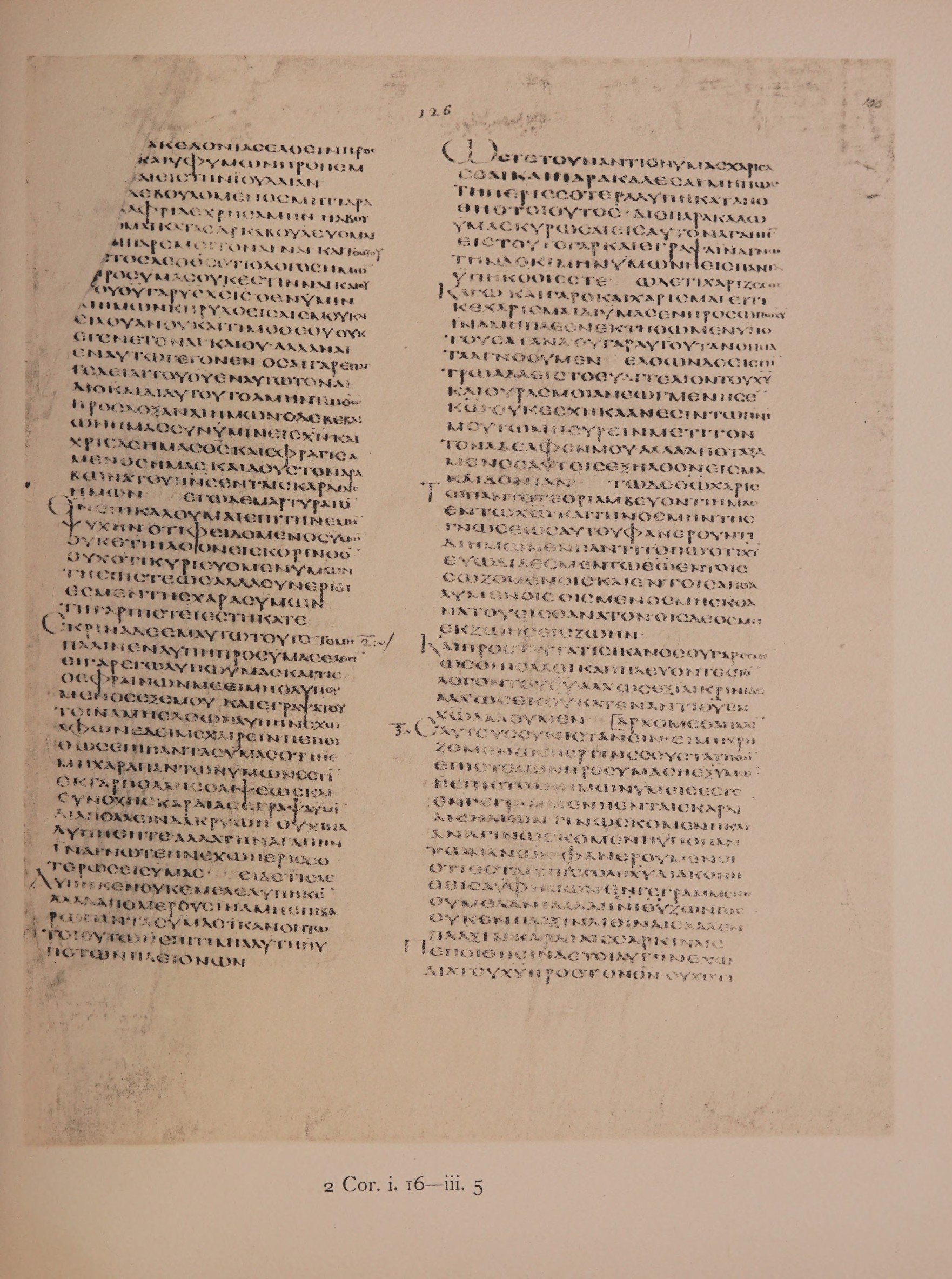
Where on the image
Page from the NTVMR transcription (docID 20002): verses 1-6 on fol. 126r (facsimile leaf 213), col. 1.
1εκρινα δε εμαυτω τουτο · το μη παλιν εν λυπη προς υμας ελθειν 2ει γαρ εγω λυπω υμας και τις ο εφραινων με ει μη ο λυπουμενος εξ εμου 3και εγραψα τουτο̣ ινα μη ελθων λυπην σχω αφ ων εδει με̣ χαιρειν · πεποιθως επι παντας υμας οτι η εμη χαρα παντων υμων εστιν · 4εκ γαρ πολλης θλιψεως και συνοχης καρδιας εγραψα υμιν δια πολλων δακρυων ουχ ινα λυπηθητε · αλλα την αγαπην ινα γνωτε ην εχω περισσοτερως εις υμας · 5ει δε τις λελυπηκεν ουκ εμε λελυπηκεν αλλα απο μερους ινα μη επιβαρω παντας υμας · 6ικανον τω τοιουτω η επιτιμια αυτη η υπο των πλειονων
Compare: Tischendorf 8th edition (1869)
1Ἔκρινα δὲ ἐμαυτῷ τοῦτο, τὸ μὴ πάλιν ἐν λύπῃ πρὸς ὑμᾶς ἐλθεῖν· 2εἰ γὰρ ἐγὼ λυπῶ ὑμᾶς, καὶ τίς ὁ εὐφραίνων με εἰ μὴ ὁ λυπούμενος ἐξ ἐμοῦ; 3καὶ ἔγραψα τοῦτο αὐτὸ ἵνα μὴ ἐλθὼν λύπην σχῶ ἀφ’ ὧν ἔδει με χαίρειν, πεποιθὼς ἐπὶ πάντας ὑμᾶς ὅτι ἡ ἐμὴ χαρὰ πάντων ὑμῶν ἐστιν. 4ἐκ γὰρ πολλῆς θλίψεως καὶ συνοχῆς καρδίας ἔγραψα ὑμῖν διὰ πολλῶν δακρύων, οὐχ ἵνα λυπηθῆτε ἀλλὰ τὴν ἀγάπην ἵνα γνῶτε ἣν ἔχω περισσοτέρως εἰς ὑμᾶς. 5Εἰ δέ τις λελύπηκεν, οὐκ ἐμὲ λελύπηκεν, ἀλλὰ ἀπὸ μέρους, ἵνα μὴ ἐπιβαρῶ, πάντας ὑμᾶς. 6ἱκανὸν τῷ τοιούτῳ ἡ ἐπιτιμία αὕτη ἡ ὑπὸ τῶν πλειόνων,
1But I determined this with myself, that I would not come again to you in heaviness. 2For if I make you sorry, who is he then that maketh me glad, but the same which is made sorry by me? 3And I wrote this same unto you, lest, when I came, I should have sorrow from them of whom I ought to rejoice; having confidence in you all, that my joy is the joy of you all. 4For out of much affliction and anguish of heart I wrote unto you with many tears; not that ye should be grieved, but that ye might know the love which I have more abundantly unto you. 5But if any have caused grief, he hath not grieved me, but in part: that I may not overcharge you all. 6Sufficient to such a man is this punishment, which was inflicted of many.
Where on the image
Page from the NTVMR transcription (docID 20002): verses 7-17 on fol. 126r (facsimile leaf 213), col. 2.
7ωστε τουναντιον υμας χαρισασθαι και παρακαλεσαι μη πως τη περισσοτερα λυπη καταποθη ο τοιουτος · 8διο παρακαλω υμας κυρωσαι εις αυτον αγαπην · 9εις τουτο γαρ και εγραψα ινα γνω την δοκιμην υμων η εις παντα υπηκοοι εστε · 10ω δε τι χαριζεσθε καγω και γαρ ο καιχαρισμαι ει τι κεχαρισμαι δι υμας εν προσωπω χυ 11ινα μη πλεονεκτηθωμεν υπο του σατανα · ου γαρ αυτου τα νοηματα αγνοουμεν · 12ελθων δε εις την τρωαδα εις το ευαγγελιον του χυ και θυρας μοι ανεωγμενης εν κω · 13ουκ εσχηκα ανεσιν τω πνι μου τω μη ευρειν με τιτον τον αδελφον μου · αλλα αποταξαμενος αυτοις εξηλθον εις μακαιδονιαν · 14τω δε θω χαρις τω παντοτε θριαμβευοντι ημας εν τω χω · και την οσμην της γνωσεως αυτου φανερουντι δι ημων εν παντι τοπω · 15οτι χυ ευωδια εσμεν τω θω εν τοις σωζομενοις και εν τοις απολλυμενοις 16οις μεν οσμη εκ θανατου εις θανατον · οις δε οσμη εκ ζωης εις ζωην · και προς ταυτα τις ικανος 17ου γαρ εσμεν ως οι πολλοι καπηλευοντες τον λογον του θυ · αλλ ως εξ ιλικρινιας αλλ ως εκ θυ κατεναντι θυ εν χω λαλουμεν
Compare: Tischendorf 8th edition (1869)
7ὥστε τοὐναντίον μᾶλλον ὑμᾶς χαρίσασθαι καὶ παρακαλέσαι, μήπως τῇ περισσοτέρᾳ λύπῃ καταποθῇ ὁ τοιοῦτος. 8διὸ παρακαλῶ ὑμᾶς κυρῶσαι εἰς αὐτὸν ἀγάπην· 9εἰς τοῦτο γὰρ καὶ ἔγραψα ἵνα γνῶ τὴν δοκιμὴν ὑμῶν, εἰ εἰς πάντα ὑπήκοοί ἐστε. 10ᾧ δέ τι χαρίζεσθε, κἀγώ· καὶ γὰρ ἐγὼ ὃ κεχάρισμαι, εἴ τι κεχάρισμαι, δι’ ὑμᾶς ἐν προσώπῳ Χριστοῦ, 11ἵνα μὴ πλεονεκτηθῶμεν ὑπὸ τοῦ σατανᾶ· οὐ γὰρ αὐτοῦ τὰ νοήματα ἀγνοοῦμεν. 12Ἐλθὼν δὲ εἰς τὴν Τρῳάδα εἰς τὸ εὐαγγέλιον τοῦ Χριστοῦ, καὶ θύρας μοι ἀνεῳγμένης ἐν κυρίῳ, 13οὐκ ἔσχηκα ἄνεσιν τῷ πνεύματί μου τῷ μὴ εὑρεῖν με Τίτον τὸν ἀδελφόν μου, ἀλλὰ ἀποταξάμενος αὐτοῖς ἐξῆλθον εἰς Μακεδονίαν. 14Τῷ δὲ θεῷ χάρις τῷ πάντοτε θριαμβεύοντι ἡμᾶς ἐν τῷ Χριστῷ καὶ τὴν ὀσμὴν τῆς γνώσεως αὐτοῦ φανεροῦντι δι’ ἡμῶν ἐν παντὶ τόπῳ· 15ὅτι Χριστοῦ εὐωδία ἐσμὲν τῷ θεῷ ἐν τοῖς σῳζομένοις καὶ ἐν τοῖς ἀπολλυμένοις, 16οἷς μὲν ὀσμὴ ἐκ θανάτου εἰς θάνατον, οἷς δὲ ὀσμὴ ἐκ ζωῆς εἰς ζωήν. καὶ πρὸς ταῦτα τίς ἱκανός; 17οὐ γάρ ἐσμεν ὡς οἱ πολλοὶ καπηλεύοντες τὸν λόγον τοῦ θεοῦ, ἀλλ’ ὡς ἐξ εἰλικρινίας, ἀλλ’ ὡς ἐκ θεοῦ κατέναντι θεοῦ ἐν Χριστῷ λαλοῦμεν.
7So that contrariwise ye ought rather to forgive him, and comfort him, lest perhaps such a one should be swallowed up with overmuch sorrow. 8Wherefore I beseech you that ye would confirm your love toward him. 9For to this end also did I write, that I might know the proof of you, whether ye be obedient in all things. 10To whom ye forgive any thing, I forgive also: for if I forgave any thing, to whom I forgave it, for your sakes forgave I it in the person of Christ; 11Lest Satan should get an advantage of us: for we are not ignorant of his devices. 12Furthermore, when I came to Troas to preach Christ’s gospel, and a door was opened unto me of the Lord, 13I had no rest in my spirit, because I found not Titus my brother: but taking my leave of them, I went from thence into Macedonia. 14Now thanks be unto God, which always causeth us to triumph in Christ, and maketh manifest the savour of his knowledge by us in every place. 15For we are unto God a sweet savour of Christ, in them that are saved, and in them that perish: 16To the one we are the savour of death unto death; and to the other the savour of life unto life. And who is sufficient for these things? 17For we are not as many, which corrupt the word of God: but as of sincerity, but as of God, in the sight of God speak we in Christ.
Cite
Sources
- Source: Codex Alexandrinus page images + NTVMR transcription (CC BY 4.0) + Tischendorf 8th edition + KJV (holding institution)
- Critical edition: Codex Alexandrinus transcription, NTVMR (INTF Münster, CC BY 4.0); Tischendorf 8th edition for comparison
← previous · → next · v cycle view · l back to library