2 Corinthians, Chapter 3 (Codex Alexandrinus)
Introduction
2 Corinthians 3 from Codex Alexandrinus (GA 02), a fifth-century Greek Bible held by the British Library (Royal MS 1 D. VIII). In the New Testament it is the chief witness to the Byzantine text in the Gospels and to the Alexandrian text in the rest of the New Testament. Its New Testament volume lacks Matthew 1:1-25:5, John 6:50-8:52 and 2 Corinthians 4:13-12:6.
This entry meets the strict three-criteria standard of the Theosis Library:
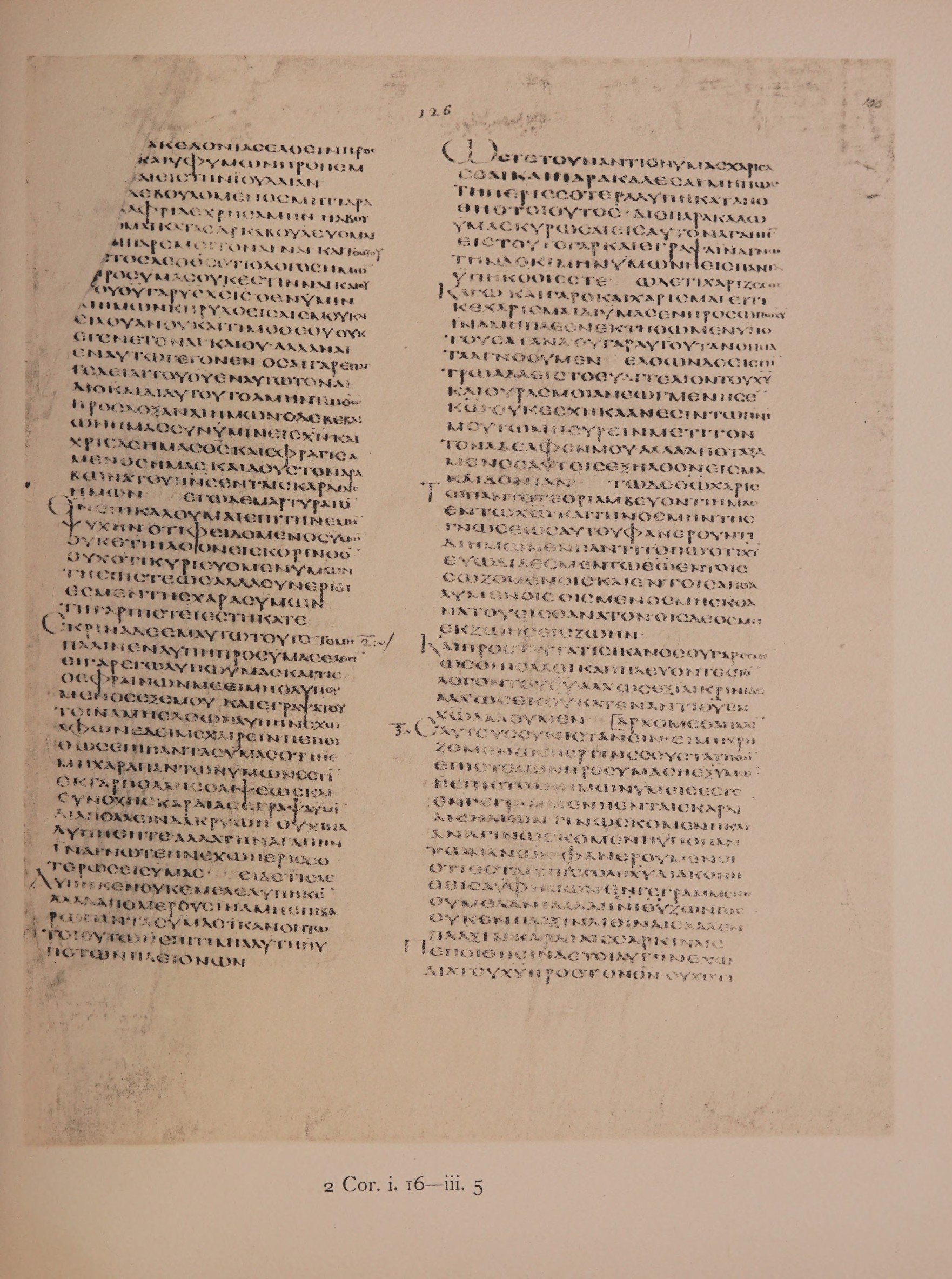
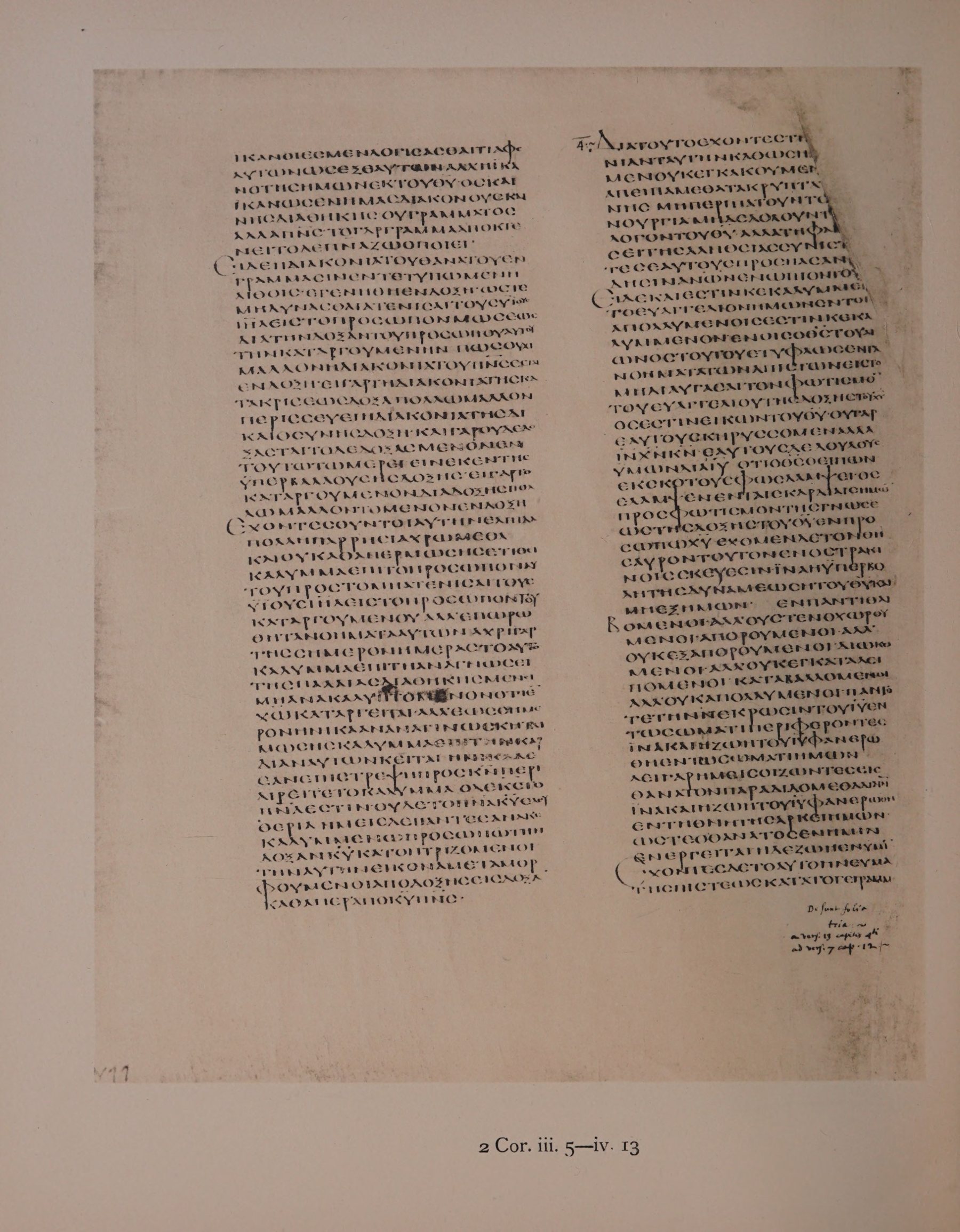
- Manuscript scan: the actual page(s) of Codex Alexandrinus containing this passage (folios 126r, 126v), reproduced from the British Museum's 1909 photographic facsimile edited by F. G. Kenyon, as digitised by the Getty Research Institute for the Internet Archive. The facsimile prints the verse range beneath each plate; that printed range was read for every page used and agrees with the INTF's NTVMR verse-level page index (CC BY 4.0). The page for each section now comes from the NTVMR transcription itself, which records the page and column on which every verse is written.
- Original text: the manuscript's own text, from a diplomatic transcription (see Greek text below), with Tischendorf's 8th critical edition (1869) for comparison.
- English translation: the King James Version (1611), retrieved verbatim from the public-domain bible-api.com endpoint.
Greek text: a diplomatic transcription of Codex Alexandrinus made by the Institut für Neutestamentliche Textforschung (INTF), Münster, for the New Testament Virtual Manuscript Room (NTVMR), published under a Creative Commons Attribution 4.0 licence. It gives the letters as the first scribe wrote them: no accents or breathings, the scribe's own spelling, and the sacred names in their contracted form (θς for θεος, ις for ιησους, κς for κυριος; the overline is not reproduced). Corrections by later hands are not shown. Letters in square brackets are not legible on the page and were restored by the transcribers, a dot under a letter marks an uncertain reading, and [...] marks text lost to damage. Beneath each section, for comparison, is Tischendorf's 8th critical edition (1869). Where the two differ, the transcription is what the manuscript says. Each section is shown with the page on which the transcription places its verses.
How was this verified? (Provenance)
Where on the image
Page from the NTVMR transcription (docID 20002): verses 1-5 on fol. 126r (facsimile leaf 213), col. 2; verse 5 continues on fol. 126v (facsimile leaf 214), col. 1 (which begins 'ικανοι εσμεν λογισασθαι').
1αρχομεθα παλιν εαυτους συνιστανειν · ει μη χρηζομεν ωσπερ τινες συστατικων επιστολων προς υμας η εξ υμων · 2η επιστολη ημων υμεις εστε ενγεγρα̣μμενη εν ταις καρδιαις ημων · γινωσκομενη και αναγινωσκομενη υπο παντων ανων · 3φανερουμενοι οτι εσται επιστολη χυ διακονηθεισα υφ ημων ενγεγραμμενη ου μελανι αλλα πνι θυ ζωντος ουκ εν πλαξιν λιθιναις αλλ εν πλαξιν κ̣αρδιαις σαρκιναις 4πεποιθησιν δε τοιαυτην εχω δια του χυ προς τον θν · 5ουχ οτι ικανοι εσμεν λογισασθαι τι αφ εαυτων ως εξ ε̣αυτων · αλλ η ικανοτης ημων εκ του θυ ·
Compare: Tischendorf 8th edition (1869)
1Ἀρχόμεθα πάλιν ἑαυτοὺς συνιστάνειν; ἢ μὴ χρῄζομεν ὥς τινες συστατικῶν ἐπιστολῶν πρὸς ὑμᾶς ἢ ἐξ ὑμῶν; 2ἡ ἐπιστολὴ ἡμῶν ὑμεῖς ἐστε, ἐνγεγραμμένη ἐν ταῖς καρδίαις ἡμῶν, γινωσκομένη καὶ ἀναγινωσκομένη ὑπὸ πάντων ἀνθρώπων· 3φανερούμενοι ὅτι ἐστὲ ἐπιστολὴ Χριστοῦ διακονηθεῖσα ὑφ’ ἡμῶν, ἐνγεγραμμένη οὐ μέλανι ἀλλὰ πνεύματι θεοῦ ζῶντος, οὐκ ἐν πλαξὶν λιθίναις ἀλλ’ ἐν πλαξὶν καρδίαις σαρκίναις. 4πεποίθησιν δὲ τοιαύτην ἔχομεν διὰ τοῦ Χριστοῦ πρὸς τὸν θεόν. 5οὐχ ὅτι ἀφ’ ἑαυτῶν ἱκανοί ἐσμεν λογίσασθαί τι ὡς ἐξ ἑαυτῶν, ἀλλ’ ἡ ἱκανότης ἡμῶν ἐκ τοῦ θεοῦ,
1Do we begin again to commend ourselves? or need we, as some others, epistles of commendation to you, or letters of commendation from you? 2Ye are our epistle written in our hearts, known and read of all men: 3Forasmuch as ye are manifestly declared to be the epistle of Christ ministered by us, written not with ink, but with the Spirit of the living God; not in tables of stone, but in fleshy tables of the heart. 4And such trust have we through Christ to God-ward: 5Not that we are sufficient of ourselves to think any thing as of ourselves; but our sufficiency is of God;
Where on the image
Page from the NTVMR transcription (docID 20002): verses 6-12 on fol. 126v (facsimile leaf 214), col. 1.
6ος και ικανωσεν ημας διακονους καινης διαθηκης ου γραμματος αλλα πνς · το γαρ γραμμα αποκτενει το δε πνα ζωοποιει · 7ει δε η διακονια του θανατου εν γραμμασιν εντετυπωμενη λιθοις · εγενηθη εν δοξη · ωστε μη δυνασθαι ατενισαι τους υιους ιηλ εις το προσωπον μωσεως δια την δοξαν του προσωπου αυτου την καταργουμενην · 8πως ουχι μαλλον η διακονια του πνς εσται εν δοξη · 9ει γαρ τη διακονια της κατακρισεως δοξα πολλω μαλλον περισσευει η διακονια της δικαιοσυνης δοξη · 10και γαρ ου δεδοξασται το δεδοξασμενον εν τουτω τω μερει · εινεκεν της υπερβαλλουσης δοξης · 11ει γαρ το καταργουμενον δια δοξης πολλω μαλλον το μενον εν δοξη 12εχοντες ουν τοιαυτην ελπιδα πολλη παρρησια χρωμεθα ·
Compare: Tischendorf 8th edition (1869)
6ὃς καὶ ἱκάνωσεν ἡμᾶς διακόνους καινῆς διαθήκης, οὐ γράμματος ἀλλὰ πνεύματος· τὸ γὰρ γράμμα ἀποκτέννει, τὸ δὲ πνεῦμα ζῳοποιεῖ. 7εἰ δὲ ἡ διακονία τοῦ θανάτου ἐν γράμμασιν ἐντετυπωμένη λίθοις ἐγενήθη ἐν δόξῃ, ὥστε μὴ δύνασθαι ἀτενίσαι τοὺς υἱοὺς Ἰσραὴλ εἰς τὸ πρόσωπον Μωϋσέως διὰ τὴν δόξαν τοῦ προσώπου αὐτοῦ τὴν καταργουμένην, 8πῶς οὐχὶ μᾶλλον ἡ διακονία τοῦ πνεύματος ἔσται ἐν δόξῃ; 9εἰ γὰρ τῇ διακονίᾳ τῆς κατακρίσεως δόξα, πολλῷ μᾶλλον περισσεύει ἡ διακονία τῆς δικαιοσύνης δόξῃ. 10καὶ γὰρ οὐ δεδόξασται τὸ δεδοξασμένον ἐν τούτῳ τῷ μέρει εἵνεκεν τῆς ὑπερβαλλούσης δόξης. 11εἰ γὰρ τὸ καταργούμενον διὰ δόξης, πολλῷ μᾶλλον τὸ μένον ἐν δόξῃ. 12Ἔχοντες οὖν τοιαύτην ἐλπίδα πολλῇ παρρησίᾳ χρώμεθα,
6Who also hath made us able ministers of the new testament; not of the letter, but of the spirit: for the letter killeth, but the spirit giveth life. 7But if the ministration of death, written and engraven in stones, was glorious, so that the children of Israel could not stedfastly behold the face of Moses for the glory of his countenance; which glory was to be done away: 8How shall not the ministration of the spirit be rather glorious? 9For if the ministration of condemnation be glory, much more doth the ministration of righteousness exceed in glory. 10For even that which was made glorious had no glory in this respect, by reason of the glory that excelleth. 11For if that which is done away was glorious, much more that which remaineth is glorious. 12Seeing then that we have such hope, we use great plainness of speech:
Where on the image
Page from the NTVMR transcription (docID 20002): verses 13-18 on fol. 126v (facsimile leaf 214), col. 1.
13και ου καθαπερ μωσης ετιθει καλυμμα επι το προσωπον αυτου προς το μη ατενισαι τους υιους ιηλ εις το προσωπον του καταργουμενου 14αλλ επωρωθη τα νοηματα αυτων · αχρι γαρ της σημερον ημερας το αυτο καλυμμα επι τη αναγνωσει της παλαιας διαθηκης μενει μη ανακαλυπτομε̣νον οτι εν χω καταργειται · 15αλλ εως σημερον ηνικα αν αναγινωσκητ̣αι μωσης καλυμμα επι την καρδιαν αυτων κειται · 16ηνικα δε εαν επιστρεψη προς κν περιαιρειτε το καλυμμα · 17ο δε κς το πνα εστιν · ου δε το πνα κυ ελευθερια · 18ημεις δε παντες ανακεκαλυμμενω προσωπω την δοξαν κυ κατοπτριζομενοι · την αυτην εικονα μεταμορφουμενοι απο δοξης εις δοξαν καθαπερ απο κυ πνς ·
Compare: Tischendorf 8th edition (1869)
13καὶ οὐ καθάπερ Μωϋσῆς ἐτίθει κάλυμμα ἐπὶ τὸ πρόσωπον ἑαυτοῦ, πρὸς τὸ μὴ ἀτενίσαι τοὺς υἱοὺς Ἰσραὴλ εἰς τὸ τέλος τοῦ καταργουμένου. 14ἀλλὰ ἐπωρώθη τὰ νοήματα αὐτῶν. ἄχρι γὰρ τῆς σήμερον ἡμέρας τὸ αὐτὸ κάλυμμα ἐπὶ τῇ ἀναγνώσει τῆς παλαιᾶς διαθήκης μένει μὴ ἀνακαλυπτόμενον, ὅτι ἐν Χριστῷ καταργεῖται· 15ἀλλ’ ἕως σήμερον ἡνίκα ἂν ἀναγινώσκηται Μωϋσῆς κάλυμμα ἐπὶ τὴν καρδίαν αὐτῶν κεῖται· 16ἡνίκα δὲ ἐὰν ἐπιστρέψῃ πρὸς κύριον, περιαιρεῖται τὸ κάλυμμα. 17ὁ δὲ κύριος τὸ πνεῦμά ἐστιν· οὗ δὲ τὸ πνεῦμα κυρίου, ἐλευθερία. 18ἡμεῖς δὲ πάντες ἀνακεκαλυμμένῳ προσώπῳ τὴν δόξαν κυρίου κατοπτριζόμενοι τὴν αὐτὴν εἰκόνα μεταμορφούμεθα ἀπὸ δόξης εἰς δόξαν, καθάπερ ἀπὸ κυρίου πνεύματος.
13And not as Moses, which put a vail over his face, that the children of Israel could not stedfastly look to the end of that which is abolished: 14But their minds were blinded: for until this day remaineth the same vail untaken away in the reading of the old testament; which vail is done away in Christ. 15But even unto this day, when Moses is read, the vail is upon their heart. 16Nevertheless when it shall turn to the Lord, the vail shall be taken away. 17Now the Lord is that Spirit: and where the Spirit of the Lord is, there is liberty. 18But we all, with open face beholding as in a glass the glory of the Lord, are changed into the same image from glory to glory, even as by the Spirit of the Lord.
Cite
Sources
- Source: Codex Alexandrinus page images + NTVMR transcription (CC BY 4.0) + Tischendorf 8th edition + KJV (holding institution)
- Critical edition: Codex Alexandrinus transcription, NTVMR (INTF Münster, CC BY 4.0); Tischendorf 8th edition for comparison
← previous · → next · v cycle view · l back to library