Acts, Chapter 28 (Codex Alexandrinus)
Introduction
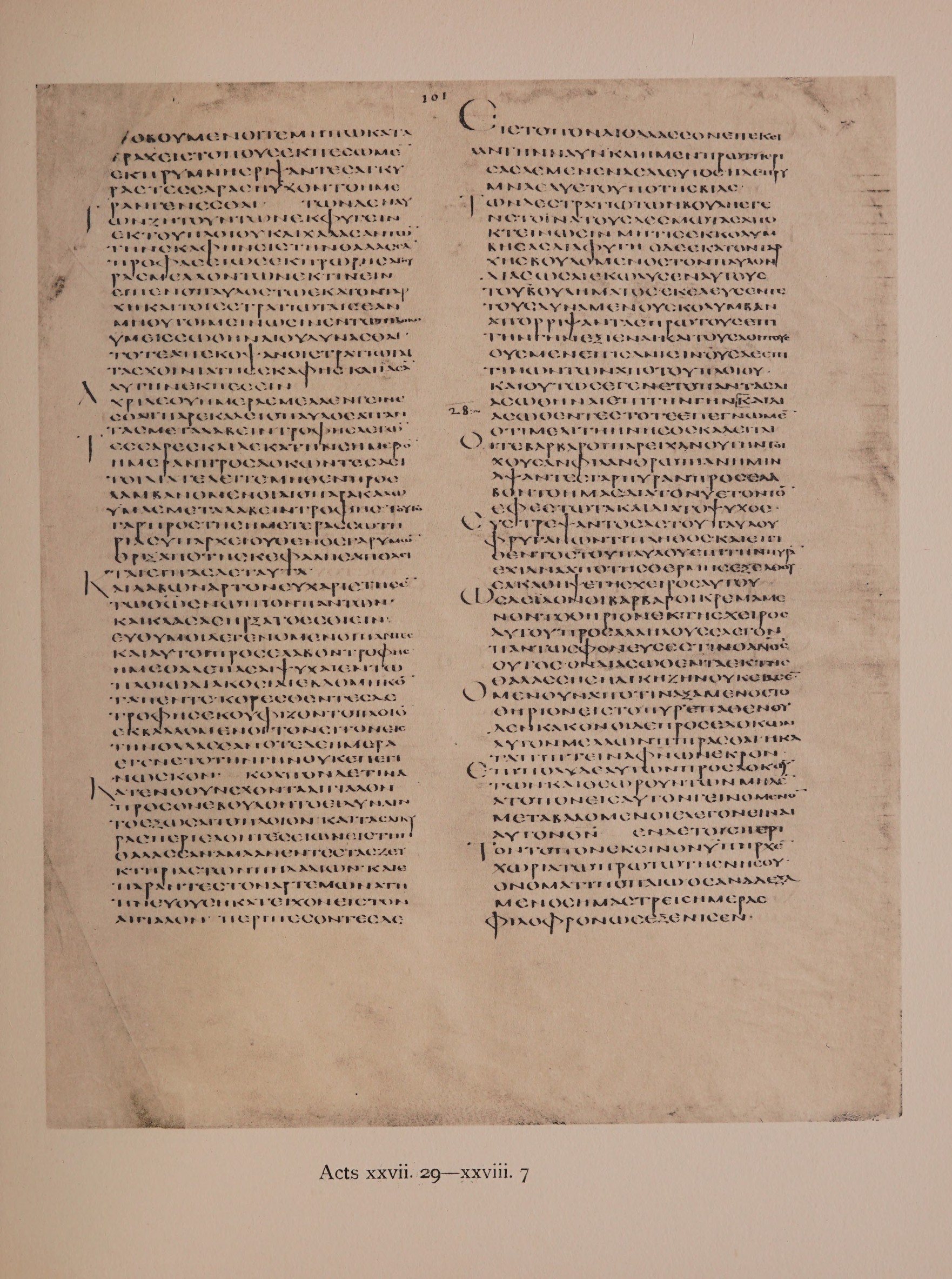
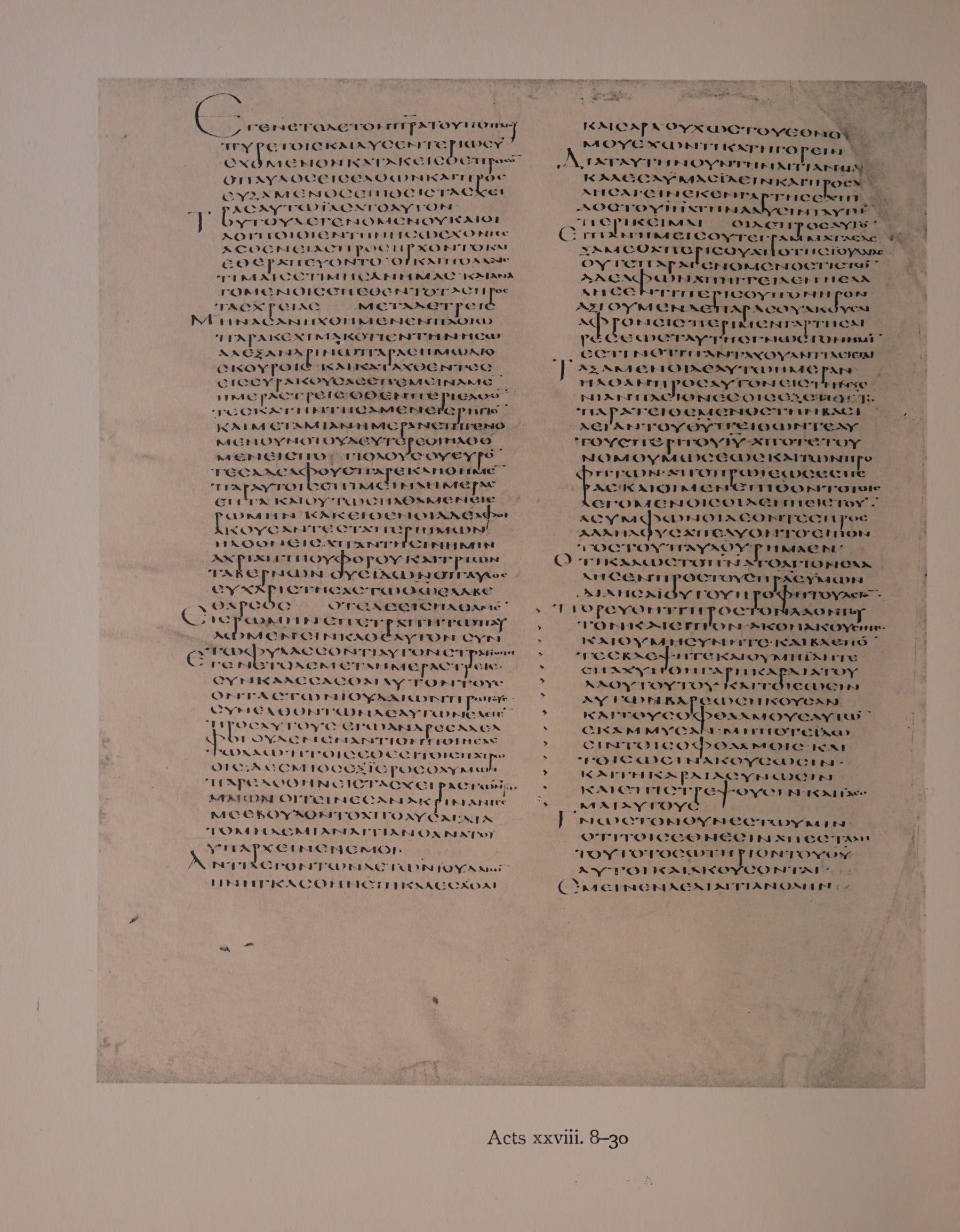
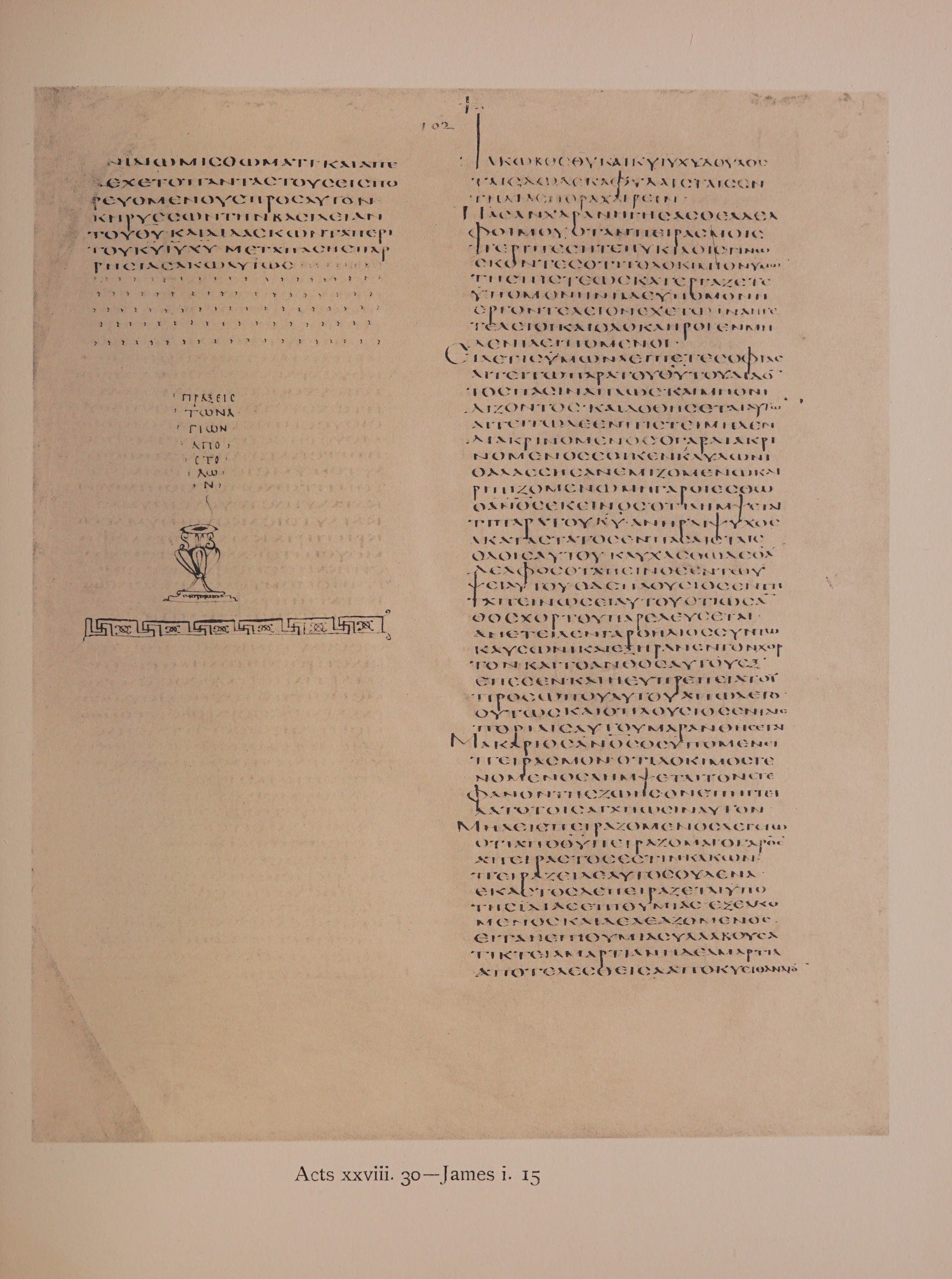
Acts 28 from Codex Alexandrinus (GA 02), a fifth-century Greek Bible held by the British Library (Royal MS 1 D. VIII). In the New Testament it is the chief witness to the Byzantine text in the Gospels and to the Alexandrian text in the rest of the New Testament. Its New Testament volume lacks Matthew 1:1-25:5, John 6:50-8:52 and 2 Corinthians 4:13-12:6.
This entry meets the strict three-criteria standard of the Theosis Library:
- Manuscript scan: the actual page(s) of Codex Alexandrinus containing this passage (folios 101r, 101v, 102r), reproduced from the British Museum's 1909 photographic facsimile edited by F. G. Kenyon, as digitised by the Getty Research Institute for the Internet Archive. The facsimile prints the verse range beneath each plate; that printed range was read for every page used and agrees with the INTF's NTVMR verse-level page index (CC BY 4.0). The page for each section now comes from the NTVMR transcription itself, which records the page and column on which every verse is written.
- Original text: the manuscript's own text, from a diplomatic transcription (see Greek text below), with Tischendorf's 8th critical edition (1869) for comparison.
- English translation: the King James Version (1611), retrieved verbatim from the public-domain bible-api.com endpoint.
Greek text: a diplomatic transcription of Codex Alexandrinus made by the Institut für Neutestamentliche Textforschung (INTF), Münster, for the New Testament Virtual Manuscript Room (NTVMR), published under a Creative Commons Attribution 4.0 licence. It gives the letters as the first scribe wrote them: no accents or breathings, the scribe's own spelling, and the sacred names in their contracted form (θς for θεος, ις for ιησους, κς for κυριος; the overline is not reproduced). Corrections by later hands are not shown. Letters in square brackets are not legible on the page and were restored by the transcribers, a dot under a letter marks an uncertain reading, and [...] marks text lost to damage. Beneath each section, for comparison, is Tischendorf's 8th critical edition (1869). Where the two differ, the transcription is what the manuscript says. Each section is shown with the page on which the transcription places its verses.
Manuscript note: Not written in Codex Alexandrinus: verse 29. The English is shown with a bracketed note in the Greek column.
How was this verified? (Provenance)
Where on the image
Page from the NTVMR transcription (docID 20002): verses 1-7 on fol. 101r (facsimile leaf 163), col. 2.
1και διασωθεντες τοτε επεγνωμεν οτι μελιτη η νησος καλειται · 2οι τε βαρβαροι παρειχαν ου την τοιχουσαν φιλανθρωπιαν ημιν αψαντες γαρ πυραν προσελαβοντο ημας · δια τον υετον τον εφεστωτα και δια το ψυχος · 3συστρεψαντος δε του παυλου φρυγανων τι πληθος · και επιθεντος του παυλου επι την πυραν εχιδνα απο της θερμης εξελθουσα καθηψε της χειρος αυτου 4ως δε ιδον οι βαρβαροι κρεμαμενον το θηριον εκ της χειρος αυτου προς αλληλους ελεγον παντως φονευς εστιν ο ανος ουτος · ον διασωθεντα εκ της θαλασσης η δικη ζην ουκ ειασεν · 5ο μεν ουν αποτιναξαμενος το θηριον εις το πυρ επαθεν ουδεν κακον 6οι δε προσεδοκων αυτον μελλων πιπρασθαι · η καταπιπτειν αφνω νεκρον · επι πολυ δε αυτων προσδοκουντων · και θεωρουντων μηδεν ατοπον εις αυτον γεινομενον μεταβαλομενοι ελεγον ειναι αυτον θν · 7εν δε τοις περι τον τοπον εκεινον υπηρχεν χωρια τω πρωτω της νησου · ονοματι ποπλιω ος αναδεξαμενος ημας τρεις ημερας φιλοφρονως εξενισεν ·
Compare: Tischendorf 8th edition (1869)
1Καὶ διασωθέντες τότε ἐπέγνωμεν ὅτι Μελίτη ἡ νῆσος καλεῖται. 2οἵ τε βάρβαροι παρεῖχαν οὐ τὴν τυχοῦσαν φιλανθρωπίαν ἡμῖν, ἅψαντες γὰρ πυρὰν προσελάβοντο πάντας ἡμᾶς διὰ τὸν ὑετὸν τὸν ἐφεστῶτα καὶ διὰ τὸ ψῦχος. 3συστρέψαντος δὲ τοῦ Παύλου φρυγάνων τι πλῆθος καὶ ἐπιθέντος ἐπὶ τὴν πυράν, ἔχιδνα ἀπὸ τῆς θέρμης ἐξελθοῦσα καθῆψεν τῆς χειρὸς αὐτοῦ. 4ὡς δὲ εἶδον οἱ βάρβαροι κρεμάμενον τὸ θηρίον ἐκ τῆς χειρὸς αὐτοῦ, πρὸς ἀλλήλους ἔλεγον, πάντως φονεύς ἐστιν ὁ ἄνθρωπος οὗτος ὃν διασωθέντα ἐκ τῆς θαλάσσης ἡ δίκη ζῆν οὐκ εἴασεν. 5ὁ μὲν οὖν ἀποτινάξας τὸ θηρίον εἰς τὸ πῦρ ἔπαθεν οὐδὲν κακόν· 6οἱ δὲ προσεδόκων αὐτὸν μέλλειν ἐμπιπρᾶσθαι ἢ καταπίπτειν ἄφνω νεκρόν. ἐπὶ πολὺ δὲ αὐτῶν προσδοκώντων καὶ θεωρούντων μηδὲν ἄτοπον εἰς αὐτὸν γινόμενον, μεταβαλλόμενοι ἔλεγον αὐτὸν εἶναι θεόν. 7ἐν δὲ τοῖς περὶ τὸν τόπον ἐκεῖνον ὑπῆρχεν χωρία τῷ πρώτῳ τῆς νήσου ὀνόματι Ποπλίῳ, ὃς ἀναδεξάμενος ἡμᾶς τρεῖς ἡμέρας φιλοφρόνως ἐξένισεν.
1And when they were escaped, then they knew that the island was called Melita. 2And the barbarous people shewed us no little kindness: for they kindled a fire, and received us every one, because of the present rain, and because of the cold. 3And when Paul had gathered a bundle of sticks, and laid them on the fire, there came a viper out of the heat, and fastened on his hand. 4And when the barbarians saw the venomous beast hang on his hand, they said among themselves, No doubt this man is a murderer, whom, though he hath escaped the sea, yet vengeance suffereth not to live. 5And he shook off the beast into the fire, and felt no harm. 6Howbeit they looked when he should have swollen, or fallen down dead suddenly: but after they had looked a great while, and saw no harm come to him, they changed their minds, and said that he was a god. 7In the same quarters were possessions of the chief man of the island, whose name was Publius; who received us, and lodged us three days courteously.
Where on the image
Page from the NTVMR transcription (docID 20002): verses 8-19 on fol. 101v (facsimile leaf 164), col. 1.
8εγενετο δε τον πρα του ποπλιου πυρετοις και δυσεντεριω συνεχομενον κατακεισθε προς ον ο παυλος εισελθων και προσευξαμενος επιθεις τας χειρας αυτω ιασατο αυτον · 9τουτου δε γενομενου και οι λοιποι οι εν τη νησω εχοντες ασθενειας προσηρχοντο και εθεραπευοντο · 10οι και πολλαις τιμαις ετιμησαν ημας · και αναγομενοις επεθεντο τας προς τας χρειας 11μετα δε τρεις μηνας ανηχθημεν εν πλοιω παρακεχιμακοτι εν τη νησω αλεξανδρινω παρασημω διοσκουροις · 12και καταχθεντες εις συρακουσας επεμειναμεν ημερας τρεις · 13οθεν περιελθοντες κατηντησαμεν εις ρηγιον και μετα μιαν ημεραν επιγενομενου νοτου δευτερεοι ηλθομεν εις πορτιολους · 14ου ευροντες αδελφους παρεκληθημεν παρ αυτοις επιμεινα ημερας επτα · και ουτως ηλθαμεν εις ρωμην · 15κακειθεν οι αδελφοι ακουσαντες τα περι ημων ηλθον εις απαντησιν ημιν αχρι αππιου φορου · και τριων ταβερνων ους ιδων ο παυλος ευχαριστησας τω θω ελαβε θαρσος · 16οτε δε εισηλθαμεν εις ρωμην · επετραπη τω παυλω μενειν καθ εαυτον · συν τω φυλασσοντι αυτον στρατιωτη 17εγενετο δε μετα ημερας τρεις · συνκαλεσασθαι αυτον τους οντας των ιουδαιων πρωτους συνελθοντων δε αυτων ελεγεν προς αυτους · εγω ανδρες αδελφοι · ουδεν εναντιον ποιησας τω λαω · η τοις εθεσι τοις πατρωοις · δεσμιος εξ ιεροσολυμων παρεδοθην εις τας χειρας των [...] 18οιτεινες ανακριναντες με εβουλοντο απολυσαι · δια το μηδεμιαν αιτιαν θανατου υπαρχειν εν εμοι · 19αντιλεγοντων δε των ιουδαιων ηνηγκασθην επικαλεσαθαι καισαρα · ουχ ως του εθνο[υς] μου εχων τι κατηγορειν
Compare: Tischendorf 8th edition (1869)
8ἐγένετο δὲ τὸν πατέρα τοῦ Ποπλίου πυρετοῖς καὶ δυσεντερίῳ συνεχόμενον κατακεῖσθαι, πρὸς ὃν ὁ Παῦλος εἰσελθὼν καὶ προσευξάμενος, ἐπιθεὶς τὰς χεῖρας αὐτῷ ἰάσατο αὐτόν. 9τούτου δὲ γενομένου καὶ οἱ λοιποὶ οἱ ἐν τῇ νήσῳ ἔχοντες ἀσθενείας προσήρχοντο καὶ ἐθεραπεύοντο, 10οἳ καὶ πολλαῖς τιμαῖς ἐτίμησαν ἡμᾶς καὶ ἀναγομένοις ἐπέθεντο τὰ πρὸς τὰς χρείας. 11Μετὰ δὲ τρεῖς μῆνας ἀνήχθημεν ἐν πλοίῳ παρακεχειμακότι ἐν τῇ νήσῳ Ἀλεξανδρίνῳ, παρασήμῳ Διοσκούροις. 12καὶ καταχθέντες εἰς Συρακούσας ἐπεμείναμεν ἡμέρας τρεῖς, 13ὅθεν περιελθόντες κατηντήσαμεν εἰς Ῥήγιον. καὶ μετὰ μίαν ἡμέραν ἐπιγενομένου νότου δευτεραῖοι ἤλθομεν εἰς Ποτιόλους, 14οὗ εὑρόντες ἀδελφοὺς παρεκλήθημεν παρ’ αὐτοῖς ἐπιμεῖναι ἡμέρας ἑπτά· καὶ οὕτως εἰς τὴν Ῥώμην ἤλθαμεν. 15κἀκεῖθεν οἱ ἀδελφοὶ ἀκούσαντες τὰ περὶ ἡμῶν ἦλθαν εἰς ἀπάντησιν ἡμῖν ἄχρι Ἀππίου φόρου καὶ Τριῶν ταβερνῶν, οὓς ἰδὼν ὁ Παῦλος εὐχαριστήσας τῷ θεῷ ἔλαβε θάρσος. 16Ὅτε δὲ εἰσήλθομεν εἰς τὴν Ῥώμην, ἐπετράπη τῷ Παύλῳ μένειν καθ’ ἑαυτὸν σὺν τῷ φυλάσσοντι αὐτὸν στρατιώτῃ. 17ἐγένετο δὲ μετὰ ἡμέρας τρεῖς συνκαλέσασθαι αὐτὸν τοὺς ὄντας τῶν Ἰουδαίων πρώτους· συνελθόντων δὲ αὐτῶν ἔλεγεν πρὸς αὐτούς· ἐγώ, ἄνδρες ἀδελφοί, οὐδὲν ἐναντίον ποιήσας τῷ λαῷ ἢ τοῖς ἔθεσι τοῖς πατρῴοις, δέσμιος ἐξ Ἱεροσολύμων παρεδόθην εἰς τὰς χεῖρας τῶν Ῥωμαίων, 18οἵτινες ἀνακρίναντές με ἐβούλοντο ἀπολῦσαι διὰ τὸ μηδεμίαν αἰτίαν θανάτου ὑπάρχειν ἐν ἐμοί· 19ἀντιλεγόντων δὲ τῶν Ἰουδαίων ἠναγκάσθην ἐπικαλέσασθαι Καίσαρα, οὐχ ὡς τοῦ ἔθνους μου ἔχων τι κατηγορεῖν.
8And it came to pass, that the father of Publius lay sick of a fever and of a bloody flux: to whom Paul entered in, and prayed, and laid his hands on him, and healed him. 9So when this was done, others also, which had diseases in the island, came, and were healed: 10Who also honoured us with many honours; and when we departed, they laded us with such things as were necessary. 11And after three months we departed in a ship of Alexandria, which had wintered in the isle, whose sign was Castor and Pollux. 12And landing at Syracuse, we tarried there three days. 13And from thence we fetched a compass, and came to Rhegium: and after one day the south wind blew, and we came the next day to Puteoli: 14Where we found brethren, and were desired to tarry with them seven days: and so we went toward Rome. 15And from thence, when the brethren heard of us, they came to meet us as far as Appii Forum, and The three taverns: whom when Paul saw, he thanked God, and took courage. 16And when we came to Rome, the centurion delivered the prisoners to the captain of the guard: but Paul was suffered to dwell by himself with a soldier that kept him. 17And it came to pass, that after three days Paul called the chief of the Jews together: and when they were come together, he said unto them, Men and brethren, though I have committed nothing against the people, or customs of our fathers, yet was I delivered prisoner from Jerusalem into the hands of the Romans. 18Who, when they had examined me, would have let me go, because there was no cause of death in me. 19But when the Jews spake against it, I was constrained to appeal unto Caesar; not that I had ought to accuse my nation of.
Where on the image
Page from the NTVMR transcription (docID 20002): verses 20-28, 30 on fol. 101v (facsimile leaf 164), col. 2; verse 30 continues on fol. 102r (facsimile leaf 165), col. 1 (which begins '[ε]ν ιδιω μισθωματι'). Verse 29 is not in Codex Alexandrinus; the NTVMR transcription (docID 20002) shows the text passing over it on fol. 101v (facsimile leaf 164), col. 2.
20δια ταυτην ουν την αιτιαν πα[ρε]καλεσα υμας ιδειν και προσλ[α]λησαι · εινεκεν γαρ της ελπιδος του ιηλ την αλυσιν ταυτην περικειμαι 21οι δε προς αυτον ειπαν · ημεις ουτε γραμματα εδεξαμεθα περι σου απο της ιουδαιας ουτε παραγενομενος τις των αδελφων απηγγειλεν · η ελαλησεν τι περι σου πονηρον · 22αξιουμεν δε παρα σου ακουσαι α φρονεις περι μεν γαρ της αιρεσεως ταυτης γνωστον ημιν εστιν οτι πανταχου αντιλεγεται 23ταξαμενοι δε αυτω ημεραν · ηλθαν προς αυτον εις την ξενιαν πλειονες · οις εξεθ̣ετ̣[ο] παρατειθεμενος την βασιλειαν του θυ πειθων τε αυτους περι του ιυ · απο τε του νομου μωσεως και των προφητων · απο πρωι εως εσπερας · 24και οι μεν επιθοντο τοις λεγομενοις οι δε ηπειστουν · 25ασυμφωνοι δε οντες προς αλληλους απελυοντο · ειποντος του παυλου · ρημα εν οτι καλως το πνα το αγιον ελαλησεν προς τους πρας υμων δια ησαιου του προφητου 26λεγον · πορευθητι προς τον λαον τουτον · και ειπον · ακοη ακουσητε · και ου μη συνητε · και βλεποντες βλεψητε και ου μη ιδητε · 27επαχυνθη γαρ η καρδια του λαου τουτου και τοις ωσιν αυτων βαρεως ηκουσαν και τους οφθαλμους αυτων εκαμμυσαν · μηποτε ιδωσιν τοις οφθαλμοις · και τοις ωσιν ακουσωσιν · και τη καρδια συνωσιν και επιστρεψουσιν · και ιασομαι αυτους 28γνωστον ουν εστω υμιν οτι τοις εθνεσιν απεσταλη τουτο το σωτηριον του θυ · αυτοι και ακουσονται · 29[not in Codex Alexandrinus] 30εμεινεν δε διαιτιαν ολην [ε]ν ιδιω μισθωματι · και απεδ̣εχετο παντας τους εισπορευομενους προς αυτον ·
Compare: Tischendorf 8th edition (1869)
20διὰ ταύτην οὖν τὴν αἰτίαν παρεκάλεσα ὑμᾶς ἰδεῖν καὶ προσλαλῆσαι· εἵνεκεν γὰρ τῆς ἐλπίδος τοῦ Ἰσραὴλ τὴν ἅλυσιν ταύτην περίκειμαι. 21οἱ δὲ πρὸς αὐτὸν εἶπαν, ἡμεῖς οὔτε γράμματα περὶ σοῦ ἐδεξάμεθα ἀπὸ τῆς Ἰουδαίας, οὔτε παραγενόμενός τις τῶν ἀδελφῶν ἀπήγγειλεν ἢ ἐλάλησέν τι περὶ σοῦ πονηρόν. 22ἀξιοῦμεν δὲ παρὰ σοῦ ἀκοῦσαι ἃ φρονεῖς, περὶ μὲν γὰρ τῆς αἱρέσεως ταύτης γνωστὸν ἡμῖν ἐστιν ὅτι πανταχοῦ ἀντιλέγεται. 23ταξάμενοι δὲ αὐτῷ ἡμέραν ἦλθον πρὸς αὐτὸν εἰς τὴν ξενίαν πλείονες, οἷς ἐξετίθετο διαμαρτυρόμενος τὴν βασιλείαν τοῦ θεοῦ πείθων τε αὐτοὺς περὶ τοῦ Ἰησοῦ ἀπό τε τοῦ νόμου Μωϋσέως καὶ τῶν προφητῶν ἀπὸ πρωῒ ἕως ἑσπέρας. 24καὶ οἱ μὲν ἐπείθοντο τοῖς λεγομένοις, οἱ δὲ ἠπίστουν· 25ἀσύμφωνοι τε ὄντες πρὸς ἀλλήλους ἀπελύοντο, εἰπόντος τοῦ Παύλου ῥῆμα ἓν ὅτι καλῶς τὸ πνεῦμα τὸ ἅγιον ἐλάλησεν διὰ Ἠσαΐου τοῦ προφήτου πρὸς τοὺς πατέρας ὑμῶν 26λέγων, πορεύθητι πρὸς τὸν λαὸν τοῦτον καὶ εἰπόν, ἀκοῇ ἀκούσετε καὶ οὐ μὴ συνῆτε, καὶ βλέποντες βλέψετε καὶ οὐ μὴ ἴδητε· 27ἐπαχύνθη γὰρ ἡ καρδία τοῦ λαοῦ τούτου, καὶ τοῖς ὠσὶν βαρέως ἤκουσαν, καὶ τοὺς ὀφθαλμοὺς αὐτῶν ἐκάμμυσαν· μήποτε ἴδωσιν τοῖς ὀφθαλμοῖς καὶ τοῖς ὠσὶν ἀκούσωσιν καὶ τῇ καρδίᾳ συνῶσιν καὶ ἐπιστρέψωσιν, καὶ ἰάσομαι αὐτούς. 28γνωστὸν οὖν ἔστω ὑμῖν ὅτι τοῖς ἔθνεσιν ἀπεστάλη τοῦτο τὸ σωτήριον τοῦ θεοῦ· αὐτοὶ καὶ ἀκούσονται. 29 30Ἐνέμεινεν δὲ διετίαν ὅλην ἐν ἰδίῳ μισθώματι, καὶ ἀπεδέχετο πάντας τοὺς εἰσπορευομένους πρὸς αὐτόν,
20For this cause therefore have I called for you, to see you, and to speak with you: because that for the hope of Israel I am bound with this chain. 21And they said unto him, We neither received letters out of Judaea concerning thee, neither any of the brethren that came shewed or spake any harm of thee. 22But we desire to hear of thee what thou thinkest: for as concerning this sect, we know that every where it is spoken against. 23And when they had appointed him a day, there came many to him into his lodging; to whom he expounded and testified the kingdom of God, persuading them concerning Jesus, both out of the law of Moses, and out of the prophets, from morning till evening. 24And some believed the things which were spoken, and some believed not. 25And when they agreed not among themselves, they departed, after that Paul had spoken one word, Well spake the Holy Ghost by Esaias the prophet unto our fathers, 26Saying, Go unto this people, and say, Hearing ye shall hear, and shall not understand; and seeing ye shall see, and not perceive: 27For the heart of this people is waxed gross, and their ears are dull of hearing, and their eyes have they closed; lest they should see with their eyes, and hear with their ears, and understand with their heart, and should be converted, and I should heal them. 28Be it known therefore unto you, that the salvation of God is sent unto the Gentiles, and that they will hear it. 29And when he had said these words, the Jews departed, and had great reasoning among themselves. 30And Paul dwelt two whole years in his own hired house, and received all that came in unto him,
Where on the image
Page from the NTVMR transcription (docID 20002): verse 31 on fol. 102r (facsimile leaf 165), col. 1.
31κηρυσσων την βασιλειαν του θυ · και διδασκων τα περι του κυ ιυ χυ · μετα πασης παρρησιας ακωλυτως
Compare: Tischendorf 8th edition (1869)
31κηρύσσων τὴν βασιλείαν τοῦ θεοῦ καὶ διδάσκων τὰ περὶ τοῦ κυρίου Ἰησοῦ μετὰ πάσης παρρησίας ἀκωλύτως.
31Preaching the kingdom of God, and teaching those things which concern the Lord Jesus Christ, with all confidence, no man forbidding him.
Cite
Sources
- Source: Codex Alexandrinus page images + NTVMR transcription (CC BY 4.0) + Tischendorf 8th edition + KJV (holding institution)
- Critical edition: Codex Alexandrinus transcription, NTVMR (INTF Münster, CC BY 4.0); Tischendorf 8th edition for comparison
← previous · → next · v cycle view · l back to library