Acts, Chapter 27 (Codex Alexandrinus)
Introduction
Acts 27 from Codex Alexandrinus (GA 02), a fifth-century Greek Bible held by the British Library (Royal MS 1 D. VIII). In the New Testament it is the chief witness to the Byzantine text in the Gospels and to the Alexandrian text in the rest of the New Testament. Its New Testament volume lacks Matthew 1:1-25:5, John 6:50-8:52 and 2 Corinthians 4:13-12:6.
This entry meets the strict three-criteria standard of the Theosis Library:
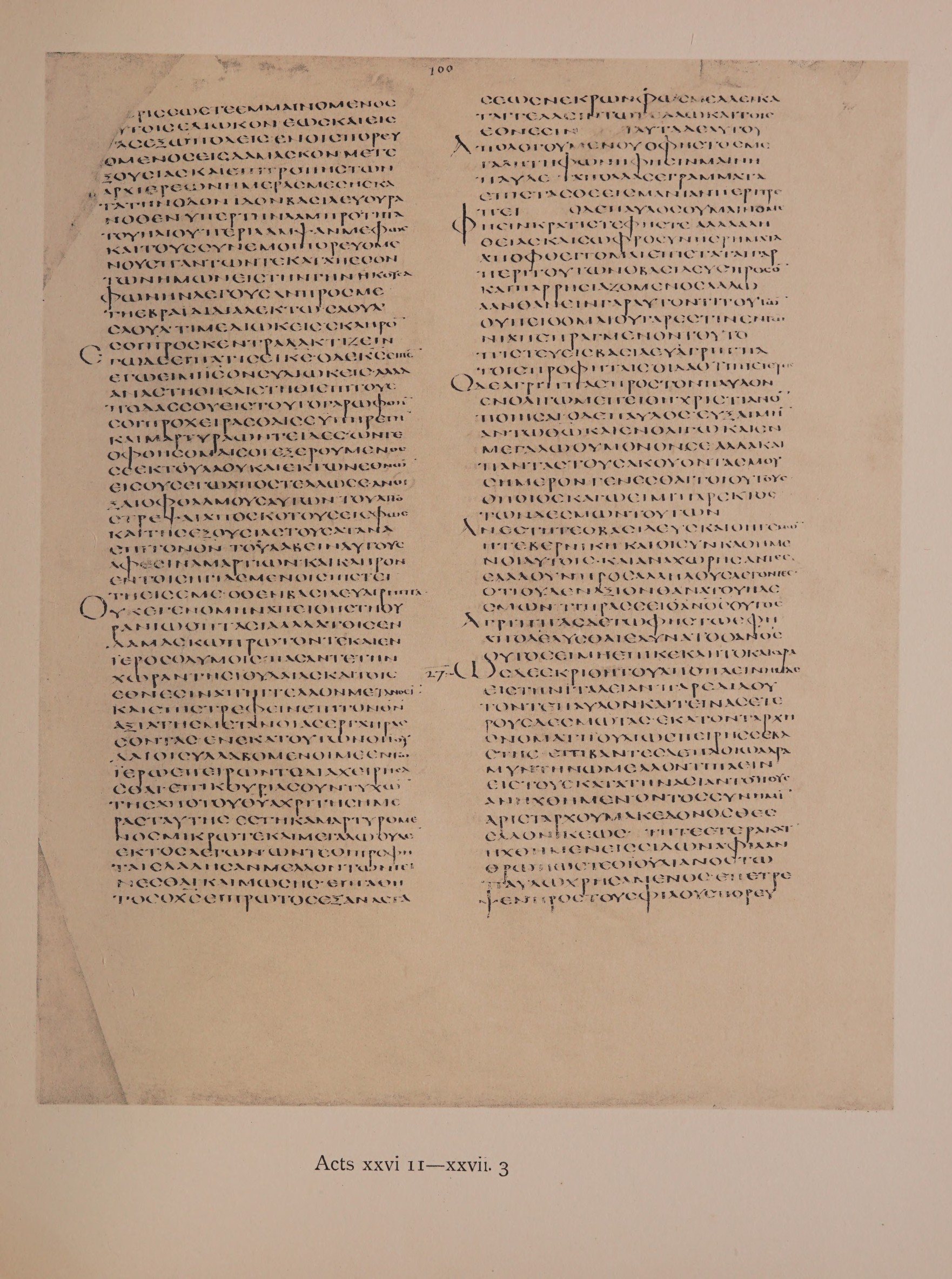
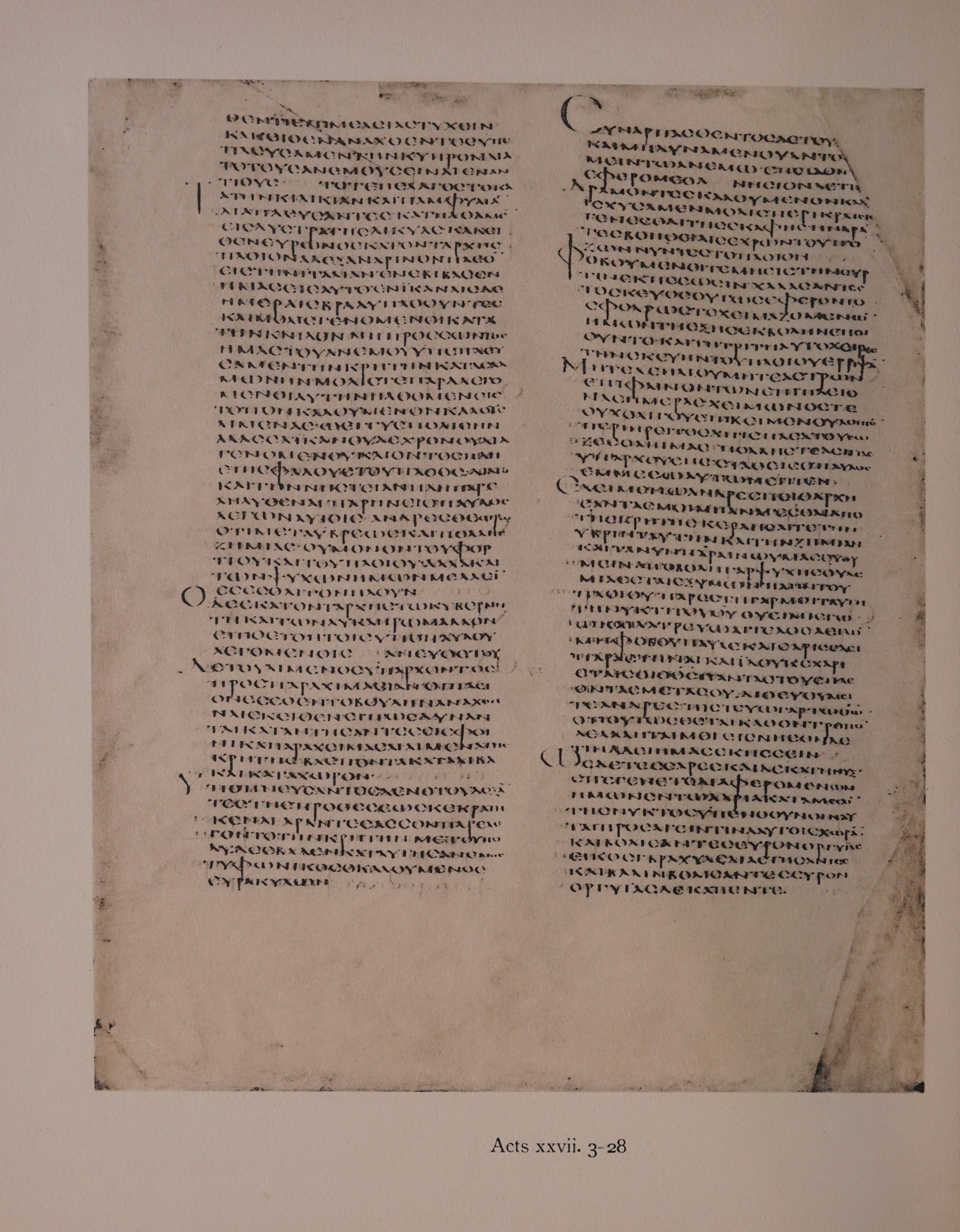
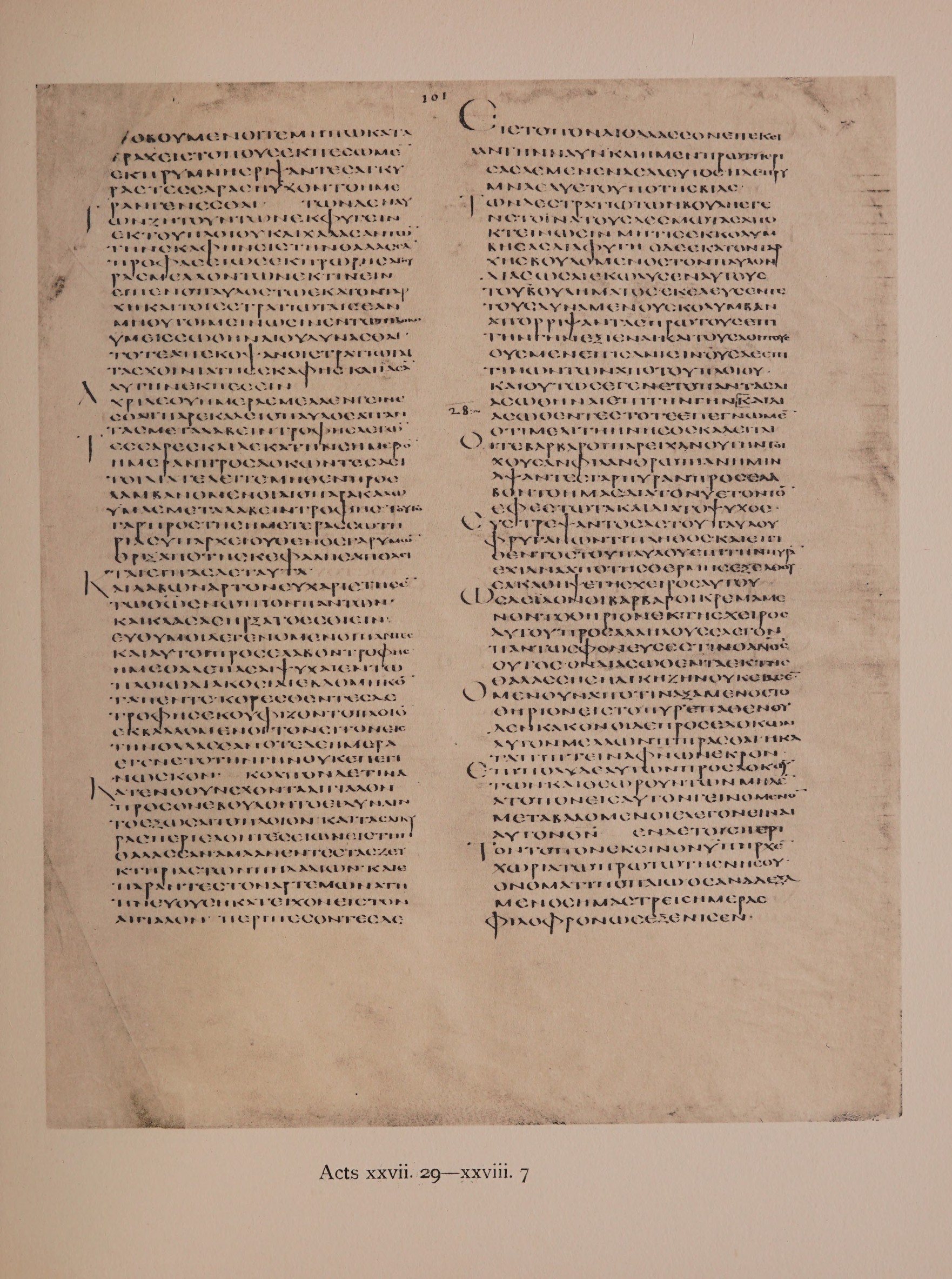
- Manuscript scan: the actual page(s) of Codex Alexandrinus containing this passage (folios 100r, 100v, 101r), reproduced from the British Museum's 1909 photographic facsimile edited by F. G. Kenyon, as digitised by the Getty Research Institute for the Internet Archive. The facsimile prints the verse range beneath each plate; that printed range was read for every page used and agrees with the INTF's NTVMR verse-level page index (CC BY 4.0). The page for each section now comes from the NTVMR transcription itself, which records the page and column on which every verse is written.
- Original text: the manuscript's own text, from a diplomatic transcription (see Greek text below), with Tischendorf's 8th critical edition (1869) for comparison.
- English translation: the King James Version (1611), retrieved verbatim from the public-domain bible-api.com endpoint.
Greek text: a diplomatic transcription of Codex Alexandrinus made by the Institut für Neutestamentliche Textforschung (INTF), Münster, for the New Testament Virtual Manuscript Room (NTVMR), published under a Creative Commons Attribution 4.0 licence. It gives the letters as the first scribe wrote them: no accents or breathings, the scribe's own spelling, and the sacred names in their contracted form (θς for θεος, ις for ιησους, κς for κυριος; the overline is not reproduced). Corrections by later hands are not shown. Letters in square brackets are not legible on the page and were restored by the transcribers, a dot under a letter marks an uncertain reading, and [...] marks text lost to damage. Beneath each section, for comparison, is Tischendorf's 8th critical edition (1869). Where the two differ, the transcription is what the manuscript says. Each section is shown with the page on which the transcription places its verses.
How was this verified? (Provenance)
Where on the image
Page from the NTVMR transcription (docID 20002): verses 1-3 on fol. 100r (facsimile leaf 161), col. 2; verse 3 continues on fol. 100v (facsimile leaf 162), col. 1 (which begins 'θεντι επιμελειας τυχειν').
1ως δε εκριθη του αποπλειν ημας εις την ιταλειαν παρεδιδου τον τε παυλον · και τεινας ετερους δεσμωτας · εκατονταρχη ονοματι ιουλιω σπειρης σεβαστης · 2επιβαντες δε πλοιω αδραμυντηνω μελλοντι πλειν εις τους κατα την ασιαν τοπους ανηχθημεν · οντος συν ημιν αρισταρχου μακεδονος θεσσαλονικεως · 3τη τε ετερα κατηχθημεν εις σιδωνα · φιλανθρωπως τε ο ιουλιανος τω παυλω χρησαμενος · επετρεψεν προς τους φιλους πορευθεντι επιμελειας τυχειν ·
Compare: Tischendorf 8th edition (1869)
1Ὡς δὲ ἐκρίθη τοῦ ἀποπλεῖν ἡμᾶς εἰς τὴν Ἰταλίαν, παρεδίδουν τόν τε Παῦλον καί τινας ἑτέρους δεσμώτας ἑκατοντάρχῃ ὀνόματι Ἰουλίῳ σπείρης Σεβαστῆς. 2ἐπιβάντες δὲ πλοίῳ Ἀδραμυττηνῷ μέλλοντι πλεῖν εἰς τοὺς κατὰ τὴν Ἀσίαν τόπους ἀνήχθημεν, ὄντος σὺν ἡμῖν Ἀριστάρχου Μακεδόνος Θεσσαλονικέως· 3τῇ τε ἑτέρᾳ κατήχθημεν εἰς Σιδῶνα, φιλανθρώπως τε ὁ Ἰούλιος τῷ Παύλῳ χρησάμενος ἐπέτρεψεν πρὸς τοὺς φίλους πορευθέντι ἐπιμελείας τυχεῖν.
1And when it was determined that we should sail into Italy, they delivered Paul and certain other prisoners unto one named Julius, a centurion of Augustus’ band. 2And entering into a ship of Adramyttium, we launched, meaning to sail by the coasts of Asia; one Aristarchus, a Macedonian of Thessalonica, being with us. 3And the next day we touched at Sidon. And Julius courteously entreated Paul, and gave him liberty to go unto his friends to refresh himself.
Where on the image
Page from the NTVMR transcription (docID 20002): verses 4-14 on fol. 100v (facsimile leaf 162), col. 1.
4κακειθεν αναχθεντες υπεπλευσαμεν την κυπρον δια το τους ανεμους ειναι εναντιους · 5το τε πελαγος το κατα την κιλικιαν και παμφυλιαν διαπλευσαντες · κατηλθαμεν εις λυστρα της λικυας · 6κακειθεν ευρων ο εκατονταρχης πλοιον αλεξανδρινον πλεον εις την ιταλιαν · ενεβιβασεν ημας εις αυτο · 7εν ικαναις δε ημεραις βραδυπλοουντες και μολις γενομενοι κατα την κνιδον μη προσεωντος ημας του ανεμου υπεπλευσαμεν την κρητην κατα σαλμωνην · 8μολις τε παραλεγομενοι αυτην ηλθομεν εις τοπον καλουμενον καλους λιμενας · ω εγγυς πολις ην αλασσα · 9ικανου δε χρονου διαγενομενου · και οντος ηδη επισφαλους του πλοος · δια το και την νηστειαν ηδη παρεληλυθεναι παρηνει ο παυλος 10λεγων αυτοις · ανδρες θεωρω οτι μετα υβρεως και πολλης ζημιας · ου μονον του φορτιου και του πλοιου · αλλα και των ψυχων ημων μελλειν εσεσθαι τον πλουν 11ο δε εκατονταρχης τω κυβερνητη και τω ναυκληρω μαλλον επιθετο η τοις υπο παυλου λεγομενοις · 12ανευθετου δε του λιμενος υπαρχοντος προς παραχιμασιαν οι πλειονες εθεντο βουλην αναχθηναι εκειθεν · ει πως δυνανται καταντησαντες εις φοινικα παραχειμασαι · λιμενα της κρητης βλεποντα κατα λιβα και κατα χωρον · 13υποπνευσαντος δε νοτου δοξαντες της προθεσεως κεκρατηκεναι · αραντες ασσον παρελεγοντο την κρητην 14μετ ου πολυ δε εβαλεν κατ αυτης ανεμος τυφωνικος ο καλουμενος ευρακυλων ·
Compare: Tischendorf 8th edition (1869)
4κἀκεῖθεν ἀναχθέντες ὑπεπλεύσαμεν τὴν Κύπρον διὰ τὸ τοὺς ἀνέμους εἶναι ἐναντίους, 5τό τε πέλαγος τὸ κατὰ τὴν Κιλικίαν καὶ Παμφυλίαν διαπλεύσαντες κατήλθαμεν εἰς Μύρρα τῆς Λυκίας. 6Κἀκεῖ εὑρὼν ὁ ἑκατοντάρχης πλοῖον Ἀλεξανδρῖνον πλέον εἰς τὴν Ἰταλίαν ἐνεβίβασεν ἡμᾶς εἰς αὐτό. 7ἐν ἱκαναῖς δὲ ἡμέραις βραδυπλοοῦντες καὶ μόλις γενόμενοι κατὰ τὴν Κνίδον, μὴ προσεῶντος ἡμᾶς τοῦ ἀνέμου, ὑπεπλεύσαμεν τὴν Κρήτην κατὰ Σαλμώνην, 8μόλις τε παραλεγόμενοι αὐτὴν ἤλθομεν εἰς τόπον τινὰ καλούμενον Καλοὺς λιμένας, ᾧ ἐγγὺς πόλις ἦν Λασαία. 9ἱκανοῦ δὲ χρόνου διαγενομένου καὶ ὄντος ἤδη ἐπισφαλοῦς τοῦ πλοὸς διὰ τὸ καὶ τὴν νηστείαν ἤδη παρεληλυθέναι, παρῄνει ὁ Παῦλος 10λέγων αὐτοῖς, ἄνδρες, θεωρῶ ὅτι μετὰ ὕβρεως καὶ πολλῆς ζημίας οὐ μόνον τοῦ φορτίου καὶ τοῦ πλοίου ἀλλὰ καὶ τῶν ψυχῶν ἡμῶν μέλλειν ἔσεσθαι τὸν πλοῦν. 11ὁ δὲ ἑκατοντάρχης τῷ κυβερνήτῃ καὶ τῷ ναυκλήρῳ μᾶλλον ἐπείθετο ἢ τοῖς ὑπὸ Παύλου λεγομένοις. 12ἀνευθέτου δὲ τοῦ λιμένος ὑπάρχοντος πρὸς παραχειμασίαν οἱ πλείονες ἔθεντο βουλὴν ἀναχθῆναι ἐκεῖθεν, εἴπως δύναιντο καταντήσαντες εἰς Φοίνικα παραχειμάσαι, λιμένα τῆς Κρήτης βλέποντα κατὰ λίβα καὶ κατὰ χῶρον. 13ὑποπνεύσαντος δὲ νότου δόξαντες τῆς προθέσεως κεκρατηκέναι, ἄραντες ἆσσον παρελέγοντο τὴν Κρήτην. 14μετ’ οὐ πολὺ δὲ ἔβαλεν κατ’ αὐτῆς ἄνεμος τυφωνικὸς ὁ καλούμενος εὐρακύλων·
4And when we had launched from thence, we sailed under Cyprus, because the winds were contrary. 5And when we had sailed over the sea of Cilicia and Pamphylia, we came to Myra, a city of Lycia. 6And there the centurion found a ship of Alexandria sailing into Italy; and he put us therein. 7And when we had sailed slowly many days, and scarce were come over against Cnidus, the wind not suffering us, we sailed under Crete, over against Salmone; 8And, hardly passing it, came unto a place which is called The fair havens; nigh whereunto was the city of Lasea. 9Now when much time was spent, and when sailing was now dangerous, because the fast was now already past, Paul admonished them, 10And said unto them, Sirs, I perceive that this voyage will be with hurt and much damage, not only of the lading and ship, but also of our lives. 11Nevertheless the centurion believed the master and the owner of the ship, more than those things which were spoken by Paul. 12And because the haven was not commodious to winter in, the more part advised to depart thence also, if by any means they might attain to Phenice, and there to winter; which is an haven of Crete, and lieth toward the south west and north west. 13And when the south wind blew softly, supposing that they had obtained their purpose, loosing thence, they sailed close by Crete. 14But not long after there arose against it a tempestuous wind, called Euroclydon.
Where on the image
Page from the NTVMR transcription (docID 20002): verses 15-21 on fol. 100v (facsimile leaf 162), col. 2.
15συναρπασθεντος δε του [πλοιου] και μη δυναμενου αντο[φθαλ]μειν τω ανεμω · επειδον[τες] εφερομεθα 16νησιον δε τι υ̣[πο]δραμοντες καλουμενον κλα[υδα] ισχυσαμεν μολις περικρατεις γενεσθαι της σκαφης · 17ην αραντες βοηθειαις εχρωντο υποζωννυντες το πλοιον φοβουμενοι τε μη εις την συρτιν εκπεσωσιν · χαλασαντες το σκευος ουτως εφεροντο · 18σφοδρως τε χειμαζομενων ημων τη εξης εκβολην εποιουντο · 19και τη τριτη αυτοχειρες την σκευην του πλοιου ερριψαν · 20μητε δε ηλιου μητε αστρων επιφαινοντων επι πλειονας ημερας · χειμωνος τε ουχ ολιγου επικειμενου · λοιπον περιηρειτο ελπις πασα του σωζεσθαι ημας 21πολλης τε ασιτιας υπαρχουσης · σταθεις ο παυλος εμμεσω αυτων ειπεν · εδει μεν ω ανδρες πειθαρχησαντας μοι μη αναγεσθαι απο της κρητης · κερδησαι τε την υβριν ταυτην και την ζημιαν
Compare: Tischendorf 8th edition (1869)
15συναρπασθέντος δὲ τοῦ πλοίου καὶ μὴ δυναμένου ἀντοφθαλμεῖν τῷ ἀνέμῳ ἐπιδόντες ἐφερόμεθα. 16νησίον δέ τι ὑποδραμόντες καλούμενον Κλαῦδα ἰσχύσαμεν μόλις περικρατεῖς γενέσθαι τῆς σκάφης, 17ἣν ἄραντες βοηθείαις ἐχρῶντο ὑποζωννύντες τὸ πλοῖον· φοβούμενοί τε μὴ εἰς τὴν Σύρτιν ἐκπέσωσιν, χαλάσαντες τὸ σκεῦος, οὕτως ἐφέροντο. 18σφοδρῶς δὲ χειμαζομένων ἡμῶν τῇ ἑξῆς ἐκβολὴν ἐποιοῦντο, 19καὶ τῇ τρίτῃ αὐτόχειρες τὴν σκευὴν τοῦ πλοίου ἔριψαν· 20μήτε δὲ ἡλίου μήτε ἄστρων ἐπιφαινόντων ἐπὶ πλείονας ἡμέρας, χειμῶνός τε οὐκ ὀλίγου ἐπικειμένου, λοιπὸν περιῃρεῖτο ἐλπὶς πᾶσα τοῦ σώζεσθαι ἡμᾶς. 21πολλῆς τε ἀσιτίας ὑπαρχούσης, τότε σταθεὶς ὁ Παῦλος ἐν μέσῳ αὐτῶν εἶπεν· ἔδει μέν, ὦ ἄνδρες, πειθαρχήσαντάς μοι μὴ ἀνάγεσθαι ἀπὸ τῆς Κρήτης κερδῆσαί τε τὴν ὕβριν ταύτην καὶ τὴν ζημίαν.
15And when the ship was caught, and could not bear up into the wind, we let her drive. 16And running under a certain island which is called Clauda, we had much work to come by the boat: 17Which when they had taken up, they used helps, undergirding the ship; and, fearing lest they should fall into the quicksands, strake sail, and so were driven. 18And we being exceedingly tossed with a tempest, the next day they lightened the ship; 19And the third day we cast out with our own hands the tackling of the ship. 20And when neither sun nor stars in many days appeared, and no small tempest lay on us, all hope that we should be saved was then taken away. 21But after long abstinence Paul stood forth in the midst of them, and said, Sirs, ye should have hearkened unto me, and not have loosed from Crete, and to have gained this harm and loss.
Where on the image
Page from the NTVMR transcription (docID 20002): verses 22-28 on fol. 100v (facsimile leaf 162), col. 2.
22και τα νυν παραινω υμας ευθυμειν · αποβολη γαρ ψυχης ουδεμια εσται εξ υμων πλην του πλοιου · 23παρεστη γαρ μοι ταυτη τη νυκτι του θυ ου ειμι εγω ω και λατρευω αγγελος 24λεγων μη φοβου παυλε καισαρι σε δει παραστηναι · και ιδου κεχαρισται σοι ο θς παντας τους πλεοντας μετα σου 25διο ευθυμειτε ανδρες · πιστευω γαρ τω θω οτι ουτως εσται καθ ον τροπον λελαληται μοι · 26εις νησον δε τινα δει ημας εκπεσειν · 27ως δε τεσσαρεσκαιδεκατη νυξ επεγενετο διαφερομενων ημων εν τω αδρια κατα μεσον της νυκτος υπενοουν οι ναυται προσαγειν τινα αυτοις χωραν . 28και βολισαντες ευρον οργυιας εικοσι · βραχυ δε διαστησαντες και βαλιν βολισαντες ευρον οργυιας δεκαπεντε .
Compare: Tischendorf 8th edition (1869)
22καὶ τὰ νῦν παραινῶ ὑμᾶς εὐθυμεῖν; ἀποβολὴ γὰρ ψυχῆς οὐδεμία ἔσται ἐξ ὑμῶν πλὴν τοῦ πλοίου. 23παρέστη γάρ μοι ταύτῃ τῇ νυκτὶ τοῦ θεοῦ οὗ εἰμὶ ἐγώ, ᾧ καὶ λατρεύω, ἄγγελος 24λέγων· μὴ φοβοῦ, Παῦλε· Καίσαρί σε δεῖ παραστῆναι, καὶ ἰδοὺ κεχάρισταί σοι ὁ θεὸς πάντας τοὺς πλέοντας μετὰ σοῦ. 25διὸ εὐθυμεῖτε, ἄνδρες· πιστεύω γὰρ τῷ θεῷ ὅτι οὕτως ἔσται καθ’ ὃν τρόπον λελάληταί μοι. 26εἰς νῆσον δέ τινα δεῖ ἡμᾶς ἐκπεσεῖν. 27Ὡς δὲ τεσσαρεσκαιδεκάτη νὺξ ἐγένετο διαφερομένων ἡμῶν ἐν τῷ Ἀδρίᾳ, κατὰ μέσον τῆς νυκτὸς ὑπενόουν οἱ ναῦται προσάγειν τινὰ αὐτοῖς χώραν. 28καὶ βολίσαντες εὗρον ὀργυιὰς εἴκοσι, βραχὺ δὲ διαστήσαντες καὶ πάλιν βολίσαντες εὗρον ὀργυιὰς δεκαπέντε·
22And now I exhort you to be of good cheer: for there shall be no loss of any man’s life among you, but of the ship. 23For there stood by me this night the angel of God, whose I am, and whom I serve, 24Saying, Fear not, Paul; thou must be brought before Caesar: and, lo, God hath given thee all them that sail with thee. 25Wherefore, sirs, be of good cheer: for I believe God, that it shall be even as it was told me. 26Howbeit we must be cast upon a certain island. 27But when the fourteenth night was come, as we were driven up and down in Adria, about midnight the shipmen deemed that they drew near to some country; 28And sounded, and found it twenty fathoms: and when they had gone a little further, they sounded again, and found it fifteen fathoms.
Where on the image
Page from the NTVMR transcription (docID 20002): verses 29-35 on fol. 101r (facsimile leaf 163), col. 1.
29[φ]οβουμενοι τε μηπω κατα τ̣ραχεις τοπους εκπεσωμεν εκ πρυμνης ριψαντες αγκυρας τεσσαρας ηυχοντο ημεραν γενεσθαι · 30των δε ναυτων ζητουντων εκφυγειν εκ του πλοιου και χαλασαντων την σκαφην εις την θαλασσαν προφασει ως εκ πρωρης αγκυρας μελλοντων εκτινειν 31ειπεν ο παυλος τω εκατονταρχη και τοις στρατιωταις εαν μη ουτοι μεινωσιν εν τω πλοιω υμεις σωθηναι ου δυνασθαι · 32τοτε απεκοψαν οι στρατιωται τα σχοινια της σκαφης · και ιασαν αυτην εκπεσειν 33αχρι δε ου ημερα εμελλεν γεινεσθαι παρεκαλει ο παυλος απαντας μεταλαβειν τροφης λεγων τεσσαρεσκαιδεκατην σημερον ημεραν προσδοκωντες ασιτοι διατελειτε · μηθεν προσλαμβανομενοι 34διο παρακαλω υμας μεταλαβειν τροφης · τουτο γαρ προς της ημετερας σωτηριας υπαρχει · ουθενος γαρ υμων θριξ απο της κεφαλης απολειται 35ειπας δε ταυτα · και λαβων αρτον ευχαριστησεν τω θω ενωπιον παντων · και κλασας ηρξατο εσθιειν ·
Compare: Tischendorf 8th edition (1869)
29φοβούμενοί τε μήπου κατὰ τραχεῖς τόπους ἐκπέσωμεν, ἐκ πρύμνης ῥίψαντες ἀγκύρας τέσσαρας εὔχοντο ἡμέραν γενέσθαι. 30τῶν δὲ ναυτῶν ζητούντων φυγεῖν ἐκ τοῦ πλοίου καὶ χαλασάντων τὴν σκάφην εἰς τὴν θάλασσαν προφάσει ὡς ἐκ πρῴρης ἀγκύρας μελλόντων ἐκτείνειν, 31εἶπεν ὁ Παῦλος τῷ ἑκατοντάρχῃ καὶ τοῖς στρατιώταις· ἐὰν μὴ οὗτοι μείνωσιν ἐν τῷ πλοίῳ, ὑμεῖς σωθῆναι οὐ δύνασθε. 32τότε ἀπέκοψαν οἱ στρατιῶται τὰ σχοινία τῆς σκάφης καὶ εἴασαν αὐτὴν ἐκπεσεῖν. 33Ἄχρι δὲ οὗ ἡμέρα ἔμελλεν γίνεσθαι, παρεκάλει ὁ Παῦλος ἅπαντας μεταλαβεῖν τροφῆς λέγων· τεσσαρεσκαιδεκάτην σήμερον ἡμέραν προσδοκῶντες ἄσιτοι διατελεῖτε, μηθὲν προσλαβόμενοι. 34διὸ παρακαλῶ ὑμᾶς μεταλαβεῖν τροφῆς, τοῦτο γὰρ πρὸς τῆς ὑμετέρας σωτηρίας ὑπάρχει· οὐδενὸς γὰρ ὑμῶν θρὶξ ἀπὸ τῆς κεφαλῆς ἀπολεῖται. 35εἴπας δὲ ταῦτα καὶ λαβὼν ἄρτον εὐχαρίστησεν τῷ θεῷ ἐνώπιον πάντων καὶ κλάσας ἤρξατο ἐσθίειν.
29Then fearing lest we should have fallen upon rocks, they cast four anchors out of the stern, and wished for the day. 30And as the shipmen were about to flee out of the ship, when they had let down the boat into the sea, under colour as though they would have cast anchors out of the foreship, 31Paul said to the centurion and to the soldiers, Except these abide in the ship, ye cannot be saved. 32Then the soldiers cut off the ropes of the boat, and let her fall off. 33And while the day was coming on, Paul besought them all to take meat, saying, This day is the fourteenth day that ye have tarried and continued fasting, having taken nothing. 34Wherefore I pray you to take some meat: for this is for your health: for there shall not an hair fall from the head of any of you. 35And when he had thus spoken, he took bread, and gave thanks to God in presence of them all: and when he had broken it, he began to eat.
Where on the image
Page from the NTVMR transcription (docID 20002): verses 36-41 on fol. 101r (facsimile leaf 163), col. 1.
36ευθυμοι δε γενομενοι παντες και αυτοι προσελαβον τροφης · 37ημεθα δε πασαι ψυχαι εν τω πλοιω διακοσιαι εβδομηκοντα πεντε · 38κορεσθεντες δε τροφης εκουφιζον το πλοιον εκβαλλομενοι τον σιτον εις την θαλασσαν · 39οτε δε ημερα εγενετο την γην ουκ επεγινωσκον · κολπον δε τινα κατενοουν εχοντα αιγιαλον προς ον εβουλοντο ει δυναιντο εξωσαι το πλοιον · 40και τας αγκυρας περιελοντες ειων εις την θαλασσαν · αμα ανεντες τας ζευκτηριας των πηδαλιων · και επαραντες τον αρτεμωνα τη πνευουση κατειχον εις τον αιγιαλον · 41περιπεσοντες δε εις τοπον διθαλασσον επεκειν την ναυν · και η μεν πρωτη ερισασα εμενεν ασαλευτος · η δε πρυμνα ελυετο υπο της βιας ·
Compare: Tischendorf 8th edition (1869)
36εὔθυμοι δὲ γενόμενοι πάντες καὶ αὐτοὶ προσελάβοντο τροφῆς. 37ἤμεθα δὲ αἱ πᾶσαι ψυχαὶ ἐν τῷ πλοίῳ διακόσιαι ἑβδομήκοντα ἕξ. 38κορεσθέντες δὲ τροφῆς ἐκούφιζον τὸ πλοῖον ἐκβαλλόμενοι τὸν σῖτον εἰς τὴν θάλασσαν. 39Ὅτε δὲ ἡμέρα ἐγένετο, τὴν γῆν οὐκ ἐπεγίνωσκον, κόλπον δέ τινα κατενόουν ἔχοντα αἰγιαλὸν εἰς ὃν ἐβουλεύοντο εἰ δύναιντο ἐξῶσαι τὸ πλοῖον. 40καὶ τὰς ἀγκύρας περιελόντες εἴων εἰς τὴν θάλασσαν, ἅμα ἀνέντες τὰς ζευκτηρίας τῶν πηδαλίων, καὶ ἐπάραντες τὸν ἀρτέμωνα τῇ πνεούσῃ κατεῖχον εἰς τὸν αἰγιαλόν. 41περιπεσόντες δὲ εἰς τόπον διθάλασσον ἐπέκειλαν τὴν ναῦν, καὶ ἡ μὲν πρῷρα ἐρείσασα ἔμεινεν ἀσάλευτος, ἡ δὲ πρύμνα ἐλύετο ὑπὸ τῆς βίας.
36Then were they all of good cheer, and they also took some meat. 37And we were in all in the ship two hundred threescore and sixteen souls. 38And when they had eaten enough, they lightened the ship, and cast out the wheat into the sea. 39And when it was day, they knew not the land: but they discovered a certain creek with a shore, into the which they were minded, if it were possible, to thrust in the ship. 40And when they had taken up the anchors, they committed themselves unto the sea, and loosed the rudder bands, and hoised up the mainsail to the wind, and made toward shore. 41And falling into a place where two seas met, they ran the ship aground; and the forepart stuck fast, and remained unmoveable, but the hinder part was broken with the violence of the waves.
Where on the image
Page from the NTVMR transcription (docID 20002): verses 42-44 on fol. 101r (facsimile leaf 163), col. 2.
42των δε στρατιωτων βουλη εγενετο ινα τους δεσμωτας αποκτεινωσιν · μη τις εκκολυμβησας διαφυγη 43ο δε εκατονταρχης βουλομενος τον παυλον διασωσαι εκωλυσεν αυτους του βουληματος · εκελευσεν τε τους δυναμενους κολυμβαν απορριψαντας πρωτους επι την γην εξιεναι · 44και τους λοιπους ους μεν επι σανισιν · ους δε επι τινων των απο του πλοιου και ουτως εγενετο παντας διασωθηναι επι την γην
Compare: Tischendorf 8th edition (1869)
42τῶν δὲ στρατιωτῶν βουλὴ ἐγένετο ἵνα τοὺς δεσμώτας ἀποκτείνωσιν, μή τις ἐκκολυμβήσας διαφύγῃ· 43ὁ δὲ ἑκατοντάρχης βουλόμενος διασῶσαι τὸν Παῦλον ἐκώλυσεν αὐτοὺς τοῦ βουλήματος, ἐκέλευσέν τε τοὺς δυναμένους κολυμβᾶν ἀπορίψαντας πρώτους ἐπὶ τὴν γῆν ἐξιέναι, 44καὶ τοὺς λοιποὺς οὓς μὲν ἐπὶ σανίσιν οὓς δὲ ἐπί τινων τῶν ἀπὸ τοῦ πλοίου· καὶ οὕτως ἐγένετο πάντας διασωθῆναι ἐπὶ τὴν γῆν.
42And the soldiers’ counsel was to kill the prisoners, lest any of them should swim out, and escape. 43But the centurion, willing to save Paul, kept them from their purpose; and commanded that they which could swim should cast themselves first into the sea, and get to land: 44And the rest, some on boards, and some on broken pieces of the ship. And so it came to pass, that they escaped all safe to land.
Cite
Sources
- Source: Codex Alexandrinus page images + NTVMR transcription (CC BY 4.0) + Tischendorf 8th edition + KJV (holding institution)
- Critical edition: Codex Alexandrinus transcription, NTVMR (INTF Münster, CC BY 4.0); Tischendorf 8th edition for comparison
← previous · → next · v cycle view · l back to library