Romans, Chapter 1 (Codex Alexandrinus)
Introduction
Romans 1 from Codex Alexandrinus (GA 02), a fifth-century Greek Bible held by the British Library (Royal MS 1 D. VIII). In the New Testament it is the chief witness to the Byzantine text in the Gospels and to the Alexandrian text in the rest of the New Testament. Its New Testament volume lacks Matthew 1:1-25:5, John 6:50-8:52 and 2 Corinthians 4:13-12:6.
This entry meets the strict three-criteria standard of the Theosis Library:
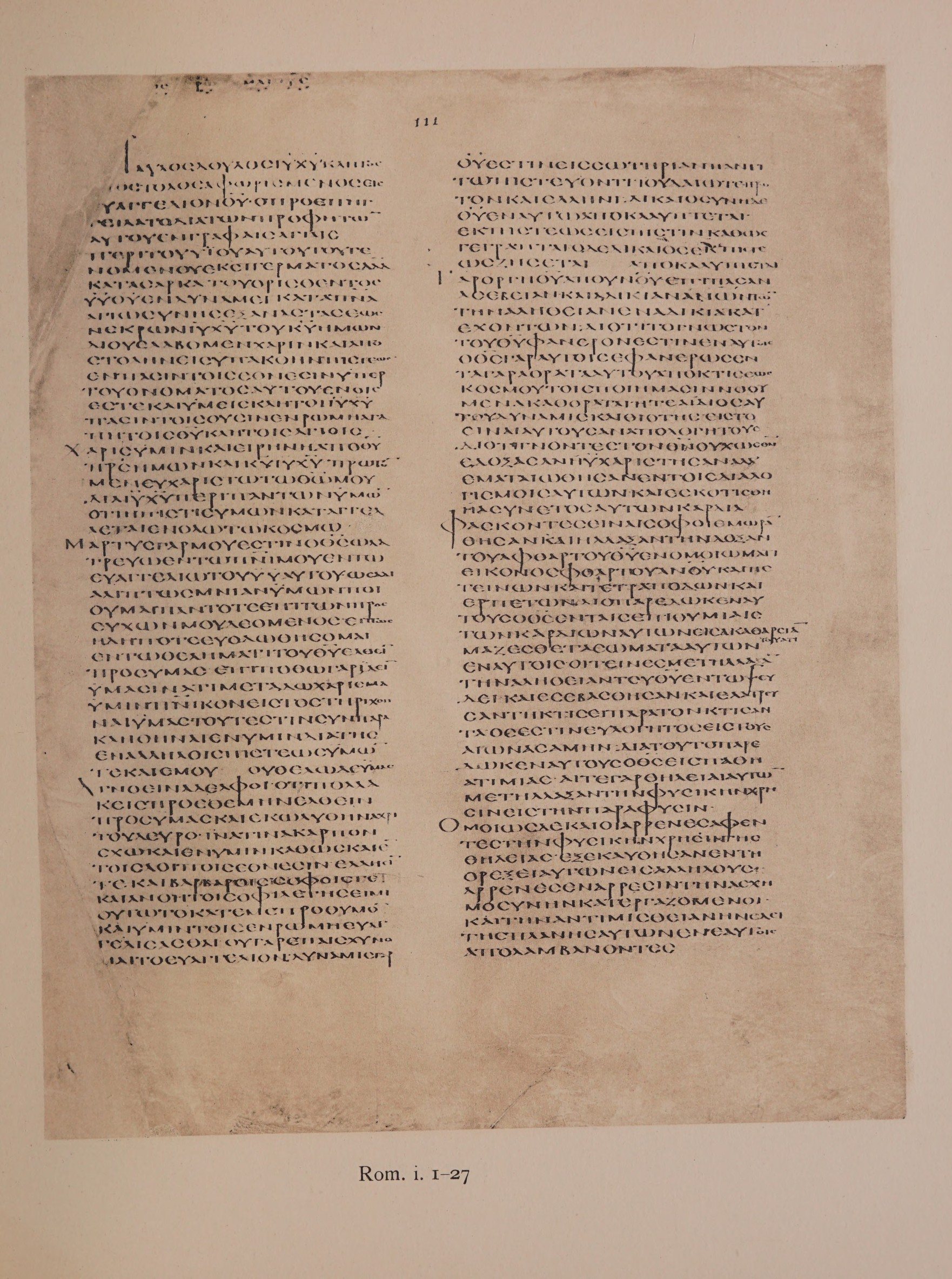
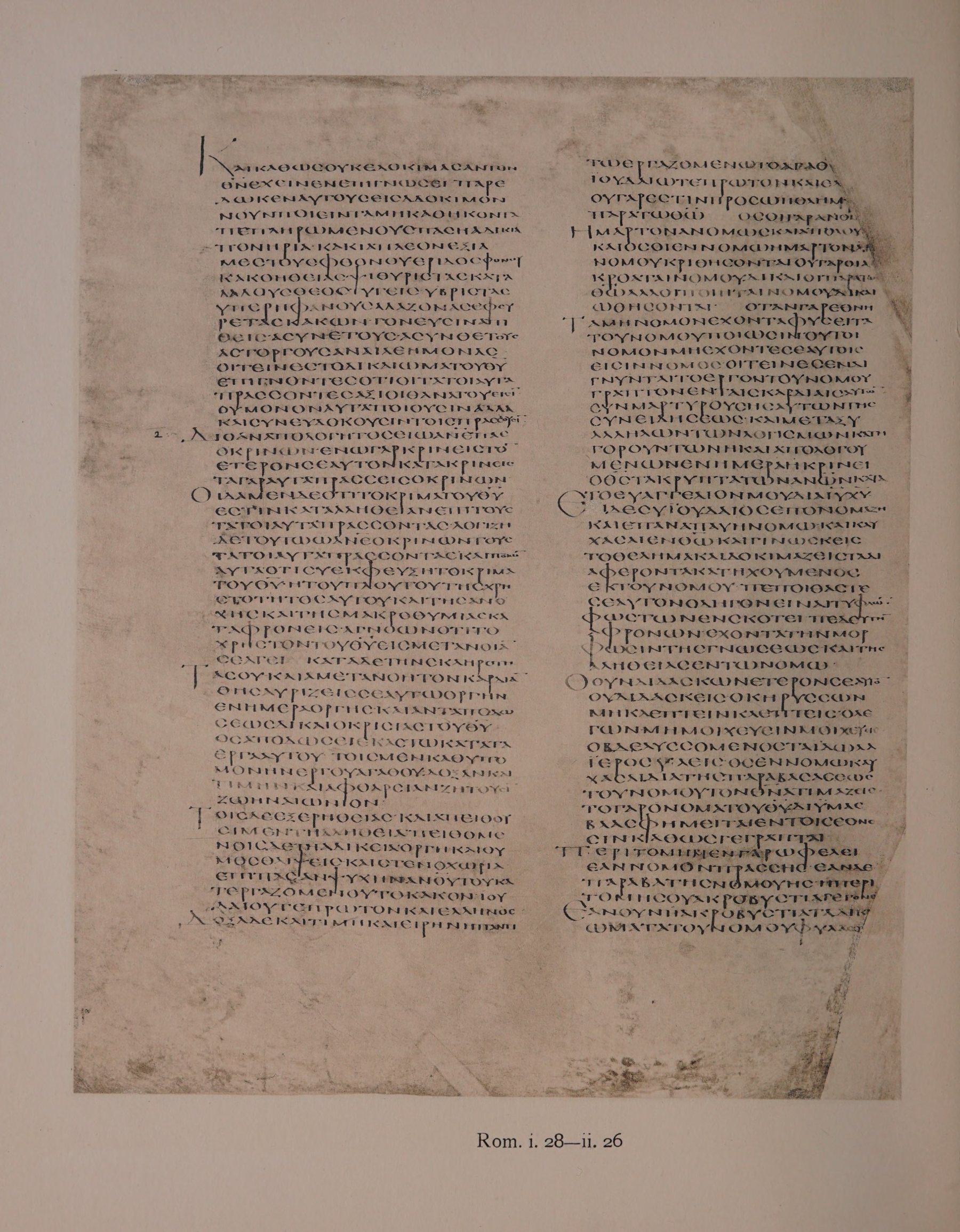
- Manuscript scan: the actual page(s) of Codex Alexandrinus containing this passage (folios 111r, 111v), reproduced from the British Museum's 1909 photographic facsimile edited by F. G. Kenyon, as digitised by the Getty Research Institute for the Internet Archive. The facsimile prints the verse range beneath each plate; that printed range was read for every page used and agrees with the INTF's NTVMR verse-level page index (CC BY 4.0). The page for each section now comes from the NTVMR transcription itself, which records the page and column on which every verse is written.
- Original text: the manuscript's own text, from a diplomatic transcription (see Greek text below), with Tischendorf's 8th critical edition (1869) for comparison.
- English translation: the King James Version (1611), retrieved verbatim from the public-domain bible-api.com endpoint.
Greek text: a diplomatic transcription of Codex Alexandrinus made by the Institut für Neutestamentliche Textforschung (INTF), Münster, for the New Testament Virtual Manuscript Room (NTVMR), published under a Creative Commons Attribution 4.0 licence. It gives the letters as the first scribe wrote them: no accents or breathings, the scribe's own spelling, and the sacred names in their contracted form (θς for θεος, ις for ιησους, κς for κυριος; the overline is not reproduced). Corrections by later hands are not shown. Letters in square brackets are not legible on the page and were restored by the transcribers, a dot under a letter marks an uncertain reading, and [...] marks text lost to damage. Beneath each section, for comparison, is Tischendorf's 8th critical edition (1869). Where the two differ, the transcription is what the manuscript says. Each section is shown with the page on which the transcription places its verses.
How was this verified? (Provenance)
Where on the image
Page from the NTVMR transcription (docID 20002): verses 1-8 on fol. 111r (facsimile leaf 183), col. 1.
1π̣αυλος δουλος ιυ χυ κλητος [απ]οστολος αφωρισμενος εις [ε]υαγγελιον θυ · 2ο προεπηγγ̣ειλατο δια των προφητων αυτου εν γραφαις αγιαις 3περι του υιου αυτου του γενομενου εκ σπερματος δαδ κατα σαρκα 4του ορισθεντος υυ θυ εν δυναμει κατα πνα αγιωσυνης εξ αναστασεως νεκρων ιυ χυ του κυ ημων 5δι ου ελαβομεν χαριν και αποστολην εις υπακοην πιστεως εν πασιν τοις εθνεσιν υπερ του ονοματος αυτου 6εν οις εστε και υμεις κλητοι ιυ χυ 7πασιν τοις ουσιν εν ρωμη αγαπητοις θυ κλητοις αγιοις χαρις υμιν και ειρηνη απο θυ πρς ημων και κυ ιυ χυ 8πρωτον μεν ευχαριστω τω θω μου δια ιυ χυ περι παντων υμων οτι η πιστις υμων καταγγελλεται εν ολω τω κοσμω
Compare: Tischendorf 8th edition (1869)
1Παῦλος δοῦλος Χριστοῦ Ἰησοῦ, κλητὸς ἀπόστολος ἀφωρισμένος εἰς εὐαγγέλιον θεοῦ, 2ὃ προεπηγγείλατο διὰ τῶν προφητῶν αὐτοῦ ἐν γραφαῖς ἁγίαις, 3περὶ τοῦ υἱοῦ αὐτοῦ τοῦ γενομένου ἐκ σπέρματος Δαυεὶδ κατὰ σάρκα, 4τοῦ ὁρισθέντος υἱοῦ θεοῦ ἐν δυνάμει κατὰ πνεῦμα ἁγιωσύνης ἐξ ἀναστάσεως νεκρῶν, Ἰησοῦ Χριστοῦ τοῦ κυρίου ἡμῶν, 5δι’ οὗ ἐλάβομεν χάριν καὶ ἀποστολὴν εἰς ὑπακοὴν πίστεως ἐν πᾶσιν τοῖς ἔθνεσιν ὑπὲρ τοῦ ὀνόματος αὐτοῦ, 6ἐν οἷς ἐστε καὶ ὑμεῖς κλητοὶ Ἰησοῦ Χριστοῦ, 7πᾶσιν τοῖς οὖσιν ἐν Ῥώμῃ ἀγαπητοῖς θεοῦ, κλητοῖς ἁγίοις· χάρις ὑμῖν καὶ εἰρήνη ἀπὸ θεοῦ πατρὸς ἡμῶν καὶ κυρίου Ἰησοῦ Χριστοῦ. 8Πρῶτον μὲν εὐχαριστῶ τῷ θεῶ μου διὰ Ἰησοῦ Χριστοῦ περὶ πάντων ὑμῶν, ὅτι ἡ πίστις ὑμῶν καταγγέλλεται ἐν ὅλῳ τῷ κόσμῳ.
1Paul, a servant of Jesus Christ, called to be an apostle, separated unto the gospel of God, 2(Which he had promised afore by his prophets in the holy scriptures,) 3Concerning his Son Jesus Christ our Lord, which was made of the seed of David according to the flesh; 4And declared to be the Son of God with power, according to the spirit of holiness, by the resurrection from the dead: 5By whom we have received grace and apostleship, for obedience to the faith among all nations, for his name: 6Among whom are ye also the called of Jesus Christ: 7To all that be in Rome, beloved of God, called to be saints: Grace to you and peace from God our Father, and the Lord Jesus Christ. 8First, I thank my God through Jesus Christ for you all, that your faith is spoken of throughout the whole world.
Where on the image
Page from the NTVMR transcription (docID 20002): verses 9-16 on fol. 111r (facsimile leaf 183), col. 1.
9μαρτυς γαρ μου εστιν ο θς ω λατρευω εν τω πνι μου εν τω ευαγγελιω του υυ αυτου ως αδιαλιπτως μνιαν υμων ποιουμαι 10παντοτε επι των προσευχων μου δεομενος · ει πως ηδη ποτε ευοδωθησομαι εν τω θεληματι του θυ ελθειν προς υμας · 11επιποθω γαρ ιδειν υμας ινα τι μεταδω χαρισμα υμιν πνικον εις το στηριχθηναι υμας 12τουτ εστιν συνπαρακληθηναι εν υμιν δια της εν αλληλοις πιστεως υμων τε και εμου · 13ου θελω δε υμας αγνοειν αδελφοι · οτι πολλακεις προεθεμην ελθειν προς υμας και εκωλυθην αχρι του δευρο · ινα τινα καρπον σχω και εν υμιν καθως και εν τοις λοιποις εθνεσιν · 14ελλησιν τε και βαρβαροις · σοφοις τε και ανοητοις οφιλετης ειμι 15ουτω το κατ εμε προθυμον και υμιν τοις εν ρωμη ευαγγελισασθαι · 16ου γαρ επαισχυνομ̣αι το ευαγγελιον · δυναμις γαρ θυ εστιν εις σωτηριαν παντι τω πιστευοντι · ιουδαιω τε πρωτον και ελληνι ·
Compare: Tischendorf 8th edition (1869)
9μάρτυς γάρ μού ἐστιν ὁ θεός, ᾧ λατρεύω ἐν τῷ πνεύματί μου ἐν τῷ εὐαγγελίῳ τοῦ υἱοῦ αὐτοῦ, ὡς ἀδιαλείπτως μνείαν ὑμῶν ποιοῦμαι 10πάντοτε ἐπὶ τῶν προσευχῶν μου, δεόμενος εἴπως ἤδη ποτὲ εὐοδωθήσομαι ἐν τῷ θελήματι τοῦ θεοῦ ἐλθεῖν πρὸς ὑμᾶς. 11ἐπιποθῶ γὰρ ἰδεῖν ὑμᾶς, ἵνα τι μεταδῶ χάρισμα ὑμῖν πνευματικὸν εἰς τὸ στηριχθῆναι ὑμᾶς, 12τοῦτο δέ ἐστιν συνπαρακληθῆναι ἐν ὑμῖν διὰ τῆς ἐν ἀλλήλοις πίστεως ὑμῶν τε καὶ ἐμοῦ. 13οὐ θέλω δὲ ὑμᾶς ἀγνοεῖν, ἀδελφοί, ὅτι πολλάκις προεθέμην ἐλθεῖν πρὸς ὑμᾶς, καὶ ἐκωλύθην ἄχρι τοῦ δεῦρο, ἵνα τινὰ καρπὸν σχῶ καὶ ἐν ὑμῖν καθὼς καὶ ἐν τοῖς λοιποῖς ἔθνεσιν. 14Ἕλλησίν τε καὶ βαρβάροις, σοφοῖς τε καὶ ἀνοήτοις ὀφειλέτης εἰμί· 15οὕτως τὸ κατ’ ἐμὲ πρόθυμον καὶ ὑμῖν τοῖς ἐν Ῥώμῃ εὐαγγελίσασθαι. 16οὐ γὰρ ἐπαισχύνομαι τὸ εὐαγγέλιον, δύναμις γὰρ θεοῦ ἐστιν εἰς σωτηρίαν παντὶ τῷ πιστεύοντι, Ἰουδαίῳ τε πρῶτον καὶ Ἕλληνι.
9For God is my witness, whom I serve with my spirit in the gospel of his Son, that without ceasing I make mention of you always in my prayers; 10Making request, if by any means now at length I might have a prosperous journey by the will of God to come unto you. 11For I long to see you, that I may impart unto you some spiritual gift, to the end ye may be established; 12That is, that I may be comforted together with you by the mutual faith both of you and me. 13Now I would not have you ignorant, brethren, that oftentimes I purposed to come unto you, (but was let hitherto,) that I might have some fruit among you also, even as among other Gentiles. 14I am debtor both to the Greeks, and to the Barbarians; both to the wise, and to the unwise. 15So, as much as in me is, I am ready to preach the gospel to you that are at Rome also. 16For I am not ashamed of the gospel of Christ: for it is the power of God unto salvation to every one that believeth; to the Jew first, and also to the Greek.
Where on the image
Page from the NTVMR transcription (docID 20002): verses 17-27 on fol. 111r (facsimile leaf 183), col. 2.
17δικαιοσυνη δε θυ εν αυτω αποκαλυπτεται · εκ πιστεως εις πιστιν καθως γεγραπται · ο δε δικαιος εκ πιστεως ζησεται 18αποκαλυπτεται γαρ οργη θυ απ ουνου επι πασαν ασεβειαν · και αδικιαν ανων των την αληθειαν εν αδικια κατεχοντων · 19διοτι το γνωστον του θυ φανερον εστιν εν αυτοις ο θς γαρ αυτοις εφανερωσεν 20τα γαρ αορατα αυτου απο κτισεως κοσμου τοις ποιημασιν νοουμενα καθοραται · η τε αιδιος αυτου δυναμις και θιοτης · εις το ειναι αυτους αναπολογητους 21διοτι γνοντες τον θν ουχ ως θν εδοξασαν η υχαριστησαν αλλ εματαιωθησαν εν τοις διαλογισμοις αυτων · και εσκοτισθη η ασυνετος αυτων καρδια · 22φασκοντες ειναι σοφοι εμωρανθησαν 23και ηλλαξαν την δοξαν του αφθαρτου θυ εν ομοιωματι εικονος φθαρτου ανου και πετεινων και τετραποδων και ερπετων 24διο παρεδωκεν αυτους ο θς εν ταις επιθυμιαις των καρδιων αυτων [...] του ατιμαζεσθε τα σωματα αυτων εν αυτοις · 25οιτεινες μετηλλαξαν την αληθειαν του θυ εν τω ψευδει · και εσεβασθησαν · και ελατρευσαν τη κτισει παρα τον κτισαντα · ος εστιν ευλογητος εις τους αιωνας αμην · 26δια τουτο παρεδωκεν αυτους ο θς εις παθη ατιμιας · αι τε γαρ θηλειαι αυτων μετηλλαξαν την φυσικην χρησιν εις την παρα φυσιν · 27ομοιως δε και οι αρρενες αφεντες την φυσικην χρησιν της θηλειας · εξεκαυθησαν εν τη ορεξει αυτων εις αλληλους · αρρενες εν αρρεσιν την ασχημοσυνην κατεργαζομενοι · και την αντιμισθειαν ην εδει της πλανης αυτων εν εαυτοις απολαμβανοντες
Compare: Tischendorf 8th edition (1869)
17δικαιοσύνη γὰρ θεοῦ ἐν αὐτῷ ἀποκαλύπτεται ἐκ πίστεως εἰς πίστιν, καθὼς γέγραπται, ὁ δὲ δίκαιος ἐκ πίστεως ζήσεται. 18Ἀποκαλύπτεται γὰρ ὀργὴ θεοῦ ἀπ’ οὐρανοῦ ἐπὶ πᾶσαν ἀσέβειαν καὶ ἀδικίαν ἀνθρώπων τῶν τὴν ἀλήθειαν ἐν ἀδικίᾳ κατεχόντων, 19διότι τὸ γνωστὸν τοῦ θεοῦ φανερόν ἐστιν ἐν αὐτοῖς· ὁ θεὸς γὰρ αὐτοῖς ἐφανέρωσεν. 20τὰ γὰρ ἀόρατα αὐτοῦ ἀπὸ κτίσεως κόσμου τοῖς ποιήμασιν νοούμενα καθορᾶται, ἥ τε ἀΐδιος αὐτοῦ δύναμις καὶ θειότης, εἰς τὸ εἶναι αὐτοὺς ἀναπολογήτους· 21διότι γνόντες τὸν θεὸν οὐχ ὡς θεὸν ἐδόξασαν ἢ ηὐχαρίστησαν, ἀλλ’ ἐματαιώθησαν ἐν τοῖς διαλογισμοῖς αὐτῶν καὶ ἐσκοτίσθη ἡ ἀσύνετος αὐτῶν καρδία. 22φάσκοντες εἶναι σοφοὶ ἐμωράνθησαν, 23καὶ ἤλλαξαν τὴν δόξαν τοῦ ἀφθάρτου θεοῦ ἐν ὁμοιώματι εἰκόνος φθαρτοῦ ἀνθρώπου καὶ πετεινῶν καὶ τετραπόδων καὶ ἑρπετῶν. 24διὸ παρέδωκεν αὐτοὺς ὁ θεὸς ἐν ταῖς ἐπιθυμίαις τῶν καρδιῶν αὐτῶν εἰς ἀκαθαρσίαν τοῦ ἀτιμάζεσθαι τὰ σώματα αὐτῶν ἐν αὐτοῖς, 25οἵτινες μετήλλαξαν τὴν ἀλήθειαν τοῦ θεοῦ ἐν τῷ ψεύδει, καὶ ἐσεβάσθησαν καὶ ἐλάτρευσαν τῇ κτίσει παρὰ τὸν κτίσαντα, ὅς ἐστιν εὐλογητὸς εἰς τοὺς αἰῶνας· ἀμήν. 26διὰ τοῦτο παρέδωκεν αὐτοὺς ὁ θεὸς εἰς πάθη ἀτιμίας· αἵ τε γὰρ θήλειαι αὐτῶν μετήλλαξαν τὴν φυσικὴν χρῆσιν εἰς τὴν παρὰ φύσιν, 27ὁμοίως τε καὶ οἱ ἄρρενες ἀφέντες τὴν φυσικὴν χρῆσιν τῆς θηλείας ἐξεκαύθησαν ἐν τῇ ὀρέξει αὐτῶν εἰς ἀλλήλους, ἄρρενες ἐν ἄρρεσιν τὴν ἀσχημοσύνην κατεργαζόμενοι καὶ τὴν ἀντιμισθίαν ἣν ἔδει τῆς πλάνης αὐτῶν ἐν ἑαυτοῖς ἀπολαμβάνοντες.
17For therein is the righteousness of God revealed from faith to faith: as it is written, The just shall live by faith. 18For the wrath of God is revealed from heaven against all ungodliness and unrighteousness of men, who hold the truth in unrighteousness; 19Because that which may be known of God is manifest in them; for God hath shewed it unto them. 20For the invisible things of him from the creation of the world are clearly seen, being understood by the things that are made, even his eternal power and Godhead; so that they are without excuse: 21Because that, when they knew God, they glorified him not as God, neither were thankful; but became vain in their imaginations, and their foolish heart was darkened. 22Professing themselves to be wise, they became fools, 23And changed the glory of the uncorruptible God into an image made like to corruptible man, and to birds, and fourfooted beasts, and creeping things. 24Wherefore God also gave them up to uncleanness through the lusts of their own hearts, to dishonour their own bodies between themselves: 25Who changed the truth of God into a lie, and worshipped and served the creature more than the Creator, who is blessed for ever. Amen. 26For this cause God gave them up unto vile affections: for even their women did change the natural use into that which is against nature: 27And likewise also the men, leaving the natural use of the woman, burned in their lust one toward another; men with men working that which is unseemly, and receiving in themselves that recompence of their error which was meet.
Where on the image
Page from the NTVMR transcription (docID 20002): verses 28-32 on fol. 111v (facsimile leaf 184), col. 1.
28και καθως ουκ εδοκιμασαν τον θν εχειν εν επιγνωσει παρεδωκεν αυτους εις αδοκιμον νουν ποιειν τα μη καθηκοντα 29πεπληρωμενους παση αδικια πονηρια · κακια πλεονεξια μεστους φθονου εριδος φονου κακοηθειας ψιθυριστας 30καταλαλους θεοστυγεις υβριστας υπερηφανους αλαζονας εφευρετας κακων · γονευσιν απιθεις · 31ασυνετους · ασυνθετους αστοργους αναιλεημονας 32οιτεινες το δικαιωμα του θυ επιγνοντες οτι οι τα τοιαυτα πρασσοντες αξιοι θανατου εισιν ου μονον αυτα ποιουσιν αλλα και συνευδοκουσιν τοις πρασσουσιν
Compare: Tischendorf 8th edition (1869)
28καὶ καθὼς οὐκ ἐδοκίμασαν τὸν θεὸν ἔχειν ἐν ἐπιγνώσει, παρέδωκεν αὐτοὺς ὁ θεὸς εἰς ἀδόκιμον νοῦν, ποιεῖν τὰ μὴ καθήκοντα, 29πεπληρωμένους πάσῃ ἀδικίᾳ πονηρίᾳ κακίᾳ πλεονεξίᾳ, μεστοὺς φθόνου φόνου ἔριδος δόλου κακοηθείας, 30ψιθυριστάς, καταλάλους, θεοστυγεῖς, ὑβριστάς, ὑπερηφάνους, ἀλαζόνας, ἐφευρετὰς κακῶν, γονεῦσιν ἀπειθεῖς, 31ἀσυνέτους, ἀσυνθέτους, ἀστόργους, ἀνελεήμονας· 32οἵτινες τὸ δικαίωμα τοῦ θεοῦ ἐπιγνόντες, ὅτι οἱ τὰ τοιαῦτα πράσσοντες ἄξιοι θανάτου εἰσίν, οὐ μόνον αὐτὰ ποιοῦσιν ἀλλὰ καὶ συνευδοκοῦσιν τοῖς πράσσουσιν.
28And even as they did not like to retain God in their knowledge, God gave them over to a reprobate mind, to do those things which are not convenient; 29Being filled with all unrighteousness, fornication, wickedness, covetousness, maliciousness; full of envy, murder, debate, deceit, malignity; whisperers, 30Backbiters, haters of God, despiteful, proud, boasters, inventors of evil things, disobedient to parents, 31Without understanding, covenantbreakers, without natural affection, implacable, unmerciful: 32Who knowing the judgment of God, that they which commit such things are worthy of death, not only do the same, but have pleasure in them that do them.
Cite
Sources
- Source: Codex Alexandrinus page images + NTVMR transcription (CC BY 4.0) + Tischendorf 8th edition + KJV (holding institution)
- Critical edition: Codex Alexandrinus transcription, NTVMR (INTF Münster, CC BY 4.0); Tischendorf 8th edition for comparison
← previous · → next · v cycle view · l back to library