Hebrews, Chapter 1 (Codex Alexandrinus)
Introduction
Hebrews 1 from Codex Alexandrinus (GA 02), a fifth-century Greek Bible held by the British Library (Royal MS 1 D. VIII). In the New Testament it is the chief witness to the Byzantine text in the Gospels and to the Alexandrian text in the rest of the New Testament. Its New Testament volume lacks Matthew 1:1-25:5, John 6:50-8:52 and 2 Corinthians 4:13-12:6.
This entry meets the strict three-criteria standard of the Theosis Library:
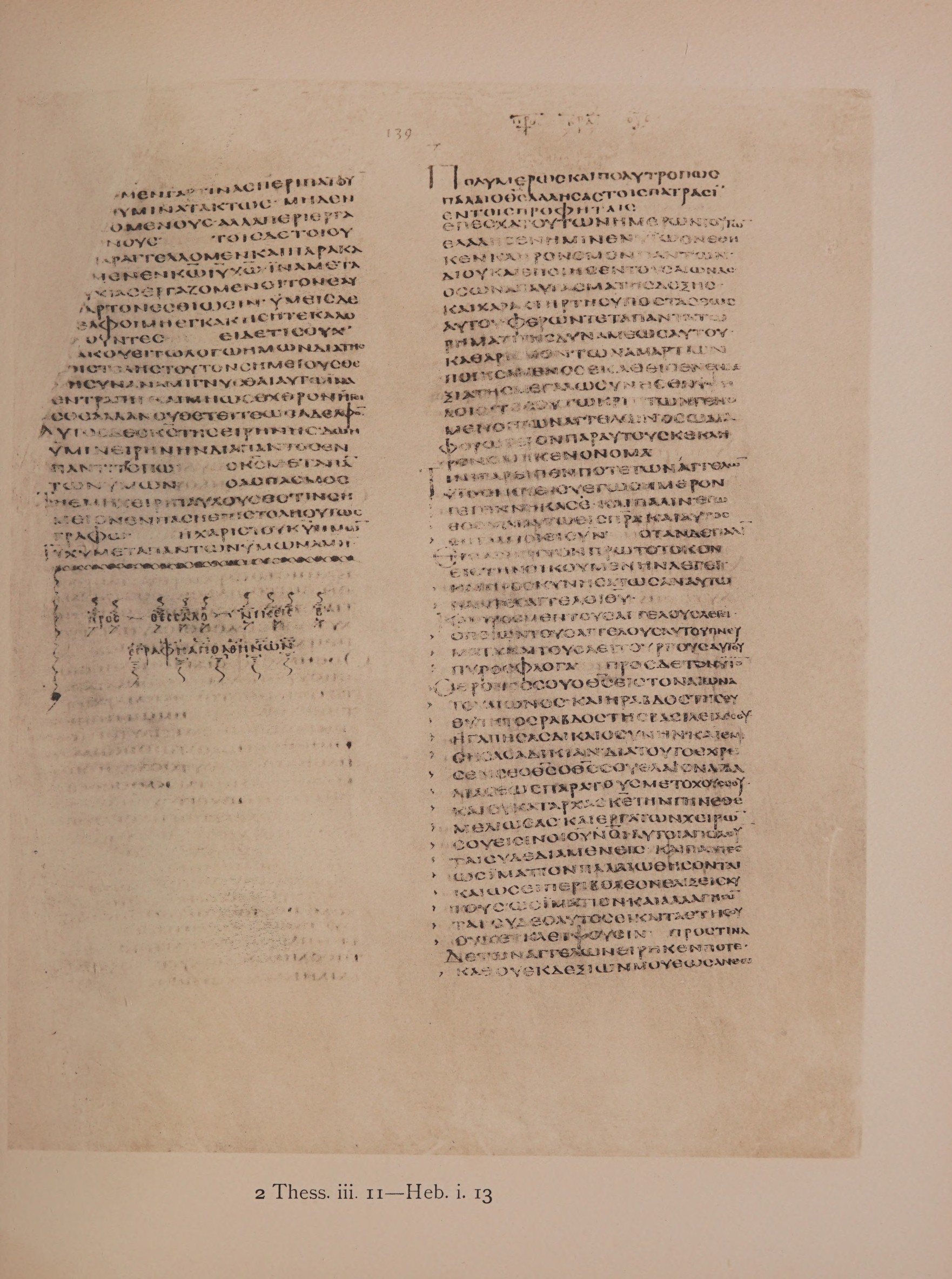
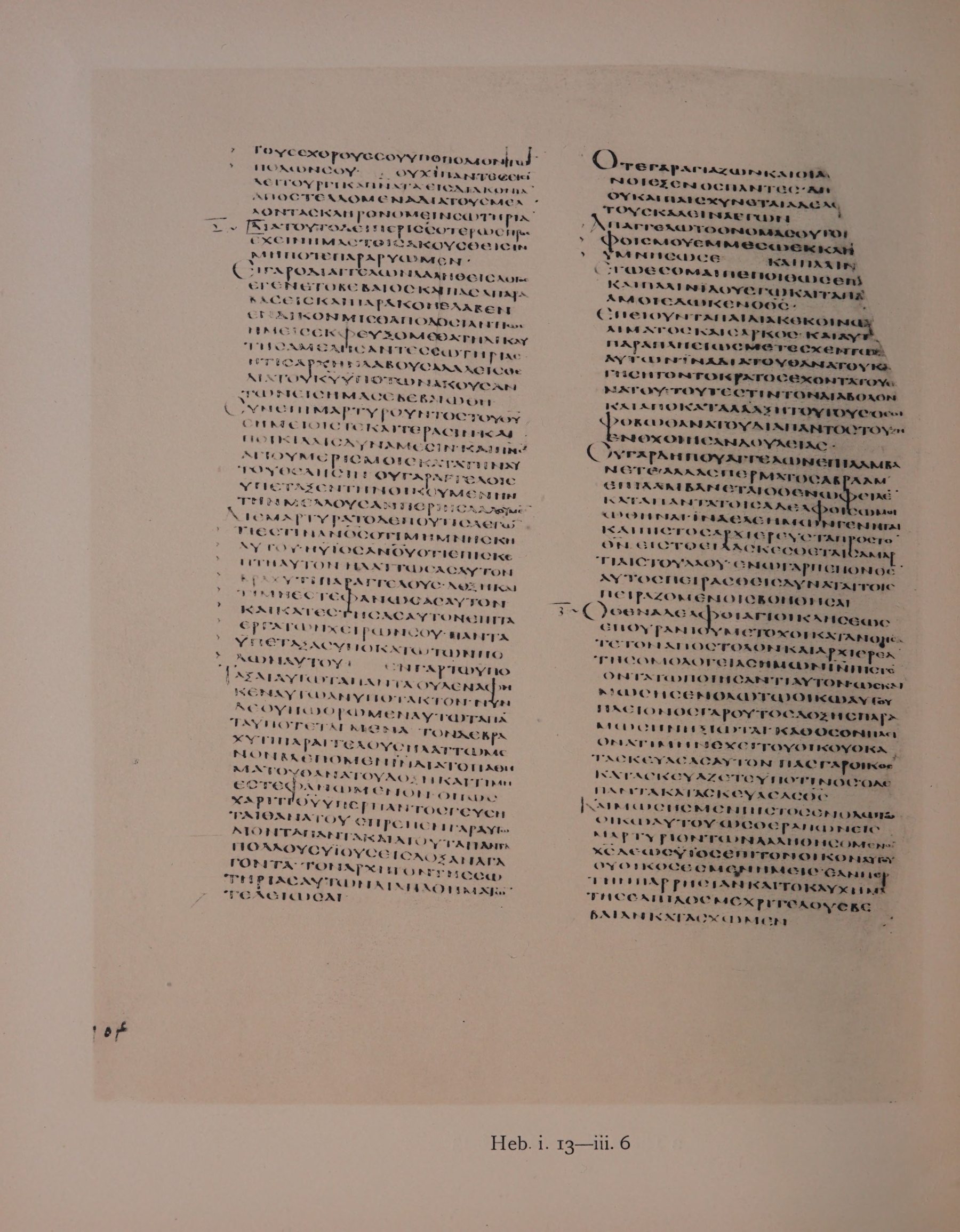
- Manuscript scan: the actual page(s) of Codex Alexandrinus containing this passage (folios 139r, 139v), reproduced from the British Museum's 1909 photographic facsimile edited by F. G. Kenyon, as digitised by the Getty Research Institute for the Internet Archive. The facsimile prints the verse range beneath each plate; that printed range was read for every page used and agrees with the INTF's NTVMR verse-level page index (CC BY 4.0). The page for each section now comes from the NTVMR transcription itself, which records the page and column on which every verse is written.
- Original text: the manuscript's own text, from a diplomatic transcription (see Greek text below), with Tischendorf's 8th critical edition (1869) for comparison.
- English translation: the King James Version (1611), retrieved verbatim from the public-domain bible-api.com endpoint.
Greek text: a diplomatic transcription of Codex Alexandrinus made by the Institut für Neutestamentliche Textforschung (INTF), Münster, for the New Testament Virtual Manuscript Room (NTVMR), published under a Creative Commons Attribution 4.0 licence. It gives the letters as the first scribe wrote them: no accents or breathings, the scribe's own spelling, and the sacred names in their contracted form (θς for θεος, ις for ιησους, κς for κυριος; the overline is not reproduced). Corrections by later hands are not shown. Letters in square brackets are not legible on the page and were restored by the transcribers, a dot under a letter marks an uncertain reading, and [...] marks text lost to damage. Beneath each section, for comparison, is Tischendorf's 8th critical edition (1869). Where the two differ, the transcription is what the manuscript says. Each section is shown with the page on which the transcription places its verses.
How was this verified? (Provenance)
Where on the image
Page from the NTVMR transcription (docID 20002): verses 1-7 on fol. 139r (facsimile leaf 239), col. 2.
1πολυμερως και πολυτροπως παλαι ο θς λαλησας τοις πατρασιν εν τοις προφηταις 2επ εσχατου των ημερων τουτων ελαλησεν ημιν εν υιω ον εθηκεν κληρονομον παντων · δι ου και εποιησεν τους αιωνας · 3ος ων απαυγασμα της δοξης · και χαρακτηρ της υποστασεως αυτου · φερων τε τα παντα τω ρηματι της δυναμεως αυτου · καθαρισμ̣ον των αμαρτιων ποιησαμενος εκαθεισεν εν δεξια της μεγαλωσυνης εν υψηλοις · 4τοσουτω κριττων γενομενος των αγγελων οσω διαφορωτερον παρ αυτους κεκληρονομηκεν ονομα · 5τινι γαρ ειπεν ποτε των αγγελων υιος μου ει συ εγω σημερον γεγεννηκα σε · και παλιν · εγω εσομαι αυτω εις πρα · και αυτος εσται μοι εις υν · 6οταν δε παλιν εισαγαγη τον πρωτοτοκον εις την οικουμενην λεγει · και προσκυνησατωσαν αυτω παντες αγγελοι θυ · 7και π̣ρος μεν τους αγγελους λεγει ο ποιων τους αγγελους αυτου πνευματα και τους λειτουργους αυτου πυρος φλογα ·
Compare: Tischendorf 8th edition (1869)
1Πολυμερῶς καὶ πολυτρόπως πάλαι ὁ θεὸς λαλήσας τοῖς πατράσιν ἐν τοῖς προφήταις ἐπ’ ἐσχάτου τῶν ἡμερῶν τούτων ἐλάλησεν ἡμῖν ἐν υἱῷ, 2ὃν ἔθηκεν κληρονόμον πάντων, δι’ οὗ καὶ ἐποίησεν τοὺς αἰῶνας· 3ὃς ὢν ἀπαύγασμα τῆς δόξης καὶ χαρακτὴρ τῆς ὑποστάσεως αὐτοῦ, φέρων τε τὰ πάντα τῷ ῥήματι τῆς δυνάμεως αὐτοῦ, καθαρισμὸν τῶν ἁμαρτιῶν ποιησάμενος ἐκάθισεν ἐν δεξιᾷ τῆς μεγαλωσύνης ἐν ὑψηλοῖς, 4τοσούτῳ κρείττων γενόμενος τῶν ἀγγέλων ὅσῳ διαφορώτερον παρ’ αὐτοὺς κεκληρονόμηκεν ὄνομα. 5τίνι γὰρ εἶπέν ποτε τῶν ἀγγέλων, υἱός μου εἶ σύ, ἐγὼ σήμερον γεγέννηκά σε; καὶ πάλιν, ἐγὼ ἔσομαι αὐτῷ εἰς πατέρα, καὶ αὐτὸς ἔσται μοι εἰς υἱόν; 6ὅταν δὲ πάλιν εἰσαγάγῃ τὸν πρωτότοκον εἰς τὴν οἰκουμένην, λέγει, καὶ προσκυνησάτωσαν αὐτῷ πάντες ἄγγελοι θεοῦ. 7καὶ πρὸς μὲν τοὺς ἀγγέλους λέγει, ὁ ποιῶν τοὺς ἀγγέλους αὐτοῦ πνεύματα, καὶ τοὺς λειτουργοὺς αὐτοῦ πυρὸς φλόγα·
1God, who at sundry times and in divers manners spake in time past unto the fathers by the prophets, 2Hath in these last days spoken unto us by his Son, whom he hath appointed heir of all things, by whom also he made the worlds; 3Who being the brightness of his glory, and the express image of his person, and upholding all things by the word of his power, when he had by himself purged our sins, sat down on the right hand of the Majesty on high; 4Being made so much better than the angels, as he hath by inheritance obtained a more excellent name than they. 5For unto which of the angels said he at any time, Thou art my Son, this day have I begotten thee? And again, I will be to him a Father, and he shall be to me a Son? 6And again, when he bringeth in the firstbegotten into the world, he saith, And let all the angels of God worship him. 7And of the angels he saith, Who maketh his angels spirits, and his ministers a flame of fire.
Where on the image
Page from the NTVMR transcription (docID 20002): verses 8-13 on fol. 139r (facsimile leaf 239), col. 2; verse 13 continues on fol. 139v (facsimile leaf 240), col. 1 (which begins 'τους εχθρους σου').
8προς δε τον υιον ο θρονος σου ο θς εις τον αιωνα του αιωνος · και η ραβδος της ευθυτητος ραβδος της βασιλειας σου · 9ηγαπησας δικαιοσυνην · και εμισησας αδικιαν · δια τουτο εχρεισεν σε ο θς ο θς σου ελαιον αγαλλιασεως παρα τους μετοχους σου · 10και συ κατ αρχας κε την γην εθεμελιωσας · και εργα των χειρων σου εισιν οι ουνοι · 11αυτοι απολουνται συ δε διαμενεις · και παντες ως ιματιον παλαιωθησονται 12και ωσει περιβολεον ελιξεις αυτους · ως ιματιον και αλλαγησονται · συ δε ο αυτος ει και τα ετη σου ουκ εγκλειψουσιν · 13προς τινα δε των αγγελων ειρηκεν ποτε · καθου εκ δεξιων μου εως αν θω τους εχθρους σου υποποδιον των ποδων σου ·
Compare: Tischendorf 8th edition (1869)
8πρὸς δὲ τὸν υἱόν, ὁ θρόνος σου, ὁ θεός, εἰς τὸν αἰῶνα τοῦ αἰῶνος, καὶ ἡ ῥάβδος τῆς εὐθύτητος ῥάβδος τῆς βασιλείας σου. 9ἠγάπησας δικαιοσύνην καὶ ἐμίσησας ἀδικίαν· διὰ τοῦτο ἔχρισέν σε ὁ θεός, ὁ θεός σου, ἔλαιον ἀγαλλιάσεως παρὰ τοὺς μετόχους σου· 10καί, σὺ κατ’ ἀρχάς, κύριε, τὴν γῆν ἐθεμελίωσας, καὶ ἔργα τῶν χειρῶν σού εἰσιν οἱ οὐρανοί· 11αὐτοὶ ἀπολοῦνται, σὺ δὲ διαμένεις· καὶ πάντες ὡς ἱμάτιον παλαιωθήσονται, 12καὶ ὡσεὶ περιβόλαιον ἀλλάξεις αὐτούς, καὶ ἀλλαγήσονται, σὺ δὲ ὁ αὐτὸς εἶ καὶ τὰ ἔτη σου οὐκ ἐκλείψουσιν. 13πρὸς τίνα δὲ τῶν ἀγγέλων εἴρηκέν ποτε, κάθου ἐκ δεξιῶν μου ἕως ἂν θῶ τοὺς ἐχθρούς σου ὑποπόδιον τῶν ποδῶν σου;
8But unto the Son he saith, Thy throne, O God, is for ever and ever: a sceptre of righteousness is the sceptre of thy kingdom. 9Thou hast loved righteousness, and hated iniquity; therefore God, even thy God, hath anointed thee with the oil of gladness above thy fellows. 10And, Thou, Lord, in the beginning hast laid the foundation of the earth; and the heavens are the works of thine hands: 11They shall perish; but thou remainest; and they all shall wax old as doth a garment; 12And as a vesture shalt thou fold them up, and they shall be changed: but thou art the same, and thy years shall not fail. 13But to which of the angels said he at any time, Sit on my right hand, until I make thine enemies thy footstool?
Where on the image
Page from the NTVMR transcription (docID 20002): verse 14 on fol. 139v (facsimile leaf 240), col. 1.
14ουχι παντες εισιν λειτουργικα πνατα · εις διακονιαν αποστελλομενα δια τους μελλοντας κληρονομειν σωτηριαν
Compare: Tischendorf 8th edition (1869)
14οὐχὶ πάντες εἰσὶν λειτουργικὰ πνεύματα εἰς διακονίαν ἀποστελλόμενα διὰ τοὺς μέλλοντας κληρονομεῖν σωτηρίαν;
14Are they not all ministering spirits, sent forth to minister for them who shall be heirs of salvation?
Cite
Sources
- Source: Codex Alexandrinus page images + NTVMR transcription (CC BY 4.0) + Tischendorf 8th edition + KJV (holding institution)
- Critical edition: Codex Alexandrinus transcription, NTVMR (INTF Münster, CC BY 4.0); Tischendorf 8th edition for comparison
← previous · → next · v cycle view · l back to library