Hebrews, Chapter 13 (Codex Alexandrinus)
Introduction
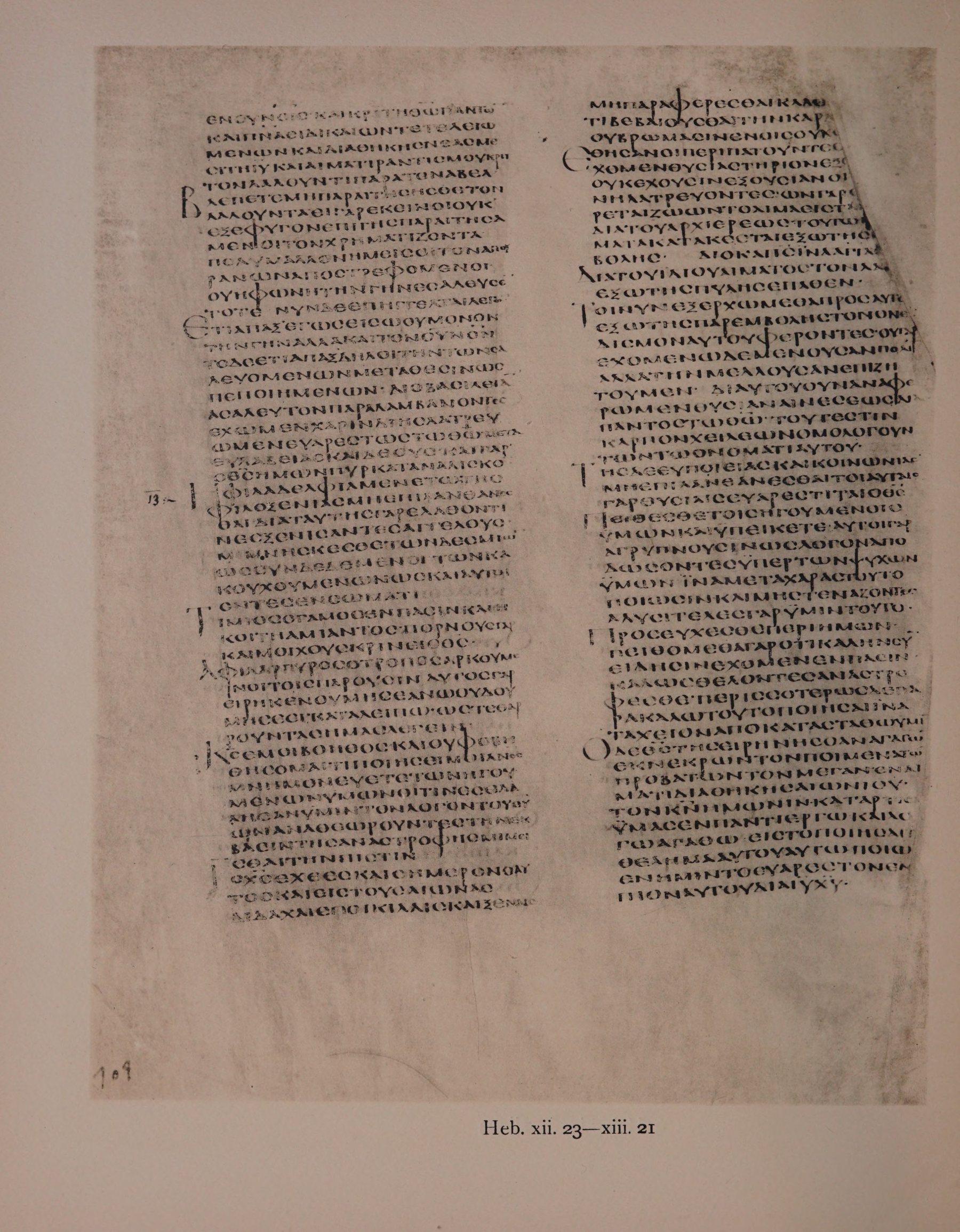
Hebrews 13 from Codex Alexandrinus (GA 02), a fifth-century Greek Bible held by the British Library (Royal MS 1 D. VIII). In the New Testament it is the chief witness to the Byzantine text in the Gospels and to the Alexandrian text in the rest of the New Testament. Its New Testament volume lacks Matthew 1:1-25:5, John 6:50-8:52 and 2 Corinthians 4:13-12:6.
This entry meets the strict three-criteria standard of the Theosis Library:
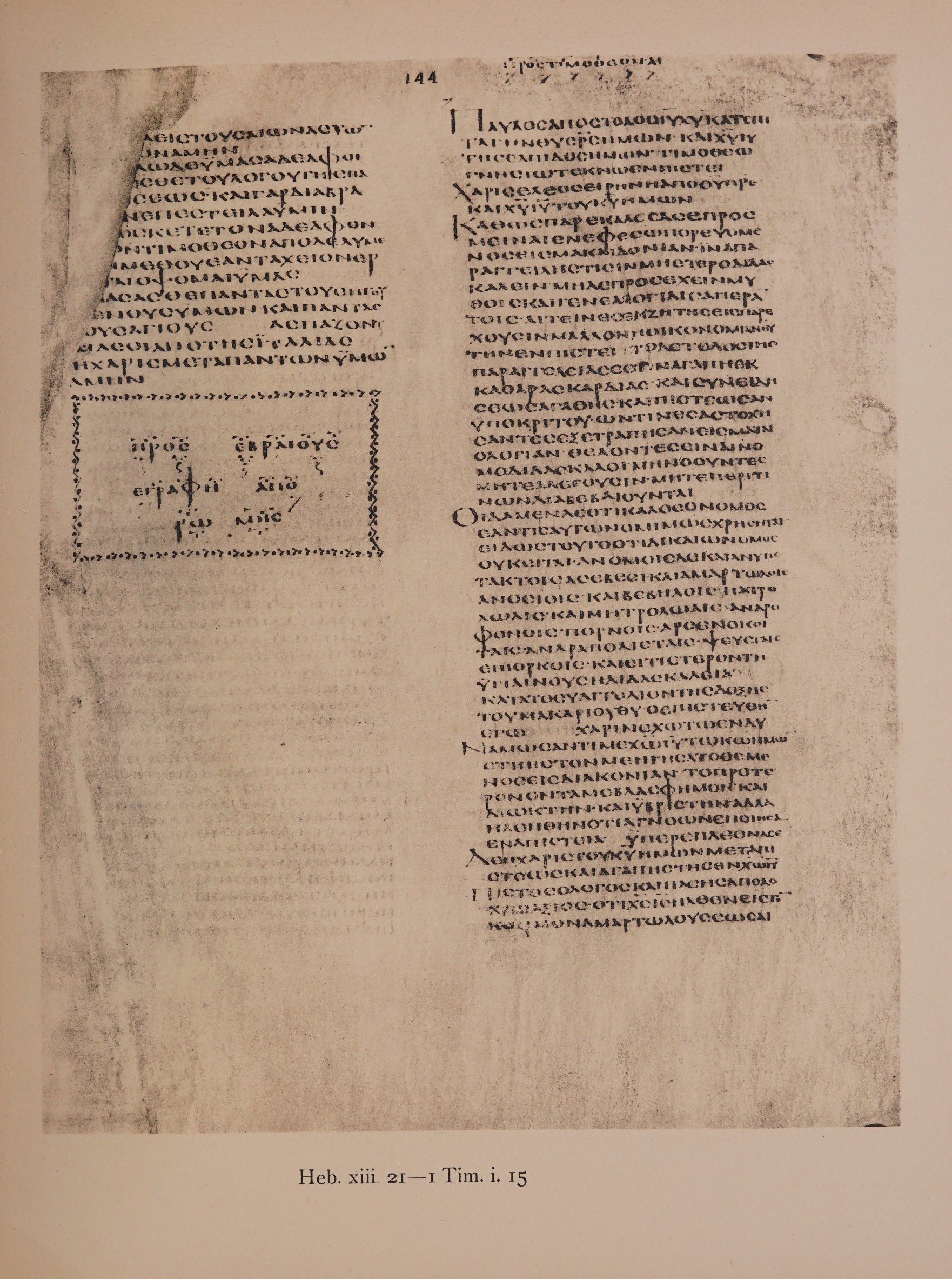
- Manuscript scan: the actual page(s) of Codex Alexandrinus containing this passage (folios 143v, 144r), reproduced from the British Museum's 1909 photographic facsimile edited by F. G. Kenyon, as digitised by the Getty Research Institute for the Internet Archive. The facsimile prints the verse range beneath each plate; that printed range was read for every page used and agrees with the INTF's NTVMR verse-level page index (CC BY 4.0). The page for each section now comes from the NTVMR transcription itself, which records the page and column on which every verse is written.
- Original text: the manuscript's own text, from a diplomatic transcription (see Greek text below), with Tischendorf's 8th critical edition (1869) for comparison.
- English translation: the King James Version (1611), retrieved verbatim from the public-domain bible-api.com endpoint.
Greek text: a diplomatic transcription of Codex Alexandrinus made by the Institut für Neutestamentliche Textforschung (INTF), Münster, for the New Testament Virtual Manuscript Room (NTVMR), published under a Creative Commons Attribution 4.0 licence. It gives the letters as the first scribe wrote them: no accents or breathings, the scribe's own spelling, and the sacred names in their contracted form (θς for θεος, ις for ιησους, κς for κυριος; the overline is not reproduced). Corrections by later hands are not shown. Letters in square brackets are not legible on the page and were restored by the transcribers, a dot under a letter marks an uncertain reading, and [...] marks text lost to damage. Beneath each section, for comparison, is Tischendorf's 8th critical edition (1869). Where the two differ, the transcription is what the manuscript says. Each section is shown with the page on which the transcription places its verses.
How was this verified? (Provenance)
Where on the image
Page from the NTVMR transcription (docID 20002): verses 1-9 on fol. 143v (facsimile leaf 250), col. 1.
1η φιλαδελφια μενετω 2της φιλοξενιας μη επιλανθανεσθαι · δια ταυτης γαρ ελαθον τινες ξενισαντες αγγελους · 3μιμνησκεσθε των δεσμιων ως συνδεδεμενοι των κακουχουμενων ως και αυτοι οντες εν σωματι · 4τιμιος ο γαμος εν πασιν και η κοιτη αμιαντος πορνους γαρ και μοιχους κρινει ο θς · 5αφιλαργυρος ο τροπος αρκουμενοι τοις παρουσιν · αυτος γαρ ειρηκεν ου μη σε ανω ουδ ου μη σε εγκαταλειπω · 6ωστε θαρρουντας ημας λεγειν · κς εμοι βοηθος · και ου φοβηθησομαι τι ποιησει μοι ανος 7μνημονευετε των ηγουμενων υμων οιτινες ελαλησαν υμιν τον λογον του θυ ων αναθεωρουντες την εκβασιν της αναστροφης μιμεισθαι την πιστιν 8ις χς εχθες και σημερον ο αυτος και εις τους αιωνας 9διδαχαις ποικιλαις και ξεναις μη παραφερεσθαι · καλο[ν] [γαρ] [χαρι]τι βεβαιουσθαι την καρδ[ιαν] ου βρωμασιν εν οις ουκ ω̣[φελη]θησαν οι περιπατουντες
Compare: Tischendorf 8th edition (1869)
1Ἡ φιλαδελφία μενέτω. 2τῆς φιλοξενίας μὴ ἐπιλανθάνεσθε· διὰ ταύτης γὰρ ἔλαθόν τινες ξενίσαντες ἀγγέλους. 3μιμνῄσκεσθε τῶν δεσμίων ὡς συνδεδεμένοι, τῶν κακουχουμένων ὡς καὶ αὐτοὶ ὄντες ἐν σώματι. 4τίμιος ὁ γάμος ἐν πᾶσιν καὶ ἡ κοίτη ἀμίαντος, πόρνους γὰρ καὶ μοιχοὺς κρινεῖ ὁ θεός. 5ἀφιλάργυρος ὁ τρόπος, ἀρκούμενοι τοῖς παροῦσιν· αὐτὸς γὰρ εἴρηκεν, οὐ μή σε ἀνῶ οὐδ’ οὐ μή σε ἐγκαταλείπω, 6ὥστε θαρροῦντας ἡμᾶς λέγειν, κύριος ἐμοὶ βοηθός, οὐ φοβηθήσομαι· τί ποιήσει μοι ἄνθρωπος; 7Μνημονεύετε τῶν ἡγουμένων ὑμῶν, οἵτινες ἐλάλησαν ὑμῖν τὸν λόγον τοῦ θεοῦ, ὧν ἀναθεωροῦντες τὴν ἔκβασιν τῆς ἀναστροφῆς μιμεῖσθε τὴν πίστιν. 8Ἰησοῦς Χριστὸς ἐχθὲς καὶ σήμερον ὁ αὐτός, καὶ εἰς τοὺς αἰῶνας. 9διδαχαῖς ποικίλαις καὶ ξέναις μὴ παραφέρεσθε· καλὸν γὰρ χάριτι βεβαιοῦσθαι τὴν καρδίαν, οὐ βρώμασιν, ἐν οἷς οὐκ ὠφελήθησαν οἱ περιπατοῦντες.
1Let brotherly love continue. 2Be not forgetful to entertain strangers: for thereby some have entertained angels unawares. 3Remember them that are in bonds, as bound with them; and them which suffer adversity, as being yourselves also in the body. 4Marriage is honourable in all, and the bed undefiled: but whoremongers and adulterers God will judge. 5Let your conversation be without covetousness; and be content with such things as ye have: for he hath said, I will never leave thee, nor forsake thee. 6So that we may boldly say, The Lord is my helper, and I will not fear what man shall do unto me. 7Remember them which have the rule over you, who have spoken unto you the word of God: whose faith follow, considering the end of their conversation. 8Jesus Christ the same yesterday, and to day, and for ever. 9Be not carried about with divers and strange doctrines. For it is a good thing that the heart be established with grace; not with meats, which have not profited them that have been occupied therein.
Where on the image
Page from the NTVMR transcription (docID 20002): verses 10-21 on fol. 143v (facsimile leaf 250), col. 2; verse 21 continues on fol. 144r (facsimile leaf 251), col. 1 (which begins '[ω] [η] [δοξ]α').
10εχομεν θυσιαστηριον εξ ο̣[υ] [φαγειν] ουκ εχουσιν εξουσιαν οι [τη] [σκη]νη λατρευοντες · 11ων γαρ ε̣[ισφε]ρεται ζωων το αιμα εις τα [αγια] δια του αρχιερεως τουτων̣ [τα] [σω]ματα κατακεεται εξω της [παρεμ]βολης · 12διο και ις ινα αγια[ση] δια του ιδιου αιματος τον λα[ον] εξω της πυλης επαθεν · 13τοινυν εξερχωμεθα προς αυτο̣[ν] εξω της παρεμβολης τον ονε[ι]δισμον αυτου φεροντες · 14ου γαρ εχομεν ωδε μενουσαν πολιν αλλα την μελλουσαν επιζητουμεν · 15δι αυτου ουν αναφερωμεν θυσιαν αινεσεως δια παντος τω θω · τουτ εστιν καρπον χειλεων ομολογουντων τω ονοματι αυτου · 16της δε ευποιειας και κοινωνιας μη επιλανθανεσθαι τοιαυταις γαρ θυσιαις ευαρεστιται ο θς 17πειθεσθε τοις ηγουμενοις υμων και υπεικετε · αυτοι γαρ αγρυπνουσιν ως λογον αποδωσοντες υπερ των ψυχων υμων · ινα μετα χαρας τουτο ποιωσιν και μη στεναζοντες αλυσιτελες γαρ υμιν τουτο · 18προσευχεσθε περι ημων · πειθομεθα γαρ οτι καλην συνειδησιν εχομεν εν πασιν καλως θελοντες αναστρεφεσθε · 19περισσοτερως δε παρακαλω τουτο ποιησαι ινα ταχειον αποκατασταθω υμιν 20ο δε θς της ειρηνης ο αναγαγων εκ νεκρων τον ποιμενα των προβατων τον μεγαν · εν αιματι διαθηκης αιωνιου · τον κν ημων ιν · 21καταρτισα[ι] υμας εν παντι εργω και λογω αγαθω εις το ποιησαι τ[ο] θελημα αυτου αυτω ποιω[ν] εν ημιν το ευαρεστον εν[ω]πιον αυτου δια ιυ χυ · [ω] [η] [δοξ]α εις τους αιωνας των [αιων]ω̣ν αμην
Compare: Tischendorf 8th edition (1869)
10Ἔχομεν θυσιαστήριον ἐξ οὗ φαγεῖν οὐκ ἔχουσιν ἐξουσίαν οἱ τῇ σκηνῇ λατρεύοντες. 11ὧν γὰρ εἰσφέρεται ζώων τὸ αἷμα περὶ ἁμαρτίας εἰς τὰ ἅγια διὰ τοῦ ἀρχιερέως, τούτων τὰ σώματα κατακαίεται ἔξω τῆς παρεμβολῆς. 12διὸ καὶ Ἰησοῦς, ἵνα ἁγιάσῃ διὰ τοῦ ἰδίου αἵματος τὸν λαόν, ἔξω τῆς πύλης ἔπαθεν. 13τοίνυν ἐξερχώμεθα πρὸς αὐτὸν ἔξω τῆς παρεμβολῆς, τὸν ὀνειδισμὸν αὐτοῦ φέροντες· 14οὐ γὰρ ἔχομεν ὧδε μένουσαν πόλιν, ἀλλὰ τὴν μέλλουσαν ἐπιζητοῦμεν. 15Δι’ αὐτοῦ οὖν ἀναφέρωμεν θυσίαν αἰνέσεως διαπαντὸς τῷ θεῷ, τοῦτ’ ἔστιν καρπὸν χειλέων ὁμολογούντων τῷ ὀνόματι αὐτοῦ. 16τῆς δὲ εὐποιΐας καὶ κοινωνίας μὴ ἐπιλανθάνεσθε, τοιαύταις γὰρ θυσίαις εὐαρεστεῖται ὁ θεός. 17Πείθεσθε τοῖς ἡγουμένοις ὑμῶν καὶ ὑπείκετε, αὐτοὶ γὰρ ἀγρυπνοῦσιν ὑπὲρ τῶν ψυχῶν ὑμῶν ὡς λόγον ἀποδώσοντες, ἵνα μετὰ χαρᾶς τοῦτο ποιῶσιν καὶ μὴ στενάζοντες, ἀλυσιτελὲς γὰρ ὑμῖν τοῦτο. 18Προσεύχεσθε περὶ ἡμῶν, πειθόμεθα γὰρ ὅτι καλὴν συνείδησιν ἔχομεν, ἐν πᾶσιν καλῶς θέλοντες ἀναστρέφεσθαι. 19περισσοτέρως δὲ παρακαλῶ τοῦτο ποιῆσαι ἵνα τάχιον ἀποκατασταθῶ ὑμῖν. 20Ὁ δὲ θεὸς τῆς εἰρήνης, ὁ ἀναγαγὼν ἐκ νεκρῶν τὸν ποιμένα τῶν προβάτων τὸν μέγαν ἐν αἵματι διαθήκης αἰωνίου, τὸν κύριον ἡμῶν Ἰησοῦν, 21καταρτίσαι ὑμᾶς ἐν παντὶ ἀγαθῷ εἰς τὸ ποιῆσαι τὸ θέλημα αὐτοῦ, ποιῶν ἐν ἡμῖν τὸ εὐάρεστον ἐνώπιον αὐτοῦ διὰ Ἰησοῦ Χριστοῦ, ᾧ ἡ δόξα εἰς τοὺς αἰῶνας τῶν αἰώνων· ἀμήν.
10We have an altar, whereof they have no right to eat which serve the tabernacle. 11For the bodies of those beasts, whose blood is brought into the sanctuary by the high priest for sin, are burned without the camp. 12Wherefore Jesus also, that he might sanctify the people with his own blood, suffered without the gate. 13Let us go forth therefore unto him without the camp, bearing his reproach. 14For here have we no continuing city, but we seek one to come. 15By him therefore let us offer the sacrifice of praise to God continually, that is, the fruit of our lips giving thanks to his name. 16But to do good and to communicate forget not: for with such sacrifices God is well pleased. 17Obey them that have the rule over you, and submit yourselves: for they watch for your souls, as they that must give account, that they may do it with joy, and not with grief: for that is unprofitable for you. 18Pray for us: for we trust we have a good conscience, in all things willing to live honestly. 19But I beseech you the rather to do this, that I may be restored to you the sooner. 20Now the God of peace, that brought again from the dead our Lord Jesus, that great shepherd of the sheep, through the blood of the everlasting covenant, 21Make you perfect in every good work to do his will, working in you that which is wellpleasing in his sight, through Jesus Christ; to whom be glory for ever and ever. Amen.
Where on the image
Page from the NTVMR transcription (docID 20002): verses 22-25 on fol. 144r (facsimile leaf 251), col. 1.
22[παρακα]λω δε υμας αδελφοι [ανεχ]εσθε του λογου της πα[ρακλη]σεως · και γαρ δια βρα[χεω]ν επεστειλα υμιν · 23[γιν]ω̣σκετε τον αδελφον [ημ]ω̣ν τιμοθεον απολελυμε[νο]ν̣ μεθ ου εαν ταχειον ερ[χη]τ̣αι οψομαι υμας 24[ασπ]ασασθε παντας τους ηγου[μ]ενους υμων και παντας [τ]ους αγιους ασπαζονται [υ]μας οι απο της ιταλιας 25η χαρις μετα παντων υμων αμην
Compare: Tischendorf 8th edition (1869)
22Παρακαλῶ δὲ ὑμᾶς, ἀδελφοί, ἀνέχεσθε τοῦ λόγου τῆς παρακλήσεως, καὶ γὰρ διὰ βραχέων ἐπέστειλα ὑμῖν. 23γινώσκετε τὸν ἀδελφὸν ἡμῶν Τιμόθεον ἀπολελυμένον, μεθ’ οὗ ἐὰν τάχιον ἔρχηται ὄψομαι ὑμᾶς. 24ἀσπάσασθε πάντας τοὺς ἡγουμένους ὑμῶν καὶ πάντας τοὺς ἁγίους. ἀσπάζονται ὑμᾶς οἱ ἀπὸ τῆς Ἰταλίας. 25Ἡ χάρις μετὰ πάντων ὑμῶν.
22And I beseech you, brethren, suffer the word of exhortation: for I have written a letter unto you in few words. 23Know ye that our brother Timothy is set at liberty; with whom, if he come shortly, I will see you. 24Salute all them that have the rule over you, and all the saints. They of Italy salute you. 25Grace be with you all. Amen.
Cite
Sources
- Source: Codex Alexandrinus page images + NTVMR transcription (CC BY 4.0) + Tischendorf 8th edition + KJV (holding institution)
- Critical edition: Codex Alexandrinus transcription, NTVMR (INTF Münster, CC BY 4.0); Tischendorf 8th edition for comparison
← previous · → next · v cycle view · l back to library