Hebrews, Chapter 12 (Codex Alexandrinus)
Introduction
Hebrews 12 from Codex Alexandrinus (GA 02), a fifth-century Greek Bible held by the British Library (Royal MS 1 D. VIII). In the New Testament it is the chief witness to the Byzantine text in the Gospels and to the Alexandrian text in the rest of the New Testament. Its New Testament volume lacks Matthew 1:1-25:5, John 6:50-8:52 and 2 Corinthians 4:13-12:6.
This entry meets the strict three-criteria standard of the Theosis Library:
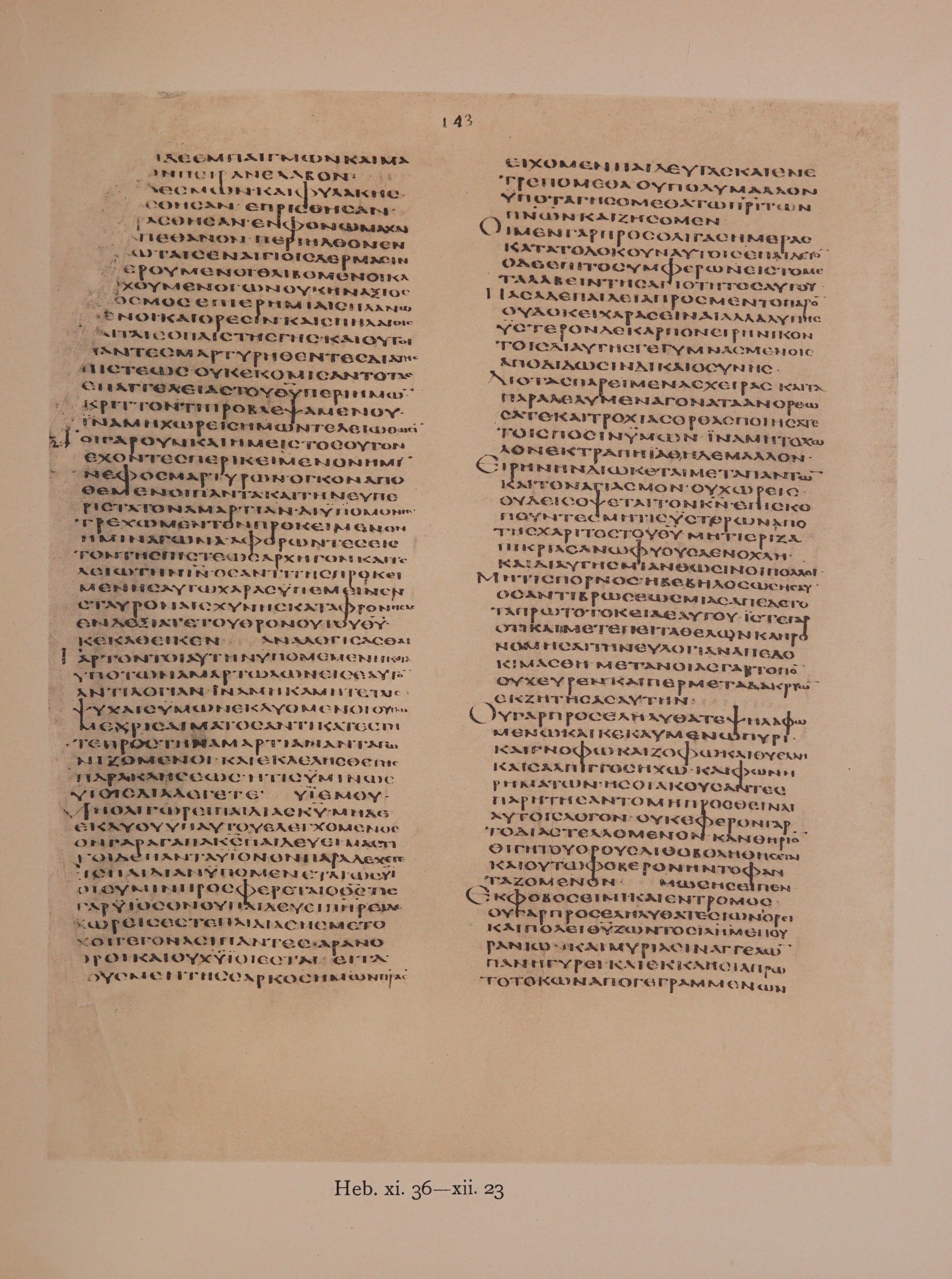
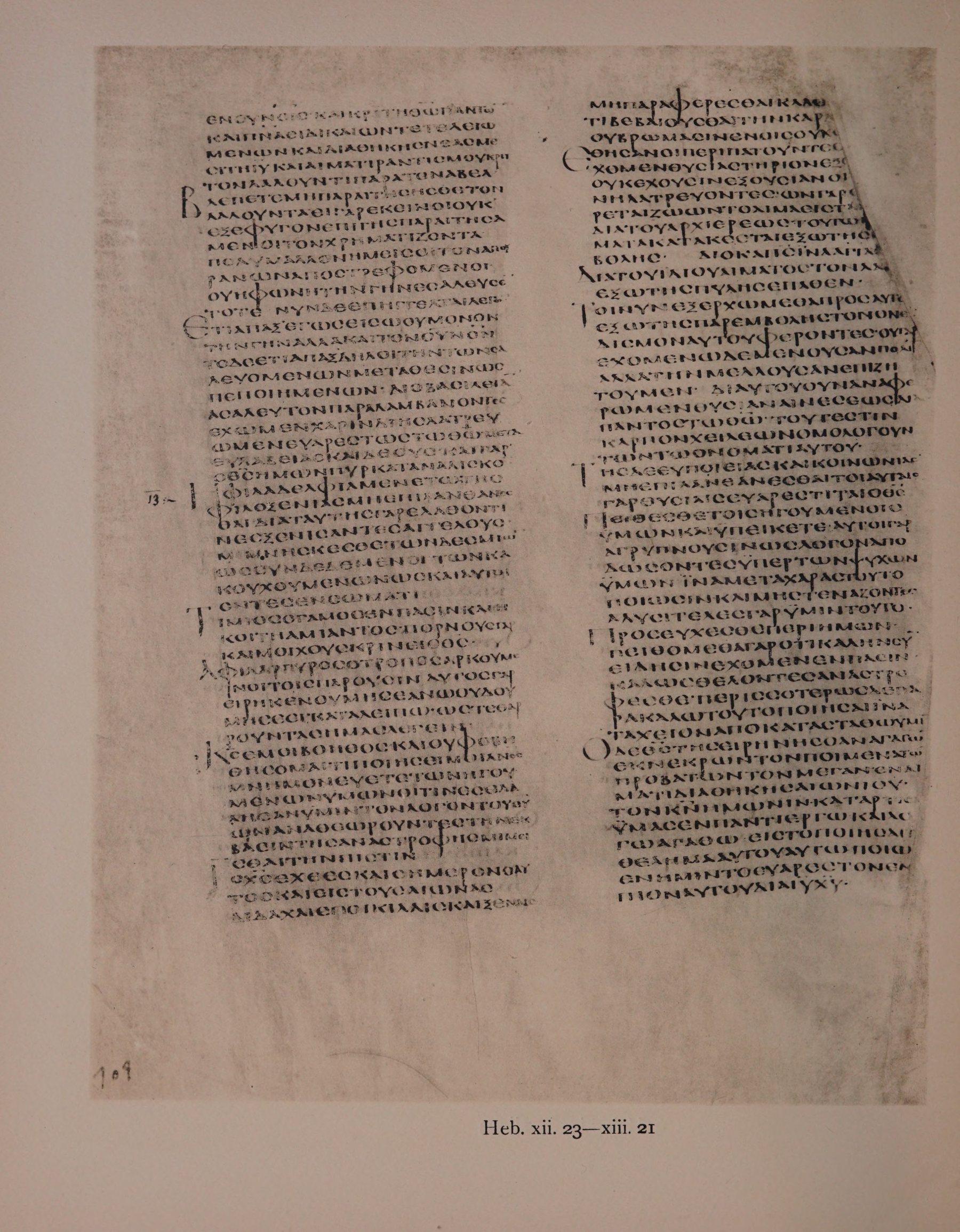
- Manuscript scan: the actual page(s) of Codex Alexandrinus containing this passage (folios 143r, 143v), reproduced from the British Museum's 1909 photographic facsimile edited by F. G. Kenyon, as digitised by the Getty Research Institute for the Internet Archive. The facsimile prints the verse range beneath each plate; that printed range was read for every page used and agrees with the INTF's NTVMR verse-level page index (CC BY 4.0). The page for each section now comes from the NTVMR transcription itself, which records the page and column on which every verse is written.
- Original text: the manuscript's own text, from a diplomatic transcription (see Greek text below), with Tischendorf's 8th critical edition (1869) for comparison.
- English translation: the King James Version (1611), retrieved verbatim from the public-domain bible-api.com endpoint.
Greek text: a diplomatic transcription of Codex Alexandrinus made by the Institut für Neutestamentliche Textforschung (INTF), Münster, for the New Testament Virtual Manuscript Room (NTVMR), published under a Creative Commons Attribution 4.0 licence. It gives the letters as the first scribe wrote them: no accents or breathings, the scribe's own spelling, and the sacred names in their contracted form (θς for θεος, ις for ιησους, κς for κυριος; the overline is not reproduced). Corrections by later hands are not shown. Letters in square brackets are not legible on the page and were restored by the transcribers, a dot under a letter marks an uncertain reading, and [...] marks text lost to damage. Beneath each section, for comparison, is Tischendorf's 8th critical edition (1869). Where the two differ, the transcription is what the manuscript says. Each section is shown with the page on which the transcription places its verses.
How was this verified? (Provenance)
Where on the image
Page from the NTVMR transcription (docID 20002): verses 1-9 on fol. 143r (facsimile leaf 249), col. 1.
1τοιγαρουν και ημεις τοσουτον εχοντες περικειμενον ημιν νεφος μαρτυρων · ογκον αποθεμενοι παντα και την ευπεριστατον αμαρτιαν · δι υπομονης τρεχωμεν τον προκειμενον ημιν αγωνα · 2αφορωντες εις τον της πιστεως αρχηγον και τελειωτην ιν · ος αντι της προκειμενης αυτω χαρας υπεμεινεν σταυρον αισχυνης καταφρονησας εν δεξια τε του θρονου του θυ κεκαθεικεν 3αναλογισασθαι γαρ τον τοιαυτην υπομεμενηκοτα υπο των αμαρτωλων εις εαυτον αντιλογιαν · ινα μη καμητε ταις ψυχαις υμων εκλυομενοι · 4ουπω μεχρις αιματος αντικατεστητε προς την αμαρτιαν ανταγωνιζομενοι · 5και εκλελησθε της παρακλησεως · ητις υμιν ως υιοις διαλεγετε · υιε μου · μη ολιγωρει παιδιας κυ · μηδε εκλυου υπ αυτου ελεγχομενος 6ον γαρ αγαπα κς παιδευει · μαστιγοι δε παντα υιον ον παραδεχετε 7εις παιδιαν υπομενεται · ως υιοις υμιν προσφερεται ο θς τις γαρ υιος ον ου παιδευει πηρ 8ει δε χωρεις εστε παιδιας ης μετοχοι γεγονασι παντες · αρα νοθ̣ροι και ουχ υιοι εσται · 9ειτα · [τ]ους μεν της σαρκος ημων πρας ειχομεν παιδευτας και ενετρεπομεθα ου πολυ μαλλον υποταγησομεθα τω πρι των πνων και ζησομεν ·
Compare: Tischendorf 8th edition (1869)
1Τοιγαροῦν καὶ ἡμεῖς, τοσοῦτον ἔχοντες περικείμενον ἡμῖν νέφος μαρτύρων, ὄγκον ἀποθέμενοι πάντα καὶ τὴν εὐπερίστατον ἁμαρτίαν, δι’ ὑπομονῆς τρέχωμεν τὸν προκείμενον ἡμῖν ἀγῶνα, 2ἀφορῶντες εἰς τὸν τῆς πίστεως ἀρχηγὸν καὶ τελειωτὴν Ἰησοῦν, ὃς ἀντὶ τῆς προκειμένης αὐτῷ χαρᾶς ὑπέμεινεν σταυρὸν αἰσχύνης καταφρονήσας, ἐν δεξιᾷ τε τοῦ θρόνου τοῦ θεοῦ κεκάθικεν. 3ἀναλογίσασθε γὰρ τὸν τοιαύτην ὑπομεμενηκότα ὑπὸ τῶν ἁμαρτωλῶν εἰς ἑαυτὸν ἀντιλογίαν, ἵνα μὴ κάμητε ταῖς ψυχαῖς ὑμῶν ἐκλυόμενοι. 4Οὔπω μέχρις αἵματος ἀντικατέστητε πρὸς τὴν ἁμαρτίαν ἀνταγωνιζόμενοι, 5καὶ ἐκλέλησθε τῆς παρακλήσεως, ἥτις ὑμῖν ὡς υἱοῖς διαλέγεται, υἱέ μου, μὴ ὀλιγώρει παιδίας κυρίου, μηδὲ ἐκλύου ὑπ’ αὐτοῦ ἐλεγχόμενος· 6ὃν γὰρ ἀγαπᾷ κύριος παιδεύει, μαστιγοῖ δὲ πάντα υἱὸν ὃν παραδέχεται. 7εἰς παιδίαν ὑπομένετε· ὡς υἱοῖς ὑμῖν προσφέρεται ὁ θεός· τίς γὰρ υἱὸς ὃν οὐ παιδεύει πατήρ; 8εἰ δὲ χωρίς ἐστε παιδίας, ἧς μέτοχοι γεγόνασιν πάντες, ἄρα νόθοι καὶ οὐχ υἱοί ἐστε. 9εἶτα τοὺς μὲν τῆς σαρκὸς ἡμῶν πατέρας εἴχομεν παιδευτὰς καὶ ἐνετρεπόμεθα· οὐ πολὺ μᾶλλον ὑποταγησόμεθα τῷ πατρὶ τῶν πνευμάτων καὶ ζήσομεν;
1Wherefore seeing we also are compassed about with so great a cloud of witnesses, let us lay aside every weight, and the sin which doth so easily beset us, and let us run with patience the race that is set before us, 2Looking unto Jesus the author and finisher of our faith; who for the joy that was set before him endured the cross, despising the shame, and is set down at the right hand of the throne of God. 3For consider him that endured such contradiction of sinners against himself, lest ye be wearied and faint in your minds. 4Ye have not yet resisted unto blood, striving against sin. 5And ye have forgotten the exhortation which speaketh unto you as unto children, My son, despise not thou the chastening of the Lord, nor faint when thou art rebuked of him: 6For whom the Lord loveth he chasteneth, and scourgeth every son whom he receiveth. 7If ye endure chastening, God dealeth with you as with sons; for what son is he whom the father chasteneth not? 8But if ye be without chastisement, whereof all are partakers, then are ye bastards, and not sons. 9Furthermore we have had fathers of our flesh which corrected us, and we gave them reverence: shall we not much rather be in subjection unto the Father of spirits, and live?
Where on the image
Page from the NTVMR transcription (docID 20002): verses 10-16 on fol. 143r (facsimile leaf 249), col. 2.
10οι μεν γαρ προς ολιγας ημερας κατα το δοκουν αυτοις επαιδευον ο δε επι το συμφερων εις το μεταλαβειν της αγιοτητος αυτου 11πασα δε παιδεια προς μεν το παρον ου δοκει χαρας ειναι αλλα λυπης υστερον δε καρπον ειρηνικον τοις δι αυτης γεγυμνασμενοις αποδιδωσιν δικαιοσυνης · 12διο τας παρειμενας χειρας και τα παραλελυμενα γονατα ανορθωσατε · 13και τροχιας ορθας ποιησατε τοις ποσιν υμων · ινα μη το χωλον εκτραπη ιαθη δε μαλλον · 14ειρηνην διωκεται μετα παντων και τον αγιασμον · ου χωρεις ουδεις οψεται τον κν · 15επισκοπουντες μη τις υστερων απο της χαριτος του θυ · μη τις ριζα πικριας ανω φυουσα ενοχλη · και δι αυτης μιανθωσιν οι πολλοι · 16μη τις πορνος · η βεβηλος ως ησαυ ος αντι βρωσεως μιας απεδετο τα πρωτοτοκεια εαυτου ·
Compare: Tischendorf 8th edition (1869)
10οἱ μὲν γὰρ πρὸς ὀλίγας ἡμέρας κατὰ τὸ δοκοῦν αὐτοῖς ἐπαίδευον, ὁ δὲ ἐπὶ τὸ συμφέρον εἰς τὸ μεταλαβεῖν τῆς ἁγιότητος αὐτοῦ. 11πᾶσα μὲν παιδία πρὸς μὲν τὸ παρὸν οὐ δοκεῖ χαρᾶς εἶναι ἀλλὰ λύπης, ὕστερον δὲ καρπὸν εἰρηνικὸν τοῖς δι’ αὐτῆς γεγυμνασμένοις ἀποδίδωσιν δικαιοσύνης. 12Διὸ τὰς παρειμένας χεῖρας καὶ τὰ παραλελυμένα γόνατα ἀνορθώσατε, 13καὶ τροχιὰς ὀρθὰς ποιεῖτε τοῖς ποσὶν ὑμῶν, ἵνα μὴ τὸ χωλὸν ἐκτραπῇ, ἰαθῇ δὲ μᾶλλον. 14εἰρήνην διώκετε μετὰ πάντων, καὶ τὸν ἁγιασμόν, οὗ χωρὶς οὐδεὶς ὄψεται τὸν κύριον, 15ἐπισκοποῦντες μή τις ὑστερῶν ἀπὸ τῆς χάριτος τοῦ θεοῦ, μή τις ῥίζα πικρίας ἄνω φύουσα ἐνοχλῇ καὶ διὰ ταύτης μιανθῶσιν οἱ πολλοί, 16μή τις πόρνος ἢ βέβηλος ὡς Ἠσαῦ, ὃς ἀντὶ βρώσεως μιᾶς ἀπέδετο τὰ πρωτοτόκια ἑαυτοῦ.
10For they verily for a few days chastened us after their own pleasure; but he for our profit, that we might be partakers of his holiness. 11Now no chastening for the present seemeth to be joyous, but grievous: nevertheless afterward it yieldeth the peaceable fruit of righteousness unto them which are exercised thereby. 12Wherefore lift up the hands which hang down, and the feeble knees; 13And make straight paths for your feet, lest that which is lame be turned out of the way; but let it rather be healed. 14Follow peace with all men, and holiness, without which no man shall see the Lord: 15Looking diligently lest any man fail of the grace of God; lest any root of bitterness springing up trouble you, and thereby many be defiled; 16Lest there be any fornicator, or profane person, as Esau, who for one morsel of meat sold his birthright.
Where on the image
Page from the NTVMR transcription (docID 20002): verses 17-23 on fol. 143r (facsimile leaf 249), col. 2; verse 23 continues on fol. 143v (facsimile leaf 250), col. 1 (which begins 'εν ουνοις ·').
17ιστε γαρ οτι και μετεπειτα θελων κληρονομησαι την ευλογιαν απεδοκιμασθη · μετανοιας γαρ τοπον ουχ ευρεν · καιπερ μετα δακρυων εκζητησας αυτην · 18ου γαρ προσεληλυθατε ψηλαφωμενω · και κεκαυμενω πυρι · και γνοφω · και ζοφω · και θυελλη 19και σαλπιγγος ηχω · και φωνη ρηματων · ης οι ακουσαντες παρητησαντο μη προσθειναι αυτοις λογον · 20ουκ εφερον γαρ το διαστελλομενον · καν θηριον θιγη του ορους λιθοβοληθησεται 21και ουτω φοβερον ην το φανταζομενον · μωσης ειπεν εκφοβος ειμι και εντρομος 22ου γαρ προσεληλυθατε σιων ορει και πολει θυ ζωντος ιλημ επουρανιων και μυριασιν αγγελων πανηγυρει · 23και εκκλησια πρωτοτοκων απογεγραμμενων εν ουνοις · και κριτη θω παντων και πνασι δικαιων τετελειωμενων ·
Compare: Tischendorf 8th edition (1869)
17ἴστε γὰρ ὅτι καὶ μετέπειτα θέλων κληρονομῆσαι τὴν εὐλογίαν ἀπεδοκιμάσθη, μετανοίας γὰρ τόπον οὐχ εὗρεν, καίπερ μετὰ δακρύων ἐκζητήσας αὐτήν. 18Οὐ γὰρ προσεληλύθατε ψηλαφωμένῳ καὶ κεκαυμένῳ πυρὶ καὶ γνόφῳ καὶ ζόφῳ καὶ θυέλλῃ 19καὶ σάλπιγγος ἤχῳ καὶ φωνῇ ῥημάτων, ἧς οἱ ἀκούσαντες παρῃτήσαντο μὴ προστεθῆναι αὐτοῖς λόγον· 20οὐκ ἔφερον γὰρ τὸ διαστελλόμενον, κἂν θηρίον θίγῃ τοῦ ὄρους, λιθοβοληθήσεται· 21καί, οὕτω φοβερὸν ἦν τὸ φανταζόμενον, Μωϋσῆς εἶπεν· ἔκφοβός εἰμι καὶ ἔντρομος. 22ἀλλὰ προσεληλύθατε Σιὼν ὄρει καὶ πόλει θεοῦ ζῶντος, Ἱερουσαλὴμ ἐπουρανίῳ, καὶ μυριάσιν ἀγγέλων 23πανηγύρει, καὶ ἐκκλησίᾳ πρωτοτόκων ἀπογεγραμμένων ἐν οὐρανοῖς, καὶ κριτῇ θεῷ πάντων, καὶ πνεύμασι δικαίων τετελειωμένων,
17For ye know how that afterward, when he would have inherited the blessing, he was rejected: for he found no place of repentance, though he sought it carefully with tears. 18For ye are not come unto the mount that might be touched, and that burned with fire, nor unto blackness, and darkness, and tempest, 19And the sound of a trumpet, and the voice of words; which voice they that heard intreated that the word should not be spoken to them any more: 20(For they could not endure that which was commanded, And if so much as a beast touch the mountain, it shall be stoned, or thrust through with a dart: 21And so terrible was the sight, that Moses said, I exceedingly fear and quake:) 22But ye are come unto mount Sion, and unto the city of the living God, the heavenly Jerusalem, and to an innumerable company of angels, 23To the general assembly and church of the firstborn, which are written in heaven, and to God the Judge of all, and to the spirits of just men made perfect,
Where on the image
Page from the NTVMR transcription (docID 20002): verses 24-29 on fol. 143v (facsimile leaf 250), col. 1.
24και διαθηκης νεας μεσιτη ιυ και αιματι ραντισμου κριττον λαλουντι παρα τον αβελ · 25βλεπετε μη παραιτησησθε τον λαλουντα · ει γαρ εκεινοι ουκ εξεφυγον επι γης παραιτησαμενοι τον χρηματιζοντα · πολυ μαλλον ημεις οι τον απ ουρανων αποστρεφομενοι · 26ου η φωνη την γην εσαλευσεν τοτε · νυν δε επηγγελται λεγων · ετι απαξ εγω σεισω ου μονον την γην · αλλα και τον ουνον · 27το δε ετι απαξ δηλοι την των σαλευομενων μεταθεσιν ως πεποιημενων · 28διο βασιλειαν ασαλευτον παραλαμβανοντες εχωμεν χαριν δι ης λατρευωμεν ευαρεστως τω θω μετα ευλαβειας και δεους · 29και γαρ ο θς ημων πυρ καταναλισκον ·
Compare: Tischendorf 8th edition (1869)
24καὶ διαθήκης νέας μεσίτῃ Ἰησοῦ, καὶ αἵματι ῥαντισμοῦ κρεῖττον λαλοῦντι παρὰ τὸν Ἄβελ. 25βλέπετε μὴ παραιτήσησθε τὸν λαλοῦντα· εἰ γὰρ ἐκεῖνοι οὐκ ἐξέφυγον ἐπὶ γῆς παραιτησάμενοι τὸν χρηματίζοντα, πολὺ μᾶλλον ἡμεῖς οἱ τὸν ἀπ’ οὐρανῶν ἀποστρεφόμενοι· 26οὗ ἡ φωνὴ τὴν γῆν ἐσάλευσεν τότε, νῦν δὲ ἐπήγγελται λέγων, ἔτι ἅπαξ ἐγὼ σείσω οὐ μόνον τὴν γῆν ἀλλὰ καὶ τὸν οὐρανόν. 27τὸ δέ, ἔτι ἅπαξ δηλοῖ τὴν τῶν σαλευομένων μετάθεσιν ὡς πεποιημένων, ἵνα μείνῃ τὰ μὴ σαλευόμενα. 28διὸ βασιλείαν ἀσάλευτον παραλαμβάνοντες ἔχωμεν χάριν, δι’ ἧς λατρεύωμεν εὐαρέστως τῷ θεῷ μετὰ εὐλαβείας καὶ δέους· 29καὶ γὰρ ὁ θεὸς ἡμῶν πῦρ καταναλίσκον.
24And to Jesus the mediator of the new covenant, and to the blood of sprinkling, that speaketh better things than that of Abel. 25See that ye refuse not him that speaketh. For if they escaped not who refused him that spake on earth, much more shall not we escape, if we turn away from him that speaketh from heaven: 26Whose voice then shook the earth: but now he hath promised, saying, Yet once more I shake not the earth only, but also heaven. 27And this word, Yet once more, signifieth the removing of those things that are shaken, as of things that are made, that those things which cannot be shaken may remain. 28Wherefore we receiving a kingdom which cannot be moved, let us have grace, whereby we may serve God acceptably with reverence and godly fear: 29For our God is a consuming fire.
Cite
Sources
- Source: Codex Alexandrinus page images + NTVMR transcription (CC BY 4.0) + Tischendorf 8th edition + KJV (holding institution)
- Critical edition: Codex Alexandrinus transcription, NTVMR (INTF Münster, CC BY 4.0); Tischendorf 8th edition for comparison
← previous · → next · v cycle view · l back to library