Hebrews, Chapter 7 (Codex Alexandrinus)
Introduction
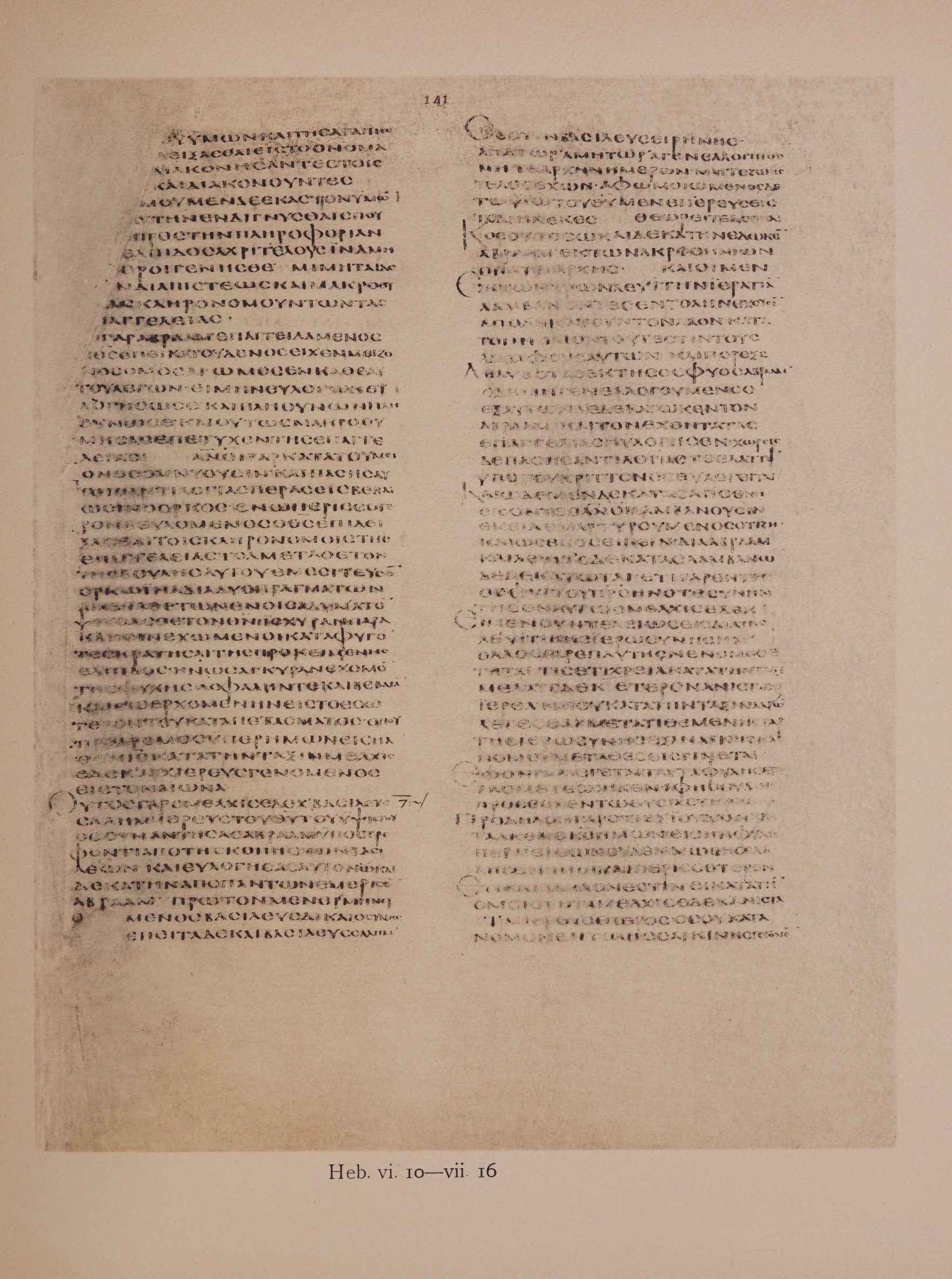
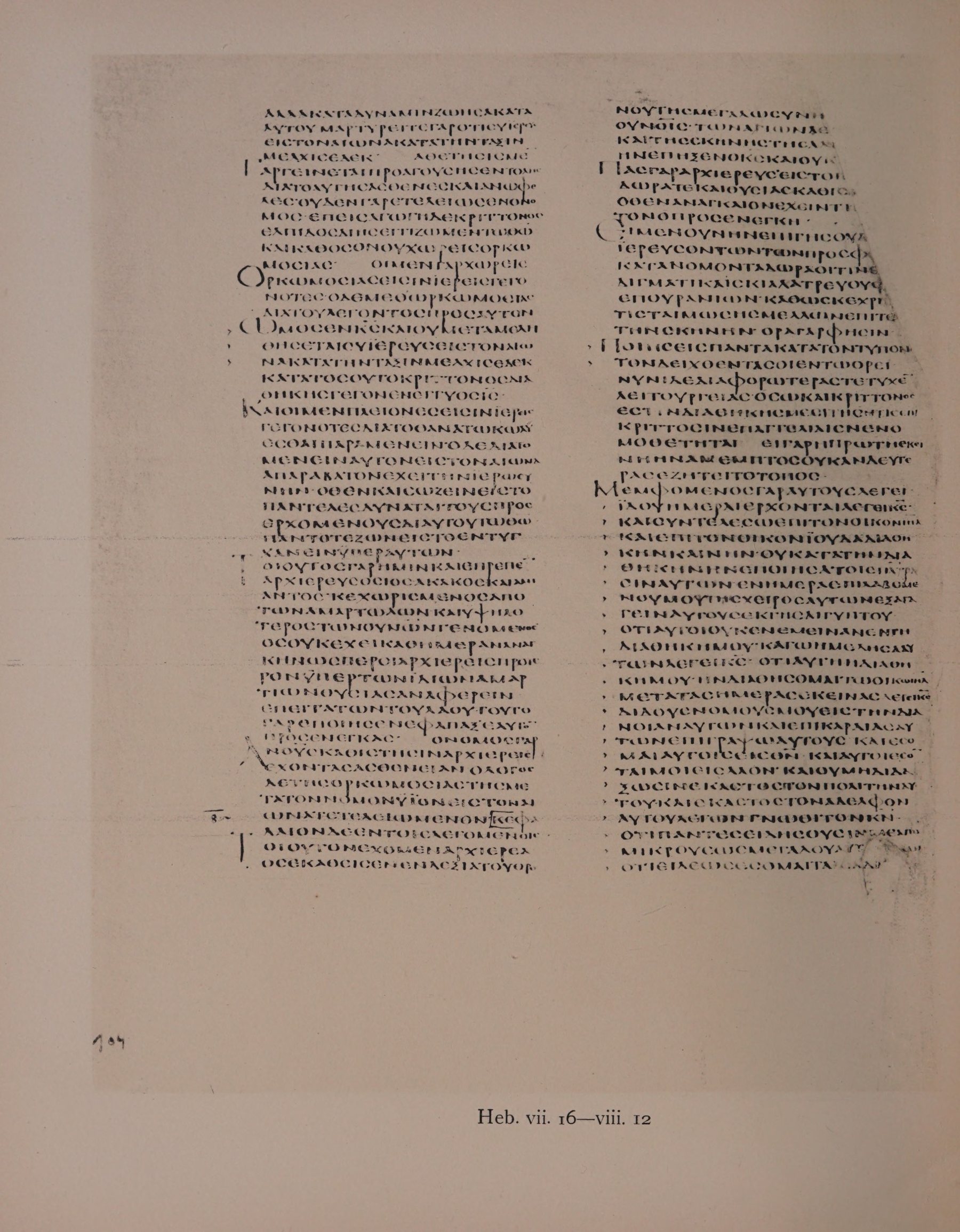
Hebrews 7 from Codex Alexandrinus (GA 02), a fifth-century Greek Bible held by the British Library (Royal MS 1 D. VIII). In the New Testament it is the chief witness to the Byzantine text in the Gospels and to the Alexandrian text in the rest of the New Testament. Its New Testament volume lacks Matthew 1:1-25:5, John 6:50-8:52 and 2 Corinthians 4:13-12:6.
This entry meets the strict three-criteria standard of the Theosis Library:
- Manuscript scan: the actual page(s) of Codex Alexandrinus containing this passage (folios 141r, 141v), reproduced from the British Museum's 1909 photographic facsimile edited by F. G. Kenyon, as digitised by the Getty Research Institute for the Internet Archive. The facsimile prints the verse range beneath each plate; that printed range was read for every page used and agrees with the INTF's NTVMR verse-level page index (CC BY 4.0). The page for each section now comes from the NTVMR transcription itself, which records the page and column on which every verse is written.
- Original text: the manuscript's own text, from a diplomatic transcription (see Greek text below), with Tischendorf's 8th critical edition (1869) for comparison.
- English translation: the King James Version (1611), retrieved verbatim from the public-domain bible-api.com endpoint.
Greek text: a diplomatic transcription of Codex Alexandrinus made by the Institut für Neutestamentliche Textforschung (INTF), Münster, for the New Testament Virtual Manuscript Room (NTVMR), published under a Creative Commons Attribution 4.0 licence. It gives the letters as the first scribe wrote them: no accents or breathings, the scribe's own spelling, and the sacred names in their contracted form (θς for θεος, ις for ιησους, κς for κυριος; the overline is not reproduced). Corrections by later hands are not shown. Letters in square brackets are not legible on the page and were restored by the transcribers, a dot under a letter marks an uncertain reading, and [...] marks text lost to damage. Beneath each section, for comparison, is Tischendorf's 8th critical edition (1869). Where the two differ, the transcription is what the manuscript says. Each section is shown with the page on which the transcription places its verses.
How was this verified? (Provenance)
Where on the image
Page from the NTVMR transcription (docID 20002): verses 1-2 on fol. 141r (facsimile leaf 243), col. 1.
1ουτος γαρ ο μελχισεδεχ · βασιλευς σαλημ ιερευς του θυ του υψιστου ος συναντησας αβρααμ υποστρεφοντι απο της κοπης τ̣ων β̣ασιλεων · και ευλογησας αυτον · 2ω και δεκατην απο παντων εμερισεν αβρααμ · πρωτον μεν ερμηνευομενος βασιλευς δικαιοσυνης επειτα δε και βασιλευς σαλημ ο εστι̣ν βασιλευς ειρηνης ·
Compare: Tischendorf 8th edition (1869)
1Οὗτος γὰρ ὁ Μελχισέδεκ, βασιλεὺς Σαλήμ, ἱερεὺς τοῦ θεοῦ τοῦ ὑψίστου, ὁ συναντήσας Ἀβραὰμ ὑποστρέφοντι ἀπὸ τῆς κοπῆς τῶν βασιλέων καὶ εὐλογήσας αὐτόν, 2ᾧ καὶ δεκάτην ἀπὸ πάντων ἐμέρισεν Ἀβραάμ, πρῶτον μὲν ἑρμηνευόμενος βασιλεὺς δικαιοσύνης ἔπειτα δὲ καὶ βασιλεὺς Σαλήμ, ὅ ἐστιν βασιλεὺς εἰρήνης,
1For this Melchisedec, king of Salem, priest of the most high God, who met Abraham returning from the slaughter of the kings, and blessed him; 2To whom also Abraham gave a tenth part of all; first being by interpretation King of righteousness, and after that also King of Salem, which is, King of peace;
Where on the image
Page from the NTVMR transcription (docID 20002): verses 3-9 on fol. 141r (facsimile leaf 243), col. 2.
3απατωρ · αμητωρ · αγενεαλογητος μητ̣ε̣ αρχην ημερων · μητε ζωης τελος εχων · αφωμοιωμενος δε τω υι̣ω του θυ μενει ιερευς εις το διηνεκες 4θεωρειτε δε πηλικος ουτος ω και δεκατην εδωκεν αβρααμ εκ των ακροθηνιων ο πατρ̣ιαρχης · 5και οι μεν εκ των υιων λευι την ιερατιαν λαμβανοντες εντολην εχουσιν αποδεκατουν τον λαον κατα τον νομον τουτ εστιν τους αδελφους αυτων καιπερ εξεληλυθοτας εκ της οσφυος αβρααμ 6ο δε μη γενεαλογουμενος εξ αυτων δεδεκατωκεν τον αβρααμ και τον εχοντα τας επαγγελιας ηυλογησεν · 7χωρεις δε πασης αντιλογιας το ελαττον υπο του κριττονος ευλογειται · 8και ωδε μεν δεκατας αποθνησκοντες ανοι · λαμβανουσιν εκει δε μαρτυρουμενος οτι ζη · 9και ως επος ειπειν · δι αβρααμ και λευις ο δεκατας λαμβανων δεδεκατωται ·
Compare: Tischendorf 8th edition (1869)
3ἀπάτωρ, ἀμήτωρ, ἀγενεαλόγητος, μήτε ἀρχὴν ἡμερῶν μήτε ζωῆς τέλος ἔχων, ἀφωμοιωμένος δὲ τῷ υἱῷ τοῦ θεοῦ, μένει ἱερεὺς εἰς τὸ διηνεκές. 4Θεωρεῖτε δὲ πηλίκος οὗτος ᾧ καὶ δεκάτην Ἀβραὰμ ἔδωκεν ἐκ τῶν ἀκροθινίων ὁ πατριάρχης. 5καὶ οἱ μὲν ἐκ τῶν υἱῶν Λευεὶ τὴν ἱερατείαν λαμβάνοντες ἐντολὴν ἔχουσιν ἀποδεκατοῦν τὸν λαὸν κατὰ τὸν νόμον, τοῦτ’ ἔστιν τοὺς ἀδελφοὺς αὐτῶν, καίπερ ἐξεληλυθότας ἐκ τῆς ὀσφύος Ἀβραάμ· 6ὁ δὲ μὴ γενεαλογούμενος ἐξ αὐτῶν δεδεκάτωκεν Ἀβραάμ, καὶ τὸν ἔχοντα τὰς ἐπαγγελίας εὐλόγηκεν. 7χωρὶς δὲ πάσης ἀντιλογίας τὸ ἔλαττον ὑπὸ τοῦ κρείττονος εὐλογεῖται. 8καὶ ὧδε μὲν δεκάτας ἀποθνῄσκοντες ἄνθρωποι λαμβάνουσιν, ἐκεῖ δὲ μαρτυρούμενος ὅτι ζῇ. 9καὶ ὡς ἔπος εἰπεῖν, διὰ Ἀβραὰμ καὶ Λευεὶς ὁ δεκάτας λαμβάνων δεδεκάτωται·
3Without father, without mother, without descent, having neither beginning of days, nor end of life; but made like unto the Son of God; abideth a priest continually. 4Now consider how great this man was, unto whom even the patriarch Abraham gave the tenth of the spoils. 5And verily they that are of the sons of Levi, who receive the office of the priesthood, have a commandment to take tithes of the people according to the law, that is, of their brethren, though they come out of the loins of Abraham: 6But he whose descent is not counted from them received tithes of Abraham, and blessed him that had the promises. 7And without all contradiction the less is blessed of the better. 8And here men that die receive tithes; but there he receiveth them, of whom it is witnessed that he liveth. 9And as I may so say, Levi also, who receiveth tithes, payed tithes in Abraham.
Where on the image
Page from the NTVMR transcription (docID 20002): verses 10-16 on fol. 141r (facsimile leaf 243), col. 2; verse 16 continues on fol. 141v (facsimile leaf 244), col. 1 (which begins 'αλλα κατα δυναμιν').
10ετι γαρ εν τη οσφυι του πρς ην οτε συνηντησεν αυτω ο μελχισεδεκ · 11ει μεν ουν τελειωσεις δια της λευιτικης ιερωσυνης ην̣ · ο λαος γαρ επ αυτης νενομοθετηται τις ετι χρεια κατα την ταξιν μελχισδεκ ετερον ανιστασθαι ιερεα · και ου κατα την ταξιν ααρων λεγεσθαι̣ 12μετατιθεμενης γαρ της ιερωσυνης εξ αναγκης και̣ νομου μεταθεσεις γινεται · 13εφ ον γαρ λεγεται ταυτα φυλης ετερας μετεσχηκεν · αφ ης ουδεις προσεσχεν τω θυσιαστη̣ρ̣ι̣ω 14προδηλον γαρ οτι εξ ιουδα ανατεταλκεν ο κς ημων · εις ην φυλην περι ιερεων ουδεν μωσης ελαλησ̣ε̣ν · 15και περισσοτερον ετι καταδηλον εστιν · ει κατα την ομοιοτητα μελχισεδεκ ανιστα[..]αι ιερ̣ευς ετερος · 16ος ου κατα νομον εντολης σαρκινης γεγονεν αλλα κατα δυναμιν ζωης ακαταλυτου
Compare: Tischendorf 8th edition (1869)
10ἔτι γὰρ ἐν τῇ ὀσφύϊ τοῦ πατρὸς ἦν ὅτε συνήντησεν αὐτῷ ὁ Μελχισεδέκ. 11Εἰ μὲν οὖν τελείωσις διὰ τῆς Λευειτικῆς ἱερωσύνης ἦν, ὁ λαὸς γὰρ ἐπ’ αὐτῆς νενομοθέτηται, τίς ἔτι χρεία κατὰ τὴν τάξιν Μελχισεδὲκ ἕτερον ἀνίστασθαι ἱερέα καὶ οὐ κατὰ τὴν τάξιν Ἀαρὼν λέγεσθαι; 12μετατιθεμένης γὰρ τῆς ἱερωσύνης ἐξ ἀνάγκης καὶ νόμου μετάθεσις γίνεται. 13ἐφ’ ὃν γὰρ λέγεται ταῦτα φυλῆς ἑτέρας μετέσχηκεν, ἀφ’ ἧς οὐδεὶς προσέσχηκεν τῷ θυσιαστηρίῳ· 14πρόδηλον γὰρ ὅτι ἐξ Ἰούδα ἀνατέταλκεν ὁ κύριος ἡμῶν, εἰς ἣν φυλὴν περὶ ἱερέων οὐδὲν Μωϋσῆς ἐλάλησεν. 15καὶ περισσότερον ἔτι κατάδηλόν ἐστιν, εἰ κατὰ τὴν ὁμοιότητα Μελχισέδεκ ἀνίσταται ἱερεὺς ἕτερος, 16ὃς οὐ κατὰ νόμον ἐντολῆς σαρκίνης γέγονεν ἀλλὰ κατὰ δύναμιν ζωῆς ἀκαταλύτου,
10For he was yet in the loins of his father, when Melchisedec met him. 11If therefore perfection were by the Levitical priesthood, (for under it the people received the law,) what further need was there that another priest should rise after the order of Melchisedec, and not be called after the order of Aaron? 12For the priesthood being changed, there is made of necessity a change also of the law. 13For he of whom these things are spoken pertaineth to another tribe, of which no man gave attendance at the altar. 14For it is evident that our Lord sprang out of Juda; of which tribe Moses spake nothing concerning priesthood. 15And it is yet far more evident: for that after the similitude of Melchisedec there ariseth another priest, 16Who is made, not after the law of a carnal commandment, but after the power of an endless life.
Where on the image
Page from the NTVMR transcription (docID 20002): verses 17-28 on fol. 141v (facsimile leaf 244), col. 1.
17μαρτυρειτε γαρ οτι συ ιερευς εις τον αιωνα κατα την ταξιν μελχισεδεκ · 18αθετησις μεν γαρ γεινεται προαγουσης εντολης δια το αυτης ασθενες και ανωφελες · 19ουδεν γαρ ετελειωσεν ο νομος · επεισαγωγη δε κριττονος ελπιδος δι ης εγγιζωμεν τω θω 20και καθ οσον ου χωρεις ορκωμοσιας · οι μεν γαρ χωρεις ορκωμοσιας εισιν ιερεις γεγονοτες · 21ο δε μεθ ωρκωμοσιας δια του λεγοντος προς αυτον ωμοσεν κς και ου μεταμεληθησεται συ ιερευς εις τον αιωνα · κατα την ταξιν μελχισεδεκ 22κατα τοσουτο κριττονος διαθηκης γεγονεν εγγυος ις · 23και οι μεν πλειονες εισιν ιερεις γεγονοτες δια το θανατω κωλυεσθαι παραμενειν · 24ο δε δια το μενειν αυτον εις τον αιωνα απαραβατον εχει την ιερωσυνην · 25οθεν και σωζειν εις το παντελες δυναται τους προσερχομενους δι αυτου τω θω παντοτε ζων εις το εντυγχανειν υπερ αυτων · 26τοιουτος γαρ ημιν και επρεπεν αρχιερευς οσιος · ακακος και αμιαντος · κεχωρισμενος απο των αμαρτωλων και υψηλοτερος των ουνων γενομενος · 27ος ουκ εχει καθ ημεραν αναγκην ωσπερ οι αρχιερεις προτερον υπερ των ιδιων αμαρτιων θυσιας αναφερειν · επειτα των του λαου τουτο γαρ εποιησεν εφαπαξ εαυτον προσενεγκας · 28ο νομος γαρ ανους καθιστησιν αρχιερεις εχοντας ασθενειαν · ο λογος δε της ορκωμοσιας της μετα τον νομον υιον εις τον αιωνα τετελειωμενον ·
Compare: Tischendorf 8th edition (1869)
17μαρτυρεῖται γὰρ ὅτι σὺ ἱερεὺς εἰς τὸν αἰῶνα κατὰ τὴν τάξιν Μελχισέδεκ. 18Ἀθέτησις μὲν γὰρ γίνεται προαγούσης ἐντολῆς διὰ τὸ αὐτῆς ἀσθενὲς καὶ ἀνωφελές, 19οὐδὲν γὰρ ἐτελείωσεν ὁ νόμος, ἐπεισαγωγὴ δὲ κρείττονος ἐλπίδος, δι’ ἧς ἐγγίζομεν τῷ θεῷ. 20καὶ καθ’ ὅσον οὐ χωρὶς ὁρκωμοσίας, οἱ μὲν γὰρ χωρὶς ὁρκωμοσίας εἰσὶν ἱερεῖς γεγονότες, 21ὁ δὲ μετὰ ὁρκωμοσίας διὰ τοῦ λέγοντος πρὸς αὐτόν, ὤμοσεν κύριος, καὶ οὐ μεταμεληθήσεται, σὺ ἱερεὺς εἰς τὸν αἰῶνα· 22κατὰ τοσοῦτο καὶ κρείττονος διαθήκης γέγονεν ἔγγυος Ἰησοῦς. 23καὶ οἱ μὲν πλείονές εἰσιν γεγονότες ἱερεῖς διὰ τὸ θανάτῳ κωλύεσθαι παραμένειν· 24ὁ δὲ διὰ τὸ μένειν αὐτὸν εἰς τὸν αἰῶνα ἀπαράβατον ἔχει τὴν ἱερωσύνην· 25ὅθεν καὶ σῴζειν εἰς τὸ παντελὲς δύναται τοὺς προσερχομένους δι’ αὐτοῦ τῷ θεῷ, πάντοτε ζῶν εἰς τὸ ἐντυγχάνειν ὑπὲρ αὐτῶν. 26Τοιοῦτος γὰρ ὑμῖν καὶ ἔπρεπεν ἀρχιερεύς, ὅσιος, ἄκακος, ἀμίαντος, κεχωρισμένος ἀπὸ τῶν ἁμαρτωλῶν, καὶ ὑψηλότερος τῶν οὐρανῶν γενόμενος, 27ὃς οὐκ ἔχει καθ’ ἡμέραν ἀνάγκην, ὥσπερ οἱ ἀρχιερεῖς, πρότερον ὑπὲρ τῶν ἰδίων ἁμαρτιῶν θυσίας ἀναφέρειν, ἔπειτα τῶν τοῦ λαοῦ· τοῦτο γὰρ ἐποίησεν ἐφάπαξ ἑαυτὸν προσενέγκας. 28ὁ νόμος γὰρ ἀνθρώπους καθίστησιν ἀρχιερεῖς ἔχοντας ἀσθένειαν, ὁ λόγος δὲ τῆς ὁρκωμοσίας τῆς μετὰ τὸν νόμον υἱὸν εἰς τὸν αἰῶνα τετελειωμένον.
17For he testifieth, Thou art a priest for ever after the order of Melchisedec. 18For there is verily a disannulling of the commandment going before for the weakness and unprofitableness thereof. 19For the law made nothing perfect, but the bringing in of a better hope did; by the which we draw nigh unto God. 20And inasmuch as not without an oath he was made priest: 21(For those priests were made without an oath; but this with an oath by him that said unto him, The Lord sware and will not repent, Thou art a priest for ever after the order of Melchisedec:) 22By so much was Jesus made a surety of a better testament. 23And they truly were many priests, because they were not suffered to continue by reason of death: 24But this man, because he continueth ever, hath an unchangeable priesthood. 25Wherefore he is able also to save them to the uttermost that come unto God by him, seeing he ever liveth to make intercession for them. 26For such an high priest became us, who is holy, harmless, undefiled, separate from sinners, and made higher than the heavens; 27Who needeth not daily, as those high priests, to offer up sacrifice, first for his own sins, and then for the people’s: for this he did once, when he offered up himself. 28For the law maketh men high priests which have infirmity; but the word of the oath, which was since the law, maketh the Son, who is consecrated for evermore.
Cite
Sources
- Source: Codex Alexandrinus page images + NTVMR transcription (CC BY 4.0) + Tischendorf 8th edition + KJV (holding institution)
- Critical edition: Codex Alexandrinus transcription, NTVMR (INTF Münster, CC BY 4.0); Tischendorf 8th edition for comparison
← previous · → next · v cycle view · l back to library