Hebrews, Chapter 6 (Codex Alexandrinus)
Introduction
Hebrews 6 from Codex Alexandrinus (GA 02), a fifth-century Greek Bible held by the British Library (Royal MS 1 D. VIII). In the New Testament it is the chief witness to the Byzantine text in the Gospels and to the Alexandrian text in the rest of the New Testament. Its New Testament volume lacks Matthew 1:1-25:5, John 6:50-8:52 and 2 Corinthians 4:13-12:6.
This entry meets the strict three-criteria standard of the Theosis Library:
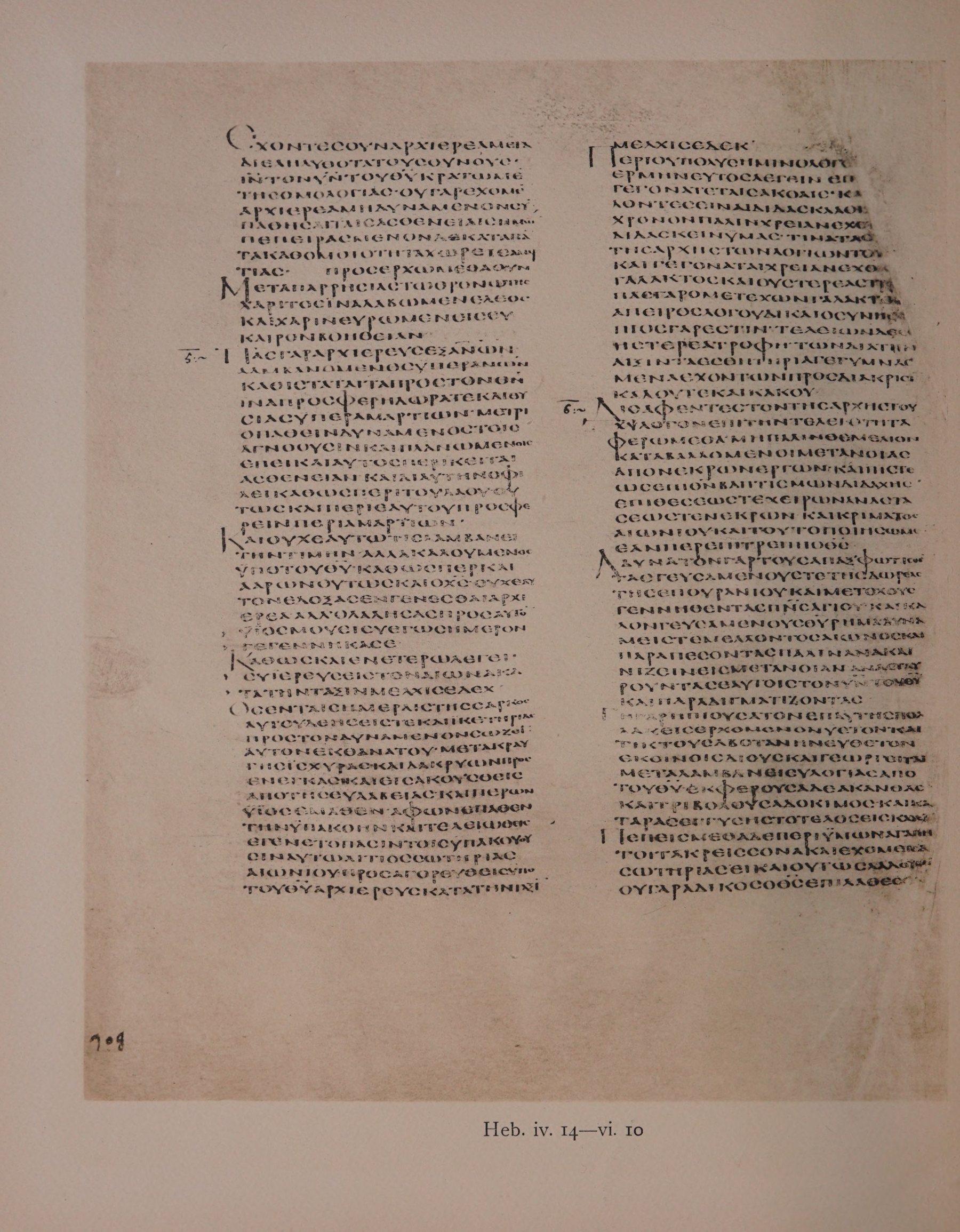
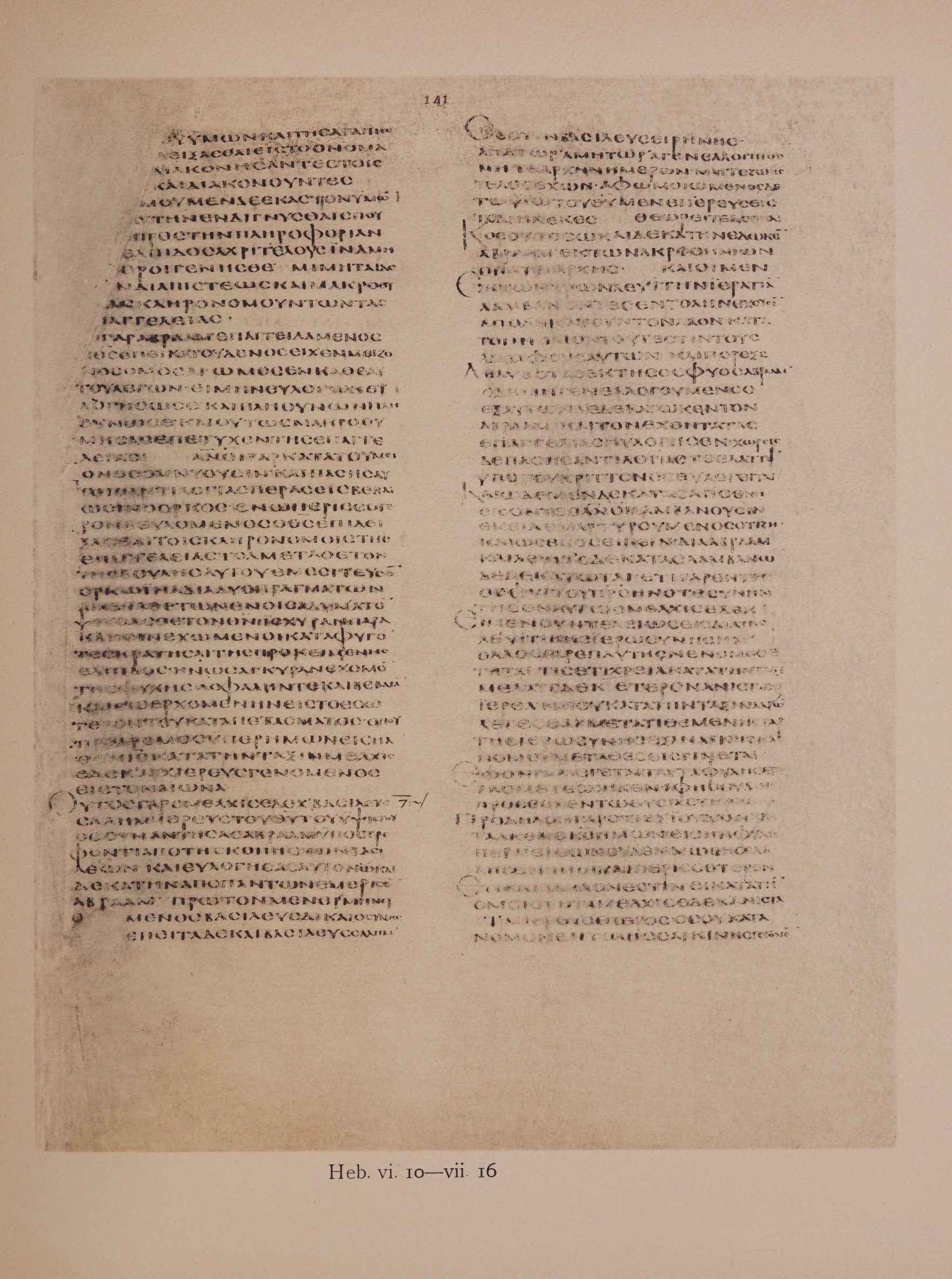
- Manuscript scan: the actual page(s) of Codex Alexandrinus containing this passage (folios 140v, 141r), reproduced from the British Museum's 1909 photographic facsimile edited by F. G. Kenyon, as digitised by the Getty Research Institute for the Internet Archive. The facsimile prints the verse range beneath each plate; that printed range was read for every page used and agrees with the INTF's NTVMR verse-level page index (CC BY 4.0). The page for each section now comes from the NTVMR transcription itself, which records the page and column on which every verse is written.
- Original text: the manuscript's own text, from a diplomatic transcription (see Greek text below), with Tischendorf's 8th critical edition (1869) for comparison.
- English translation: the King James Version (1611), retrieved verbatim from the public-domain bible-api.com endpoint.
Greek text: a diplomatic transcription of Codex Alexandrinus made by the Institut für Neutestamentliche Textforschung (INTF), Münster, for the New Testament Virtual Manuscript Room (NTVMR), published under a Creative Commons Attribution 4.0 licence. It gives the letters as the first scribe wrote them: no accents or breathings, the scribe's own spelling, and the sacred names in their contracted form (θς for θεος, ις for ιησους, κς for κυριος; the overline is not reproduced). Corrections by later hands are not shown. Letters in square brackets are not legible on the page and were restored by the transcribers, a dot under a letter marks an uncertain reading, and [...] marks text lost to damage. Beneath each section, for comparison, is Tischendorf's 8th critical edition (1869). Where the two differ, the transcription is what the manuscript says. Each section is shown with the page on which the transcription places its verses.
How was this verified? (Provenance)
Where on the image
Page from the NTVMR transcription (docID 20002): verses 1-10 on fol. 140v (facsimile leaf 242), col. 2; verse 10 continues on fol. 141r (facsimile leaf 243), col. 1 (which begins '[του] [εργ]ου υμων').
1διο αφεντες τον της αρχης του χυ λογον επι την τελειοτητα φερωμεθα · μη παλιν θεμελιον καταβαλλομενοι μετανοιας απο νεκρων εργων · και πιστεως επι θν 2βαπτισμων διδαχης επιθεσεως τε χειρων αναστασεως τε νεκρων και κριματος αιωνιου 3και τουτο ποιησωμεν εανπερ επιτρεπη ο θς 4αδυνατον γαρ τους απαξ φωτισθεντας γευσαμενους τε της δωρεας της επουρανιου · και μετοχους γεννηθεντας πνς αγιου · 5και καλον γευσαμενους θυ ρημα · δυναμεις τε μελλοντος αιωνος 6και παραπεσοντας παλιν ανακαινιζειν εις μετανοιαν ανασταυρουντας εαυτοις τον υν του θυ και παραδιγματιζοντας · 7γη γαρ η πιουσα τον επ αυτης πολλακεις ερχομενον υετον και τικτουσα βοτανην ευθετον εκε̣ινοις δι ους και γεωργειται μεταλαμβανει ευλογιας απο του θυ · 8εκφερουσα δε ακανθας και τριβολους αδοκιμος · και καταρας εγγυς ης το τελος εις καυσι̣ν 9πεπεισμεθα δε περι υμων αγαπητοι τα κρεισσονα και εχομενα σωτηριας ει και ουτως λαλουμ̣ε̣ν 10ου γαρ αδικος ο θς επιλαθεσθ̣α̣[ι] [του] [εργ]ου υμων και της αγαπης [ης] [ενε]δειξασθαι εις το ονομα [αυτου] διακονησαντες τοις [αγιοις] και διακονουντες
Compare: Tischendorf 8th edition (1869)
1Διὸ ἀφέντες τὸν τῆς ἀρχῆς τοῦ Χριστοῦ λόγον ἐπὶ τὴν τελειότητα φερώμεθα, μὴ πάλιν θεμέλιον καταβαλλόμενοι μετανοίας ἀπὸ νεκρῶν ἔργων, καὶ πίστεως ἐπὶ θεόν, 2βαπτισμῶν διδαχῆς, ἐπιθέσεώς τε χειρῶν, ἀναστάσεώς τε νεκρῶν, καὶ κρίματος αἰωνίου. 3καὶ τοῦτο ποιήσομεν ἐάνπερ ἐπιτρέπῃ ὁ θεός. 4ἀδύνατον γὰρ τοὺς ἅπαξ φωτισθέντας, γευσαμένους τε τῆς δωρεᾶς τῆς ἐπουρανίου καὶ μετόχους γενηθέντας πνεύματος ἁγίου 5καὶ καλὸν γευσαμένους θεοῦ ῥῆμα δυνάμεις τε μέλλοντος αἰῶνος, 6καὶ παραπεσόντας, πάλιν ἀνακαινίζειν εἰς μετάνοιαν, ἀνασταυροῦντας ἑαυτοῖς τὸν υἱὸν τοῦ θεοῦ καὶ παραδειγματίζοντας. 7γῆ γὰρ ἡ πιοῦσα τὸν ἐπ’ αὐτῆς ἐρχόμενον πολλάκις ὑετόν, καὶ τίκτουσα βοτάνην εὔθετον ἐκείνοις δι’ οὓς καὶ γεωργεῖται, μεταλαμβάνει εὐλογίας ἀπὸ τοῦ θεοῦ· 8ἐκφέρουσα δὲ ἀκάνθας καὶ τριβόλους ἀδόκιμος καὶ κατάρας ἐγγύς, ἧς τὸ τέλος εἰς καῦσιν. 9Πεπείσμεθα δὲ περὶ ὑμῶν, ἀγαπητοί, τὰ κρείσσονα καὶ ἐχόμενα σωτηρίας, εἰ καὶ οὕτως λαλοῦμεν· 10οὐ γὰρ ἄδικος ὁ θεὸς ἐπιλαθέσθαι τοῦ ἔργου ὑμῶν καὶ τῆς ἀγάπης ἧς ἐνεδείξασθε εἰς τὸ ὄνομα αὐτοῦ, διακονήσαντες τοῖς ἁγίοις καὶ διακονοῦντες.
1Therefore leaving the principles of the doctrine of Christ, let us go on unto perfection; not laying again the foundation of repentance from dead works, and of faith toward God, 2Of the doctrine of baptisms, and of laying on of hands, and of resurrection of the dead, and of eternal judgment. 3And this will we do, if God permit. 4For it is impossible for those who were once enlightened, and have tasted of the heavenly gift, and were made partakers of the Holy Ghost, 5And have tasted the good word of God, and the powers of the world to come, 6If they shall fall away, to renew them again unto repentance; seeing they crucify to themselves the Son of God afresh, and put him to an open shame. 7For the earth which drinketh in the rain that cometh oft upon it, and bringeth forth herbs meet for them by whom it is dressed, receiveth blessing from God: 8But that which beareth thorns and briers is rejected, and is nigh unto cursing; whose end is to be burned. 9But, beloved, we are persuaded better things of you, and things that accompany salvation, though we thus speak. 10For God is not unrighteous to forget your work and labour of love, which ye have shewed toward his name, in that ye have ministered to the saints, and do minister.
Where on the image
Page from the NTVMR transcription (docID 20002): verses 11-20 on fol. 141r (facsimile leaf 243), col. 1.
11[επιθυ]μουμεν δε εκαστον υμων [την] α̣υτην ενδιγνυσθαι σπου[δην] προς την πληροφοριαν [της] ελπιδος αχρι τελους 12ινα μη [νω]θροι γενησθε · μιμηται δε [τω]ν δια πιστεως και μακροθυ[μι]ας κληρονομουντων τας [ε]π̣αγγελειας · 13[τ]ω̣ γαρ αβρααμ επαγγειλαμενος ο̣ θς επει κατ ουδενος ειχεν μειζονος ομοσαι · ωμοσεν καθ εαυτου 14λεγων · ει μην ευλογων ευλογησω σε · και πληθυνων πληθυνω σε · 15και ουτως μακροθυμησας επετυχεν της επαγγελειας · 16ανοι γαρ κατα του μειζονος ομνυουσιν · και πασης αυτοις αντιλογιας περας εις βεβαιωσιν ο ορκος · 17εν ω περισσοτερον βουλομενος ο θς επιδειξασθαι τοις κληρονομοις της επαγγελειας το αμεταθετον της βουλης αυτου εμεσιτευσεν ορκω 18ινα δια δυο πραγματων αμεταθετων εν οις αδυνατον ψευσασθε τον θν ισχυραν παρακλησιν εχωμεν οι καταφυγοντες κρατησαι της προκειμενης ελπιδος · 19ην ως αγκυραν εχομεν της ψυχης ασφαλην τε και βεβαιαν και εισερχομενην εις το εσωτερ̣ον του καταπετασματος · 20οπου προδρομος υπερ ημων εισηλθε̣ν ις κατα την ταξιν μελχισεδεκ αρχιερευς γενομενος εις τον αιωνα
Compare: Tischendorf 8th edition (1869)
11ἐπιθυμοῦμεν δὲ ἕκαστον ὑμῶν τὴν αὐτὴν ἐνδείκνυσθαι σπουδὴν πρὸς τὴν πληροφορίαν τῆς ἐλπίδος ἄχρι τέλους, 12ἵνα μὴ νωθροὶ γένησθε, μιμηταὶ δὲ τῶν διὰ πίστεως καὶ μακροθυμίας κληρονομούντων τὰς ἐπαγγελίας. 13τῷ γὰρ Ἀβραὰμ ἐπαγγειλάμενος ὁ θεός, ἐπεὶ κατ’ οὐδενὸς εἶχεν μείζονος ὀμόσαι, ὤμοσεν καθ’ ἑαυτοῦ, 14λέγων· εἰ μὴν εὐλογῶν εὐλογήσω σε καὶ πληθύνων πληθυνῶ σε· 15καὶ οὕτως μακροθυμήσας ἐπέτυχεν τῆς ἐπαγγελίας. 16ἄνθρωποι γὰρ κατὰ τοῦ μείζονος ὀμνύουσιν, καὶ πάσης αὐτοῖς ἀντιλογίας πέρας εἰς βεβαίωσιν ὁ ὅρκος· 17ἐν ᾧ περισσότερον βουλόμενος ὁ θεὸς ἐπιδεῖξαι τοῖς κληρονόμοις τῆς ἐπαγγελίας τὸ ἀμετάθετον τῆς βουλῆς αὐτοῦ ἐμεσίτευσεν ὅρκῳ, 18ἵνα διὰ δύο πραγμάτων ἀμεταθέτων, ἐν οἷς ἀδύνατον ψεύσασθαι τὸν θεόν, ἰσχυρὰν παράκλησιν ἔχωμεν οἱ καταφυγόντες κρατῆσαι τῆς προκειμένης ἐλπίδος· 19ἣν ὡς ἄγκυραν ἔχομεν τῆς ψυχῆς, ἀσφαλῆ τε καὶ βεβαίαν καὶ εἰσερχομένην εἰς τὸ ἐσώτερον τοῦ καταπετάσματος, 20ὅπου πρόδρομος ὑπὲρ ἡμῶν εἰσῆλθεν Ἰησοῦς, κατὰ τὴν τάξιν Μελχισέδεκ ἀρχιερεὺς γενόμενος εἰς τὸν αἰῶνα.
11And we desire that every one of you do shew the same diligence to the full assurance of hope unto the end: 12That ye be not slothful, but followers of them who through faith and patience inherit the promises. 13For when God made promise to Abraham, because he could swear by no greater, he sware by himself, 14Saying, Surely blessing I will bless thee, and multiplying I will multiply thee. 15And so, after he had patiently endured, he obtained the promise. 16For men verily swear by the greater: and an oath for confirmation is to them an end of all strife. 17Wherein God, willing more abundantly to shew unto the heirs of promise the immutability of his counsel, confirmed it by an oath: 18That by two immutable things, in which it was impossible for God to lie, we might have a strong consolation, who have fled for refuge to lay hold upon the hope set before us: 19Which hope we have as an anchor of the soul, both sure and stedfast, and which entereth into that within the veil; 20Whither the forerunner is for us entered, even Jesus, made an high priest for ever after the order of Melchisedec.
Cite
Sources
- Source: Codex Alexandrinus page images + NTVMR transcription (CC BY 4.0) + Tischendorf 8th edition + KJV (holding institution)
- Critical edition: Codex Alexandrinus transcription, NTVMR (INTF Münster, CC BY 4.0); Tischendorf 8th edition for comparison
← previous · → next · v cycle view · l back to library