John, Chapter 1 (Codex Alexandrinus)
Introduction
John 1 from Codex Alexandrinus (GA 02), a fifth-century Greek Bible held by the British Library (Royal MS 1 D. VIII). In the New Testament it is the chief witness to the Byzantine text in the Gospels and to the Alexandrian text in the rest of the New Testament. Its New Testament volume lacks Matthew 1:1-25:5, John 6:50-8:52 and 2 Corinthians 4:13-12:6.
Numbering: Tischendorf's verse numbering in this chapter differs from the KJV's (52 Greek verses against 51 English). This affects only the Tischendorf comparison text.
This entry meets the strict three-criteria standard of the Theosis Library:
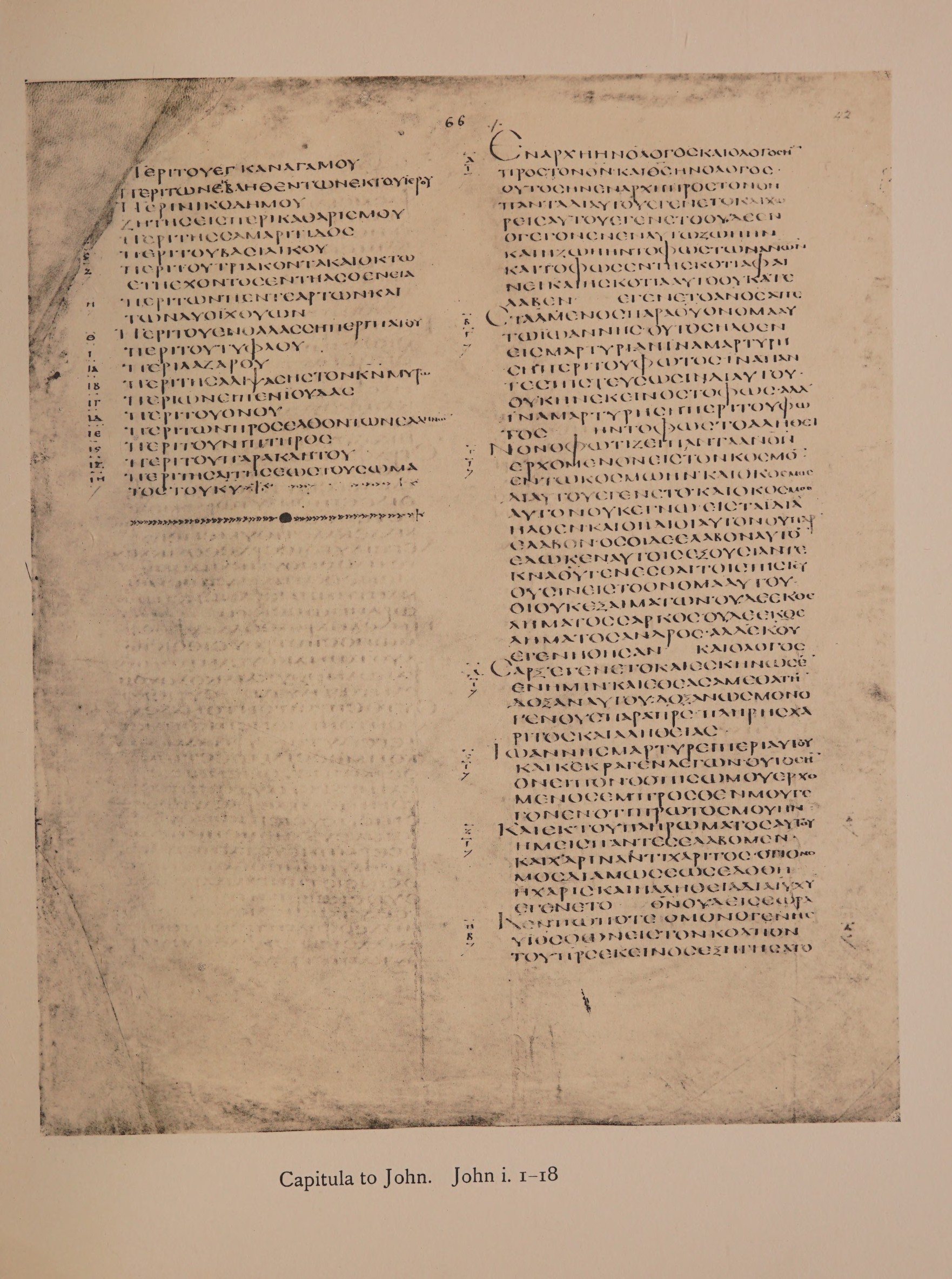
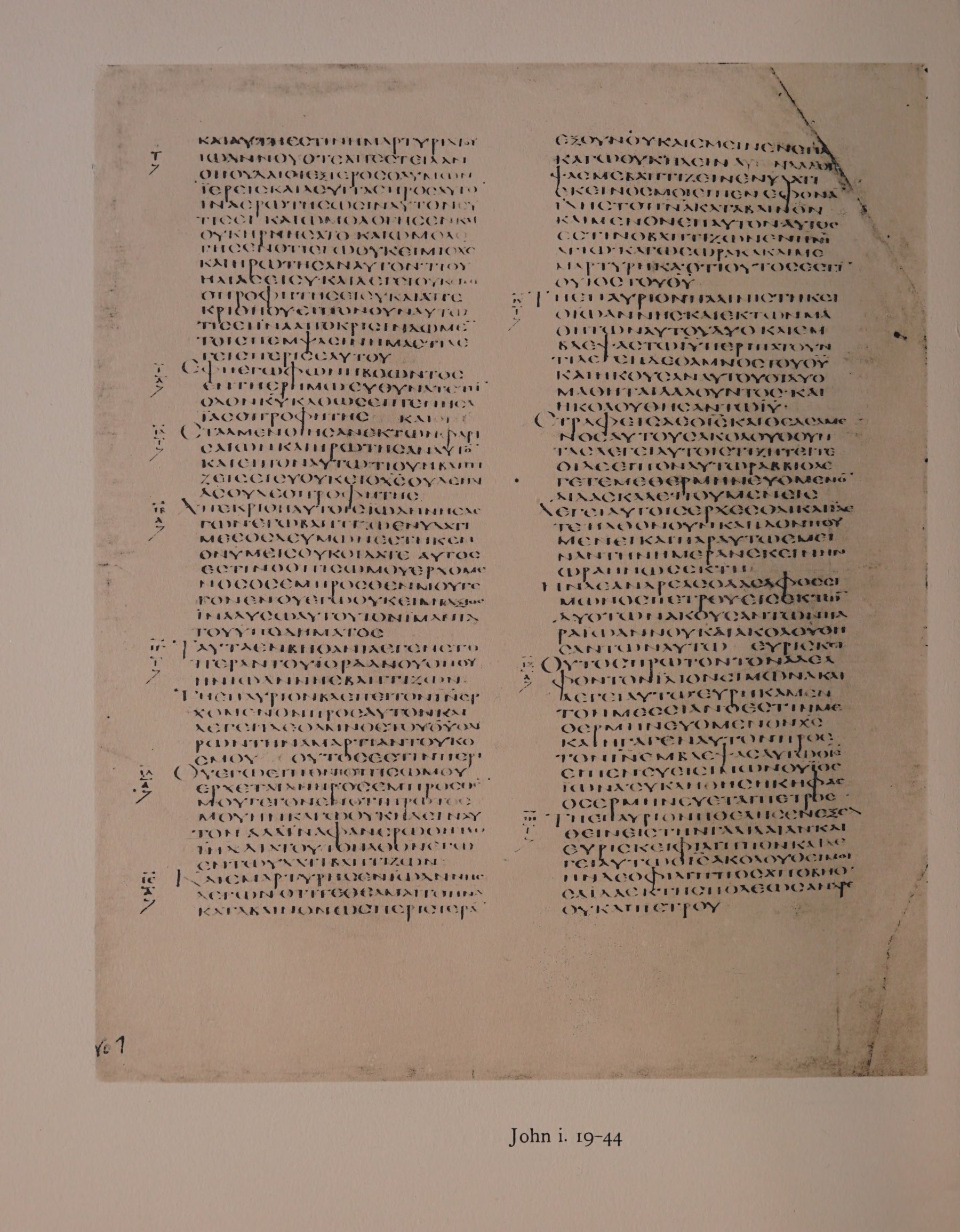
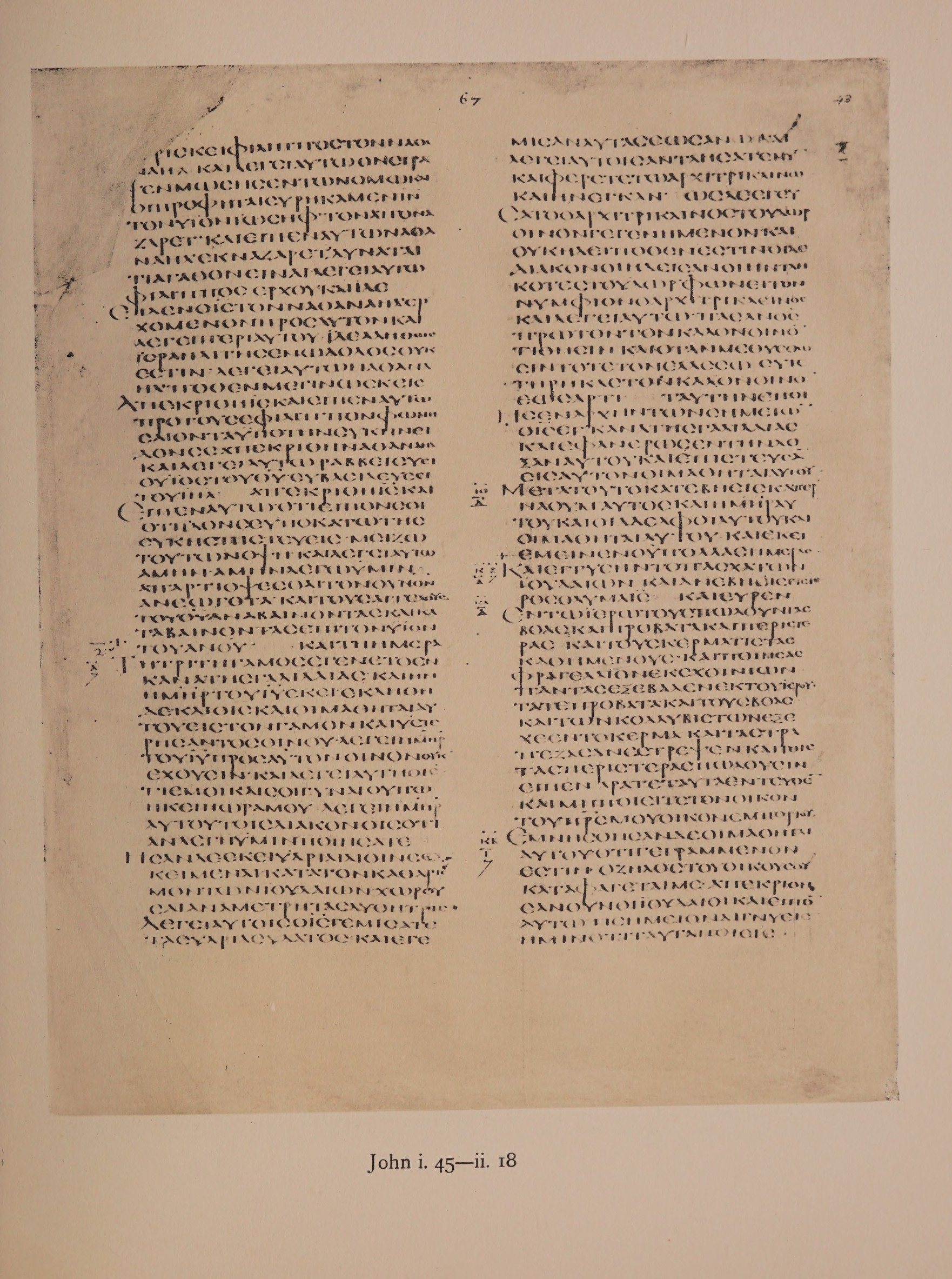
- Manuscript scan: the actual page(s) of Codex Alexandrinus containing this passage (folios 66r, 66v, 67r), reproduced from the British Museum's 1909 photographic facsimile edited by F. G. Kenyon, as digitised by the Getty Research Institute for the Internet Archive. The facsimile prints the verse range beneath each plate; that printed range was read for every page used and agrees with the INTF's NTVMR verse-level page index (CC BY 4.0). The page for each section now comes from the NTVMR transcription itself, which records the page and column on which every verse is written.
- Original text: the manuscript's own text, from a diplomatic transcription (see Greek text below), with Tischendorf's 8th critical edition (1869) for comparison.
- English translation: the King James Version (1611), retrieved verbatim from the public-domain bible-api.com endpoint.
Greek text: a diplomatic transcription of Codex Alexandrinus made by the Institut für Neutestamentliche Textforschung (INTF), Münster, for the New Testament Virtual Manuscript Room (NTVMR), published under a Creative Commons Attribution 4.0 licence. It gives the letters as the first scribe wrote them: no accents or breathings, the scribe's own spelling, and the sacred names in their contracted form (θς for θεος, ις for ιησους, κς for κυριος; the overline is not reproduced). Corrections by later hands are not shown. Letters in square brackets are not legible on the page and were restored by the transcribers, a dot under a letter marks an uncertain reading, and [...] marks text lost to damage. Beneath each section, for comparison, is Tischendorf's 8th critical edition (1869). Where the two differ, the transcription is what the manuscript says. Each section is shown with the page on which the transcription places its verses.
How was this verified? (Provenance)
Where on the image
Page from the NTVMR transcription (docID 20002): verses 1-9 on fol. 66r (facsimile leaf 97), col. 1.
1εν αρχη ην ο λογος και ο λογος ην προς τον θν · και θς ην ο λογος · 2ουτος ην εν αρχη προς τον θν 3παντα δι αυτου εγενετο και χωρεις αυτου εγενετο ουδε εν ο γεγονεν 4εν αυτω ζωη ην και η ζωη ην το φως των ανων 5και το φως εν τη σκοτια φαινει · και η σκοτια αυτο ου κατελαβεν · 6εγενετο ανος απεσταλμενος παρα θυ ονομα αυτω ιωαννης · 7ουτος ηλθεν εις μαρτυριαν ινα μαρτυρηση περι του φωτος · ινα παντες πιστευσωσιν δι αυτου · 8ουκ ην εκεινος το φως · αλλ ινα μαρτυρηση περι του φωτος · 9ην το φως το αληθεινον ο φωτιζει παντα ανον ερχομενον εις τον κοσμον ·
Compare: Tischendorf 8th edition (1869)
1Ἐν ἀρχῇ ἦν ὁ λόγος, καὶ ὁ λόγος ἦν πρὸς τὸν θεόν, καὶ θεὸς ἦν ὁ λόγος. 2οὗτος ἦν ἐν ἀρχῇ πρὸς τὸν θεόν. 3πάντα δι’ αὐτοῦ ἐγένετο, καὶ χωρὶς αὐτοῦ ἐγένετο οὐδὲ ἕν ὃ γέγονεν 4ἐν αὐτῷ ζωὴ ἐστιν, καὶ ἡ ζωὴ ἦν τὸ φῶς τῶν ἀνθρώπων. 5καὶ τὸ φῶς ἐν τῇ σκοτίᾳ φαίνει, καὶ ἡ σκοτία αὐτὸ οὐ κατέλαβεν. 6Ἐγένετο ἄνθρωπος, ἀπεσταλμένος παρὰ θεοῦ, ὄνομα αὐτῷ Ἰωάννης· 7οὗτος ἦλθεν εἰς μαρτυρίαν, ἵνα μαρτυρήσῃ περὶ τοῦ φωτός, ἵνα πάντες πιστεύσωσιν δι’ αὐτοῦ. 8οὐκ ἦν ἐκεῖνος τὸ φῶς, ἀλλ’ ἵνα μαρτυρήσῃ περὶ τοῦ φωτός. 9Ἦν τὸ φῶς τὸ ἀληθινόν, ὃ φωτίζει πάντα ἄνθρωπον, ἐρχόμενον εἰς τὸν κόσμον.
1In the beginning was the Word, and the Word was with God, and the Word was God. 2The same was in the beginning with God. 3All things were made by him; and without him was not any thing made that was made. 4In him was life; and the life was the light of men. 5And the light shineth in darkness; and the darkness comprehended it not. 6There was a man sent from God, whose name was John. 7The same came for a witness, to bear witness of the Light, that all men through him might believe. 8He was not that Light, but was sent to bear witness of that Light. 9That was the true Light, which lighteth every man that cometh into the world.
Where on the image
Page from the NTVMR transcription (docID 20002): verses 10-18 on fol. 66r (facsimile leaf 97), col. 1.
10εν τω κοσμω ην · και ο κοσμος δι αυτου εγενετο · και ο κοσμος αυτον ουκ εγνω · 11εις τα ιδια ηλθεν · και οι ιδιοι αυτον ου παρελαβον · 12οσοι δε ελαβον αυτον εδωκεν αυτοις εξουσιαν τεκνα θυ γενεσθαι τοις πιστευουσιν εις το ονομα αυτου · 13οι ουκ εξ αιματων · ουδε εκ θεληματος σαρκος · ουδε εκ θεληματος ανδρος · αλλ εκ θυ εγενηθησαν · 14και ο λογος σαρξ εγενετο και εσκηνωσεν εν ημιν · και εθεασαμεθα την δοξαν αυτου · δοξαν ως μονογενους παρα πρς πληρης χαριτος και αληθειας · 15ιωαννης μαρτυρει περι αυτου και κεκραγεν λεγων · ουτος ην ον ειπον · ο οπισω μου ερχομενος εμπροσθεν μου γεγονεν οτι πρωτος μου ην · 16και εκ του πληρωματος αυτου ημεις παντες ελαβομεν · και χαριν αντι χαριτος · 17οτι ο νομος δια μωσεως εδοθη η χαρις και η αληθεια δια ιυ χυ εγενετο · 18θν ουδεις εωρακεν πωποτε · ο μονογενης υιος ο ων εις τον κολπον του πρς εκεινος εξηγησατο
Compare: Tischendorf 8th edition (1869)
10ἐν τῷ κόσμῳ ἦν, καὶ ὁ κόσμος δι’ αὐτοῦ ἐγένετο, καὶ ὁ κόσμος αὐτὸν οὐκ ἔγνω. 11εἰς τὰ ἴδια ἦλθεν, καὶ οἱ ἴδιοι αὐτὸν οὐ παρέλαβον. 12ὅσοι δὲ ἔλαβον αὐτόν, ἔδωκεν αὐτοῖς ἐξουσίαν τέκνα θεοῦ γενέσθαι, τοῖς πιστεύουσιν εἰς τὸ ὄνομα αὐτοῦ, 13οἳ οὐκ ἐξ αἱμάτων οὐδὲ ἐκ θελήματος σαρκὸς οὐδὲ ἐκ θελήματος ἀνδρὸς ἀλλ’ ἐκ θεοῦ ἐγεννήθησαν. 14καὶ ὁ λόγος σὰρξ ἐγένετο καὶ ἐσκήνωσεν ἐν ἡμῖν, καὶ ἐθεασάμεθα τὴν δόξαν αὐτοῦ, δόξαν ὡς μονογενοῦς παρὰ πατρός, πλήρης χάριτος καὶ ἀληθείας. 15Ἰωάννης μαρτυρεῖ περὶ αὐτοῦ καὶ κέκραγεν λέγων· οὗτος ἦν ὃν εἶπον· ὁ ὀπίσω μου ἐρχόμενος ἔμπροσθέν μου γέγονεν, ὅτι πρῶτός μου ἦν. 16ὅτι ἐκ τοῦ πληρώματος αὐτοῦ ἡμεῖς πάντες ἐλάβομεν, καὶ χάριν ἀντὶ χάριτος· 17ὅτι ὁ νόμος διὰ Μωϋσέως ἐδόθη, ἡ χάρις καὶ ἡ ἀλήθεια διὰ Ἰησοῦ Χριστοῦ ἐγένετο. 18θεὸν οὐδεὶς ἑώρακεν πώποτε· ὁ μονογενὴς υἱὸς ὁ ὢν εἰς τὸν κόλπον τοῦ πατρός, ἐκεῖνος ἐξηγήσατο.
10He was in the world, and the world was made by him, and the world knew him not. 11He came unto his own, and his own received him not. 12But as many as received him, to them gave he power to become the sons of God, even to them that believe on his name: 13Which were born, not of blood, nor of the will of the flesh, nor of the will of man, but of God. 14And the Word was made flesh, and dwelt among us, (and we beheld his glory, the glory as of the only begotten of the Father,) full of grace and truth. 15John bare witness of him, and cried, saying, This was he of whom I spake, He that cometh after me is preferred before me: for he was before me. 16And of his fulness have all we received, and grace for grace. 17For the law was given by Moses, but grace and truth came by Jesus Christ. 18No man hath seen God at any time; the only begotten Son, which is in the bosom of the Father, he hath declared him.
Where on the image
Page from the NTVMR transcription (docID 20002): verses 19-25 on fol. 66v (facsimile leaf 98), col. 1.
19και αυτη εστιν η μαρτυρια του ιωαννου οτε απεστειλαν οι ιουδαιοι εξ ιεροσολυμων ιερεις και λευιτας προς αυτον ινα ερωτησωσιν αυτον συ τις ει · 20και ωμολογησεν και ουκ ηρνησατο και ωμολογησεν οτι εγω ουκ ειμι ο χς 21και ηρωτησαν αυτον · τι ουν ηλιας ει συ · και λεγει ουκ ειμι ο προφητης ει συ και απεκριθη ου · 22ειπον ουν αυτω τις ει ινα αποκρισιν δωμεν τοις πεμψασιν ημας τι λεγεις περι σεαυτου 23εφη εγω φωνη βοωντος εν τη ερημω · ευθυνατε την οδον κυ καθως ειπεν ησαιας ο προφητης · 24και [...] απεσταλμενοι ησαν εκ των φαρισαιων · 25και ηρωτησαν αυτον και ειπον αυτω · τι ουν βαπτιζεις ει συ ουκ ει ο χς ουδε ηλιας ουδε ο προφητης
Compare: Tischendorf 8th edition (1869)
19Καὶ αὕτη ἐστὶν ἡ μαρτυρία τοῦ Ἰωάννου, ὅτε ἀπέστειλαν οἱ Ἰουδαῖοι ἐξ Ἱεροσολύμων ἱερεῖς καὶ Λευείτας ἵνα ἐρωτήσωσιν αὐτόν· σὺ τίς εἶ; 20καὶ ὡμολόγησεν καὶ οὐκ ἠρνήσατο, καὶ ὡμολόγησεν ὅτι ἐγὼ οὐκ εἰμὶ ὁ Χριστός. 21καὶ ἠρώτησαν αὐτόν· τί οὖν; Ἡλείας εἶ; λέγει· οὐκ εἰμί. ὁ προφήτης εἶ σύ; καὶ ἀπεκρίθη· οὔ. 22εἶπαν οὖν αὐτῷ· τίς εἶ; ἵνα ἀπόκρισιν δῶμεν τοῖς πέμψασιν ἡμᾶς· τί λέγεις περὶ σεαυτοῦ; 23ἔφη· ἐγὼ φωνὴ βοῶντος ἐν τῇ ἐρήμῳ· εὐθύνατε τὴν ὁδὸν κυρίου, καθὼς εἶπεν Ἡσαΐας ὁ προφήτης. 24καὶ ἀπεσταλμένοι ἦσαν ἐκ τῶν Φαρισαίων. 25καὶ ἠρώτησαν αὐτὸν καὶ εἶπαν αὐτῷ· τί οὖν βαπτίζεις, εἰ σὺ οὐκ εἶ ὁ Χριστὸς οὐδὲ Ἡλείας οὐδὲ ὁ προφήτης;
19And this is the record of John, when the Jews sent priests and Levites from Jerusalem to ask him, Who art thou? 20And he confessed, and denied not; but confessed, I am not the Christ. 21And they asked him, What then? Art thou Elias? And he saith, I am not. Art thou that prophet? And he answered, No. 22Then said they unto him, Who art thou? that we may give an answer to them that sent us. What sayest thou of thyself? 23He said, I am the voice of one crying in the wilderness, Make straight the way of the Lord, as said the prophet Esaias. 24And they which were sent were of the Pharisees. 25And they asked him, and said unto him, Why baptizest thou then, if thou be not that Christ, nor Elias, neither that prophet?
Where on the image
Page from the NTVMR transcription (docID 20002): verses 26-32 on fol. 66v (facsimile leaf 98), col. 1.
26απεκριθη αυτοις ιωαννης λεγων · εγω βαπτιζω εν υδατι μεσος δε υμων εστηκεν ον υμεις ουκ οιδατε 27αυτος εστιν ο οπισω μου ερχομενος ος εμπροσθεν μου γεγονεν · ου εγω ουκ ειμι αξιος ινα λυσω αυτου τον ιμαντα του υποδηματος 28ταυτα εν βηθανια εγενετο περαν του ιορδανου οπου ην ιωαννης βαπτιζων · 29τη επαυριον βλεπει τον ιν ερχομενον προς αυτον και λεγει · ιδε ο αμνος του θυ ο αιρων την αμαρτιαν του κοσμου · 30ουτος εστιν περι ου εγω ειπον · οπισω μου ερχεται ανηρ · ος εμπροσθεν μου γεγονεν οτι πρωτος μου ην 31καγω ουκ ηδειν αυτον · αλλ ινα φανερωθη · τω ιηλ · δια τουτο ηλθον εγω εν τω υδατι βαπτιζων · 32και εμαρτυρησεν ιωαννης λεγων οτι τεθεαμαι το πνα καταβαινον ως περιστεραν εξ ουνου · και εμεινεν επ α[υτον]
Compare: Tischendorf 8th edition (1869)
26ἀπεκρίθη αὐτοῖς ὁ Ἰωάννης λέγων· ἐγὼ βαπτίζω ἐν ὕδατι· μέσος ὑμῶν στήκει, ὃν ὑμεῖς οὐκ οἴδατε, 27ὁ ὀπίσω μου ἐρχόμενος, οὗ οὐκ εἰμὶ ἐγὼ ἄξιος ἵνα λύσω αὐτοῦ τὸν ἱμάντα τοῦ ὑποδήματος. 28ταῦτα ἐν Βηθανίᾳ ἐγένετο πέραν τοῦ Ἰορδάνου, ὅπου ἦν ὁ Ἰωάννης βαπτίζων. 29Τῇ ἐπαύριον βλέπει τὸν Ἰησοῦν ἐρχόμενον πρὸς αὐτόν, καὶ λέγει· ἴδε ὁ ἀμνὸς τοῦ θεοῦ ὁ αἴρων τὴν ἁμαρτίαν τοῦ κόσμου. 30οὗτός ἐστιν ὑπὲρ οὗ ἐγὼ εἶπον· ὀπίσω μου ἔρχεται ἀνὴρ ὃς ἔμπροσθέν μου γέγονεν, ὅτι πρῶτός μου ἦν. 31κἀγὼ οὐκ ᾔδειν αὐτόν, ἀλλ’ ἵνα φανερωθῇ τῷ Ἰσραήλ, διὰ τοῦτο ἦλθον ἐγὼ ἐν ὕδατι βαπτίζων. 32καὶ ἐμαρτύρησεν Ἰωάννης λέγων ὅτι τεθέαμαι τὸ πνεῦμα καταβαῖνον ὡς περιστερὰν ἐξ οὐρανοῦ, καὶ ἔμεινεν ἐπ’ αὐτόν.
26John answered them, saying, I baptize with water: but there standeth one among you, whom ye know not; 27He it is, who coming after me is preferred before me, whose shoe’s latchet I am not worthy to unloose. 28These things were done in Bethabara beyond Jordan, where John was baptizing. 29The next day John seeth Jesus coming unto him, and saith, Behold the Lamb of God, which taketh away the sin of the world. 30This is he of whom I said, After me cometh a man which is preferred before me: for he was before me. 31And I knew him not: but that he should be made manifest to Israel, therefore am I come baptizing with water. 32And John bare record, saying, I saw the Spirit descending from heaven like a dove, and it abode upon him.
Where on the image
Page from the NTVMR transcription (docID 20002): verses 33-44 on fol. 66v (facsimile leaf 98), col. 2.
33καγω ουκ · ηδειν [...] αλλ ο π[εμ]ψας με βαπτιζειν εν υδατι εκεινος μοι ειπεν εφ ον αν ιδης το πνα καταβαινον και μενον επ αυτον · αυτος εστιν ο βαπτιζων εν πνι αγιω · 34καγω εωρακα και μεμαρτυρηκα · οτι ουτος εστιν ο υιος του θυ 35τη επαυριον παλιν ιστηκει ο ιωαννης · και εκ των μαθητων αυτου δυο 36και εμβλεψας τω ιυ περιπατουντι λεγει ιδε ο αμνος του θυ 37και ηκουσαν αυτου οι δυο μαθηται λαλουντος · και ηκολουθησαν τω ιυ · 38στραφεις δε ο ις και θεασαμενος αυτους ακολουθουντας λεγει αυτοις τι ζητειτε οι δε ειπον αυτω ραββι ο λεγετε μεθερμηνευομενον διδασκαλε που μενεις 39λεγει αυτοις ερχεσθαι και ιδετε · ηλθον ουν και ιδον που μενει · και παρ αυτω εμειναν την ημεραν εκεινην ωρα ην ως εκτη · 40ην δε ανδρεας ο αδελφος σιμωνος πετρου · εις εκ των δυο των ακουσαντων παρα ιωαννου · και ακολουθησαντων αυτω · 41ευρισκει ουτος πρωτον τον αδελφον τον ιδιον σιμωνα και λεγει αυτω · ευρηκαμεν τον μεσσιαν · ο εστιν μεθερμηνευομενον χς · 42και ηγαγεν αυτον προς τον ιν εμβλεψας αυτω ο ις ειπεν · συ ει σιμων ο υιος ιωνα · συ κληθηση κηφας ος ερμηνευεται πετρος · 43τη επαυριον ηθελησεν εξελθειν εις την γαλιλαιαν · και ευρισκει φιλιππον · και λεγει αυτω ο ις ακολουθει μοι 44ην δε ο φιλιππος απο βηθσαιδα εκ της πολεως ανδρεου και πετρου ·
Compare: Tischendorf 8th edition (1869)
33κἀγὼ οὐκ ᾔδειν αὐτόν, ἀλλ’ ὁ πέμψας με βαπτίζειν ἐν ὕδατι, ἐκεῖνός μοι εἶπεν· ἐφ’ ὃν ἂν ἴδῃς τὸ πνεῦμα καταβαῖνον καὶ μένον ἐπ’ αὐτόν, οὗτός ἐστιν ὁ βαπτίζων ἐν πνεύματι ἁγίῳ. 34κἀγὼ ἑώρακα, καὶ μεμαρτύρηκα ὅτι οὗτός ἐστιν ὁ υἱὸς τοῦ θεοῦ. 35Τῇ ἐπαύριον πάλιν εἱστήκει ὁ Ἰωάννης καὶ ἐκ τῶν μαθητῶν αὐτοῦ δύο, 36καὶ ἐμβλέψας τῷ Ἰησοῦ περιπατοῦντι λέγει· ἴδε ὁ ἀμνὸς τοῦ θεοῦ. 37ἤκουσαν οἱ δύο μαθηταὶ αὐτοῦ λαλοῦντος, καὶ ἠκολούθησαν τῷ Ἰησοῦ. 38στραφεὶς ὁ Ἰησοῦς καὶ θεασάμενος αὐτοὺς ἀκολουθοῦντας λέγει αὐτοῖς· 39τί ζητεῖτε; οἱ δὲ εἶπαν αὐτῷ· ῥαββεί, ὃ λέγεται ἑρμηνευόμενον διδάσκαλε, ποῦ μένεις; 40λέγει αὐτοῖς· ἔρχεσθε καὶ ὄψεσθε. ἦλθαν οὖν καὶ εἶδαν ποῦ μένει, καὶ παρ’ αὐτῷ ἔμειναν τὴν ἡμέραν ἐκείνην· ὥρα ἦν ὡς δεκάτη. 41ἦν Ἀνδρέας ὁ ἀδελφὸς Σίμωνος Πέτρου εἷς ἐκ τῶν δύο τῶν ἀκουσάντων παρὰ Ἰωάννου καὶ ἀκολουθησάντων αὐτῷ· 42εὑρίσκει οὗτος πρῶτος τὸν ἀδελφὸν τὸν ἴδιον Σίμωνα καὶ λέγει αὐτῷ· εὑρήκαμεν τὸν Μεσσίαν, ὅ ἐστιν μεθερμηνευόμενον Χριστός. 43ἤγαγεν αὐτὸν πρὸς τὸν Ἰησοῦν. ἐμβλέψας αὐτῷ ὁ Ἰησοῦς εἶπεν· σὺ εἶ Σίμων ὁ υἱὸς Ἰωάννου, σὺ κληθήσῃ Κηφᾶς, ὃ ἑρμηνεύεται Πέτρος. 44Τῇ ἐπαύριον ἠθέλησεν ἐξελθεῖν εἰς τὴν Γαλιλαίαν, καὶ εὑρίσκει Φίλιππον. καὶ λέγει αὐτῷ ὁ Ἰησοῦς, ἀκολούθει μοι.
33And I knew him not: but he that sent me to baptize with water, the same said unto me, Upon whom thou shalt see the Spirit descending, and remaining on him, the same is he which baptizeth with the Holy Ghost. 34And I saw, and bare record that this is the Son of God. 35Again the next day after John stood, and two of his disciples; 36And looking upon Jesus as he walked, he saith, Behold the Lamb of God! 37And the two disciples heard him speak, and they followed Jesus. 38Then Jesus turned, and saw them following, and saith unto them, What seek ye? They said unto him, Rabbi, (which is to say, being interpreted, Master,) where dwellest thou? 39He saith unto them, Come and see. They came and saw where he dwelt, and abode with him that day: for it was about the tenth hour. 40One of the two which heard John speak, and followed him, was Andrew, Simon Peter’s brother. 41He first findeth his own brother Simon, and saith unto him, We have found the Messias, which is, being interpreted, the Christ. 42And he brought him to Jesus. And when Jesus beheld him, he said, Thou art Simon the son of Jona: thou shalt be called Cephas, which is by interpretation, A stone. 43The day following Jesus would go forth into Galilee, and findeth Philip, and saith unto him, Follow me. 44Now Philip was of Bethsaida, the city of Andrew and Peter.
Where on the image
Page from the NTVMR transcription (docID 20002): verses 45-51 on fol. 67r (facsimile leaf 99), col. 1.
45[ευ]ρισκει φιλιππος τον ναθαν̣αηλ · και λεγει αυτω · ον εγραψεν μωσης εν τω νομω και οι προφηται ευρηκαμεν ιν τον υιον ιωσηφ · τον απο ναζαρετ · 46και ειπεν αυτω ναθαναηλ · εκ ναζαρετ δυναται τι αγαθον ειναι · λεγει αυτω φιλιππος ερχου και ιδε · 47ειδεν ο ις τον ναθαναηλ · ερχομενον προς αυτον και λεγει περι αυτου · ιδε αληθως ισραηλιτης εν ω δολος ουκ εστιν · 48λεγει αυτω ναθαναηλ · ποθεν με γινωσκεις απεκριθη ις και ειπεν αυτω προ του σε φιλιππον φωνησαι οντα υπο την συκην ειδον σε 49απεκριθη ναθαναηλ και λεγει αυτω · ραββει συ ει ο υιος του θυ · συ βασιλευς ει του ιηλ · 50απεκριθη ις και ειπεν αυτω · οτι ειπον σοι οτι ιδον σε υποκατω της συκης πιστευεις · μειζω τουτων οψη · 51και λεγει αυτω αμην · αμην λεγω υμιν · απ αρτι οψεσθαι τον ουνον ανεωγοτα · και τους αγγελους του θυ αναβαινοντας και καταβαινοντας επι τον υιον του ανου ·
Compare: Tischendorf 8th edition (1869)
45ἦν δὲ ὁ Φίλιππος ἀπὸ Βηθσαϊδά, ἐκ τῆς πόλεως Ἀνδρέου καὶ Πέτρου. 46εὑρίσκει Φίλιππος τὸν Ναθαναὴλ καὶ λέγει αὐτῷ· ὃν ἔγραψεν Μωϋσῆς ἐν τῷ νόμῳ καὶ οἱ προφῆται, εὑρήκαμεν, Ἰησοῦν υἱὸν τοῦ Ἰωσὴφ τὸν ἀπὸ Ναζαρέτ. 47εἶπεν αὐτῷ Ναθαναήλ· ἐκ Ναζαρὲτ δύναταί τι ἀγαθὸν εἶναι; λέγει αὐτῷ Φίλιππος· ἔρχου καὶ ἴδε. 48εἶδεν Ἰησοῦς τὸν Ναθαναὴλ ἐρχόμενον πρὸς αὐτὸν καὶ λέγει περὶ αὐτοῦ· ἴδε ἀληθῶς Ἰσραηλείτης, ἐν ᾧ δόλος οὐκ ἔστιν. 49λέγει αὐτῷ Ναθαναήλ· πόθεν με γινώσκεις; ἀπεκρίθη Ἰησοῦς καὶ εἶπεν αὐτῷ· πρὸ τοῦ σε Φίλιππον φωνῆσαι ὄντα ὑπὸ τὴν συκῆν εἶδόν σε. 50ἀπεκρίθη αὐτῷ Ναθαναήλ· ῥαββεί, σὺ εἶ ὁ υἱὸς τοῦ θεοῦ, σὺ βασιλεὺς εἶ τοῦ Ἰσραήλ. 51ἀπεκρίθη Ἰησοῦς καὶ εἶπεν αὐτῷ· ὅτι εἶπόν σοι ὅτι εἶδόν σε ὑποκάτω τῆς συκῆς, πιστεύεις; μείζω τούτων ὄψῃ. 52καὶ λέγει αὐτῷ· ἀμὴν ἀμὴν λέγω ὑμῖν, ὄψεσθε τὸν οὐρανὸν ἀνεῳγότα καὶ τοὺς ἀγγέλους τοῦ θεοῦ ἀναβαίνοντας καὶ καταβαίνοντας ἐπὶ τὸν υἱὸν τοῦ ἀνθρώπου.
45Philip findeth Nathanael, and saith unto him, We have found him, of whom Moses in the law, and the prophets, did write, Jesus of Nazareth, the son of Joseph. 46And Nathanael said unto him, Can there any good thing come out of Nazareth? Philip saith unto him, Come and see. 47Jesus saw Nathanael coming to him, and saith of him, Behold an Israelite indeed, in whom is no guile! 48Nathanael saith unto him, Whence knowest thou me? Jesus answered and said unto him, Before that Philip called thee, when thou wast under the fig tree, I saw thee. 49Nathanael answered and saith unto him, Rabbi, thou art the Son of God; thou art the King of Israel. 50Jesus answered and said unto him, Because I said unto thee, I saw thee under the fig tree, believest thou? thou shalt see greater things than these. 51And he saith unto him, Verily, verily, I say unto you, Hereafter ye shall see heaven open, and the angels of God ascending and descending upon the Son of man.
Cite
Sources
- Source: Codex Alexandrinus page images + NTVMR transcription (CC BY 4.0) + Tischendorf 8th edition + KJV (holding institution)
- Critical edition: Codex Alexandrinus transcription, NTVMR (INTF Münster, CC BY 4.0); Tischendorf 8th edition for comparison
← previous · → next · v cycle view · l back to library