John, Chapter 13 (Codex Alexandrinus)
Introduction
John 13 from Codex Alexandrinus (GA 02), a fifth-century Greek Bible held by the British Library (Royal MS 1 D. VIII). In the New Testament it is the chief witness to the Byzantine text in the Gospels and to the Alexandrian text in the rest of the New Testament. Its New Testament volume lacks Matthew 1:1-25:5, John 6:50-8:52 and 2 Corinthians 4:13-12:6.
This entry meets the strict three-criteria standard of the Theosis Library:
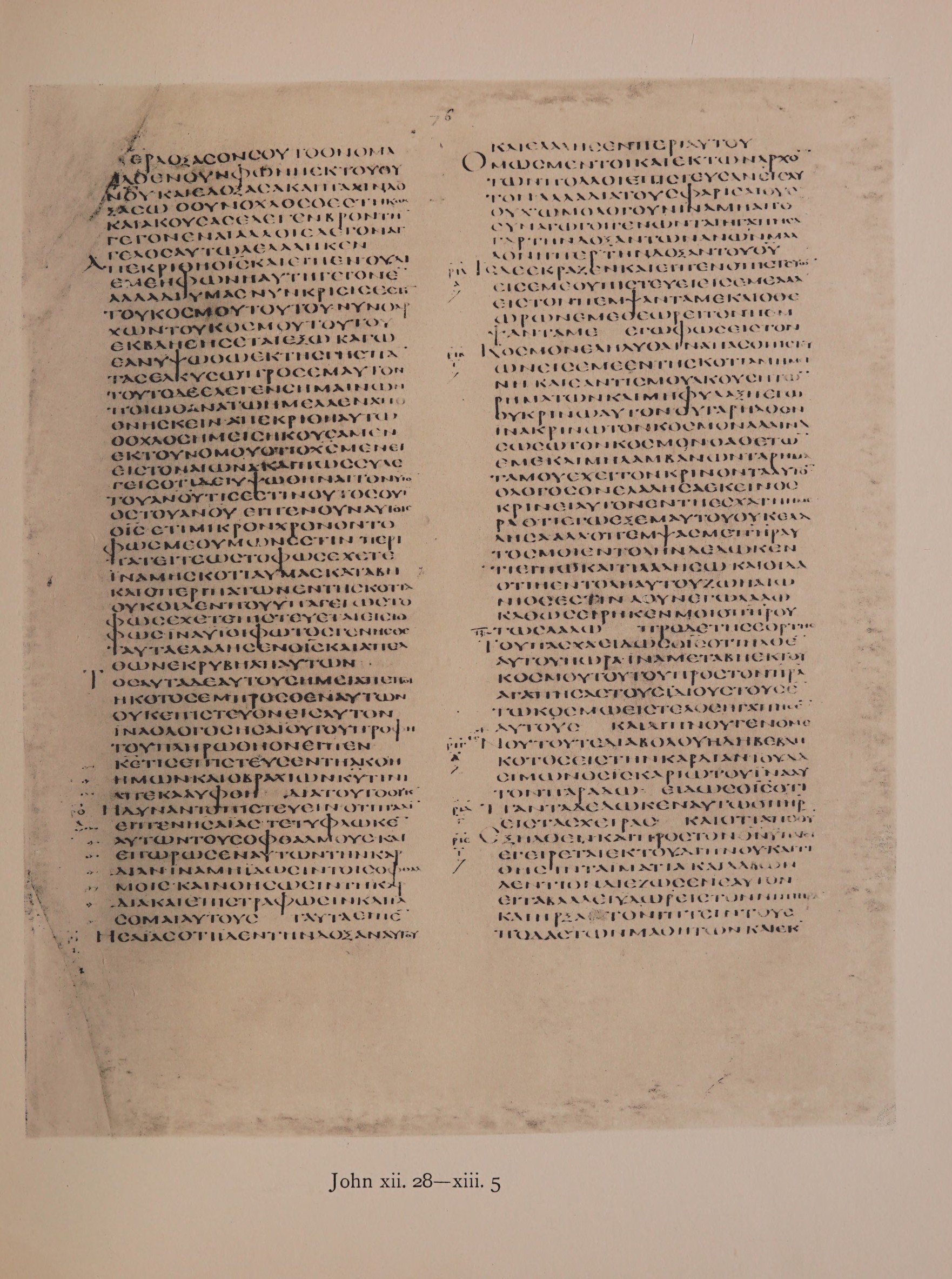
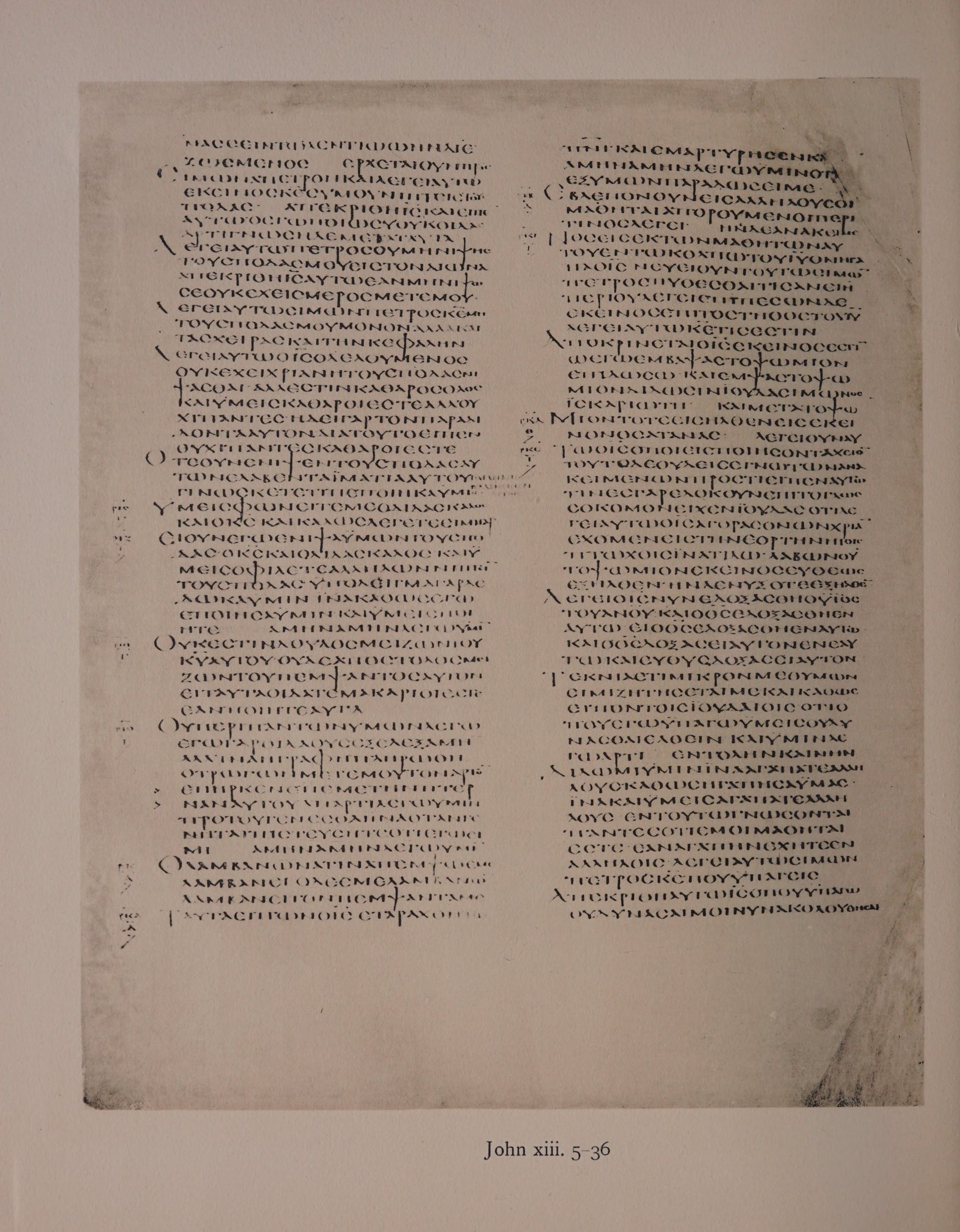
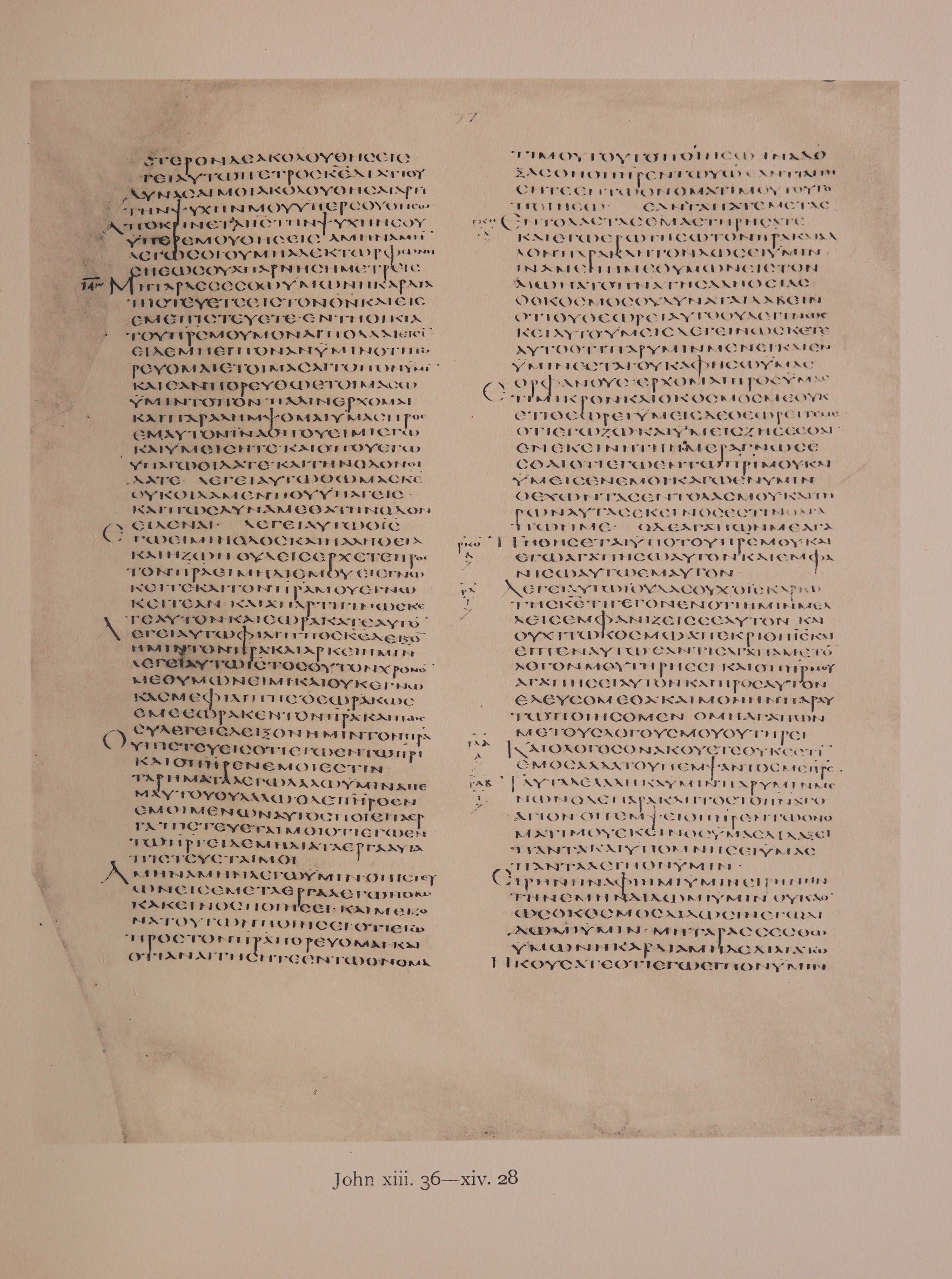
- Manuscript scan: the actual page(s) of Codex Alexandrinus containing this passage (folios 76r, 76v, 77r), reproduced from the British Museum's 1909 photographic facsimile edited by F. G. Kenyon, as digitised by the Getty Research Institute for the Internet Archive. The facsimile prints the verse range beneath each plate; that printed range was read for every page used and agrees with the INTF's NTVMR verse-level page index (CC BY 4.0). The page for each section now comes from the NTVMR transcription itself, which records the page and column on which every verse is written.
- Original text: the manuscript's own text, from a diplomatic transcription (see Greek text below), with Tischendorf's 8th critical edition (1869) for comparison.
- English translation: the King James Version (1611), retrieved verbatim from the public-domain bible-api.com endpoint.
Greek text: a diplomatic transcription of Codex Alexandrinus made by the Institut für Neutestamentliche Textforschung (INTF), Münster, for the New Testament Virtual Manuscript Room (NTVMR), published under a Creative Commons Attribution 4.0 licence. It gives the letters as the first scribe wrote them: no accents or breathings, the scribe's own spelling, and the sacred names in their contracted form (θς for θεος, ις for ιησους, κς for κυριος; the overline is not reproduced). Corrections by later hands are not shown. Letters in square brackets are not legible on the page and were restored by the transcribers, a dot under a letter marks an uncertain reading, and [...] marks text lost to damage. Beneath each section, for comparison, is Tischendorf's 8th critical edition (1869). Where the two differ, the transcription is what the manuscript says. Each section is shown with the page on which the transcription places its verses.
How was this verified? (Provenance)
Where on the image
Page from the NTVMR transcription (docID 20002): verses 1-5 on fol. 76r (facsimile leaf 113), col. 2; verse 5 continues on fol. 76v (facsimile leaf 114), col. 1 (which begins 'μασσειν τω λεντιω').
1προ δε της εορτης του πασχα · ειδως ο ις οτι ηλθεν αυτου η ωρα · ινα μεταβη εκ του κοσμου τουτου προς τον πρα αγαπησας τους ιδιους τους εν τω κοσμω εις τελος ηγαπησεν αυτους · 2και διπνου γενομενου του τε διαβολου ηδη βεβληκοτος εις την καρδιαν · ιουδα σιμωνος ισκαριωτου ινα αυτον παραδω · 3ειδως ο ις οτι παντα δεδωκεν αυτω ο πηρ εις τας χειρας · και οτι απο θυ εξηλθεν · και προς τον θν υπαγει 4εγειρεται εκ του διπνου · και τιθησιν τα ιματια και λαβων λεντιον διεζωσεν εαυτον 5ειτα βαλλει υδωρ εις τον νιπτηρα · και ηρξαντο νιπτειν τους ποδας των μαθητων και εκμασσειν τω λεντιω ω ην διεζωσμενος
Compare: Tischendorf 8th edition (1869)
1Πρὸ δὲ τῆς ἑορτῆς τοῦ πάσχα εἰδὼς ὁ Ἰησοῦς ὅτι ἦλθεν αὐτοῦ ἡ ὥρα ἵνα μεταβῇ ἐκ τοῦ κόσμου τούτου πρὸς τὸν πατέρα, ἀγαπήσας τοὺς ἰδίους τοὺς ἐν τῷ κόσμῳ, εἰς τέλος ἠγάπησεν αὐτούς. 2καὶ δείπνου γινομένου, τοῦ διαβόλου ἤδη βεβληκότος εἰς τὴν καρδίαν ἵνα παραδοῖ αὐτὸν Ἰούδας Σίμωνος Ἰσκαριώτης, 3εἰδὼς ὅτι πάντα ἔδωκεν αὐτῷ ὁ πατὴρ εἰς τὰς χεῖρας καὶ ὅτι ἀπὸ θεοῦ ἐξῆλθεν καὶ πρὸς τὸν θεὸν ὑπάγει, 4ἐγείρεται ἐκ τοῦ δείπνου καὶ τίθησιν τὰ ἱμάτια, καὶ λαβὼν λέντιον διέζωσεν ἑαυτόν· 5εἶτα βάλλει ὕδωρ εἰς τὸν νιπτῆρα, καὶ ἤρξατο νίπτειν τοὺς πόδας τῶν μαθητῶν καὶ ἐκμάσσειν τῷ λεντίῳ ᾧ ἦν διεζωσμένος.
1Now before the feast of the passover, when Jesus knew that his hour was come that he should depart out of this world unto the Father, having loved his own which were in the world, he loved them unto the end. 2And supper being ended, the devil having now put into the heart of Judas Iscariot, Simon’s son, to betray him; 3Jesus knowing that the Father had given all things into his hands, and that he was come from God, and went to God; 4He riseth from supper, and laid aside his garments; and took a towel, and girded himself. 5After that he poureth water into a bason, and began to wash the disciples’ feet, and to wipe them with the towel wherewith he was girded.
Where on the image
Page from the NTVMR transcription (docID 20002): verses 6-13 on fol. 76v (facsimile leaf 114), col. 1.
6ερχεται ουν προς σιμωνα πετρον και λεγει αυτω εκεινος κε συ μου νιπτεις τους ποδας · 7απεκριθη ις και ειπεν αυτω · ο εγω ποιω συ ουκ οιδας αρτι γνωση δε μετα ταυτα 8λεγει αυτω πετρος ου μη νιψης τους ποδας μου εις τον αιωνα απεκριθη ις αυτω εαν μη νιψω σε ουκ εχεις μερος μετ εμου · 9λεγει αυτω σιμων πετρος κε μη τους ποδας μου μονον · αλλα και τας χειρας και την κεφαλην 10λεγει αυτω ο ις ο λελουμενος ουκ εχει χριαν η τους ποδας νιψασθαι · αλλ εστιν καθαρος ολος και υμεις καθαροι εστε αλλ ουχι παντες · 11ηδει γαρ τον παραδιδοντα αυτον · δια τουτο ειπεν ουχι παντες καθαροι εστε 12οτε ουν ενιψεν τους ποδας αυτων ελαβεν τα ιματια αυτου γινωσκετε τι πεποιηκα υμιν · 13υμεις φωνειτε με ο διδασκαλος και ο κς · και καλως λεγετε ειμι γαρ
Compare: Tischendorf 8th edition (1869)
6ἔρχεται οὖν πρὸς Σίμωνα Πέτρον· λέγει αὐτῷ· κύριε, σύ μου νίπτεις τοὺς πόδας; 7ἀπεκρίθη Ἰησοῦς καὶ εἶπεν αὐτῷ· ὃ ἐγὼ ποιῶ σὺ οὐκ οἶδας ἄρτι, γνώσῃ δὲ μετὰ ταῦτα. 8λέγει αὐτῷ Πέτρος· οὐ μὴ νίψῃς μου τοὺς πόδας εἰς τὸν αἰῶνα. ἀπεκρίθη Ἰησοῦς αὐτῷ· ἐὰν μὴ νίψω σε, οὐκ ἔχεις μέρος μετ’ ἐμοῦ. 9λέγει αὐτῷ Σίμων Πέτρος· κύριε, μὴ τοὺς πόδας μου μόνον ἀλλὰ καὶ τὰς χεῖρας καὶ τὴν κεφαλήν. 10λέγει αὐτῷ Ἰησοῦς· ὁ λελουμένος οὐκ ἔχει χρείαν νίψασθαι, ἀλλ’ ἔστιν καθαρὸς ὅλος· καὶ ὑμεῖς καθαροί ἐστε, ἀλλ’ οὐχὶ πάντες. 11ᾔδει γὰρ τὸν παραδιδόντα αὐτόν· διὰ τοῦτο εἶπεν ὅτι οὐχὶ πάντες καθαροί ἐστε. 12Ὅτε οὖν ἔνιψεν τοὺς πόδας αὐτῶν καὶ ἔλαβεν τὰ ἱμάτια αὐτοῦ καὶ ἀνέπεσεν πάλιν, εἶπεν αὐτοῖς· γινώσκετε τί πεποίηκα ὑμῖν; 13ὑμεῖς φωνεῖτέ με· ὁ διδάσκαλος καὶ ὁ κύριος, καὶ καλῶς λέγετε· εἰμὶ γάρ.
6Then cometh he to Simon Peter: and Peter saith unto him, Lord, dost thou wash my feet? 7Jesus answered and said unto him, What I do thou knowest not now; but thou shalt know hereafter. 8Peter saith unto him, Thou shalt never wash my feet. Jesus answered him, If I wash thee not, thou hast no part with me. 9Simon Peter saith unto him, Lord, not my feet only, but also my hands and my head. 10Jesus saith to him, He that is washed needeth not save to wash his feet, but is clean every whit: and ye are clean, but not all. 11For he knew who should betray him; therefore said he, Ye are not all clean. 12So after he had washed their feet, and had taken his garments, and was set down again, he said unto them, Know ye what I have done to you? 13Ye call me Master and Lord: and ye say well; for so I am.
Where on the image
Page from the NTVMR transcription (docID 20002): verses 14-21 on fol. 76v (facsimile leaf 114), col. 1.
14ει ουν εγω ενιψα υμων τους ποδας · ο κς και ο διδασκαλος και υμεις οφιλετε αλληλων νιπτειν τους ποδας · 15υποδειγμα γαρ δεδωκα υμιν · ινα καθως εγω εποιησα υμιν · και υμεις ποιητε · 16αμην αμην λεγω υμιν ουκ εστιν δουλος μειζων του κυ αυτου · ουδε αποστολος μειζων του πεμψαντος αυτον 17ει ταυτα οιδατε μακαριοι εστε εαν ποιητε αυτα 18ου περι παντων υμων λεγω εγω γαρ οιδα ους εξελεξαμην αλλ ινα η γραφη πληρωθη ο τρωγων μετ εμου τον αρτον επηρκεν επ εμε την πτερναν αυτου 19απ αρτι λεγω υμιν προ του γενεσθαι ινα οταν γενηται πιστευσητε οτι εγω ειμι · 20αμην αμην λεγω υμιν ο λαμβανων ατινα πεμψω εμε λαμβανει · ο δε εμε λαμβανων λαμβανει τον πεμψαντα με 21ταυτα ειπων ο ις · εταραχθη τω πνι · και εμαρτυρησεν κα[ι] [ειπεν] αμην αμην λεγω υμιν οτι [εις] εξ υμων παραδωσει με ·
Compare: Tischendorf 8th edition (1869)
14εἰ οὖν ἐγὼ ἔνιψα ὑμῶν τοὺς πόδας ὁ κύριος καὶ ὁ διδάσκαλος, καὶ ὑμεῖς ὀφείλετε ἀλλήλων νίπτειν τοὺς πόδας· 15ὑπόδειγμα γὰρ δέδωκα ὑμῖν, ἵνα καθὼς ἐγὼ ἐποίησα ὑμῖν καὶ ὑμεῖς ποιῆτε. 16ἀμὴν ἀμὴν λέγω ὑμῖν, οὐκ ἔστιν δοῦλος μείζων τοῦ κυρίου αὐτοῦ οὐδὲ ἀπόστολος μείζων τοῦ πέμψαντος αὐτόν. 17εἰ ταῦτα οἴδατε, μακάριοί ἐστε ἐὰν ποιῆτε αὐτά. 18οὐ περὶ πάντων ὑμῶν λέγω· ἐγὼ οἶδα τίνας ἐξελεξάμην· ἀλλ’ ἵνα ἡ γραφὴ πληρωθῇ· ὁ τρώγων μετ’ ἐμοῦ τὸν ἄρτον ἐπῆρκεν ἐπ’ ἐμὲ τὴν πτέρναν αὐτοῦ. 19ἀπάρτι λέγω ὑμῖν πρὸ τοῦ γενέσθαι, ἵνα πιστεύσητε ὅταν γένηται ὅτι ἐγώ εἰμι. 20ἀμὴν ἀμὴν λέγω ὑμῖν, ὁ λαμβάνων ἄν τινα πέμψω ἐμὲ λαμβάνει, ὁ δὲ ἐμὲ λαμβάνων λαμβάνει τὸν πέμψαντά με. 21Ταῦτα εἰπὼν Ἰησοῦς ἐταράχθη τῷ πνεύματι καὶ ἐμαρτύρησεν καὶ εἶπεν· ἀμὴν ἀμὴν λέγω ὑμῖν ὅτι εἷς ἐξ ὑμῶν παραδώσει με.
14If I then, your Lord and Master, have washed your feet; ye also ought to wash one another’s feet. 15For I have given you an example, that ye should do as I have done to you. 16Verily, verily, I say unto you, The servant is not greater than his lord; neither he that is sent greater than he that sent him. 17If ye know these things, happy are ye if ye do them. 18I speak not of you all: I know whom I have chosen: but that the scripture may be fulfilled, He that eateth bread with me hath lifted up his heel against me. 19Now I tell you before it come, that, when it is come to pass, ye may believe that I am he. 20Verily, verily, I say unto you, He that receiveth whomsoever I send receiveth me; and he that receiveth me receiveth him that sent me. 21When Jesus had thus said, he was troubled in spirit, and testified, and said, Verily, verily, I say unto you, that one of you shall betray me.
Where on the image
Page from the NTVMR transcription (docID 20002): verses 22-29 on fol. 76v (facsimile leaf 114), col. 2.
22εβλεπον ουν εις αλληλους οι μαθηται απορουμενοι περι τινος λεγει · 23ην δε ανακειμενος εις εκ των μαθητων αυτου εν τω κολπω του ιυ ον ηγαπα ο ις 24νευει ουν τουτω σιμων πετρος πυθεσθαι τις αν ειη περι ου λεγει 25επιπεσων δε εκεινος επι το στηθος του ιυ λεγει αυτω κε τις εστιν 26αποκρινεται ο ις εκεινος εστιν ω εγω εμβαψας το ψωμιον επιδωσω · και εμψας το ψωμιον διδωσιν ιουδα σιμωνος ισκαριωτη · 27και μετα το ψωμιον τοτε εισηλθεν εις εκεινον ο σατανας · λεγει ουν αυτω ο ις ο ποιεις ποιησον ταχειον 28τουτο δε ουδεις εγνω των ανακειμενων προς τι ειπεν αυτω 29τινες γαρ εδοκουν επι το γλωσσοκομον ειχεν ιουδας οτι λεγει αυτω ο ις αγορασον ων χριαν εχομεν εις την εορτην η τοις πτωχοις ινα τι δω ·
Compare: Tischendorf 8th edition (1869)
22ἔβλεπον εἰς ἀλλήλους οἱ μαθηταί, ἀπορούμενοι περὶ τίνος λέγει. 23ἦν ἀνακείμενος εἷς ἐκ τῶν μαθητῶν αὐτοῦ ἐν τῷ κόλπῳ τοῦ Ἰησοῦ, ὃν ἠγάπα ὁ Ἰησοῦς· 24νεύει οὖν τούτῳ Σίμων Πέτρος καὶ λέγει αὐτῷ· εἰπὲ τίς ἐστιν περὶ οὗ λέγει. 25ἐπιπεσὼν οὖν ἐκεῖνος οὕτως ἐπὶ τὸ στῆθος τοῦ Ἰησοῦ λέγει αὐτῷ· κύριε, τίς ἐστιν; 26ἀποκρίνεται ὁ Ἰησοῦς, ἐκεῖνός ἐστιν ᾧ ἐγὼ βάψω τὸ ψωμίον καὶ δώσω αὐτῷ. βάψας οὖν τὸ ψωμίον λαμβάνει καὶ δίδωσιν Ἰούδᾳ Σίμωνος Ἰσκαριώτου. 27καὶ μετὰ τὸ ψωμίον, τότε εἰσῆλθεν εἰς ἐκεῖνον ὁ σατανᾶς. λέγει οὖν αὐτῷ Ἰησοῦς· ὃ ποιεῖς ποίησον τάχιον. 28τοῦτο δὲ οὐδεὶς ἔγνω τῶν ἀνακειμένων πρὸς τί εἶπεν αὐτῷ· 29τινὲς γὰρ ἐδόκουν, ἐπεὶ τὸ γλωσσόκομον εἶχεν Ἰούδας, ὅτι λέγει αὐτῷ Ἰησοῦς, ἀγόρασον ὧν χρείαν ἔχομεν εἰς τὴν ἑορτήν, ἢ τοῖς πτωχοῖς ἵνα τι δῷ.
22Then the disciples looked one on another, doubting of whom he spake. 23Now there was leaning on Jesus’ bosom one of his disciples, whom Jesus loved. 24Simon Peter therefore beckoned to him, that he should ask who it should be of whom he spake. 25He then lying on Jesus’ breast saith unto him, Lord, who is it? 26Jesus answered, He it is, to whom I shall give a sop, when I have dipped it. And when he had dipped the sop, he gave it to Judas Iscariot, the son of Simon. 27And after the sop Satan entered into him. Then said Jesus unto him, That thou doest, do quickly. 28Now no man at the table knew for what intent he spake this unto him. 29For some of them thought, because Judas had the bag, that Jesus had said unto him, Buy those things that we have need of against the feast; or, that he should give something to the poor.
Where on the image
Page from the NTVMR transcription (docID 20002): verses 30-36 on fol. 76v (facsimile leaf 114), col. 2; verse 36 continues on fol. 77r (facsimile leaf 115), col. 1 (which begins '[υ]στερον δε ακολουθησεις').
30λαβων ουν το ψωμιον εκεινος ευθεως εξηλθεν · ην δε νυξ 31οτε εξηλθεν λεγει ο ις νυν εδοξασθη ο υιος του ανου · και ο θς εδοξασθη εν αυτω · 32ει ο θς εδοξασθη εν αυτω και ο θς δοξασει αυτον εν εαυτω · και ευθυς δοξασει αυτον 33τεκνια ετι μικρον μεθ υμων ειμι ζητησεται με · και καθως ειπον τοις ιουδαιοις · οτι οπου εγω υπαγω υμεις ου δυνασθαι ελθειν · και υμιν λεγω αρτι · 34εντολην καινην διδωμι υμιν ινα αγαπατε αλληλους · καθως ηγαπησα υμας · ινα και υμεις αγαπατε αλληλους · 35εν τουτω γνωσονται παντες οτι εμοι μαθηται εστε · εαν αγαπην εχητε εν αλληλοις · 36λεγει αυτω σιμων πετρος κε που υπαγεις · απεκριθη αυτω ις οπου υπαγω ου δυνασαι μοι νυν ακολουθησαι [υ]στερον δε ακολουθησεις
Compare: Tischendorf 8th edition (1869)
30λαβὼν οὖν τὸ ψωμίον ἐκεῖνος ἐξῆλθεν εὐθύς· ἦν δὲ νύξ. 31Ὅτε οὖν ἐξῆλθεν λέγει Ἰησοῦς· νῦν ἐδοξάσθη ὁ υἱὸς τοῦ ἀνθρώπου, καὶ ὁ θεὸς ἐδοξάσθη ἐν αὐτῷ. 32εἰ ὁ θεὸς ἐδοξάσθη ἐν αὐτῷ, καὶ ὁ θεὸς δοξάσει αὐτὸν ἐν αὐτῷ, καὶ εὐθὺς δοξάσει αὐτόν. 33τεκνία, ἔτι μικρὸν μεθ’ ὑμῶν εἰμί· ζητήσετέ με, καὶ καθὼς εἶπον τοῖς Ἰουδαίοις ὅτι ὅπου ἐγὼ ὑπάγω ὑμεῖς οὐ δύνασθε ἐλθεῖν, καὶ ὑμῖν λέγω ἄρτι. 34ἐντολὴν καινὴν δίδωμι ὑμῖν, ἵνα ἀγαπᾶτε ἀλλήλους· καθὼς ἠγάπησα ὑμᾶς ἵνα καὶ ὑμεῖς ἀγαπᾶτε ἀλλήλους. 35ἐν τούτῳ γνώσονται πάντες ὅτι ἐμοὶ μαθηταί ἐστε, ἐὰν ἀγάπην ἔχητε ἐν ἀλλήλοις. 36Λέγει αὐτῷ Σίμων Πέτρος· κύριε, ποῦ ὑπάγεις; ἀπεκρίθη Ἰησοῦς· ὅπου ἐγὼ ὑπάγω οὐ δύνασαί μοι νῦν ἀκολουθῆσαι, ἀκολουθήσεις δὲ ὕστερον.
30He then having received the sop went immediately out: and it was night. 31Therefore, when he was gone out, Jesus said, Now is the Son of man glorified, and God is glorified in him. 32If God be glorified in him, God shall also glorify him in himself, and shall straightway glorify him. 33Little children, yet a little while I am with you. Ye shall seek me: and as I said unto the Jews, Whither I go, ye cannot come; so now I say to you. 34A new commandment I give unto you, That ye love one another; as I have loved you, that ye also love one another. 35By this shall all men know that ye are my disciples, if ye have love one to another. 36Simon Peter said unto him, Lord, whither goest thou? Jesus answered him, Whither I go, thou canst not follow me now; but thou shalt follow me afterwards.
Where on the image
Page from the NTVMR transcription (docID 20002): verses 37-38 on fol. 77r (facsimile leaf 115), col. 1.
37[λ]ε̣γει αυτω πετρος κε δια τι ου δυνασαι μοι ακολουθησαι αρτι την ψυχην μου υπερ σου θησω 38αποκρινεται ις την ψυχην σου υπερ εμου θησεις αμην αμην λεγω σοι · ου μη αλεκτωρ φωνηση εως ου απαρνηση με τρεις
Compare: Tischendorf 8th edition (1869)
37λέγει αὐτῷ Πέτρος· κύριε, διατί οὐ δύναμαί σοι ἀκολουθῆσαι ἄρτι; τὴν ψυχήν μου ὑπὲρ σοῦ θήσω. 38ἀποκρίνεται Ἰησοῦς· τὴν ψυχήν σου ὑπὲρ ἐμοῦ θήσεις; ἀμὴν ἀμὴν λέγω σοι, οὐ μὴ ἀλέκτωρ φωνήσῃ ἕως οὗ ἀρνήσῃ με τρίς.
37Peter said unto him, Lord, why cannot I follow thee now? I will lay down my life for thy sake. 38Jesus answered him, Wilt thou lay down thy life for my sake? Verily, verily, I say unto thee, The cock shall not crow, till thou hast denied me thrice.
Cite
Sources
- Source: Codex Alexandrinus page images + NTVMR transcription (CC BY 4.0) + Tischendorf 8th edition + KJV (holding institution)
- Critical edition: Codex Alexandrinus transcription, NTVMR (INTF Münster, CC BY 4.0); Tischendorf 8th edition for comparison
← previous · → next · v cycle view · l back to library