John, Chapter 14 (Codex Alexandrinus)
Introduction
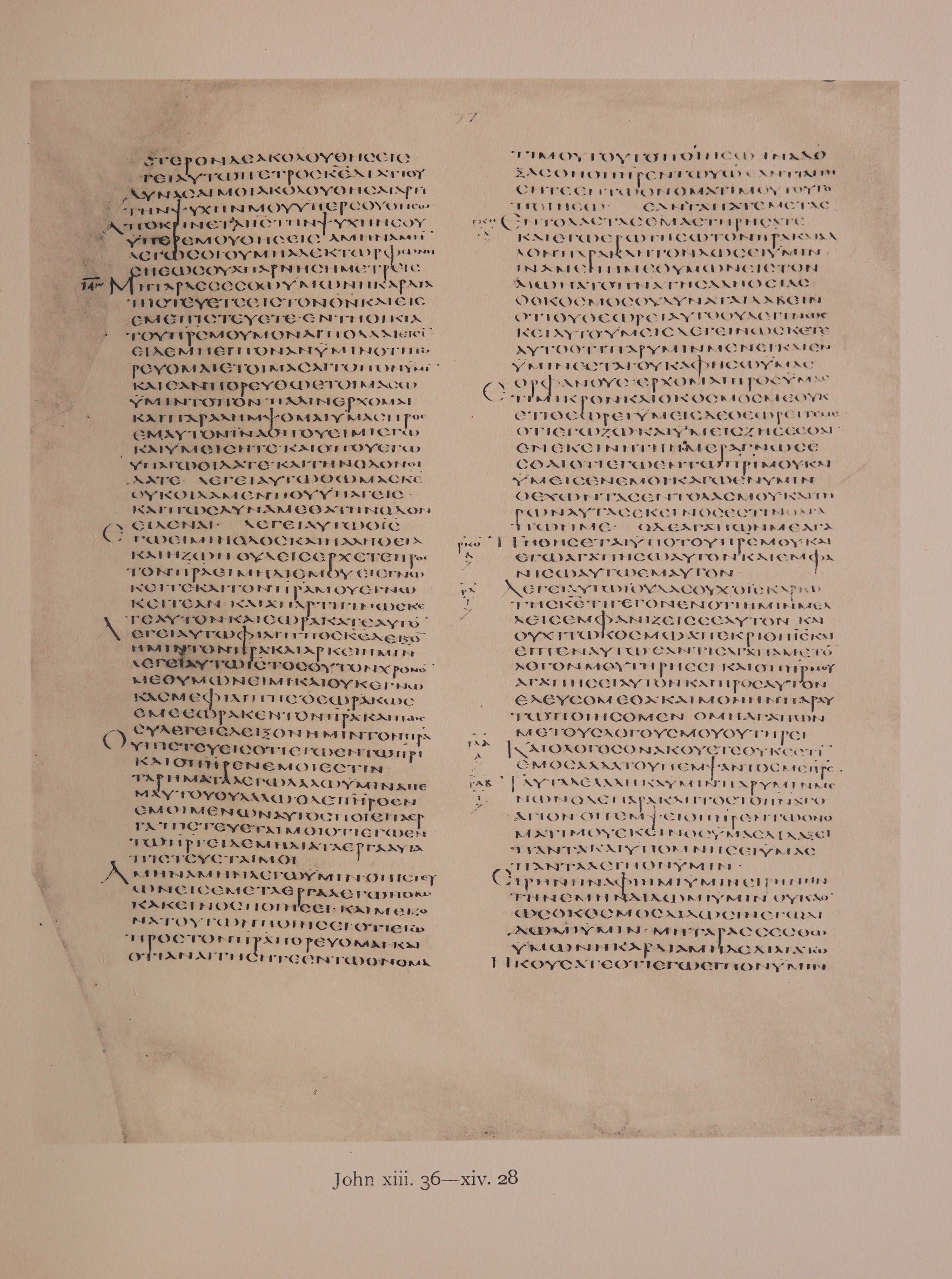
John 14 from Codex Alexandrinus (GA 02), a fifth-century Greek Bible held by the British Library (Royal MS 1 D. VIII). In the New Testament it is the chief witness to the Byzantine text in the Gospels and to the Alexandrian text in the rest of the New Testament. Its New Testament volume lacks Matthew 1:1-25:5, John 6:50-8:52 and 2 Corinthians 4:13-12:6.
This entry meets the strict three-criteria standard of the Theosis Library:
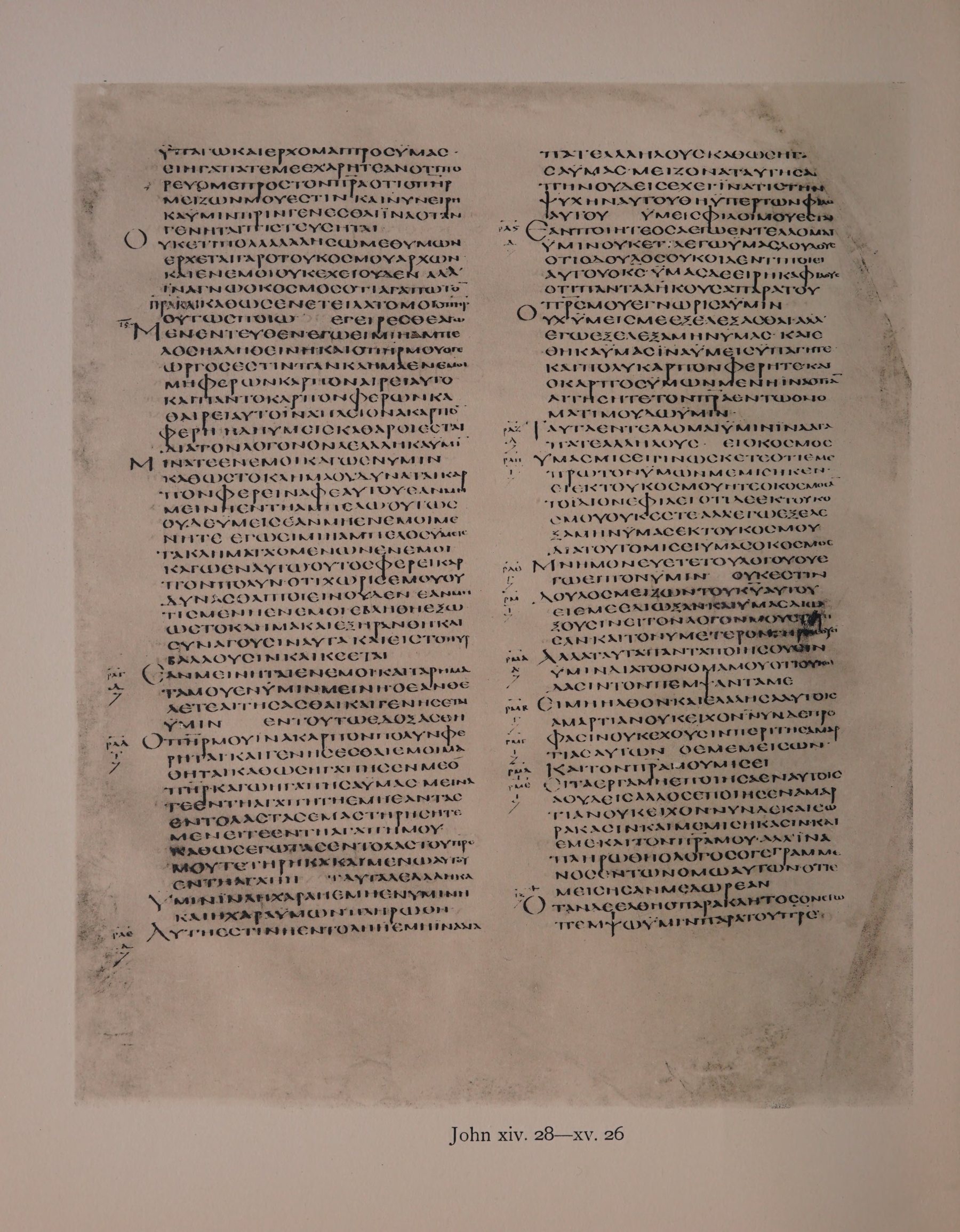
- Manuscript scan: the actual page(s) of Codex Alexandrinus containing this passage (folios 77r, 77v), reproduced from the British Museum's 1909 photographic facsimile edited by F. G. Kenyon, as digitised by the Getty Research Institute for the Internet Archive. The facsimile prints the verse range beneath each plate; that printed range was read for every page used and agrees with the INTF's NTVMR verse-level page index (CC BY 4.0). The page for each section now comes from the NTVMR transcription itself, which records the page and column on which every verse is written.
- Original text: the manuscript's own text, from a diplomatic transcription (see Greek text below), with Tischendorf's 8th critical edition (1869) for comparison.
- English translation: the King James Version (1611), retrieved verbatim from the public-domain bible-api.com endpoint.
Greek text: a diplomatic transcription of Codex Alexandrinus made by the Institut für Neutestamentliche Textforschung (INTF), Münster, for the New Testament Virtual Manuscript Room (NTVMR), published under a Creative Commons Attribution 4.0 licence. It gives the letters as the first scribe wrote them: no accents or breathings, the scribe's own spelling, and the sacred names in their contracted form (θς for θεος, ις for ιησους, κς for κυριος; the overline is not reproduced). Corrections by later hands are not shown. Letters in square brackets are not legible on the page and were restored by the transcribers, a dot under a letter marks an uncertain reading, and [...] marks text lost to damage. Beneath each section, for comparison, is Tischendorf's 8th critical edition (1869). Where the two differ, the transcription is what the manuscript says. Each section is shown with the page on which the transcription places its verses.
How was this verified? (Provenance)
Where on the image
Page from the NTVMR transcription (docID 20002): verses 1-7 on fol. 77r (facsimile leaf 115), col. 1.
1μη ταρασσεσθω υμων η καρδια πιστευετε εις τον θν και εις εμε πιστευετε · 2εν τη οικια του πρς μου μοναι πολλαι εισιν · ει δε μη ειπον αν υμιν οτι πορευομαι ετοιμασαι τοπον υμιν 3και εαν πορευθω ετοιμασω υμιν τοπον · παλιν ερχομαι και παραλημψομαι υμας προς εμαυτον ινα οπου ειμι εγω και υμεις ητε · 4και οπου εγω υπαγω οιδατε · και την οδον οιδατε · 5λεγει αυτω θωμας κε ουκ οιδαμεν που υπαγεις και πως δυναμεθα την οδον ειδεναι · 6λεγει αυτω ο ις εγω ειμι η οδος και η αληθεια και η ζωη ουδεις ερχετε προς τον πρα ει μη δι εμου 7ει εγνωκειτε και τον πρα μου εγνωκειτε αν · και απ αρτι γινωσκετε αυτον · και εωρακατε αυτον
Compare: Tischendorf 8th edition (1869)
1Μὴ ταρασσέσθω ὑμῶν ἡ καρδία· πιστεύετε εἰς τὸν θεόν, καὶ εἰς ἐμὲ πιστεύετε. 2ἐν τῇ οἰκίᾳ τοῦ πατρός μου μοναὶ πολλαί εἰσίν· εἰ δὲ μή, εἶπον ἂν ὑμῖν· ὅτι πορεύομαι ἑτοιμάσαι τόπον ὑμῖν· 3καὶ ἐὰν πορευθῶ καὶ ἑτοιμάσω τόπον ὑμῖν, πάλιν ἔρχομαι καὶ παραλήμψομαι ὑμᾶς πρὸς ἐμαυτόν, ἵνα ὅπου εἰμὶ ἐγὼ καὶ ὑμεῖς ἦτε. 4καὶ ὅπου ἐγὼ ὑπάγω οἴδατε τὴν ὁδόν. 5Λέγει αὐτῷ Θωμᾶς· κύριε, οὐκ οἴδαμεν ποῦ ὑπάγεις, καὶ πῶς οἴδαμεν τὴν ὁδόν; 6λέγει αὐτῷ Ἰησοῦς· ἐγώ εἰμι ἡ ὁδὸς καὶ ἡ ἀλήθεια καὶ ἡ ζωή· οὐδεὶς ἔρχεται πρὸς τὸν πατέρα εἰ μὴ δι’ ἐμοῦ. 7εἰ ἐγνώκατέ ἐμέ, καὶ τὸν πατέρα μου γνώσεσθε· καὶ ἀπάρτι γινώσκετε αὐτὸν καὶ ἑωράκατε αὐτόν.
1Let not your heart be troubled: ye believe in God, believe also in me. 2In my Father’s house are many mansions: if it were not so, I would have told you. I go to prepare a place for you. 3And if I go and prepare a place for you, I will come again, and receive you unto myself; that where I am, there ye may be also. 4And whither I go ye know, and the way ye know. 5Thomas saith unto him, Lord, we know not whither thou goest; and how can we know the way? 6Jesus saith unto him, I am the way, the truth, and the life: no man cometh unto the Father, but by me. 7If ye had known me, ye should have known my Father also: and from henceforth ye know him, and have seen him.
Where on the image
Page from the NTVMR transcription (docID 20002): verses 8-13 on fol. 77r (facsimile leaf 115), col. 1.
8λεγει αυτω φιλιππος κε δειξον ημιν τον πρα · και αρκει ημιν 9λεγει αυτω ις τοσουτον χρονον μεθ υμων ειμι · και ουκ εγνωκας με φιλιππε · ο εωρακως εμε εωρακεν τον πρα · και πως συ λεγεις δειξον ημιν τον πρα 10ου πιστευεις οτι εγω εν τω πρι και ο πηρ εν εμοι εστιν · τα ρηματα α εγω λαλω υμιν απ εμαυτου ου λαλω · ο δε πηρ ο εν εμοι μενων αυτος ποιει τα εργα 11πιστευεται μοι οτι εγω εν τω πρι · ει δε μη δια τα εργα αυτα πιστευεται μοι 12αμην αμην λεγω υμιν · ο πιστευων εις εμε τα εργα α εγω ποιω κακεινος ποιησει · και μειζονα τουτων ποιησει · οτι εγω προς τον πρα πορευομαι · 13και ο τι αν αιτησητε εν τω ονοματι μου τουτο ποιησω ινα δοξασθη ο πηρ εν τω υω ·
Compare: Tischendorf 8th edition (1869)
8Λέγει αὐτῷ Φίλιππος· κύριε, δεῖξον ἡμῖν τὸν πατέρα, καὶ ἀρκεῖ ἡμῖν. 9λέγει αὐτῷ ὁ Ἰησοῦς· τοσούτῳ χρόνῳ μεθ’ ὑμῶν εἰμι, καὶ οὐκ ἔγνωκάς με, Φίλιππε; ὁ ἑωρακὼς ἐμὲ ἑώρακεν τὸν πατέρα· πῶς σὺ λέγεις· δεῖξον ἡμῖν τὸν πατέρα; 10οὐ πιστεύεις ὅτι ἐγὼ ἐν τῷ πατρὶ καὶ ὁ πατὴρ ἐν ἐμοί ἐστιν; τὰ ῥήματα ἃ ἐγὼ λέγω ὑμῖν ἀπ’ ἐμαυτοῦ οὐ λαλῶ· ὁ δὲ πατὴρ ἐν ἐμοὶ μένων ποιεῖ τὰ ἔργα αὐτοῦ. 11πιστεύετέ μοι ὅτι ἐγὼ ἐν τῷ πατρὶ καὶ ὁ πατὴρ ἐν ἐμοί· εἰ δὲ μή, διὰ τὰ ἔργα αὐτὰ πιστεύετε. 12ἀμὴν ἀμὴν λέγω ὑμῖν, ὁ πιστεύων εἰς ἐμέ, τὰ ἔργα ἃ ἐγὼ ποιῶ κἀκεῖνος ποιήσει, καὶ μείζονα τούτων ποιήσει· ὅτι ἐγὼ πρὸς τὸν πατέρα πορεύομαι· 13καὶ ὅ τι ἂν αἰτήσητε ἐν τῷ ὀνόματί μου τοῦτο ποιήσω, ἵνα δοξασθῇ ὁ πατὴρ ἐν τῷ υἱῷ·
8Philip saith unto him, Lord, shew us the Father, and it sufficeth us. 9Jesus saith unto him, Have I been so long time with you, and yet hast thou not known me, Philip? he that hath seen me hath seen the Father; and how sayest thou then, Shew us the Father? 10Believest thou not that I am in the Father, and the Father in me? the words that I speak unto you I speak not of myself: but the Father that dwelleth in me, he doeth the works. 11Believe me that I am in the Father, and the Father in me: or else believe me for the very works’ sake. 12Verily, verily, I say unto you, He that believeth on me, the works that I do shall he do also; and greater works than these shall he do; because I go unto my Father. 13And whatsoever ye shall ask in my name, that will I do, that the Father may be glorified in the Son.
Where on the image
Page from the NTVMR transcription (docID 20002): verses 14-21 on fol. 77r (facsimile leaf 115), col. 2.
14εαν τι αιτησητε εν τω ονοματι μου τουτο ποιησω · 15εαν γαπατε με τας εντολας τας εμας τηρησατε 16και εγω ερωτησω τον πρα και αλλον παρακλητον δωσει υμιν ινα μενη μεθ υμων εις τον αιωνα 17το πνα της αληθειας ο ο κοσμος ου δυναται λαβειν οτι ου θεωρει αυτο ουδε γινωσκει αυτο · υμεις δε γεινωσκετε αυτο οτι παρ υμιν μενει · και εν υμιν εσται · 18ουκ αφησω υμας ορφανους · ερχομαι προς υμας 19ετι μικρον και ο κοσμος με ουκετι θεωρει υμεις δε θεωρειτε με οτι εγω ζω · και υμεις ζησεσθαι · 20εν εκεινη τη ημερα γνωσεσθαι οτι εγω εν τω πρι μου · και υμεις εν εμοι · καγω εν υμιν 21ο εχων τας εντολας μου · και τηρων αυτας εκεινος εστιν ο αγαπων με · ο δε αγαπων με αγαπηθησεται υπο του πρς μου · και εγω αγαπησω αυτον και εμφανισω αυτω εμαυτον ·
Compare: Tischendorf 8th edition (1869)
14ἐάν τι αἰτήσητέ με ἐν τῷ ὀνόματί μου ἐγὼ ποιήσω. 15Ἐὰν ἀγαπᾶτέ με, τὰς ἐντολὰς τὰς ἐμὰς τηρήσετε· 16κἀγὼ ἐρωτήσω τὸν πατέρα καὶ ἄλλον παράκλητον δώσει ὑμῖν, ἵνα μεθ’ ὑμῶν ᾖ εἰς τὸν αἰῶνα, 17τὸ πνεῦμα τῆς ἀληθείας, ὃ ὁ κόσμος οὐ δύναται λαβεῖν, ὅτι οὐ θεωρεῖ αὐτὸ οὐδὲ γινώσκει αὐτό· ὑμεῖς γινώσκετε αὐτό, ὅτι παρ’ ὑμῖν μένει καὶ ἐν ὑμῖν ἔσται. 18οὐκ ἀφήσω ὑμᾶς ὀρφανούς, ἔρχομαι πρὸς ὑμᾶς. 19ἔτι μικρὸν καὶ ὁ κόσμος με οὐκέτι θεωρεῖ· ὑμεῖς δὲ θεωρεῖτέ με, ὅτι ἐγὼ ζῶ καὶ ὑμεῖς ζήσετε. 20ἐν ἐκείνῃ τῇ ἡμέρᾳ γνώσεσθε ὑμεῖς ὅτι ἐγὼ ἐν τῷ πατρί μου καὶ ὑμεῖς ἐν ἐμοὶ κἀγὼ ἐν ὑμῖν. 21ὁ ἔχων τὰς ἐντολάς μου καὶ τηρῶν αὐτάς, ἐκεῖνός ἐστιν ὁ ἀγαπῶν με· ὁ δὲ ἀγαπῶν με ἀγαπηθήσεται ὑπὸ τοῦ πατρός μου, κἀγὼ ἀγαπήσω αὐτὸν καὶ ἐμφανίσω αὐτῷ ἐμαυτόν.
14If ye shall ask any thing in my name, I will do it. 15If ye love me, keep my commandments. 16And I will pray the Father, and he shall give you another Comforter, that he may abide with you for ever; 17Even the Spirit of truth; whom the world cannot receive, because it seeth him not, neither knoweth him: but ye know him; for he dwelleth with you, and shall be in you. 18I will not leave you comfortless: I will come to you. 19Yet a little while, and the world seeth me no more; but ye see me: because I live, ye shall live also. 20At that day ye shall know that I am in my Father, and ye in me, and I in you. 21He that hath my commandments, and keepeth them, he it is that loveth me: and he that loveth me shall be loved of my Father, and I will love him, and will manifest myself to him.
Where on the image
Page from the NTVMR transcription (docID 20002): verses 22-28 on fol. 77r (facsimile leaf 115), col. 2; verse 28 continues on fol. 77v (facsimile leaf 116), col. 1 (which begins 'υπαγω και ερχομαι').
22λεγει αυτω ιουδας ουχ ο ισκαριωτης κε τι γεγονεν οτι ημιν μελλεις εμφανιζεις σεαυτον και ουχι τω κοσμω · 23απεκριθη ις και ειπεν αυτω · εαν τις αγαπα με τον λογον μου τηρησει · και ο πηρ μου αγαπησει αυτον · και προς αυτον ελευσομεθα · και μονην παρ αυτω ποιησομεν 24ο μη αγαπων με τους λογους μου ου τηρει και ο λογος ον ακουετε ουκ εστιν εμος αλλα του πεμψαντος με πρς 25ταυτα λελαληκα υμιν παρ υμιν μενων · 26ο δε παρακλητος το πνα το αγιον · ο πεμψει ο πηρ εν τω ονοματι μου εκεινος υμας διδαξει παντα · και υπομνησει υμας παντα α ειπον υμιν · 27ειρηνην αφιημι υμιν ειρηνην την εμην διδωμι υμιν ου καθως ο κοσμος διδωσιν εγω διδωμι υμιν · μη ταρασσεσθω υμων η καρδια μηδε διλιατω 28ηκουσατε οτι εγω ειπον υμιν υπαγω και ερχομαι προς υμας · ει ηγαπατε με εχαρητε αν οτι πορευομε προς τον πρα οτι ο πηρ μειζων μου εστιν ·
Compare: Tischendorf 8th edition (1869)
22Λέγει αὐτῷ Ἰούδας, οὐχ ὁ Ἰσκαριώτης· κύριε, καὶ τί γέγονεν ὅτι ἡμῖν μέλλεις ἐμφανίζειν σεαυτὸν καὶ οὐχὶ τῷ κόσμῳ; 23ἀπεκρίθη Ἰησοῦς καὶ εἶπεν αὐτῷ· ἐάν τις ἀγαπᾷ με, τὸν λόγον μου τηρήσει, καὶ ὁ πατήρ μου ἀγαπήσει αὐτὸν, καὶ πρὸς αὐτὸν ἐλευσόμεθα καὶ μονὴν παρ’ αὐτῷ ποιησόμεθα. 24ὁ μὴ ἀγαπῶν με τοὺς λόγους μου οὐ τηρεῖ· καὶ ὁ λόγος ὃν ἀκούετε οὐκ ἔστιν ἐμὸς ἀλλὰ τοῦ πέμψαντός με πατρός. 25Ταῦτα λελάληκα ὑμῖν παρ’ ὑμῖν μένων· 26ὁ δὲ παράκλητος, τὸ πνεῦμα τὸ ἅγιον ὃ πέμψει ὁ πατὴρ ἐν τῷ ὀνόματί μου, ἐκεῖνος ὑμᾶς διδάξει πάντα καὶ ὑπομνήσει ὑμᾶς πάντα ἃ εἶπον ὑμῖν. 27εἰρήνην ἀφίημι ὑμῖν, εἰρήνην τὴν ἐμὴν δίδωμι ὑμῖν· οὐ καθὼς ὁ κόσμος δίδωσιν ἐγὼ δίδωμι ὑμῖν. μὴ ταρασσέσθω ὑμῶν ἡ καρδία μηδὲ δειλιάτω. 28ἠκούσατε ὅτι ἐγὼ εἶπον ὑμῖν· ὑπάγω καὶ ἔρχομαι πρὸς ὑμᾶς. εἰ ἠγαπᾶτέ με ἐχάρητε ἄν, ὅτι πορεύομαι πρὸς τὸν πατέρα, ὅτι ὁ πατὴρ μείζων μού ἐστιν.
22Judas saith unto him, not Iscariot, Lord, how is it that thou wilt manifest thyself unto us, and not unto the world? 23Jesus answered and said unto him, If a man love me, he will keep my words: and my Father will love him, and we will come unto him, and make our abode with him. 24He that loveth me not keepeth not my sayings: and the word which ye hear is not mine, but the Father’s which sent me. 25These things have I spoken unto you, being yet present with you. 26But the Comforter, which is the Holy Ghost, whom the Father will send in my name, he shall teach you all things, and bring all things to your remembrance, whatsoever I have said unto you. 27Peace I leave with you, my peace I give unto you: not as the world giveth, give I unto you. Let not your heart be troubled, neither let it be afraid. 28Ye have heard how I said unto you, I go away, and come again unto you. If ye loved me, ye would rejoice, because I said, I go unto the Father: for my Father is greater than I.
Where on the image
Page from the NTVMR transcription (docID 20002): verses 29-31 on fol. 77v (facsimile leaf 116), col. 1.
29και νυν ειρηκα υμιν πριν γενεσθαι ινα οταν γενηται πιστευσηται · 30ουκετι πολλα λαλησω μεθ υμων ερχεται γαρ ο του κοσμου αρχων και εν εμοι ουκ εχει ουδεν 31αλλ ινα γνω ο κοσμος οτι αγαπω τον πρα [...] καθως ενετειλατο μοι ο πηρ ουτως ποιω · εγειρεσθε αγωμεν εντευθεν ·
Compare: Tischendorf 8th edition (1869)
29καὶ νῦν εἴρηκα ὑμῖν πρὶν γενέσθαι, ἵνα ὅταν γένηται πιστεύσητε. 30οὐκέτι πολλὰ λαλήσω μεθ’ ὑμῶν· ἔρχεται γὰρ ὁ τοῦ κόσμου ἄρχων, καὶ ἐν ἐμοὶ οὐκ ἔχει οὐδέν, 31ἀλλ’ ἵνα γνῷ ὁ κόσμος ὅτι ἀγαπῶ τὸν πατέρα, καὶ καθὼς ἐνετείλατο μοι ὁ πατήρ, οὕτως ποιῶ. ἐγείρεσθε, ἄγωμεν ἐντεῦθεν.
29And now I have told you before it come to pass, that, when it is come to pass, ye might believe. 30Hereafter I will not talk much with you: for the prince of this world cometh, and hath nothing in me. 31But that the world may know that I love the Father; and as the Father gave me commandment, even so I do. Arise, let us go hence.
Cite
Sources
- Source: Codex Alexandrinus page images + NTVMR transcription (CC BY 4.0) + Tischendorf 8th edition + KJV (holding institution)
- Critical edition: Codex Alexandrinus transcription, NTVMR (INTF Münster, CC BY 4.0); Tischendorf 8th edition for comparison
← previous · → next · v cycle view · l back to library