John, Chapter 16 (Codex Alexandrinus)
Introduction
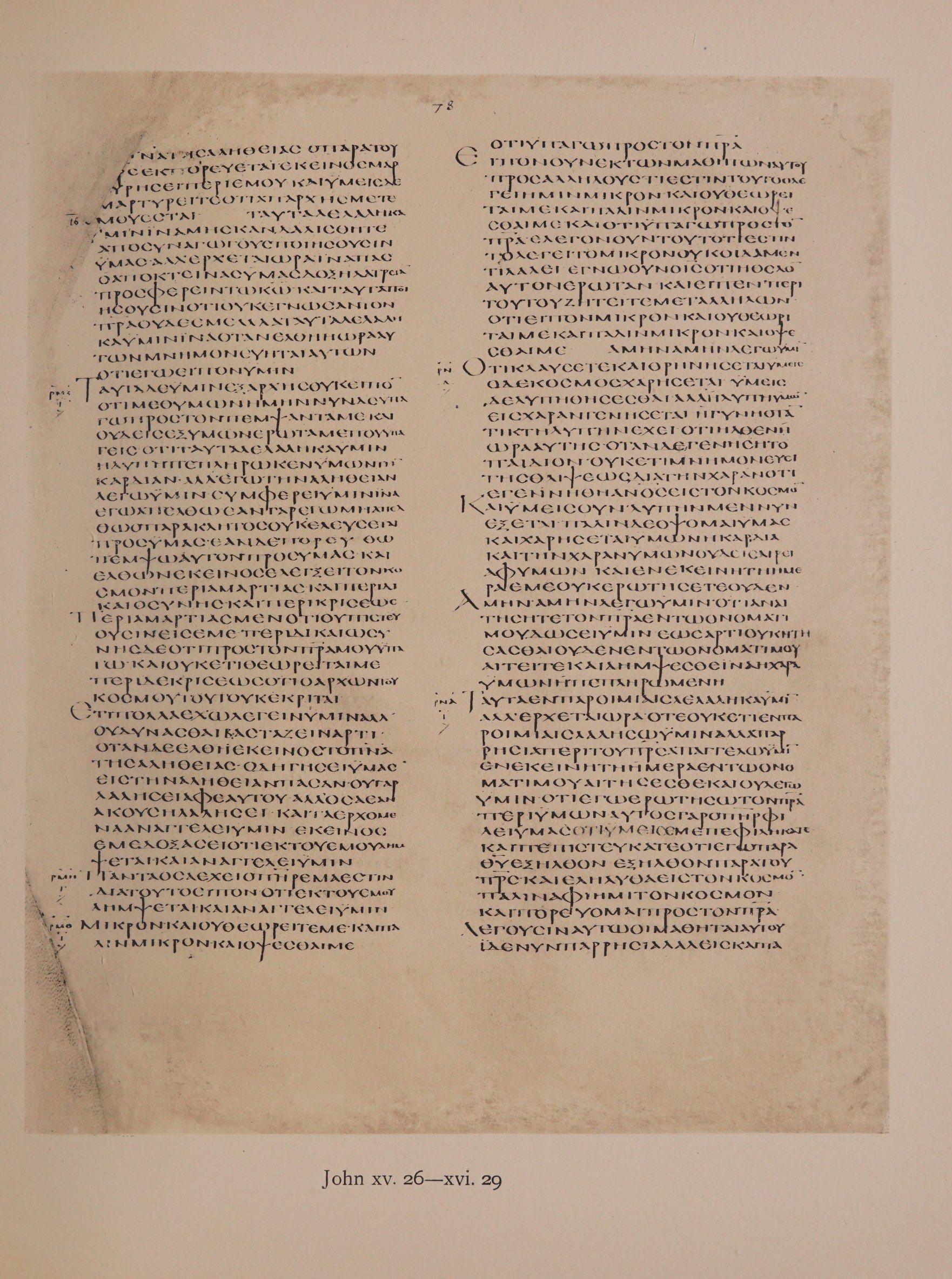
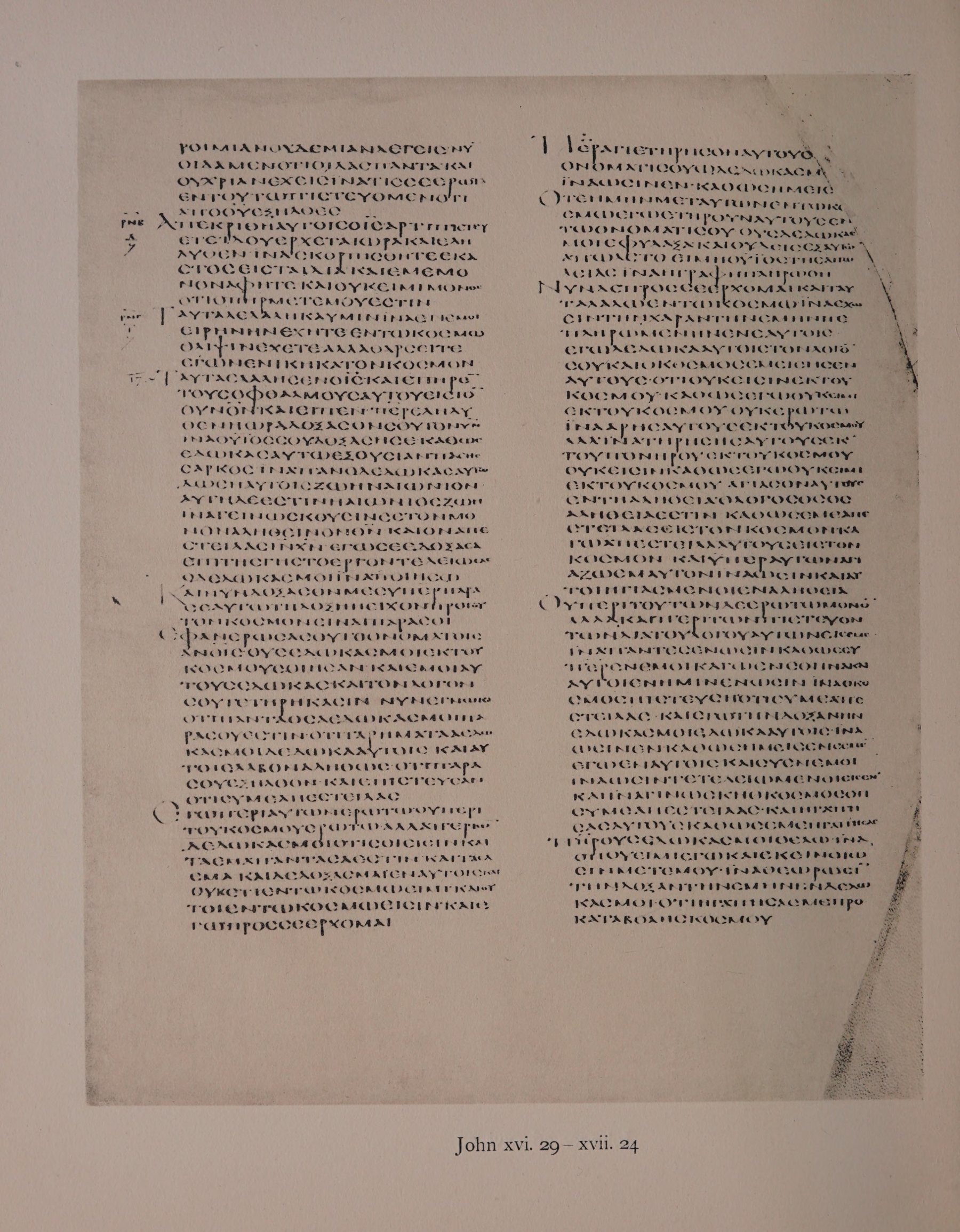
John 16 from Codex Alexandrinus (GA 02), a fifth-century Greek Bible held by the British Library (Royal MS 1 D. VIII). In the New Testament it is the chief witness to the Byzantine text in the Gospels and to the Alexandrian text in the rest of the New Testament. Its New Testament volume lacks Matthew 1:1-25:5, John 6:50-8:52 and 2 Corinthians 4:13-12:6.
This entry meets the strict three-criteria standard of the Theosis Library:
- Manuscript scan: the actual page(s) of Codex Alexandrinus containing this passage (folios 78r, 78v), reproduced from the British Museum's 1909 photographic facsimile edited by F. G. Kenyon, as digitised by the Getty Research Institute for the Internet Archive. The facsimile prints the verse range beneath each plate; that printed range was read for every page used and agrees with the INTF's NTVMR verse-level page index (CC BY 4.0). The page for each section now comes from the NTVMR transcription itself, which records the page and column on which every verse is written.
- Original text: the manuscript's own text, from a diplomatic transcription (see Greek text below), with Tischendorf's 8th critical edition (1869) for comparison.
- English translation: the King James Version (1611), retrieved verbatim from the public-domain bible-api.com endpoint.
Greek text: a diplomatic transcription of Codex Alexandrinus made by the Institut für Neutestamentliche Textforschung (INTF), Münster, for the New Testament Virtual Manuscript Room (NTVMR), published under a Creative Commons Attribution 4.0 licence. It gives the letters as the first scribe wrote them: no accents or breathings, the scribe's own spelling, and the sacred names in their contracted form (θς for θεος, ις for ιησους, κς for κυριος; the overline is not reproduced). Corrections by later hands are not shown. Letters in square brackets are not legible on the page and were restored by the transcribers, a dot under a letter marks an uncertain reading, and [...] marks text lost to damage. Beneath each section, for comparison, is Tischendorf's 8th critical edition (1869). Where the two differ, the transcription is what the manuscript says. Each section is shown with the page on which the transcription places its verses.
How was this verified? (Provenance)
Where on the image
Page from the NTVMR transcription (docID 20002): verses 1-8 on fol. 78r (facsimile leaf 117), col. 1.
1ταυτα λελαληκα υ̣μιν ινα μη σκανδαλισθητε · 2αποσυναγωγους ποιησουσιν υμας · αλλ ερχεται ωρα ινα πας ο αποκτεινας υμας δοξη λατρειαν προσφερειν τω κω · 3και ταυτα ποιησουσιν οτι ουκ εγνωσαν τον πρα ουδε εμε · 4αλλα ταυτα λελαληκα υμιν ινα οταν ελθη η ωρα αυτων μνημονευηται αυτων οτι εγω ειπον υμιν ταυτα δε υμιν εξ αρχης ουκ ειπον οτι μεθ υμων ημην 5νυν δε υπαγω προς τον πεμψαντα με · και ουδεις εξ υμων ερωτα με που υπαγεις · 6οτι ταυτα λελαληκα υμιν η λυπη πεπληρωκεν υμων την καρδιαν · 7αλλ εγω την αληθειαν λεγω υμιν · συμφερει υμιν ινα εγω απελθω · εαν γαρ εγω μη απελθω ο παρακλητος ουκ ελευσεται προς υμας · εαν δε [μη] [απελ]θ̣ω̣ πεμψω αυτον προς υμας · 8και ελθων εκεινος ελεγξει τον κοσμον περι αμαρτιας · και περι δικαιοσυνης · και περι κρισεως
Compare: Tischendorf 8th edition (1869)
1Ταῦτα λελάληκα ὑμῖν ἵνα μὴ σκανδαλισθῆτε. 2ἀποσυναγώγους ποιήσουσιν ὑμᾶς· ἀλλ’ ἔρχεται ὥρα ἵνα πᾶς ὁ ἀποκτείνας ὑμᾶς δόξῃ λατρείαν προσφέρειν τῷ θεῷ. 3καὶ ταῦτα ποιήσουσιν ὅτι οὐκ ἔγνωσαν τὸν πατέρα οὐδὲ ἐμέ. 4ἀλλὰ ταῦτα λελάληκα ὑμῖν ἵνα ὅταν ἔλθῃ ἡ ὥρα μνημονεύητε αὐτῶν, ὅτι ἐγὼ εἶπον ὑμῖν. ταῦτα δὲ ὑμῖν ἐξ ἀρχῆς οὐκ εἶπον, ὅτι μεθ’ ὑμῶν ἤμην. 5νῦν δὲ ὑπάγω πρὸς τὸν πέμψαντά με, καὶ οὐδεὶς ἐξ ὑμῶν ἐρωτᾷ με· ποῦ ὑπάγεις; 6ἀλλ’ ὅτι ταῦτα λελάληκα ὑμῖν ἡ λύπη πεπλήρωκεν ὑμῶν τὴν καρδίαν. 7ἀλλ’ ἐγὼ τὴν ἀλήθειαν λέγω ὑμῖν, συμφέρει ὑμῖν ἵνα ἐγὼ ἀπέλθω. ἐὰν γὰρ μὴ ἀπέλθω, ὁ παράκλητος οὐκ ἐλεύσεται πρὸς ὑμᾶς· ἐὰν δὲ πορευθῶ, πέμψω αὐτὸν πρὸς ὑμᾶς. 8καὶ ἐλθὼν ἐκεῖνος ἐλέγξει τὸν κόσμον περὶ ἁμαρτίας καὶ περὶ δικαιοσύνης καὶ περὶ κρίσεως·
1These things have I spoken unto you, that ye should not be offended. 2They shall put you out of the synagogues: yea, the time cometh, that whosoever killeth you will think that he doeth God service. 3And these things will they do unto you, because they have not known the Father, nor me. 4But these things have I told you, that when the time shall come, ye may remember that I told you of them. And these things I said not unto you at the beginning, because I was with you. 5But now I go my way to him that sent me; and none of you asketh me, Whither goest thou? 6But because I have said these things unto you, sorrow hath filled your heart. 7Nevertheless I tell you the truth; It is expedient for you that I go away: for if I go not away, the Comforter will not come unto you; but if I depart, I will send him unto you. 8And when he is come, he will reprove the world of sin, and of righteousness, and of judgment:
Where on the image
Page from the NTVMR transcription (docID 20002): verses 9-16 on fol. 78r (facsimile leaf 117), col. 1.
9περι αμαρτιας μεν οτι ου πιστευουσιν εις εμε · 10περι δικαιωσυνης δε οτι προς τον πρα μου υπαγω · και ουκετι θεωρειται με 11περι δε κρισεως οτι ο αρχων του κοσμου τουτου κεκριται 12ετι πολλα εχω λεγειν υμιν αλλ ου δυνασθαι βασταζειν αρτι · 13οταν δε ελθη εκεινος το πνα της αληθειας · οδηγησει υμας εις την αληθειαν πασαν · ου γαρ λαλησει αφ εαυτου · αλλ οσα εαν ακουση λαλησει · και τα ερχομενα αναγγελει υμιν · 14εκεινος εμε δοξασει οτι εκ του εμου λημψεται · και αναγγελει υμιν 15παντα οσα εχει ο πηρ εμα εστιν δια τουτο ειπον οτι εκ του εμου λημψεται · και αναγγελει υμιν 16μικρον · και ου θεωρειτε με · και παλιν μικρον · και οψεσθαι με οτι υπαγω προς τον πρα
Compare: Tischendorf 8th edition (1869)
9περὶ ἁμαρτίας μέν, ὅτι οὐ πιστεύουσιν εἰς ἐμέ· 10περὶ δικαιοσύνης δέ, ὅτι πρὸς τὸν πατέρα ὑπάγω καὶ οὐκέτι θεωρεῖτέ με· 11περὶ δὲ κρίσεως, ὅτι ὁ ἄρχων τοῦ κόσμου τούτου κέκριται. 12ἔτι πολλὰ ἔχω ὑμῖν λέγειν, ἀλλ’ οὐ δύνασθε βαστάζειν ἄρτι· 13ὅταν δὲ ἔλθῃ ἐκεῖνος, τὸ πνεῦμα τῆς ἀληθείας, ὁδηγήσει ὑμᾶς ἐν τῇ ἀληθείᾳ πάσῃ· οὐ γὰρ λαλήσει ἀφ’ ἑαυτοῦ, ἀλλ’ ὅσα ἀκούει λαλήσει, καὶ τὰ ἐρχόμενα ἀναγγελεῖ ὑμῖν. 14ἐκεῖνος ἐμὲ δοξάσει, ὅτι ἐκ τοῦ ἐμοῦ λήμψεται καὶ ἀναγγελεῖ ὑμῖν. 15πάντα ὅσα ἔχει ὁ πατὴρ ἐμά ἐστιν· διὰ τοῦτο εἶπον ὅτι ἐκ τοῦ ἐμοῦ λαμβάνει καὶ ἀναγγελεῖ ὑμῖν. 16μικρὸν καὶ οὐκέτι θεωρεῖτέ με, καὶ πάλιν μικρὸν καὶ ὄψεσθέ με.
9Of sin, because they believe not on me; 10Of righteousness, because I go to my Father, and ye see me no more; 11Of judgment, because the prince of this world is judged. 12I have yet many things to say unto you, but ye cannot bear them now. 13Howbeit when he, the Spirit of truth, is come, he will guide you into all truth: for he shall not speak of himself; but whatsoever he shall hear, that shall he speak: and he will shew you things to come. 14He shall glorify me: for he shall receive of mine, and shall shew it unto you. 15All things that the Father hath are mine: therefore said I, that he shall take of mine, and shall shew it unto you. 16A little while, and ye shall not see me: and again, a little while, and ye shall see me, because I go to the Father.
Where on the image
Page from the NTVMR transcription (docID 20002): verses 17-23 on fol. 78r (facsimile leaf 117), col. 2.
17ειπον ουν εκ των μαθητων αυτου προς αλληλους τι εστιν τουτο ο λεγει ημιν μικρον · και ου θεωρειται με · και παλιν μικρον · και οψεσθαι με · και οτι υπαγω προς τον πρα · 18ελεγον ουν τουτο τι εστιν το λεγει το μικρον ουκ οιδαμεν τι λαλει · 19εγνω ουν ο ις οτι ηθελον αυτον ερωταν · και ειπεν περι τουτου ζητειτε μετ αλληλων · οτι ειπον μικρον · και ου θεωριται με και παλιν μικρον · και οψεσθαι με · 20αμην αμην λεγω υμιν οτι κλαυσετε και θρηνησεται υμεις ο δε κοσμος χαρησεται · υμεις δε λυπηθησεσθαι · αλλ η λυπη υμων εις χαραν γενησεται · 21η γυνη οταν τικτη λυπην εχει · οτι ηλθεν η ωρα αυτης · οταν δε γενηση το παιδιον · ουκετι μνημονευει της θλιψεως δια την χαραν οτι εγεννηθη ανος εις τον κοσμον · 22και υμεις ουν · λυπην μεν νυν εξεται · παλιν δε οψομαι υμας και χαρησεται υμων η καρδια και την χαραν υμων ουδεις αιρει αφ υμων · 23και εν εκεινη τη ημερα εμε ουκ ερωτησετε ουδεν αμην · αμην λεγω υμιν · ο τι αν αιτησητε τον πρα εν τω ονοματι μου δωσει υμιν ·
Compare: Tischendorf 8th edition (1869)
17Εἶπον οὖν ἐκ τῶν μαθητῶν αὐτοῦ πρὸς ἀλλήλους· τί ἐστιν τοῦτο ὃ λέγει ἡμῖν· μικρὸν καὶ οὐ θεωρεῖτέ με, καὶ πάλιν μικρὸν καὶ ὄψεσθέ με; καί ὅτι ὑπάγω πρὸς τὸν πατέρα; 18ἔλεγον οὖν· τοῦτο τί ἐστιν ὃ λέγει, τὸ μικρόν; οὐκ οἴδαμεν τί λαλεῖ. 19ἔγνω Ἰησοῦς ὅτι ἤθελον αὐτὸν ἐρωτᾶν, καὶ εἶπεν αὐτοῖς· περὶ τούτου ζητεῖτε μετ’ ἀλλήλων ὅτι εἶπον, μικρὸν καὶ οὐ θεωρεῖτέ με, καὶ πάλιν μικρὸν καὶ ὄψεσθέ με; 20ἀμὴν ἀμὴν λέγω ὑμῖν ὅτι κλαύσετε καὶ θρηνήσετε ὑμεῖς, ὁ δὲ κόσμος χαρήσεται· ὑμεῖς λυπηθήσεσθε, ἀλλ’ ἡ λύπη ὑμῶν εἰς χαρὰν γενήσεται. 21ἡ γυνὴ ὅταν τίκτῃ λύπην ἔχει, ὅτι ἦλθεν ἡ ὥρα αὐτῆς· ὅταν δὲ γεννήσῃ τὸ παιδίον, οὐκέτι μνημονεύει τῆς θλίψεως διὰ τὴν χαρὰν ὅτι ἐγεννήθη ἄνθρωπος εἰς τὸν κόσμον. 22καὶ ὑμεῖς οὖν νῦν μὲν λύπην ἔχετε· πάλιν δὲ ὄψομαι ὑμᾶς, καὶ χαρήσεται ὑμῶν ἡ καρδία, καὶ τὴν χαρὰν ὑμῶν οὐδεὶς αἴρει ἀφ’ ὑμῶν. 23καὶ ἐν ἐκείνῃ τῇ ἡμέρᾳ ἐμὲ οὐκ ἐρωτήσετε οὐδέν. ἀμὴν ἀμὴν λέγω ὑμῖν, ἄν τι αἰτήσητε τὸν πατέρα, δώσει ὑμῖν ἐν τῷ ὀνόματί μου.
17Then said some of his disciples among themselves, What is this that he saith unto us, A little while, and ye shall not see me: and again, a little while, and ye shall see me: and, Because I go to the Father? 18They said therefore, What is this that he saith, A little while? we cannot tell what he saith. 19Now Jesus knew that they were desirous to ask him, and said unto them, Do ye enquire among yourselves of that I said, A little while, and ye shall not see me: and again, a little while, and ye shall see me? 20Verily, verily, I say unto you, That ye shall weep and lament, but the world shall rejoice: and ye shall be sorrowful, but your sorrow shall be turned into joy. 21A woman when she is in travail hath sorrow, because her hour is come: but as soon as she is delivered of the child, she remembereth no more the anguish, for joy that a man is born into the world. 22And ye now therefore have sorrow: but I will see you again, and your heart shall rejoice, and your joy no man taketh from you. 23And in that day ye shall ask me nothing. Verily, verily, I say unto you, Whatsoever ye shall ask the Father in my name, he will give it you.
Where on the image
Page from the NTVMR transcription (docID 20002): verses 24-29 on fol. 78r (facsimile leaf 117), col. 2; verse 29 continues on fol. 78v (facsimile leaf 118), col. 1 (which begins 'ροιμιαν ουδεμιαν λεγεις').
24εως αρτι ουκ ητησασθαι ουδεν εν τω ονοματι με̣ αιτειτε και λημψεσθε ινα η χαρα υμων η πεπληρωμενη 25ταυτα εν παροιμιαις λελαληκα υμιν αλλ ερχεται ωρα · οτε ουκετι εν παροιμιαις λαλησω υμιν αλλα παρρησια περι του πρς απαγγελω υμιν 26εν εκεινη τη ημερα εν τω ονοματι μου αιτησεσθε · και ου λεγω υμιν · οτι εγω ερωτησω τον πρα περι υμων · 27αυτος γαρ ο πηρ φιλει υμας [..........] πεφιληκατε και πεπιστευκατε οτι εγω παρα θυ εξηλθον · 28εξηλθον παρα του πρς · και εληλυθα εις τον κοσμον παλιν αφιημι τον κοσμον και πορευομαι προς τον πρα · 29λεγουσιν αυτω οι μαθηται αυτου ιδε νυν παρρησια λαλεις και παροιμιαν ουδεμιαν λεγεις ·
Compare: Tischendorf 8th edition (1869)
24ἕως ἄρτι οὐκ ᾐτήσατε οὐδὲν ἐν τῷ ὀνόματί μου· αἰτεῖτε καὶ λήμψεσθε, ἵνα ἡ χαρὰ ὑμῶν ᾖ πεπληρωμένη. 25Ταῦτα ἐν παροιμίαις λελάληκα ὑμῖν· ἔρχεται ὥρα ὅτε οὐκέτι ἐν παροιμίαις λαλήσω ὑμῖν, ἀλλὰ παρρησίᾳ περὶ τοῦ πατρὸς ἀπαγγελῶ ὑμῖν. 26ἐν ἐκείνῃ τῇ ἡμέρᾳ ἐν τῷ ὀνόματί μου αἰτήσεσθε, καὶ οὐ λέγω ὑμῖν ὅτι ἐγὼ ἐρωτήσω τὸν πατέρα περὶ ὑμῶν· 27αὐτὸς γὰρ ὁ πατὴρ φιλεῖ ὑμᾶς, ὅτι ὑμεῖς ἐμὲ πεφιλήκατε καὶ πεπιστεύκατε ὅτι ἐγὼ παρὰ τοῦ θεοῦ ἐξῆλθον. 28ἐξῆλθον ἐκ τοῦ πατρὸς καὶ ἐλήλυθα εἰς τὸν κόσμον· πάλιν ἀφίημι τὸν κόσμον καὶ πορεύομαι πρὸς τὸν πατέρα. 29Λέγουσιν οἱ μαθηταὶ αὐτοῦ· ἴδε νῦν ἐν παρρησίᾳ λαλεῖς, καὶ παροιμίαν οὐδεμίαν λέγεις.
24Hitherto have ye asked nothing in my name: ask, and ye shall receive, that your joy may be full. 25These things have I spoken unto you in proverbs: but the time cometh, when I shall no more speak unto you in proverbs, but I shall shew you plainly of the Father. 26At that day ye shall ask in my name: and I say not unto you, that I will pray the Father for you: 27For the Father himself loveth you, because ye have loved me, and have believed that I came out from God. 28I came forth from the Father, and am come into the world: again, I leave the world, and go to the Father. 29His disciples said unto him, Lo, now speakest thou plainly, and speakest no proverb.
Where on the image
Page from the NTVMR transcription (docID 20002): verses 30-33 on fol. 78v (facsimile leaf 118), col. 1.
30νυν οιδαμεν οτι οιδας παντα · και ου χριαν εχεις ινα τις σε ερωτα εν τουτω πιστευομεν οτι απο θυ εξηλθες 31απεκριθη αυτοις ο ις · αρτι πιστευετε · 32ιδου ερχεται ωρα και εληλυθεν · ινα σκορπισθητε εκαστος εις τα ιδια · και εμε μονον αφητε · και ουκ ειμι μονος οτι ο πηρ μετ εμου εστιν · 33ταυτα λελαληκα υμιν ινα εν εμοι ειρηνην εχητε · εν τω κοσμω θλιψιν εχετε · αλλα θαρσειτε εγω νενικηκα τον κοσμον ·
Compare: Tischendorf 8th edition (1869)
30νῦν οἴδαμεν ὅτι οἶδας πάντα καὶ οὐ χρείαν ἔχεις ἵνα τίς σε ἐρωτᾷ· ἐν τούτῳ πιστεύομεν ὅτι ἀπὸ θεοῦ ἐξῆλθες. 31ἀπεκρίθη αὐτοῖς Ἰησοῦς· ἄρτι πιστεύετε; 32ἰδοὺ ἔρχεται ὥρα καὶ ἐλήλυθεν ἵνα σκορπισθῆτε ἕκαστος εἰς τὰ ἴδια κἀμὲ μόνον ἀφῆτε· καὶ οὐκ εἰμὶ μόνος, ὅτι ὁ πατὴρ μετ’ ἐμοῦ ἐστιν. 33ταῦτα λελάληκα ὑμῖν ἵνα ἐν ἐμοὶ εἰρήνην ἔχητε. ἐν τῷ κόσμῳ θλῖψιν ἔχετε· ἀλλὰ θαρσεῖτε, ἐγὼ νενίκηκα τὸν κόσμον.
30Now are we sure that thou knowest all things, and needest not that any man should ask thee: by this we believe that thou camest forth from God. 31Jesus answered them, Do ye now believe? 32Behold, the hour cometh, yea, is now come, that ye shall be scattered, every man to his own, and shall leave me alone: and yet I am not alone, because the Father is with me. 33These things I have spoken unto you, that in me ye might have peace. In the world ye shall have tribulation: but be of good cheer; I have overcome the world.
Cite
Sources
- Source: Codex Alexandrinus page images + NTVMR transcription (CC BY 4.0) + Tischendorf 8th edition + KJV (holding institution)
- Critical edition: Codex Alexandrinus transcription, NTVMR (INTF Münster, CC BY 4.0); Tischendorf 8th edition for comparison
← previous · → next · v cycle view · l back to library