John, Chapter 5 (Codex Alexandrinus)
Introduction
John 5 from Codex Alexandrinus (GA 02), a fifth-century Greek Bible held by the British Library (Royal MS 1 D. VIII). In the New Testament it is the chief witness to the Byzantine text in the Gospels and to the Alexandrian text in the rest of the New Testament. Its New Testament volume lacks Matthew 1:1-25:5, John 6:50-8:52 and 2 Corinthians 4:13-12:6.
This entry meets the strict three-criteria standard of the Theosis Library:
- Manuscript scan: the actual page(s) of Codex Alexandrinus containing this passage (folios 69r, 69v, 70r), reproduced from the British Museum's 1909 photographic facsimile edited by F. G. Kenyon, as digitised by the Getty Research Institute for the Internet Archive. The facsimile prints the verse range beneath each plate; that printed range was read for every page used and agrees with the INTF's NTVMR verse-level page index (CC BY 4.0). The page for each section now comes from the NTVMR transcription itself, which records the page and column on which every verse is written.
- Original text: the manuscript's own text, from a diplomatic transcription (see Greek text below), with Tischendorf's 8th critical edition (1869) for comparison.
- English translation: the King James Version (1611), retrieved verbatim from the public-domain bible-api.com endpoint.
Greek text: a diplomatic transcription of Codex Alexandrinus made by the Institut für Neutestamentliche Textforschung (INTF), Münster, for the New Testament Virtual Manuscript Room (NTVMR), published under a Creative Commons Attribution 4.0 licence. It gives the letters as the first scribe wrote them: no accents or breathings, the scribe's own spelling, and the sacred names in their contracted form (θς for θεος, ις for ιησους, κς for κυριος; the overline is not reproduced). Corrections by later hands are not shown. Letters in square brackets are not legible on the page and were restored by the transcribers, a dot under a letter marks an uncertain reading, and [...] marks text lost to damage. Beneath each section, for comparison, is Tischendorf's 8th critical edition (1869). Where the two differ, the transcription is what the manuscript says. Each section is shown with the page on which the transcription places its verses.
Manuscript note: Not written in Codex Alexandrinus: verse 12. The English is shown with a bracketed note in the Greek column.
How was this verified? (Provenance)
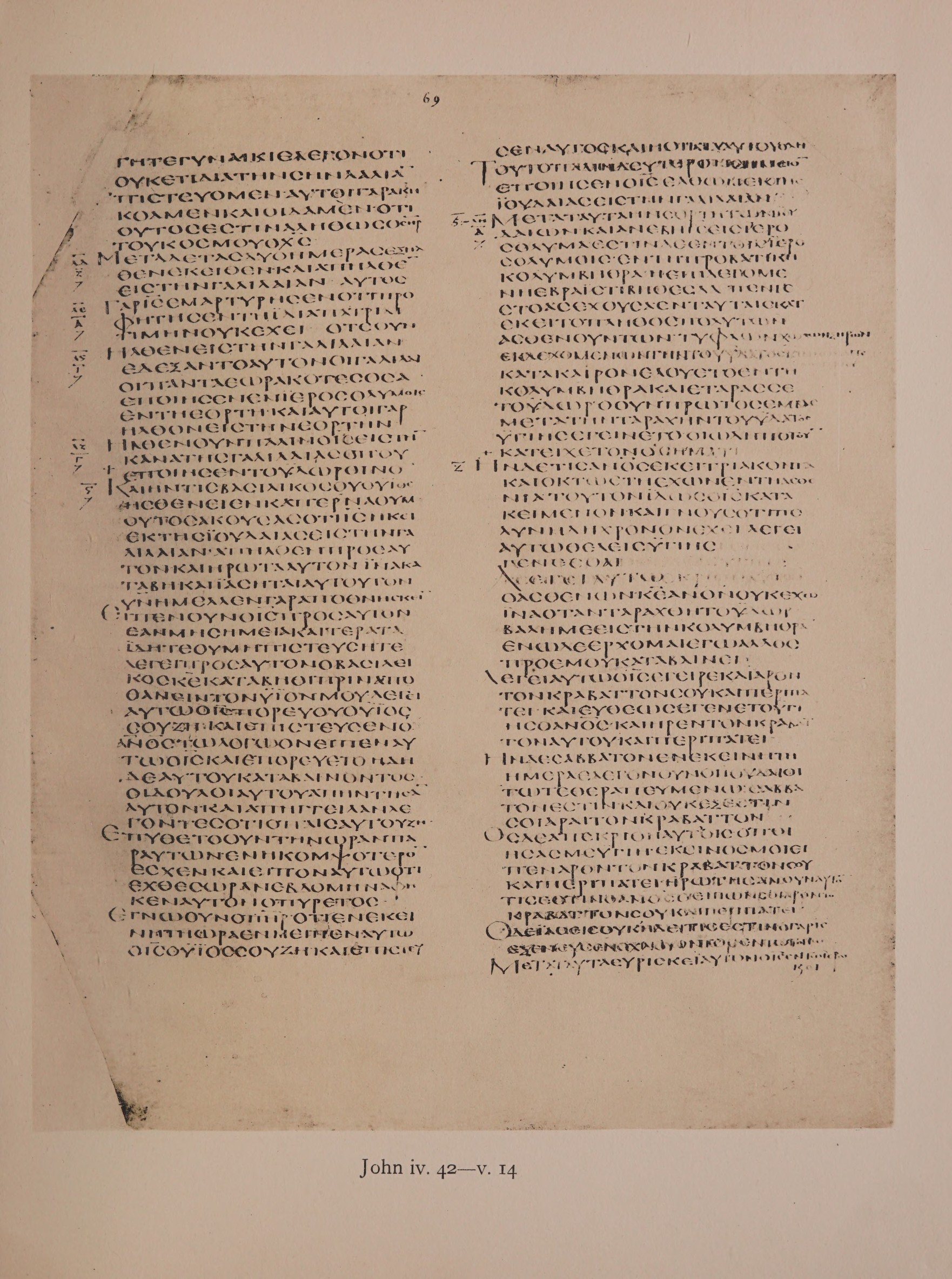
Where on the image
Page from the NTVMR transcription (docID 20002): verses 1-7 on fol. 69r (facsimile leaf 103), col. 2.
1μετα ταυτα ην εορτη των ιουδαιων · και ανεβη ις εις ιεροσολυμα · 2εστιν δε εν τοις ιεροσολυμοις · εν τη προβατικη κολυμβηθρα · η επιλεγομενη εβραιστι βηθεσδα πεντε στοας εχουσα · 3εν ταυταις κατεκειτο πληθος πολυ των ασθενουντων · τυφλων χωλων ξηρων 4αγγελος γαρ κυ κατα καιρον ελουετο εν τη κολυμβηθρα · και εταρασσε το υδωρ · ο ουν πρωτος εμβας μετα την ταραχην του υδατος υγιης εγεινετο · οιω δηποτ ουν κατειχετο νοσηματι 5ην δε τις ανος εκει τριακοντα και οκτω ετη εχων εν τη ασθενια · 6τουτον ιδως ο ις κατακειμενον · και γνους οτι πολυν ηδη χρονον εχει λεγει αυτω θελεις υγιης γενεσθαι λ̣εγε̣ι αυ̣τ̣ω θ̣ε̣λ̣εις υγιης γενεσθ̣αι̣ 7απεκριθη αυτω ο ασθενων · κε ανον ουκ εχω ινα οταν ταραχθη το υδωρ βαλη με εις την κολυμβηθραν εν ω δε ερχομαι εγω αλλος προ εμου καταβαινει
Compare: Tischendorf 8th edition (1869)
1Μετὰ ταῦτα ἦν ἡ ἑορτὴ τῶν Ἰουδαίων, καὶ ἀνέβη Ἰησοῦς εἰς Ἱεροσόλυμα. 2ἔστιν δὲ ἐν τοῖς Ἱεροσολύμοις ἐπὶ τῇ προβατικῇ κολυμβήθρα, τὸ λεγόμενον Ἑβραϊστὶ Βηθζαθά, πέντε στοὰς ἔχουσα. 3ἐν ταύταις κατέκειτο πλῆθος τῶν ἀσθενούντων, τυφλῶν, χωλῶν, ξηρῶν. 4 5ἦν δέ τις ἄνθρωπος ἐκεῖ τριάκοντα καὶ ὀκτὼ ἔτη ἔχων ἐν τῇ ἀσθενείᾳ αὐτοῦ· 6τοῦτον ἰδὼν ὁ Ἰησοῦς κατακείμενον, καὶ γνοὺς ὅτι πολὺν ἤδη χρόνον ἔχει, λέγει αὐτῷ· θέλεις ὑγιὴς γενέσθαι; 7ἀπεκρίθη αὐτῷ ὁ ἀσθενῶν· κύριε, ἄνθρωπον οὐκ ἔχω, ἵνα ὅταν ταραχθῇ τὸ ὕδωρ βάλῃ με εἰς τὴν κολυμβήθραν· ἐν ᾧ δὲ ἔρχομαι ἐγὼ ἄλλος πρὸ ἐμοῦ καταβαίνει.
1After this there was a feast of the Jews; and Jesus went up to Jerusalem. 2Now there is at Jerusalem by the sheep market a pool, which is called in the Hebrew tongue Bethesda, having five porches. 3In these lay a great multitude of impotent folk, of blind, halt, withered, waiting for the moving of the water. 4For an angel went down at a certain season into the pool, and troubled the water: whosoever then first after the troubling of the water stepped in was made whole of whatsoever disease he had. 5And a certain man was there, which had an infirmity thirty and eight years. 6When Jesus saw him lie, and knew that he had been now a long time in that case, he saith unto him, Wilt thou be made whole? 7The impotent man answered him, Sir, I have no man, when the water is troubled, to put me into the pool: but while I am coming, another steppeth down before me.
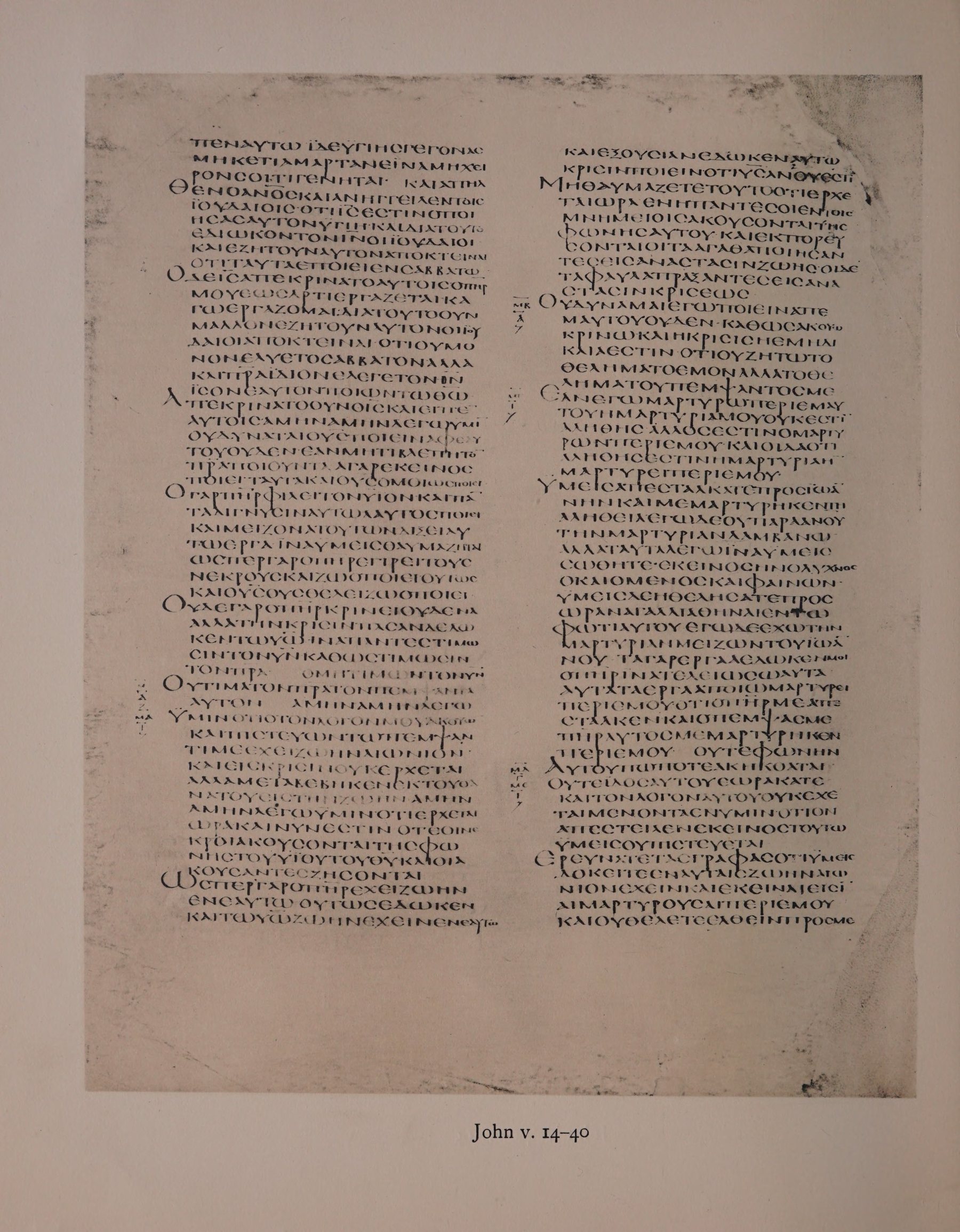
Where on the image
Page from the NTVMR transcription (docID 20002): verses 8-11, 13-14 on fol. 69r (facsimile leaf 103), col. 2; verse 14 continues on fol. 69v (facsimile leaf 104), col. 1 (which begins 'πεν αυτω ·'). Verse 12 is not in Codex Alexandrinus; the NTVMR transcription (docID 20002) shows the text passing over it on fol. 69r (facsimile leaf 103), col. 2.
8λεγει αυτω ο ις εγειρε και αρον τον κραβαττον σου και περιπατει · 9και ευθεως εγενετο υγιης ο ανος · και ηρεν τον κραβαττον αυτου και περιπατει · ην δε σαββατον εν εκεινη τη ημερα · 10ελεγον ουν οι ιουδαιοι τω τεθεραπευμενω · σαββατον εστιν · και ουκ εξεστιν σοι αραι τον κραβαττον · 11ος δε απεκριθη αυτοις ο ποιησας με υγιη · εκεινος μοι ειπεν αρον τον κραβαττον σου και περιπατει · 12[not in Codex Alexandrinus] 13ο δε ιαθεις ουκ ηδει τις εστιν ο γαρ ις εξενευσεν οχλου οντος εν τω τοπω 14μετα ταυτα ευρισκει αυτον ο ις εν τω ιερω και ειπεν αυτω · ιδε υγιης γεγονας μηκετι αμαρτανε ινα μη χειρον σοι τι γενηται ·
Compare: Tischendorf 8th edition (1869)
8λέγει αὐτῷ ὁ Ἰησοῦς· ἔγειρε ἆρον τὸν κράβαττόν σου καὶ περιπάτει. 9καὶ ἐγένετο ὑγιὴς ὁ ἄνθρωπος, καὶ ἦρεν τὸν κράβαττον αὐτοῦ καὶ περιεπάτει· ἦν δὲ σάββατον ἐν ἐκείνῃ τῇ ἡμέρᾳ. 10ἔλεγον οὖν οἱ Ἰουδαῖοι τῷ τεθεραπευμένῳ· σάββατόν ἐστιν, καὶ οὐκ ἔξεστίν σοι ἆραι τὸν κράβαττόν. 11ἀπεκρίθη αὐτοῖς· ὁ ποιήσας με ὑγιῆ, ἐκεῖνός μοι εἶπεν· ἆρον τὸν κράβαττόν σου καὶ περιπάτει. 12ἠρώτησαν αὐτόν· τίς ἐστιν ὁ ἄνθρωπος ὁ εἰπών σοι· ἆρον καὶ περιπάτει; 13ὁ δὲ ἀσθενῶν οὐκ ᾔδει τίς ἐστιν· ὁ γὰρ Ἰησοῦς ἐξένευσεν ὄχλου ὄντος ἐν τῷ τόπῳ. 14μετὰ ταῦτα εὑρίσκει αὐτὸν ὁ Ἰησοῦς ἐν τῷ ἱερῷ καὶ εἶπεν αὐτῷ· ἴδε ὑγιὴς γέγονας· μηκέτι ἁμάρτανε, ἵνα μὴ χεῖρόν σοί τι γένηται.
8Jesus saith unto him, Rise, take up thy bed, and walk. 9And immediately the man was made whole, and took up his bed, and walked: and on the same day was the sabbath. 10The Jews therefore said unto him that was cured, It is the sabbath day: it is not lawful for thee to carry thy bed. 11He answered them, He that made me whole, the same said unto me, Take up thy bed, and walk. 12Then asked they him, What man is that which said unto thee, Take up thy bed, and walk? 13And he that was healed wist not who it was: for Jesus had conveyed himself away, a multitude being in that place. 14Afterward Jesus findeth him in the temple, and said unto him, Behold, thou art made whole: sin no more, lest a worse thing come unto thee.
Where on the image
Page from the NTVMR transcription (docID 20002): verses 15-26 on fol. 69v (facsimile leaf 104), col. 1.
15και απηλθεν ο ανος και ανηγγειλεν τοις ιουδαιοις · οτι ις εστιν ο ποιησας αυτον υγιη · 16και δια τουτο εδιωκον τον ιν οι ιουδαιοι και εζητουν αυτον αποκτειναι οτι ταυτα εποιει εν σαββατω · 17ο δε ις απεκρινατο αυτοις · ο πηρ μου εως αρτι εργαζεται · καγω εργαζομαι · 18δια τουτο ουν μαλλον εζητουν αυτον οι ιουδαιοι αποκτειναι · οτι ου μονον ελυε το σαββατον · αλλα και πρα ιδιον ελεγε τον ιν ισον εαυτον ποιων τω θω · 19απεκρινατο ουν ο ις και ειπεν αυτοις · αμην αμην λεγω υμιν ου δυναται ο υς ποιειν αφ εαυτου ουδεν · εαν μη τι βλεπη τον πρα ποιουντα · α γαρ εκεινος ποιει · ταυτα και ο υς ομοιως ποιει · 20ο γαρ πηρ φιλει τον υιον · και παντα διγνυσιν αυτω α αυτος ποιει · και μειζονα τουτων διξει αυτω εργα · ινα υμεις θαυμαζηται · 21ωσπερ γαρ ο πηρ εγιρει τους νεκρους και ζωοποιει · ουτως και ο υς ους θελει ζωοποιει · 22ουδε γαρ ο πηρ κρινει ουδενα αλλα την κρισιν πασαν δεδωκεν τω υω · 23ινα παντες τιμωσιν τον υν · καθως τιμωσιν τον πρα · ο μη τιμων τον υν ου τιμα τον πρα τον πεμψαντα αυτον · 24αμην αμην λεγω υμιν · οτι ο τον λογον μου ακουων και πιστευων τω πεμψαντι με εχει ζωην αιωνιον · και εις κρισιν ουκ ερχεται αλλα μεταβεβηκεν εκ του θανατου εις την ζωην · 25αμην αμην λεγω υμιν · οτι ερχεται ωρα · και νυν εστιν · οτε οι νεκροι · ακουσονται της φωνης του υιου του θυ · και οι ακουσαντες ζησονται 26ωσπερ γαρ ο πηρ εχει ζωην εν εαυτω · ουτως εδωκεν και τω υω ζωην εχειν εν εαυτω
Compare: Tischendorf 8th edition (1869)
15ἀπῆλθεν ὁ ἄνθρωπος καὶ εἶπεν τοῖς Ἰουδαίοις ὅτι Ἰησοῦς ἐστιν ὁ ποιήσας αὐτὸν ὑγιῆ. 16καὶ διὰ τοῦτο ἐδίωκον οἱ Ἰουδαῖοι τὸν Ἰησοῦν, ὅτι ταῦτα ἐποίει ἐν σαββάτῳ. 17ὁ δὲ ἀπεκρίνατο αὐτοῖς· ὁ πατήρ μου ἕως ἄρτι ἐργάζεται, κἀγὼ ἐργάζομαι. 18διὰ τοῦτο μᾶλλον ἐζήτουν αὐτὸν οἱ Ἰουδαῖοι ἀποκτεῖναι, ὅτι οὐ μόνον ἔλυεν τὸ σάββατον, ἀλλὰ καὶ πατέρα ἴδιον ἔλεγεν τὸν θεόν, ἴσον ἑαυτὸν ποιῶν τῷ θεῷ. 19Ἀπεκρίνατο οὖν ὁ Ἰησοῦς καὶ ἔλεγεν αὐτοῖς· ἀμὴν ἀμὴν λέγω ὑμῖν, οὐ δύναται ὁ υἱὸς ποιεῖν ἀφ’ ἑαυτοῦ οὐδέν, ἂν μή τι βλέπῃ τὸν πατέρα ποιοῦντα· ἃ γὰρ ἂν ἐκεῖνος ποιῇ, ταῦτα καὶ ὁ υἱὸς ποιεῖ ὁμοίως. 20ὁ γὰρ πατὴρ φιλεῖ τὸν υἱὸν καὶ πάντα δείκνυσιν αὐτῷ ἃ αὐτὸς ποιεῖ, καὶ μείζονα τούτων δείξει αὐτῷ ἔργα, ἵνα ὑμεῖς θαυμάζετε. 21ὥσπερ γὰρ ὁ πατὴρ ἐγείρει τοὺς νεκροὺς καὶ ζῳοποιεῖ, οὕτως καὶ ὁ υἱὸς οὓς θέλει ζῳοποιεῖ. 22οὐδὲ γὰρ ὁ πατὴρ κρίνει οὐδένα, ἀλλὰ τὴν κρίσιν πᾶσαν δέδωκεν τῷ υἱῷ, 23ἵνα πάντες τιμῶσι τὸν υἱὸν καθὼς τιμῶσι τὸν πατέρα. ὁ μὴ τιμῶν τὸν υἱὸν οὐ τιμᾷ τὸν πατέρα τὸν πέμψαντα αὐτόν. 24ἀμὴν ἀμὴν λέγω ὑμῖν ὅτι ὁ τὸν λόγον μου ἀκούων καὶ πιστεύων τῷ πέμψαντί με ἔχει ζωὴν αἰώνιον, καὶ εἰς κρίσιν οὐκ ἔρχεται ἀλλὰ μεταβέβηκεν ἐκ τοῦ θανάτου εἰς τὴν ζωήν. 25ἀμὴν ἀμὴν λέγω ὑμῖν ὅτι ἔρχεται ὥρα καὶ νῦν ἐστιν, ὅτε οἱ νεκροὶ ἀκούσουσιν τῆς φωνῆς τοῦ υἱοῦ τοῦ θεοῦ καὶ οἱ ἀκούσαντες ζήσουσιν. 26ὥσπερ γὰρ ὁ πατὴρ ἔχει ζωὴν ἐν ἑαυτῷ, οὕτως καὶ τῷ υἱῷ ἔδωκεν ζωὴν ἔχειν ἐν ἑαυτῷ·
15The man departed, and told the Jews that it was Jesus, which had made him whole. 16And therefore did the Jews persecute Jesus, and sought to slay him, because he had done these things on the sabbath day. 17But Jesus answered them, My Father worketh hitherto, and I work. 18Therefore the Jews sought the more to kill him, because he not only had broken the sabbath, but said also that God was his Father, making himself equal with God. 19Then answered Jesus and said unto them, Verily, verily, I say unto you, The Son can do nothing of himself, but what he seeth the Father do: for what things soever he doeth, these also doeth the Son likewise. 20For the Father loveth the Son, and sheweth him all things that himself doeth: and he will shew him greater works than these, that ye may marvel. 21For as the Father raiseth up the dead, and quickeneth them; even so the Son quickeneth whom he will. 22For the Father judgeth no man, but hath committed all judgment unto the Son: 23That all men should honour the Son, even as they honour the Father. He that honoureth not the Son honoureth not the Father which hath sent him. 24Verily, verily, I say unto you, He that heareth my word, and believeth on him that sent me, hath everlasting life, and shall not come into condemnation; but is passed from death unto life. 25Verily, verily, I say unto you, The hour is coming, and now is, when the dead shall hear the voice of the Son of God: and they that hear shall live. 26For as the Father hath life in himself; so hath he given to the Son to have life in himself;
Where on the image
Page from the NTVMR transcription (docID 20002): verses 27-33 on fol. 69v (facsimile leaf 104), col. 2.
27και εξουσιαν εδωκεν αυτω κρισιν ποιειν οτι υς ανου εστι[ν] 28μη θαυμαζετε τουτο οτι ερχεται ωρα εν η παντες οι εν τοις μνημειοις ακουσονται της φωνης αυτου · 29και εκπορευσονται οι τα αγαθα ποιησαντες εις αναστασιν ζωης οι δε τα φαυλα πραξαντες εις αναστασιν κρισεως · 30ου δυναμαι εγω ποιειν απ εμαυτου ουδεν · καθως ακουω κρινω · και η κρισις η εμη δικαια εστιν · οτι ου ζητω το θελημα το εμον αλλα το θελημα του πεμψαντος με 31εαν εγω μαρτυρω περι εμαυτου η μαρτυρια μου ουκ εστιν αληθης · 32αλλος εστιν ο μαρτυρων περι εμου · και οιδα οτι αληθης εστιν η μαρτυρια ην μαρτυρει περι εμου · 33υμεις απεσταλκατε προς ιωαννην · και μεμαρτυρηκεν τη αληθεια ·
Compare: Tischendorf 8th edition (1869)
27καὶ ἐξουσίαν ἔδωκεν αὐτῷ κρίσιν ποιεῖν, ὅτι υἱὸς ἀνθρώπου ἐστίν. 28μὴ θαυμάζετε τοῦτο, ὅτι ἔρχεται ὥρα ἐν ᾗ πάντες οἱ ἐν τοῖς μνημείοις ἀκούσουσιν τῆς φωνῆς αὐτοῦ, 29καὶ ἐκπορεύσονται οἱ τὰ ἀγαθὰ ποιήσαντες εἰς ἀνάστασιν ζωῆς, οἱ τὰ φαῦλα πράξαντες εἰς ἀνάστασιν κρίσεως. 30οὐ δύναμαι ἐγὼ ποιεῖν ἀπ’ ἐμαυτοῦ οὐδέν· καθὼς ἀκούω κρίνω, καὶ ἡ κρίσις ἡ ἐμὴ δικαία ἐστίν, ὅτι οὐ ζητῶ τὸ θέλημα τὸ ἐμὸν ἀλλὰ τὸ θέλημα τοῦ πέμψαντός με 31ἐὰν ἐγὼ μαρτυρῶ περὶ ἐμαυτοῦ, ἡ μαρτυρία μου οὐκ ἔστιν ἀληθής· 32ἄλλος ἐστὶν ὁ μαρτυρῶν περὶ ἐμοῦ, καὶ οἴδατε ὅτι ἀληθής ἐστιν ἡ μαρτυρία ἣν μαρτυρεῖ περὶ ἐμοῦ. 33ὑμεῖς ἀπεστάλκατε πρὸς Ἰωάννην, καὶ μεμαρτύρηκεν τῇ ἀληθείᾳ·
27And hath given him authority to execute judgment also, because he is the Son of man. 28Marvel not at this: for the hour is coming, in the which all that are in the graves shall hear his voice, 29And shall come forth; they that have done good, unto the resurrection of life; and they that have done evil, unto the resurrection of damnation. 30I can of mine own self do nothing: as I hear, I judge: and my judgment is just; because I seek not mine own will, but the will of the Father which hath sent me. 31If I bear witness of myself, my witness is not true. 32There is another that beareth witness of me; and I know that the witness which he witnesseth of me is true. 33Ye sent unto John, and he bare witness unto the truth.
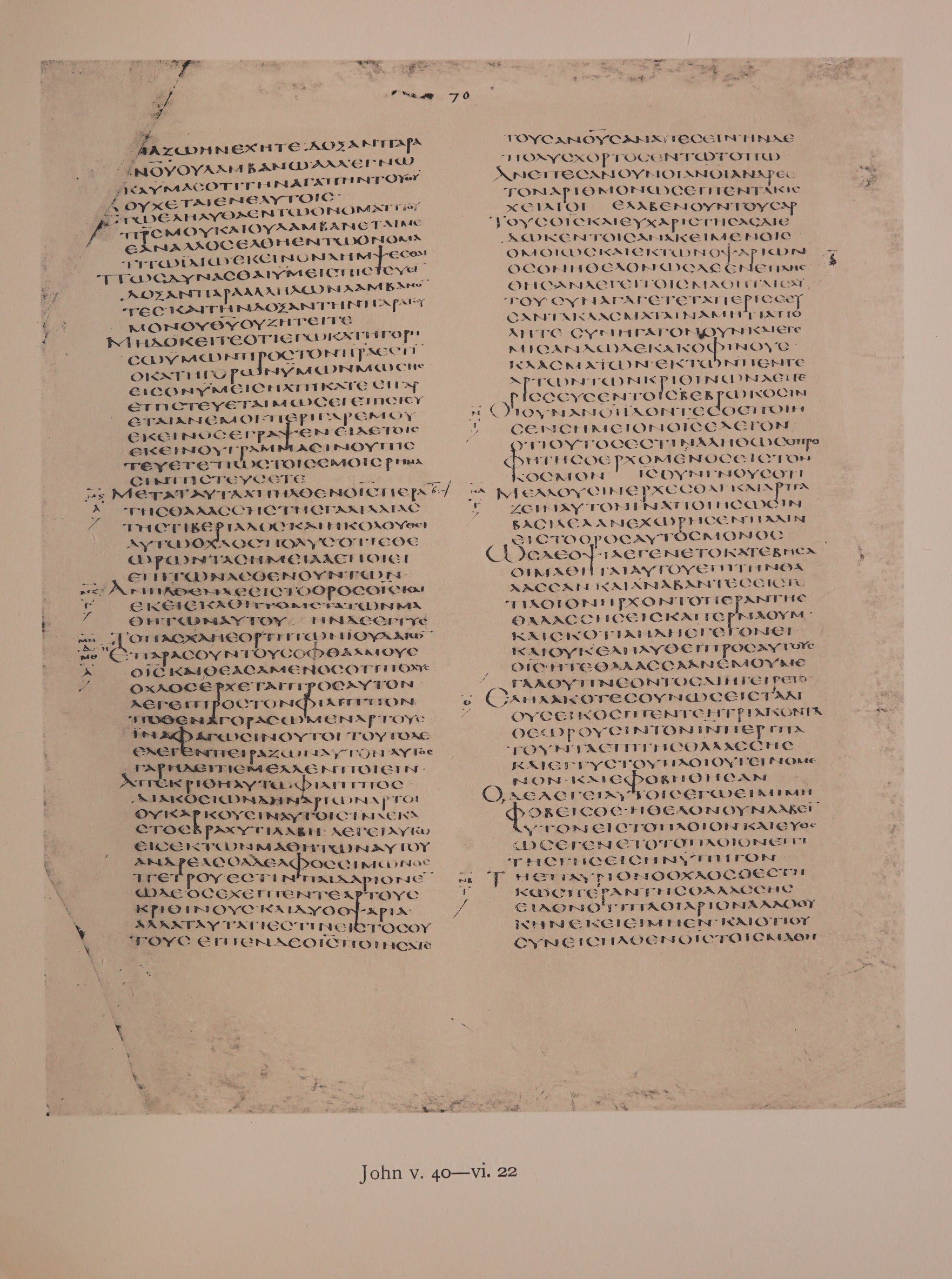
Where on the image
Page from the NTVMR transcription (docID 20002): verses 34-40 on fol. 69v (facsimile leaf 104), col. 2; verse 40 continues on fol. 70r (facsimile leaf 105), col. 1 (which begins '[ι]ν̣α ζωην εχητε').
34εγω δε ου παρα ανου την μαρτυριαν λαμβανω · αλλα ταυτα λεγω ινα υμεις σωθητε · 35εκεινος ην ο λυχνος ο καιομενος και φαινων · υμεις δε ηθελησατε προς ωραν αγαλλιαθηναι εν τω φωτι αυτου 36εγω δε εχω την μαρτυριαν μειζων του ιωαννου · τα γαρ εργα α εδωκεν μοι ο πηρ ινα τελειωσω αυτα · αυτα τα εργα α ποιω μαρτυρει περι εμου · οτι ο πηρ με απεσταλκεν · 37και ο πεμψας με πηρ αυτος μεμαρτυρηκεν περι εμου · ουτε φωνην αυτου πωποτε ακηκοαται · ουτε ιδος αυτου εωρακατε · 38και τον λογον αυτου ουκ εχεται μενοντα εν υμιν · οτι ον απεστειλεν εκεινος τουτω υμεις ου πιστευεται · 39ερευνατε τας γραφας οτι υμεις δοκειτε εν αυταις ζωην αιωνιον εχειν · και εκειναι εισιν αι μαρτυρουσαι περι εμου 40και ου θελετε ελθειν προς με [ι]ν̣α ζωην εχητε ·
Compare: Tischendorf 8th edition (1869)
34ἐγὼ δὲ οὐ παρὰ ἀνθρώπου τὴν μαρτυρίαν λαμβάνω, ἀλλὰ ταῦτα λέγω ἵνα ὑμεῖς σωθῆτε. 35ἐκεῖνος ἦν ὁ λύχνος ὁ καιόμενος καὶ φαίνων, ὑμεῖς δὲ ἠθελήσατε ἀγαλλιαθῆναι πρὸς ὥραν ἐν τῷ φωτὶ αὐτοῦ. 36ἐγὼ δὲ ἔχω τὴν μαρτυρίαν μείζω τοῦ Ἰωάννου· τὰ γὰρ ἔργα ἃ δέδωκέν μοι ὁ πατὴρ ἵνα τελειώσω αὐτά, αὐτὰ τὰ ἔργα ἃ ποιῶ μαρτυρεῖ περὶ ἐμοῦ ὅτι ὁ πατήρ με ἀπέσταλκεν. 37καὶ ὁ πέμψας με πατήρ, ἐκεῖνος μεμαρτύρηκεν περὶ ἐμοῦ. οὔτε φωνὴν αὐτοῦ πώποτε ἀκηκόατε, οὔτε εἶδος αὐτοῦ ἑωράκατε, 38καὶ τὸν λόγον αὐτοῦ οὐκ ἔχετε ἐν ὑμῖν μένοντα, ὅτι ὃν ἀπέστειλεν ἐκεῖνος, τούτῳ ὑμεῖς οὐ πιστεύετε. 39ἐραυνᾶτε τὰς γραφάς, ὅτι ὑμεῖς δοκεῖτε ἐν αὐταῖς ζωὴν αἰώνιον ἔχειν· καὶ ἐκεῖναί εἰσίν αἱ μαρτυροῦσαι περὶ ἐμοῦ· 40καὶ οὐ θέλετε ἐλθεῖν πρός με ἵνα ζωὴν ἔχητε.
34But I receive not testimony from man: but these things I say, that ye might be saved. 35He was a burning and a shining light: and ye were willing for a season to rejoice in his light. 36But I have greater witness than that of John: for the works which the Father hath given me to finish, the same works that I do, bear witness of me, that the Father hath sent me. 37And the Father himself, which hath sent me, hath borne witness of me. Ye have neither heard his voice at any time, nor seen his shape. 38And ye have not his word abiding in you: for whom he hath sent, him ye believe not. 39Search the scriptures; for in them ye think ye have eternal life: and they are they which testify of me. 40And ye will not come to me, that ye might have life.
Where on the image
Page from the NTVMR transcription (docID 20002): verses 41-47 on fol. 70r (facsimile leaf 105), col. 1.
41δοξαν παρα [α]νου ου λαμβανω · 42αλλ εγνωκα υμας οτι την αγαπην του θυ ουχεται εν εαυτοις · 43εγω εληλυθα εν τω ονοματι του πρς μου και ου λαμβανεται με εαν αλλος ελθη εν τω ονοματι τω ιδιω · εκεινον λημψεσθαι 44πως δυνασθαι υμεις πιστευειν δοξαν παρα αλληλων λαμβανοντες · και την δοξαν την παρα του μονου θυ ου ζητειτε · 45μη δοκειτε οτι εγω κατηγορησω υμων προς τον πρα εστιν ο κατηγορων υμων μωσης εις ον υμεις ηλπικατε 46ει γαρ επιστευεται μωσει · επιστευεται αν εμοι · περι γαρ εμου εκεινος εγραψεν · 47ει δε τοις εκεινου γραμμασιν ου πιστευετε πως τοις εμοις ρημασιν πιστευσετε
Compare: Tischendorf 8th edition (1869)
41δόξαν παρὰ ἀνθρώπων οὐ λαμβάνω, 42ἀλλὰ ἔγνωκα ὑμᾶς ὅτι οὐκ ἔχετε τὴν ἀγάπην τοῦ θεοῦ ἐν ἑαυτοῖς. 43ἐγὼ ἐλήλυθα ἐν τῷ ὀνόματι τοῦ πατρός μου, καὶ οὐ λαμβάνετέ με· ἐὰν ἄλλος ἔλθῃ ἐν τῷ ὀνόματι τῷ ἰδίῳ, ἐκεῖνον λήμψεσθε. 44πῶς δύνασθε ὑμεῖς πιστεῦσαι, δόξαν παρὰ ἀλλήλων λαμβάνοντες, καὶ τὴν δόξαν τὴν παρὰ τοῦ μόνου θεοῦ οὐ ζητεῖτε; 45μὴ δοκεῖτε ὅτι ἐγὼ κατηγορήσω ὑμῶν πρὸς τὸν πατέρα· ἔστιν ὁ κατηγορῶν ὑμῶν Μωϋσῆς, εἰς ὃν ὑμεῖς ἠλπίκατε. 46εἰ γὰρ ἐπιστεύετε Μωϋσεῖ, ἐπιστεύετε ἂν ἐμοί· περὶ γὰρ ἐμοῦ ἐκεῖνος ἔγραψεν. 47εἰ δὲ τοῖς ἐκείνου γράμμασιν οὐ πιστεύετε, πῶς τοῖς ἐμοῖς ῥήμασιν πιστεύσετε;
41I receive not honour from men. 42But I know you, that ye have not the love of God in you. 43I am come in my Father’s name, and ye receive me not: if another shall come in his own name, him ye will receive. 44How can ye believe, which receive honour one of another, and seek not the honour that cometh from God only? 45Do not think that I will accuse you to the Father: there is one that accuseth you, even Moses, in whom ye trust. 46For had ye believed Moses, ye would have believed me: for he wrote of me. 47But if ye believe not his writings, how shall ye believe my words?
Cite
Sources
- Source: Codex Alexandrinus page images + NTVMR transcription (CC BY 4.0) + Tischendorf 8th edition + KJV (holding institution)
- Critical edition: Codex Alexandrinus transcription, NTVMR (INTF Münster, CC BY 4.0); Tischendorf 8th edition for comparison
← previous · → next · v cycle view · l back to library