John, Chapter 6 (Codex Alexandrinus)
Introduction
John 6 from Codex Alexandrinus (GA 02), a fifth-century Greek Bible held by the British Library (Royal MS 1 D. VIII). In the New Testament it is the chief witness to the Byzantine text in the Gospels and to the Alexandrian text in the rest of the New Testament. Its New Testament volume lacks Matthew 1:1-25:5, John 6:50-8:52 and 2 Corinthians 4:13-12:6.
Lacuna: verses 51-71 of this chapter are not extant in Codex Alexandrinus (the leaves are lost); only the verses that survive on the pages shown are published here.
This entry meets the strict three-criteria standard of the Theosis Library:
- Manuscript scan: the actual page(s) of Codex Alexandrinus containing this passage (folios 70r, 70v), reproduced from the British Museum's 1909 photographic facsimile edited by F. G. Kenyon, as digitised by the Getty Research Institute for the Internet Archive. The facsimile prints the verse range beneath each plate; that printed range was read for every page used and agrees with the INTF's NTVMR verse-level page index (CC BY 4.0). The page for each section now comes from the NTVMR transcription itself, which records the page and column on which every verse is written.
- Original text: the manuscript's own text, from a diplomatic transcription (see Greek text below), with Tischendorf's 8th critical edition (1869) for comparison.
- English translation: the King James Version (1611), retrieved verbatim from the public-domain bible-api.com endpoint.
Greek text: a diplomatic transcription of Codex Alexandrinus made by the Institut für Neutestamentliche Textforschung (INTF), Münster, for the New Testament Virtual Manuscript Room (NTVMR), published under a Creative Commons Attribution 4.0 licence. It gives the letters as the first scribe wrote them: no accents or breathings, the scribe's own spelling, and the sacred names in their contracted form (θς for θεος, ις for ιησους, κς for κυριος; the overline is not reproduced). Corrections by later hands are not shown. Letters in square brackets are not legible on the page and were restored by the transcribers, a dot under a letter marks an uncertain reading, and [...] marks text lost to damage. Beneath each section, for comparison, is Tischendorf's 8th critical edition (1869). Where the two differ, the transcription is what the manuscript says. Each section is shown with the page on which the transcription places its verses.
Manuscript note: Fol. 70v ends inside John 6:50 (ο εκ του ουνου καταβαινων); the rest of 6:50 and 6:51-71 are lost with the missing leaves (the codex resumes at 8:52). The partly preserved verse is marked in both columns.
How was this verified? (Provenance)
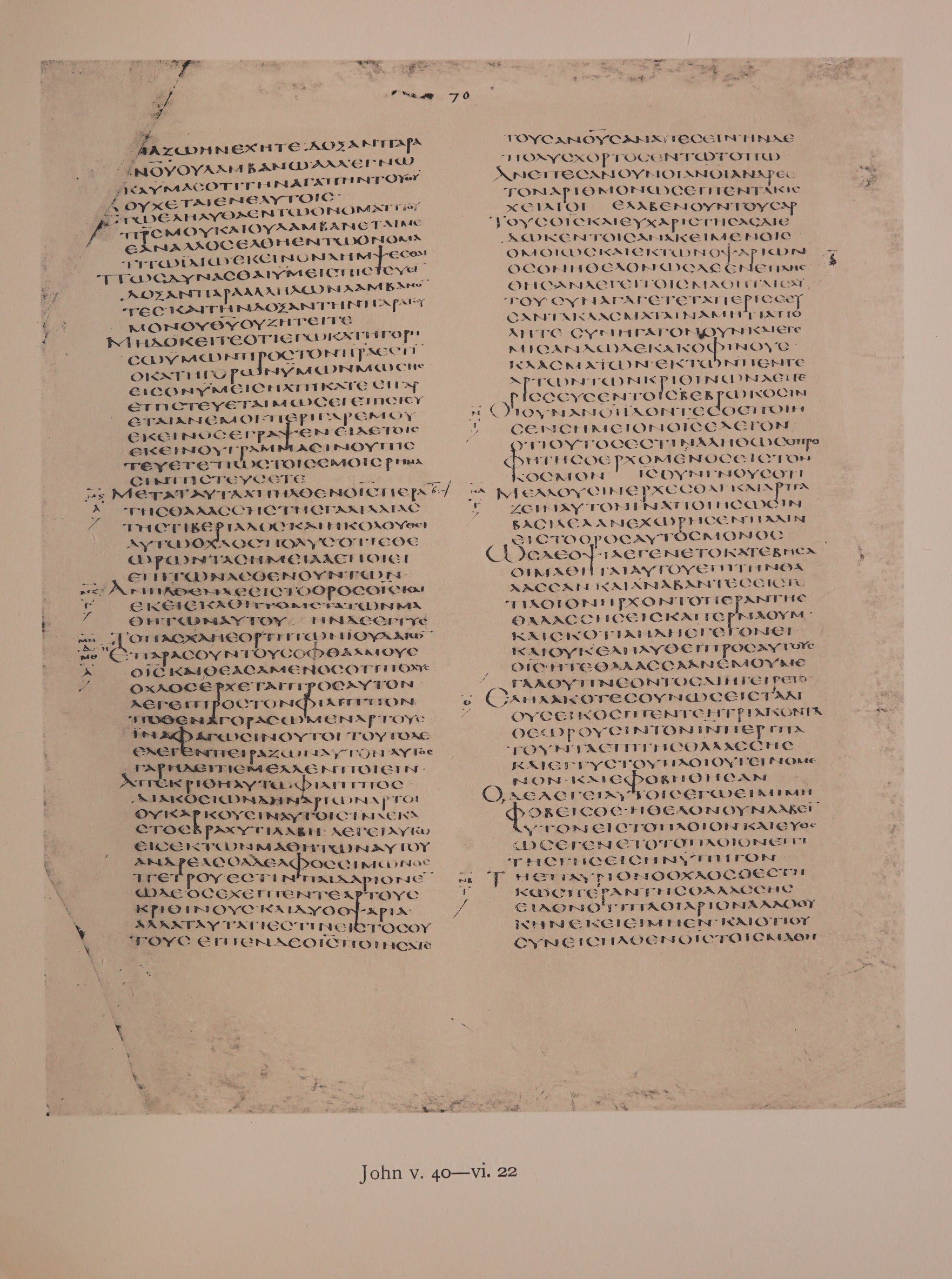
Where on the image
Page from the NTVMR transcription (docID 20002): verses 1-10 on fol. 70r (facsimile leaf 105), col. 1.
1μετα ταυτα απηλθεν ο ις περαν της θαλασσης της γαλιλαιας της τιβεριαδος · 2και ηκολουθει αυτω οχλος πολυς · οτι εθεωρων τα σημεια α εποιει επι των ασθενουντων 3ανηλθεν δε εις το ορος ο ις και εκει εκαθητο μετα των μαθητων αυτου 4ην δε εγγυς το πασχα η εορτη των ιουδαιων 5επαρας ουν τους οφθαλμους ο ις και θεασαμενος οτι πολυς οχλος ερχεται προς αυτον λεγει προς τον φιλιππον ποθεν αγορασωμεν αρτους ινα φαγωσιν ουτοι 6τουτο δε ελεγεν πειραζων αυτον · αυτος γαρ ηδει τι εμελλεν ποιειν · 7απεκριθη αυτω φιλιππος διακοσιων δηναριων αρτοι ουκ αρκουσιν αυτοις · ινα εκαστος βραχυ τι λαβη · 8λεγει αυτω εις εκ των μαθητων αυτου ανδρεας ο αδελφος σιμωνος πετρου · 9εστιν παιδαριον εν ωδε · ος εχει πεντε αρτους κριθινους · και δυο οψαρια · αλλα ταυτα τι εστιν εις τοσουτους 10ειπεν δε ο ις ποιησατε τους ανους αναπεσειν · ην δε πολυς χορτος εν τω τοπω ανεπεσαν ουν οι ανοι ανδρες τον αριθμον ωσει πεντακισχειλιοι
Compare: Tischendorf 8th edition (1869)
1Μετὰ ταῦτα ἀπῆλθεν ὁ Ἰησοῦς πέραν τῆς θαλάσσης τῆς Γαλιλαίας τῆς Τιβεριάδος· 2ἠκολούθει δὲ αὐτῷ ὄχλος πολύς, ὅτι ἑώρων τὰ σημεῖα ἃ ἐποίει ἐπὶ τῶν ἀσθενούντων. 3ἀνῆλθεν δὲ εἰς τὸ ὄρος Ἰησοῦς, καὶ ἐκεῖ ἐκαθέζετο μετὰ τῶν μαθητῶν αὐτοῦ. 4ἦν δὲ ἐγγὺς τὸ πάσχα, ἡ ἑορτὴ τῶν Ἰουδαίων. 5ἐπάρας οὖν τοὺς ὀφθαλμοὺς ὁ Ἰησοῦς καὶ θεασάμενος ὅτι πολὺς ὄχλος ἔρχεται πρὸς αὐτὸν λέγει πρὸς Φίλιππον· πόθεν ἀγοράσωμεν ἄρτους ἵνα φάγωσιν οὗτοι; 6τοῦτο δὲ ἔλεγεν πειράζων αὐτόν· αὐτὸς γὰρ ᾔδει τί ἔμελλεν ποιεῖν. 7ἀποκρίνεται αὐτῷ ὁ Φίλιππος, διακοσίων δηναρίων ἄρτοι οὐκ ἀρκοῦσιν αὐτοῖς, ἵνα ἕκαστος βραχύ τι λάβῃ. 8λέγει αὐτῷ εἷς ἐκ τῶν μαθητῶν αὐτοῦ, Ἀνδρέας ὁ ἀδελφὸς Σίμωνος Πέτρου· 9ἔστιν παιδάριον ὧδε ὃς ἔχει πέντε ἄρτους κριθίνους καὶ δύο ὀψάρια· ἀλλὰ ταῦτα τί ἐστιν εἰς τοσούτους; 10εἶπεν ὁ Ἰησοῦς· ποιήσατε τοὺς ἀνθρώπους ἀναπεσεῖν. ἦν δὲ χόρτος πολὺς ἐν τῷ τόπῳ. ἀνέπεσαν οὖν οἱ ἄνδρες τὸν ἀριθμὸν ὡς πεντακισχίλιοι.
1After these things Jesus went over the sea of Galilee, which is the sea of Tiberias. 2And a great multitude followed him, because they saw his miracles which he did on them that were diseased. 3And Jesus went up into a mountain, and there he sat with his disciples. 4And the passover, a feast of the Jews, was nigh. 5When Jesus then lifted up his eyes, and saw a great company come unto him, he saith unto Philip, Whence shall we buy bread, that these may eat? 6And this he said to prove him: for he himself knew what he would do. 7Philip answered him, Two hundred pennyworth of bread is not sufficient for them, that every one of them may take a little. 8One of his disciples, Andrew, Simon Peter’s brother, saith unto him, 9There is a lad here, which hath five barley loaves, and two small fishes: but what are they among so many? 10And Jesus said, Make the men sit down. Now there was much grass in the place. So the men sat down, in number about five thousand.
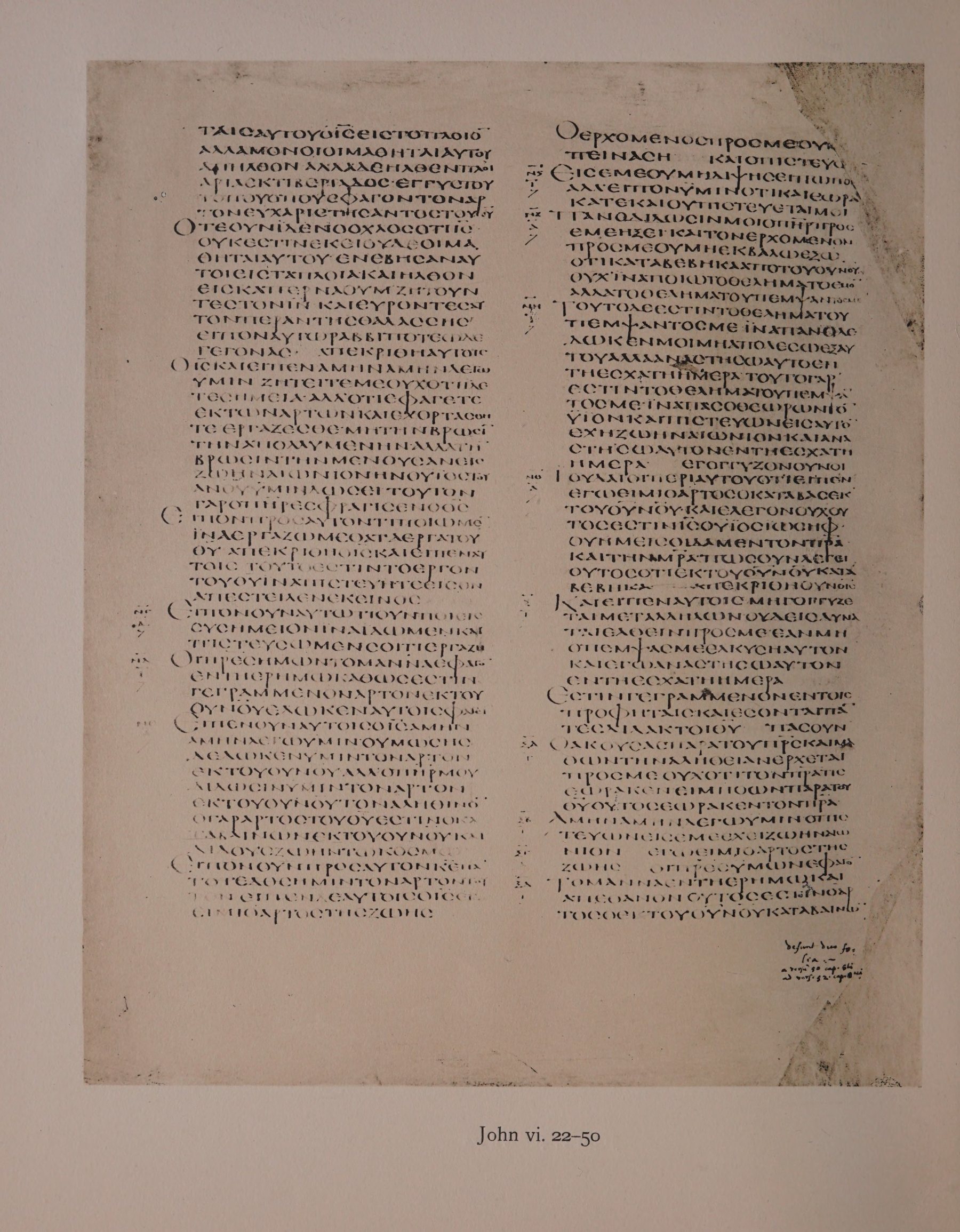
Where on the image
Page from the NTVMR transcription (docID 20002): verses 11-22 on fol. 70r (facsimile leaf 105), col. 2; verse 22 continues on fol. 70v (facsimile leaf 106), col. 1 (which begins 'ταις αυτου ο').
11ελαβεν ουν τους αρτους ο ις και ευχαριστησας διεδωκεν τοις ανακειμενοις ομοιως και εκ των οψαριων οσον ηθελον 12ως δε ενεπλησθησαν λεγει τοις μαθηταις αυτου · συναγαγετε τα περισσευσαντα κλασματα ινα μη τι απολητε · 13συνηγαγον ουν · και εγεμισαν δωδεκα κοφινους κλασματων · εκ των πεντε αρτων των κριθινων α επερισσευσεν τοις βεβρωκοσιν 14οι ουν ανοι ιδοντες ο εποιησεν σημειον ο ις ελεγον οτι ουτος εστιν αληθως ο προφητης ο ερχομενος εις τον κοσμον · 15ις ουν γνους οτι μελλουσιν ερχεσθαι · και αρπαζειν αυτον ινα ποιησωσιν βασιλεα ανεχωρησεν παλιν εις το ορος αυτος μονος 16ως δε οψια εγενετο κατεβησαν οι μαθηται αυτου επι την θαλασσαν 17και αναβαντες εις το πλοιον ηρχοντο περαν της θαλασσης εις καπερναουμ · και σκοτια ηδη εγεγονει και ουκ εληλυθει προς αυτους ο ις · 18η τε θαλασσα ανεμου μεγαλου πνεοντος διηγειρετο · 19εληλακοτες ουν ωσει σταδιους εικοσι πεντε η τριακοντα θεωρουσιν τον ιν περιπατουντα επι της θαλασσης και εγγυς του πλοιου γεινομενον · και εφοβηθησαν 20ο δε λεγει αυτοις εγω ειμι μη φοβεισθε · 21ηθελον ουν λαβειν αυτον εις το πλοιον · και ευθεως εγενετο το πλοιον επι της γης εις ην υπηγον 22τη επαυριον ο οχλος ο εστηκως περαν της θαλασσης ειδον οτι πλοιαριον αλλο ουκ ην εκει ει μη εν · και οτι ου συνεισηλθεν ο ις τοις μαθηταις αυτου ο ις εις το πλοιον αλλα μονοι οι μαθηται αυτου απηλθον ·
Compare: Tischendorf 8th edition (1869)
11ἔλαβεν οὖν τοὺς ἄρτους ὁ Ἰησοῦς καὶ εὐχαρίστησεν καὶ ἔδωκεν τοῖς ἀνακειμένοις, ὁμοίως καὶ ἐκ τῶν ὀψαρίων ὅσον ἤθελον. 12ὡς δὲ ἐνεπλήσθησαν, λέγει τοῖς μαθηταῖς αὐτοῦ· συναγάγετε τὰ περισσεύσαντα κλάσματα, ἵνα μή τι ἀπόληται. 13συνήγαγον οὖν, καὶ ἐγέμισαν δώδεκα κοφίνους κλασμάτων ἐκ τῶν πέντε ἄρτων τῶν κριθίνων, ἃ ἐπερίσσευσαν τοῖς βεβρωκόσιν. 14Οἱ οὖν ἄνθρωποι ἰδόντες ὃ ἐποίησεν σημεῖον ἔλεγον ὅτι οὗτός ἐστιν ἀληθῶς ὁ προφήτης ὁ εἰς τὸν κόσμον ἐρχόμενος. 15Ἰησοῦς οὖν γνοὺς ὅτι μέλλουσιν ἔρχεσθαι καὶ ἁρπάζειν αὐτὸν ἵνα ποιήσωσιν βασιλέα, φεύγει πάλιν εἰς τὸ ὄρος αὐτὸς μόνος. 16Ὡς δὲ ὀψία ἐγένετο, κατέβησαν οἱ μαθηταὶ αὐτοῦ ἐπὶ τὴν θάλασσαν, 17καὶ ἐμβάντες εἰς πλοῖον ἤρχοντο πέραν τῆς θαλάσσης εἰς Καφαρναούμ. κατέλαβεν δὲ αὐτοὺς ἡ σκοτία καὶ οὔπω ἐληλύθει Ἰησοῦς πρὸς αὐτοὺς, 18ἥ τε θάλασσα ἀνέμου μεγάλου πνέοντος διεγείρετο. 19ἐληλακότες οὖν ὡς στάδια εἴκοσι πέντε ἢ τριάκοντα θεωροῦσιν τὸν Ἰησοῦν περιπατοῦντα ἐπὶ τῆς θαλάσσης καὶ ἐγγὺς τοῦ πλοίου γινόμενον, καὶ ἐφοβήθησαν. 20ὁ δὲ λέγει αὐτοῖς· ἐγώ εἰμι, μὴ φοβεῖσθε. 21ἤθελον οὖν λαβεῖν αὐτὸν εἰς τὸ πλοῖον, καὶ εὐθέως ἐγένετο τὸ πλοῖον ἐπὶ τὴν γῆν εἰς ἣν ὑπῆγον. 22Τῇ ἐπαύριον ὁ ὄχλος ὁ ἑστηκὼς πέραν τῆς θαλάσσης εἶδον ὅτι πλοιάριον ἄλλο οὐκ ἦν ἐκεῖ εἰ μὴ ἕν, καὶ ὅτι οὐ συνεισῆλθεν τοῖς μαθηταῖς αὐτοῦ ὁ Ἰησοῦς εἰς τὸ πλοῖον ἀλλὰ μόνοι οἱ μαθηταὶ αὐτοῦ ἀπῆλθον·
11And Jesus took the loaves; and when he had given thanks, he distributed to the disciples, and the disciples to them that were set down; and likewise of the fishes as much as they would. 12When they were filled, he said unto his disciples, Gather up the fragments that remain, that nothing be lost. 13Therefore they gathered them together, and filled twelve baskets with the fragments of the five barley loaves, which remained over and above unto them that had eaten. 14Then those men, when they had seen the miracle that Jesus did, said, This is of a truth that prophet that should come into the world. 15When Jesus therefore perceived that they would come and take him by force, to make him a king, he departed again into a mountain himself alone. 16And when even was now come, his disciples went down unto the sea, 17And entered into a ship, and went over the sea toward Capernaum. And it was now dark, and Jesus was not come to them. 18And the sea arose by reason of a great wind that blew. 19So when they had rowed about five and twenty or thirty furlongs, they see Jesus walking on the sea, and drawing nigh unto the ship: and they were afraid. 20But he saith unto them, It is I; be not afraid. 21Then they willingly received him into the ship: and immediately the ship was at the land whither they went. 22The day following, when the people which stood on the other side of the sea saw that there was none other boat there, save that one whereinto his disciples were entered, and that Jesus went not with his disciples into the boat, but that his disciples were gone away alone;
Where on the image
Page from the NTVMR transcription (docID 20002): verses 23-29 on fol. 70v (facsimile leaf 106), col. 1.
23αλλα δε ηλθεν πλοιαρια εκ τιβεριαδος · εγγυς του τοπου οπου εφαγον τον αρτον ευχαριστησαντος του κυ 24οτε ουν ιδεν ο οχλος οτι ις ουκ εστιν εκει ουδε οι μαθηται αυτου · ενεβησαν αυτοι εις τα πλοια · και ηλθον εις καπερναουμ ζητουντες τον ιν · 25και ευροντες αυτον περαν της θαλασσης ειπον αυτω ραββι ποτε ωδε γεγονας · 26απεκριθη αυτοις ο ις και ειπεν · αμην αμην λεγω υμιν ζητειτε με ουχ οτι ιδετε σημεια · αλλ οτι εφαγετε εκ των αρτων και εχορτασθητε · 27εργαζεσθε · μη την βρωσιν την απολλυμενην · αλλα την βρωσιν την μενουσαν εις ζωην αιωνιον ην ο υιος του ανου υμιν δωσει · τουτον γαρ ο πηρ εσφραγισεν ο θς 28ειπον προς αυτον τι ποιωμεν ινα εργαζωμεθα τα εργα του θυ · 29απεκριθη ο ις και ειπεν αυτοις τουτο εστιν το εργον του θυ ινα πιστευητε εις ον απεστειλεν εκεινος
Compare: Tischendorf 8th edition (1869)
23ἄλλα ἦλθεν πλοιάρια ἐκ Τιβεριάδος ἐγγὺς τοῦ τόπου ὅπου ἔφαγον τὸν ἄρτον εὐχαριστήταντος τοῦ κυρίου. 24ὅτε οὖν εἶδεν ὁ ὄχλος ὅτι Ἰησοῦς οὐκ ἔστιν ἐκεῖ οὐδὲ οἱ μαθηταὶ αὐτοῦ, ἐνέβησαν αὐτοὶ εἰς τὰ πλοιάρια καὶ ἦλθον εἰς Καφαρναοὺμ ζητοῦντες τὸν Ἰησοῦν. 25καὶ εὑρόντες αὐτὸν πέραν τῆς θαλάσσης εἶπον αὐτῷ· ῥαββεί, πότε ὧδε γέγονας; 26ἀπεκρίθη αὐτοῖς ὁ Ἰησοῦς καὶ εἶπεν· ἀμὴν ἀμὴν λέγω ὑμῖν, ζητεῖτέ με οὐχ ὅτι εἴδετε σημεῖα, ἀλλ’ ὅτι ἐφάγετε ἐκ τῶν ἄρτων καὶ ἐχορτάσθητε. 27ἐργάζεσθε μὴ τὴν βρῶσιν τὴν ἀπολλυμένην, ἀλλὰ τὴν βρῶσιν τὴν μένουσαν εἰς ζωὴν αἰώνιον, ἣν ὁ υἱὸς τοῦ ἀνθρώπου δίδωσιν ὑμῖν· τοῦτον γὰρ ὁ πατὴρ ἐσφράγισεν, ὁ θεός. 28εἶπον οὖν πρὸς αὐτόν· τί ποιῶμεν ἵνα ἐργαζώμεθα τὰ ἔργα τοῦ θεοῦ; 29ἀπεκρίθη Ἰησοῦς καὶ εἶπεν αὐτοῖς· τοῦτό ἐστιν τὸ ἔργον τοῦ θεοῦ, ἵνα πιστεύητε εἰς ὃν ἀπέστειλεν ἐκεῖνος.
23(Howbeit there came other boats from Tiberias nigh unto the place where they did eat bread, after that the Lord had given thanks:) 24When the people therefore saw that Jesus was not there, neither his disciples, they also took shipping, and came to Capernaum, seeking for Jesus. 25And when they had found him on the other side of the sea, they said unto him, Rabbi, when camest thou hither? 26Jesus answered them and said, Verily, verily, I say unto you, Ye seek me, not because ye saw the miracles, but because ye did eat of the loaves, and were filled. 27Labour not for the meat which perisheth, but for that meat which endureth unto everlasting life, which the Son of man shall give unto you: for him hath God the Father sealed. 28Then said they unto him, What shall we do, that we might work the works of God? 29Jesus answered and said unto them, This is the work of God, that ye believe on him whom he hath sent.
Where on the image
Page from the NTVMR transcription (docID 20002): verses 30-35 on fol. 70v (facsimile leaf 106), col. 1.
30ειπον ουν αυτω τι ουν ποιεις συ σημειον ινα ιδωμεν και πιστευσωμεν σοι τι εργαζη 31οι πρες ημων το μαννα εφαγον εν τη ερημω καθως εστιν γεγραμμενον αρτον εκ του ουνου εδωκεν αυτοις φαγειν 32ειπεν ουν αυτοις ο ις αμην αμην λεγω υμιν ου μωσης δεδωκεν υμιν τον αρτον εκ του ουνου · αλλ ο πηρ μου διδωσιν υμιν τον αρτον εκ του ουνου τον αληθινον 33ο γαρ αρτος του θυ εστιν ο καταβαινων εκ του ουνου · και διδους ζωην τω κοσμω · 34ειπον ουν προς αυτον κε παντοτε δος ημιν τον αρτον τουτον · 35ειπεν δε αυτοις ο ις εγω ειμι ο αρτος της ζωης ο ερχομενος προς με ου μ̣[η] πειναση και ο πιστευω̣[ν] εις εμε ου μη διψησει πωπο[τε]
Compare: Tischendorf 8th edition (1869)
30εἶπον οὖν αὐτῷ· τί οὖν ποιεῖς σὺ σημεῖον, ἵνα ἴδωμεν καὶ πιστεύσωμέν σοι; τί ἐργάζῃ; 31οἱ πατέρες ἡμῶν τὸ μάννα ἔφαγον ἐν τῇ ἐρήμῳ, καθώς ἐστιν γεγραμμένον· ἄρτον ἐκ τοῦ οὐρανοῦ ἔδωκεν αὐτοῖς φαγεῖν. 32εἶπεν οὖν αὐτοῖς ὁ Ἰησοῦς· ἀμὴν ἀμὴν λέγω ὑμῖν, οὐ Μωϋσῆς δέδωκεν ὑμῖν τὸν ἄρτον ἐκ τοῦ οὐρανοῦ, ἀλλ’ ὁ πατήρ μου δίδωσιν ὑμῖν τὸν ἄρτον ἐκ τοῦ οὐρανοῦ τὸν ἀληθινόν. 33ὁ γὰρ ἄρτος τοῦ θεοῦ ἐστιν ὁ καταβαίνων ἐκ τοῦ οὐρανοῦ καὶ ζωὴν διδοὺς τῷ κόσμῳ. 34εἶπον οὖν πρὸς αὐτόν· κύριε, πάντοτε δὸς ἡμῖν τὸν ἄρτον τοῦτον. 35εἶπεν οὖν αὐτοῖς ὁ Ἰησοῦς· ἐγώ εἰμι ὁ ἄρτος τῆς ζωῆς· ὁ ἐρχόμενος πρός ἐμὲ οὐ μὴ πεινάσῃ, καὶ ὁ πιστεύων εἰς ἐμὲ οὐ μὴ διψήσει πώποτε.
30They said therefore unto him, What sign shewest thou then, that we may see, and believe thee? what dost thou work? 31Our fathers did eat manna in the desert; as it is written, He gave them bread from heaven to eat. 32Then Jesus said unto them, Verily, verily, I say unto you, Moses gave you not that bread from heaven; but my Father giveth you the true bread from heaven. 33For the bread of God is he which cometh down from heaven, and giveth life unto the world. 34Then said they unto him, Lord, evermore give us this bread. 35And Jesus said unto them, I am the bread of life: he that cometh to me shall never hunger; and he that believeth on me shall never thirst.
Where on the image
Page from the NTVMR transcription (docID 20002): verses 36-43 on fol. 70v (facsimile leaf 106), col. 2.
36αλλ ειπον υμιν οτι και εωρακατε και ου πιστευεται μοι 37παν ο διδωσιν μοι ο πηρ προς εμε ηξει · και τον ερχομενον προς με ου μη εκβαλω εξω 38οτι καταβεβηκα απο του ουνου ουχ ινα ποιω το θελημα το εμον αλλα το θελημα του πεμψαντος με 39τουτο δε εστιν το θελημα του πεμψαντος με ινα παν ο δεδωκεν μοι μη απολεσω εξ αυτου αλλα αναστησω αυτο εν τη εσχατη ημερα · 40τουτο γαρ · εστιν το θελημα του πεμψαντος με · ινα πας ο θεωρων τον υιον και πιστευων εις αυτον εχη ζωην αιωνιον · και αναστησω αυτον εν τη εσχατη ημερα · 41εγογγυζον ουν οι ιουδαιοι περι αυτου οτι ειπεν εγω ειμι ο αρτος ο καταβας εκ του ουνου · 42και ελεγον ουχ ουτος εστιν ις ο υιος ιωσηφ ου ημεις οιδαμεν τον πρα και την μρα · πως ουν λεγει ουτος οτι εκ του ουνου καταβεβηκα · 43απεκριθη ουν ο ις και ειπεν αυτοις μη γογγυζεται · μετ αλληλων ·
Compare: Tischendorf 8th edition (1869)
36ἀλλ’ εἶπον ὑμῖν ὅτι καὶ ἑωράκατέ καὶ οὐ πιστεύετε. 37πᾶν ὃ δίδωσίν μοι ὁ πατὴρ πρὸς ἐμὲ ἥξει, καὶ τὸν ἐρχόμενον πρὸς ἐμὲ οὐ μὴ ἐκβάλω ἔξω, 38ὅτι καταβέβηκα ἀπὸ τοῦ οὐρανοῦ οὐχ ἵνα ποιήσω τὸ θέλημα τὸ ἐμὸν ἀλλὰ τὸ θέλημα τοῦ πέμψαντός με· 39τοῦτο δέ ἐστιν τὸ θέλημα τοῦ πέμψαντός με, ἵνα πᾶν ὃ δέδωκέν μοι μὴ ἀπολέσω ἐξ αὐτοῦ, ἀλλὰ ἀναστήσω αὐτὸ ἐν τῇ ἐσχάτῃ ἡμέρᾳ. 40τοῦτο γάρ ἐστιν τὸ θέλημα τοῦ πατρός μου, ἵνα πᾶς ὁ θεωρῶν τὸν υἱὸν καὶ πιστεύων εἰς αὐτὸν ἔχῃ ζωὴν αἰώνιον καὶ ἀναστήσω αὐτὸν ἐγὼ ἐν τῇ ἐσχάτῃ ἡμέρᾳ. 41Ἐγόγγυζον οὖν οἱ Ἰουδαῖοι περὶ αὐτοῦ, ὅτι εἶπεν· ἐγώ εἰμι ὁ ἄρτος ὁ καταβὰς ἐκ τοῦ οὐρανοῦ, 42καὶ ἔλεγον· οὐχ οὗτός ἐστιν Ἰησοῦς ὁ υἱὸς Ἰωσήφ, οὗ ἡμεῖς οἴδαμεν τὸν πατέρα καὶ τὴν μητέρα; πῶς νῦν λέγει οὗτος, ὅτι ἐκ τοῦ οὐρανοῦ καταβέβηκα; 43ἀπεκρίθη Ἰησοῦς καὶ εἶπεν αὐτοῖς· μὴ γογγύζετε μετ’ ἀλλήλων.
36But I said unto you, That ye also have seen me, and believe not. 37All that the Father giveth me shall come to me; and him that cometh to me I will in no wise cast out. 38For I came down from heaven, not to do mine own will, but the will of him that sent me. 39And this is the Father’s will which hath sent me, that of all which he hath given me I should lose nothing, but should raise it up again at the last day. 40And this is the will of him that sent me, that every one which seeth the Son, and believeth on him, may have everlasting life: and I will raise him up at the last day. 41The Jews then murmured at him, because he said, I am the bread which came down from heaven. 42And they said, Is not this Jesus, the son of Joseph, whose father and mother we know? how is it then that he saith, I came down from heaven? 43Jesus therefore answered and said unto them, Murmur not among yourselves.
Where on the image
Page from the NTVMR transcription (docID 20002): verses 44-50 on fol. 70v (facsimile leaf 106), col. 2.
44ουδεις δυναται ελθειν προς με · εαν μη ο πεμψας με ελκυση αυτον και εγω αναστησω αυτον εν τη εσχατη ημερα 45εστιν γεγραμμενον εν τοις προφηταις · και εσονται παντες διδακτοι θυ · πας ουν ο ακουσας παρα του πρς και μαθων την αληθειαν ερχεται προς με · 46ουχ οτι τον πρα τις εωρακεν · ει μη ο ων παρα του θυ ουτος εωρακεν τον πρα 47αμην αμην λεγω υμιν ο πιστευων εις εμε εχει ζωην αιωνιον 48εγω ειμι ο αρτος της ζωης 49οι πρες υμων εφαγον το μαννα εν τη ερημω · και απεθανον · 50ουτος εστιν ο αρτος ο εκ του ουνου καταβαινων [the rest of this verse is lost with the missing leaves (John 6:50-8:52)]
Compare: Tischendorf 8th edition (1869)
44οὐδεὶς δύναται ἐλθεῖν πρός με ἐὰν μὴ ὁ πατὴρ ὁ πέμψας με ἑλκύσῃ αὐτόν, κἀγὼ ἀναστήσω αὐτὸν ἐν τῇ ἐσχάτῃ ἡμέρᾳ. 45ἔστιν γεγραμμένον ἐν τοῖς προφήταις· καὶ ἔσονται πάντες διδακτοὶ θεοῦ· πᾶς ὁ ἀκούσας παρὰ τοῦ πατρὸς καὶ μαθὼν ἔρχεται πρὸς ἐμέ. 46οὐχ ὅτι τὸν πατέρα ἑώρακέν τις, εἰ μὴ ὁ ὢν παρὰ τοῦ θεοῦ, οὗτος ἑώρακεν τὸν θεόν. 47ἀμὴν ἀμὴν λέγω ὑμῖν, ὁ πιστεύων ἔχει ζωὴν αἰώνιον. 48ἐγώ εἰμι ὁ ἄρτος τῆς ζωῆς. 49οἱ πατέρες ὑμῶν ἔφαγον ἐν τῇ ἐρήμῳ τὸ μάννα καὶ ἀπέθανον· 50οὗτός ἐστιν ὁ ἄρτος ὁ ἐκ τοῦ οὐρανοῦ καταβαίνων, ἵνα τις ἐξ αὐτοῦ φάγῃ καὶ μὴ ἀποθάνῃ.
44No man can come to me, except the Father which hath sent me draw him: and I will raise him up at the last day. 45It is written in the prophets, And they shall be all taught of God. Every man therefore that hath heard, and hath learned of the Father, cometh unto me. 46Not that any man hath seen the Father, save he which is of God, he hath seen the Father. 47Verily, verily, I say unto you, He that believeth on me hath everlasting life. 48I am that bread of life. 49Your fathers did eat manna in the wilderness, and are dead. 50This is the bread which cometh down from heaven, [the rest of this verse, "that a man may eat thereof, and not die.", is lost with the missing leaves]
Cite
Sources
- Source: Codex Alexandrinus page images + NTVMR transcription (CC BY 4.0) + Tischendorf 8th edition + KJV (holding institution)
- Critical edition: Codex Alexandrinus transcription, NTVMR (INTF Münster, CC BY 4.0); Tischendorf 8th edition for comparison
← previous · → next · v cycle view · l back to library