John, Chapter 8 (Codex Alexandrinus)
Introduction
John 8 from Codex Alexandrinus (GA 02), a fifth-century Greek Bible held by the British Library (Royal MS 1 D. VIII). In the New Testament it is the chief witness to the Byzantine text in the Gospels and to the Alexandrian text in the rest of the New Testament. Its New Testament volume lacks Matthew 1:1-25:5, John 6:50-8:52 and 2 Corinthians 4:13-12:6.
Lacuna: verses 1-51 of this chapter are not extant in Codex Alexandrinus (the leaves are lost); only the verses that survive on the pages shown are published here.
This entry meets the strict three-criteria standard of the Theosis Library:
- Manuscript scan: the actual page(s) of Codex Alexandrinus containing this passage (folio 73r), reproduced from the British Museum's 1909 photographic facsimile edited by F. G. Kenyon, as digitised by the Getty Research Institute for the Internet Archive. The facsimile prints the verse range beneath each plate; that printed range was read for every page used and agrees with the INTF's NTVMR verse-level page index (CC BY 4.0). The page for each section now comes from the NTVMR transcription itself, which records the page and column on which every verse is written.
- Original text: the manuscript's own text, from a diplomatic transcription (see Greek text below), with Tischendorf's 8th critical edition (1869) for comparison.
- English translation: the King James Version (1611), retrieved verbatim from the public-domain bible-api.com endpoint.
Greek text: a diplomatic transcription of Codex Alexandrinus made by the Institut für Neutestamentliche Textforschung (INTF), Münster, for the New Testament Virtual Manuscript Room (NTVMR), published under a Creative Commons Attribution 4.0 licence. It gives the letters as the first scribe wrote them: no accents or breathings, the scribe's own spelling, and the sacred names in their contracted form (θς for θεος, ις for ιησους, κς for κυριος; the overline is not reproduced). Corrections by later hands are not shown. Letters in square brackets are not legible on the page and were restored by the transcribers, a dot under a letter marks an uncertain reading, and [...] marks text lost to damage. Beneath each section, for comparison, is Tischendorf's 8th critical edition (1869). Where the two differ, the transcription is what the manuscript says. Each section is shown with the page on which the transcription places its verses.
Manuscript note: Lost from Codex Alexandrinus (missing or damaged leaves): verse 52; not shown.
How was this verified? (Provenance)
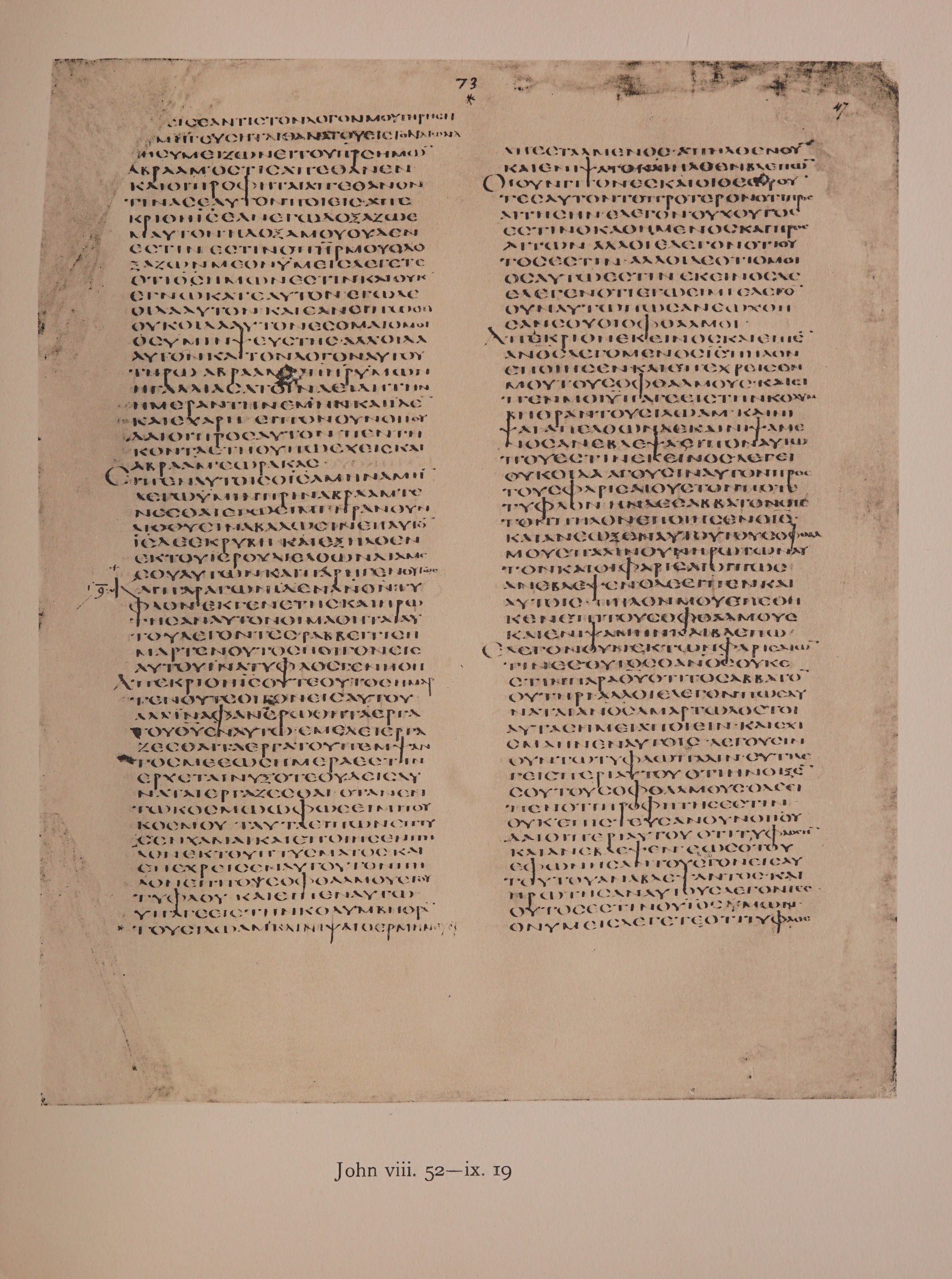
Where on the image
Page from the NTVMR transcription (docID 20002): verses 53-59 on fol. 73r (facsimile leaf 107), col. 1.
53[μ]η συ μειζων ει του πρς ημων αβρααμ · οστις απεθανεν και οι προφηται απεθανον τινα σεαυτον ποιεις · 54απεκριθη ις εαν εγω δοξαζω εμαυτον · η δοξα μου ουδεν εστιν · εστιν ο πηρ μου ο δοξαζων με ον υμεις λεγετε οτι θς ημων εστιν 55και ουκ εγνωκατε αυτον · εγω δε οιδα αυτον · και εαν ειπω οτι ουκ οιδα αυτον εσομαι ομοιος υμιν ψευστης · αλλ οιδα αυτον και τον λογον αυτου τηρω · 56αβρααμ ο πηρ υμων ηγαλλιασατο ινα ειδη την ημεραν την εμην και ιδεν και εχαρη · 57ειπον ουν οι ιουδαιοι προς αυτον πεντηκοντα ετη ουπω εχεις και αβρααμ εωρακας · 58ειπεν αυτοις ο ις αμην αμην λεγω υμιν πριν αβρααμ γενεσθαι εγω ειμι · 59ηραν ουν λιθους ινα βαλωσιν επ αυτον ις δε εκρυβη και εξηλθεν εκ του ιερου διελθων δια μεσου αυτων και παρηγεν ουτως
Compare: Tischendorf 8th edition (1869)
53μὴ σὺ μείζων εἶ τοῦ πατρὸς ἡμῶν Ἀβραάμ, ὅστις ἀπέθανεν; καὶ οἱ προφῆται ἀπέθανον· τίνα σεαυτὸν ποιεῖς; 54ἀπεκρίθη Ἰησοῦς· ἐὰν ἐγὼ δοξάσω ἐμαυτόν, ἡ δόξα μου οὐδέν ἐστιν· ἔστιν ὁ πατήρ μου ὁ δοξάζων με, ὃν ὑμεῖς λέγετε ὅτι θεὸς ἡμῶν ἐστιν, 55καὶ οὐκ ἐγνώκατε αὐτόν, ἐγὼ δὲ οἶδα αὐτόν. κἂν εἴπω ὅτι οὐκ οἶδα αὐτόν, ἔσομαι ὅμοιος ὑμῖν ψεύστης· ἀλλὰ οἶδα αὐτὸν καὶ τὸν λόγον αὐτοῦ τηρῶ. 56Ἀβραὰμ ὁ πατὴρ ὑμῶν ἠγαλλιάσατο ἵνα εἴδῃ τὴν ἡμέραν τὴν ἐμήν, καὶ εἶδεν καὶ ἐχάρη. 57εἶπαν οὖν οἱ Ἰουδαῖοι πρὸς αὐτόν· πεντήκοντα ἔτη οὔπω ἔχεις καὶ Ἀβραὰμ ἑώρακας; 58εἶπεν αὐτοῖς Ἰησοῦς· ἀμὴν ἀμὴν λέγω ὑμῖν, πρὶν Ἀβραὰμ γενέσθαι ἐγὼ εἰμί. 59ἦραν οὖν λίθους ἵνα βάλωσιν ἐπ’ αὐτόν· Ἰησοῦς δὲ ἐκρύβη καὶ ἐξῆλθεν ἐκ τοῦ ἱεροῦ.
53Art thou greater than our father Abraham, which is dead? and the prophets are dead: whom makest thou thyself? 54Jesus answered, If I honour myself, my honour is nothing: it is my Father that honoureth me; of whom ye say, that he is your God: 55Yet ye have not known him; but I know him: and if I should say, I know him not, I shall be a liar like unto you: but I know him, and keep his saying. 56Your father Abraham rejoiced to see my day: and he saw it, and was glad. 57Then said the Jews unto him, Thou art not yet fifty years old, and hast thou seen Abraham? 58Jesus said unto them, Verily, verily, I say unto you, Before Abraham was, I am. 59Then took they up stones to cast at him: but Jesus hid himself, and went out of the temple, going through the midst of them, and so passed by.
Cite
Sources
- Source: Codex Alexandrinus page images + NTVMR transcription (CC BY 4.0) + Tischendorf 8th edition + KJV (holding institution)
- Critical edition: Codex Alexandrinus transcription, NTVMR (INTF Münster, CC BY 4.0); Tischendorf 8th edition for comparison
← previous · → next · v cycle view · l back to library