Romans, Chapter 12 (Codex Alexandrinus)
Introduction
Romans 12 from Codex Alexandrinus (GA 02), a fifth-century Greek Bible held by the British Library (Royal MS 1 D. VIII). In the New Testament it is the chief witness to the Byzantine text in the Gospels and to the Alexandrian text in the rest of the New Testament. Its New Testament volume lacks Matthew 1:1-25:5, John 6:50-8:52 and 2 Corinthians 4:13-12:6.
This entry meets the strict three-criteria standard of the Theosis Library:
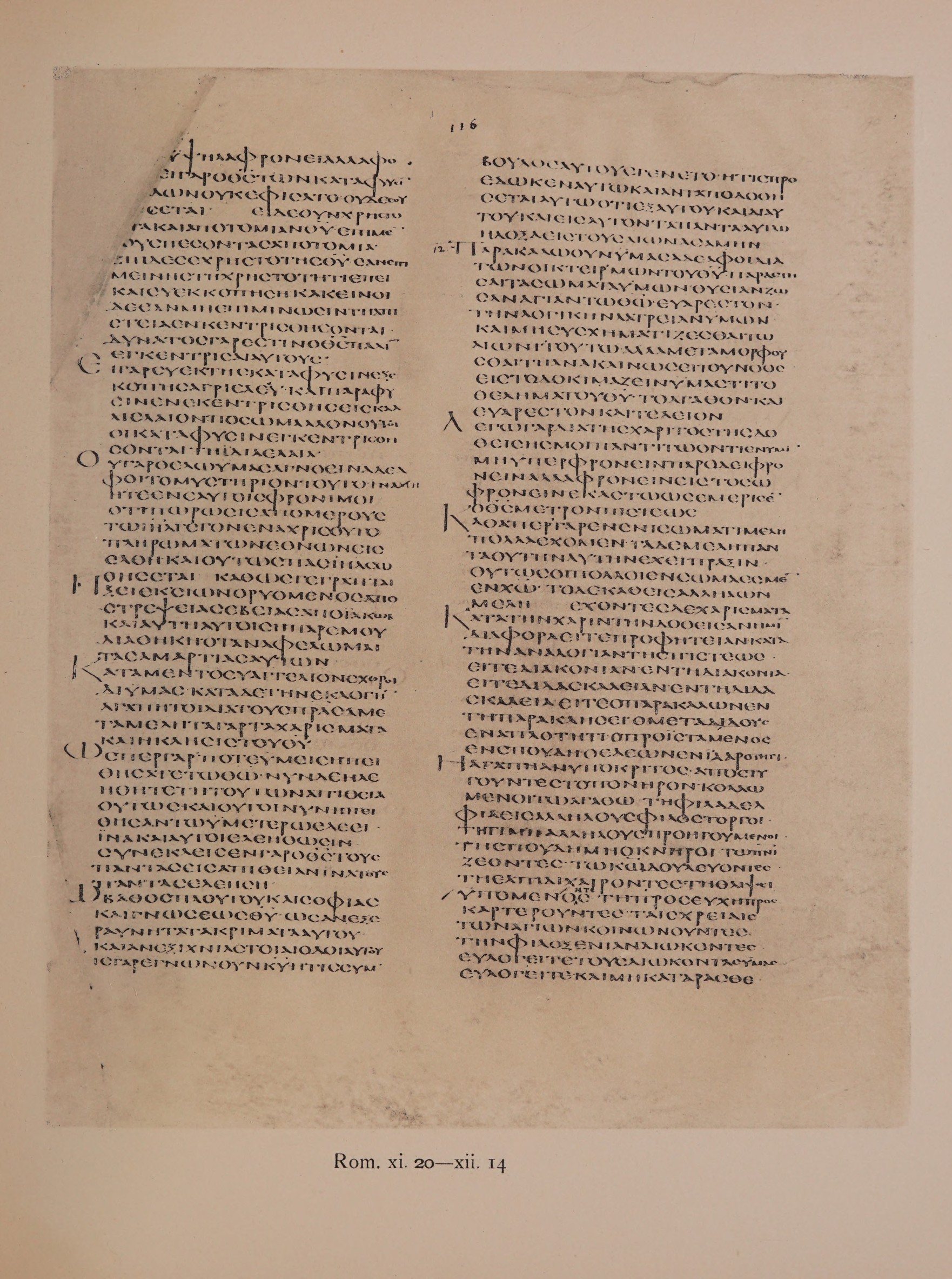
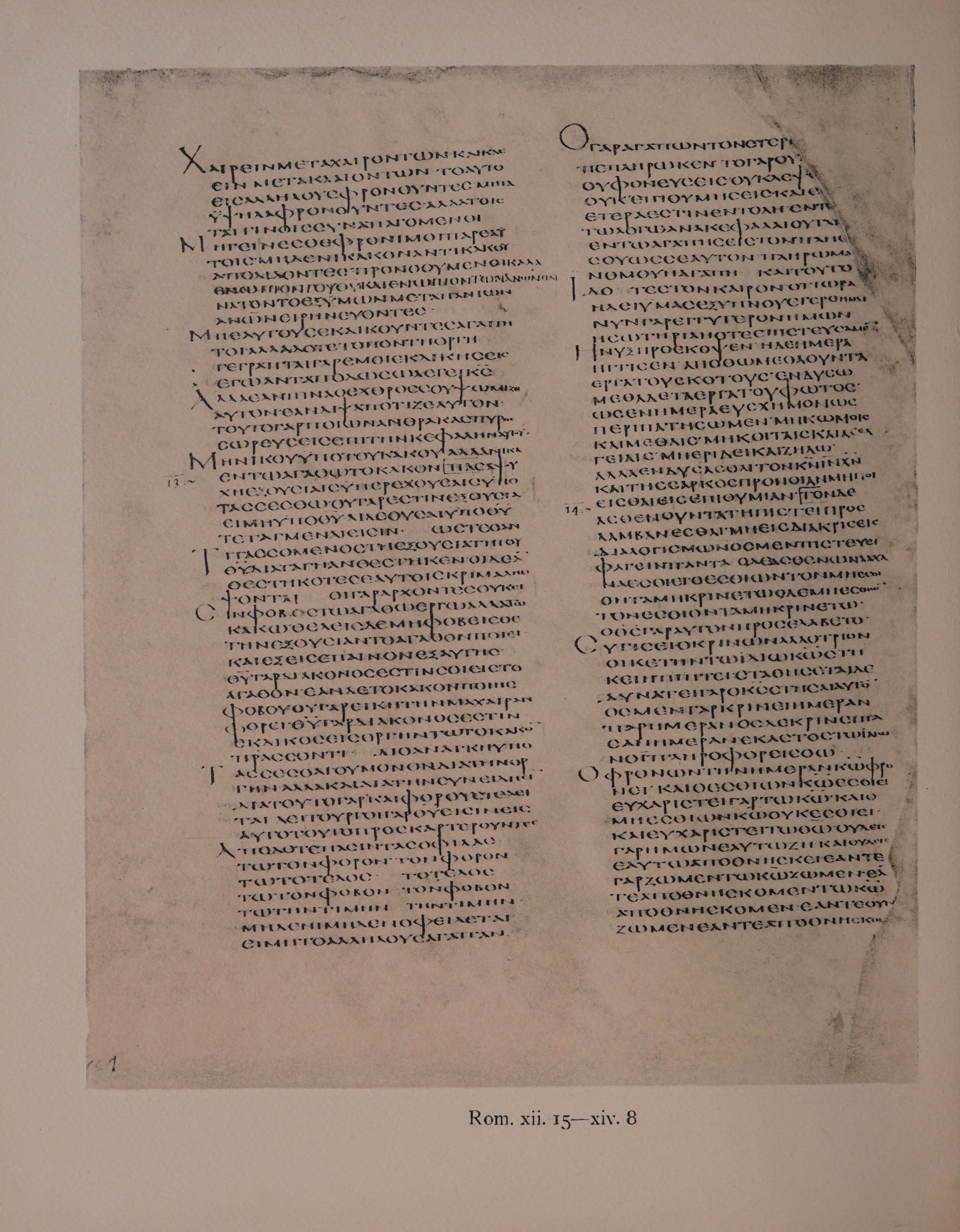
- Manuscript scan: the actual page(s) of Codex Alexandrinus containing this passage (folios 116r, 116v), reproduced from the British Museum's 1909 photographic facsimile edited by F. G. Kenyon, as digitised by the Getty Research Institute for the Internet Archive. The facsimile prints the verse range beneath each plate; that printed range was read for every page used and agrees with the INTF's NTVMR verse-level page index (CC BY 4.0). The page for each section now comes from the NTVMR transcription itself, which records the page and column on which every verse is written.
- Original text: the manuscript's own text, from a diplomatic transcription (see Greek text below), with Tischendorf's 8th critical edition (1869) for comparison.
- English translation: the King James Version (1611), retrieved verbatim from the public-domain bible-api.com endpoint.
Greek text: a diplomatic transcription of Codex Alexandrinus made by the Institut für Neutestamentliche Textforschung (INTF), Münster, for the New Testament Virtual Manuscript Room (NTVMR), published under a Creative Commons Attribution 4.0 licence. It gives the letters as the first scribe wrote them: no accents or breathings, the scribe's own spelling, and the sacred names in their contracted form (θς for θεος, ις for ιησους, κς for κυριος; the overline is not reproduced). Corrections by later hands are not shown. Letters in square brackets are not legible on the page and were restored by the transcribers, a dot under a letter marks an uncertain reading, and [...] marks text lost to damage. Beneath each section, for comparison, is Tischendorf's 8th critical edition (1869). Where the two differ, the transcription is what the manuscript says. Each section is shown with the page on which the transcription places its verses.
How was this verified? (Provenance)
Where on the image
Page from the NTVMR transcription (docID 20002): verses 1-7 on fol. 116r (facsimile leaf 193), col. 2.
1παρακαλω ουν υμας αδελφοι δια των οικτειρμων του θυ παραστησαι τα σωματα υμων · θυσιαν ζωσαν αγιαν τω θω · ευαρεστον · την λογικην λατρειαν υμων 2και μη συσχηματιζεσθαι τω αιωνι τουτω · αλλα μεταμορφουσθαι τη ανακαινωσει του νοος εις το δοκιμαζειν υμας τι το θελημα του θυ · το αγαθον · και ευαρεστον και τελειον 3λεγω γαρ δια της χαριτος της δοθεισης μοι παντι τω οντι εν υμιν μη υπερφρονειν παρ ο δει φρονειν · αλλα φρονειν εις το σωφρονειν εκαστω ως εμερισεν ο θς μετρον πιστεως 4καθαπερ γαρ εν ενι σωματι μελη πολλα εχομεν · τα δε μελη παντα ου την αυτην εχει πραξιν · 5ουτως οι πολλοι εν σωμα εσμεν εν χω · το δε καθ εις αλληλων μελη 6εχοντες δε χαρισματα κατα την χαριν την δοθεισαν ημιν διαφορα ειτε προφητειαν · κατα την αναλογιαν της πιστεως 7ειτε διακονιαν · εν τη διακονια · ειτε διδασκαλειαν · εν τη διδασκαλεια ·
Compare: Tischendorf 8th edition (1869)
1Παρακαλῶ οὖν ὑμᾶς, ἀδελφοί, διὰ τῶν οἰκτιρμῶν τοῦ θεοῦ, παραστῆσαι τὰ σώματα ὑμῶν θυσίαν ζῶσαν ἁγίαν τῷ θεῷ εὐάρεστον, τὴν λογικὴν λατρείαν ὑμῶν· 2καὶ μὴ συνσχηματίζεσθε τῷ αἰῶνι τούτῳ, ἀλλὰ μεταμορφοῦσθε τῇ ἀνακαινώσει τοῦ νοός, εἰς τὸ δοκιμάζειν ὑμᾶς τί τὸ θέλημα τοῦ θεοῦ, τὸ ἀγαθὸν καὶ εὐάρεστον καὶ τέλειον. 3λέγω γὰρ διὰ τῆς χάριτος τῆς δοθείσης μοι παντὶ τῷ ὄντι ἐν ὑμῖν μὴ ὑπερφρονεῖν παρ’ ὃ δεῖ φρονεῖν, ἀλλὰ φρονεῖν εἰς τὸ σωφρονεῖν, ἑκάστῳ ὡς ὁ θεὸς ἐμέρισεν μέτρον πίστεως. 4καθάπερ γὰρ ἐν ἑνὶ σώματι πολλὰ μέλη ἔχομεν, τὰ δὲ μέλη πάντα οὐ τὴν αὐτὴν ἔχει πρᾶξιν, 5οὕτως οἱ πολλοὶ ἓν σῶμά ἐσμεν ἐν Χριστῷ, τὸ δὲ καθ’ εἷς ἀλλήλων μέλη, 6ἔχοντες δὲ χαρίσματα κατὰ τὴν χάριν τὴν δοθεῖσαν ἡμῖν διάφορα· εἴτε προφητείαν, κατὰ τὴν ἀναλογίαν τῆς πίστεως, 7εἴτε διακονίαν, ἐν τῇ διακονίᾳ, εἴτε ὁ διδάσκων ἐν τῇ διδασκαλίᾳ·
1I beseech you therefore, brethren, by the mercies of God, that ye present your bodies a living sacrifice, holy, acceptable unto God, which is your reasonable service. 2And be not conformed to this world: but be ye transformed by the renewing of your mind, that ye may prove what is that good, and acceptable, and perfect, will of God. 3For I say, through the grace given unto me, to every man that is among you, not to think of himself more highly than he ought to think; but to think soberly, according as God hath dealt to every man the measure of faith. 4For as we have many members in one body, and all members have not the same office: 5So we, being many, are one body in Christ, and every one members one of another. 6Having then gifts differing according to the grace that is given to us, whether prophecy, let us prophesy according to the proportion of faith; 7Or ministry, let us wait on our ministering: or he that teacheth, on teaching;
Where on the image
Page from the NTVMR transcription (docID 20002): verses 8-14 on fol. 116r (facsimile leaf 193), col. 2.
8ειτε ο παρακαλων εν τη παρακλησει · ο μεταδιδους εν απλοτητι ο προισταμενος εν σπουδη ο ελεων εν ιλαροτητι · 9η αγαπη ανυποκριτος · αποστυγουντες το πονηρον · κολλωμενοι τω αγαθω · 10τη φιλαδελφια εις αλληλους φιλοστοργοι · τη τιμη αλληλους προηγουμενοι 11τη σπουδη μη οκνηροι τω πνι ζεοντες · τω κω δουλευοντες 12τη ελπιδι χαιροντες τη θλιψει υπομενος · τη προσευχη προσκαρτερουντες · 13ταις χρειαις των αγιων κοινωνουντες την φιλοξενιαν διωκοντες 14ευλογειτε τους διωκοντας υμας ευλογειτε · και μη καταρασθε ·
Compare: Tischendorf 8th edition (1869)
8εἴτε ὁ παρακαλῶν, ἐν τῇ παρακλήσει· ὁ μεταδιδοὺς ἐν ἁπλότητι, ὁ προϊστάμενος ἐν σπουδῇ, ὁ ἐλεῶν ἐν ἱλαρότητι. 9Ἡ ἀγάπη ἀνυπόκριτος. ἀποστυγοῦντες τὸ πονηρόν, κολλώμενοι τῷ ἀγαθῷ, 10τῇ φιλαδελφίᾳ εἰς ἀλλήλους φιλόστοργοι, τῇ τιμῇ ἀλλήλους προηγούμενοι, 11τῇ σπουδῇ μὴ ὀκνηροί, τῷ πνεύματι ζέοντες, τῷ κυρίῳ δουλεύοντες, 12τῇ ἐλπίδι χαίροντες, τῇ θλίψει ὑπομένοντες, τῇ προσευχῇ προσκαρτεροῦντες, 13ταῖς χρείαις τῶν ἁγίων κοινωνοῦντες, τὴν φιλοξενίαν διώκοντες. 14εὐλογεῖτε τοὺς διώκοντας ὑμᾶς, εὐλογεῖτε καὶ μὴ καταρᾶσθε.
8Or he that exhorteth, on exhortation: he that giveth, let him do it with simplicity; he that ruleth, with diligence; he that sheweth mercy, with cheerfulness. 9Let love be without dissimulation. Abhor that which is evil; cleave to that which is good. 10Be kindly affectioned one to another with brotherly love; in honour preferring one another; 11Not slothful in business; fervent in spirit; serving the Lord; 12Rejoicing in hope; patient in tribulation; continuing instant in prayer; 13Distributing to the necessity of saints; given to hospitality. 14Bless them which persecute you: bless, and curse not.
Where on the image
Page from the NTVMR transcription (docID 20002): verses 15-21 on fol. 116v (facsimile leaf 194), col. 1.
15χαιρειν μετα χαιροντων · και κλεειν μετα κλαιοντων · 16το αυτο εις αλληλους φρονουντες · μη τα υψηλα φρονουντες · αλλα τοις ταπινοις συναπαγομενοι μη γεινεσθε φρονιμοι παρ εαυτοις · 17μηδενι κακον αντι κακου αποδιδοντες προνοουμενοι καλα ενωπιον [...] των ανων 18ει δυνατον το εξ υμων μετα παντων ανων ειρηνευοντες · 19μη εαυτους εκδικουντες αγαπητοι · αλλα δοτε τοπον τη οργη γεγραπται γαρ εμοι εκδικησεις εγω ανταποδωσω λεγει κς 20αλλα εαν πινα ο εχθρος σου ψωμιζε αυτον · εαν διψα ποτιζε αυτον · τουτο γαρ ποιων ανθρακας πυρος σωρευσεις επι την κεφαλην αυτου · 21μη νικου υπο του κακου αλλα νικα εν τω αγαθω το κακον
Compare: Tischendorf 8th edition (1869)
15χαίρειν μετὰ χαιρόντων, κλαίειν μετὰ κλαιόντων. 16τὸ αὐτὸ εἰς ἀλλήλους φρονοῦντες, μὴ τὰ ὑψηλὰ φρονοῦντες ἀλλὰ τοῖς ταπεινοῖς συναπαγόμενοι. μὴ γίνεσθε φρόνιμοι παρ’ ἑαυτοῖς. 17μηδενὶ κακὸν ἀντὶ κακοῦ ἀποδιδόντες· προνοούμενοι καλὰ ἐνώπιον πάντων ἀνθρώπων· 18εἰ δυνατόν, τὸ ἐξ ὑμῶν μετὰ πάντων ἀνθρώπων εἰρηνεύοντες· 19μὴ ἑαυτοὺς ἐκδικοῦντες, ἀγαπητοί, ἀλλὰ δότε τόπον τῇ ὀργῇ, γέγραπται γάρ, ἐμοὶ ἐκδίκησις, ἐγὼ ἀνταποδώσω, λέγει κύριος. 20ἀλλὰ ἐὰν πεινᾷ ὁ ἐχθρός σου, ψώμιζε αὐτόν· ἐὰν διψᾷ, πότιζε αὐτόν· τοῦτο γὰρ ποιῶν ἄνθρακας πυρὸς σωρεύσεις ἐπὶ τὴν κεφαλὴν αὐτοῦ. 21μὴ νικῶ ὑπὸ τοῦ κακοῦ, ἀλλὰ νίκα ἐν τῷ ἀγαθῷ τὸ κακόν.
15Rejoice with them that do rejoice, and weep with them that weep. 16Be of the same mind one toward another. Mind not high things, but condescend to men of low estate. Be not wise in your own conceits. 17Recompense to no man evil for evil. Provide things honest in the sight of all men. 18If it be possible, as much as lieth in you, live peaceably with all men. 19Dearly beloved, avenge not yourselves, but rather give place unto wrath: for it is written, Vengeance is mine; I will repay, saith the Lord. 20Therefore if thine enemy hunger, feed him; if he thirst, give him drink: for in so doing thou shalt heap coals of fire on his head. 21Be not overcome of evil, but overcome evil with good.
Cite
Sources
- Source: Codex Alexandrinus page images + NTVMR transcription (CC BY 4.0) + Tischendorf 8th edition + KJV (holding institution)
- Critical edition: Codex Alexandrinus transcription, NTVMR (INTF Münster, CC BY 4.0); Tischendorf 8th edition for comparison
← previous · → next · v cycle view · l back to library