Romans, Chapter 13 (Codex Alexandrinus)
Introduction
Romans 13 from Codex Alexandrinus (GA 02), a fifth-century Greek Bible held by the British Library (Royal MS 1 D. VIII). In the New Testament it is the chief witness to the Byzantine text in the Gospels and to the Alexandrian text in the rest of the New Testament. Its New Testament volume lacks Matthew 1:1-25:5, John 6:50-8:52 and 2 Corinthians 4:13-12:6.
This entry meets the strict three-criteria standard of the Theosis Library:
- Manuscript scan: the actual page(s) of Codex Alexandrinus containing this passage (folio 116v), reproduced from the British Museum's 1909 photographic facsimile edited by F. G. Kenyon, as digitised by the Getty Research Institute for the Internet Archive. The facsimile prints the verse range beneath each plate; that printed range was read for every page used and agrees with the INTF's NTVMR verse-level page index (CC BY 4.0). The page for each section now comes from the NTVMR transcription itself, which records the page and column on which every verse is written.
- Original text: the manuscript's own text, from a diplomatic transcription (see Greek text below), with Tischendorf's 8th critical edition (1869) for comparison.
- English translation: the King James Version (1611), retrieved verbatim from the public-domain bible-api.com endpoint.
Greek text: a diplomatic transcription of Codex Alexandrinus made by the Institut für Neutestamentliche Textforschung (INTF), Münster, for the New Testament Virtual Manuscript Room (NTVMR), published under a Creative Commons Attribution 4.0 licence. It gives the letters as the first scribe wrote them: no accents or breathings, the scribe's own spelling, and the sacred names in their contracted form (θς for θεος, ις for ιησους, κς for κυριος; the overline is not reproduced). Corrections by later hands are not shown. Letters in square brackets are not legible on the page and were restored by the transcribers, a dot under a letter marks an uncertain reading, and [...] marks text lost to damage. Beneath each section, for comparison, is Tischendorf's 8th critical edition (1869). Where the two differ, the transcription is what the manuscript says. Each section is shown with the page on which the transcription places its verses.
How was this verified? (Provenance)
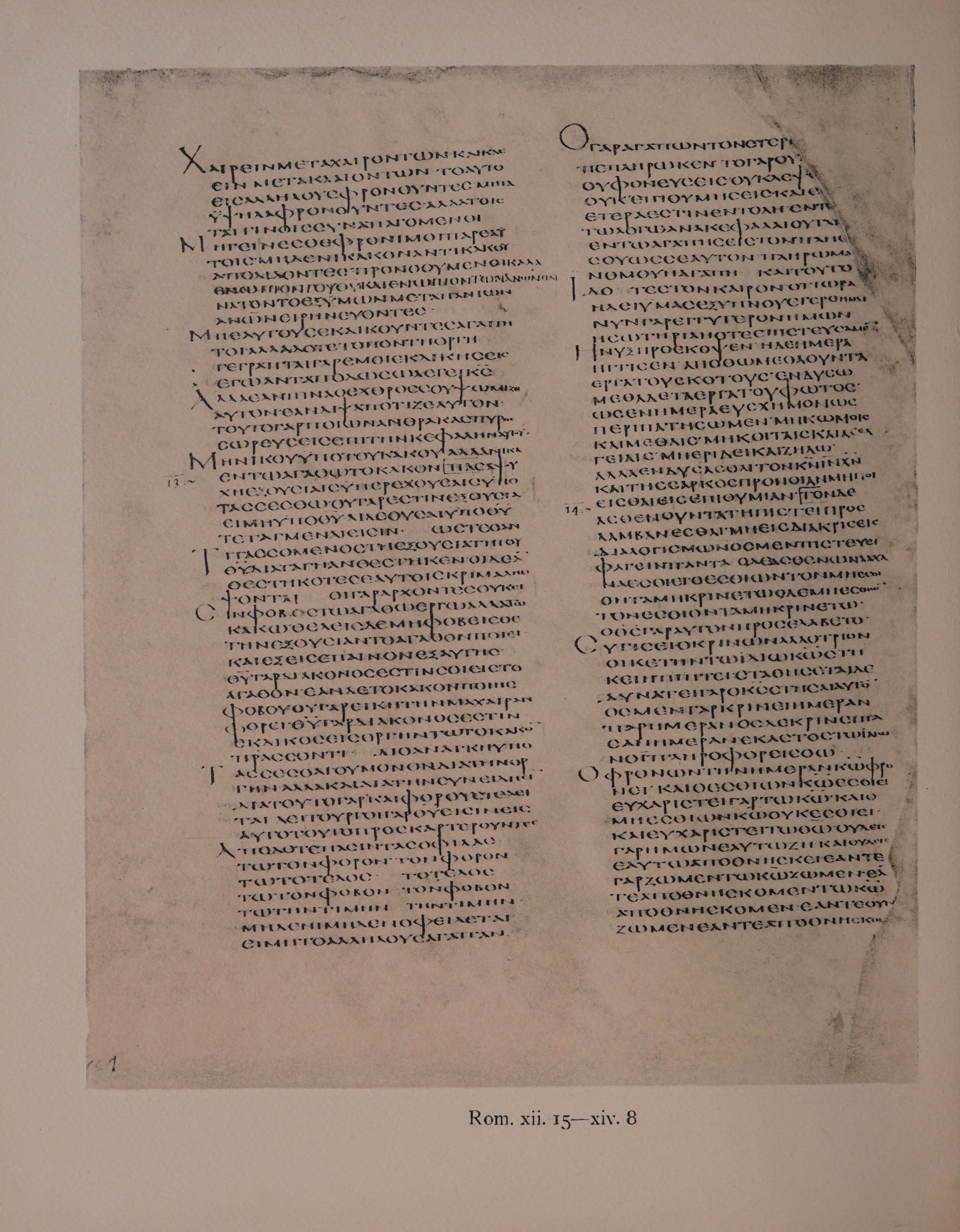
Where on the image
Page from the NTVMR transcription (docID 20002): verses 1-8 on fol. 116v (facsimile leaf 194), col. 1.
1πασα ψυχη εξουσιαις υπερεχουσαις υποτασσεσθω · ου γαρ εστιν εξουσια ει μη υπο θυ · αι δε ουσαι υπο θυ τεταγμεναι εισιν · 2ωστε ο αντιτασσομενος τη εξουσια τη του θυ διαταγη · ανθεστηκεν · οι δε ανθεστηκοτες εαυτοις κριμα λημψονται 3οι γαρ αρχοντες ουκ εισιν φοβως τω αγαθω εργω αλλα τω κακω · θελεις δε μη φοβεισθε την εξουσιαν το αγαθον ποιει και εξεις επαινον εξ αυτης · 4θυ γαρ διακονος εστιν σοι εις το αγαθον · εαν δε το κακον ποιης φοβου · ου γαρ εικη την μαχαιραν φορει · θυ γαρ διακονος εστιν εκδικος εις οργην τω το κακον πρασσοντι · 5διο αναγκη υποτασσεσθαι · ου μονον δια την οργην · αλλα και δια την συνειδησιν 6δια τουτο γαρ · και φορους τελειται · λειτουργοι γαρ θυ εισιν εις αυτο τουτο προσκαρτερουντες 7αποδοτε πασιν τας οφιλας τω τον φορον · τον φορον τω το τελος · το τελος τω τον φοβον τον φοβον τω την τιμην την τιμην · 8μηδενι μηδεν οφειλεται ει μη το αλληλους αγαπαν ο γαρ αγαπων τον ετερ[ον] [νομον] πεπληρωκεν ·
Compare: Tischendorf 8th edition (1869)
1Πᾶσα ψυχὴ ἐξουσίαις ὑπερεχούσαις ὑποτασσέσθω. οὐ γὰρ ἔστιν ἐξουσία εἰ μὴ ὑπὸ θεοῦ, αἱ δὲ οὖσαι ὑπὸ θεοῦ τεταγμέναι εἰσίν· 2ὥστε ὁ ἀντιτασσόμενος τῇ ἐξουσίᾳ τῇ τοῦ θεοῦ διαταγῇ ἀνθέστηκεν, οἱ δὲ ἀνθεστηκότες ἑαυτοῖς κρίμα λήμψονται. 3οἱ γὰρ ἄρχοντες οὐκ εἰσὶν φόβος τῷ ἀγαθῷ ἔργῳ ἀλλὰ τῷ κακῷ. θέλεις δὲ μὴ φοβεῖσθαι τὴν ἐξουσίαν; τὸ ἀγαθὸν ποίει, καὶ ἕξεις ἔπαινον ἐξ αὐτῆς· 4θεοῦ γὰρ διάκονός ἐστιν σοὶ εἰς τὸ ἀγαθόν. ἐὰν δὲ τὸ κακὸν ποιῇς, φοβοῦ· οὐ γὰρ εἰκῇ τὴν μάχαιραν φορεῖ· θεοῦ γὰρ διάκονός ἐστιν, ἔκδικος εἰς ὀργὴν τῷ τὸ κακὸν πράσσοντι. 5διὸ ἀνάγκη ὑποτάσσεσθαι, οὐ μόνον διὰ τὴν ὀργὴν ἀλλὰ καὶ διὰ τὴν συνείδησιν. 6διὰ τοῦτο γὰρ καὶ φόρους τελεῖτε, λειτουργοὶ γὰρ θεοῦ εἰσιν εἰς αὐτὸ τοῦτο προσκαρτεροῦντες. 7ἀπόδοτε πᾶσιν τὰς ὀφειλάς, τῷ τὸν φόρον τὸν φόρον, τῷ τὸ τέλος τὸ τέλος, τῷ τὸν φόβον τὸν φόβον, τῷ τὴν τιμὴν τὴν τιμήν. 8Μηδενὶ μηδὲν ὀφείλετε, εἰ μὴ τὸ ἀλλήλους ἀγαπᾶν· ὁ γὰρ ἀγαπῶν τὸν ἕτερον νόμον πεπλήρωκεν.
1Let every soul be subject unto the higher powers. For there is no power but of God: the powers that be are ordained of God. 2Whosoever therefore resisteth the power, resisteth the ordinance of God: and they that resist shall receive to themselves damnation. 3For rulers are not a terror to good works, but to the evil. Wilt thou then not be afraid of the power? do that which is good, and thou shalt have praise of the same: 4For he is the minister of God to thee for good. But if thou do that which is evil, be afraid; for he beareth not the sword in vain: for he is the minister of God, a revenger to execute wrath upon him that doeth evil. 5Wherefore ye must needs be subject, not only for wrath, but also for conscience sake. 6For for this cause pay ye tribute also: for they are God’s ministers, attending continually upon this very thing. 7Render therefore to all their dues: tribute to whom tribute is due; custom to whom custom; fear to whom fear; honour to whom honour. 8Owe no man any thing, but to love one another: for he that loveth another hath fulfilled the law.
Where on the image
Page from the NTVMR transcription (docID 20002): verses 9-14 on fol. 116v (facsimile leaf 194), col. 2.
9το γαρ ου [μοιχευσεις] ου φονευσεις ου κλεψ[εις] ουκ · επιθυμησεις · και ε[ι] [τις] ετερα εστιν εντολη εν τ[ουτω] τω λογω ανακεφαλαιουται εν τω αγαπησεις τον πλησ̣[ιον] σου ως σεαυτον · 10πληρωμα [ουν] νομου η αγαπη 11και τουτο ιδοντες τον καιρον οτι ωρα ηδει υμας εξ υπνου εγερθηναι νυν γαρ εγγυτερον ημων η σωτηρια η οτε επιστευσαμεν 12η νυξ προεκοψεν · η δε ημερα ηγγισεν · αποθωμεθα ουν τα εργα του σκοτους · ενδυσωμεθα δε τα εργα του φωτος · 13ως εν ημερα ευσχημονως περιπατησωμεν · μη κωμοις και μεθαις · μη κοιταις και ασελγειαις · μη εριδει και ζηλω · 14αλλα ενδυσασθαι τον κν ιν χν και της σαρκος προνοιαν μη ποιεισθαι εις επιθυμιαν ·
Compare: Tischendorf 8th edition (1869)
9τὸ γὰρ οὐ μοιχεύσεις, οὐ φονεύσεις, οὐ κλέψεις, οὐκ ἐπιθυμήσεις, καὶ εἴ τις ἑτέρα ἐντολή, ἐν τῷ λόγῳ τούτῳ ἀνακεφαλαιοῦται, ἐν τῷ ἀγαπήσεις τὸν πλησίον σου ὡς σεαυτόν. 10ἡ ἀγάπη τῷ πλησίον κακὸν οὐκ ἐργάζεται· πλήρωμα οὖν νόμου ἡ ἀγάπη. 11Καὶ τοῦτο εἰδότες τὸν καιρόν, ὅτι ὥρα ἤδη ὑμᾶς ἐξ ὕπνου ἐγερθῆναι, νῦν γὰρ ἐγγύτερον ἡμῶν ἡ σωτηρία ἢ ὅτε ἐπιστεύσαμεν. 12ἡ νὺξ προέκοψεν, ἡ δὲ ἡμέρα ἤγγικεν. ἀποθώμεθα οὖν τὰ ἔργα τοῦ σκότους, ἐνδυσώμεθα δὲ τὰ ὅπλα τοῦ φωτός. 13ὡς ἐν ἡμέρᾳ εὐσχημόνως περιπατήσωμεν, μὴ κώμοις καὶ μέθαις, μὴ κοίταις καὶ ἀσελγείαις, μὴ ἔριδι καὶ ζήλῳ· 14ἀλλὰ ἐνδύσασθε τὸν κύριον Ἰησοῦν Χριστόν, καὶ τῆς σαρκὸς πρόνοιαν μὴ ποιεῖσθε εἰς ἐπιθυμίας.
9For this, Thou shalt not commit adultery, Thou shalt not kill, Thou shalt not steal, Thou shalt not bear false witness, Thou shalt not covet; and if there be any other commandment, it is briefly comprehended in this saying, namely, Thou shalt love thy neighbour as thyself. 10Love worketh no ill to his neighbour: therefore love is the fulfilling of the law. 11And that, knowing the time, that now it is high time to awake out of sleep: for now is our salvation nearer than when we believed. 12The night is far spent, the day is at hand: let us therefore cast off the works of darkness, and let us put on the armour of light. 13Let us walk honestly, as in the day; not in rioting and drunkenness, not in chambering and wantonness, not in strife and envying. 14But put ye on the Lord Jesus Christ, and make not provision for the flesh, to fulfil the lusts thereof.
Cite
Sources
- Source: Codex Alexandrinus page images + NTVMR transcription (CC BY 4.0) + Tischendorf 8th edition + KJV (holding institution)
- Critical edition: Codex Alexandrinus transcription, NTVMR (INTF Münster, CC BY 4.0); Tischendorf 8th edition for comparison
← previous · → next · v cycle view · l back to library