Romans, Chapter 14 (Codex Alexandrinus)
Introduction
Romans 14 from Codex Alexandrinus (GA 02), a fifth-century Greek Bible held by the British Library (Royal MS 1 D. VIII). In the New Testament it is the chief witness to the Byzantine text in the Gospels and to the Alexandrian text in the rest of the New Testament. Its New Testament volume lacks Matthew 1:1-25:5, John 6:50-8:52 and 2 Corinthians 4:13-12:6.
This entry meets the strict three-criteria standard of the Theosis Library:
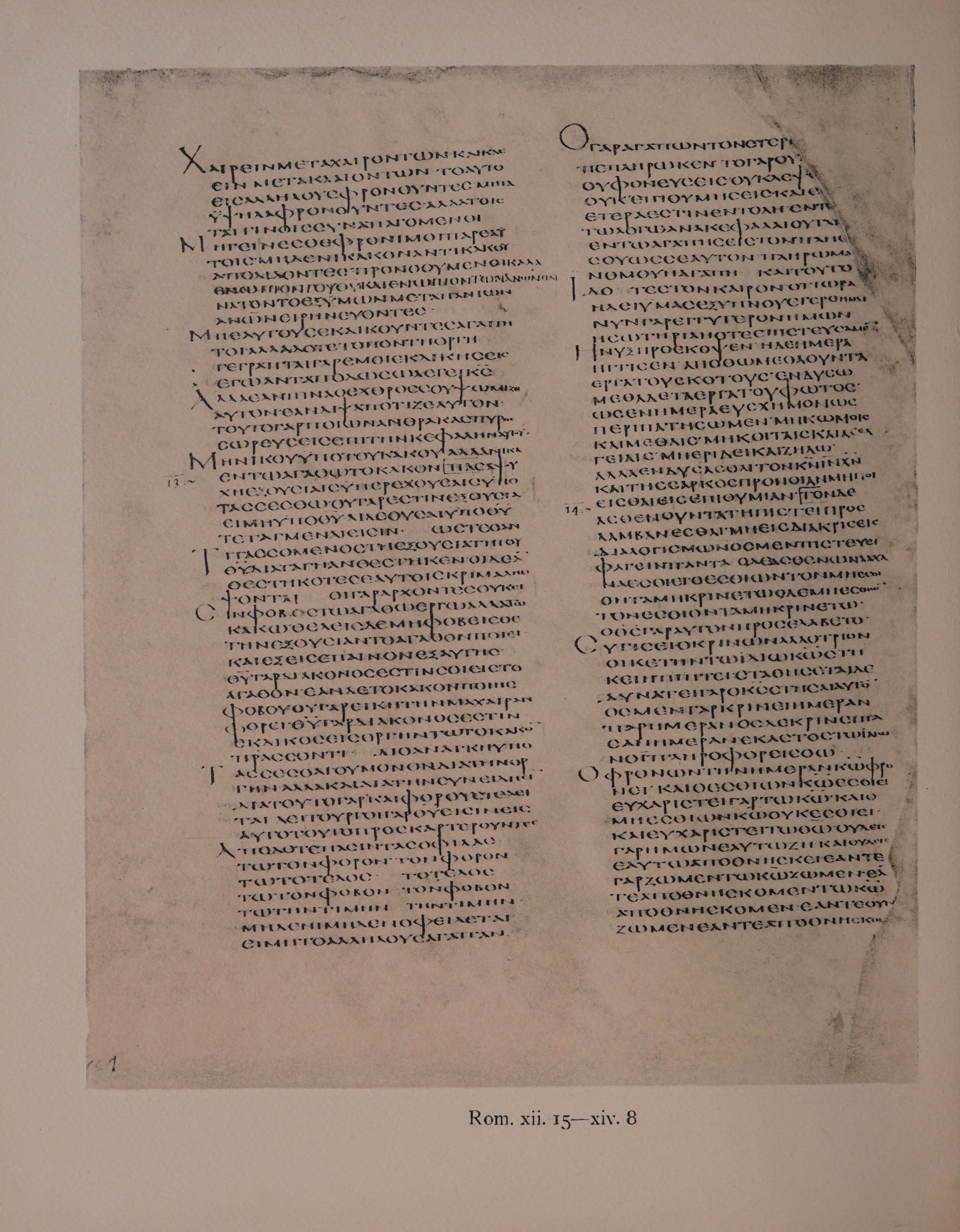
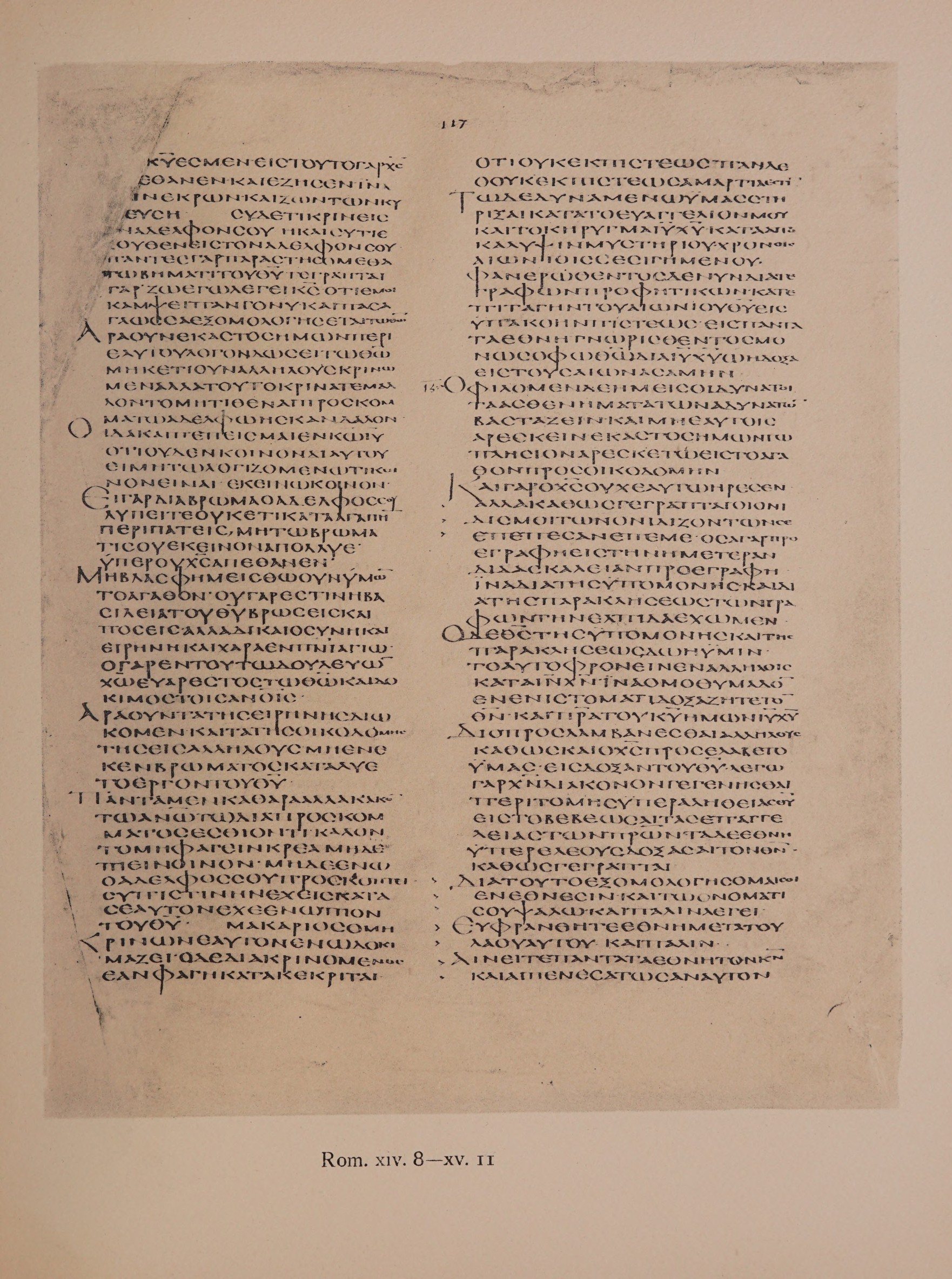
- Manuscript scan: the actual page(s) of Codex Alexandrinus containing this passage (folios 116v, 117r), reproduced from the British Museum's 1909 photographic facsimile edited by F. G. Kenyon, as digitised by the Getty Research Institute for the Internet Archive. The facsimile prints the verse range beneath each plate; that printed range was read for every page used and agrees with the INTF's NTVMR verse-level page index (CC BY 4.0). The page for each section now comes from the NTVMR transcription itself, which records the page and column on which every verse is written.
- Original text: the manuscript's own text, from a diplomatic transcription (see Greek text below), with Tischendorf's 8th critical edition (1869) for comparison.
- English translation: the King James Version (1611), retrieved verbatim from the public-domain bible-api.com endpoint.
Greek text: a diplomatic transcription of Codex Alexandrinus made by the Institut für Neutestamentliche Textforschung (INTF), Münster, for the New Testament Virtual Manuscript Room (NTVMR), published under a Creative Commons Attribution 4.0 licence. It gives the letters as the first scribe wrote them: no accents or breathings, the scribe's own spelling, and the sacred names in their contracted form (θς for θεος, ις for ιησους, κς for κυριος; the overline is not reproduced). Corrections by later hands are not shown. Letters in square brackets are not legible on the page and were restored by the transcribers, a dot under a letter marks an uncertain reading, and [...] marks text lost to damage. Beneath each section, for comparison, is Tischendorf's 8th critical edition (1869). Where the two differ, the transcription is what the manuscript says. Each section is shown with the page on which the transcription places its verses.
How was this verified? (Provenance)
Where on the image
Page from the NTVMR transcription (docID 20002): verses 1-8 on fol. 116v (facsimile leaf 194), col. 2; verse 8 continues on fol. 117r (facsimile leaf 195), col. 1 (which begins '[του] κυ εσμεν').
1τον δε ασθενουντα τη πιστει προσλαμβανεσθαι · μη εις διακρισεις διαλογισμων 2ος μεν πιστευει φαγειν παντα ο δε ασθενων λαχανα εσθιει · 3ο εσθιων τον μη εσθιοντα μη κρινετω ο δε μη εσθιων τον εσθιοντα μη κρινετω · ο θς γαρ αυτον προσελαβετο · 4συ τις ει ο κρινων αλλοτριον οικετην τω ιδιω κω στηκει η πιπτει · σταθησεται δε δυνατει γαρ ο κς στησαι αυτον 5ος μεν γαρ κρινει ημεραν παρ ημεραν ος δε κρινει πασαν ημεραν · εκαστος τω ιδιω νοι πληροφορεισθω · 6ο φρονων την ημεραν κω φρονει · και ο εσθιων κω εσθιει ευχαριστει γαρ τω κω · και ο μη εσθιων κω ουκ εσθιει και ευχαριστει τω θω · 7ουδεις γαρ ημων εαυτω ζη · και ουδεις εαυτω αποθνησκει · 8εαν τε γαρ ζωμεν τω κω ζωμεν · εαν τε αποθνησκομεν τω κω αποθνησκομεν · εαν τε ουν ζωμεν εαν τε αποθνησκομ̣[εν] [του] κυ εσμεν ·
Compare: Tischendorf 8th edition (1869)
1Τὸν δὲ ἀσθενοῦντα τῇ πίστει προσλαμβάνεσθε, μὴ εἰς διακρίσεις διαλογισμῶν. 2ὃς μὲν πιστεύει φαγεῖν πάντα, ὁ δὲ ἀσθενῶν λάχανα ἐσθίει. 3ὁ ἐσθίων τὸν μὴ ἐσθίοντα μὴ ἐξουθενείτω, ὁ δὲ μὴ ἐσθίων τὸν ἐσθίοντα μὴ κρινέτω, ὁ θεὸς γὰρ αὐτὸν προσελάβετο. 4σὺ τίς εἶ ὁ κρίνων ἀλλότριον οἰκέτην; τῷ ἰδίῳ κυρίῳ στήκει ἢ πίπτει· σταθήσεται δέ, δυνατεῖ γὰρ ὁ κύριος στῆσαι αὐτόν. 5ὃς μὲν γὰρ κρίνει ἡμέραν παρ’ ἡμέραν, ὃς δὲ κρίνει πᾶσαν ἡμέραν· ἕκαστος ἐν τῷ ἰδίῳ νοῒ πληροφορείσθω. 6ὁ φρονῶν τὴν ἡμέραν κυρίῳ φρονεῖ· καὶ ὁ ἐσθίων κυρίῳ ἐσθίει, εὐχαριστεῖ γὰρ τῷ θεῷ· καὶ ὁ μὴ ἐσθίων κυρίῳ οὐκ ἐσθίει, καὶ εὐχαριστεῖ τῷ θεῷ. 7οὐδεὶς γὰρ ἡμῶν ἑαυτῷ ζῇ, καὶ οὐδεὶς ἑαυτῷ ἀποθνῄσκει· 8ἐάν τε γὰρ ζῶμεν, τῷ κυρίῳ ζῶμεν, ἐάν τε ἀποθνῄσκωμεν, τῷ κυρίῳ ἀποθνῄσκομεν. ἐάν τε οὖν ζῶμεν ἐάν τε ἀποθνῄσκωμεν, τοῦ κυρίου ἐσμέν.
1Him that is weak in the faith receive ye, but not to doubtful disputations. 2For one believeth that he may eat all things: another, who is weak, eateth herbs. 3Let not him that eateth despise him that eateth not; and let not him which eateth not judge him that eateth: for God hath received him. 4Who art thou that judgest another man’s servant? to his own master he standeth or falleth. Yea, he shall be holden up: for God is able to make him stand. 5One man esteemeth one day above another: another esteemeth every day alike. Let every man be fully persuaded in his own mind. 6He that regardeth the day, regardeth it unto the Lord; and he that regardeth not the day, to the Lord he doth not regard it. He that eateth, eateth to the Lord, for he giveth God thanks; and he that eateth not, to the Lord he eateth not, and giveth God thanks. 7For none of us liveth to himself, and no man dieth to himself. 8For whether we live, we live unto the Lord; and whether we die, we die unto the Lord: whether we live therefore, or die, we are the Lord’s.
Where on the image
Page from the NTVMR transcription (docID 20002): verses 9-16 on fol. 117r (facsimile leaf 195), col. 1.
9εις τουτο γαρ χς [απ]εθανεν · και εζησεν · ινα [κα]ι̣ νεκρων · και ζωντων κυ[ρι]ευση · 10συ δε τι κρινεις [το]ν αδελφον σου η και συ τι ε[ξ]ουθενεις τον αδελφον σου παντες γαρ παραστησομεθα τω βηματι του θυ · 11γεγραπται γαρ · ζω εγω λεγει κς · οτι εμοι καμψει παν γονυ · και πασα γλωσσα εξομολογησεται τω θω 12αρα ουν εκαστος ημων περι εαυτου λογον δωσει τω θω 13μηκετι ουν αλληλους κρινωμεν αλλα τουτο κρινατε μαλλον το μη τιθεναι προσκομμα τω αδελφω η σκανδαλον · 14οιδα και πεπεισμαι εν κω ιυ οτι ουδεν κοινον δι αυτου ει μη τω λογιζομενω τι κοινον ειναι · εκεινω κοινον · 15ει γαρ δια βρωμα ο αδελφος σου λυπειτε ουκετι κατα αγαπην περιπατεις , μη τω βρωματι σου εκεινον απολλυε · υπερ ου χς απεθανεν · 16μη βλασφημεισθω ουν υμων το αγαθον ·
Compare: Tischendorf 8th edition (1869)
9εἰς τοῦτο γὰρ Χριστὸς ἀπέθανεν καὶ ἔζησεν ἵνα καὶ νεκρῶν καὶ ζώντων κυριεύσῃ. 10σὺ δὲ τί κρίνεις τὸν ἀδελφόν σου; ἢ καὶ σὺ τί ἐξουθενεῖς τὸν ἀδελφόν σου; πάντες γὰρ παραστησόμεθα τῷ βήματι τοῦ θεοῦ· 11γέγραπται γάρ, ζῶ ἐγώ, λέγει κύριος, ὅτι ἐμοὶ κάμψει πᾶν γόνυ, καὶ πᾶσα γλῶσσα ἐξομολογήσεται τῷ θεῷ. 12ἄρα οὖν ἕκαστος ἡμῶν περὶ ἑαυτοῦ λόγον δώσει τῷ θεῷ. 13Μηκέτι οὖν ἀλλήλους κρίνωμεν, ἀλλὰ τοῦτο κρίνατε μᾶλλον, τὸ μὴ τιθέναι πρόσκομμα τῷ ἀδελφῷ ἢ σκάνδαλον. 14οἶδα καὶ πέπεισμαι ἐν κυρίῳ Ἰησοῦ ὅτι οὐδὲν κοινὸν δι’ ἑαυτοῦ· εἰ μὴ τῷ λογιζομένῳ τι κοινὸν εἶναι, ἐκείνῳ κοινόν. 15εἰ γὰρ διὰ βρῶμα ὁ ἀδελφός σου λυπεῖται, οὐκέτι κατὰ ἀγάπην περιπατεῖς. μὴ τῷ βρώματί σου ἐκεῖνον ἀπόλλυε ὑπὲρ οὗ Χριστὸς ἀπέθανεν. 16μὴ βλασφημείσθω οὖν ὑμῶν τὸ ἀγαθόν.
9For to this end Christ both died, and rose, and revived, that he might be Lord both of the dead and living. 10But why dost thou judge thy brother? or why dost thou set at nought thy brother? for we shall all stand before the judgment seat of Christ. 11For it is written, As I live, saith the Lord, every knee shall bow to me, and every tongue shall confess to God. 12So then every one of us shall give account of himself to God. 13Let us not therefore judge one another any more: but judge this rather, that no man put a stumblingblock or an occasion to fall in his brother’s way. 14I know, and am persuaded by the Lord Jesus, that there is nothing unclean of itself: but to him that esteemeth any thing to be unclean, to him it is unclean. 15But if thy brother be grieved with thy meat, now walkest thou not charitably. Destroy not him with thy meat, for whom Christ died. 16Let not then your good be evil spoken of:
Where on the image
Page from the NTVMR transcription (docID 20002): verses 17-23 on fol. 117r (facsimile leaf 195), col. 1.
17ου γαρ εστιν η βασιλεια του θυ βρωσεις και ποσεις · αλλα δικαιοσυνη και ειρηνη και χαρα εν πνι αγιω · 18ο γαρ εν τουτω δουλευων χω ευαρεστος τω θω και δοκιμος τοις ανοις · 19αρα ουν τα της ειρηνης διωκομεν και τα της οικοδομης της εις αλληλους · 20μη ενεκεν βρωματος καταλυε το εργον του θυ · παντα μεν καθαρα αλλα κακον τω ανω τω δια προσκομματος εσθιοντι · 21καλον το μη φαγειν κρεα μηδε πιειν οινον · μηδε εν ω ο αδελφος σου προσκοπτει · 22συ πιστιν ην εχεις κατα σεαυτον εχε ενωπιον του θυ · μακαριος ο μη κρινων εαυτον εν ω δοκιμαζει · 23ο δε διακρινομενος εαν φαγη κατακεκριται · οτι ουκ εκ πιστεως παν δε ο ουκ εκ πιστεως αμαρτια εστιν τω δε δυναμενω υμας στηριξαι κατα το ευαγγελιον μου και το κηρυγμα ιυ χυ · κατα αποκαλυψιν μυστηριου · χρονοις αιωνιοις σεσιγημενου · φανερωθεντος δε νυν δια τε γραφων προφητικων · κατ επιταγην του αιωνιου θυ εις υπακοην πιστεως · εις παντα τα εθνη · γνωρισθεντος μονω σοφω θω δια ιυ χυ ω η δοξα εις τους αιωνας αμην ·
Compare: Tischendorf 8th edition (1869)
17οὐ γάρ ἐστιν ἡ βασιλεία τοῦ θεοῦ βρῶσις καὶ πόσις, ἀλλὰ δικαιοσύνη καὶ εἰρήνη καὶ χαρὰ ἐν πνεύματι ἁγίῳ· 18ὁ γὰρ ἐν τούτῳ δουλεύων τῷ Χριστῷ εὐάρεστος τῷ θεῷ καὶ δόκιμος τοῖς ἀνθρώποις. 19ἄρα οὖν τὰ τῆς εἰρήνης διώκομεν καὶ τὰ τῆς οἰκοδομῆς τῆς εἰς ἀλλήλους· 20μὴ ἕνεκεν βρώματος κατάλυε τὸ ἔργον τοῦ θεοῦ. πάντα μὲν καθαρά, ἀλλὰ κακὸν τῷ ἀνθρώπῳ τῷ διὰ προσκόμματος ἐσθίοντι. 21καλὸν τὸ μὴ φαγεῖν κρέα μηδὲ πιεῖν οἶνον μηδὲ ἐν ᾧ ὁ ἀδελφός σου προσκόπτει. 22σὺ πίστιν ἣν ἔχεις κατὰ σεαυτὸν ἔχε ἐνώπιον τοῦ θεοῦ. μακάριος ὁ μὴ κρίνων ἑαυτὸν ἐν ᾧ δοκιμάζει· 23ὁ δὲ διακρινόμενος ἐὰν φάγῃ κατακέκριται, ὅτι οὐκ ἐκ πίστεως· πᾶν δὲ ὃ οὐκ ἐκ πίστεως ἁμαρτία ἐστίν.
17For the kingdom of God is not meat and drink; but righteousness, and peace, and joy in the Holy Ghost. 18For he that in these things serveth Christ is acceptable to God, and approved of men. 19Let us therefore follow after the things which make for peace, and things wherewith one may edify another. 20For meat destroy not the work of God. All things indeed are pure; but it is evil for that man who eateth with offence. 21It is good neither to eat flesh, nor to drink wine, nor any thing whereby thy brother stumbleth, or is offended, or is made weak. 22Hast thou faith? have it to thyself before God. Happy is he that condemneth not himself in that thing which he alloweth. 23And he that doubteth is damned if he eat, because he eateth not of faith: for whatsoever is not of faith is sin.
Cite
Sources
- Source: Codex Alexandrinus page images + NTVMR transcription (CC BY 4.0) + Tischendorf 8th edition + KJV (holding institution)
- Critical edition: Codex Alexandrinus transcription, NTVMR (INTF Münster, CC BY 4.0); Tischendorf 8th edition for comparison
← previous · → next · v cycle view · l back to library