Romans, Chapter 16 (Codex Alexandrinus)
Introduction
Romans 16 from Codex Alexandrinus (GA 02), a fifth-century Greek Bible held by the British Library (Royal MS 1 D. VIII). In the New Testament it is the chief witness to the Byzantine text in the Gospels and to the Alexandrian text in the rest of the New Testament. Its New Testament volume lacks Matthew 1:1-25:5, John 6:50-8:52 and 2 Corinthians 4:13-12:6.
This entry meets the strict three-criteria standard of the Theosis Library:
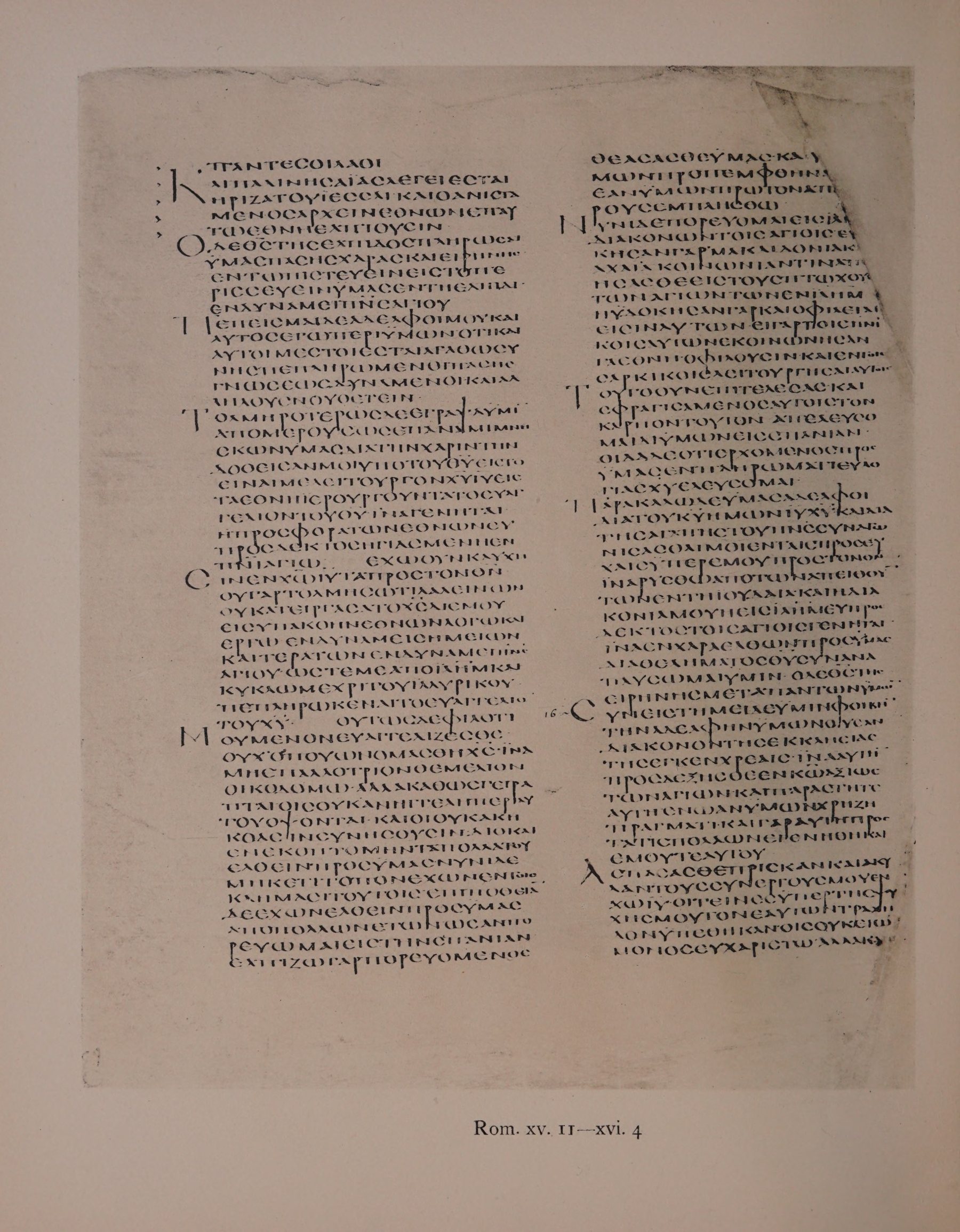
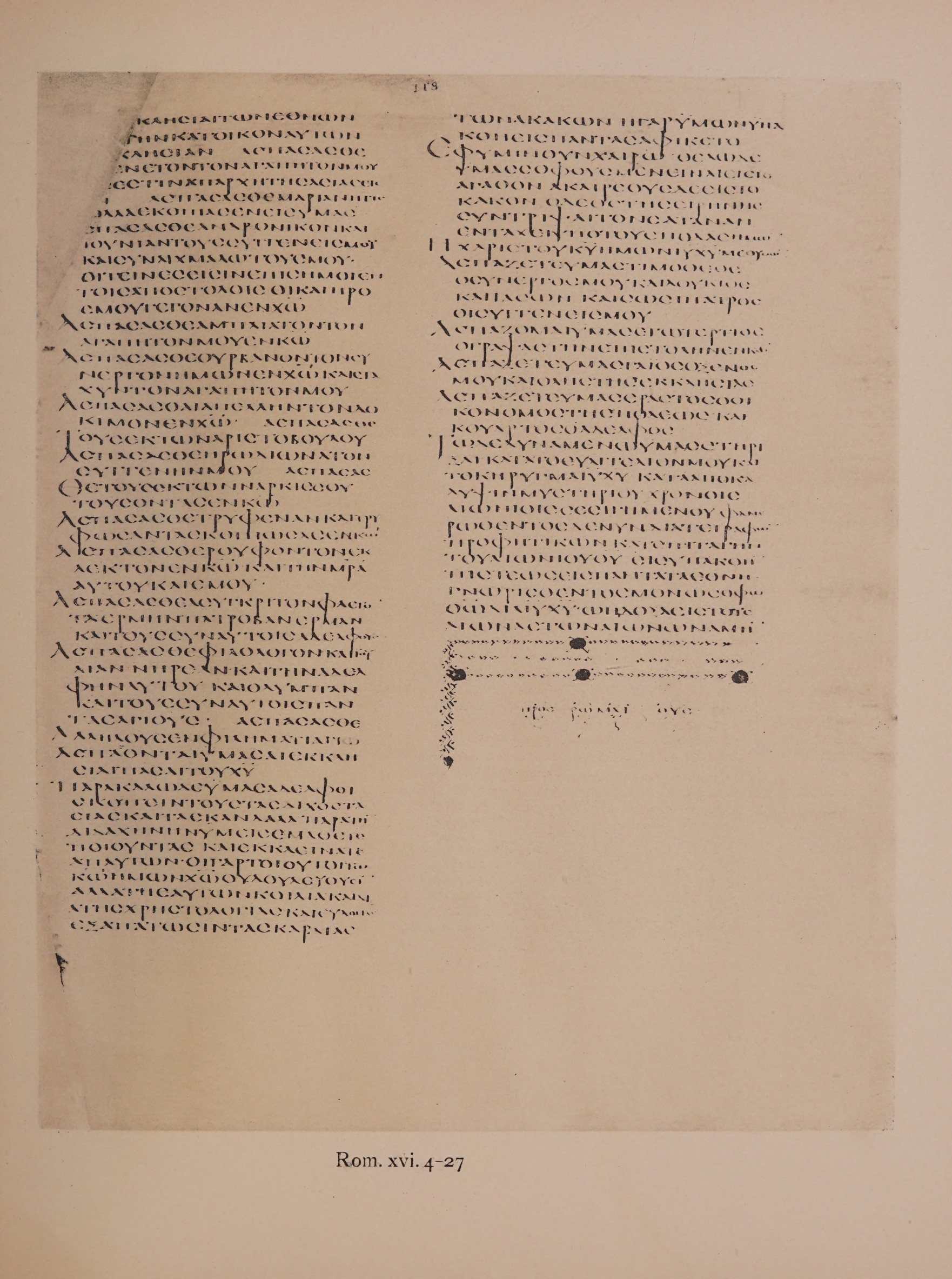
- Manuscript scan: the actual page(s) of Codex Alexandrinus containing this passage (folios 117v, 118r), reproduced from the British Museum's 1909 photographic facsimile edited by F. G. Kenyon, as digitised by the Getty Research Institute for the Internet Archive. The facsimile prints the verse range beneath each plate; that printed range was read for every page used and agrees with the INTF's NTVMR verse-level page index (CC BY 4.0). The page for each section now comes from the NTVMR transcription itself, which records the page and column on which every verse is written.
- Original text: the manuscript's own text, from a diplomatic transcription (see Greek text below), with Tischendorf's 8th critical edition (1869) for comparison.
- English translation: the King James Version (1611), retrieved verbatim from the public-domain bible-api.com endpoint.
Greek text: a diplomatic transcription of Codex Alexandrinus made by the Institut für Neutestamentliche Textforschung (INTF), Münster, for the New Testament Virtual Manuscript Room (NTVMR), published under a Creative Commons Attribution 4.0 licence. It gives the letters as the first scribe wrote them: no accents or breathings, the scribe's own spelling, and the sacred names in their contracted form (θς for θεος, ις for ιησους, κς for κυριος; the overline is not reproduced). Corrections by later hands are not shown. Letters in square brackets are not legible on the page and were restored by the transcribers, a dot under a letter marks an uncertain reading, and [...] marks text lost to damage. Beneath each section, for comparison, is Tischendorf's 8th critical edition (1869). Where the two differ, the transcription is what the manuscript says. Each section is shown with the page on which the transcription places its verses.
Manuscript note: Not written in Codex Alexandrinus: verse 24. The English is shown with a bracketed note in the Greek column.
How was this verified? (Provenance)
Where on the image
Page from the NTVMR transcription (docID 20002): verses 1-4 on fol. 117v (facsimile leaf 196), col. 2; verse 4 continues on fol. 118r (facsimile leaf 197), col. 1 (which begins '[αι] [εκ]κλησιαι των').
1συνειστημει δε υμιν φοιβην την αδελφην υμων ουσαν διακονον της εκκλησιας της εγ κενχρεαις · 2ινα αυτην προσδεξησθε εν κω αξιως των αγιων · και παραστητε αυτη εν ω αν υμων χρηζη πραγματι · και γαρ αυτη προστατις πολλων εγενηθη και εμου τε αυτου 3ασπασασθε πρισκαν και ακυλαν τους συνεργους μου εν χω ιυ · 4οιτεινες υπερ της ψυχης μου τον εαυτων τραχηλον υπεθηκαν · οις ουκ εγ̣ω μονος ευχαριστω · αλλα και̣ π̣[ασαι] [αι] [εκ]κλησιαι των εθνων
Compare: Tischendorf 8th edition (1869)
1Συνίστημι δὲ ὑμῖν Φοίβην τὴν ἀδελφὴν ἡμῶν, οὖσαν διάκονον τῆς ἐκκλησίας τῆς ἐν Κενχρεαῖς, 2ἵνα αὐτὴν προσδέξησθε ἐν κυρίῳ ἀξίως τῶν ἁγίων, καὶ παραστῆτε αὐτῇ ἐν ᾧ ἂν ὑμῶν χρῄζῃ πράγματι, καὶ γὰρ αὐτὴ προστάτις πολλῶν ἐγενήθη καὶ ἐμοῦ αὐτοῦ. 3Ἀσπάσασθε Πρίσκαν καὶ Ἀκύλαν τοὺς συνεργούς μου ἐν Χριστῷ Ἰησοῦ, 4οἵτινες ὑπὲρ τῆς ψυχῆς μου τὸν ἑαυτῶν τράχηλον ὑπέθηκαν, οἷς οὐκ ἐγὼ μόνος εὐχαριστῶ ἀλλὰ καὶ πᾶσαι αἱ ἐκκλησίαι τῶν ἐθνῶν,
1I commend unto you Phebe our sister, which is a servant of the church which is at Cenchrea: 2That ye receive her in the Lord, as becometh saints, and that ye assist her in whatsoever business she hath need of you: for she hath been a succourer of many, and of myself also. 3Greet Priscilla and Aquila my helpers in Christ Jesus: 4Who have for my life laid down their own necks: unto whom not only I give thanks, but also all the churches of the Gentiles.
Where on the image
Page from the NTVMR transcription (docID 20002): verses 5-11 on fol. 118r (facsimile leaf 197), col. 1.
5[και] [τ]ην κατ οικον αυτων [εκ]κ̣λησιαν ασπασασθε [επ]ε̣νετον τον αγαπητον μου [ος] εστιν απαρχη της ασιας εις [χ]ν 6ασπασασθε μαριαν ητις [π]ο̣λλα εκοπιασεν εις υμας 7[α]σπασασθε ανδρονικον και ιουνιαν τους συγγενεις μου και συναιχμαλωτους μου · οιτεινες εισιν επισημοι εν τοις αποστολοις οι και προ εμου γεγοναν εν χω 8ασπασασθε αμπλιατον τον αγαπητον μου εν κω 9ασπασασθε ουρβανον τον συνεργον ημων εν χω και σταχυν τον αγαπητον μου 10ασπασασθαι απελλην τον δοκιμον εν χω · ασπασασθε τους εκ των αριστοβουλου 11ασπασασθε ηρωδιωνα τον συγγενην μου ασπασασθε τους εκ των ναρκισσου τους οντας εν κω
Compare: Tischendorf 8th edition (1869)
5καὶ τὴν κατ’ οἶκον αὐτῶν ἐκκλησίαν. ἀσπάσασθε Ἐπαινετὸν τὸν ἀγαπητόν μου, ὅς ἐστιν ἀπαρχὴ τῆς Ἀσίας εἰς Χριστόν. 6ἀσπάσασθε Μαρίαμ, ἥτις πολλὰ ἐκοπίασεν εἰς ὑμᾶς. 7ἀσπάσασθε Ἀνδρόνικον καὶ Ἰουνιᾶν τοὺς συγγενεῖς μου καὶ συναιχμαλώτους μου, οἵτινές εἰσιν ἐπίσημοι ἐν τοῖς ἀποστόλοις, οἳ καὶ πρὸ ἐμοῦ γέγοναν ἐν Χριστῷ. 8ἀσπάσασθε Ἀμπλιᾶτον τὸν ἀγαπητόν μου ἐν κυρίῳ. 9ἀσπάσασθε Οὐρβανὸν τὸν συνεργὸν ἡμῶν ἐν Χριστῷ καὶ Στάχυν τὸν ἀγαπητόν μου. 10ἀσπάσασθε Ἀπελλῆν τὸν δόκιμον ἐν Χριστῷ. ἀσπάσασθε τοὺς ἐκ τῶν Ἀριστοβούλου. 11ἀσπάσασθε Ἡρῳδίωνα τὸν συγγενῆ μου. ἀσπάσασθε τοὺς ἐκ τῶν Ναρκίσσου τοὺς ὄντας ἐν κυρίῳ.
5Likewise greet the church that is in their house. Salute my wellbeloved Epaenetus, who is the firstfruits of Achaia unto Christ. 6Greet Mary, who bestowed much labour on us. 7Salute Andronicus and Junia, my kinsmen, and my fellowprisoners, who are of note among the apostles, who also were in Christ before me. 8Greet Amplias my beloved in the Lord. 9Salute Urbane, our helper in Christ, and Stachys my beloved. 10Salute Apelles approved in Christ. Salute them which are of Aristobulus’ household. 11Salute Herodion my kinsman. Greet them that be of the household of Narcissus, which are in the Lord.
Where on the image
Page from the NTVMR transcription (docID 20002): verses 12-18 on fol. 118r (facsimile leaf 197), col. 1.
12ασπασασθε τρυφεναν και τρυφωσαν τας κοπιωσας εν κω 13ασπασασθε ρουφον τον εκλεκτον εν κω · και την μρα αυτου και εμου · 14ασπασασθε ασυγκριτον φλεγοντα ερμην πατροβαν ερμαν και τους συν αυτοις αδελφους 15ασπασασθε φιλολογον και ιουλιαν · νηρεαν · και την αδελφην αυτου και ολυμπαν και τους συν αυτοις παντας αγιους · 16ασπασασθε αλληλους εν φιληματι αγιω ασπαονται υμας αι εκκλησιαι πασαι του χυ 17παρακαλω δε υμας αδελφοι σκοπειν τους τας διχοστασιας και τα σκανδαλα παρα την διδαχην ην υμεις εμαθετε ποιουντας και εκκλεινατε απ αυτων · 18οι γαρ τοιουτοι τω κω ημων χω ου δουλευουσιν αλλα τη εαυτων κοιλια και δια της χρηστολογιας και ευλογιας εξαπατωσιν τας καρδιας των ακακων ·
Compare: Tischendorf 8th edition (1869)
12ἀσπάσασθε Τρύφαιναν καὶ Τρυφῶσαν τὰς κοπιώσας ἐν κυρίῳ. ἀσπάσασθε Περσίδα τὴν ἀγαπητήν, ἥτις πολλὰ ἐκοπίασεν ἐν κυρίῳ. 13ἀσπάσασθε Ῥοῦφον τὸν ἐκλεκτὸν ἐν κυρίῳ καὶ τὴν μητέρα αὐτοῦ καὶ ἐμοῦ. 14ἀσπάσασθε Ἀσύνκριτον, Φλέγοντα, Ἑρμῆν, Πατροβᾶν, Ἑρμᾶν, καὶ τοὺς σὺν αὐτοῖς ἀδελφούς. 15ἀσπάσασθε Φιλόλογον καὶ Ἰουλίαν, Νηρέα καὶ τὴν ἀδελφὴν αὐτοῦ, καὶ Ὀλυμπᾶν, καὶ τοὺς σὺν αὐτοῖς πάντας ἁγίους. 16ἀσπάσασθε ἀλλήλους ἐν φιλήματι ἁγίῳ. ἀσπάζονται ὑμᾶς αἱ ἐκκλησίαι πᾶσαι τοῦ Χριστοῦ. 17Παρακαλῶ δὲ ὑμᾶς, ἀδελφοί, σκοπεῖν τοὺς τὰς διχοστασίας καὶ τὰ σκάνδαλα παρὰ τὴν διδαχὴν ἣν ὑμεῖς ἐμάθετε ποιοῦντας, καὶ ἐκκλίνετε ἀπ’ αὐτῶν· 18οἱ γὰρ τοιοῦτοι τῷ κυρίῳ ἡμῶν Χριστῷ οὐ δουλεύουσιν ἀλλὰ τῇ ἑαυτῶν κοιλίᾳ, καὶ διὰ τῆς χρηστολογίας καὶ εὐλογίας ἐξαπατῶσιν τὰς καρδίας τῶν ἀκάκων.
12Salute Tryphena and Tryphosa, who labour in the Lord. Salute the beloved Persis, which laboured much in the Lord. 13Salute Rufus chosen in the Lord, and his mother and mine. 14Salute Asyncritus, Phlegon, Hermas, Patrobas, Hermes, and the brethren which are with them. 15Salute Philologus, and Julia, Nereus, and his sister, and Olympas, and all the saints which are with them. 16Salute one another with an holy kiss. The churches of Christ salute you. 17Now I beseech you, brethren, mark them which cause divisions and offences contrary to the doctrine which ye have learned; and avoid them. 18For they that are such serve not our Lord Jesus Christ, but their own belly; and by good words and fair speeches deceive the hearts of the simple.
Where on the image
Page from the NTVMR transcription (docID 20002): verses 19-23, 25-27 on fol. 118r (facsimile leaf 197), col. 2. Verse 24 is not in Codex Alexandrinus; the NTVMR transcription (docID 20002) shows the text passing over it on fol. 118r (facsimile leaf 197), col. 2.
19η γαρ υμων υπακοη εις παντας αφικετο εφ υμιν ουν χαιρω · θελω δε υμας σοφους μεν ειναι εις το αγαθον · ακαιρεους δε εις το κακον 20ο δε θς της ειρηνης συντριψαι τον σαταναν εν ταχει υπο τους ποδας ημων η χαρις του κυ ημων ιυ χυ μεθ υμων 21ασπαζετε υμας τιμοθεος ο συνεργος μου και λουκιος και ιασων και σωσιπατρος οι συγγενεις μου 22ασπαζομαι υμας εγω τερτιος ο γραψας την επιστολην εν κω 23ασπαζετε υμας γαιος ο ξενος μου και ολης της εκκλησιας ασπαζετε υμας εραστος ο οικονομος της πολεως · και κουαρτος ο αδελφος 24[not in Codex Alexandrinus] 25τω δε δυναμενω υμας στηριξαι · κατα το ευαγγελιον μου και το κηρυγμα ιυ χυ · κατα αποκαλυψιν μυστηριου χρονοις αιωνιοις σεσιγημενου 26φανερωθεντος δε νυν δια τε γραφων προφητικων κατ επιταγην του αιωνιου θυ εις υπακοην πιστεως εις παντα τα εθνη γνωρισθεντος 27μονω σοφω θω δια ιυ χυ · ω η δοξα εις τους αιωνας των αιωνων αμην
Compare: Tischendorf 8th edition (1869)
19ἡ γὰρ ὑμῶν ὑπακοὴ εἰς πάντας ἀφίκετο· ἐφ’ ὑμῖν οὖν χαίρω, θέλω δὲ ὑμᾶς σοφοὺς εἶναι εἰς τὸ ἀγαθόν, ἀκεραίους δὲ εἰς τὸ κακόν. 20ὁ δὲ θεὸς τῆς εἰρήνης συντρίψει τὸν σατανᾶν ὑπὸ τοὺς πόδας ὑμῶν ἐν τάχει. Ἡ χάρις τοῦ κυρίου ἡμῶν Ἰησοῦ μεθ’ ὑμῶν. 21Ἀσπάζεται ὑμᾶς Τιμόθεος ὁ συνεργός μου, καὶ Λούκιος καὶ Ἰάσων καὶ Σωσίπατρος οἱ συγγενεῖς μου. 22ἀσπάζομαι ὑμᾶς ἐγὼ Τέρτιος ὁ γράψας τὴν ἐπιστολὴν ἐν κυρίῳ. 23ἀσπάζεται ὑμᾶς Γάϊος ὁ ξένος μου καὶ ὅλης τῆς ἐκκλησίας. ἀσπάζεται ὑμᾶς Ἔραστος ὁ οἰκονόμος τῆς πόλεως καὶ Κούαρτος ὁ ἀδελφός. 24 25Τῷ δὲ δυναμένῳ ὑμᾶς στηρίξαι κατὰ τὸ εὐαγγέλιόν μου καὶ τὸ κήρυγμα Ἰησοῦ Χριστοῦ, κατὰ ἀποκάλυψιν μυστηρίου χρόνοις αἰωνίοις σεσιγημένου 26φανερωθέντος δὲ νῦν διά τε γραφῶν προφητικῶν κατ’ ἐπιταγὴν τοῦ αἰωνίου θεοῦ εἰς ὑπακοὴν πίστεως εἰς πάντα τὰ ἔθνη γνωρισθέντος, 27μόνῳ σοφῷ θεῷ, διὰ Ἰησοῦ Χριστοῦ, ᾧ ἡ δόξα εἰς τοὺς αἰῶνας τῶν αἰώνων· ἀμήν.
19For your obedience is come abroad unto all men. I am glad therefore on your behalf: but yet I would have you wise unto that which is good, and simple concerning evil. 20And the God of peace shall bruise Satan under your feet shortly. The grace of our Lord Jesus Christ be with you. Amen. 21Timotheus my workfellow, and Lucius, and Jason, and Sosipater, my kinsmen, salute you. 22I Tertius, who wrote this epistle, salute you in the Lord. 23Gaius mine host, and of the whole church, saluteth you. Erastus the chamberlain of the city saluteth you, and Quartus a brother. 24The grace of our Lord Jesus Christ be with you all. Amen. 25Now to him that is of power to stablish you according to my gospel, and the preaching of Jesus Christ, according to the revelation of the mystery, which was kept secret since the world began, 26But now is made manifest, and by the scriptures of the prophets, according to the commandment of the everlasting God, made known to all nations for the obedience of faith: 27To God only wise, be glory through Jesus Christ for ever. Amen.
Cite
Sources
- Source: Codex Alexandrinus page images + NTVMR transcription (CC BY 4.0) + Tischendorf 8th edition + KJV (holding institution)
- Critical edition: Codex Alexandrinus transcription, NTVMR (INTF Münster, CC BY 4.0); Tischendorf 8th edition for comparison
← previous · → next · v cycle view · l back to library