Romans, Chapter 5 (Codex Alexandrinus)
Introduction
Romans 5 from Codex Alexandrinus (GA 02), a fifth-century Greek Bible held by the British Library (Royal MS 1 D. VIII). In the New Testament it is the chief witness to the Byzantine text in the Gospels and to the Alexandrian text in the rest of the New Testament. Its New Testament volume lacks Matthew 1:1-25:5, John 6:50-8:52 and 2 Corinthians 4:13-12:6.
This entry meets the strict three-criteria standard of the Theosis Library:
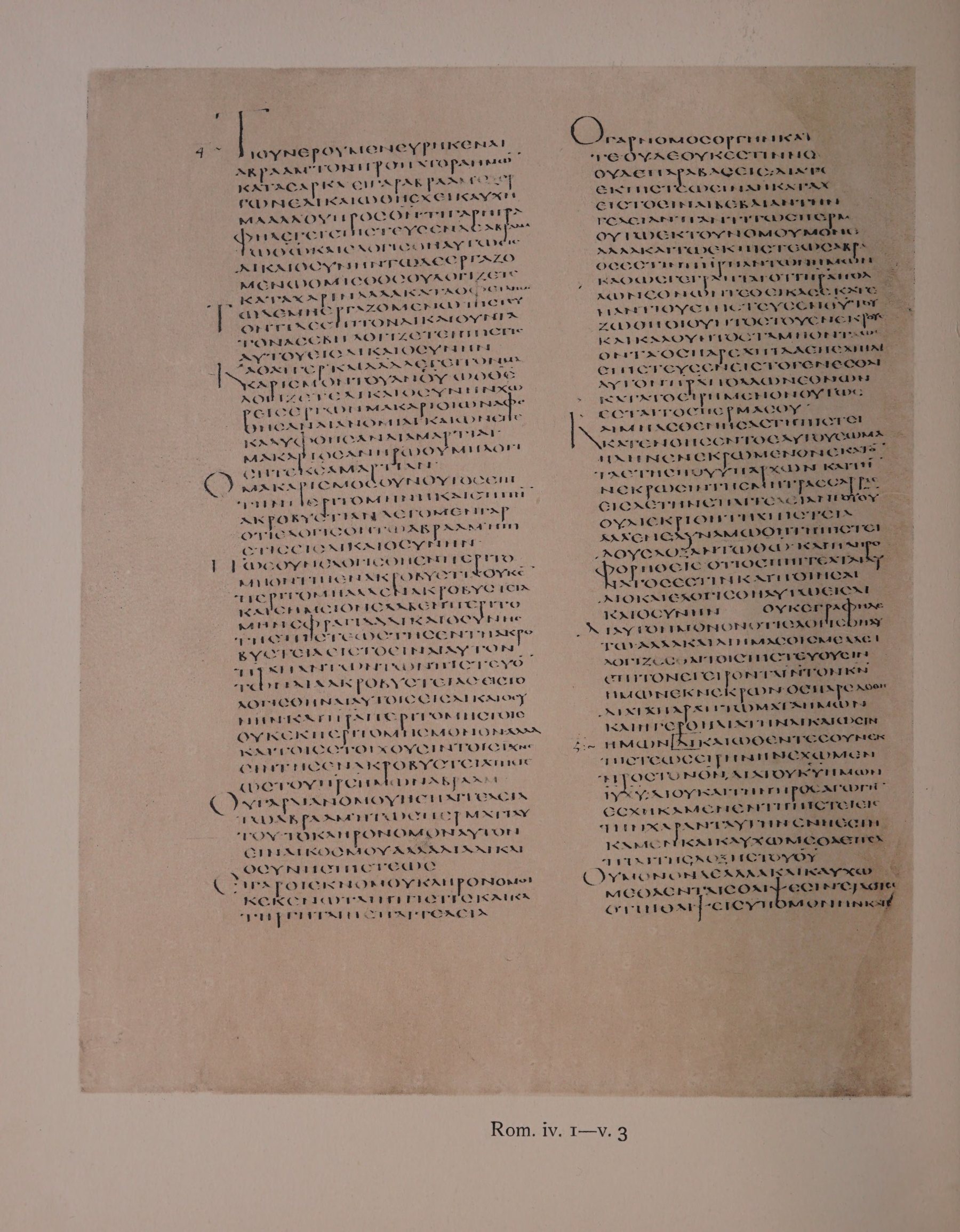
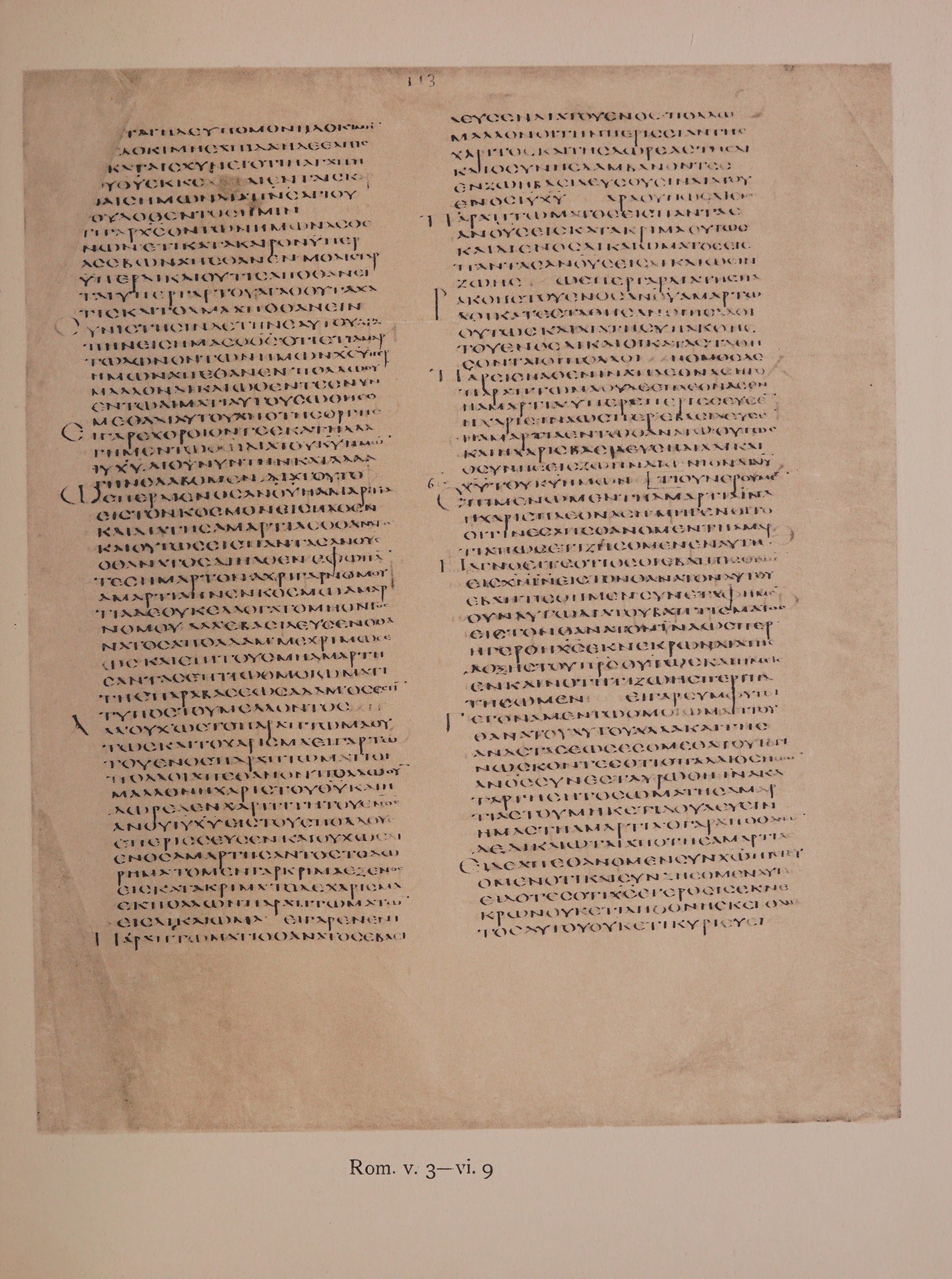
- Manuscript scan: the actual page(s) of Codex Alexandrinus containing this passage (folios 112v, 113r), reproduced from the British Museum's 1909 photographic facsimile edited by F. G. Kenyon, as digitised by the Getty Research Institute for the Internet Archive. The facsimile prints the verse range beneath each plate; that printed range was read for every page used and agrees with the INTF's NTVMR verse-level page index (CC BY 4.0). The page for each section now comes from the NTVMR transcription itself, which records the page and column on which every verse is written.
- Original text: the manuscript's own text, from a diplomatic transcription (see Greek text below), with Tischendorf's 8th critical edition (1869) for comparison.
- English translation: the King James Version (1611), retrieved verbatim from the public-domain bible-api.com endpoint.
Greek text: a diplomatic transcription of Codex Alexandrinus made by the Institut für Neutestamentliche Textforschung (INTF), Münster, for the New Testament Virtual Manuscript Room (NTVMR), published under a Creative Commons Attribution 4.0 licence. It gives the letters as the first scribe wrote them: no accents or breathings, the scribe's own spelling, and the sacred names in their contracted form (θς for θεος, ις for ιησους, κς for κυριος; the overline is not reproduced). Corrections by later hands are not shown. Letters in square brackets are not legible on the page and were restored by the transcribers, a dot under a letter marks an uncertain reading, and [...] marks text lost to damage. Beneath each section, for comparison, is Tischendorf's 8th critical edition (1869). Where the two differ, the transcription is what the manuscript says. Each section is shown with the page on which the transcription places its verses.
How was this verified? (Provenance)
Where on the image
Page from the NTVMR transcription (docID 20002): verses 1-3 on fol. 112v (facsimile leaf 186), col. 2; verse 3 continues on fol. 113r (facsimile leaf 187), col. 1 (which begins '[γαζε]ται ·').
1δικαιωθεντες ουν εκ πιστεως ειρηνην εχωμεν προς τον θν · δια του κυ ημων ιυ χυ · 2δι ου και την προσαγωγην εσχηκαμεν εν τη πιστει εις την χαραν ταυτην · εν η εστηκαμεν · και καυχωμεθα επ ελπιδι της δοξης του θυ 3ου μονον δε αλλα και καυχωμεθα εν ταις θλιψεσιν ειδοτες̣ οτι η θλιψεις υπομονην κατε̣[ρ][γαζε]ται ·
Compare: Tischendorf 8th edition (1869)
1Δικαιωθέντες οὖν ἐκ πίστεως εἰρήνην ἔχωμεν πρὸς τὸν θεὸν διὰ τοῦ κυρίου ἡμῶν Ἰησοῦ Χριστοῦ, 2δι’ οὗ καὶ τὴν προσαγωγὴν ἐσχήκαμεν τῇ πίστει εἰς τὴν χάριν ταύτην ἐν ᾗ ἑστήκαμεν, καὶ καυχώμεθα ἐπ’ ἐλπίδι τῆς δόξης τοῦ θεοῦ. 3οὐ μόνον δέ, ἀλλὰ καὶ καυχώμεθα ἐν ταῖς θλίψεσιν, εἰδότες ὅτι ἡ θλῖψις ὑπομονὴν κατεργάζεται,
1Therefore being justified by faith, we have peace with God through our Lord Jesus Christ: 2By whom also we have access by faith into this grace wherein we stand, and rejoice in hope of the glory of God. 3And not only so, but we glory in tribulations also: knowing that tribulation worketh patience;
Where on the image
Page from the NTVMR transcription (docID 20002): verses 4-10 on fol. 113r (facsimile leaf 187), col. 1.
4η δε υπομονη δοκιμην [η] [δ]ε̣ δοκιμη ελπιδα · 5η δε ελπις [ου] καταισχυνει · οτι η αγαπη [τ]ο̣υ θυ εκκεχυ̣τ̣αι εν ταις καρ[δ]ιαις ημων δια πνς αγιου [τ]ου δοθεντος ημιν 6[ε]τι γαρ χς οντων ημων ασθενων · ετι κατα καιρον υπερ ασεβων απεθανεν · 7μολις γαρ υπερ δικαιου τις αποθανειται υπερ γαρ του αγαθου ταχα τις και τολμα αποθανειν 8συνιστησιν δε την εαυτου αγαπην εις ημας ο θς · οτι ετι αμαρτωλων οντων ημων χς υπερ ημων απεθανεν 9πολλω ουν μαλλον δικαιωθεντες νυν εν τω αιματι αυτου σωθησομεθα δι αυτου απο της οργης 10ει γαρ εχθροι οντες κατηλλαγημεν τω θω
Compare: Tischendorf 8th edition (1869)
4ἡ δὲ ὑπομονὴ δοκιμήν, ἡ δὲ δοκιμὴ ἐλπίδα· 5ἡ δὲ ἐλπὶς οὐ καταισχύνει, ὅτι ἡ ἀγάπη τοῦ θεοῦ ἐκκέχυται ἐν ταῖς καρδίαις ἡμῶν διὰ πνεύματος ἁγίου τοῦ δοθέντος ἡμῖν, 6ἔτι γὰρ Χριστὸς ὄντων ἡμῶν ἀσθενῶν ἔτι κατὰ καιρὸν ὑπὲρ ἀσεβῶν ἀπέθανεν. 7μόλις γὰρ ὑπὲρ δικαίου τις ἀποθανεῖται· ὑπὲρ γὰρ τοῦ ἀγαθοῦ τάχα τις καὶ τολμᾷ ἀποθανεῖν· 8συνίστησιν δὲ τὴν ἑαυτοῦ ἀγάπην εἰς ἡμᾶς ὁ θεὸς ὅτι ἔτι ἁμαρτωλῶν ὄντων ἡμῶν Χριστὸς ὑπὲρ ἡμῶν ἀπέθανεν. 9πολλῷ οὖν μᾶλλον δικαιωθέντες νῦν ἐν τῷ αἵματι αὐτοῦ σωθησόμεθα δι’ αὐτοῦ ἀπὸ τῆς ὀργῆς. 10εἰ γὰρ ἐχθροὶ ὄντες κατηλλάγημεν τῷ θεῷ διὰ τοῦ θανάτου τοῦ υἱοῦ αὐτοῦ, πολλῷ μᾶλλον καταλλαγέντες σωθησόμεθα ἐν τῇ ζωῇ αὐτοῦ·
4And patience, experience; and experience, hope: 5And hope maketh not ashamed; because the love of God is shed abroad in our hearts by the Holy Ghost which is given unto us. 6For when we were yet without strength, in due time Christ died for the ungodly. 7For scarcely for a righteous man will one die: yet peradventure for a good man some would even dare to die. 8But God commendeth his love toward us, in that, while we were yet sinners, Christ died for us. 9Much more then, being now justified by his blood, we shall be saved from wrath through him. 10For if, when we were enemies, we were reconciled to God by the death of his Son, much more, being reconciled, we shall be saved by his life.
Where on the image
Page from the NTVMR transcription (docID 20002): verses 11-17 on fol. 113r (facsimile leaf 187), col. 1.
11δια του κυ ημων ιυ χυ δι ου νυν την καταλλαγην ελαβομεν 12δια τουτο ωσπερ δι ενος ανου η αμαρτια εις τον κοσμον εισηλθεν και δια της αμαρτιας ο θανατος και ουτως εις παντας ανους ο θανατος διηλθεν εφ ω παντες ημαρτον · 13αχρι γαρ νομου αμαρτια ην εν κοσμω αμαρτια δε ουκ ελλογατο μη οντος νομου 14αλλ εβασιλευσεν ο θανατος απο αδαμ · μεχρι μωσεως και επι τους μη αμαρτησαντας επι τω ομοιωματι της παραβασεως αδαμ · ος εστιν τυπος του μελλοντος 15αλλ ουχ ως το παραπτωμα ουτως και το χαρισμα · ει γαρ τω του ενος παραπτωματι οι πολλοι απεθανον πολλω ουν μαλλον η χαρις του θυ και η δωρεα εν χαριτι τη του ενος ανου ιυ χυ εις τους πολλους επερισσευσεν · 16και ουχ ως δι ενος αμαρτησαντος το δωρημα το μεν γαρ κριμα εξ ενος εις κατακριμα · το δε χαρισμα εκ πολλων παραπτωματων εις δικαιωμα · 17ει γαρ εν ενι παραπτωματι ο θανατος εβασιλευσεν δια του ενος · πολλω μαλλον οι την περισσιαν της χαριτος και της δωρεας της δικαιοσυνης λαμβανοντες εν ζωη βασιλευσουσιν δια του ενος ιυ χυ
Compare: Tischendorf 8th edition (1869)
11οὐ μόνον δέ, ἀλλὰ καὶ καυχώμενοι ἐν τῷ θεῷ διὰ τοῦ κυρίου ἡμῶν Ἰησοῦ Χριστοῦ, δι’ οὗ νῦν τὴν καταλλαγὴν ἐλάβομεν. 12Διὰ τοῦτο ὥσπερ δι’ ἑνὸς ἀνθρώπου ἡ ἁμαρτία εἰς τὸν κόσμον εἰσῆλθεν καὶ διὰ τῆς ἁμαρτίας ὁ θάνατος, καὶ οὕτως εἰς πάντας ἀνθρώπους ὁ θάνατος διῆλθεν, ἐφ’ ᾧ πάντες ἥμαρτον 13ἄχρι γὰρ νόμου ἁμαρτία ἦν ἐν κόσμῳ, ἁμαρτία δὲ οὐκ ἐλλογεῖται μὴ ὄντος νόμου· 14ἀλλὰ ἐβασίλευσεν ὁ θάνατος ἀπὸ Ἀδὰμ μέχρι Μωϋσέως καὶ ἐπὶ τοὺς μὴ ἁμαρτήσαντας ἐπὶ τῷ ὁμοιώματι τῆς παραβάσεως Ἀδάμ, ὅς ἐστιν τύπος τοῦ μέλλοντος. 15ἀλλ’ οὐχ ὡς τὸ παράπτωμα, οὕτως καὶ τὸ χάρισμα· εἰ γὰρ τῷ τοῦ ἑνὸς παραπτώματι οἱ πολλοὶ ἀπέθανον, πολλῷ μᾶλλον ἡ χάρις τοῦ θεοῦ καὶ ἡ δωρεὰ ἐν χάριτι τῇ τοῦ ἑνὸς ἀνθρώπου Ἰησοῦ Χριστοῦ εἰς τοὺς πολλοὺς ἐπερίσσευσεν. 16καὶ οὐχ ὡς δι’ ἑνὸς ἁμαρτήσαντος τὸ δώρημα· τὸ μὲν γὰρ κρίμα ἐξ ἑνὸς εἰς κατάκριμα, τὸ δὲ χάρισμα ἐκ πολλῶν παραπτωμάτων εἰς δικαίωμα. 17εἰ γὰρ τῷ τοῦ ἑνὸς παραπτώματι ὁ θάνατος ἐβασίλευσεν διὰ τοῦ ἑνός, πολλῷ μᾶλλον οἱ τὴν περισσείαν τῆς χάριτος καὶ τῆς δωρεᾶς τῆς δικαιοσύνης λαμβάνοντες ἐν ζωῇ βασιλεύσουσιν διὰ τοῦ ἑνὸς Ἰησοῦ Χριστοῦ.
11And not only so, but we also joy in God through our Lord Jesus Christ, by whom we have now received the atonement. 12Wherefore, as by one man sin entered into the world, and death by sin; and so death passed upon all men, for that all have sinned: 13(For until the law sin was in the world: but sin is not imputed when there is no law. 14Nevertheless death reigned from Adam to Moses, even over them that had not sinned after the similitude of Adam’s transgression, who is the figure of him that was to come. 15But not as the offence, so also is the free gift. For if through the offence of one many be dead, much more the grace of God, and the gift by grace, which is by one man, Jesus Christ, hath abounded unto many. 16And not as it was by one that sinned, so is the gift: for the judgment was by one to condemnation, but the free gift is of many offences unto justification. 17For if by one man’s offence death reigned by one; much more they which receive abundance of grace and of the gift of righteousness shall reign in life by one, Jesus Christ.)
Where on the image
Page from the NTVMR transcription (docID 20002): verses 18-21 on fol. 113r (facsimile leaf 187), col. 2.
18αρα ουν ως δι ενος παραπτωματος εις παντας ανους εις κατακριμα · ουτως και δι ενος δικαιωματος εις παντας ανους εις δικαιωσιν ζωης 19ωσπερ γαρ δια της παρακοης του ενος ανου αμαρτωλοι κατεσταθησαν οι πολλοι ουτως και δια της υπακοης του ενος δικαιοι κατασταθησονται οι πολλοι 20νομος δε παρεισηλθεν ινα πλεοναση το παραπτωμα ου δε επλεονασεν η αμαρτια · υπερεπερισσευσεν η χαρις · 21ινα ωσπερ εβασιλευσεν η αμαρτια εν τω θανατω ουτως και η χαρις βασιλευση δια δικαιοσυνης εις ζωην αιωνιον δια ιυ χυ του κυ ημων
Compare: Tischendorf 8th edition (1869)
18Ἄρα οὖν ὡς δι’ ἑνὸς παραπτώματος εἰς πάντας ἀνθρώπους εἰς κατάκριμα, οὕτως καὶ δι’ ἑνὸς δικαιώματος εἰς πάντας ἀνθρώπους εἰς δικαίωσιν ζωῆς· 19ὥσπερ γὰρ διὰ τῆς παρακοῆς τοῦ ἑνὸς ἀνθρώπου ἁμαρτωλοὶ κατεστάθησαν οἱ πολλοί, οὕτως καὶ διὰ τῆς ὑπακοῆς τοῦ ἑνὸς δίκαιοι κατασταθήσονται οἱ πολλοί. 20νόμος δὲ παρεισῆλθεν ἵνα πλεονάσῃ τὸ παράπτωμα· οὗ δὲ ἐπλεόνασεν ἡ ἁμαρτία, ὑπερεπερίσσευσεν ἡ χάρις, 21ἵνα ὥσπερ ἐβασίλευσεν ἡ ἁμαρτία ἐν τῷ θανάτῳ, οὕτως καὶ ἡ χάρις βασιλεύσῃ διὰ δικαιοσύνης εἰς ζωὴν αἰώνιον διὰ Ἰησοῦ Χριστοῦ τοῦ κυρίου ἡμῶν.
18Therefore as by the offence of one judgment came upon all men to condemnation; even so by the righteousness of one the free gift came upon all men unto justification of life. 19For as by one man’s disobedience many were made sinners, so by the obedience of one shall many be made righteous. 20Moreover the law entered, that the offence might abound. But where sin abounded, grace did much more abound: 21That as sin hath reigned unto death, even so might grace reign through righteousness unto eternal life by Jesus Christ our Lord.
Cite
Sources
- Source: Codex Alexandrinus page images + NTVMR transcription (CC BY 4.0) + Tischendorf 8th edition + KJV (holding institution)
- Critical edition: Codex Alexandrinus transcription, NTVMR (INTF Münster, CC BY 4.0); Tischendorf 8th edition for comparison
← previous · → next · v cycle view · l back to library