Analects, Book 3: Ba yi 八佾 (Kamakura-period manuscript)
Introduction
Book 3 of the Analects (論語 Lunyu), titled 八佾 (Ba yi) after its opening words, 26 chapters in Legge's division. It is shown on a manuscript of the Analects in the Kiyohara family collection (Seike bunko) of Kyoto University Library, two volumes in regular script, seven columns of fourteen characters to the page, main text only, with red and black Japanese reading marks. A colophon by Kiyohara Edakata dated 1550 names the copyist as his ancestor Kiyohara Yoshieda (1253-1331), which places the copy around 1300, in the late Kamakura period; the attribution is traditional. The Kiyohara were hereditary readers of the Confucian classics at the Japanese court, and their text descends from the edition of the Analects with the collected commentary of He Yan (3rd century CE): after each pair of books the scribe copied the character counts of the classic and of the commentary, although only the classic is written out. The manuscript is an Important Cultural Property of Japan.
In this copy Book 3 runs from canvas 11, left-hand page to canvas 15, right-hand page (volume 1). Each section gathers the paragraphs that begin on one page, numbered by chapter and paragraph as in Legge, and links to that page and to any page the last paragraph runs onto. The page boundaries were found by reading the first characters of every column on the photographs. The Chinese shown is the received text, from Wikisource. This manuscript differs from it in places, most often by an added or missing particle (也, 矣, 焉) or a variant character form; the differences seen at column openings are listed in the scan notes. The English is James Legge's translation of the received text.
How was this verified? (Provenance)
Where on the image
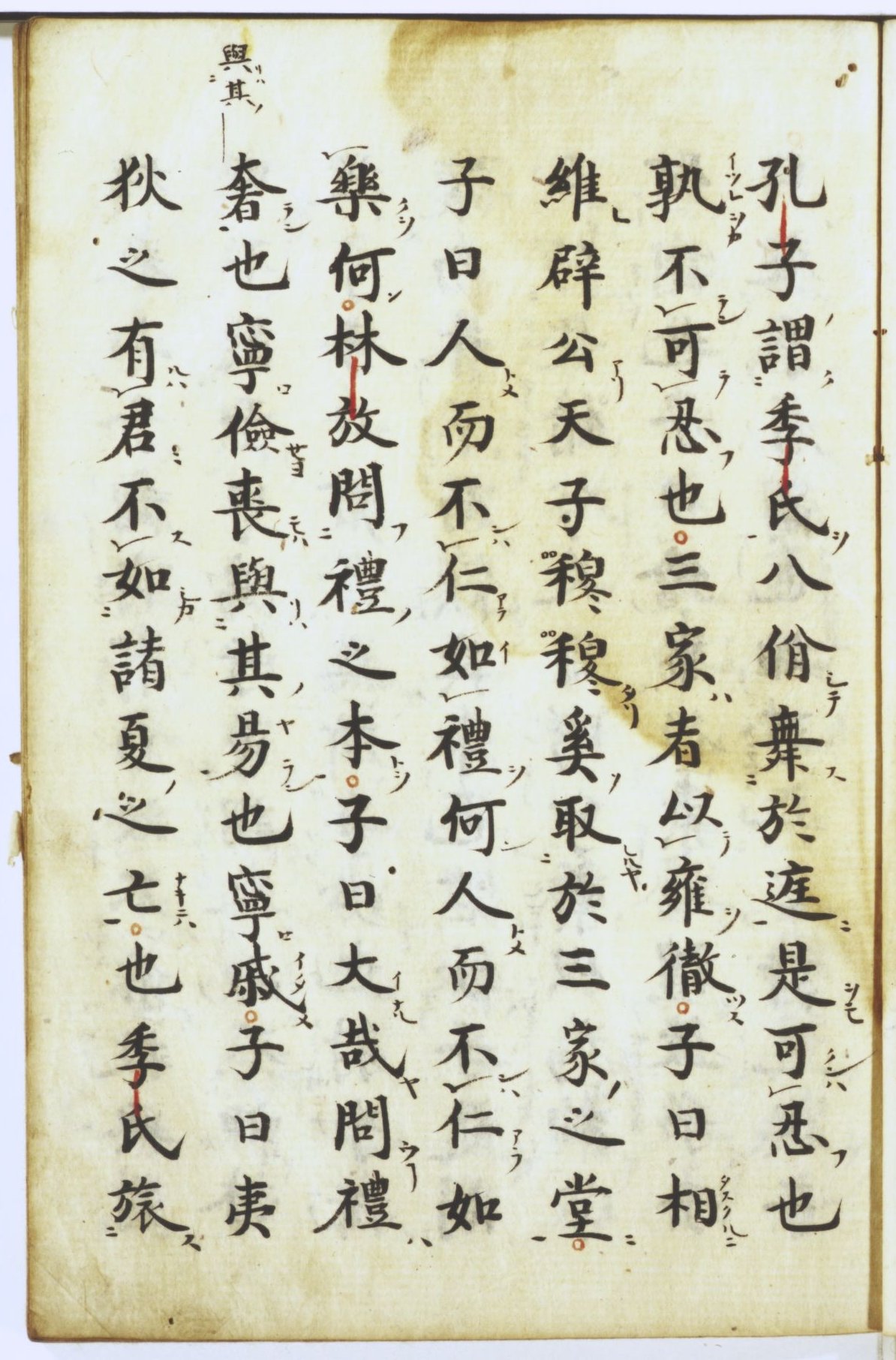
Kyoto University Library RB00007936, IIIF canvas 11, left-hand page: 7 written columns of up to 14 characters, main text only, with Japanese reading marks. Checked on the image: the first column of this book's text on this page begins ‹孔子謂›, the last begins ‹狄之有›. The book title stands in the last written column of the facing canvas 11, right-hand page. 3.1 opens column 1. 3.6 runs on to canvas 12, right-hand page (first column ‹於泰山›), where the section ends. The Chinese shown is the received text (Wikisource), not a transcription of this manuscript; Legge's English translates the received text.
1孔子謂季氏:「八佾舞於庭。是可忍也,孰不可忍也!」
2三家者,以雍徹。子曰:「『相維辟公,天子穆穆。』奚取於三家之堂?」
3子曰:「人而不仁,如禮何?人而不仁,如樂何?」
4.1林放問禮之本。
4.2子曰:「大哉問!
4.3禮,與其奢也,寧儉;喪,與其易也,寧戚。」
5子曰:「夷狄之有君,不如諸夏之亡也。」
6季氏旅於泰山。子謂冉有曰:「女弗能救與?」對曰:「不能。」子曰:「嗚呼!曾謂泰山不如林放乎?」
1Confucius said of the head of the Chi family, who had eight rows of pantomimes in his area, 'If he can bear to do this, what may he not bear to do?'
2The three families used the YUNG ode, while the vessels were being removed, at the conclusion of the sacrifice. The Master said, '"Assisting are the princes;-- the son of heaven looks profound and grave:"-- what application can these words have in the hall of the three families?'
3The Master said, 'If a man be without the virtues proper to humanity, what has he to do with the rites of propriety? If a man be without the virtues proper to humanity, what has he to do with music?'
4.1Lin Fang asked what was the first thing to be attended to in ceremonies.
4.2The Master said, 'A great question indeed!
4.3'In festive ceremonies, it is better to be sparing than extravagant. In the ceremonies of mourning, it is better that there be deep sorrow than a minute attention to observances.'
5The Master said, 'The rude tribes of the east and north have their princes, and are not like the States of our great land which are without them.'
6The chief of the Chi family was about to sacrifice to the T'ai mountain. The Master said to Zan Yu, 'Can you not save him from this?' He answered, 'I cannot.' Confucius said, 'Alas! will you say that the T'ai mountain is not so discerning as Lin Fang?'
Where on the image
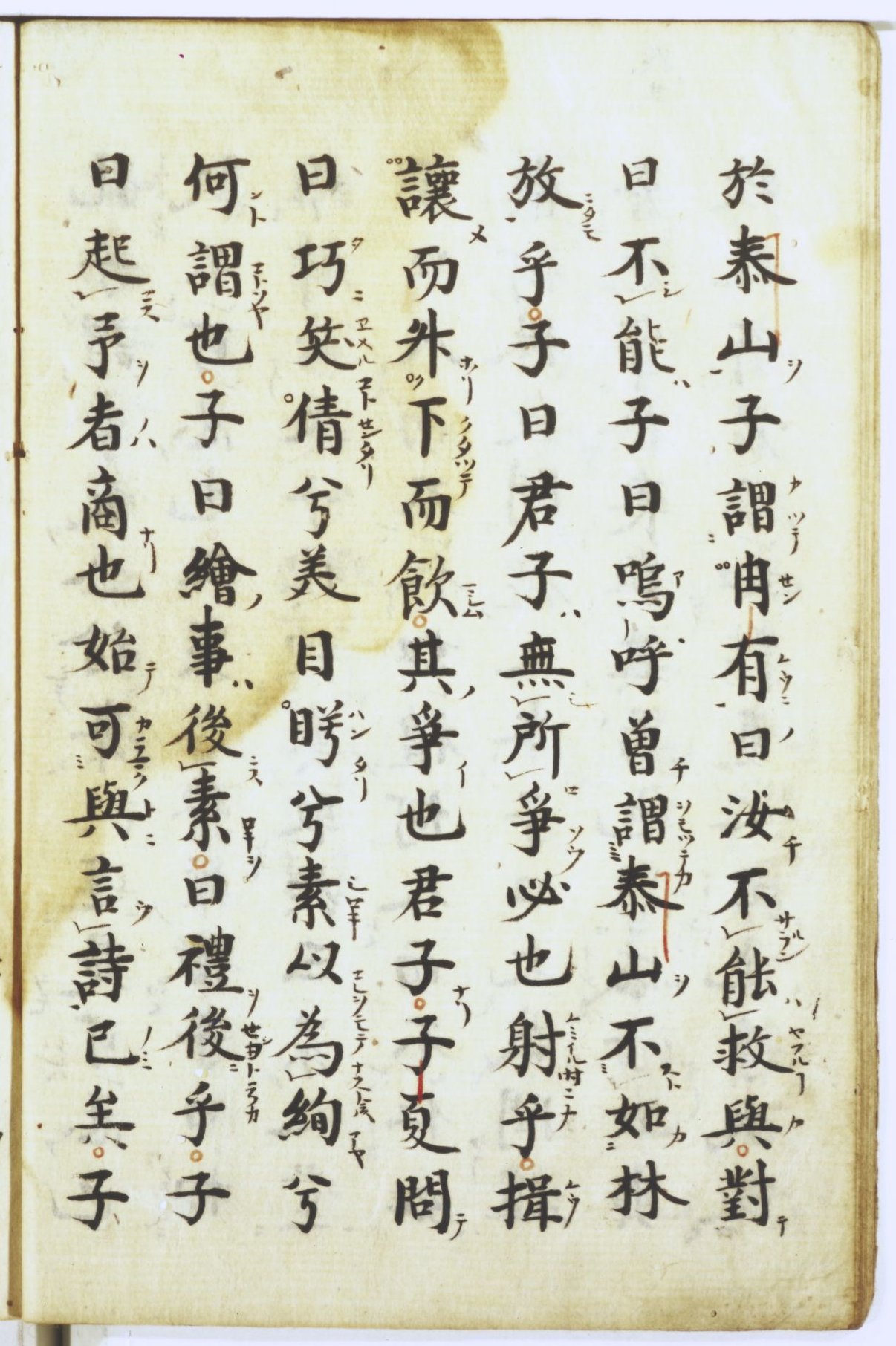
Kyoto University Library RB00007936, IIIF canvas 12, right-hand page: 7 written columns of up to 14 characters, main text only, with Japanese reading marks. Checked on the image: the first column of this book's text on this page begins ‹於泰山›, the last begins ‹曰起予›. 3.7 begins inside column 3 (the column opens ‹放乎子›), 2 characters down in the received text. Above it the page finishes 3.6, shown in the previous section. 3.9 runs on to canvas 12, left-hand page (first column ‹曰夏禮›), where the section ends. The Chinese shown is the received text (Wikisource), not a transcription of this manuscript; Legge's English translates the received text.
7子曰:「君子無所爭,必也射乎!揖讓而升,下而飮,其爭也君子。」
8.1子夏問曰:「『巧笑倩兮,美目盼兮,素以爲絢兮。』何謂也?」
8.2子曰:「繪事後素。」
8.3曰:「禮後乎?」子曰:「起予者商也,始可與言《詩》已矣。」
9子曰:「夏禮,吾能言之,杞不足徵也;殷禮,吾能言之,宋不足徵也。文獻不足故也,足,則吾能徵之矣。」
7The Master said, 'The student of virtue has no contentions. If it be said he cannot avoid them, shall this be in archery? But he bows complaisantly to his competitors; thus he ascends the hall, descends, and exacts the forfeit of drinking. In his contention, he is still the Chun-tsze.'
8.1Tsze-hsia asked, saying, 'What is the meaning of the passage-- "The pretty dimples of her artful smile! The well- defined black and white of her eye! The plain ground for the colours?"'
8.2The Master said, 'The business of laying on the colours follows (the preparation of) the plain ground.'
8.3'Ceremonies then are a subsequent thing?' The Master said, 'It is Shang who can bring out my meaning. Now I can begin to talk about the odes with him.'
9The Master said, 'I could describe the ceremonies of the Hsia dynasty, but Chi cannot sufficiently attest my words. I could describe the ceremonies of the Yin dynasty, but Sung cannot sufficiently attest my words. (They cannot do so) because of the insufficiency of their records and wise men. If those were sufficient, I could adduce them in support of my words.'
Where on the image
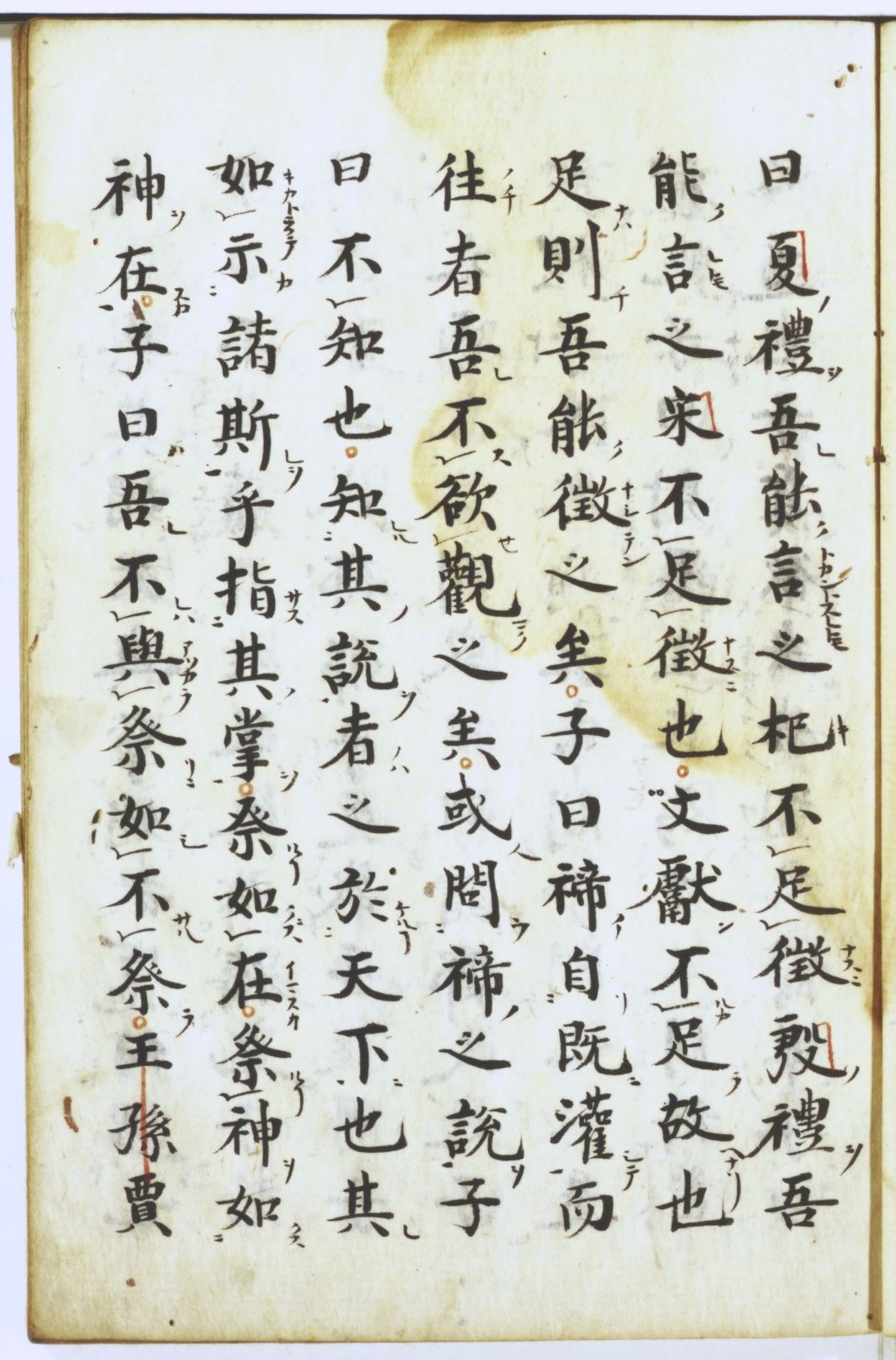
Kyoto University Library RB00007936, IIIF canvas 12, left-hand page: 7 written columns of up to 14 characters, main text only, with Japanese reading marks. Checked on the image: the first column of this book's text on this page begins ‹曰夏禮›, the last begins ‹神在子›. 3.10 begins inside column 3 (the column opens ‹足則吾›), 7 characters down in the received text. Above it the page finishes 3.9, shown in the previous section. 3.13.1 runs on to canvas 13, right-hand page (first column ‹問曰與›), where the section ends. The Chinese shown is the received text (Wikisource), not a transcription of this manuscript; Legge's English translates the received text.
10子曰:「禘自既灌而往者,吾不欲觀之矣。」
11或問「禘」之說。子曰:「不知也。知其說者之於天下也,其如示諸斯乎?」指其掌。
12.1祭如在,祭神如神在。
12.2子曰:「吾不與祭,如不祭。」
13.1王孫賈問曰:「『與其媚於奧,寧媚於竈。』何謂也?」
10The Master said, 'At the great sacrifice, after the pouring out of the libation, I have no wish to look on.'
11Some one asked the meaning of the great sacrifice. The Master said, 'I do not know. He who knew its meaning would find it as easy to govern the kingdom as to look on this;-- pointing to his palm.
12.1He sacrificed to the dead, as if they were present. He sacrificed to the spirits, as if the spirits were present.
12.2The Master said, 'I consider my not being present at the sacrifice, as if I did not sacrifice.'
13.1Wang-sun Chia asked, saying, 'What is the meaning of the saying, "It is better to pay court to the furnace than to the south-west corner?"'
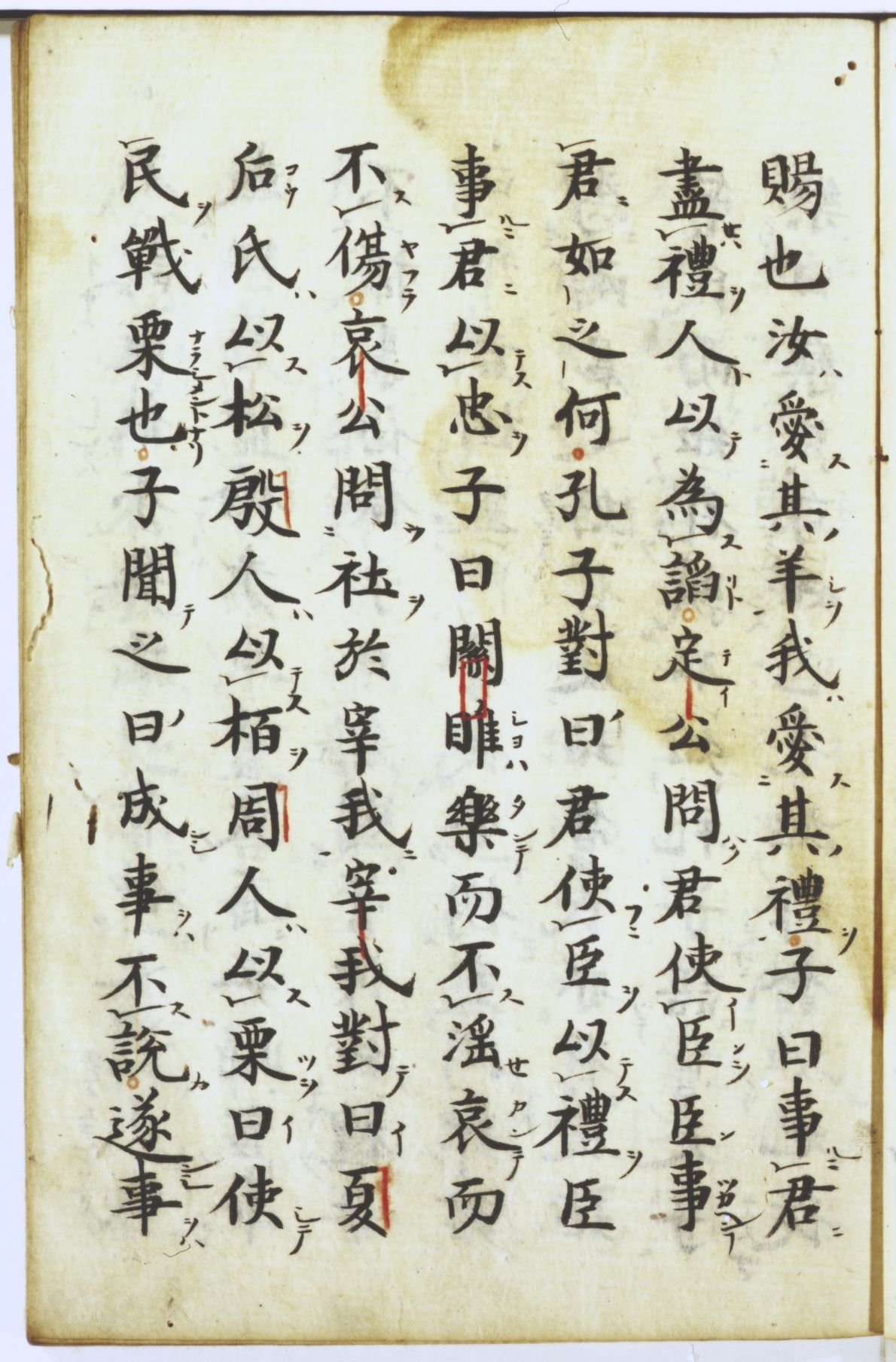
Where on the image
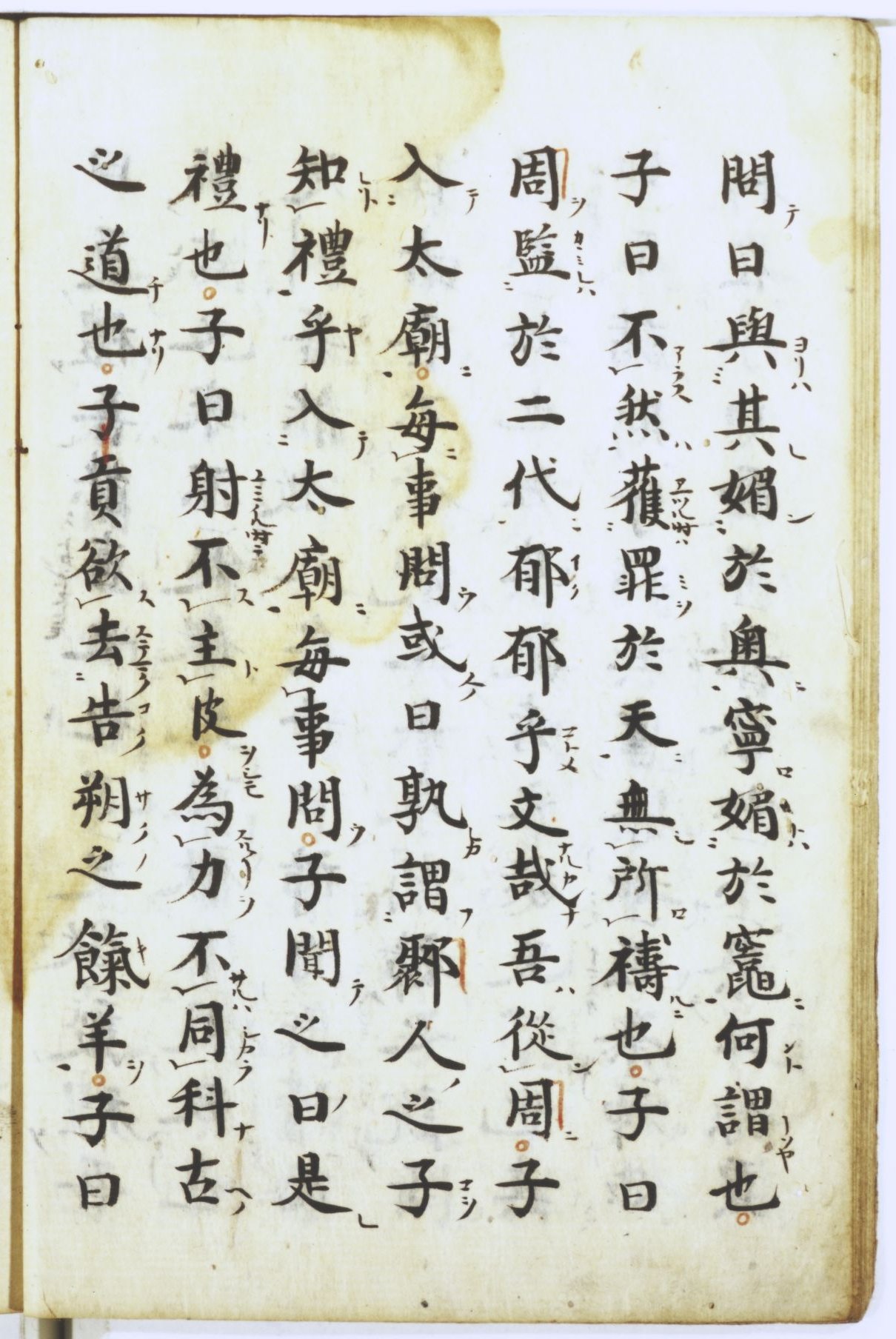
Kyoto University Library RB00007936, IIIF canvas 13, right-hand page: 7 written columns of up to 14 characters, main text only, with Japanese reading marks. Checked on the image: the first column of this book's text on this page begins ‹問曰與›, the last begins ‹之道也›. 3.13.2 opens column 2. Above it the page finishes 3.13.1, shown in the previous section. 3.17.2 runs on to canvas 13, left-hand page (first column ‹賜也汝›), where the section ends. Column openings on these pages that differ from the received text: ‹賜也汝› where the received text has ‹賜也爾›. The Chinese shown is the received text (Wikisource), not a transcription of this manuscript; Legge's English translates the received text.
13.2子曰:「不然。獲罪於天,無所禱也。」
14子曰:「周監於二代,郁郁乎文哉!吾從周。」
15子入太廟,每事問。或曰:「孰謂鄹人之子知禮乎?入太廟,每事問。」子聞之曰:「是禮也!」
16子曰:「射不主皮,爲力不同科,古之道也。」
17.1子貢欲去吿朔之餼羊。
17.2子曰:「賜也!爾愛其羊,我愛其禮。」
13.2The Master said, 'Not so. He who offends against Heaven has none to whom he can pray.'
14The Master said, 'Chau had the advantage of viewing the two past dynasties. How complete and elegant are its regulations! I follow Chau.'
15The Master, when he entered the grand temple, asked about everything. Some one said, 'Who will say that the son of the man of Tsau knows the rules of propriety! He has entered the grand temple and asks about everything.' The Master heard the remark, and said, 'This is a rule of propriety.'
16The Master said, 'In archery it is not going through the leather which is the principal thing;-- because people's strength is not equal. This was the old way.'
17.1Tsze-kung wished to do away with the offering of a sheep connected with the inauguration of the first day of each month.
17.2The Master said, 'Ts'ze, you love the sheep; I love the ceremony.'
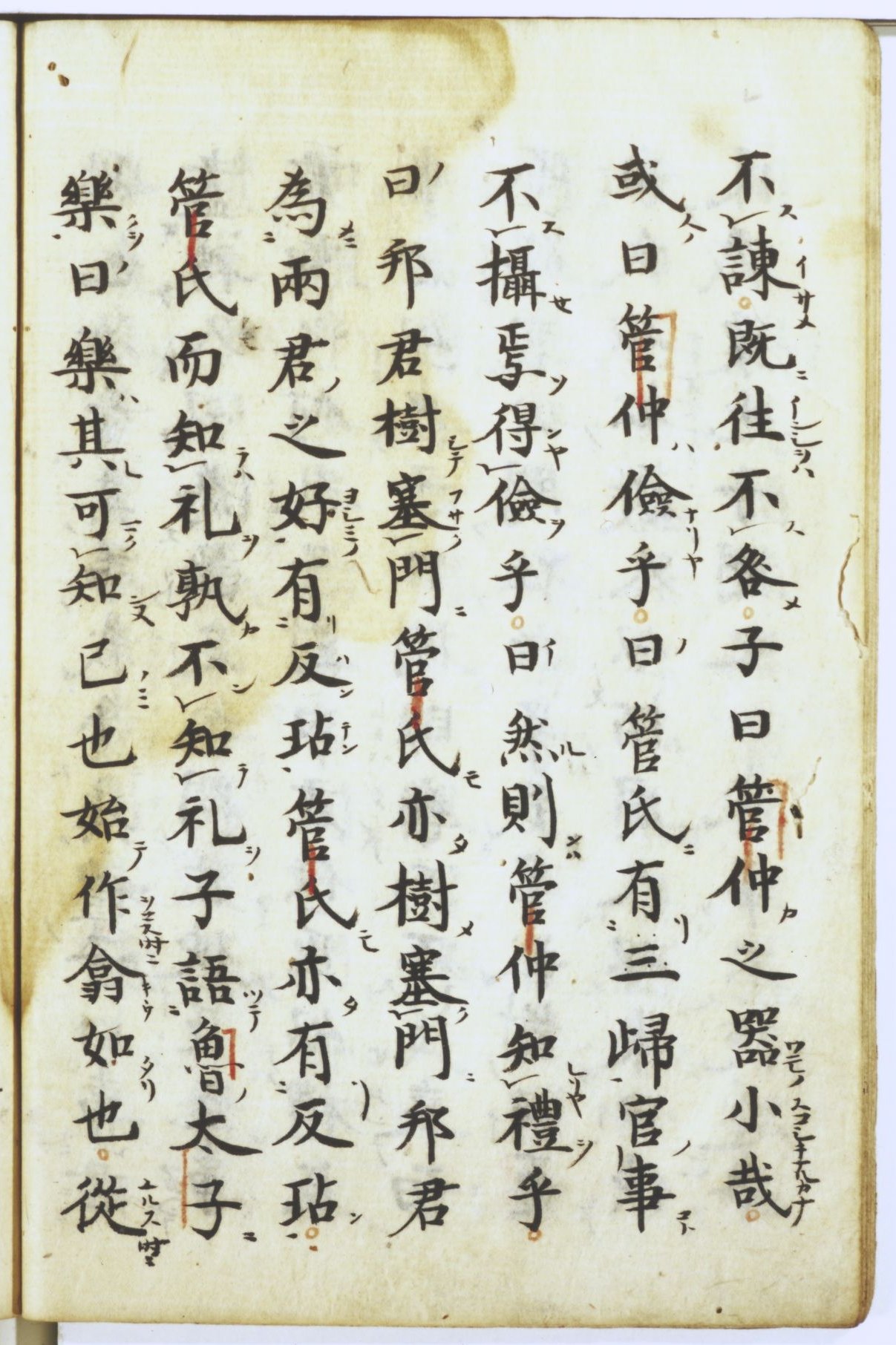
Where on the image
Kyoto University Library RB00007936, IIIF canvas 13, left-hand page: 7 written columns of up to 14 characters, main text only, with Japanese reading marks. Checked on the image: the first column of this book's text on this page begins ‹賜也汝›, the last begins ‹民戰栗›. 3.18 begins inside column 1 (the column opens ‹賜也汝›), 10 characters down in the received text. Above it the page finishes 3.17.2, shown in the previous section. 3.21.2 runs on to canvas 14, right-hand page (first column ‹不諫既›), where the section ends. The Chinese shown is the received text (Wikisource), not a transcription of this manuscript; Legge's English translates the received text.
18子曰:「事君盡禮,人以爲諂也。」
19定公問:「君使臣,臣事君,如之何?」孔子對曰:「君使臣以禮,臣事君以忠。」
20子曰:「《關雎》,樂而不淫,哀而不傷。」
21.1哀公問社於宰我。宰我對曰:「夏后氏以松,殷人以柏,周人以栗。曰:『使民戰栗。』」
21.2子聞之,曰:「成事不說,遂事不諫,既往不咎。」
18The Master said, 'The full observance of the rules of propriety in serving one's prince is accounted by people to be flattery.'
19The Duke Ting asked how a prince should employ his ministers, and how ministers should serve their prince. Confucius replied, 'A prince should employ his minister according to according to the rules of propriety; ministers should serve their prince with faithfulness.'
20The Master said, 'The Kwan Tsu is expressive of enjoyment without being licentious, and of grief without being hurtfully excessive.'
21.1The Duke Ai asked Tsai Wo about the altars of the spirits of the land. Tsai Wo replied, 'The Hsia sovereign planted the pine tree about them; the men of the Yin planted the cypress; and the men of the Chau planted the chestnut tree, meaning thereby to cause the people to be in awe.'
21.2When the Master heard it, he said, 'Things that are done, it is needless to speak about; things that have had their course, it is needless to remonstrate about; things that are past, it is needless to blame.'
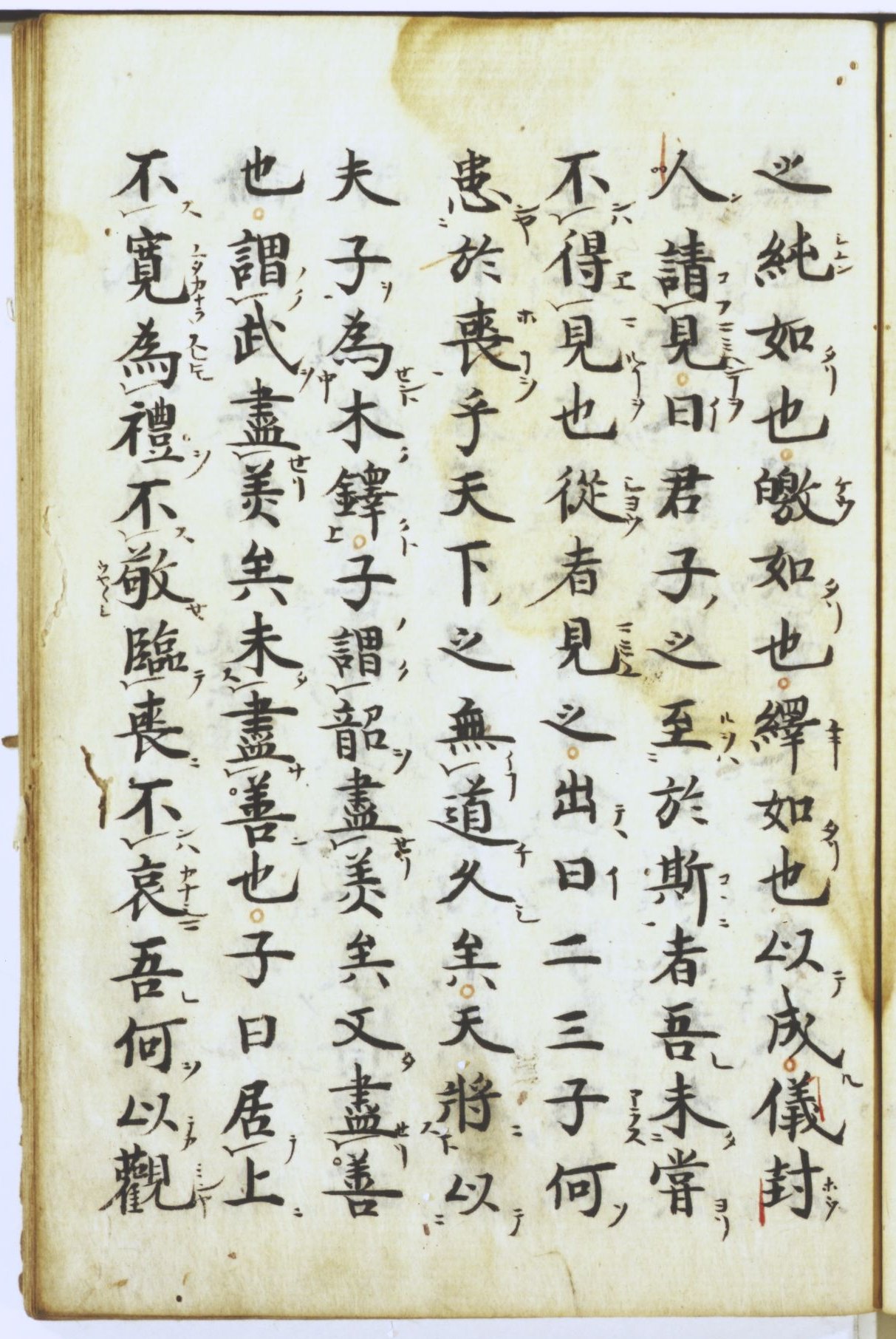
Where on the image
Kyoto University Library RB00007936, IIIF canvas 14, right-hand page: 7 written columns of up to 14 characters, main text only, with Japanese reading marks. Checked on the image: the first column of this book's text on this page begins ‹不諫既›, the last begins ‹樂曰樂›. 3.22.1 begins inside column 1 (the column opens ‹不諫既›), 6 characters down in the received text. Above it the page finishes 3.21.2, shown in the previous section. 3.23 runs on to canvas 14, left-hand page (first column ‹之純如›), where the section ends. The Chinese shown is the received text (Wikisource), not a transcription of this manuscript; Legge's English translates the received text.
22.1子曰:「管仲之器小哉!」
22.2或曰:「管仲儉乎?」曰:「管氏有三歸,官事不攝,焉得儉?」
22.3「然則管仲知禮乎?」曰:「邦君樹塞門,管氏亦樹塞門。邦君爲兩君之好,有反坫,管氏亦有反坫。管氏而知禮,孰不知禮?」
23子語魯大師樂,曰:「樂其可知也。始作,翕如也。從之,純如也,皦如也,繹如也。以成。」
22.1The Master said, 'Small indeed was the capacity of Kwan Chung!'
22.2Some one said, 'Was Kwan Chung parsimonious?' 'Kwan,' was the reply, 'had the San Kwei, and his officers performed no double duties; how can he be considered parsimonious?'
22.3'Then, did Kwan Chung know the rules of propriety?' The Master said, 'The princes of States have a screen intercepting the view at their gates. Kwan had likewise a screen at his gate. The princes of States on any friendly meeting between two of them, had a stand on which to place their inverted cups. Kwan had also such a stand. If Kwan knew the rules of propriety, who does not know them?'
23The Master instructing the grand music-master of Lu said, 'How to play music may be known. At the commencement of the piece, all the parts should sound together. As it proceeds, they should be in harmony while severally distinct and flowing without break, and thus on to the conclusion.'
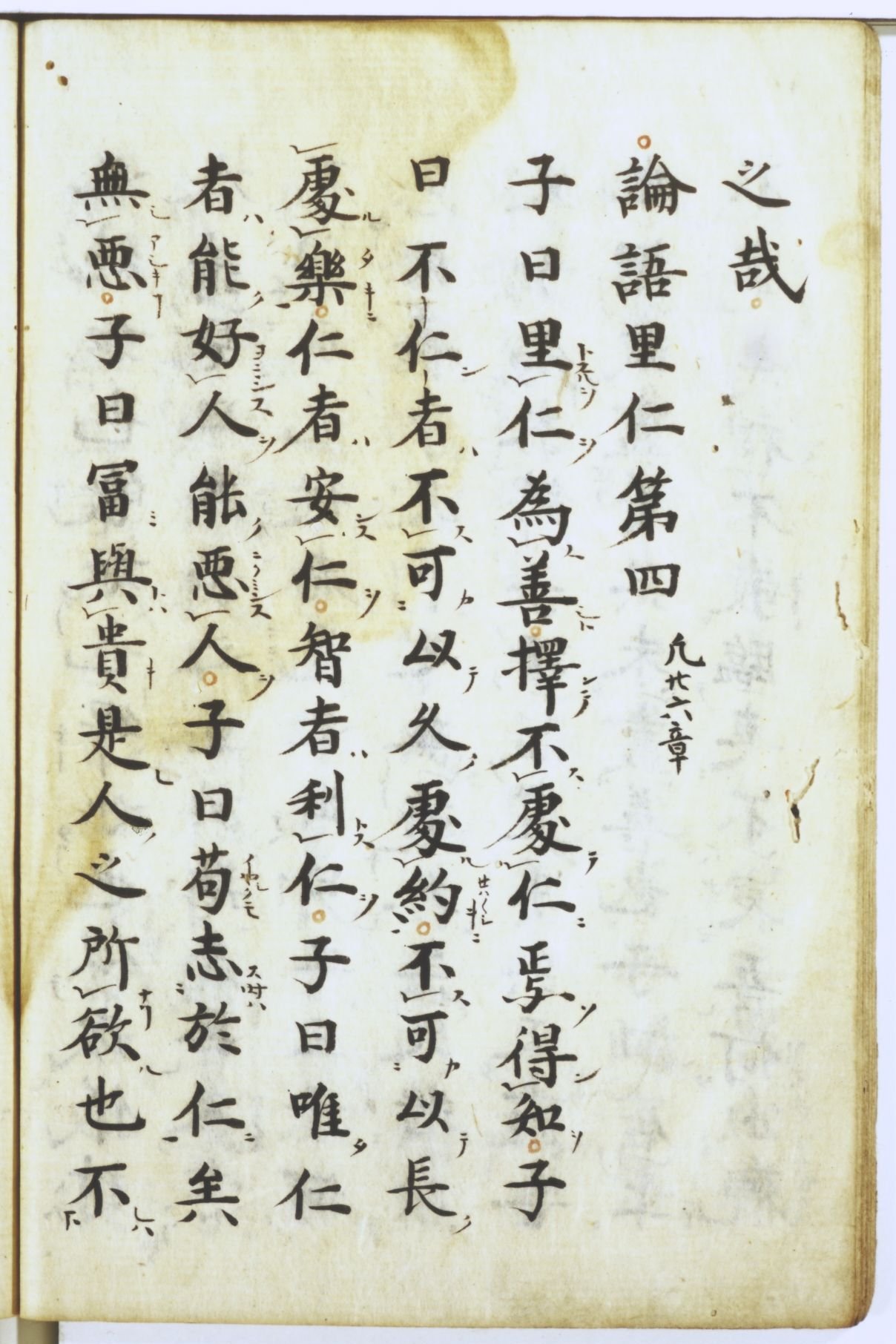
Where on the image
Kyoto University Library RB00007936, IIIF canvas 14, left-hand page: 7 written columns of up to 14 characters, main text only, with Japanese reading marks. Checked on the image: the first column of this book's text on this page begins ‹之純如›, the last begins ‹不寬為›. 3.24 begins inside column 1 (the column opens ‹之純如›), 12 characters down in the received text. Above it the page finishes 3.23, shown in the previous section. 3.26 runs on to canvas 15, right-hand page (first column ‹之哉›), where the section ends. The Chinese shown is the received text (Wikisource), not a transcription of this manuscript; Legge's English translates the received text.
24儀封人請見,曰:「君子之至於斯也,吾未嘗不得見也。」從者見之。出曰:「二三子,何患於喪乎?天下之無道也久矣,天將以夫子爲木鐸。」
25子謂韶:「盡美矣,又盡善也。」謂武:「盡美矣,未盡善也。」
26子曰:「居上不寬,爲禮不敬,臨喪不哀,吾何以觀之哉!」
24The border warden at Yi requested to be introduced to the Master, saying, 'When men of superior virtue have come to this, I have never been denied the privilege of seeing them.' The followers of the sage introduced him, and when he came out from the interview, he said, 'My friends, why are you distressed by your master's loss of office? The kingdom has long been without the principles of truth and right; Heaven is going to use your master as a bell with its wooden tongue.'
25The Master said of the Shao that it was perfectly beautiful and also perfectly good. He said of the Wu that it was perfectly beautiful but not perfectly good.
26The Master said, 'High station filled without indulgent generosity; ceremonies performed without reverence; mourning conducted without sorrow;-- wherewith should I contemplate such ways?'
Notes
- English: James Legge, Confucian Analects, The Chinese Classics vol. 1. Legge's chapter and paragraph numbers are kept as superscripts (chapter.paragraph).
- Legge translated the received text. Where this manuscript's wording differs, his English follows the received text shown here.
Cite
Sources
- Source: Kyoto University Library RB00007936 (Analects manuscript attributed to Kiyohara Yoshieda, c. 1300) + Wikisource received text + James Legge's English (Project Gutenberg) (holding institution)
- Critical edition: Received text (Wikisource) in Legge's chapter and paragraph division
← previous · → next · v cycle view · l back to library