Analects, Book 4: Li ren 里仁 (Kamakura-period manuscript)
Introduction
Book 4 of the Analects (論語 Lunyu), titled 里仁 (Li ren) after its opening words, 26 chapters in Legge's division. It is shown on a manuscript of the Analects in the Kiyohara family collection (Seike bunko) of Kyoto University Library, two volumes in regular script, seven columns of fourteen characters to the page, main text only, with red and black Japanese reading marks. A colophon by Kiyohara Edakata dated 1550 names the copyist as his ancestor Kiyohara Yoshieda (1253-1331), which places the copy around 1300, in the late Kamakura period; the attribution is traditional. The Kiyohara were hereditary readers of the Confucian classics at the Japanese court, and their text descends from the edition of the Analects with the collected commentary of He Yan (3rd century CE): after each pair of books the scribe copied the character counts of the classic and of the commentary, although only the classic is written out. The manuscript is an Important Cultural Property of Japan.
In this copy Book 4 runs from canvas 15, right-hand page to canvas 17, left-hand page (volume 1). Each section gathers the paragraphs that begin on one page, numbered by chapter and paragraph as in Legge, and links to that page and to any page the last paragraph runs onto. The page boundaries were found by reading the first characters of every column on the photographs. The Chinese shown is the received text, from Wikisource. This manuscript differs from it in places, most often by an added or missing particle (也, 矣, 焉) or a variant character form; the differences seen at column openings are listed in the scan notes. The English is James Legge's translation of the received text.
How was this verified? (Provenance)
Where on the image
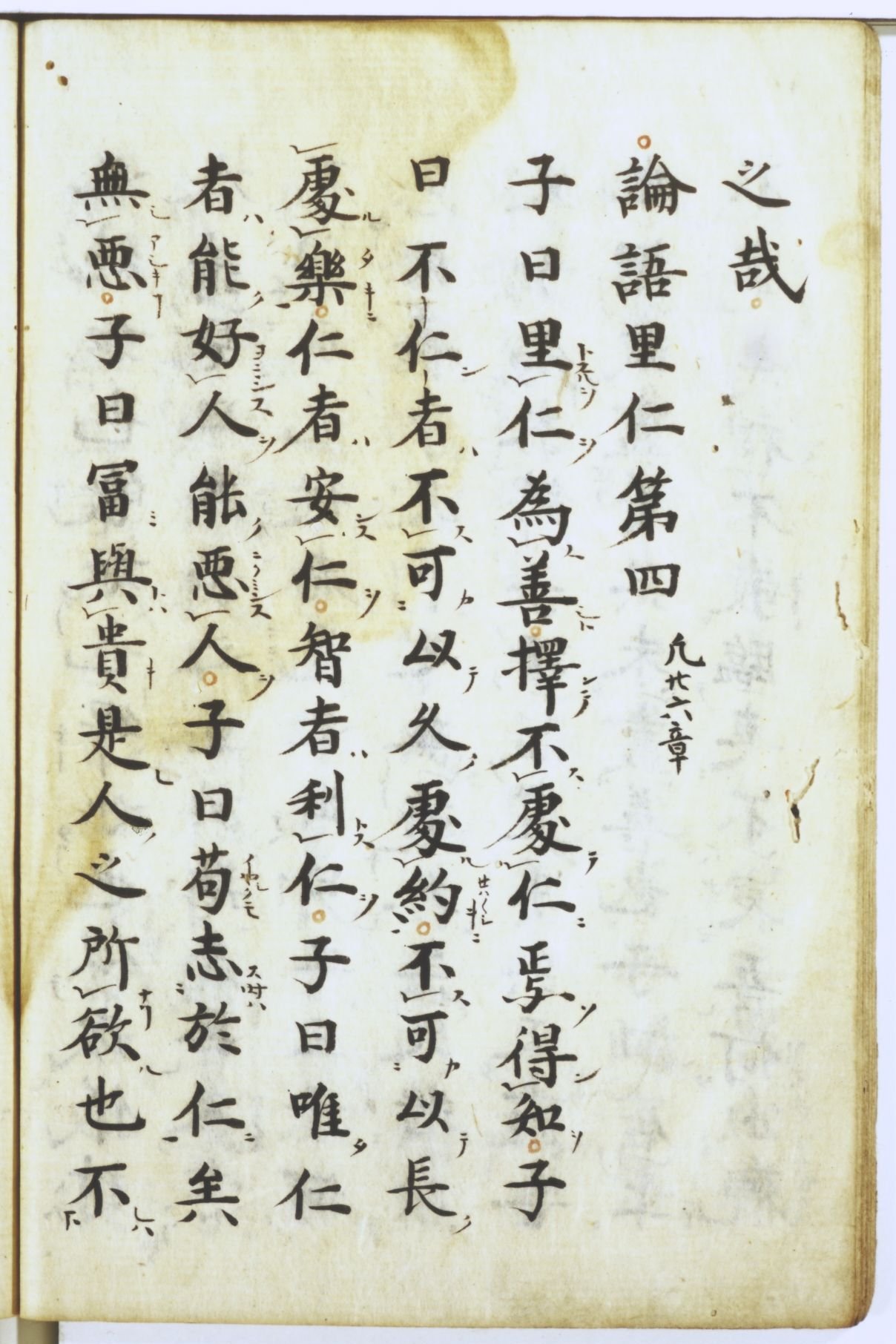
Kyoto University Library RB00007936, IIIF canvas 15, right-hand page: 7 written columns of up to 14 characters, main text only, with Japanese reading marks. Checked on the image: the first column of this book's text on this page begins ‹子曰里›, the last begins ‹無惡也›. Column 2 carries the title 論語里仁第四. 4.1 opens column 3. 4.5.1 runs on to canvas 15, left-hand page (first column ‹以其道›), where the section ends. Column openings on these pages that differ from the received text: ‹所惡不› where the received text has ‹所惡也›. The Chinese shown is the received text (Wikisource), not a transcription of this manuscript; Legge's English translates the received text.
1子曰:「里仁爲美。擇不處仁,焉得知?」
2子曰:「不仁者,不可以久處約,不可以長處樂。仁者安仁,知者利仁。」
3子曰:「惟仁者能好人,能惡人。」
4子曰:「苟志於仁矣,無惡也。」
5.1子曰:「富與貴,是人之所欲也,不以其道得之,不處也。貧與賤,是人之所惡也;不以其道得之,不去也。
1The Master said, 'It is virtuous manners which constitute the excellence of a neighborhood. If a man in selecting a residence, do not fix on one where such prevail, how can he be wise?'
2The Master said, 'Those who are without virtue cannot abide long either in a condition of poverty and hardship, or in a condition of enjoyment. The virtuous rest in virtue; the wise desire virtue.'
3The Master said, 'It is only the (truly) virtuous man, who can love, or who can hate, others.'
4The Master said, 'If the will be set on virtue, there will be no practice of wickedness.'
5.1The Master said, 'Riches and honours are what men desire. If it cannot be obtained in the proper way, they should not be held. Poverty and meanness are what men dislike. If it cannot be avoided in the proper way, they should not be avoided.
Where on the image
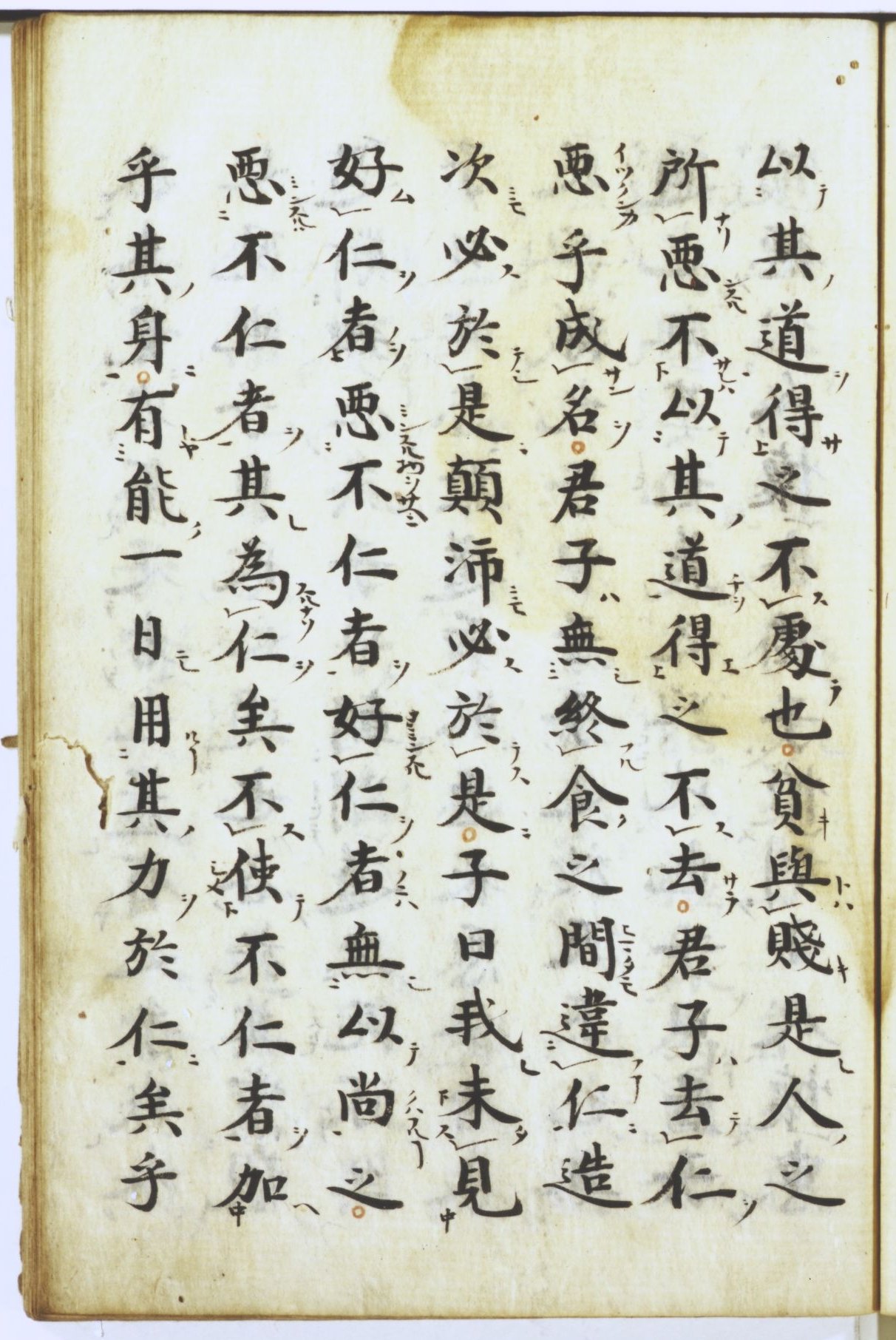
Kyoto University Library RB00007936, IIIF canvas 15, left-hand page: 7 written columns of up to 14 characters, main text only, with Japanese reading marks. Checked on the image: the first column of this book's text on this page begins ‹以其道›, the last begins ‹乎其身›. 4.5.2 begins inside column 2 (the column opens ‹所惡不›), 12 characters down in the received text. Above it the page finishes 4.5.1, shown in the previous section. 4.6.2 runs on to canvas 16, right-hand page (first column ‹我未見›), where the section ends. The Chinese shown is the received text (Wikisource), not a transcription of this manuscript; Legge's English translates the received text.
5.2君子去仁,惡乎成名?
5.3君子無終食之閒違仁,造次必於是,顚沛必於是。」
6.1子曰:「我未見好仁者,惡不仁者。好仁者,無以尙之;惡不仁者,其爲仁矣。不使不仁者加乎其身。
6.2有能一日用其力於仁矣乎?我未見力不足者!
5.2'If a superior man abandon virtue, how can he fulfil the requirements of that name?
5.3'The superior man does not, even for the space of a single meal, act contrary to virtue. In moments of haste, he cleaves to it. In seasons of danger, he cleaves to it.'
6.1The Master said, 'I have not seen a person who loved virtue, or one who hated what was not virtuous. He who loved virtue, would esteem nothing above it. He who hated what is not virtuous, would practise virtue in such a way that he would not allow anything that is not virtuous to approach his person.
6.2'Is any one able for one day to apply his strength to virtue? I have not seen the case in which his strength would be insufficient.
Where on the image
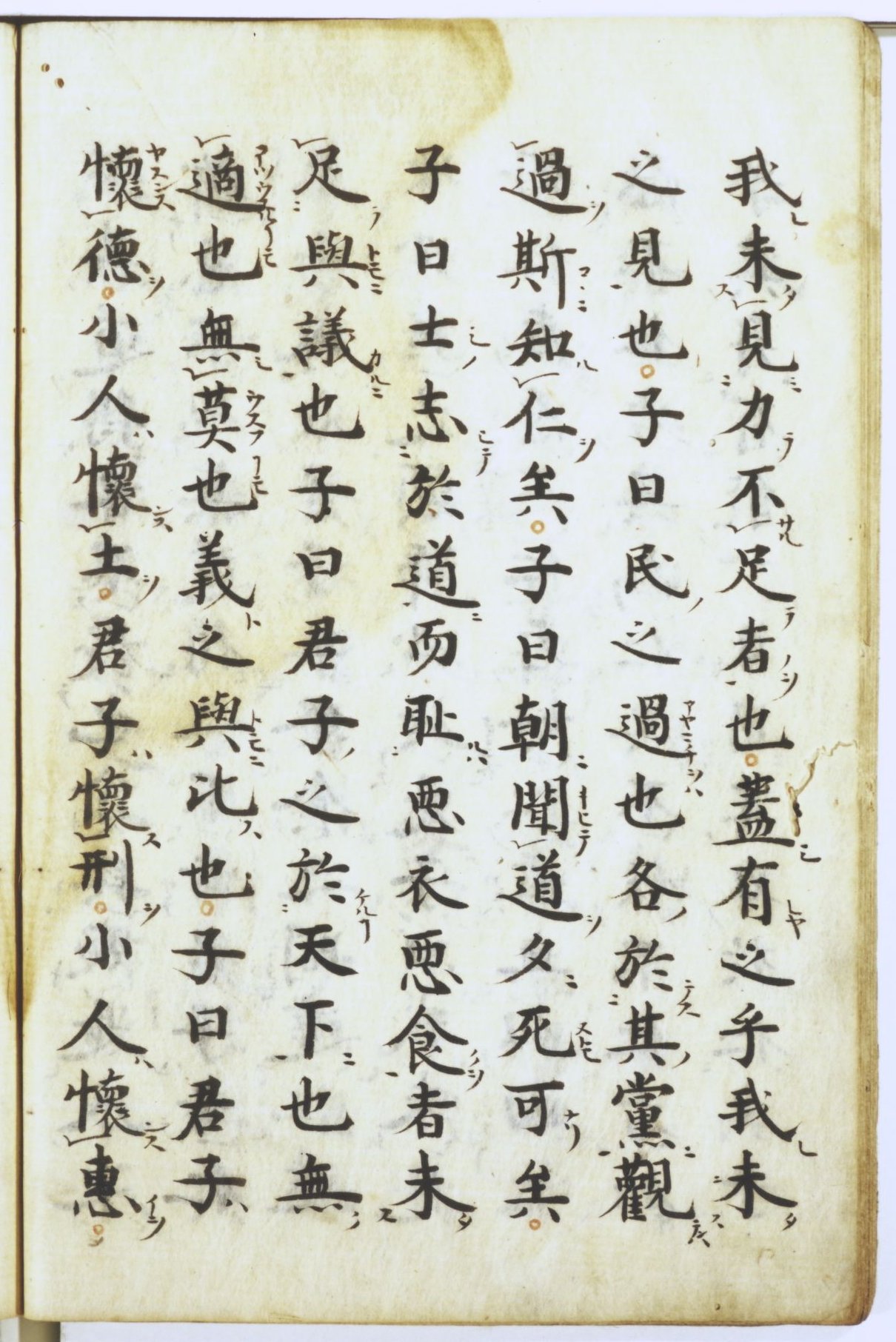
Kyoto University Library RB00007936, IIIF canvas 16, right-hand page: 7 written columns of up to 14 characters, main text only, with Japanese reading marks. Checked on the image: the first column of this book's text on this page begins ‹我未見›, the last begins ‹懷德小›. 4.6.3 begins inside column 1 (the column opens ‹我未見›), 7 characters down in the received text. Above it the page finishes 4.6.2, shown in the previous section. The section ends on this page. The Chinese shown is the received text (Wikisource), not a transcription of this manuscript; Legge's English translates the received text.
6.3蓋有之矣,我未之見也。」
7子曰:「人之過也,各於其黨。觀過,斯知仁矣。」
8子曰:「朝聞道,夕死可矣!」
9子曰:「士志於道,而恥惡衣惡食者,未足與議也!」
10子曰:「君子之於天下也,無適也,無莫也,義之與比。」
11子曰:「君子懷德,小人懷土;君子懷刑,小人懷惠。」
6.3'Should there possibly be any such case, I have not seen it.'
7The Master said, 'The faults of men are characteristic of the class to which they belong. By observing a man's faults, it may be known that he is virtuous.'
8The Master said, 'If a man in the morning hear the right way, he may die in the evening without regret.'
9The Master said, 'A scholar, whose mind is set on truth, and who is ashamed of bad clothes and bad food, is not fit to be discoursed with.'
10The Master said, 'The superior man, in the world, does not set his mind either for anything, or against anything; what is right he will follow.'
11The Master said, 'The superior man thinks of virtue; the small man thinks of comfort. The superior man thinks of the sanctions of law; the small man thinks of favours which he may receive.'
Where on the image
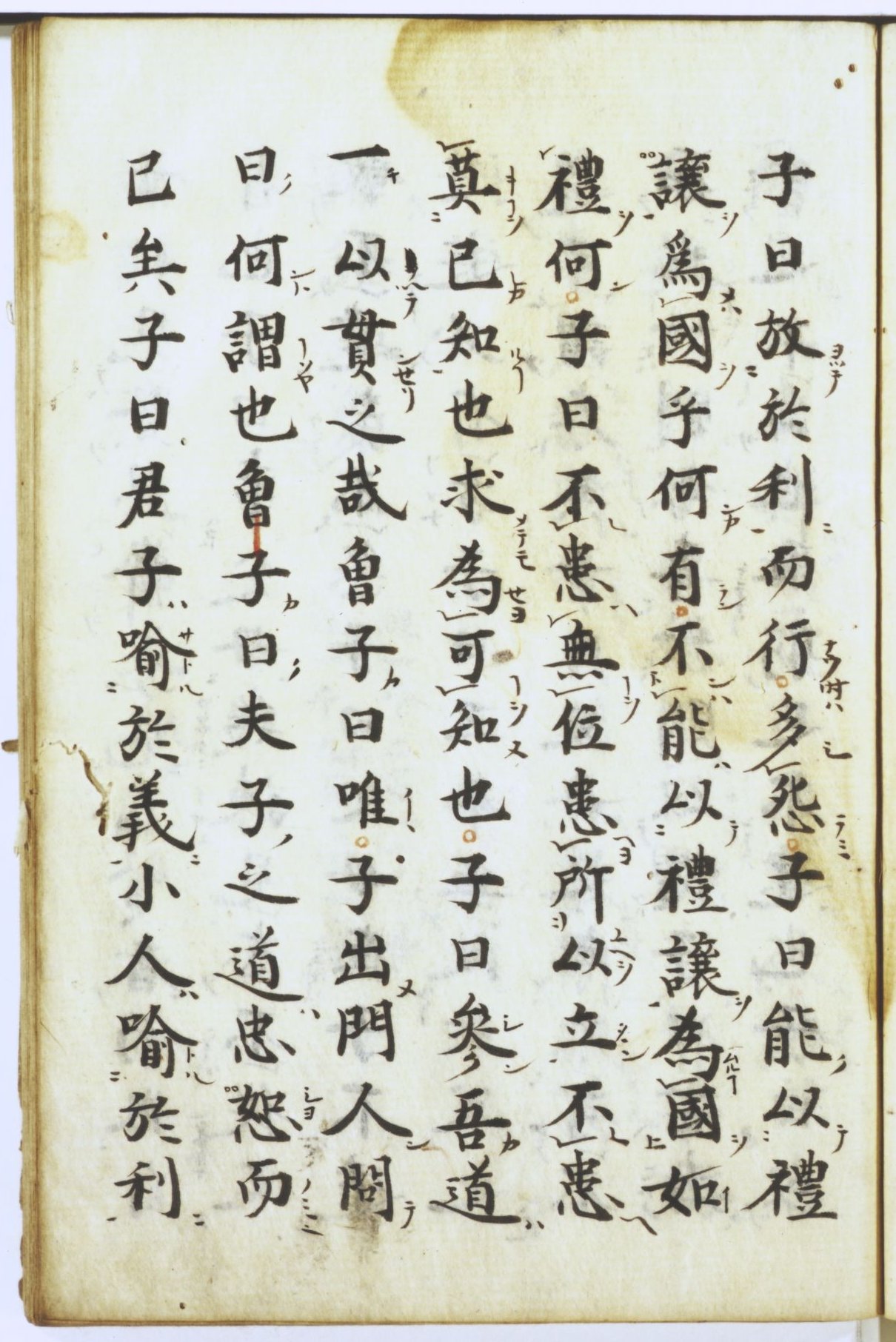
Kyoto University Library RB00007936, IIIF canvas 16, left-hand page: 7 written columns of up to 14 characters, main text only, with Japanese reading marks. Checked on the image: the first column of this book's text on this page begins ‹子曰放›, the last begins ‹已矣子›. 4.12 opens column 1. The section ends on this page. The Chinese shown is the received text (Wikisource), not a transcription of this manuscript; Legge's English translates the received text.
12子曰:「放於利而行,多怨。」
13子曰:「能以禮讓爲國乎,何有?不能以禮讓爲國,如禮何?」
14子曰:「不患無位,患所以立。不患莫己知,求爲可知也。」
15.1子曰:「參乎!吾道一以貫之。」曾子曰:「唯。」
15.2子出,門人問曰:「何謂也?」曾子曰:「夫子之道,忠恕而已矣!」
16子曰:「君子喻於義,小人喻於利。」
12The Master said: 'He who acts with a constant view to his own advantage will be much murmured against.'
13The Master said, 'If a prince is able to govern his kingdom with the complaisance proper to the rules of propriety, what difficulty will he have? If he cannot govern it with that complaisance, what has he to do with the rules of propriety?'
14The Master said, 'A man should say, I am not concerned that I have no place, I am concerned how I may fit myself for one. I am not concerned that I am not known, I seek to be worthy to be known.'
15.1The Master said, 'Shan, my doctrine is that of an all-pervading unity.' The disciple Tsang replied, 'Yes.'
15.2The Master went out, and the other disciples asked, saying, 'What do his words mean?' Tsang said, 'The doctrine of our master is to be true to the principles of our nature and the benevolent exercise of them to others,-- this and nothing more.'
16The Master said, 'The mind of the superior man is conversant with righteousness; the mind of the mean man is conversant with gain.'
Where on the image
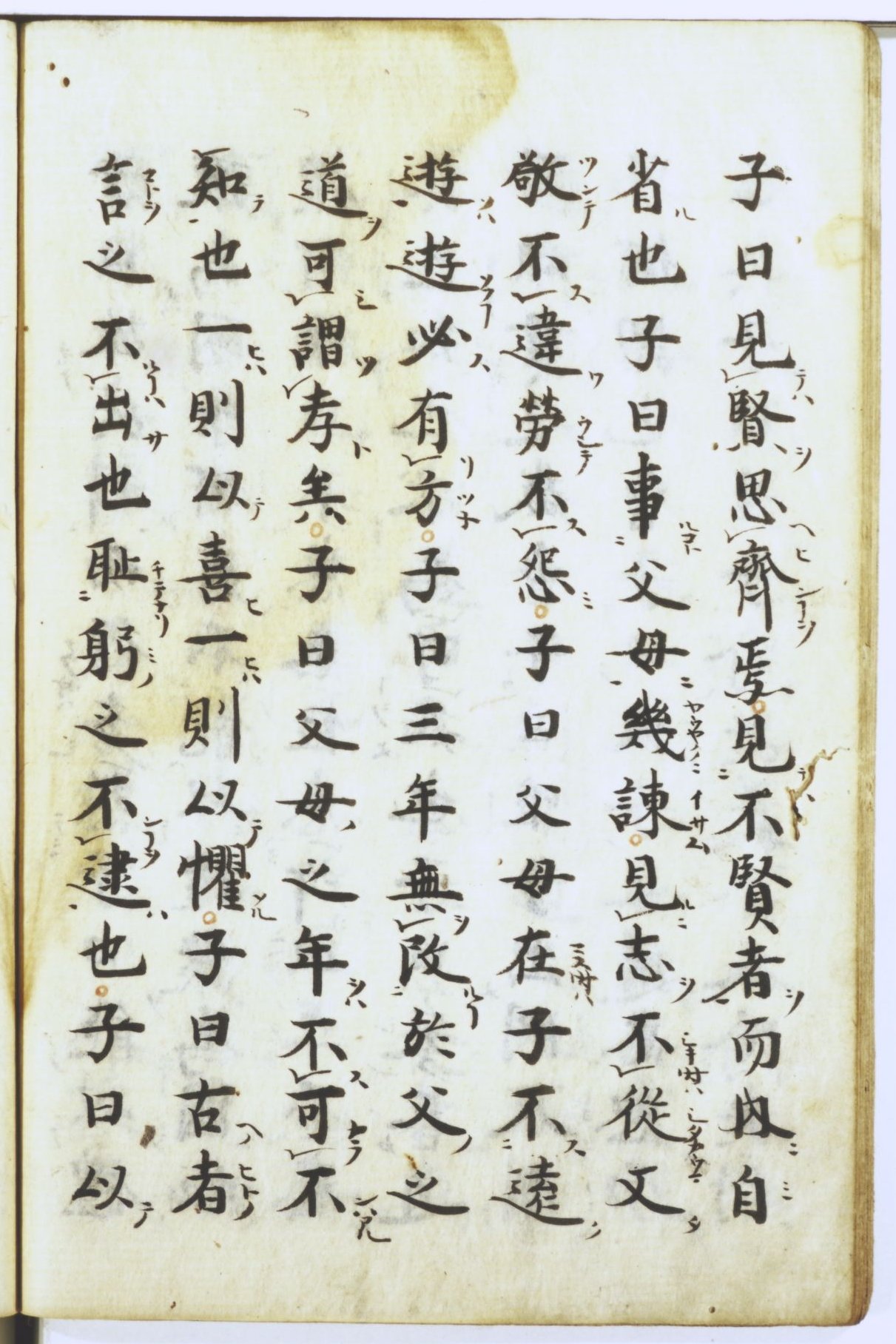
Kyoto University Library RB00007936, IIIF canvas 17, right-hand page: 7 written columns of up to 14 characters, main text only, with Japanese reading marks. Checked on the image: the first column of this book's text on this page begins ‹子曰見›, the last begins ‹言之不›. 4.17 opens column 1. 4.23 runs on to canvas 17, left-hand page (first column ‹約失之›), where the section ends. Column openings on these pages that differ from the received text: ‹敬不違› where the received text has ‹敬而不›. The Chinese shown is the received text (Wikisource), not a transcription of this manuscript; Legge's English translates the received text.
17子曰:「見賢思齊焉,見不賢而內自省也。」
18子曰:「事父母幾諫;見志不從,又敬而不違,勞而不怨。」
19子曰:「父母在,不遠遊;遊必有方。」
20子曰:「三年無改於父之道,可謂孝矣。」
21子曰:「父母之年,不可不知也。一則以喜,一則以懼。」
22子曰:「古者言之不出,恥躬之不逮也。」
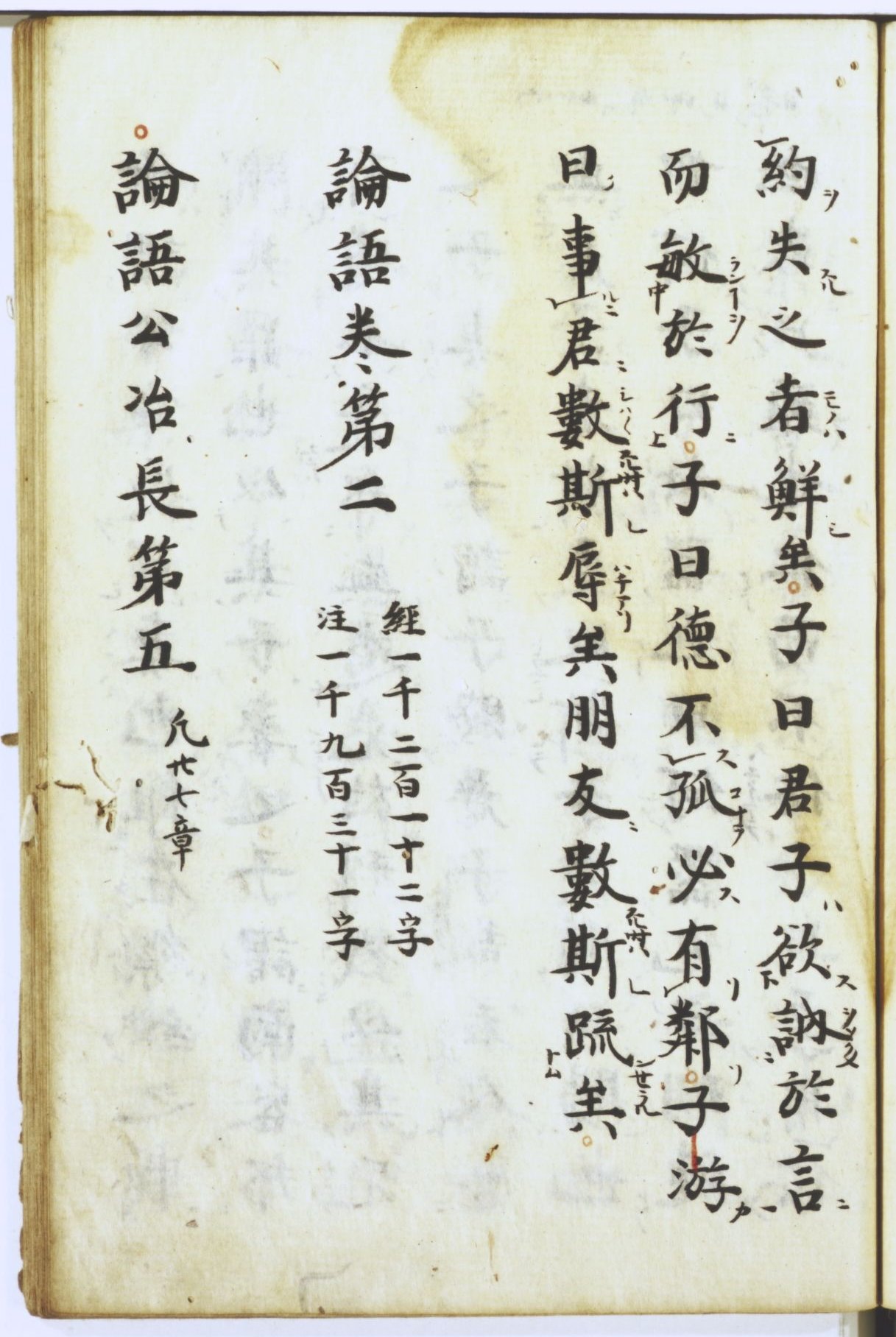
23子曰:「以約失之者,鮮矣。」
17The Master said, 'When we see men of worth, we should think of equalling them; when we see men of a contrary character, we should turn inwards and examine ourselves.'
18The Master said, 'In serving his parents, a son may remonstrate with them, but gently; when he sees that they do not incline to follow his advice, he shows an increased degree of reverence, but does not abandon his purpose; and should they punish him, he does not allow himself to murmur.'
19The Master said, 'While his parents are alive, the son may not go abroad to a distance. If he does go abroad, he must have a fixed place to which he goes.'
20The Master said, 'If the son for three years does not alter from the way of his father, he may be called filial.'
21The Master said, 'The years of parents may by no means not be kept in the memory, as an occasion at once for joy and for fear.'
22The Master said, 'The reason why the ancients did not readily give utterance to their words, was that they feared lest their actions should not come up to them.'
23The Master said, 'The cautious seldom err.'
Where on the image
Kyoto University Library RB00007936, IIIF canvas 17, left-hand page: 5 written columns of up to 14 characters, main text only, with Japanese reading marks. Checked on the image: the first column of this book's text on this page begins ‹約失之›, the last begins ‹曰事君›. Column 5 carries the title 論語卷第二. Column 7 carries the title 論語公冶長第五. 4.24 begins inside column 1 (the column opens ‹約失之›), 6 characters down in the received text. Above it the page finishes 4.23, shown in the previous section. The section ends on this page. The Chinese shown is the received text (Wikisource), not a transcription of this manuscript; Legge's English translates the received text.
24子曰:「君子欲訥於言而敏於行。」
25子曰:「德不孤,必有鄰。」
26子游曰:「事君數,斯辱矣。朋友數,斯疏矣。」
24The Master said, 'The superior man wishes to be slow in his speech and earnest in his conduct.'
25The Master said, 'Virtue is not left to stand alone. He who practises it will have neighbors.'
26Tsze-yu said, 'In serving a prince, frequent remonstrances lead to disgrace. Between friends, frequent reproofs make the friendship distant.'
Notes
- English: James Legge, Confucian Analects, The Chinese Classics vol. 1. Legge's chapter and paragraph numbers are kept as superscripts (chapter.paragraph).
- Legge translated the received text. Where this manuscript's wording differs, his English follows the received text shown here.
Cite
Sources
- Source: Kyoto University Library RB00007936 (Analects manuscript attributed to Kiyohara Yoshieda, c. 1300) + Wikisource received text + James Legge's English (Project Gutenberg) (holding institution)
- Critical edition: Received text (Wikisource) in Legge's chapter and paragraph division
← previous · → next · v cycle view · l back to library