Analects, Book 5: Gongye Chang 公冶長 (Kamakura-period manuscript)
Introduction
Book 5 of the Analects (論語 Lunyu), titled 公冶長 (Gongye Chang) after its opening words, 27 chapters in Legge's division. It is shown on a manuscript of the Analects in the Kiyohara family collection (Seike bunko) of Kyoto University Library, two volumes in regular script, seven columns of fourteen characters to the page, main text only, with red and black Japanese reading marks. A colophon by Kiyohara Edakata dated 1550 names the copyist as his ancestor Kiyohara Yoshieda (1253-1331), which places the copy around 1300, in the late Kamakura period; the attribution is traditional. The Kiyohara were hereditary readers of the Confucian classics at the Japanese court, and their text descends from the edition of the Analects with the collected commentary of He Yan (3rd century CE): after each pair of books the scribe copied the character counts of the classic and of the commentary, although only the classic is written out. The manuscript is an Important Cultural Property of Japan.
In this copy Book 5 runs from canvas 18, right-hand page to canvas 22, right-hand page (volume 1). Each section gathers the paragraphs that begin on one page, numbered by chapter and paragraph as in Legge, and links to that page and to any page the last paragraph runs onto. The page boundaries were found by reading the first characters of every column on the photographs. The Chinese shown is the received text, from Wikisource. This manuscript differs from it in places, most often by an added or missing particle (也, 矣, 焉) or a variant character form; the differences seen at column openings are listed in the scan notes. The English is James Legge's translation of the received text.
How was this verified? (Provenance)
Where on the image
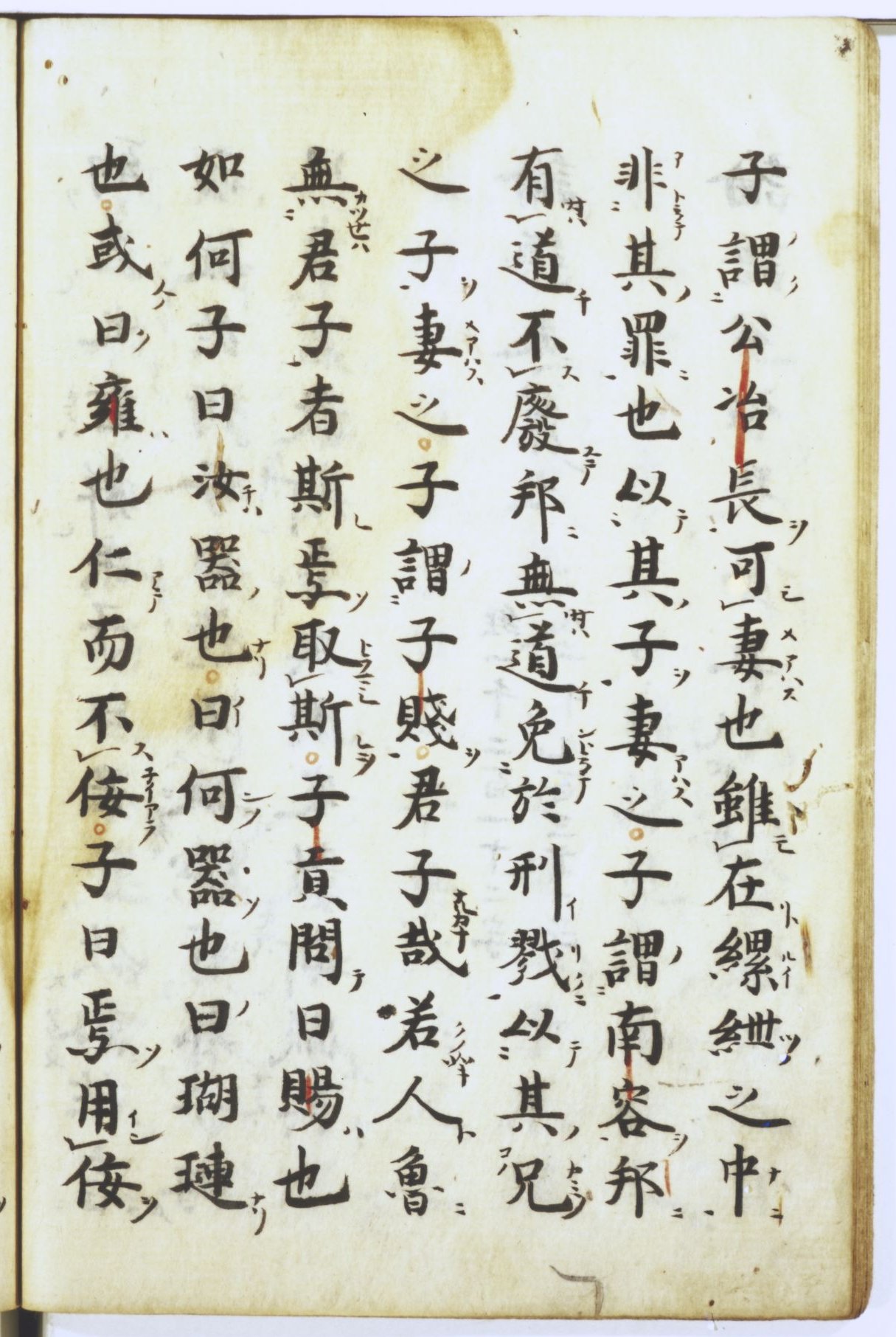
Kyoto University Library RB00007936, IIIF canvas 18, right-hand page: 7 written columns of up to 14 characters, main text only, with Japanese reading marks. Checked on the image: the first column of this book's text on this page begins ‹子謂公›, the last begins ‹也或曰›. The book title stands in the last written column of the facing canvas 17, left-hand page. 5.1.1 opens column 1. 5.4.2 runs on to canvas 18, left-hand page (first column ‹也禦人›), where the section ends. Column openings on these pages that differ from the received text: ‹如何子› where the received text has ‹如子曰›; ‹也禦人› where the received text has ‹禦人以›; ‹用佞也› where the received text has ‹用佞子›. The Chinese shown is the received text (Wikisource), not a transcription of this manuscript; Legge's English translates the received text.
1.1子謂公冶長,「可妻也;雖在縲絏之中,非其罪也。」以其子妻之。
1.2子謂南容,「邦有道,不廢;邦無道,免於刑戮。」以其兄之子妻之。
2子謂子賤:「君子哉若人!魯無君子者,斯焉取斯?」
3子貢問曰:「賜也何如?」子曰:「女器也」。曰:「何器也?」曰:「瑚璉也。」
4.1或曰:「雍也,仁而不佞。」
4.2子曰:「焉用佞?禦人以口給,屢憎於人。不知其仁;焉用佞?」
1.1The Master said of Kung-ye Ch'ang that he might be wived; although he was put in bonds, he had not been guilty of any crime. Accordingly, he gave him his own daughter to wife.
1.2Of Nan Yung he said that if the country were well governed he would not be out of office, and if it were ill-governed, he would escape punishment and disgrace. He gave him the daughter of his own elder brother to wife.
2The Master said of Tsze-chien, 'Of superior virtue indeed is such a man! If there were not virtuous men in Lu, how could this man have acquired this character?'
3Tsze-kung asked, 'What do you say of me, Ts'ze? The Master said, 'You are a utensil.' 'What utensil?' 'A gemmed sacrificial utensil.'
4.1Some one said, 'Yung is truly virtuous, but he is not ready with his tongue.'
4.2The Master said, 'What is the good of being ready with the tongue? They who encounter men with smartnesses of speech for the most part procure themselves hatred. I know not whether he be truly virtuous, but why should he show readiness of the tongue?'
Where on the image
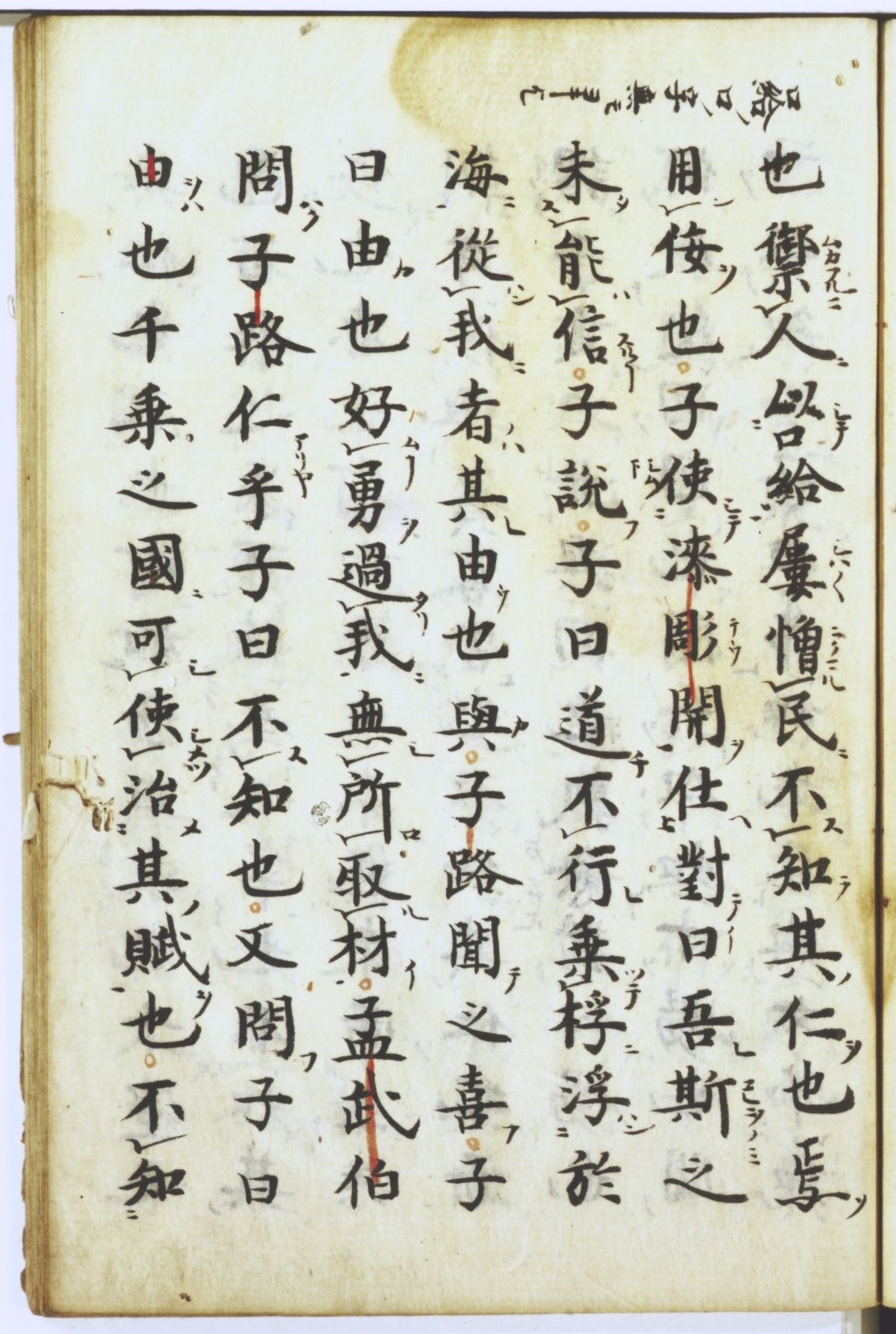
Kyoto University Library RB00007936, IIIF canvas 18, left-hand page: 7 written columns of up to 14 characters, main text only, with Japanese reading marks. Checked on the image: the first column of this book's text on this page begins ‹也禦人›, the last begins ‹由也千›. 5.5 begins inside column 2 (the column opens ‹用佞也›), 2 characters down in the received text. Above it the page finishes 5.4.2, shown in the previous section. 5.7.2 runs on to canvas 19, right-hand page (first column ‹其仁也›), where the section ends. The Chinese shown is the received text (Wikisource), not a transcription of this manuscript; Legge's English translates the received text.
5子使漆雕開仕。對曰:「吾斯之未能信。」子說。
6子曰:「道不行,乘桴浮於海,從我者,其由與?」子路聞之喜。子曰:「由也,好勇過我,無所取材。」
7.1孟武伯問:「子路仁乎?」子曰:「不知也。」
7.2又問,子曰:「由也,千乘之國,可使治其賦也;不知其仁也。」
5The Master was wishing Ch'i-tiao K'ai to enter on official employment. He replied, 'I am not yet able to rest in the assurance of THIS.' The Master was pleased.
6The Master said, 'My doctrines make no way. I will get upon a raft, and float about on the sea. He that will accompany me will be Yu, I dare say.' Tsze-lu hearing this was glad, upon which the Master said, 'Yu is fonder of daring than I am. He does not exercise his judgment upon matters.'
7.1Mang Wu asked about Tsze-lu, whether he was perfectly virtuous. The Master said, 'I do not know.'
7.2He asked again, when the Master replied, 'In a kingdom of a thousand chariots, Yu might be employed to manage the military levies, but I do not know whether he be perfectly virtuous.'
Where on the image
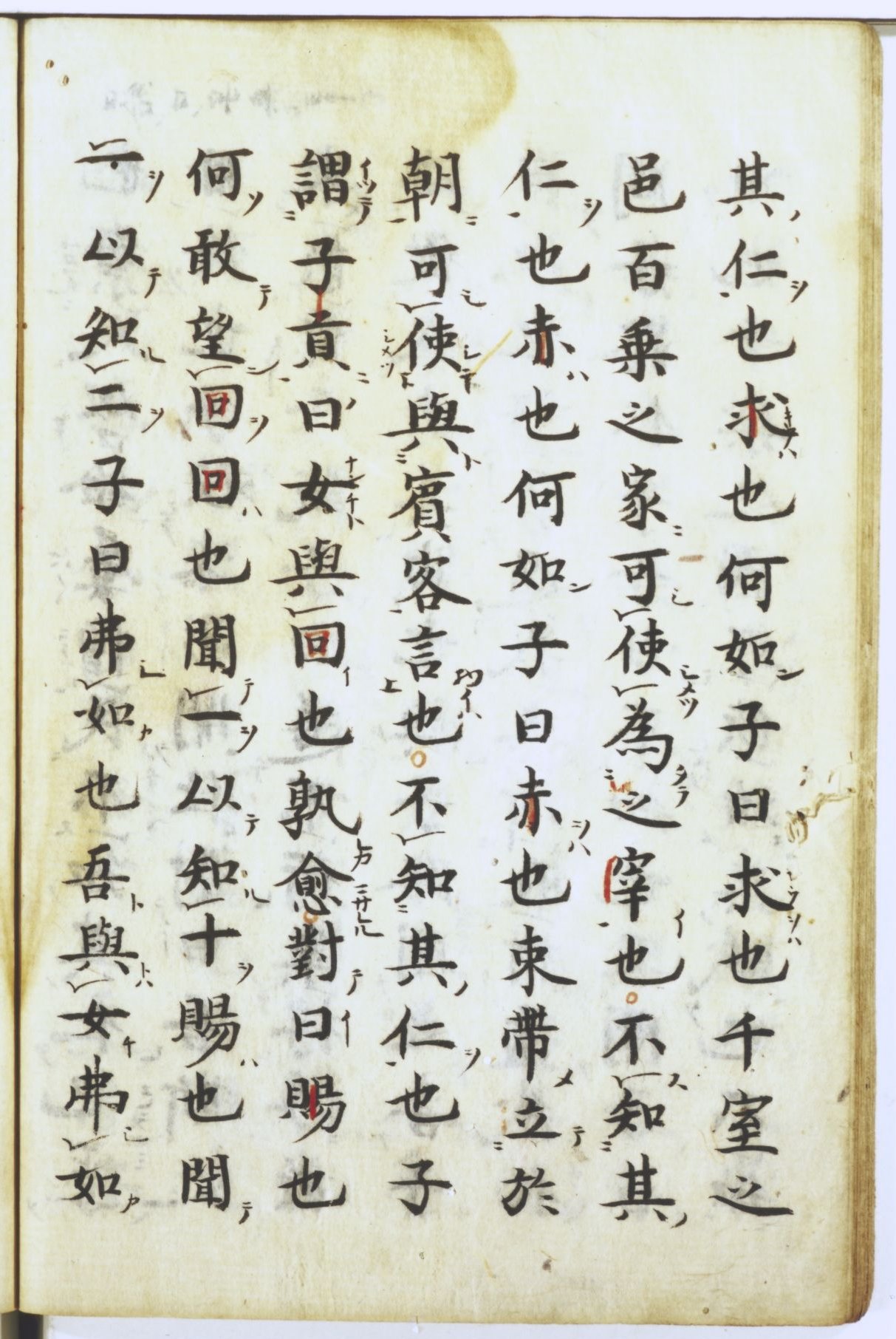
Kyoto University Library RB00007936, IIIF canvas 19, right-hand page: 7 written columns of up to 14 characters, main text only, with Japanese reading marks. Checked on the image: the first column of this book's text on this page begins ‹其仁也›, the last begins ‹一以知›. 5.7.3 begins inside column 1 (the column opens ‹其仁也›), 3 characters down in the received text. Above it the page finishes 5.7.2, shown in the previous section. 5.8.3 runs on to canvas 19, left-hand page (first column ‹也宰予›), where the section ends. The Chinese shown is the received text (Wikisource), not a transcription of this manuscript; Legge's English translates the received text.
7.3「求也何如?」子曰:「求也,千室之邑,百乘之家,可使爲之宰也;不知其仁也。」
7.4「赤也何如?」子曰:「赤也,束帶立於朝,可使與賓客言也;不知其仁也。」
8.1子謂子貢曰:「女與回也孰愈?」
8.2對曰:「賜也何敢望回!回也聞一以知十,賜也聞一以知二。」
8.3子曰:「弗如也。吾與女,弗如也。」
7.3'And what do you say of Ch'iu?' The Master replied, 'In a city of a thousand families, or a clan of a hundred chariots, Ch'iu might be employed as governor, but I do not know whether he is perfectly virtuous.'
7.4'What do you say of Ch'ih?' The Master replied, 'With his sash girt and standing in a court, Ch'ih might be employed to converse with the visitors and guests, but I do not know whether he is perfectly virtuous.'
8.1The Master said to Tsze-kung, 'Which do you consider superior, yourself or Hui?'
8.2Tsze-kung replied, 'How dare I compare myself with Hui? Hui hears one point and knows all about a subject; I hear one point, and know a second.'
8.3The Master said, 'You are not equal to him. I grant you, you are not equal to him.'
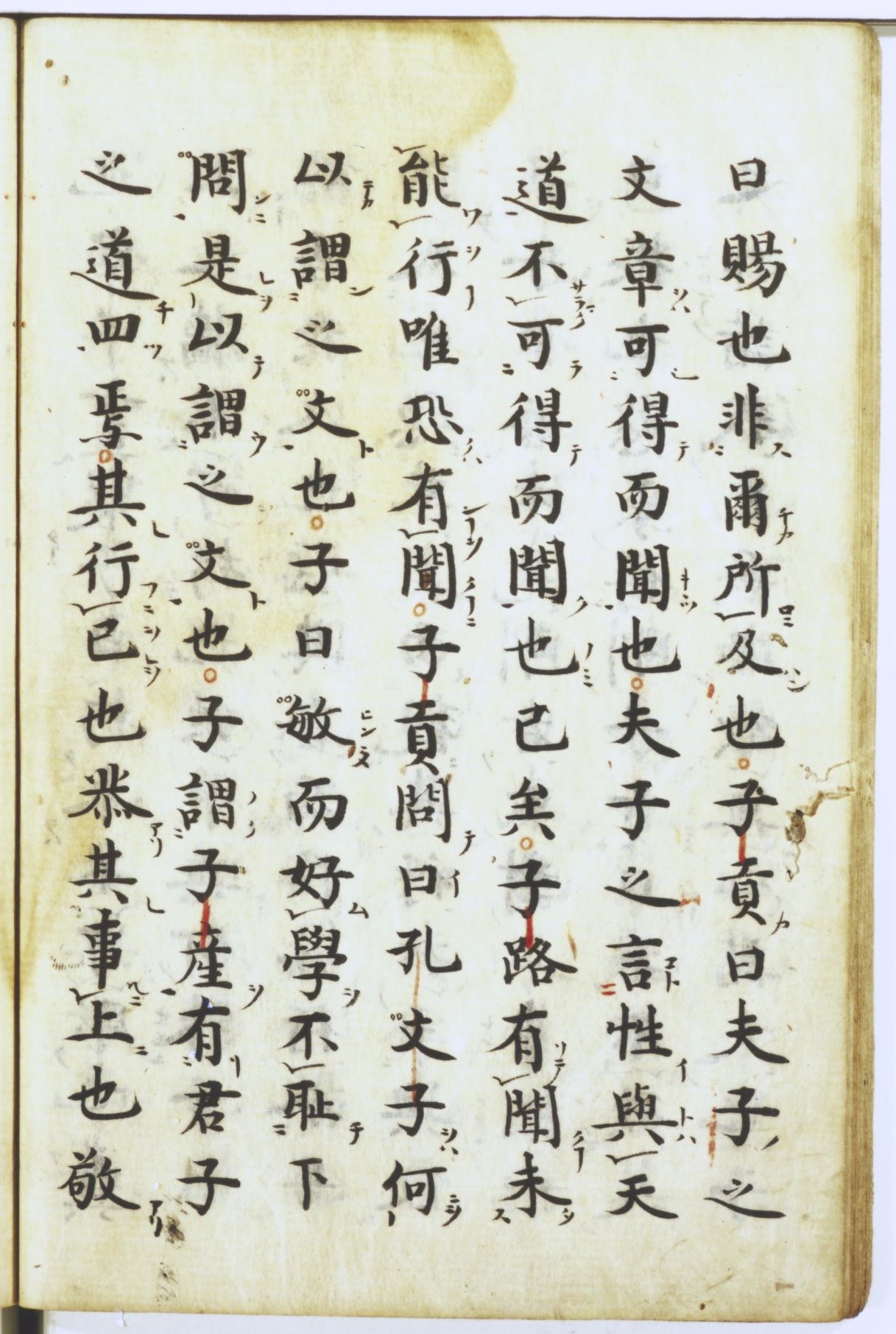
Where on the image
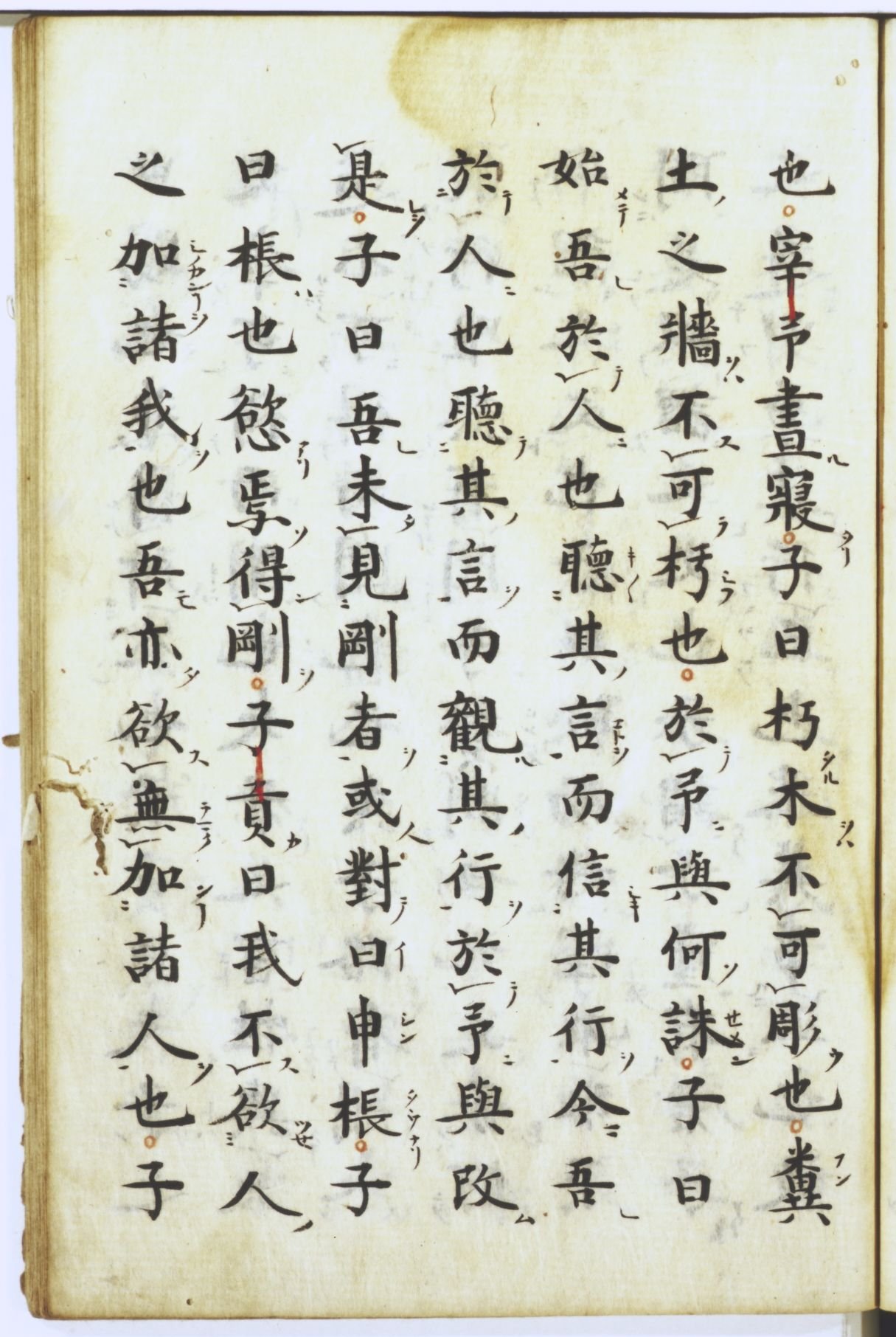
Kyoto University Library RB00007936, IIIF canvas 19, left-hand page: 7 written columns of up to 14 characters, main text only, with Japanese reading marks. Checked on the image: the first column of this book's text on this page begins ‹也宰予›, the last begins ‹之加諸›. 5.9.1 begins inside column 1 (the column opens ‹也宰予›), 1 characters down in the received text. Above it the page finishes 5.8.3, shown in the previous section. 5.11 runs on to canvas 20, right-hand page (first column ‹曰賜也›), where the section ends. The Chinese shown is the received text (Wikisource), not a transcription of this manuscript; Legge's English translates the received text.
9.1宰予晝寢。子曰:「朽木不可雕也,糞土之牆,不可杇也;於予與何誅!」
9.2子曰:「始吾於人也,聽其言而信其行;今吾於人也,聽其言而觀其行;於予與改是。」
10子曰:「吾未見剛者。」或對曰:「申棖。」子曰:「棖也慾!焉得剛?」
11子貢曰:「我不欲人之加諸我也,吾亦欲無加諸人。」子曰:「賜也,非爾所及也!」
9.1Tsai Yu being asleep during the daytime, the Master said, 'Rotten wood cannot be carved; a wall of dirty earth will not receive the trowel. This Yu!-- what is the use of my reproving him?'
9.2The Master said, 'At first, my way with men was to hear their words, and give them credit for their conduct. Now my way is to hear their words, and look at their conduct. It is from Yu that I have learned to make this change.'
10The Master said, 'I have not seen a firm and unbending man.' Some one replied, 'There is Shan Ch'ang.' 'Ch'ang,' said the Master, 'is under the influence of his passions; how can he be pronounced firm and unbending?'
11Tsze-kung said, 'What I do not wish men to do to me, I also wish not to do to men.' The Master said, 'Ts'ze, you have not attained to that.'
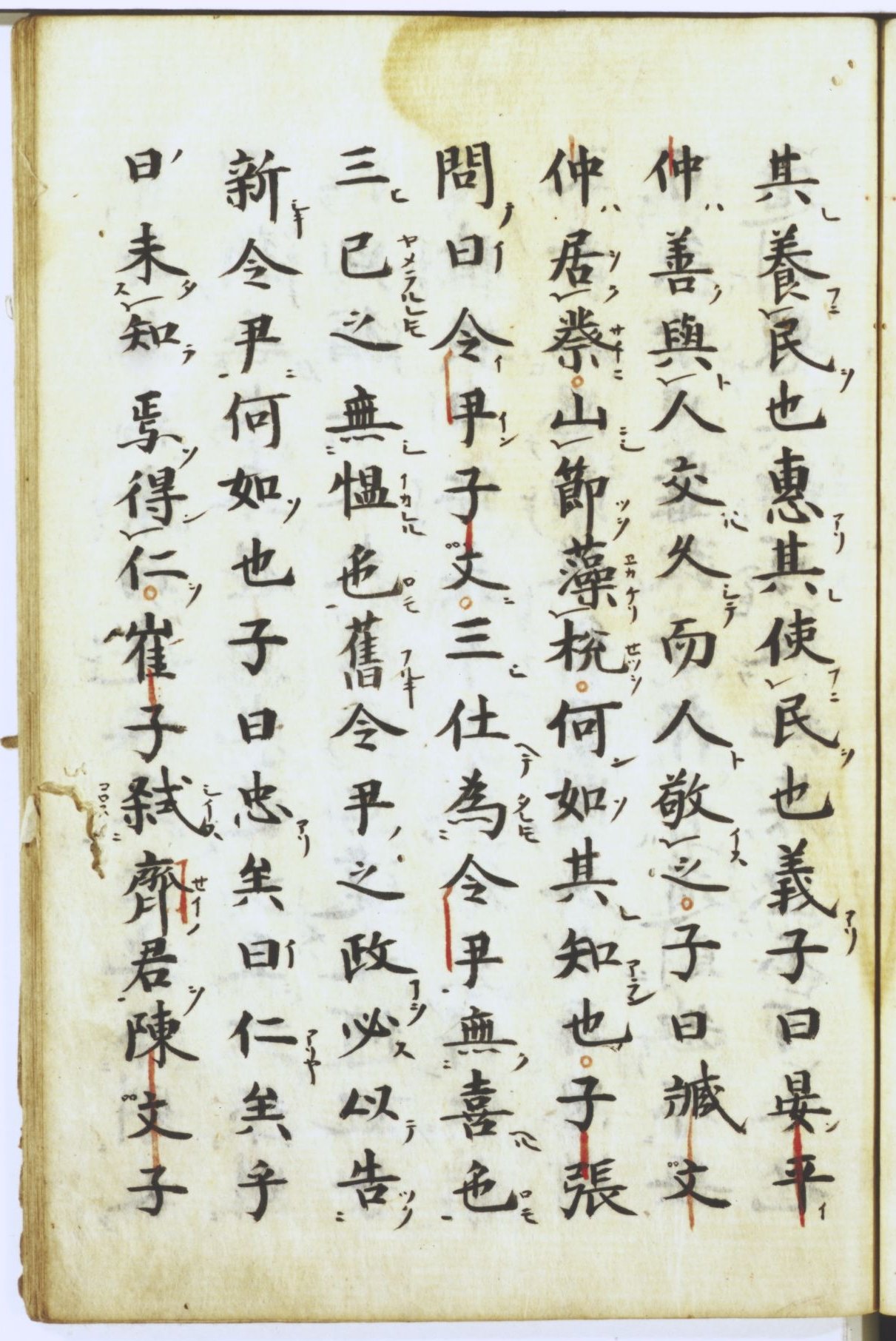
Where on the image
Kyoto University Library RB00007936, IIIF canvas 20, right-hand page: 7 written columns of up to 14 characters, main text only, with Japanese reading marks. Checked on the image: the first column of this book's text on this page begins ‹曰賜也›, the last begins ‹之道四›. 5.12 begins inside column 1 (the column opens ‹曰賜也›), 8 characters down in the received text. Above it the page finishes 5.11, shown in the previous section. 5.15 runs on to canvas 20, left-hand page (first column ‹其養民›), where the section ends. The Chinese shown is the received text (Wikisource), not a transcription of this manuscript; Legge's English translates the received text.
12子貢曰:「夫子之文章,可得而聞也;夫子之言性與天道,不可得而聞也。」
13子路有聞,未之能行,唯恐有聞。
14子貢問曰:「孔文子,何以謂之文也?」子曰:「敏而好學,不恥下問,是以謂之文也。」
15子謂子產:「有君子之道四焉:其行己也恭,其事上也敬,其養民也惠,其使民也義。」
12Tsze-kung said, 'The Master's personal displays of his principles and ordinary descriptions of them may be heard. His discourses about man's nature, and the way of Heaven, cannot be heard.'
13When Tsze-lu heard anything, if he had not yet succeeded in carrying it into practice, he was only afraid lest he should hear something else.
14Tsze-kung asked, saying, 'On what ground did Kung-wan get that title of Wan?' The Master said, 'He was of an active nature and yet fond of learning, and he was not ashamed to ask and learn of his inferiors!-- On these grounds he has been styled Wan.'
15The Master said of Tsze-ch'an that he had four of the characteristics of a superior man:-- in his conduct of himself, he was humble; in serving his superiors, he was respectful; in nourishing the people, he was kind; in ordering the people, he was just.'
Where on the image
Kyoto University Library RB00007936, IIIF canvas 20, left-hand page: 7 written columns of up to 14 characters, main text only, with Japanese reading marks. Checked on the image: the first column of this book's text on this page begins ‹其養民›, the last begins ‹曰未知›. 5.16 begins inside column 1 (the column opens ‹其養民›), 10 characters down in the received text. Above it the page finishes 5.15, shown in the previous section. 5.18.2 runs on to canvas 21, right-hand page (first column ‹有馬十›), where the section ends. The Chinese shown is the received text (Wikisource), not a transcription of this manuscript; Legge's English translates the received text.
16子曰:「晏平仲善與人交,久而敬之。」
17子曰:「臧文仲居蔡,山節藻梲。何如其知也?」
18.1子張問曰:「令尹子文,三仕爲令尹,無喜色;三已之,無慍色。舊令尹之政,必以吿新令尹。何如?」子曰:「忠矣。」曰:「仁矣乎?」曰:「未知,焉得仁?」
18.2「崔子弒齊君,陳文子有馬十乘,棄而違之,至於他邦,則曰:『猶吾大夫崔子也!』違之,之一邦,則又曰:『猶吾大夫崔子也!』違之。何如?」子曰:「淸矣。」曰:「仁矣乎?」曰:「未知,焉得仁?」
16The Master said, 'Yen P'ing knew well how to maintain friendly intercourse. The acquaintance might be long, but he showed the same respect as at first.'
17The Master said, 'Tsang Wan kept a large tortoise in a house, on the capitals of the pillars of which he had hills made, and with representations of duckweed on the small pillars above the beams supporting the rafters.-- Of what sort was his wisdom?'
18.1Tsze-chang asked, saying, 'The minister Tsze- wan thrice took office, and manifested no joy in his countenance. Thrice he retired from office, and manifested no displeasure. He made it a point to inform the new minister of the way in which he had conducted the government;-- what do you say of him?' The Master replied. 'He was loyal.' 'Was he perfectly virtuous?' 'I do not know. How can he be pronounced perfectly virtuous?'
18.2Tsze-chang proceeded, 'When the officer Ch'ui killed the prince of Ch'i, Ch'an Wan, though he was the owner of forty horses, abandoned them and left the country. Coming to another State, he said, "They are here like our great officer, Ch'ui," and left it. He came to a second State, and with the same observation left it also;-- what do you say of him?' The Master replied, 'He was pure.' 'Was he perfectly virtuous?' 'I do not know. How can he be pronounced perfectly virtuous?'
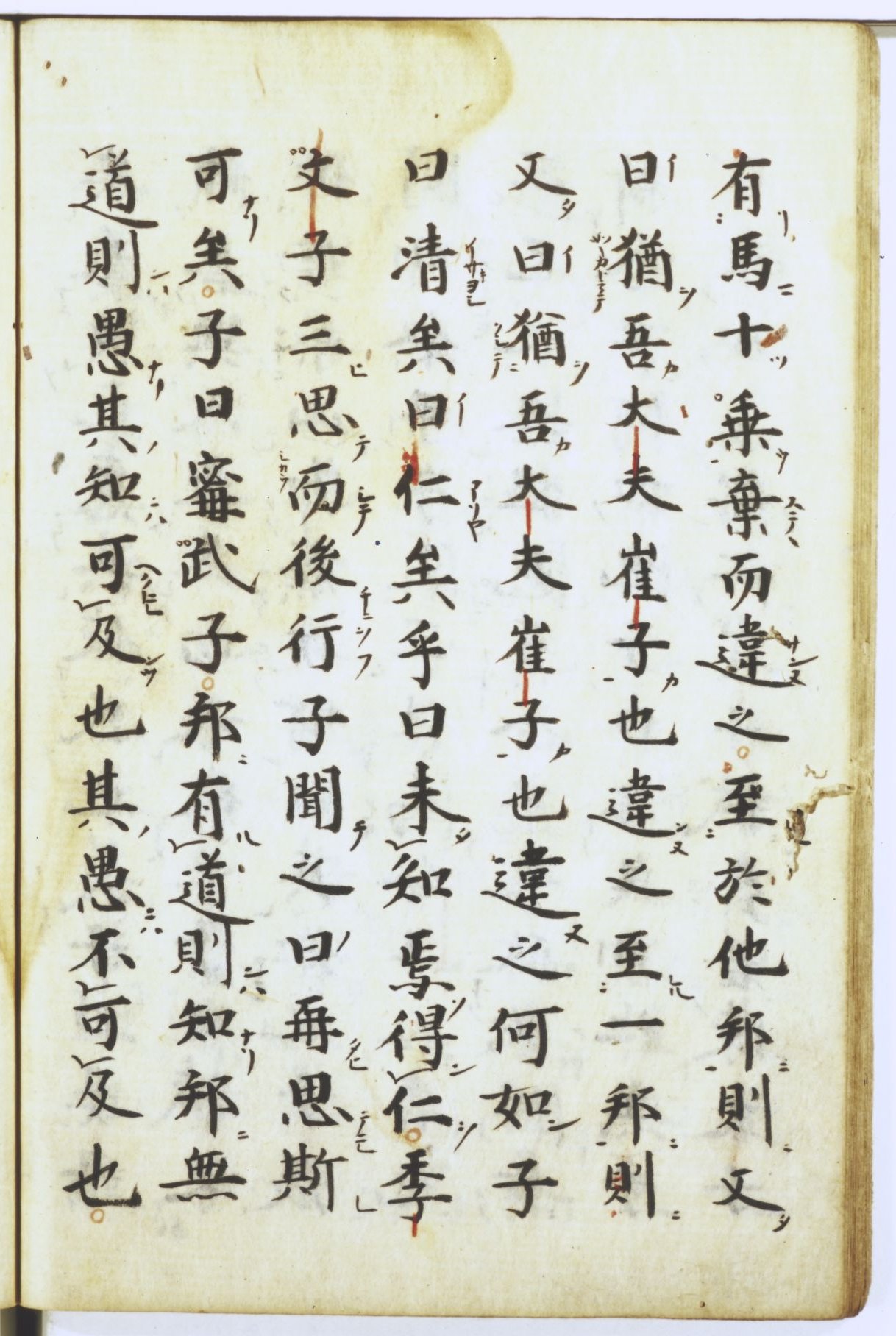
Where on the image
Kyoto University Library RB00007936, IIIF canvas 21, right-hand page: 7 written columns of up to 14 characters, main text only, with Japanese reading marks. Checked on the image: the first column of this book's text on this page begins ‹有馬十›, the last begins ‹道則愚›. 5.19 begins inside column 4 (the column opens ‹曰清矣›), 13 characters down in the received text. Above it the page finishes 5.18.2, shown in the previous section. The section ends on this page. The Chinese shown is the received text (Wikisource), not a transcription of this manuscript; Legge's English translates the received text.
19季文子三思而後行。子聞之曰:「再,斯可矣!」
20子曰:「甯武子,邦有道則知;邦無道則愚。其知可及也,其愚不可及也。」
19Chi Wan thought thrice, and then acted. When the Master was informed of it, he said, 'Twice may do.'
20The Master said, 'When good order prevailed in his country, Ning Wu acted the part of a wise man. When his country was in disorder, he acted the part of a stupid man. Others may equal his wisdom, but they cannot equal his stupidity.'
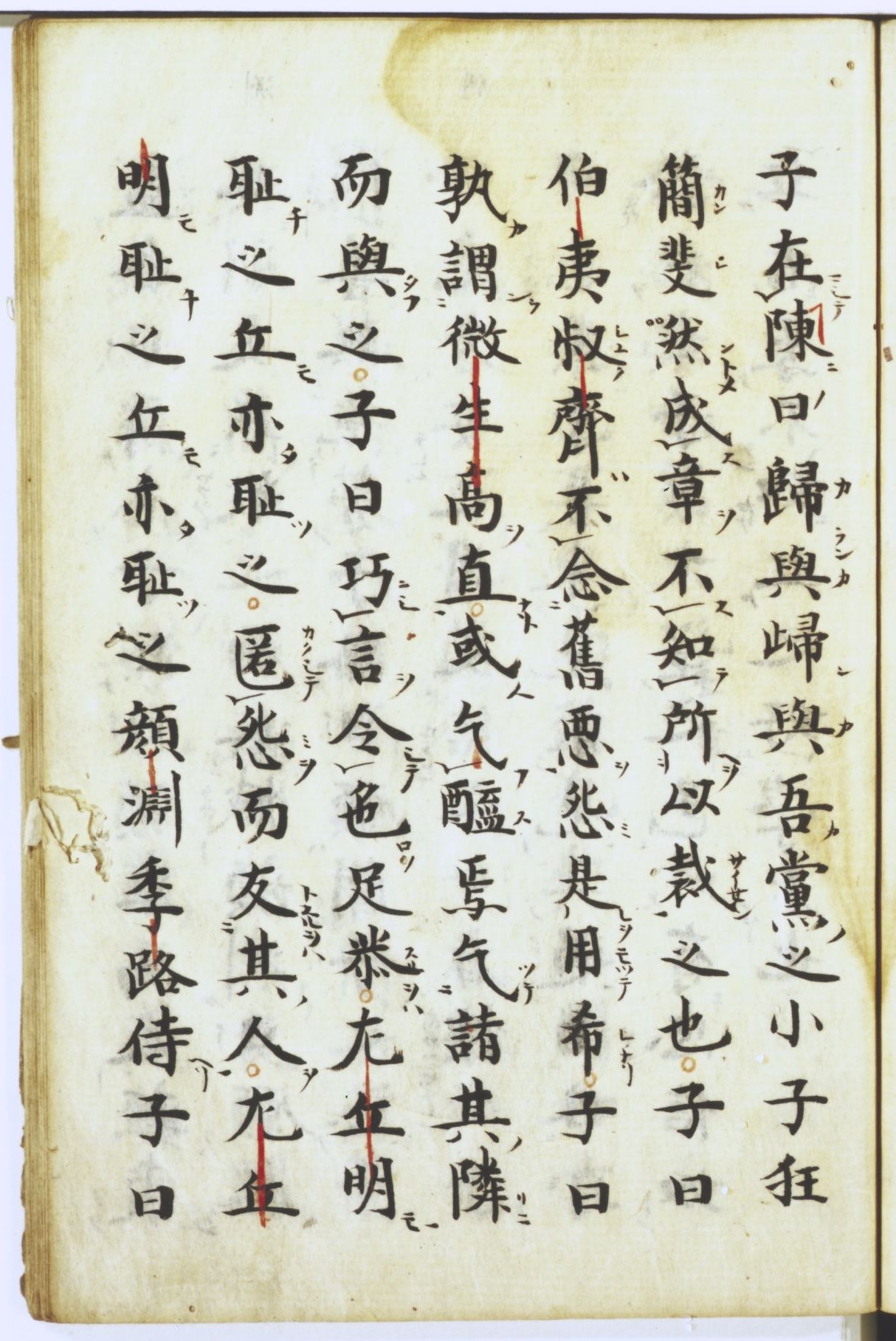
Where on the image
Kyoto University Library RB00007936, IIIF canvas 21, left-hand page: 7 written columns of up to 14 characters, main text only, with Japanese reading marks. Checked on the image: the first column of this book's text on this page begins ‹子在陳›, the last begins ‹明恥之›. 5.21 opens column 1. 5.25.1 runs on to canvas 22, right-hand page (first column ‹盍各曰›), where the section ends. Column openings on these pages that differ from the received text: ‹盍各曰› where the received text has ‹盍各言›. The Chinese shown is the received text (Wikisource), not a transcription of this manuscript; Legge's English translates the received text.
21子在陳,曰:「歸與!歸與!吾黨之小子狂簡,斐然成章,不知所以裁之。」
22子曰:「伯夷、叔齊,不念舊惡,怨是用希。」
23子曰:「孰謂微生高直?或乞醯焉,乞諸其鄰而與之。」
24子曰:「巧言、令色、足恭,左丘明恥之,丘亦恥之。匿怨而友其人,左丘明恥之,丘亦恥之。」
25.1顏淵、季路侍。子曰:「盍各言爾志?」
21When the Master was in Ch'an, he said, 'Let me return! Let me return! The little children of my school are ambitious and too hasty. They are accomplished and complete so far, but they do not know how to restrict and shape themselves.'
22The Master said, 'Po-i and Shu-ch'i did not keep the former wickednesses of men in mind, and hence the resentments directed towards them were few.'
23The Master said, 'Who says of Wei-shang Kao that he is upright? One begged some vinegar of him, and he begged it of a neighbor and gave it to the man.'
24The Master said, 'Fine words, an insinuating appearance, and excessive respect;-- Tso Ch'iu-ming was ashamed of them. I also am ashamed of them. To conceal resentment against a person, and appear friendly with him;-- Tso Ch'iu-ming was ashamed of such conduct. I also am ashamed of it.'
25.1Yen Yuan and Chi Lu being by his side, the Master said to them, 'Come, let each of you tell his wishes.'
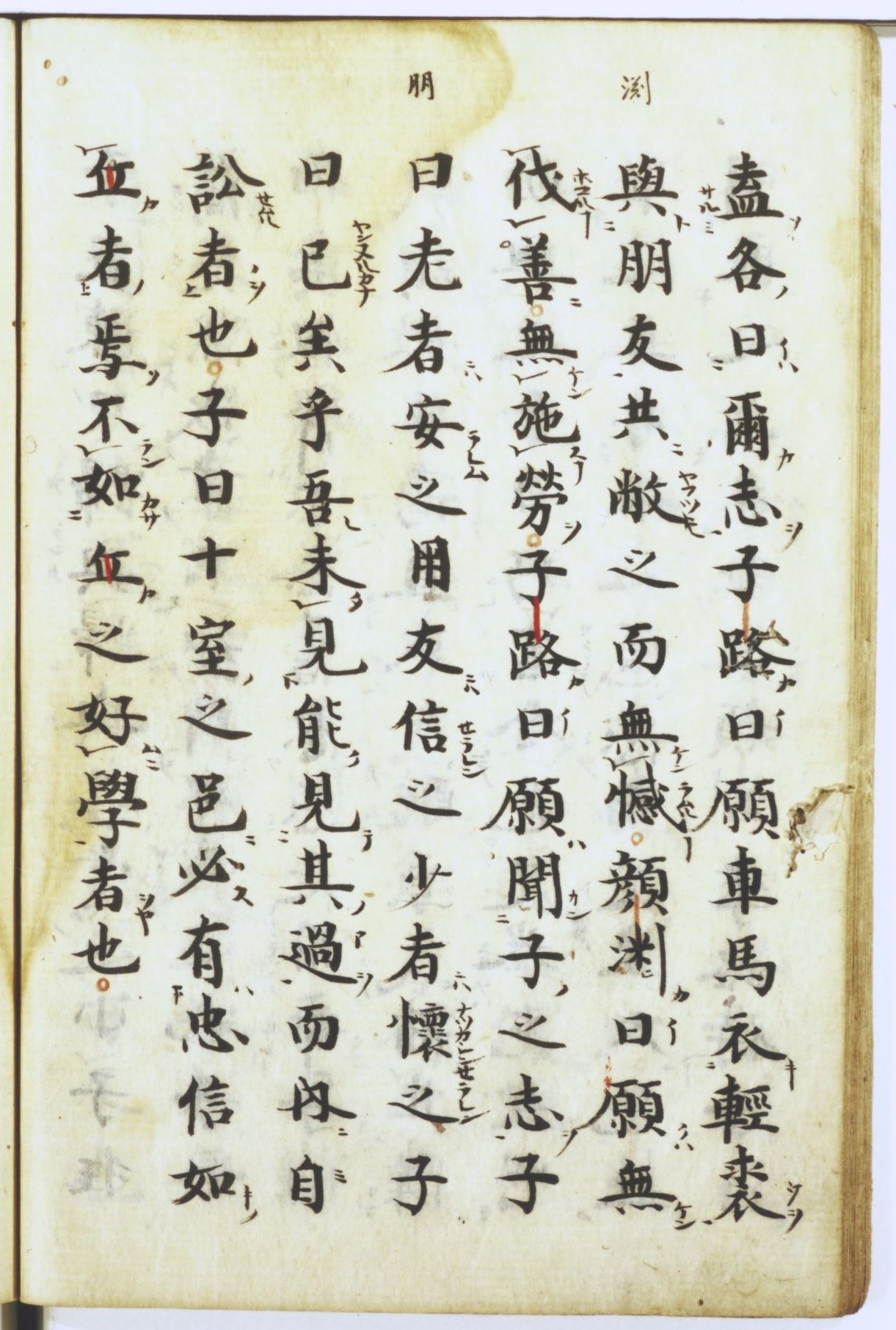
Where on the image
Kyoto University Library RB00007936, IIIF canvas 22, right-hand page: 7 written columns of up to 14 characters, main text only, with Japanese reading marks. Checked on the image: the first column of this book's text on this page begins ‹盍各曰›, the last begins ‹丘者焉›. 5.25.2 begins inside column 1 (the column opens ‹盍各曰›), 5 characters down in the received text. Above it the page finishes 5.25.1, shown in the previous section. The section ends on this page. The Chinese shown is the received text (Wikisource), not a transcription of this manuscript; Legge's English translates the received text.
25.2子路曰:「願車馬衣輕裘,與朋友共,敝之而無憾。」
25.3顏淵曰:「願無伐善,無施勞。」
25.4子路曰:「願聞子之志。」子曰:「老者安之,朋友信之,少者懷之。」
26子曰:「已矣乎!吾未見能見其過,而內自訟者也。」
27子曰:「十室之邑,必有忠信如丘者焉,不如丘之好學也。」
25.2Tsze-lu said, 'I should like, having chariots and horses, and light fur dresses, to share them with my friends, and though they should spoil them, I would not be displeased.'
25.3Yen Yuan said, 'I should like not to boast of my excellence, nor to make a display of my meritorious deeds.'
25.4Tsze-lu then said, 'I should like, sir, to hear your wishes.' The Master said, 'They are, in regard to the aged, to give them rest; in regard to friends, to show them sincerity; in regard to the young, to treat them tenderly.'
26The Master said, 'It is all over! I have not yet seen one who could perceive his faults, and inwardly accuse himself.'
27The Master said, 'In a hamlet of ten families, there may be found one honourable and sincere as I am, but not so fond of learning.'
Notes
- English: James Legge, Confucian Analects, The Chinese Classics vol. 1. Legge's chapter and paragraph numbers are kept as superscripts (chapter.paragraph).
- Legge translated the received text. Where this manuscript's wording differs, his English follows the received text shown here.
Cite
Sources
- Source: Kyoto University Library RB00007936 (Analects manuscript attributed to Kiyohara Yoshieda, c. 1300) + Wikisource received text + James Legge's English (Project Gutenberg) (holding institution)
- Critical edition: Received text (Wikisource) in Legge's chapter and paragraph division
← previous · → next · v cycle view · l back to library