Analects, Book 6: Yong ye 雍也 (Kamakura-period manuscript)
Introduction
Book 6 of the Analects (論語 Lunyu), titled 雍也 (Yong ye) after its opening words, 28 chapters in Legge's division. It is shown on a manuscript of the Analects in the Kiyohara family collection (Seike bunko) of Kyoto University Library, two volumes in regular script, seven columns of fourteen characters to the page, main text only, with red and black Japanese reading marks. A colophon by Kiyohara Edakata dated 1550 names the copyist as his ancestor Kiyohara Yoshieda (1253-1331), which places the copy around 1300, in the late Kamakura period; the attribution is traditional. The Kiyohara were hereditary readers of the Confucian classics at the Japanese court, and their text descends from the edition of the Analects with the collected commentary of He Yan (3rd century CE): after each pair of books the scribe copied the character counts of the classic and of the commentary, although only the classic is written out. The manuscript is an Important Cultural Property of Japan.
In this copy Book 6 runs from canvas 22, left-hand page to canvas 26, left-hand page (volume 1). Each section gathers the paragraphs that begin on one page, numbered by chapter and paragraph as in Legge, and links to that page and to any page the last paragraph runs onto. The page boundaries were found by reading the first characters of every column on the photographs. The Chinese shown is the received text, from Wikisource. This manuscript differs from it in places, most often by an added or missing particle (也, 矣, 焉) or a variant character form; the differences seen at column openings are listed in the scan notes. The English is James Legge's translation of the received text.
How was this verified? (Provenance)
Where on the image
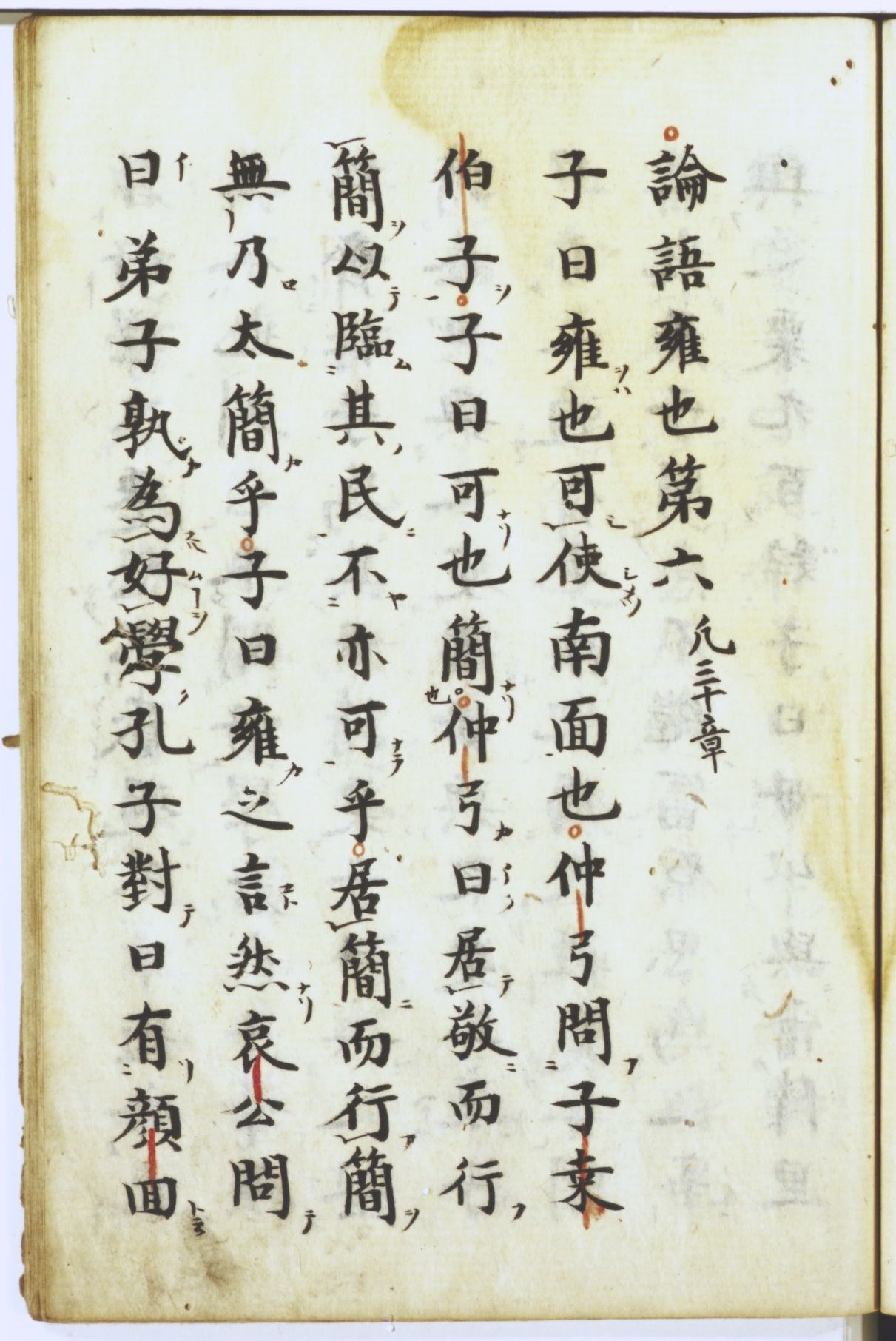
Kyoto University Library RB00007936, IIIF canvas 22, left-hand page: 6 written columns of up to 14 characters, main text only, with Japanese reading marks. Checked on the image: the first column of this book's text on this page begins ‹子曰雍›, the last begins ‹曰弟子›. Column 2 carries the title 論語雍也第六. 6.1.1 opens column 3. 6.2 runs on to canvas 23, right-hand page (first column ‹者好學›), where the section ends. Column openings on these pages that differ from the received text: ‹無乃太› where the received text has ‹無乃大›; ‹曰弟子› where the received text has ‹弟子孰›. The Chinese shown is the received text (Wikisource), not a transcription of this manuscript; Legge's English translates the received text.
1.1子曰:「雍也,可使南面。」
1.2仲弓問子桑伯子。子曰:「可也,簡。」
1.3仲弓曰:「居敬而行簡,以臨其民,不亦可乎?居簡而行簡,無乃大簡乎?」
1.4子曰:「雍之言然。」
2哀公問:「弟子孰爲好學?」孔子對曰:「有顏回者,好學;不遷怒,不貳過,不幸短命死矣!今也則亡,未聞好學者也。」
1.1The Master said, 'There is Yung!-- He might occupy the place of a prince.'
1.2Chung-kung asked about Tsze-sang Po-tsze. The Master said, 'He may pass. He does not mind small matters.'
1.3Chung-kung said, 'If a man cherish in himself a reverential feeling of the necessity of attention to business, though he may be easy in small matters in his government of the people, that may be allowed. But if he cherish in himself that easy feeling, and also carry it out in his practice, is not such an easy mode of procedure excessive?'
1.4The Master said, 'Yung's words are right.'
2The Duke Ai asked which of the disciples loved to learn. Confucius replied to him, 'There was Yen Hui; HE loved to learn. He did not transfer his anger; he did not repeat a fault. Unfortunately, his appointed time was short and he died; and now there is not such another. I have not yet heard of any one who loves to learn as he did.'
Where on the image
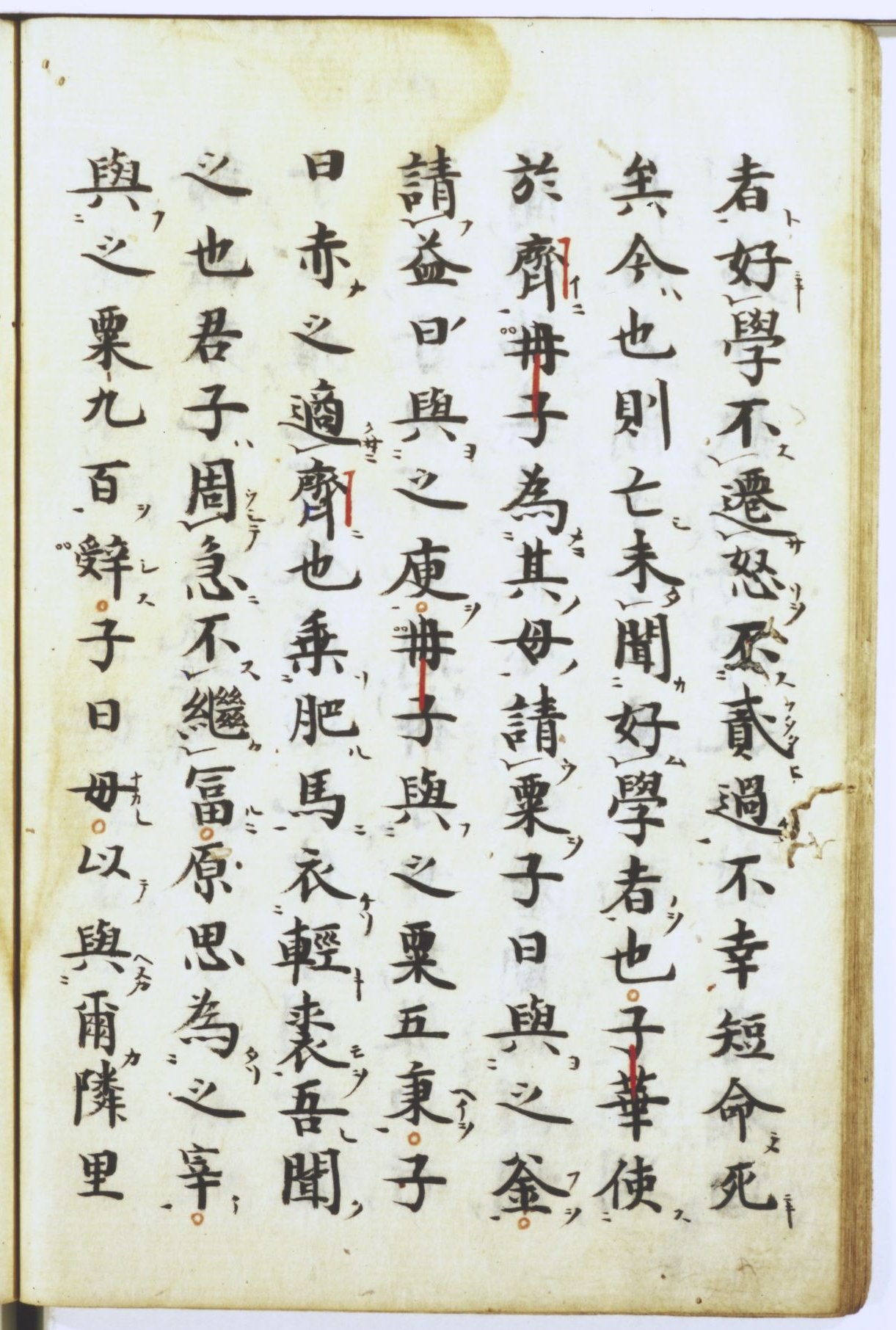
Kyoto University Library RB00007936, IIIF canvas 23, right-hand page: 7 written columns of up to 14 characters, main text only, with Japanese reading marks. Checked on the image: the first column of this book's text on this page begins ‹者好學›, the last begins ‹與之粟›. 6.3.1 begins inside column 2 (the column opens ‹矣今也›), 11 characters down in the received text. Above it the page finishes 6.2, shown in the previous section. 6.3.4 runs on to canvas 23, left-hand page (first column ‹鄉黨乎›), where the section ends. The Chinese shown is the received text (Wikisource), not a transcription of this manuscript; Legge's English translates the received text.
3.1子華使於齊,冉子爲其母請粟。子曰:「與之釜。」請益,曰:「與之庾。」冉子與之粟五秉。
3.2子曰:「赤之適齊也,乘肥馬,衣輕裘;吾聞之也:君子周急不繼富。」
3.3原思爲之宰,與之粟九百,辭。
3.4子曰:「毋!以與爾鄰里鄉黨乎!」
3.1Tsze-hwa being employed on a mission to Ch'i, the disciple Zan requested grain for his mother. The Master said, 'Give her a fu.' Yen requested more. 'Give her an yu,' said the Master. Yen gave her five ping.
3.2The Master said, 'When Ch'ih was proceeding to Ch'i, he had fat horses to his carriage, and wore light furs. I have heard that a superior man helps the distressed, but does not add to the wealth of the rich.'
3.3Yuan Sze being made governor of his town by the Master, he gave him nine hundred measures of grain, but Sze declined them.
3.4The Master said, 'Do not decline them. May you not give them away in the neighborhoods, hamlets, towns, and villages?'
Where on the image
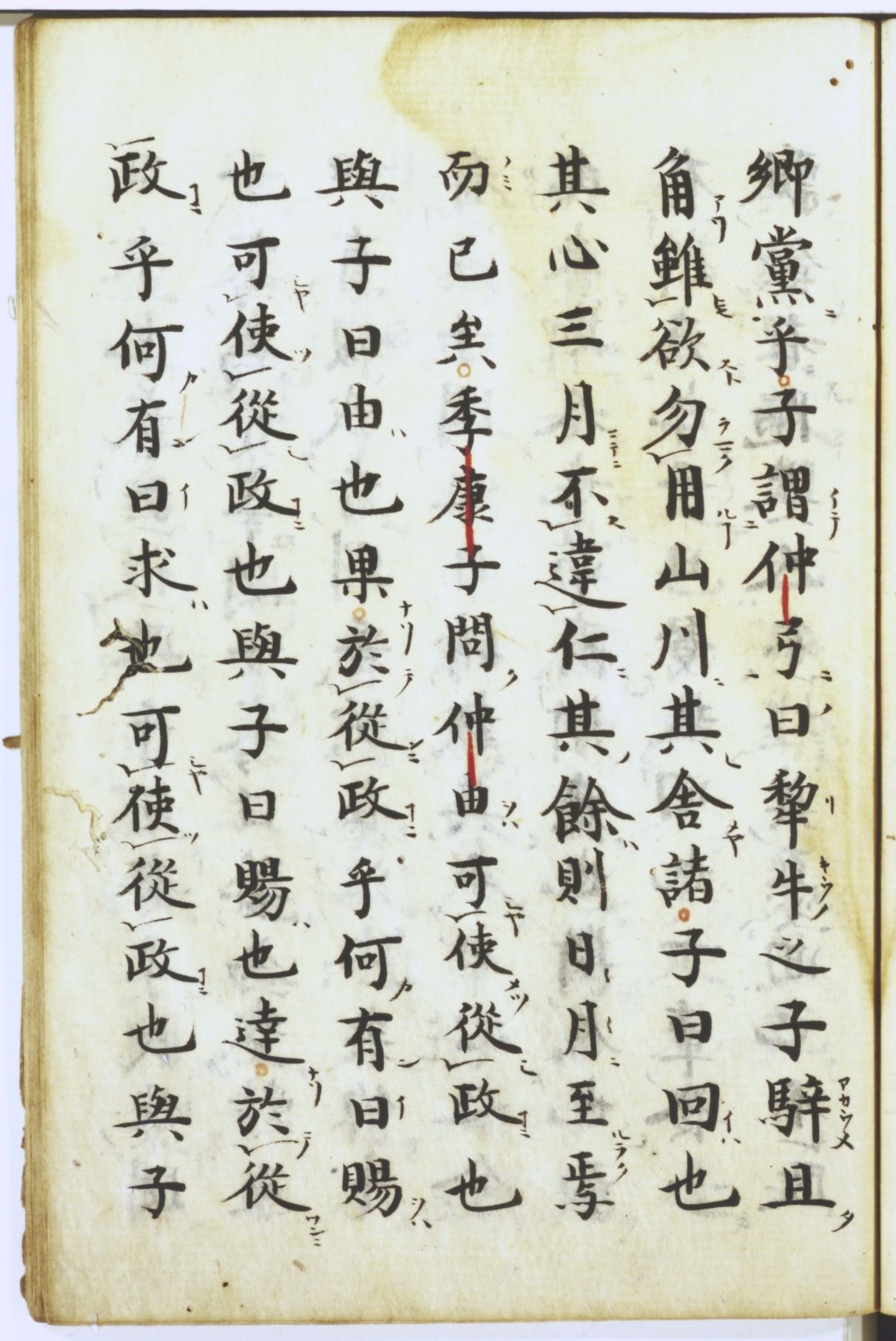
Kyoto University Library RB00007936, IIIF canvas 23, left-hand page: 7 written columns of up to 14 characters, main text only, with Japanese reading marks. Checked on the image: the first column of this book's text on this page begins ‹鄉黨乎›, the last begins ‹政乎何›. 6.4 begins inside column 1 (the column opens ‹鄉黨乎›), 3 characters down in the received text. Above it the page finishes 6.3.4, shown in the previous section. 6.6 runs on to canvas 24, right-hand page (first column ‹曰求也›), where the section ends. The Chinese shown is the received text (Wikisource), not a transcription of this manuscript; Legge's English translates the received text.
4子謂仲弓曰:「犁牛之子,騂且角;雖欲勿用,山川其舍諸?」
5子曰:「回也,其心三月不違仁。其餘,則日月至焉而已矣。」
6季康子問:「仲由可使從政也與?」子曰:「由也果,於從政乎何有!」曰:「賜也可使從政也與?」曰:「賜也達,於從政乎何有!」曰:「求也可使從政也與?」曰:「求也藝,於從政乎何有!」
4The Master, speaking of Chung-kung, said, 'If the calf of a brindled cow be red and horned, although men may not wish to use it, would the spirits of the mountains and rivers put it aside?'
5The Master said, 'Such was Hui that for three months there would be nothing in his mind contrary to perfect virtue. The others may attain to this on some days or in some months, but nothing more.'
6Chi K'ang asked about Chung-yu, whether he was fit to be employed as an officer of government. The Master said, 'Yu is a man of decision; what difficulty would he find in being an officer of government?' K'ang asked, 'Is Ts'ze fit to be employed as an officer of government?' and was answered, 'Ts'ze is a man of intelligence; what difficulty would he find in being an officer of government?' And to the same question about Ch'iu the Master gave the same reply, saying, 'Ch'iu is a man of various ability.'
Where on the image
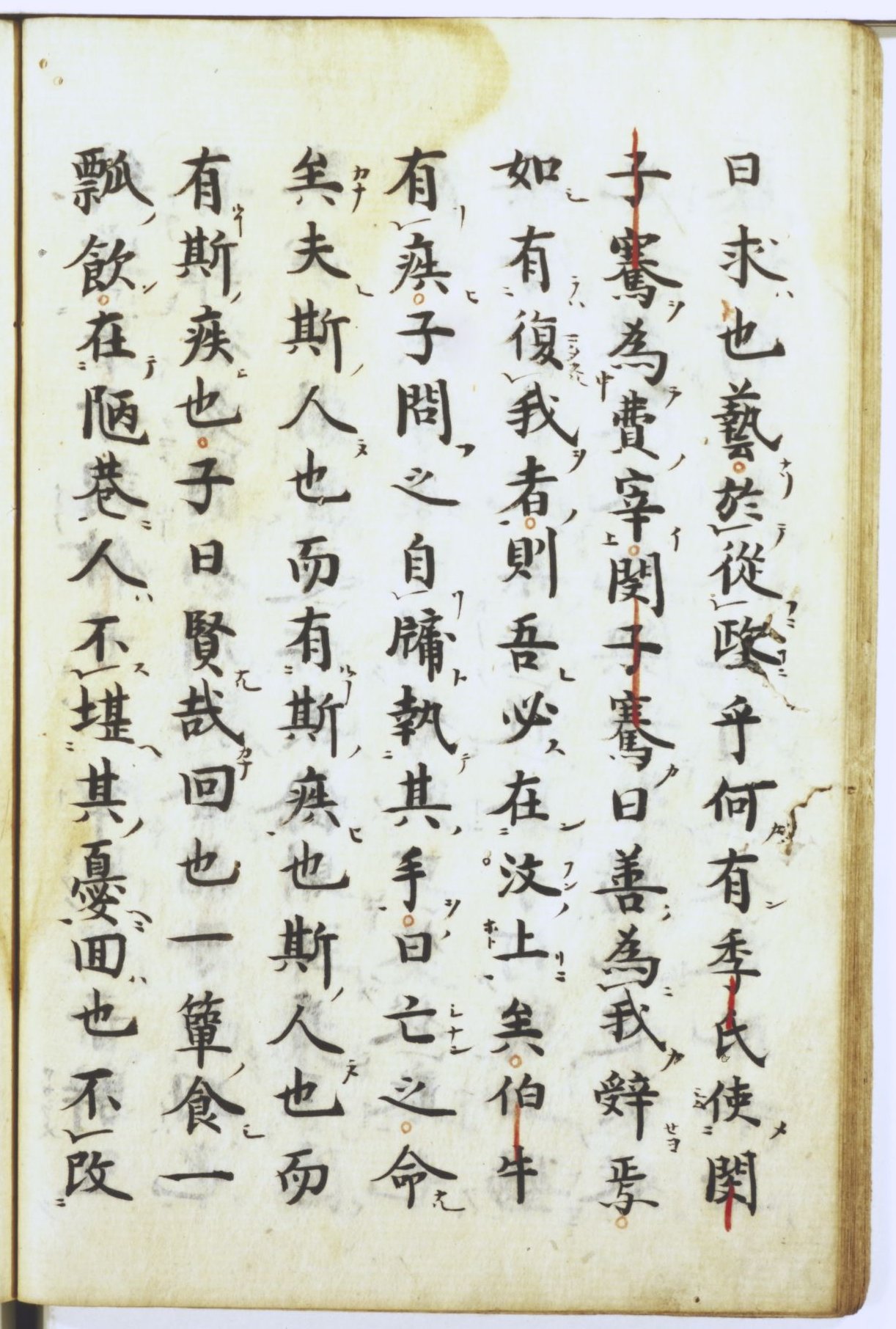
Kyoto University Library RB00007936, IIIF canvas 24, right-hand page: 7 written columns of up to 14 characters, main text only, with Japanese reading marks. Checked on the image: the first column of this book's text on this page begins ‹曰求也›, the last begins ‹瓢飲在›. 6.7 begins inside column 1 (the column opens ‹曰求也›), 10 characters down in the received text. Above it the page finishes 6.6, shown in the previous section. 6.9 runs on to canvas 24, left-hand page (first column ‹其樂賢›), where the section ends. The Chinese shown is the received text (Wikisource), not a transcription of this manuscript; Legge's English translates the received text.
7季氏使閔子騫爲費宰。閔子騫曰:「善爲我辭焉。如有復我者,則吾必在汶上矣。」
8伯牛有疾,子問之,自牖執其手,曰:「亡之,命矣夫!斯人也,而有斯疾也!斯人也,而有斯疾也!」
9子曰:「賢哉回也!一簞食,一瓢飮,在陋巷,人不堪其憂,回也不改其樂。賢哉回也!」
7The chief of the Chi family sent to ask Min Tsze- ch'ien to be governor of Pi. Min Tsze-ch'ien said, 'Decline the offer for me politely. If any one come again to me with a second invitation, I shall be obliged to go and live on the banks of the Wan.'
8Po-niu being ill, the Master went to ask for him. He took hold of his hand through the window, and said, 'It is killing him. It is the appointment of Heaven, alas! That such a man should have such a sickness! That such a man should have such a sickness!'
9The Master said, 'Admirable indeed was the virtue of Hui! With a single bamboo dish of rice, a single gourd dish of drink, and living in his mean narrow lane, while others could not have endured the distress, he did not allow his joy to be affected by it. Admirable indeed was the virtue of Hui!'
Where on the image
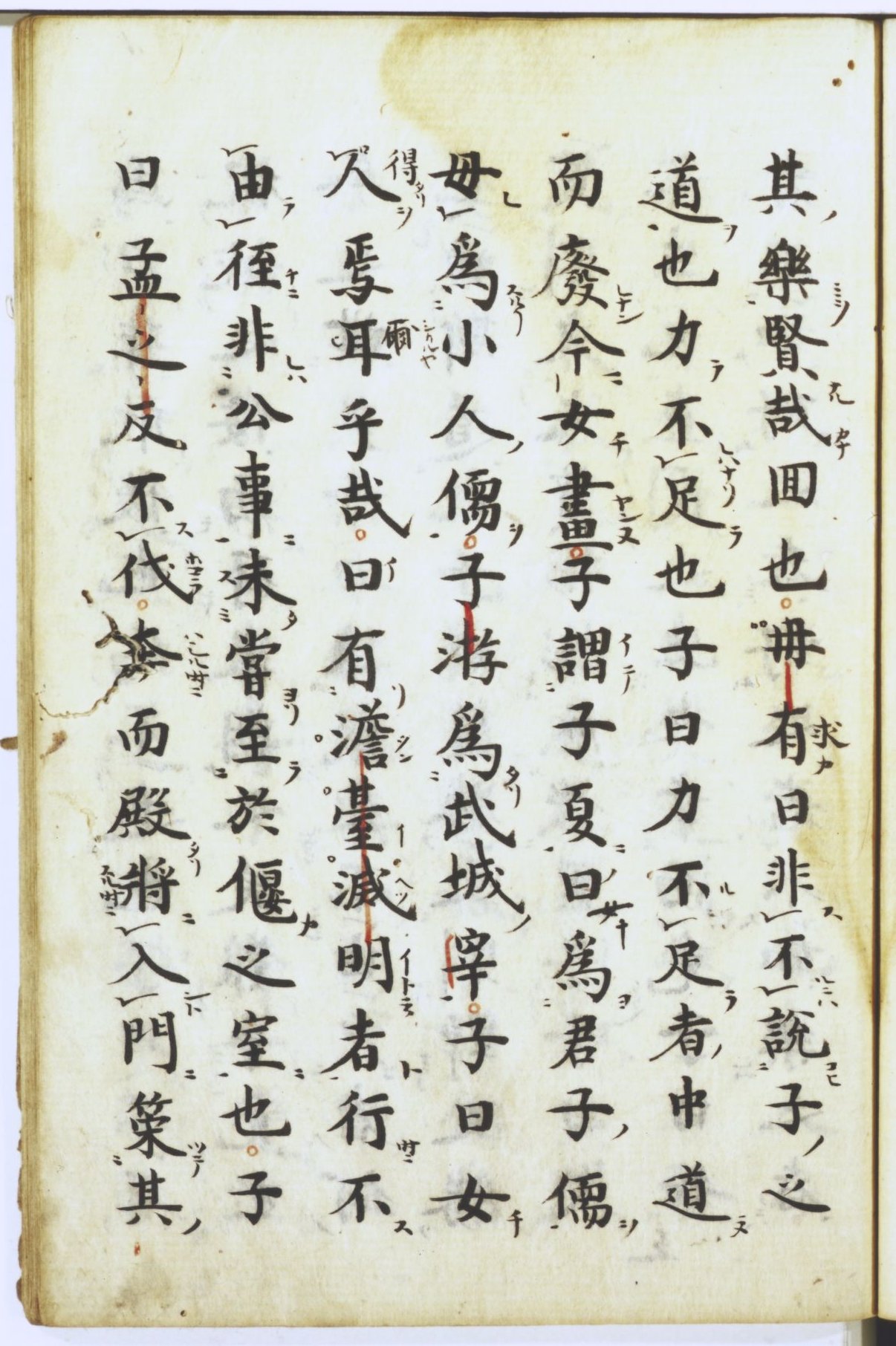
Kyoto University Library RB00007936, IIIF canvas 24, left-hand page: 7 written columns of up to 14 characters, main text only, with Japanese reading marks. Checked on the image: the first column of this book's text on this page begins ‹其樂賢›, the last begins ‹曰孟之›. 6.10 begins inside column 1 (the column opens ‹其樂賢›), 6 characters down in the received text. Above it the page finishes 6.9, shown in the previous section. 6.13 runs on to canvas 25, right-hand page (first column ‹馬曰非›), where the section ends. Column openings on these pages that differ from the received text: ‹道也力› where the received text has ‹道力不›; ‹毋為小› where the received text has ‹儒無爲›. The Chinese shown is the received text (Wikisource), not a transcription of this manuscript; Legge's English translates the received text.
10冉求曰:「非不說子之道,力不足也。」子曰:「力不足者,中道而廢;今女畫。」
11子謂子夏曰:「女爲君子儒,無爲小人儒。」
12子游爲武城宰。子曰:「女得人焉耳乎?」曰:「有澹臺滅明者,行不由徑;非公事,未嘗至於偃之室也。」
13子曰:「孟之反不伐,奔而殿,將入門,策其馬,曰:『非敢後也,馬不進也。』」
10Yen Ch'iu said, 'It is not that I do not delight in your doctrines, but my strength is insufficient.' The Master said, 'Those whose strength is insufficient give over in the middle of the way but now you limit yourself.'
11The Master said to Tsze-hsia, 'Do you be a scholar after the style of the superior man, and not after that of the mean man.'
12Tsze-yu being governor of Wu-ch'ang, the Master said to him, 'Have you got good men there?' He answered, 'There is Tan-t'ai Mieh-ming, who never in walking takes a short cut, and never comes to my office, excepting on public business.'
13The Master said, 'Mang Chih-fan does not boast of his merit. Being in the rear on an occasion of flight, when they were about to enter the gate, he whipped up his horse, saying, "It is not that I dare to be last. My horse would not advance."'
Where on the image
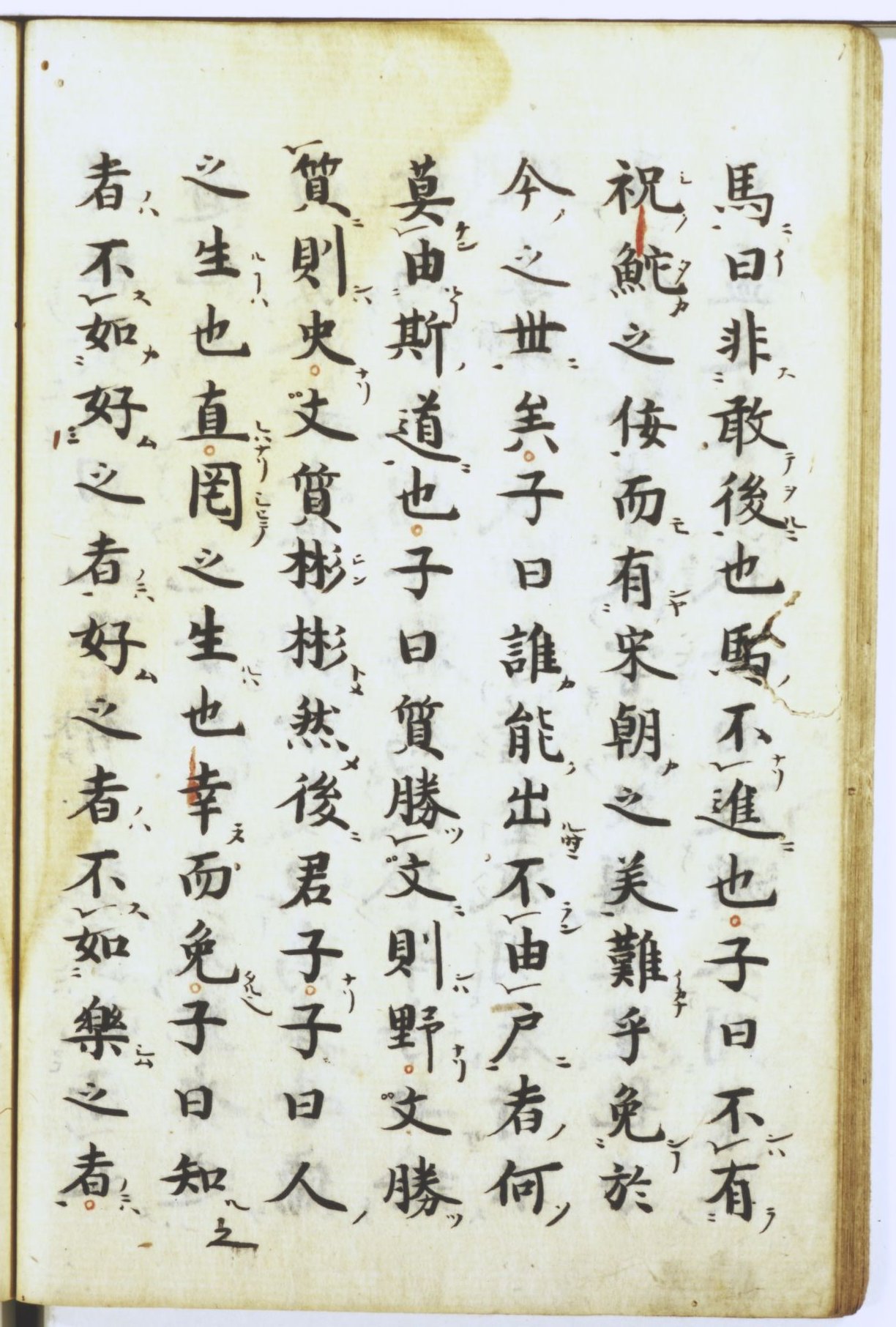
Kyoto University Library RB00007936, IIIF canvas 25, right-hand page: 7 written columns of up to 14 characters, main text only, with Japanese reading marks. Checked on the image: the first column of this book's text on this page begins ‹馬曰非›, the last begins ‹者不如›. 6.14 begins inside column 1 (the column opens ‹馬曰非›), 10 characters down in the received text. Above it the page finishes 6.13, shown in the previous section. The section ends on this page. The Chinese shown is the received text (Wikisource), not a transcription of this manuscript; Legge's English translates the received text.
14子曰:「不有祝鮀之佞,而有宋朝之美,難乎免於今之世矣。」
15子曰:「誰能出不由戶?何莫由斯道也!」
16子曰:「質勝文則野,文勝質則史。文質彬彬,然後君子。」
17子曰:「人之生也直,罔之生也幸而免。」
18子曰:「知之者,不如好之者,好之者,不如樂之者。」
14The Master said, 'Without the specious speech of the litanist T'o and the beauty of the prince Chao of Sung, it is difficult to escape in the present age.'
15The Master said, 'Who can go out but by the door? How is it that men will not walk according to these ways?'
16The Master said, 'Where the solid qualities are in excess of accomplishments, we have rusticity; where the accomplishments are in excess of the solid qualities, we have the manners of a clerk. When the accomplishments and solid qualities are equally blended, we then have the man of virtue.'
17The Master said, 'Man is born for uprightness. If a man lose his uprightness, and yet live, his escape from death is the effect of mere good fortune.'
18The Master said, 'They who know the truth are not equal to those who love it, and they who love it are not equal to those who delight in it.'
Where on the image
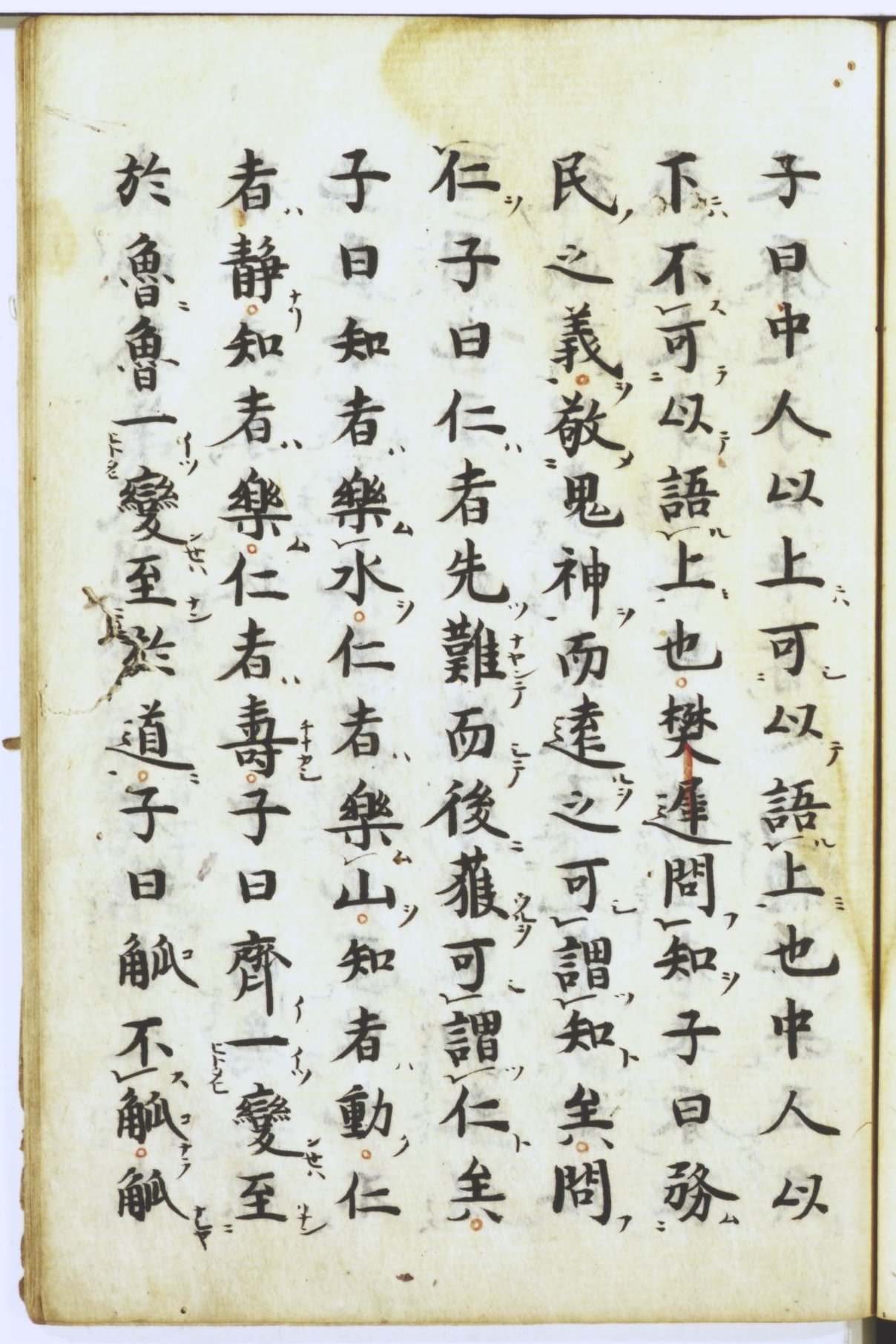
Kyoto University Library RB00007936, IIIF canvas 25, left-hand page: 7 written columns of up to 14 characters, main text only, with Japanese reading marks. Checked on the image: the first column of this book's text on this page begins ‹子曰中›, the last begins ‹於魯魯›. 6.19 opens column 1. 6.23 runs on to canvas 26, right-hand page (first column ‹哉觚哉›), where the section ends. Column openings on these pages that differ from the received text: ‹仁子曰仁者先難› where the received text has ‹仁曰仁者先難而›. The Chinese shown is the received text (Wikisource), not a transcription of this manuscript; Legge's English translates the received text.
19子曰:「中人以上,可以語上也;中人以下,不可以語上也。」
20樊遲問知。子曰:「務民之義,敬鬼神而遠之,可謂知矣。」問仁。曰:「仁者先難而後獲,可謂仁矣。」
21子曰:「知者樂水,仁者樂山。知者動,仁者靜。知者樂,仁者壽。」
22子曰:「齊一變,至於魯;魯一變,至於道。」
23子曰:「觚不觚,觚哉!觚哉!」
19The Master said, 'To those whose talents are above mediocrity, the highest subjects may be announced. To those who are below mediocrity, the highest subjects may not be announced.'
20Fan Ch'ih asked what constituted wisdom. The Master said, 'To give one's self earnestly to the duties due to men, and, while respecting spiritual beings, to keep aloof from them, may be called wisdom.' He asked about perfect virtue. The Master said, 'The man of virtue makes the difficulty to be overcome his first business, and success only a subsequent consideration;-- this may be called perfect virtue.'
21The Master said, 'The wise find pleasure in water; the virtuous find pleasure in hills. The wise are active; the virtuous are tranquil. The wise are joyful; the virtuous are long-lived.'
22The Master said, 'Ch'i, by one change, would come to the State of Lu. Lu, by one change, would come to a State where true principles predominated.'
23The Master said, 'A cornered vessel without corners.-- A strange cornered vessel! A strange cornered vessel!'
Where on the image
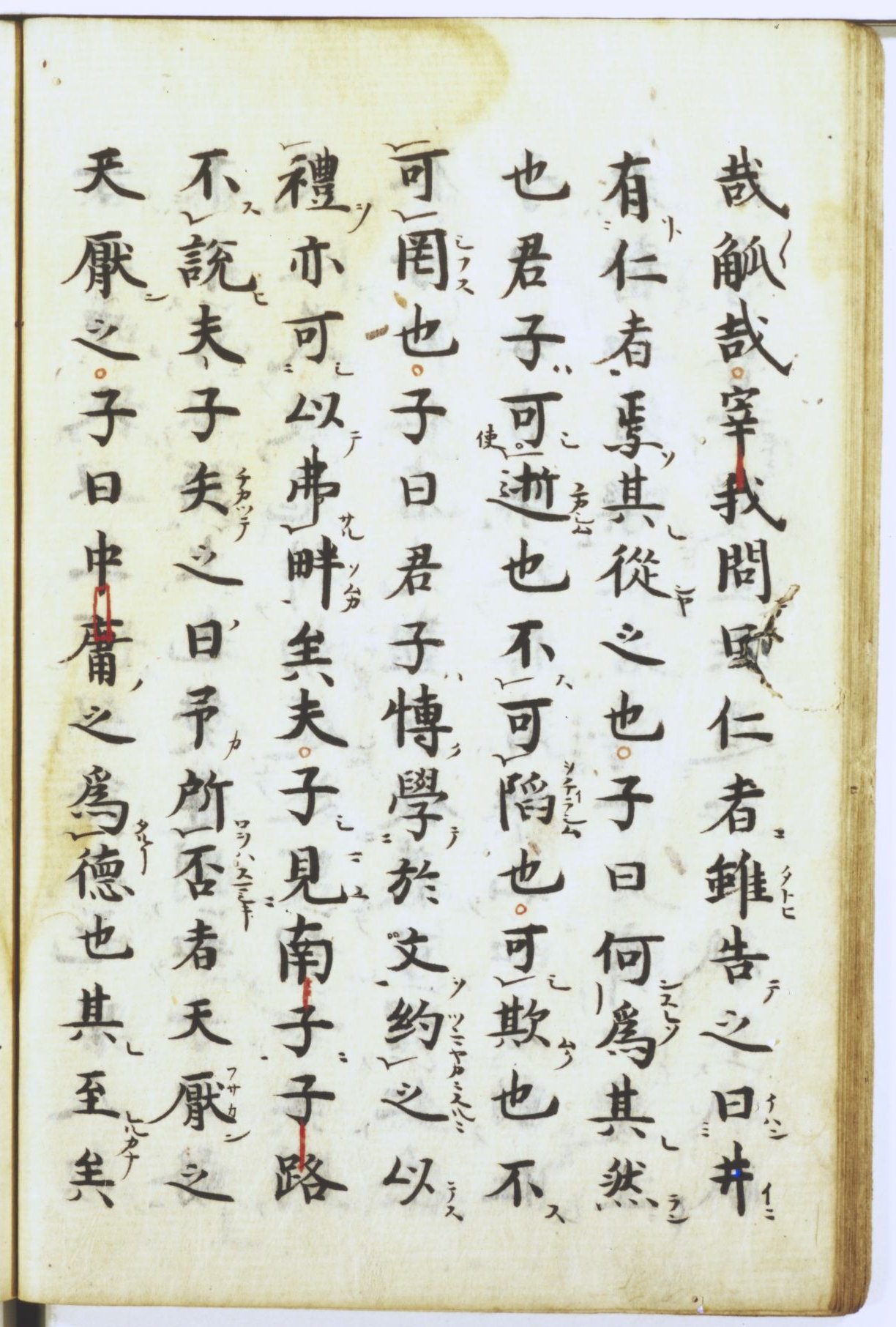
Kyoto University Library RB00007936, IIIF canvas 26, right-hand page: 7 written columns of up to 14 characters, main text only, with Japanese reading marks. Checked on the image: the first column of this book's text on this page begins ‹哉觚哉›, the last begins ‹天厭之›. 6.24 begins inside column 1 (the column opens ‹哉觚哉›), 3 characters down in the received text. Above it the page finishes 6.23, shown in the previous section. 6.27 runs on to canvas 26, left-hand page (first column ‹乎民鮮›), where the section ends. Column openings on these pages that differ from the received text: ‹有仁者› where the received text has ‹有仁焉›. The Chinese shown is the received text (Wikisource), not a transcription of this manuscript; Legge's English translates the received text.
24宰我問曰:「仁者雖吿之曰:『井有仁焉。』其從之也?」子曰:「何爲其然也?君子可逝也,不可陷也。可欺也,不可罔也。」
25子曰:「君子博學於文,約之以禮,亦可以弗畔矣夫!」
26子見南子,子路不說。夫子矢之曰:「予所否者,天厭之!天厭之!」
27子曰:「中庸之爲德也,其至矣乎!民鮮久矣!」
24Tsai Wo asked, saying, 'A benevolent man, though it be told him,-- 'There is a man in the well' will go in after him, I suppose.' Confucius said, 'Why should he do so?' A superior man may be made to go to the well, but he cannot be made to go down into it. He may be imposed upon, but he cannot be fooled.'
25The Master said, 'The superior man, extensively studying all learning, and keeping himself under the restraint of the rules of propriety, may thus likewise not overstep what is right.'
26The Master having visited Nan-tsze, Tsze-lu was displeased, on which the Master swore, saying, 'Wherein I have done improperly, may Heaven reject me, may Heaven reject me!'
27The Master said, 'Perfect is the virtue which is according to the Constant Mean! Rare for a long time has been its practise among the people.'
Where on the image
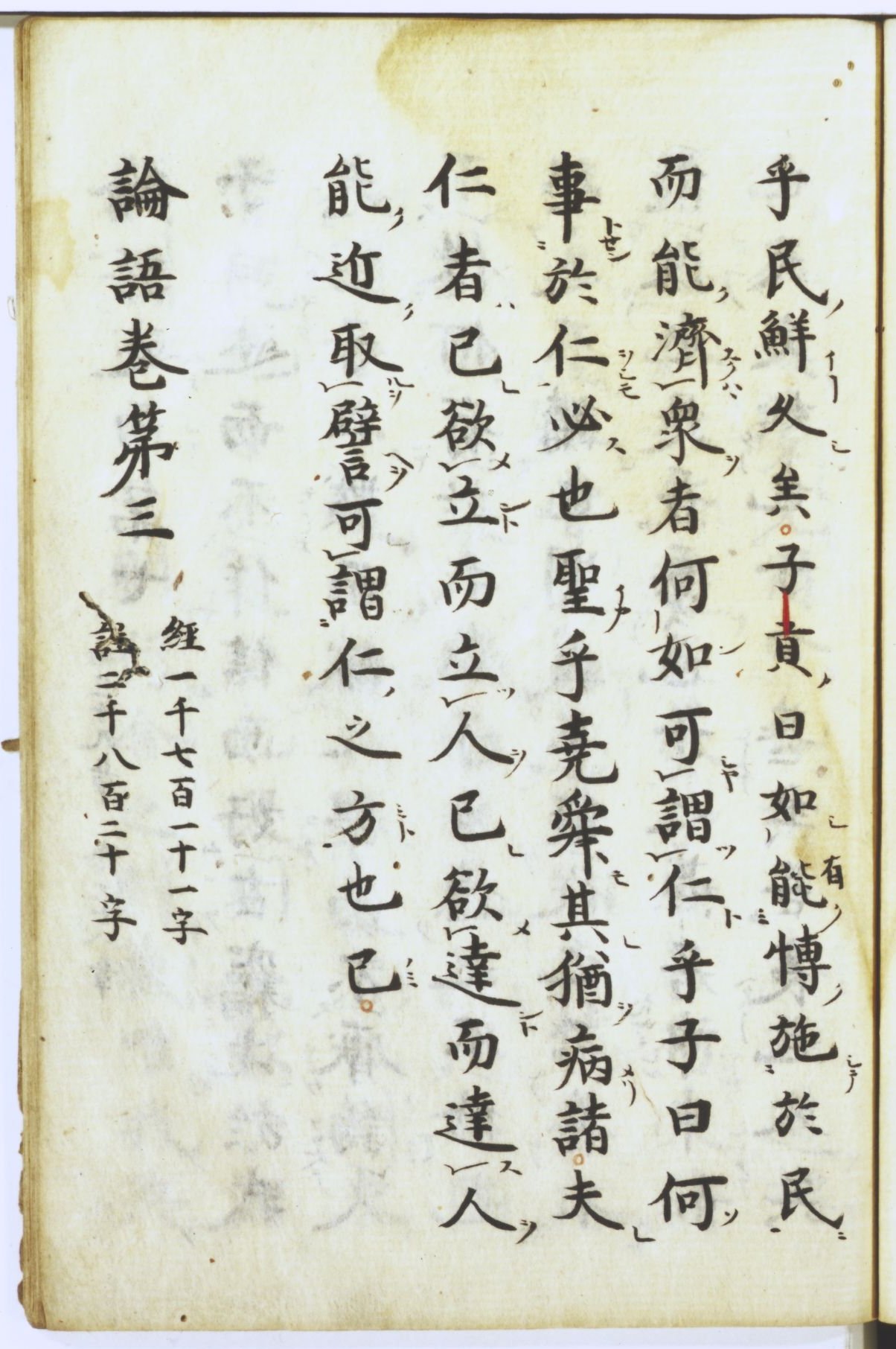
Kyoto University Library RB00007936, IIIF canvas 26, left-hand page: 6 written columns of up to 14 characters, main text only, with Japanese reading marks. Checked on the image: the first column of this book's text on this page begins ‹乎民鮮›, the last begins ‹能近取›. Column 7 carries the title 論語卷第三. 6.28.1 begins inside column 1 (the column opens ‹乎民鮮›), 5 characters down in the received text. Above it the page finishes 6.27, shown in the previous section. The section ends on this page. The Chinese shown is the received text (Wikisource), not a transcription of this manuscript; Legge's English translates the received text.
28.1子貢曰:「如有博施於民,而能濟眾,何如?可謂仁乎?」子曰:「何事於仁,必也聖乎?堯舜其猶病諸!
28.2夫仁者,己欲立而立人,己欲達而達人。
28.3能近取譬,可謂仁之方也已。」
28.1Tsze-kung said, 'Suppose the case of a man extensively conferring benefits on the people, and able to assist all, what would you say of him? Might he be called perfectly virtuous?' The Master said, 'Why speak only of virtue in connexion with him? Must he not have the qualities of a sage? Even Yao and Shun were still solicitous about this.
28.2'Now the man of perfect virtue, wishing to be established himself, seeks also to establish others; wishing to be enlarged himself, he seeks also to enlarge others.
28.3'To be able to judge of others by what is nigh in ourselves;-- this may be called the art of virtue.'
Notes
- English: James Legge, Confucian Analects, The Chinese Classics vol. 1. Legge's chapter and paragraph numbers are kept as superscripts (chapter.paragraph).
- Legge translated the received text. Where this manuscript's wording differs, his English follows the received text shown here.
Cite
Sources
- Source: Kyoto University Library RB00007936 (Analects manuscript attributed to Kiyohara Yoshieda, c. 1300) + Wikisource received text + James Legge's English (Project Gutenberg) (holding institution)
- Critical edition: Received text (Wikisource) in Legge's chapter and paragraph division
← previous · → next · v cycle view · l back to library