Analects, Book 7: Shu er 述而 (Kamakura-period manuscript)
Introduction
Book 7 of the Analects (論語 Lunyu), titled 述而 (Shu er) after its opening words, 37 chapters in Legge's division. It is shown on a manuscript of the Analects in the Kiyohara family collection (Seike bunko) of Kyoto University Library, two volumes in regular script, seven columns of fourteen characters to the page, main text only, with red and black Japanese reading marks. A colophon by Kiyohara Edakata dated 1550 names the copyist as his ancestor Kiyohara Yoshieda (1253-1331), which places the copy around 1300, in the late Kamakura period; the attribution is traditional. The Kiyohara were hereditary readers of the Confucian classics at the Japanese court, and their text descends from the edition of the Analects with the collected commentary of He Yan (3rd century CE): after each pair of books the scribe copied the character counts of the classic and of the commentary, although only the classic is written out. The manuscript is an Important Cultural Property of Japan.
In this copy Book 7 runs from canvas 27, right-hand page to canvas 31, left-hand page (volume 1). Each section gathers the paragraphs that begin on one page, numbered by chapter and paragraph as in Legge, and links to that page and to any page the last paragraph runs onto. The page boundaries were found by reading the first characters of every column on the photographs. The Chinese shown is the received text, from Wikisource. This manuscript differs from it in places, most often by an added or missing particle (也, 矣, 焉) or a variant character form; the differences seen at column openings are listed in the scan notes. The English is James Legge's translation of the received text.
How was this verified? (Provenance)
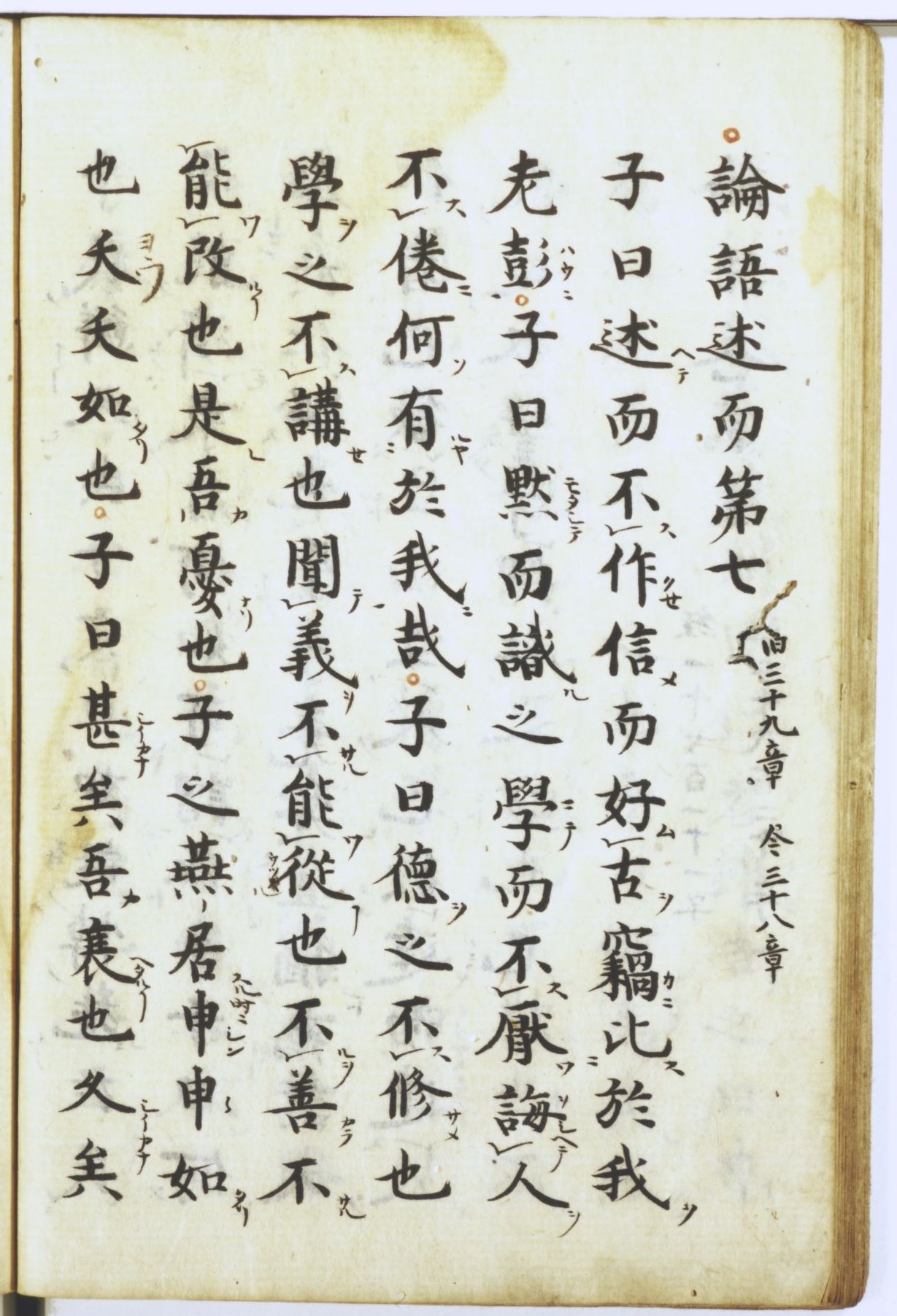
Where on the image
Kyoto University Library RB00007936, IIIF canvas 27, right-hand page: 7 written columns of up to 14 characters, main text only, with Japanese reading marks. Checked on the image: the first column of this book's text on this page begins ‹子曰述›, the last begins ‹也夭夭›. Column 1 carries the title 論語述而第七. 7.1 opens column 2. 7.5 runs on to canvas 27, left-hand page (first column ‹吾不復›), where the section ends. Column openings on these pages that differ from the received text: ‹能改也› where the received text has ‹能改是›. The Chinese shown is the received text (Wikisource), not a transcription of this manuscript; Legge's English translates the received text.
1子曰:「述而不作,信而好古,竊比於我老彭。」
2子曰:「默而識之,學而不厭,誨人不倦,何有於我哉?」
3子曰:「德之不脩,學之不講,聞義不能徙,不善不能改,是吾憂也。」
4子之燕居,申申如也,夭夭如也。
5子曰:「甚矣,吾衰也!久矣,吾不復夢見周公!」
1The Master said, 'A transmitter and not a maker, believing in and loving the ancients, I venture to compare myself with our old P'ang.'
2The Master said, 'The silent treasuring up of knowledge; learning without satiety; and instructing others without being wearied:-- which one of these things belongs to me?'
3The Master said, 'The leaving virtue without proper cultivation; the not thoroughly discussing what is learned; not being able to move towards righteousness of which a knowledge is gained; and not being able to change what is not good:-- these are the things which occasion me solicitude.'
4When the Master was unoccupied with business, his manner was easy, and he looked pleased.
5The Master said, 'Extreme is my decay. For a long time, I have not dreamed, as I was wont to do, that I saw the duke of Chau.'
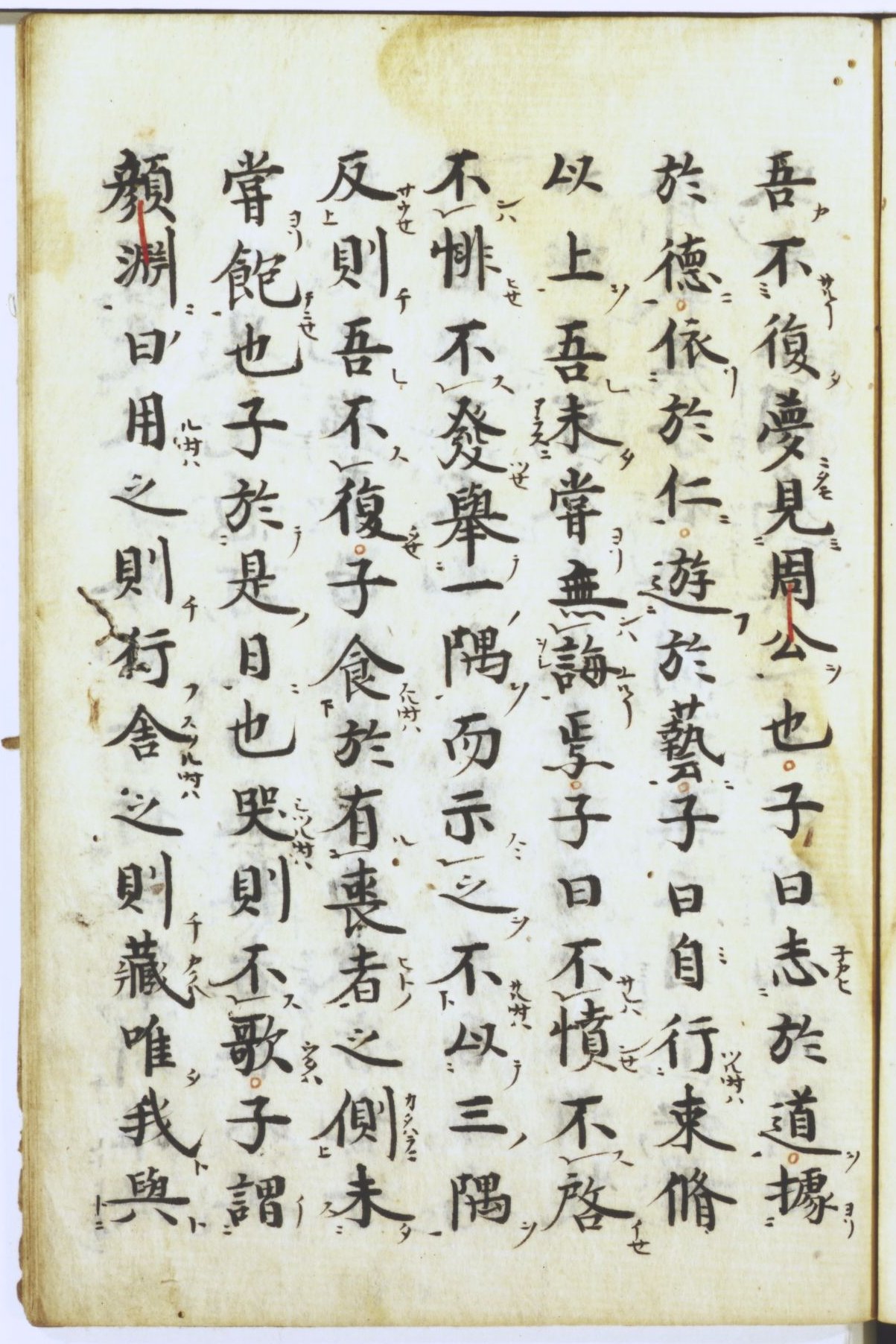
Where on the image
Kyoto University Library RB00007936, IIIF canvas 27, left-hand page: 7 written columns of up to 14 characters, main text only, with Japanese reading marks. Checked on the image: the first column of this book's text on this page begins ‹吾不復›, the last begins ‹顏淵曰›. 7.6.1 begins inside column 1 (the column opens ‹吾不復›), 7 characters down in the received text. Above it the page finishes 7.5, shown in the previous section. 7.10.1 runs on to canvas 28, right-hand page (first column ‹爾有是›), where the section ends. Column openings on these pages that differ from the received text: ‹反則吾› where the received text has ‹反則不›. The Chinese shown is the received text (Wikisource), not a transcription of this manuscript; Legge's English translates the received text.
6.1子曰:『志於道,
6.2據於德,
6.3依於仁,
6.4游於藝。』
7子曰:「自行束脩以上,吾未嘗無誨焉。」
8子曰:「不憤不啟;不悱不發。擧一隅,不以三隅反,則不復也。」
9.1子食於有喪者之側,未嘗飽也。
9.2子於是日哭,則不歌。
10.1子謂顏淵曰:「用之則行,舍之則藏。惟我與爾有是夫!」
6.1The Master said, 'Let the will be set on the path of duty.
6.2'Let every attainment in what is good be firmly grasped.
6.3'Let perfect virtue be accorded with.
6.4'Let relaxation and enjoyment be found in the polite arts.'
7The Master said, 'From the man bringing his bundle of dried flesh for my teaching upwards, I have never refused instruction to any one.'
8The Master said, 'I do not open up the truth to one who is not eager to get knowledge, nor help out any one who is not anxious to explain himself. When I have presented one corner of a subject to any one, and he cannot from it learn the other three, I do not repeat my lesson.'
9.1When the Master was eating by the side of a mourner, he never ate to the full.
9.2He did not sing on the same day in which he had been weeping.
10.1The Master said to Yen Yuan, 'When called to office, to undertake its duties; when not so called, to lie retired;-- it is only I and you who have attained to this.'
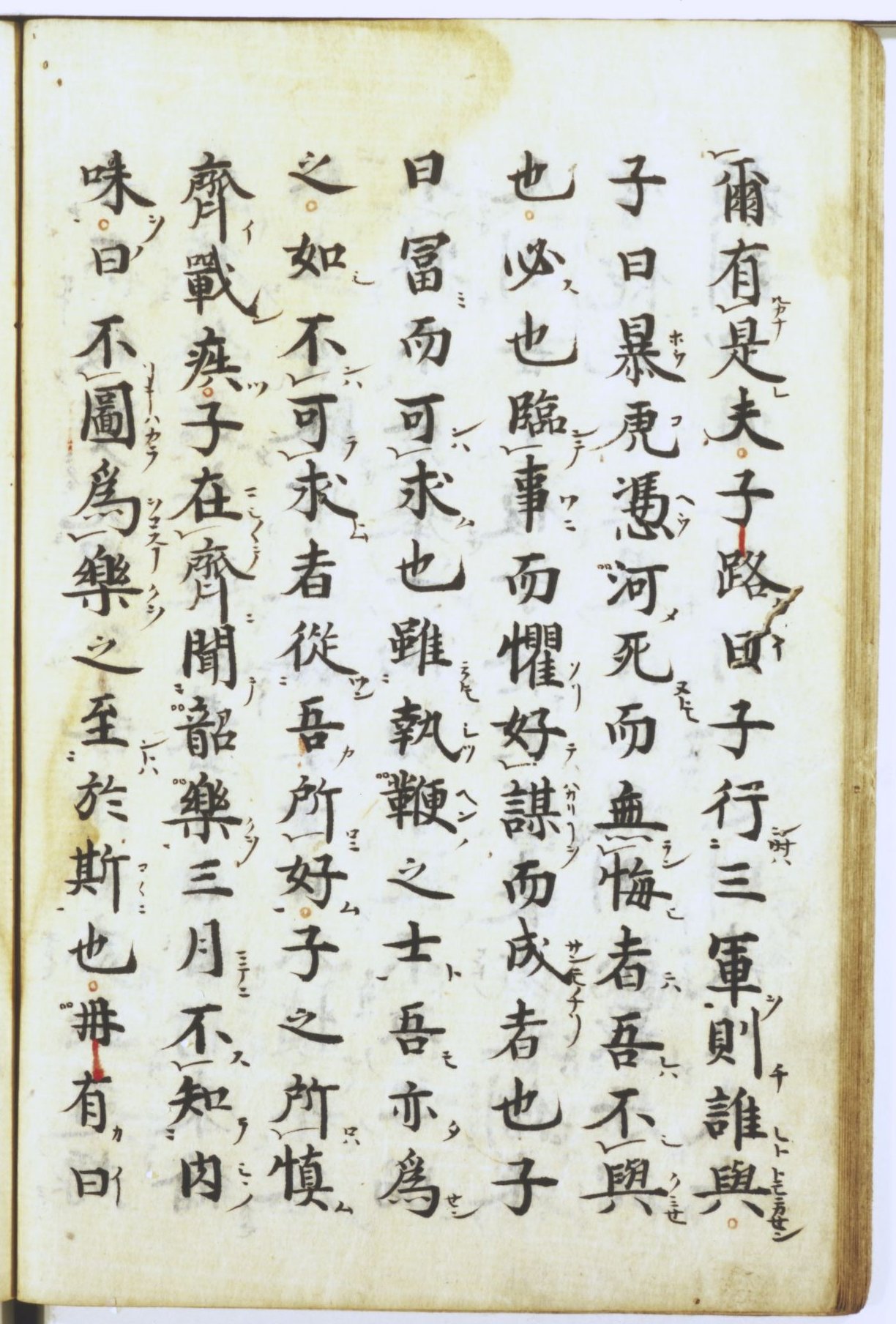
Where on the image
Kyoto University Library RB00007936, IIIF canvas 28, right-hand page: 7 written columns of up to 14 characters, main text only, with Japanese reading marks. Checked on the image: the first column of this book's text on this page begins ‹爾有是›, the last begins ‹味曰不›. 7.10.2 begins inside column 1 (the column opens ‹爾有是›), 4 characters down in the received text. Above it the page finishes 7.10.1, shown in the previous section. 7.14.1 runs on to canvas 28, left-hand page (first column ‹夫子為›), where the section ends. The Chinese shown is the received text (Wikisource), not a transcription of this manuscript; Legge's English translates the received text.
10.2子路曰:「子行三軍,則誰與?」
10.3子曰:「暴虎馮河,死而無悔者,吾不與也。必也臨事而懼,好謀而成者也。」
11子曰:「富而可求也,雖執鞭之士,吾亦爲之;如不可求,從吾所好。」
12子之所愼:齊、戰、疾。
13子在齊聞韶,三月不知肉味,曰:「不圖爲樂之至於斯也!」
14.1冉有曰:「夫子爲衞君乎?」子貢曰:「諾,吾將問之」。
10.2Tsze-lu said, 'If you had the conduct of the armies of a great State, whom would you have to act with you?'
10.3The Master said, 'I would not have him to act with me, who will unarmed attack a tiger, or cross a river without a boat, dying without any regret. My associate must be the man who proceeds to action full of solicitude, who is fond of adjusting his plans, and then carries them into execution.'
11The Master said, 'If the search for riches is sure to be successful, though I should become a groom with whip in hand to get them, I will do so. As the search may not be successful, I will follow after that which I love.'
12The things in reference to which the Master exercised the greatest caution were -- fasting, war, and sickness.
13When the Master was in Ch'i, he heard the Shao, and for three months did not know the taste of flesh. 'I did not think'' he said, 'that music could have been made so excellent as this.'
14.1Yen Yu said, 'Is our Master for the ruler of Wei?' Tsze-kung said, 'Oh! I will ask him.'
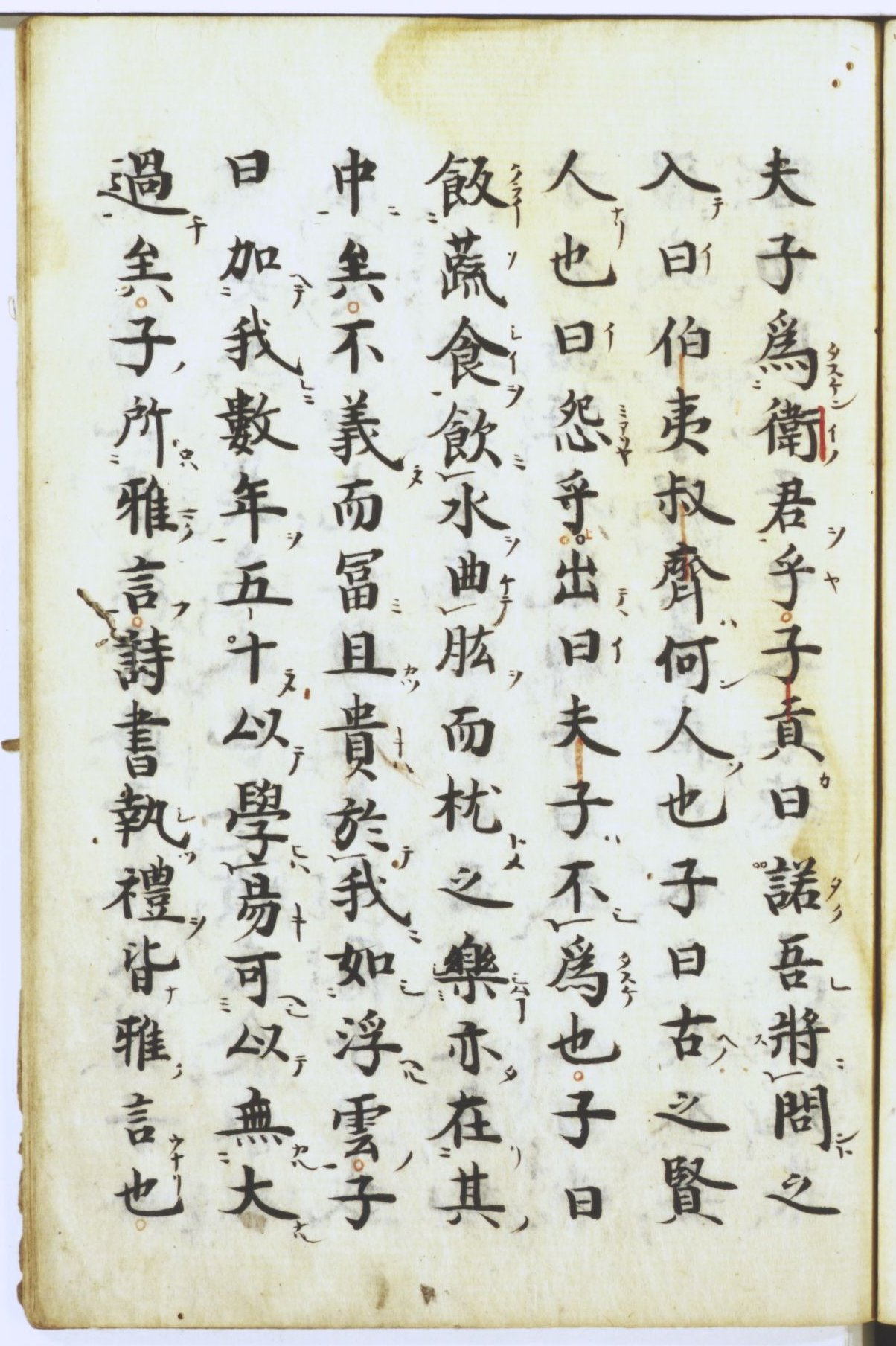
Where on the image
Kyoto University Library RB00007936, IIIF canvas 28, left-hand page: 7 written columns of up to 14 characters, main text only, with Japanese reading marks. Checked on the image: the first column of this book's text on this page begins ‹夫子為›, the last begins ‹過矣子›. 7.14.2 opens column 2. Above it the page finishes 7.14.1, shown in the previous section. The section ends on this page. The Chinese shown is the received text (Wikisource), not a transcription of this manuscript; Legge's English translates the received text.
14.2入曰:「伯夷叔齊,何人也?」曰:「古之賢人也。」曰:「怨乎?」曰:「求仁而得仁,又何怨?」出,曰:「夫子不爲也。」
15子曰:「飯疏食,飮水,曲肱而枕之,樂亦在其中矣。不義而富且貴,於我如浮雲。」
16子曰:「加我數年,五十以學易,可以無大過矣。」
17子所雅言:「詩、書、執禮,皆雅言也。」
14.2He went in accordingly, and said, 'What sort of men were Po-i and Shu-ch'i?' 'They were ancient worthies,' said the Master. 'Did they have any repinings because of their course?' The Master again replied, 'They sought to act virtuously, and they did so; what was there for them to repine about?' On this, Tsze-kung went out and said, 'Our Master is not for him.'
15The Master said, 'With coarse rice to eat, with water to drink, and my bended arm for a pillow;-- I have still joy in the midst of these things. Riches and honours acquired by unrighteousness, are to me as a floating cloud.'
16The Master said, 'If some years were added to my life, I would give fifty to the study of the Yi, and then I might come to be without great faults.'
17The Master's frequent themes of discourse were-- the Odes, the History, and the maintenance of the Rules of Propriety. On all these he frequently discoursed.
Where on the image
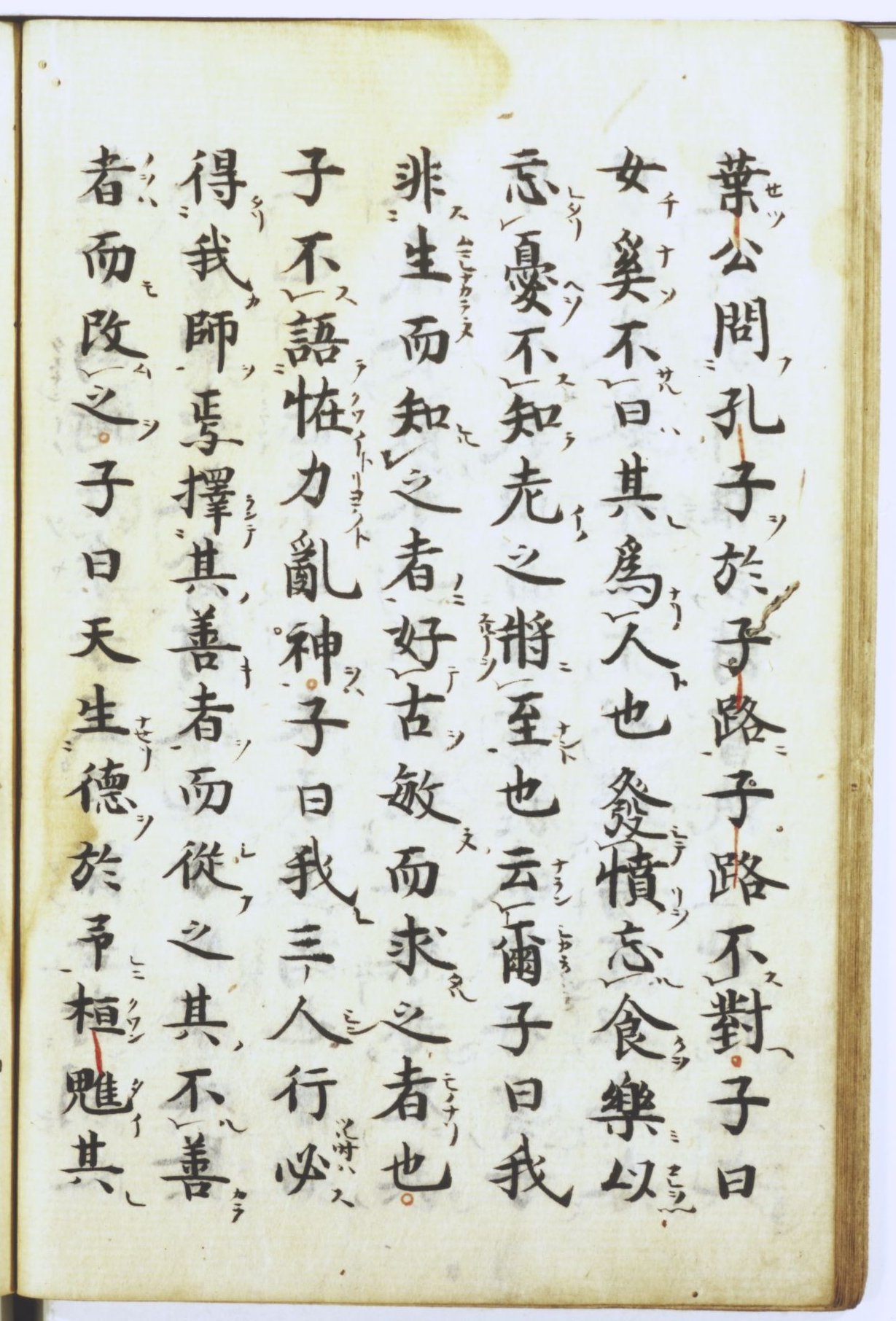
Kyoto University Library RB00007936, IIIF canvas 29, right-hand page: 7 written columns of up to 14 characters, main text only, with Japanese reading marks. Checked on the image: the first column of this book's text on this page begins ‹葉公問›, the last begins ‹者而改›. 7.18.1 opens column 1. 7.22 runs on to canvas 29, left-hand page (first column ‹如予何›), where the section ends. Column openings on these pages that differ from the received text: ‹得我師› where the received text has ‹我師焉›. The Chinese shown is the received text (Wikisource), not a transcription of this manuscript; Legge's English translates the received text.
18.1葉公問孔子於子路,子路不對。
18.2子曰:「女奚不曰:『其爲人也,發憤忘食,樂以忘憂,不知老之將至云爾。』」
19子曰:「我非生而知之者,好古,敏以求之者也。」
20子不語:怪、力、亂、神。
21子曰:「三人行,必有我師焉。擇其善者而從之,其不善者而改之。」
22子曰:「天生德於予,桓魋其如予何!」
18.1The Duke of Sheh asked Tsze-lu about Confucius, and Tsze-lu did not answer him.
18.2The Master said, 'Why did you not say to him,-- He is simply a man, who in his eager pursuit (of knowledge) forgets his food, who in the joy of its attainment forgets his sorrows, and who does not perceive that old age is coming on?'
19The Master said, 'I am not one who was born in the possession of knowledge; I am one who is fond of antiquity, and earnest in seeking it there.'
20The subjects on which the Master did not talk, were-- extraordinary things, feats of strength, disorder, and spiritual beings.
21The Master said, 'When I walk along with two others, they may serve me as my teachers. I will select their good qualities and follow them, their bad qualities and avoid them.'
22The Master said, 'Heaven produced the virtue that is in me. Hwan T'ui-- what can he do to me?'
Where on the image
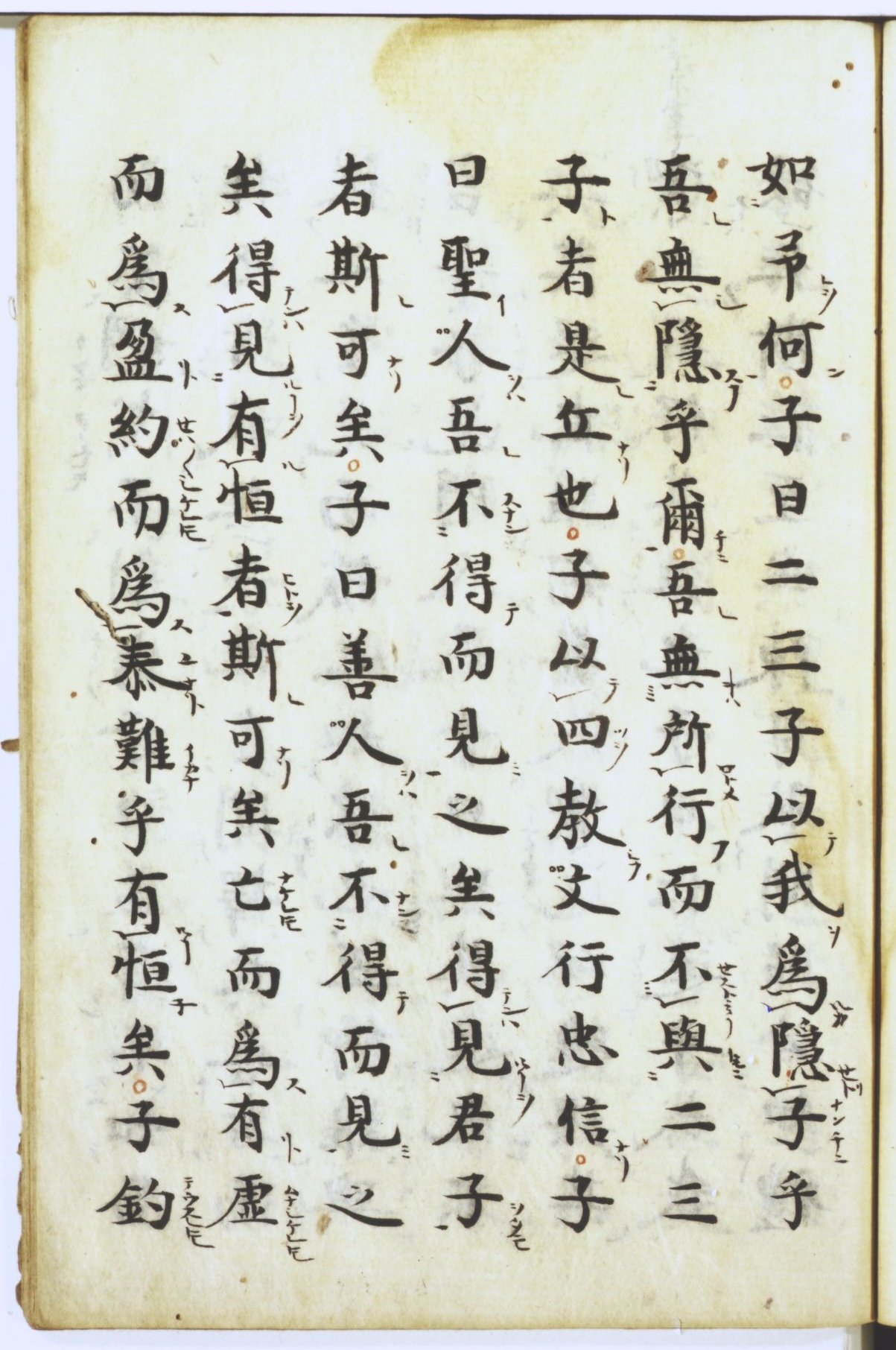
Kyoto University Library RB00007936, IIIF canvas 29, left-hand page: 7 written columns of up to 14 characters, main text only, with Japanese reading marks. Checked on the image: the first column of this book's text on this page begins ‹如予何›, the last begins ‹而為盈›. 7.23 begins inside column 1 (the column opens ‹如予何›), 3 characters down in the received text. Above it the page finishes 7.22, shown in the previous section. 7.26 runs on to canvas 30, right-hand page (first column ‹而不綱›), where the section ends. The Chinese shown is the received text (Wikisource), not a transcription of this manuscript; Legge's English translates the received text.
23子曰:「二三子,以我爲隱乎?吾無隱乎爾!吾無行而不與二三子者,是丘也。」
24子以四教:文、行、忠、信。
25.1子曰:「聖人,吾不得而見之矣!得見君子者,斯可矣。」
25.2子曰:「善人,吾不得而見之矣!得見有恆者,斯可矣。
25.3亡而爲有,虛而爲盈,約而爲泰,難乎有恆矣!」
26子釣而不綱,弋不射宿。
23The Master said, 'Do you think, my disciples, that I have any concealments? I conceal nothing from you. There is nothing which I do that is not shown to you, my disciples;-- that is my way.'
24There were four things which the Master taught,-- letters, ethics, devotion of soul, and truthfulness.
25.1The Master said, 'A sage it is not mine to see; could I see a man of real talent and virtue, that would satisfy me.'
25.2The Master said, 'A good man it is not mine to see; could I see a man possessed of constancy, that would satisfy me.
25.3'Having not and yet affecting to have, empty and yet affecting to be full, straitened and yet affecting to be at ease:-- it is difficult with such characteristics to have constancy.'
26The Master angled,-- but did not use a net. He shot,-- but not at birds perching.
Where on the image
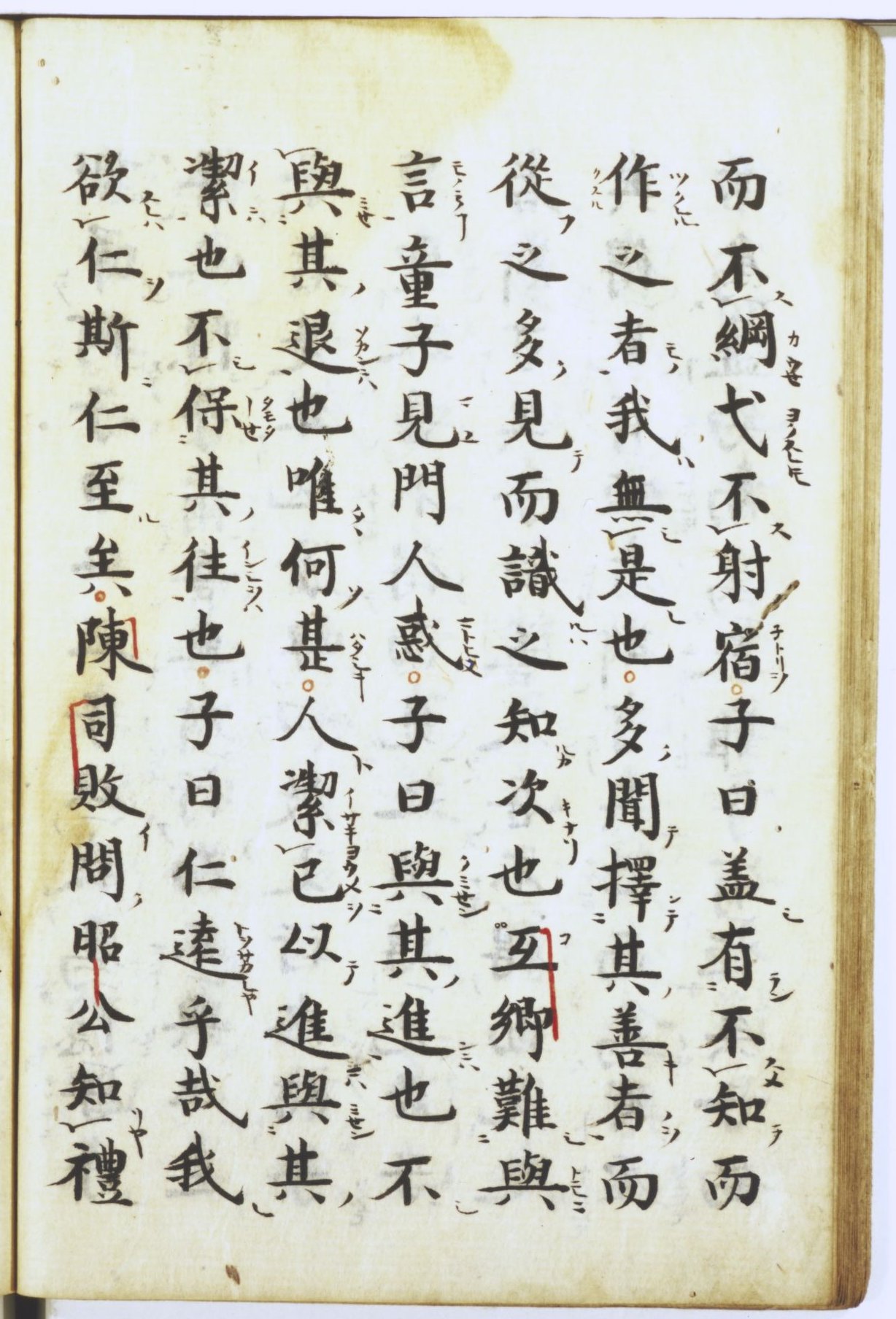
Kyoto University Library RB00007936, IIIF canvas 30, right-hand page: 7 written columns of up to 14 characters, main text only, with Japanese reading marks. Checked on the image: the first column of this book's text on this page begins ‹而不綱›, the last begins ‹欲仁斯›. 7.27 begins inside column 1 (the column opens ‹而不綱›), 7 characters down in the received text. Above it the page finishes 7.26, shown in the previous section. 7.30.1 runs on to canvas 30, left-hand page (first column ‹乎孔子›), where the section ends. The Chinese shown is the received text (Wikisource), not a transcription of this manuscript; Legge's English translates the received text.
27子曰:「蓋有不知而作之者,我無是也。多聞,擇其善者而從之,多見而識之,知之次也。」
28.1互鄉難與言。童子見,門人惑。
28.2子曰:「與其進也,不與其退也。唯何甚?人潔己以進,與其潔也,不保其往也!」
29子曰:「仁遠乎哉?我欲仁,斯仁至矣。」
30.1陳司敗問:「昭公知禮乎?」孔子對曰:「知禮。」
27The Master said, 'There may be those who act without knowing why. I do not do so. Hearing much and selecting what is good and following it; seeing much and keeping it in memory:-- this is the second style of knowledge.'
28.1It was difficult to talk (profitably and reputably) with the people of Hu-hsiang, and a lad of that place having had an interview with the Master, the disciples doubted.
28.2The Master said, 'I admit people's approach to me without committing myself as to what they may do when they have retired. Why must one be so severe? If a man purify himself to wait upon me, I receive him so purified, without guaranteeing his past conduct.'
29The Master said, 'Is virtue a thing remote? I wish to be virtuous, and lo! virtue is at hand.'
30.1The minister of crime of Ch'an asked whether the duke Chao knew propriety, and Confucius said, 'He knew propriety.'
Where on the image
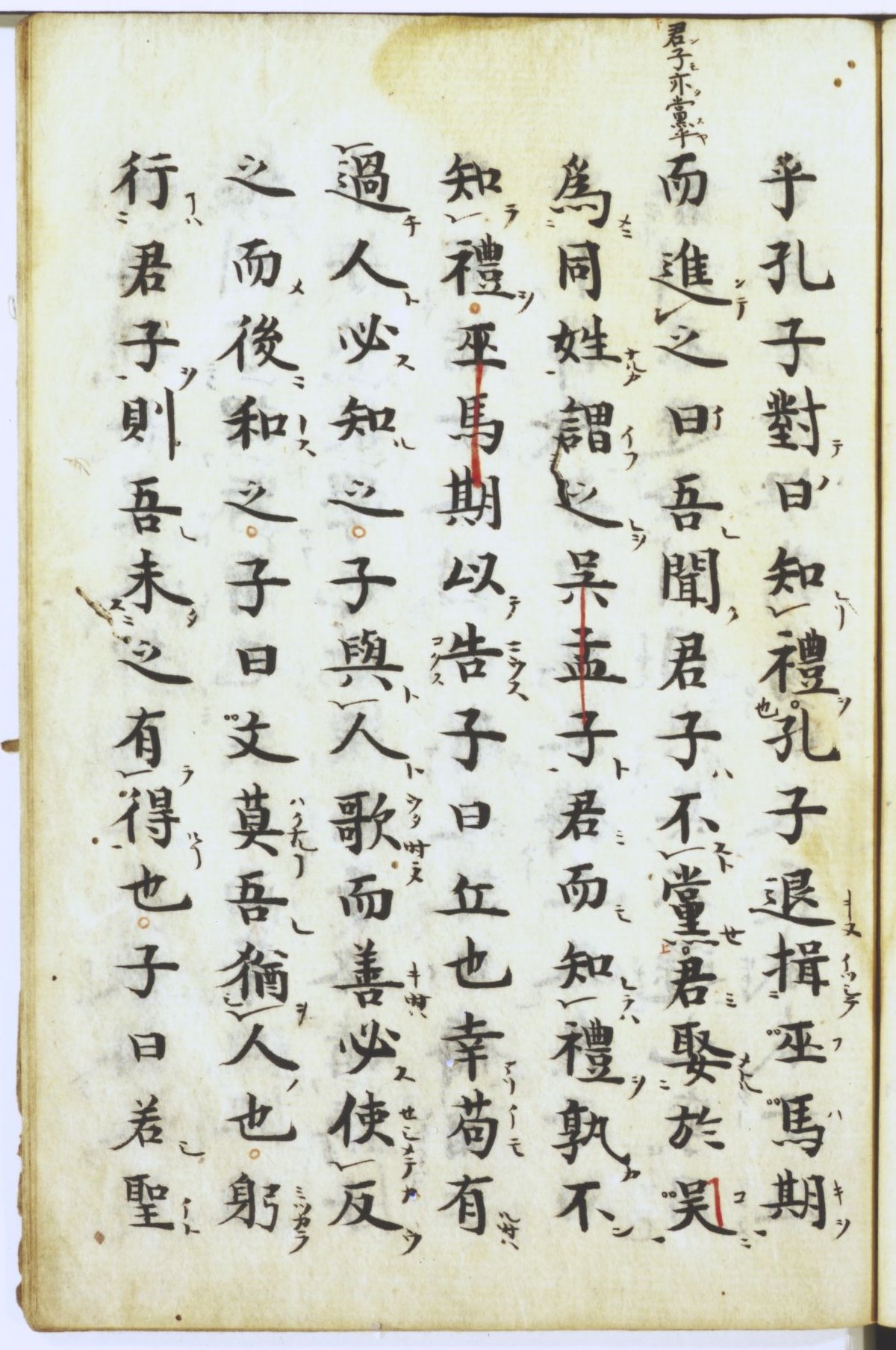
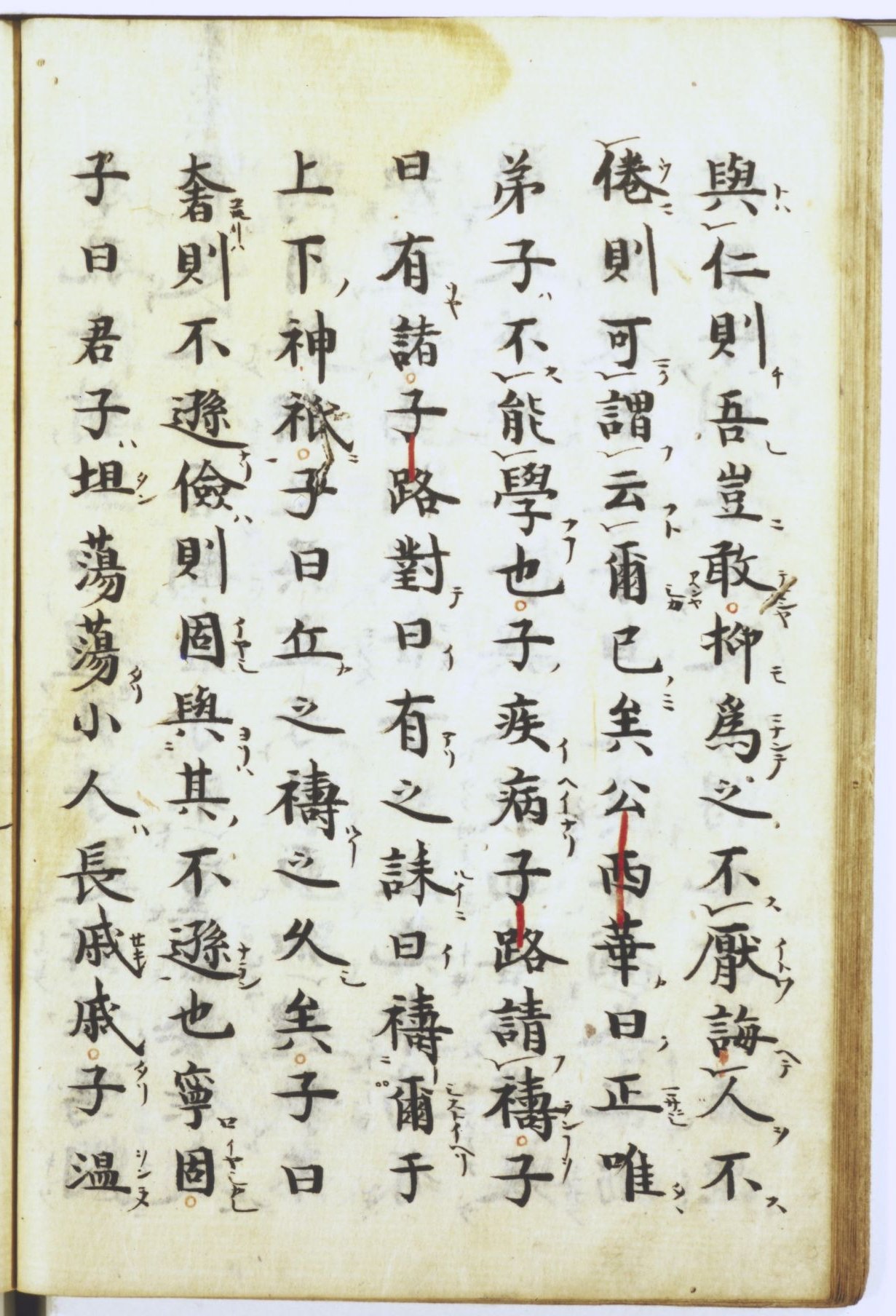
Kyoto University Library RB00007936, IIIF canvas 30, left-hand page: 7 written columns of up to 14 characters, main text only, with Japanese reading marks. Checked on the image: the first column of this book's text on this page begins ‹乎孔子›, the last begins ‹行君子›. 7.30.2 begins inside column 1 (the column opens ‹乎孔子›), 7 characters down in the received text. Above it the page finishes 7.30.1, shown in the previous section. 7.33 runs on to canvas 31, right-hand page (first column ‹與仁則›), where the section ends. The Chinese shown is the received text (Wikisource), not a transcription of this manuscript; Legge's English translates the received text.
30.2孔子退,揖巫馬期而進之,曰:「吾聞君子不黨,君子亦黨乎?君取於吳爲同姓,謂之吳孟子。君而知禮,孰不知禮?」
30.3巫馬期以吿。子曰:「丘也幸,苟有過,人必知之。」
31子與人歌而善,必使反之,而後和之。
32子曰:「文,莫吾猶人也;躬行君子,則吾未之有得!」
33子曰:「若聖與仁,則吾豈敢?抑爲之不厭,誨人不倦,則可謂云爾已矣!」公西華曰:「正唯弟子不能學也!」
30.2Confucius having retired, the minister bowed to Wu-ma Ch'i to come forward, and said, 'I have heard that the superior man is not a partisan. May the superior man be a partisan also? The prince married a daughter of the house of Wu, of the same surname with himself, and called her,-- "The elder Tsze of Wu." If the prince knew propriety, who does not know it?'
30.3Wu-ma Ch'i reported these remarks, and the Master said, 'I am fortunate! If I have any errors, people are sure to know them.'
31When the Master was in company with a person who was singing, if he sang well, he would make him repeat the song, while he accompanied it with his own voice.
32The Master said, 'In letters I am perhaps equal to other men, but the character of the superior man, carrying out in his conduct what he professes, is what I have not yet attained to.'
33The Master said, 'The sage and the man of perfect virtue;-- how dare I rank myself with them? It may simply be said of me, that I strive to become such without satiety, and teach others without weariness.' Kung-hsi Hwa said, 'This is just what we, the disciples, cannot imitate you in.'
Where on the image
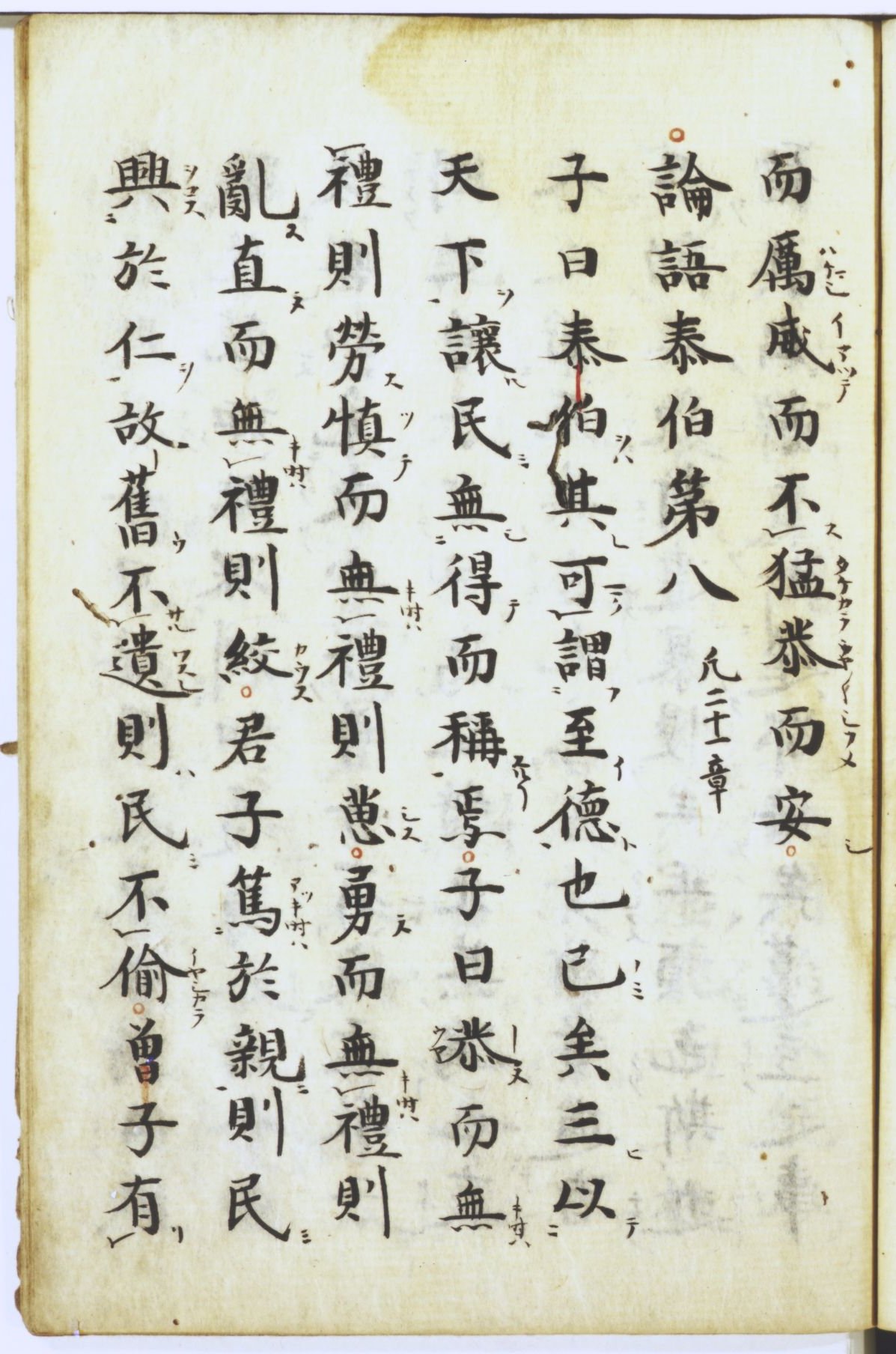
Kyoto University Library RB00007936, IIIF canvas 31, right-hand page: 7 written columns of up to 14 characters, main text only, with Japanese reading marks. Checked on the image: the first column of this book's text on this page begins ‹與仁則›, the last begins ‹子曰君›. 7.34 begins inside column 3 (the column opens ‹弟子不›), 6 characters down in the received text. Above it the page finishes 7.33, shown in the previous section. 7.37 runs on to canvas 31, left-hand page (first column ‹而厲威›), where the section ends. The Chinese shown is the received text (Wikisource), not a transcription of this manuscript; Legge's English translates the received text.
34子疾病,子路請禱。子曰:「有諸?」子路對曰:「有之。誄曰:『禱爾于上下神祇。』子曰:「丘之禱久矣!」
35子曰:「奢則不孫,儉則固;與其不孫也,甯固。」
36子曰:「君子坦蕩蕩,小人長戚戚。」
37子溫而厲,威而不猛,恭而安。
34The Master being very sick, Tsze-lu asked leave to pray for him. He said, 'May such a thing be done?' Tsze-lu replied, 'It may. In the Eulogies it is said, "Prayer has been made for thee to the spirits of the upper and lower worlds."' The Master said, 'My praying has been for a long time.'
35The Master said, 'Extravagance leads to insubordination, and parsimony to meanness. It is better to be mean than to be insubordinate.'
36The Master said, 'The superior man is satisfied and composed; the mean man is always full of distress.'
37The Master was mild, and yet dignified; majestic, and yet not fierce; respectful, and yet easy.
Notes
- English: James Legge, Confucian Analects, The Chinese Classics vol. 1. Legge's chapter and paragraph numbers are kept as superscripts (chapter.paragraph).
- Legge translated the received text. Where this manuscript's wording differs, his English follows the received text shown here.
Cite
Sources
- Source: Kyoto University Library RB00007936 (Analects manuscript attributed to Kiyohara Yoshieda, c. 1300) + Wikisource received text + James Legge's English (Project Gutenberg) (holding institution)
- Critical edition: Received text (Wikisource) in Legge's chapter and paragraph division
← previous · → next · v cycle view · l back to library