Analects, Book 8: Taibo 泰伯 (Kamakura-period manuscript)
Introduction
Book 8 of the Analects (論語 Lunyu), titled 泰伯 (Taibo) after its opening words, 21 chapters in Legge's division. It is shown on a manuscript of the Analects in the Kiyohara family collection (Seike bunko) of Kyoto University Library, two volumes in regular script, seven columns of fourteen characters to the page, main text only, with red and black Japanese reading marks. A colophon by Kiyohara Edakata dated 1550 names the copyist as his ancestor Kiyohara Yoshieda (1253-1331), which places the copy around 1300, in the late Kamakura period; the attribution is traditional. The Kiyohara were hereditary readers of the Confucian classics at the Japanese court, and their text descends from the edition of the Analects with the collected commentary of He Yan (3rd century CE): after each pair of books the scribe copied the character counts of the classic and of the commentary, although only the classic is written out. The manuscript is an Important Cultural Property of Japan.
In this copy Book 8 runs from canvas 31, left-hand page to canvas 34, left-hand page (volume 1). Each section gathers the paragraphs that begin on one page, numbered by chapter and paragraph as in Legge, and links to that page and to any page the last paragraph runs onto. The page boundaries were found by reading the first characters of every column on the photographs. The Chinese shown is the received text, from Wikisource. This manuscript differs from it in places, most often by an added or missing particle (也, 矣, 焉) or a variant character form; the differences seen at column openings are listed in the scan notes. The English is James Legge's translation of the received text.
How was this verified? (Provenance)
Where on the image
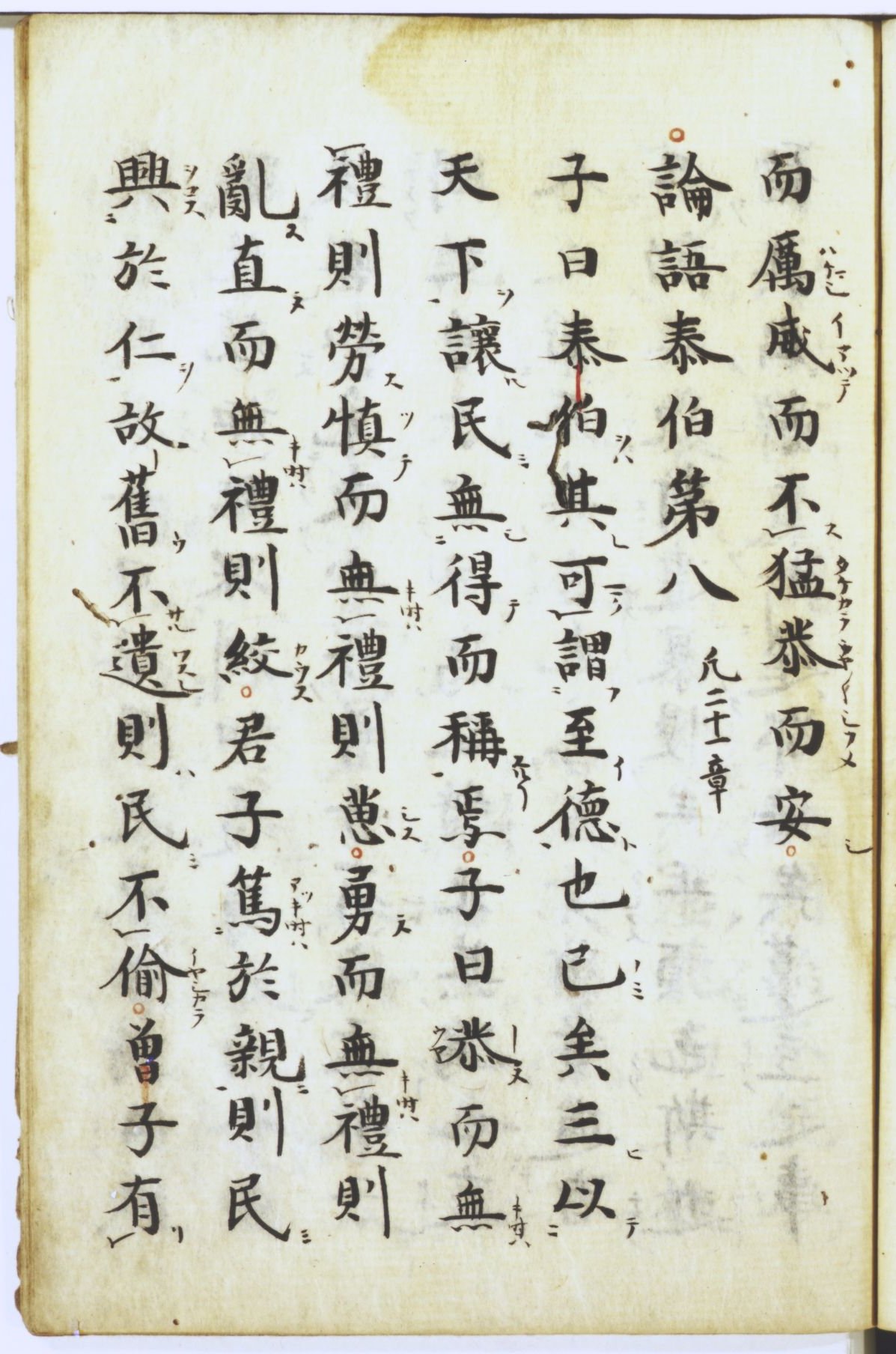
Kyoto University Library RB00007936, IIIF canvas 31, left-hand page: 7 written columns of up to 14 characters, main text only, with Japanese reading marks. Checked on the image: the first column of this book's text on this page begins ‹子曰泰›, the last begins ‹興於仁›. Column 2 carries the title 論語泰伯第八. 8.1 opens column 3. 8.3 runs on to canvas 32, right-hand page (first column ‹疾召門›), where the section ends. Column openings on these pages that differ from the received text: ‹戰兢兢› where the received text has ‹戰戰兢›. The Chinese shown is the received text (Wikisource), not a transcription of this manuscript; Legge's English translates the received text.
1子曰:「泰伯,其可謂至德也已矣!三以天下讓,民無得而稱焉。」
2.1子曰:「恭而無禮則勞,愼而無禮則葸,勇而無禮則亂,直而無禮則絞。
2.2君子篤於親,則民興於仁。故舊不遺,則民不偷。」
3曾子有疾,召門弟子曰:「啟予足!啟予手!詩云:『戰戰兢兢,如臨深淵,如履薄冰。』而今而後,吾知免夫!小子!」
1The Master said, 'T'ai-po may be said to have reached the highest point of virtuous action. Thrice he declined the kingdom, and the people in ignorance of his motives could not express their approbation of his conduct.'
2.1The Master said, 'Respectfulness, without the rules of propriety, becomes laborious bustle; carefulness, without the rules of propriety, becomes timidity; boldness, without the rules of propriety, becomes insubordination; straightforwardness, without the rules of propriety, becomes rudeness.
2.2'When those who are in high stations perform well all their duties to their relations, the people are aroused to virtue. When old friends are not neglected by them, the people are preserved from meanness.'
3The philosopher Tsang being ill, he called to him the disciples of his school, and said, 'Uncover my feet, uncover my hands. It is said in the Book of Poetry, "We should be apprehensive and cautious, as if on the brink of a deep gulf, as if treading on thin ice," and so have I been. Now and hereafter, I know my escape from all injury to my person, O ye, my little children.'
Where on the image
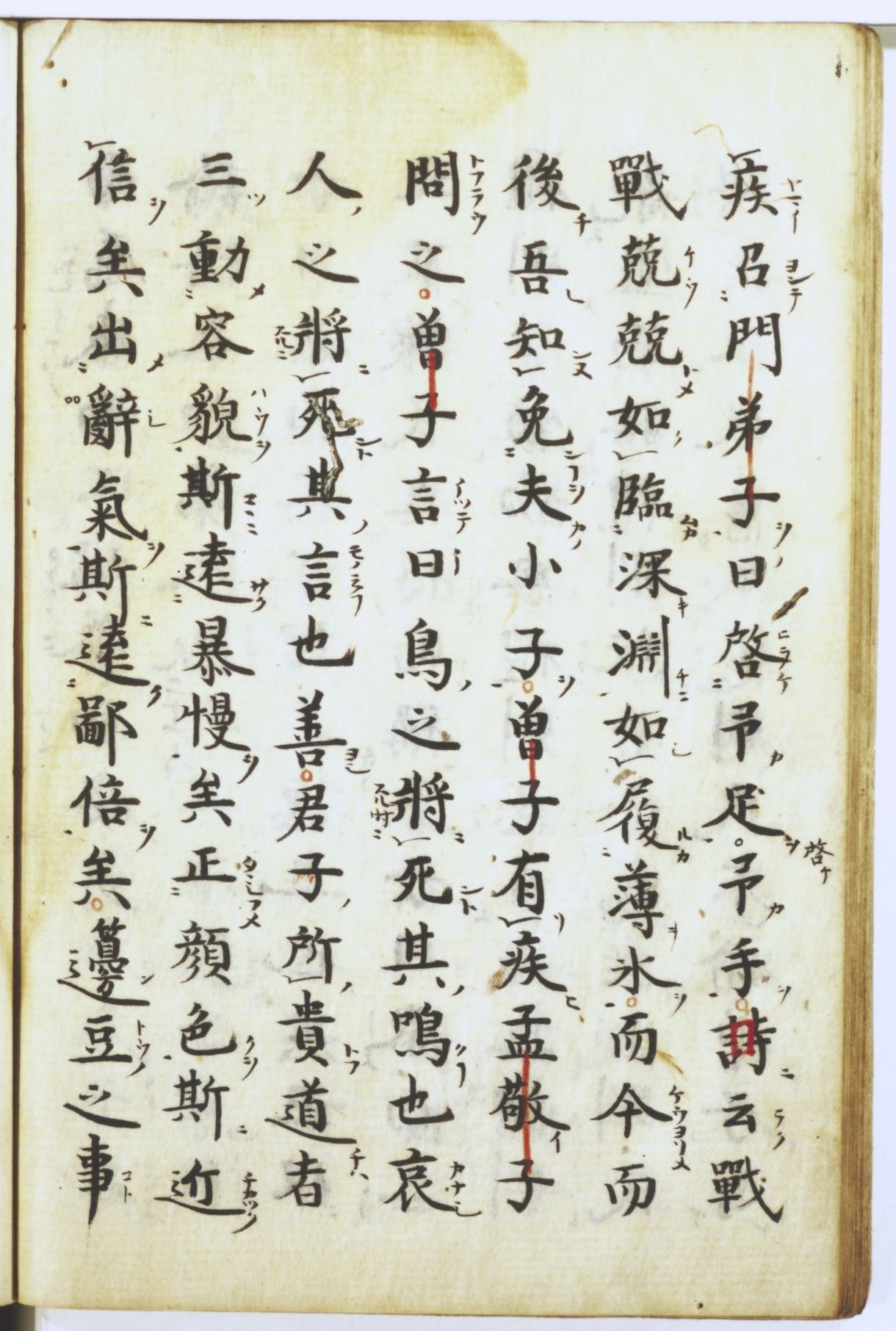
Kyoto University Library RB00007936, IIIF canvas 32, right-hand page: 7 written columns of up to 14 characters, main text only, with Japanese reading marks. Checked on the image: the first column of this book's text on this page begins ‹疾召門›, the last begins ‹信矣出›. 8.4.1 begins inside column 3 (the column opens ‹後吾知›), 7 characters down in the received text. Above it the page finishes 8.3, shown in the previous section. 8.4.3 runs on to canvas 32, left-hand page (first column ‹則有司›), where the section ends. The Chinese shown is the received text (Wikisource), not a transcription of this manuscript; Legge's English translates the received text.
4.1曾子有疾,孟敬子問之。
4.2曾子言曰:「鳥之將死,其鳴也哀,人之將死,其言也善。
4.3君子所貴乎道者三:動容貌,斯遠暴慢矣;正顏色,斯近信矣;出辭氣,斯遠鄙倍矣;籩豆之事,則有司存。」
4.1The philosopher Tsang being ill, Meng Chang went to ask how he was.
4.2Tsang said to him, 'When a bird is about to die, its notes are mournful; when a man is about to die, his words are good.
4.3'There are three principles of conduct which the man of high rank should consider specially important:-- that in his deportment and manner he keep from violence and heedlessness; that in regulating his countenance he keep near to sincerity; and that in his words and tones he keep far from lowness and impropriety. As to such matters as attending to the sacrificial vessels, there are the proper officers for them.'
Where on the image
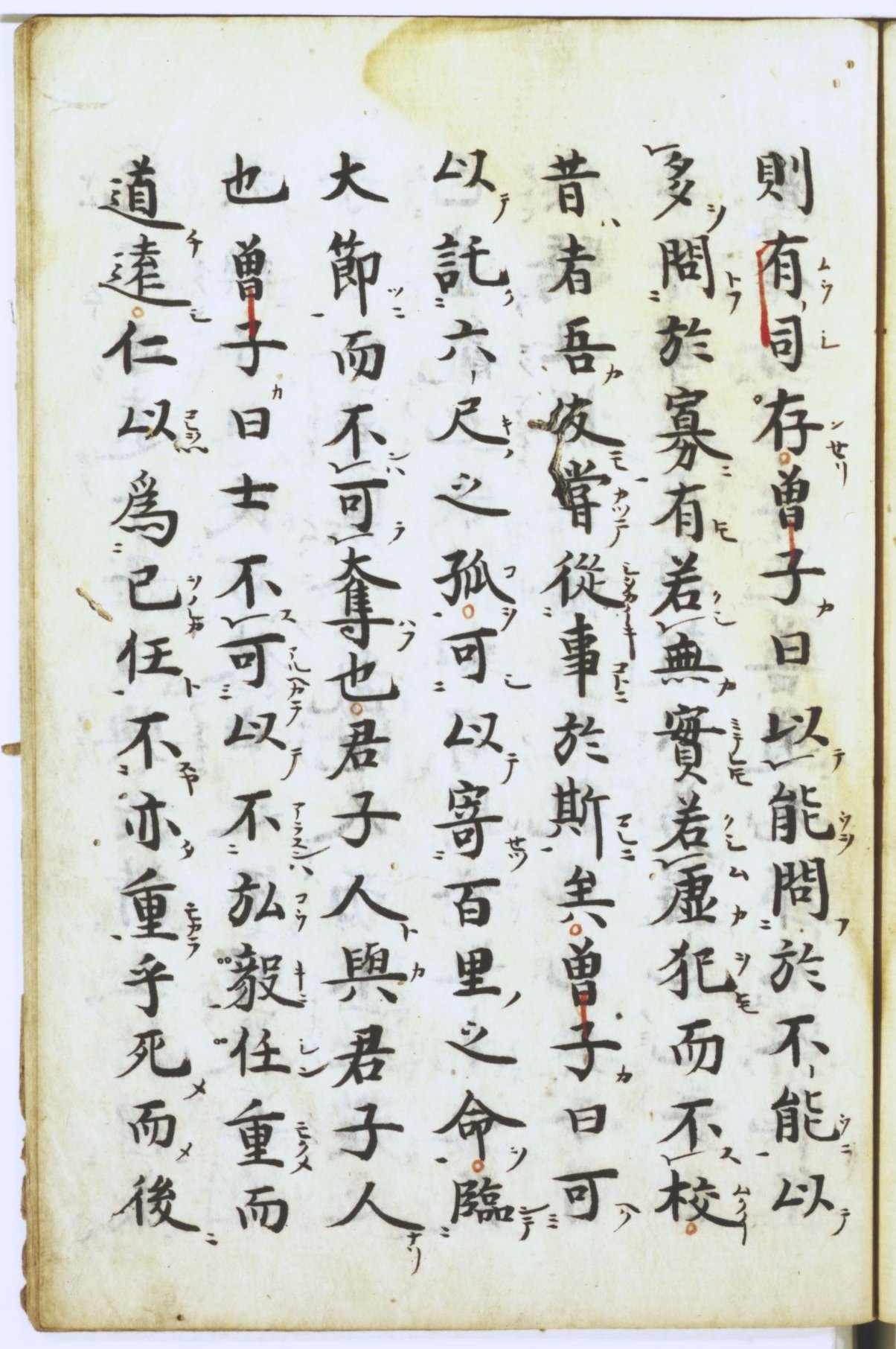
Kyoto University Library RB00007936, IIIF canvas 32, left-hand page: 7 written columns of up to 14 characters, main text only, with Japanese reading marks. Checked on the image: the first column of this book's text on this page begins ‹則有司›, the last begins ‹道遠仁›. 8.5 begins inside column 1 (the column opens ‹則有司›), 4 characters down in the received text. Above it the page finishes 8.4.3, shown in the previous section. 8.7.2 runs on to canvas 33, right-hand page (first column ‹已不亦›), where the section ends. The Chinese shown is the received text (Wikisource), not a transcription of this manuscript; Legge's English translates the received text.
5曾子曰:「以能問於不能,以多問於寡,有若無,實若虛,犯而不校。昔者吾友,嘗從事於斯矣。」
6曾子曰:「可以託六尺之孤,可以寄百里之命,臨大節而不可奪也。君子人與?君子人也!」
7.1曾子曰:「士不可以不弘毅,任重而道遠。
7.2仁以爲己任,不亦重乎;死而後已,不亦遠乎。」
5The philosopher Tsang said, 'Gifted with ability, and yet putting questions to those who were not so; possessed of much, and yet putting questions to those possessed of little; having, as though he had not; full, and yet counting himself as empty; offended against, and yet entering into no altercation; formerly I had a friend who pursued this style of conduct.'
6The philosopher Tsang said, 'Suppose that there is an individual who can be entrusted with the charge of a young orphan prince, and can be commissioned with authority over a state of a hundred li, and whom no emergency however great can drive from his principles:-- is such a man a superior man? He is a superior man indeed.'
7.1The philosopher Tsang said, 'The officer may not be without breadth of mind and vigorous endurance. His burden is heavy and his course is long.
7.2'Perfect virtue is the burden which he considers it is his to sustain;-- is it not heavy? Only with death does his course stop;-- is it not long?
Where on the image
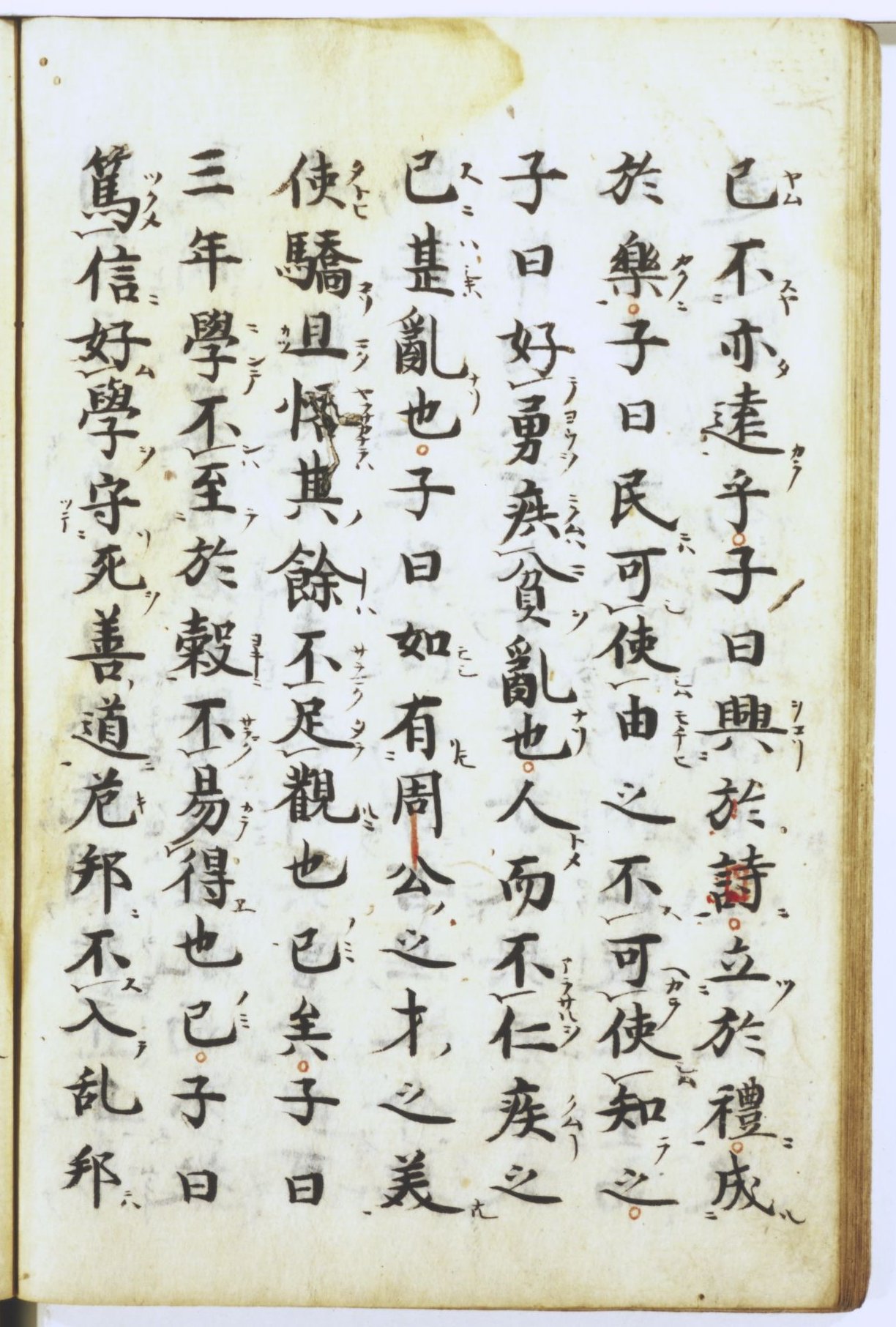
Kyoto University Library RB00007936, IIIF canvas 33, right-hand page: 7 written columns of up to 14 characters, main text only, with Japanese reading marks. Checked on the image: the first column of this book's text on this page begins ‹已不亦›, the last begins ‹篤信好›. 8.8.1 begins inside column 1 (the column opens ‹已不亦›), 5 characters down in the received text. Above it the page finishes 8.7.2, shown in the previous section. 8.13.2 runs on to canvas 33, left-hand page (first column ‹不居天›), where the section ends. The Chinese shown is the received text (Wikisource), not a transcription of this manuscript; Legge's English translates the received text.
8.1子曰:「興於詩,
8.2立於禮,
8.3成於樂。」
9子曰:「民可使由之,不可使知之。」
10子曰:「好勇疾貧,亂也。人而不仁,疾之已甚,亂也。」
11子曰:「如有周公之才之美,使驕且吝,其餘不足觀也已!」
12子曰:「三年學,不至於穀,不易得也。」
13.1子曰:「篤信好學,守死善道。
13.2危邦不入,亂邦不居。天下有道則見,無道則隱。
8.1The Master said, 'It is by the Odes that the mind is aroused.
8.2'It is by the Rules of Propriety that the character is established.
8.3'It is from Music that the finish is received.'
9The Master said, 'The people may be made to follow a path of action, but they may not be made to understand it.'
10The Master said, 'The man who is fond of daring and is dissatisfied with poverty, will proceed to insubordination. So will the man who is not virtuous, when you carry your dislike of him to an extreme.'
11The Master said, 'Though a man have abilities as admirable as those of the Duke of Chau, yet if he be proud and niggardly, those other things are really not worth being looked at.'
12The Master said, 'It is not easy to find a man who has learned for three years without coming to be good.'
13.1The Master said, 'With sincere faith he unites the love of learning; holding firm to death, he is perfecting the excellence of his course.
13.2'Such an one will not enter a tottering State, nor dwell in a disorganized one. When right principles of government prevail in the kingdom, he will show himself; when they are prostrated, he will keep concealed.
Where on the image
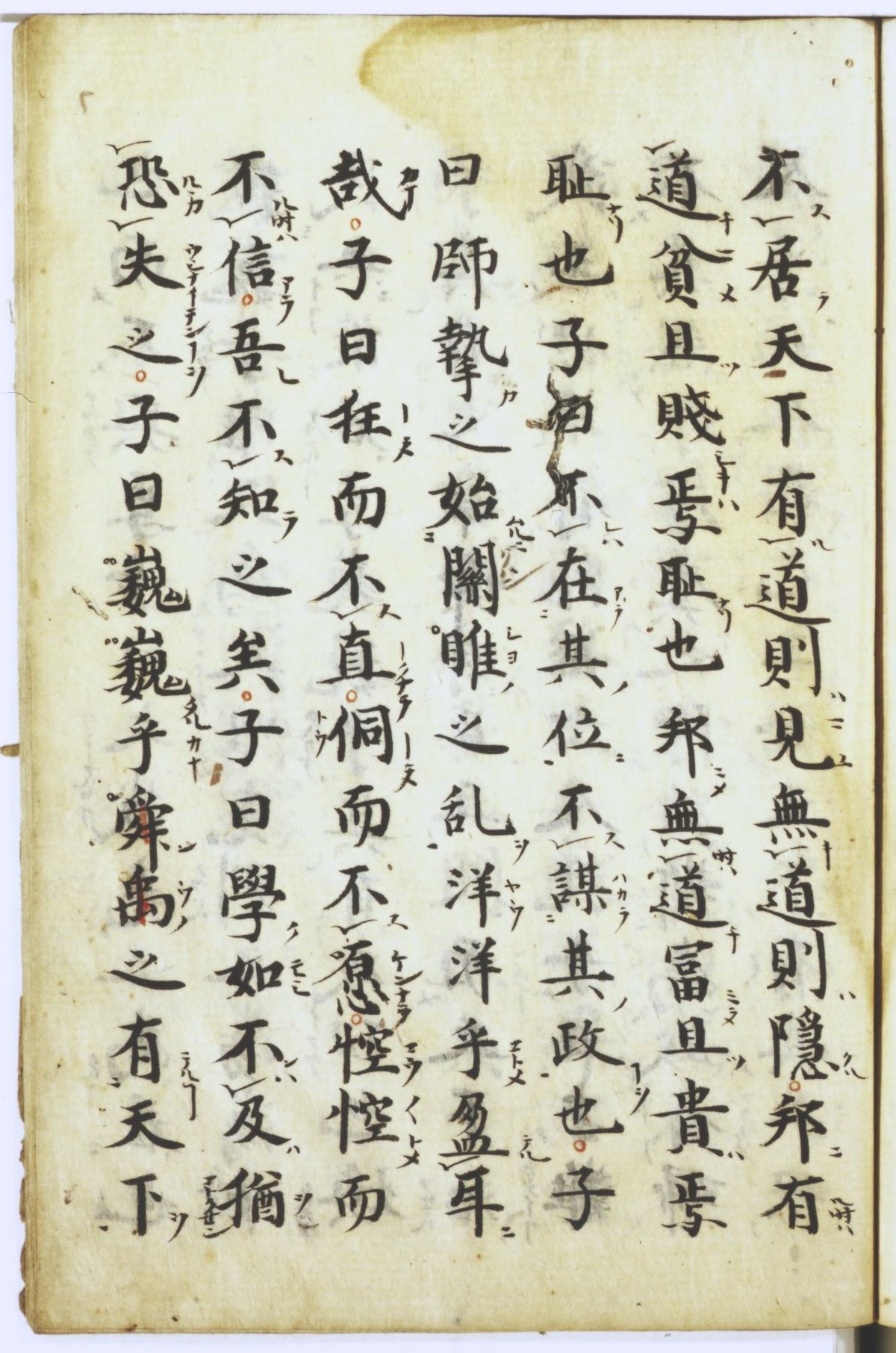
Kyoto University Library RB00007936, IIIF canvas 33, left-hand page: 7 written columns of up to 14 characters, main text only, with Japanese reading marks. Checked on the image: the first column of this book's text on this page begins ‹不居天›, the last begins ‹恐失之›. 8.13.3 begins inside column 1 (the column opens ‹不居天›), 12 characters down in the received text. Above it the page finishes 8.13.2, shown in the previous section. 8.18 runs on to canvas 34, right-hand page (first column ‹也而不›), where the section ends. The Chinese shown is the received text (Wikisource), not a transcription of this manuscript; Legge's English translates the received text.
13.3邦有道,貧且賤焉,恥也;邦無道,富且貴焉,恥也。」
14子曰:「不在其位,不謀其政。」
15子曰:「師摯之始,關雎之亂,洋洋乎,盈耳哉!」
16子曰:「狂而不直,侗而不愿,悾悾而不信,吾不知之矣!」
17子曰:「學如不及,猶恐失之。」
18子曰:「巍巍乎,舜、禹之有天下也,而不與焉。」
13.3'When a country is well-governed, poverty and a mean condition are things to be ashamed of. When a country is ill- governed, riches and honour are things to be ashamed of.'
14The Master said, 'He who is not in any particular office, has nothing to do with plans for the administration of its duties.'
15The Master said, 'When the music master Chih first entered on his office, the finish of the Kwan Tsu was magnificent;-- how it filled the ears!'
16The Master said, 'Ardent and yet not upright; stupid and yet not attentive; simple and yet not sincere:-- such persons I do not understand.'
17The Master said, 'Learn as if you could not reach your object, and were always fearing also lest you should lose it.'
18The Master said, 'How majestic was the manner in which Shun and Yu held possession of the empire, as if it were nothing to them!'
Where on the image
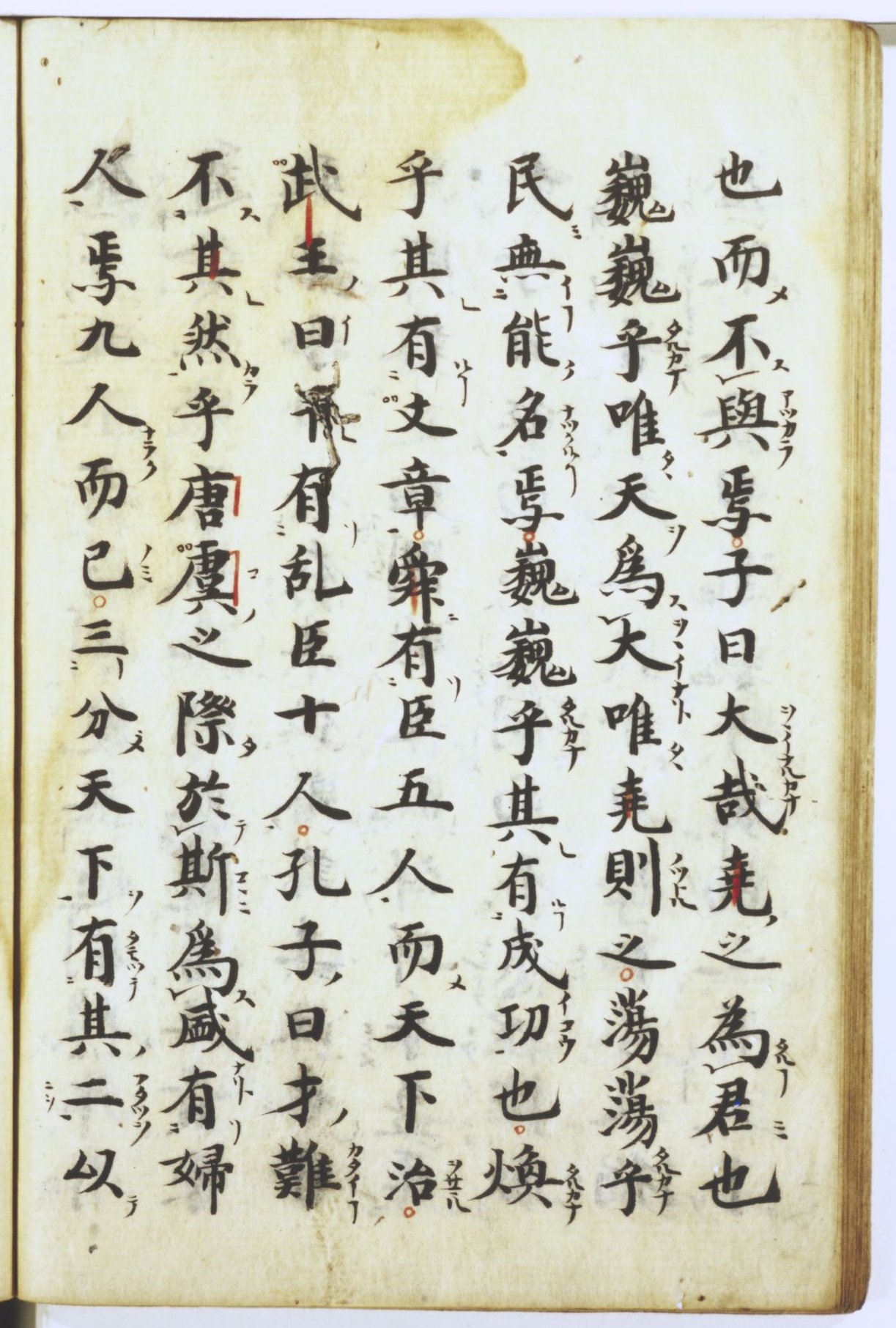
Kyoto University Library RB00007936, IIIF canvas 34, right-hand page: 7 written columns of up to 14 characters, main text only, with Japanese reading marks. Checked on the image: the first column of this book's text on this page begins ‹也而不›, the last begins ‹人焉九›. 8.19.1 begins inside column 1 (the column opens ‹也而不›), 5 characters down in the received text. Above it the page finishes 8.18, shown in the previous section. 8.20.4 runs on to canvas 34, left-hand page (first column ‹服事殷›), where the section ends. The Chinese shown is the received text (Wikisource), not a transcription of this manuscript; Legge's English translates the received text.
19.1子曰:「大哉,堯之爲君也!巍巍乎,唯天爲大,唯堯則之!蕩蕩乎,民無能名焉!
19.2巍巍乎,其有成功也!煥乎,其有文章!」
20.1舜有臣五人,而天下治。
20.2武王曰:「予有亂臣十人。」
20.3孔子曰:「『才難』,不其然乎?唐虞之際,於斯爲盛,有婦人焉,九人而已。
20.4三分天下有其二,以服事殷、周之德,其可謂至德也已矣!」
19.1The Master said, 'Great indeed was Yao as a sovereign! How majestic was he! It is only Heaven that is grand, and only Yao corresponded to it. How vast was his virtue! The people could find no name for it.
19.2'How majestic was he in the works which he accomplished! How glorious in the elegant regulations which he instituted!'
20.1Shun had five ministers, and the empire was well-governed.
20.2King Wu said, 'I have ten able ministers.'
20.3Confucius said, 'Is not the saying that talents are difficult to find, true? Only when the dynasties of T'ang and Yu met, were they more abundant than in this of Chau, yet there was a woman among them. The able ministers were no more than nine men.
20.4'King Wan possessed two of the three parts of the empire, and with those he served the dynasty of Yin. The virtue of the house of Chau may be said to have reached the highest point indeed.'
Where on the image
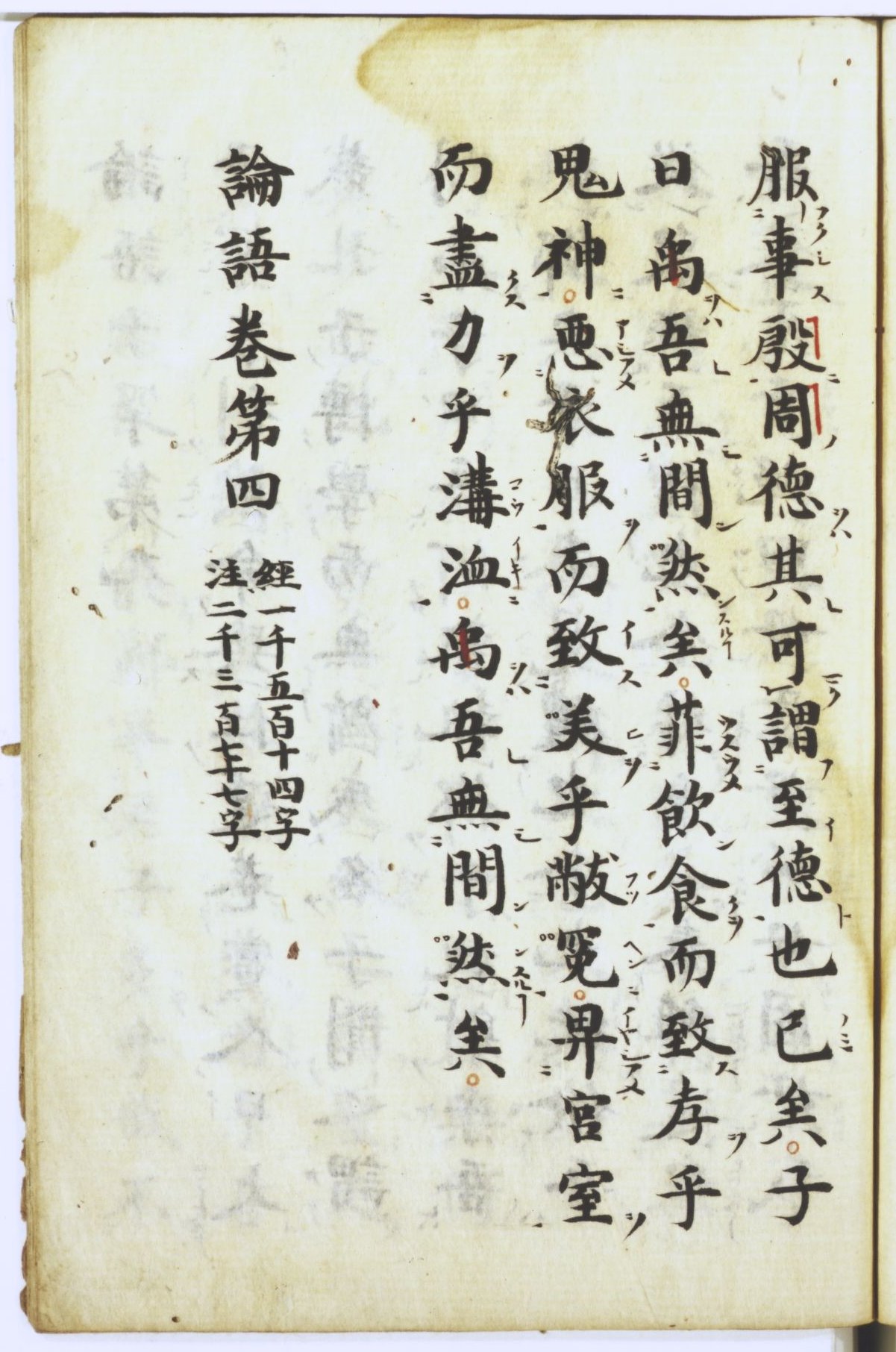
Kyoto University Library RB00007936, IIIF canvas 34, left-hand page: 5 written columns of up to 14 characters, main text only, with Japanese reading marks. Checked on the image: the first column of this book's text on this page begins ‹服事殷›, the last begins ‹而盡力›. Column 6 carries the title 論語卷第四. 8.21 begins inside column 1 (the column opens ‹服事殷›), 14 characters down in the received text. Above it the page finishes 8.20.4, shown in the previous section. The section ends on this page. The Chinese shown is the received text (Wikisource), not a transcription of this manuscript; Legge's English translates the received text.
21子曰:「禹,吾無間然矣!菲飮食,而致孝乎鬼神;惡衣服,而致美乎黻冕;卑宮室,而盡力乎溝洫。禹,吾無間然矣!」
21The Master said, 'I can find no flaw in the character of Yu. He used himself coarse food and drink, but displayed the utmost filial piety towards the spirits. His ordinary garments were poor, but he displayed the utmost elegance in his sacrificial cap and apron. He lived in a low mean house, but expended all his strength on the ditches and water-channels. I can find nothing like a flaw in Yu.'
Notes
- English: James Legge, Confucian Analects, The Chinese Classics vol. 1. Legge's chapter and paragraph numbers are kept as superscripts (chapter.paragraph).
- Legge translated the received text. Where this manuscript's wording differs, his English follows the received text shown here.
Cite
Sources
- Source: Kyoto University Library RB00007936 (Analects manuscript attributed to Kiyohara Yoshieda, c. 1300) + Wikisource received text + James Legge's English (Project Gutenberg) (holding institution)
- Critical edition: Received text (Wikisource) in Legge's chapter and paragraph division
← previous · → next · v cycle view · l back to library