Analects, Book 9: Zi han 子罕 (Kamakura-period manuscript)
Introduction
Book 9 of the Analects (論語 Lunyu), titled 子罕 (Zi han) after its opening words, 30 chapters in Legge's division. It is shown on a manuscript of the Analects in the Kiyohara family collection (Seike bunko) of Kyoto University Library, two volumes in regular script, seven columns of fourteen characters to the page, main text only, with red and black Japanese reading marks. A colophon by Kiyohara Edakata dated 1550 names the copyist as his ancestor Kiyohara Yoshieda (1253-1331), which places the copy around 1300, in the late Kamakura period; the attribution is traditional. The Kiyohara were hereditary readers of the Confucian classics at the Japanese court, and their text descends from the edition of the Analects with the collected commentary of He Yan (3rd century CE): after each pair of books the scribe copied the character counts of the classic and of the commentary, although only the classic is written out. The manuscript is an Important Cultural Property of Japan.
In this copy Book 9 runs from canvas 35, right-hand page to canvas 39, right-hand page (volume 1). Each section gathers the paragraphs that begin on one page, numbered by chapter and paragraph as in Legge, and links to that page and to any page the last paragraph runs onto. The page boundaries were found by reading the first characters of every column on the photographs. The Chinese shown is the received text, from Wikisource. This manuscript differs from it in places, most often by an added or missing particle (也, 矣, 焉) or a variant character form; the differences seen at column openings are listed in the scan notes. The English is James Legge's translation of the received text.
How was this verified? (Provenance)
Where on the image
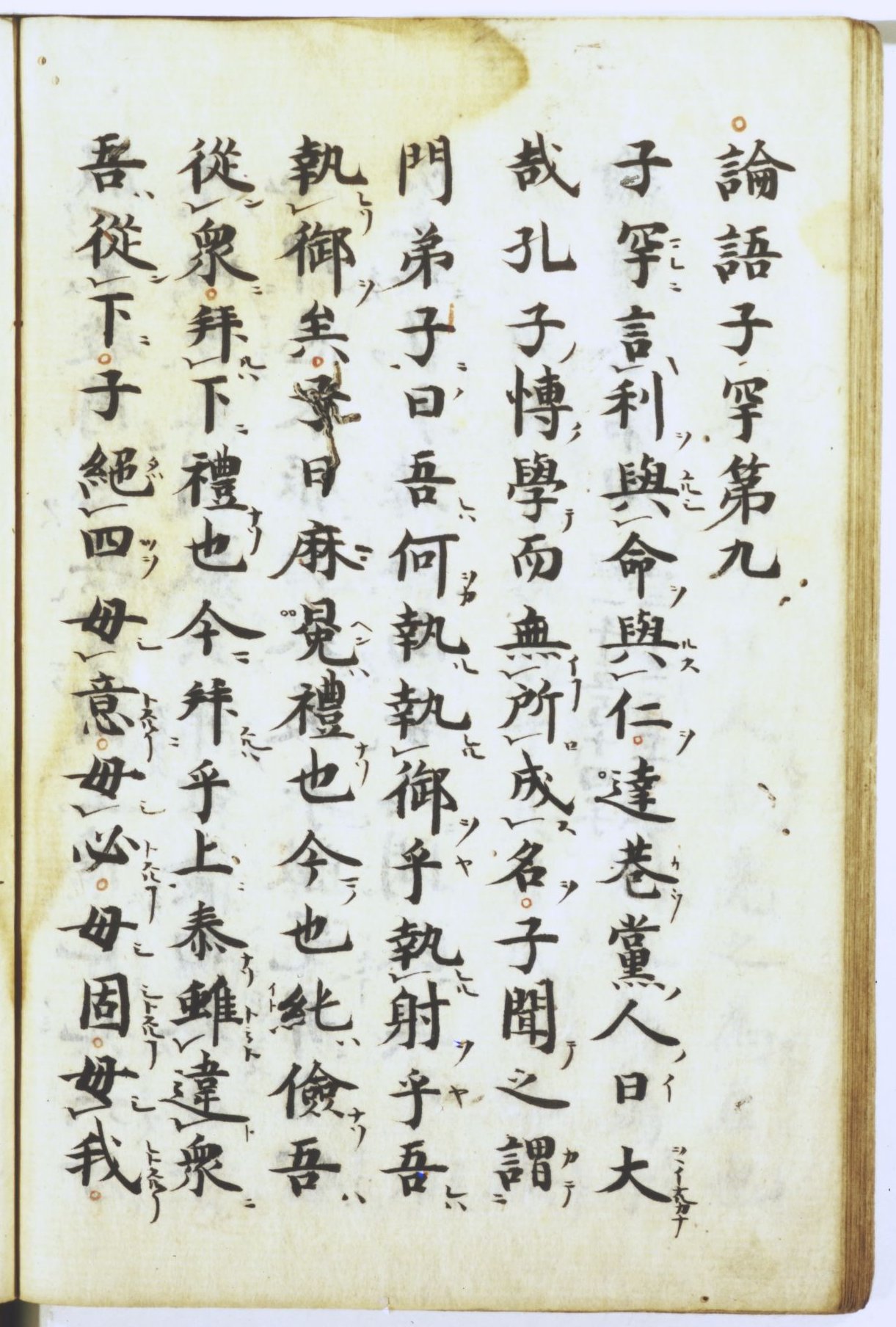
Kyoto University Library RB00007936, IIIF canvas 35, right-hand page: 7 written columns of up to 14 characters, main text only, with Japanese reading marks. Checked on the image: the first column of this book's text on this page begins ‹子罕言›, the last begins ‹吾從下›. Column 1 carries the title 論語子罕第九. 9.1 opens column 2. The section ends on this page. The Chinese shown is the received text (Wikisource), not a transcription of this manuscript; Legge's English translates the received text.
1子罕言利與命與仁。
2.1達巷黨人曰:「大哉孔子!博學而無所成名。」
2.2子聞之,謂門弟子曰:「吾何執?執御乎?執射乎?吾執御矣!」
3.1子曰:「麻冕,禮也;今也純,儉,吾從眾。
3.2拜下,禮也;今拜乎上,泰也。雖違眾,吾從下。」
4子絕四:「毋意,毋必,毋固,毋我。」
1The subjects of which the Master seldom spoke were-- profitableness, and also the appointments of Heaven, and perfect virtue.
2.1A man of the village of Ta-hsiang said, 'Great indeed is the philosopher K'ung! His learning is extensive, and yet he does not render his name famous by any particular thing.'
2.2The Master heard the observation, and said to his disciples, 'What shall I practise? Shall I practise charioteering, or shall I practise archery? I will practise charioteering.'
3.1The Master said, 'The linen cap is that prescribed by the rules of ceremony, but now a silk one is worn. It is economical, and I follow the common practice.
3.2'The rules of ceremony prescribe the bowing below the hall, but now the practice is to bow only after ascending it. That is arrogant. I continue to bow below the hall, though I oppose the common practice.'
4There were four things from which the Master was entirely free. He had no foregone conclusions, no arbitrary predeterminations, no obstinacy, and no egoism.
Where on the image
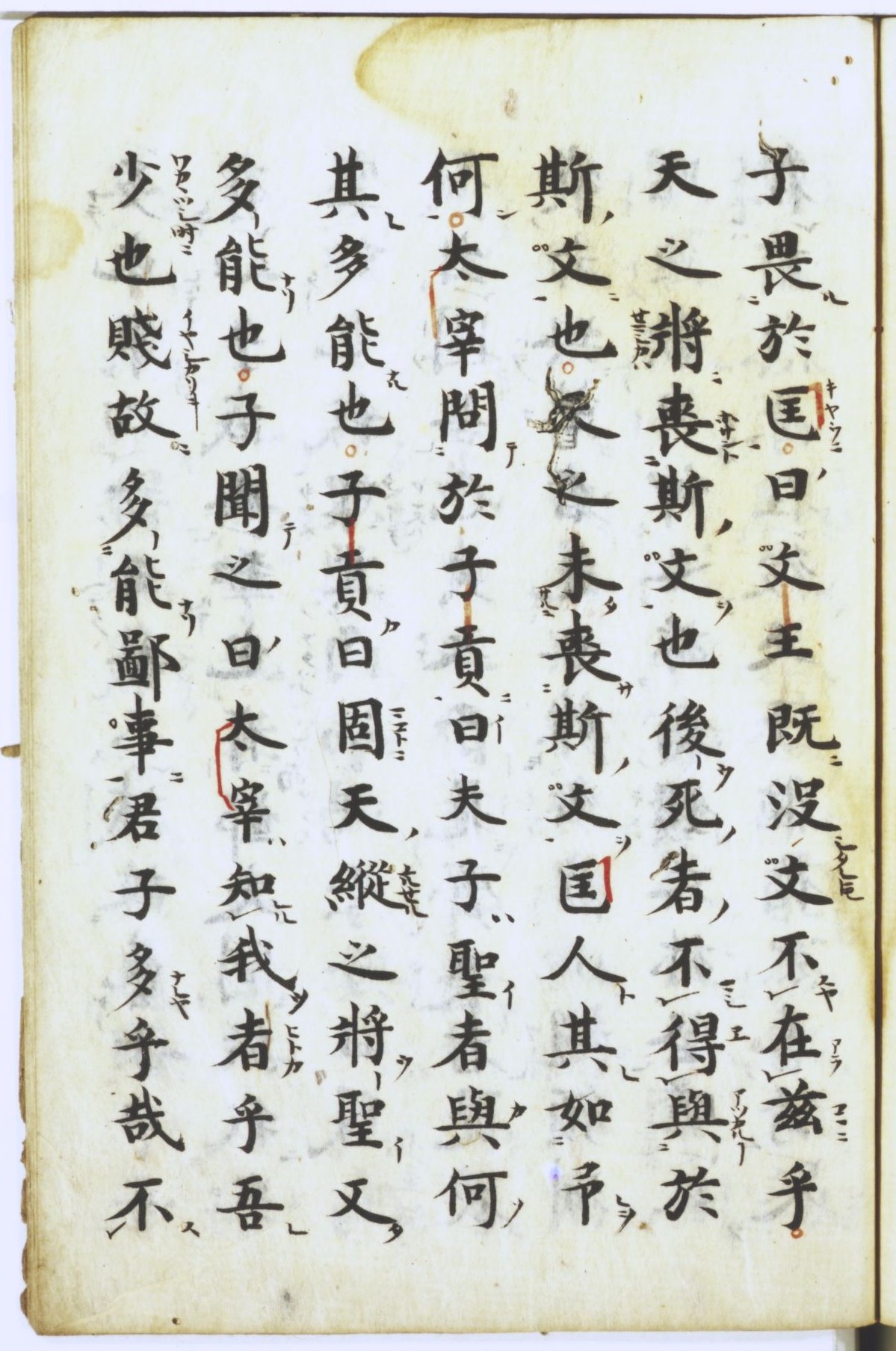
Kyoto University Library RB00007936, IIIF canvas 35, left-hand page: 7 written columns of up to 14 characters, main text only, with Japanese reading marks. Checked on the image: the first column of this book's text on this page begins ‹子畏於›, the last begins ‹少也賤›. 9.5.1 opens column 1. 9.6.3 runs on to canvas 36, right-hand page (first column ‹多也牢›), where the section ends. Column openings on these pages that differ from the received text: ‹何太宰› where the received text has ‹何大宰›. The Chinese shown is the received text (Wikisource), not a transcription of this manuscript; Legge's English translates the received text.
5.1子畏於匡。
5.2曰:「文王既沒,文不在茲乎?
5.3天之將喪斯文也,後死者,不得與於斯文也。天之未喪斯文也,匡人其如予何?」
6.1大宰問於子貢曰:「夫子聖者與?何其多能也?」
6.2子貢曰:「固天縱之將聖,又多能也。」
6.3子聞之曰:「大宰知我乎!吾少也賤,故多能鄙事。君子多乎哉?不多也!」
5.1The Master was put in fear in K'wang.
5.2He said, 'After the death of King Wan, was not the cause of truth lodged here in me?
5.3'If Heaven had wished to let this cause of truth perish, then I, a future mortal, should not have got such a relation to that cause. While Heaven does not let the cause of truth perish, what can the people of K'wang do to me?'
6.1A high officer asked Tsze-kung, saying, 'May we not say that your Master is a sage? How various is his ability!'
6.2Tsze-kung said, 'Certainly Heaven has endowed him unlimitedly. He is about a sage. And, moreover, his ability is various.'
6.3The Master heard of the conversation and said, 'Does the high officer know me? When I was young, my condition was low, and therefore I acquired my ability in many things, but they were mean matters. Must the superior man have such variety of ability? He does not need variety of ability.'
Where on the image
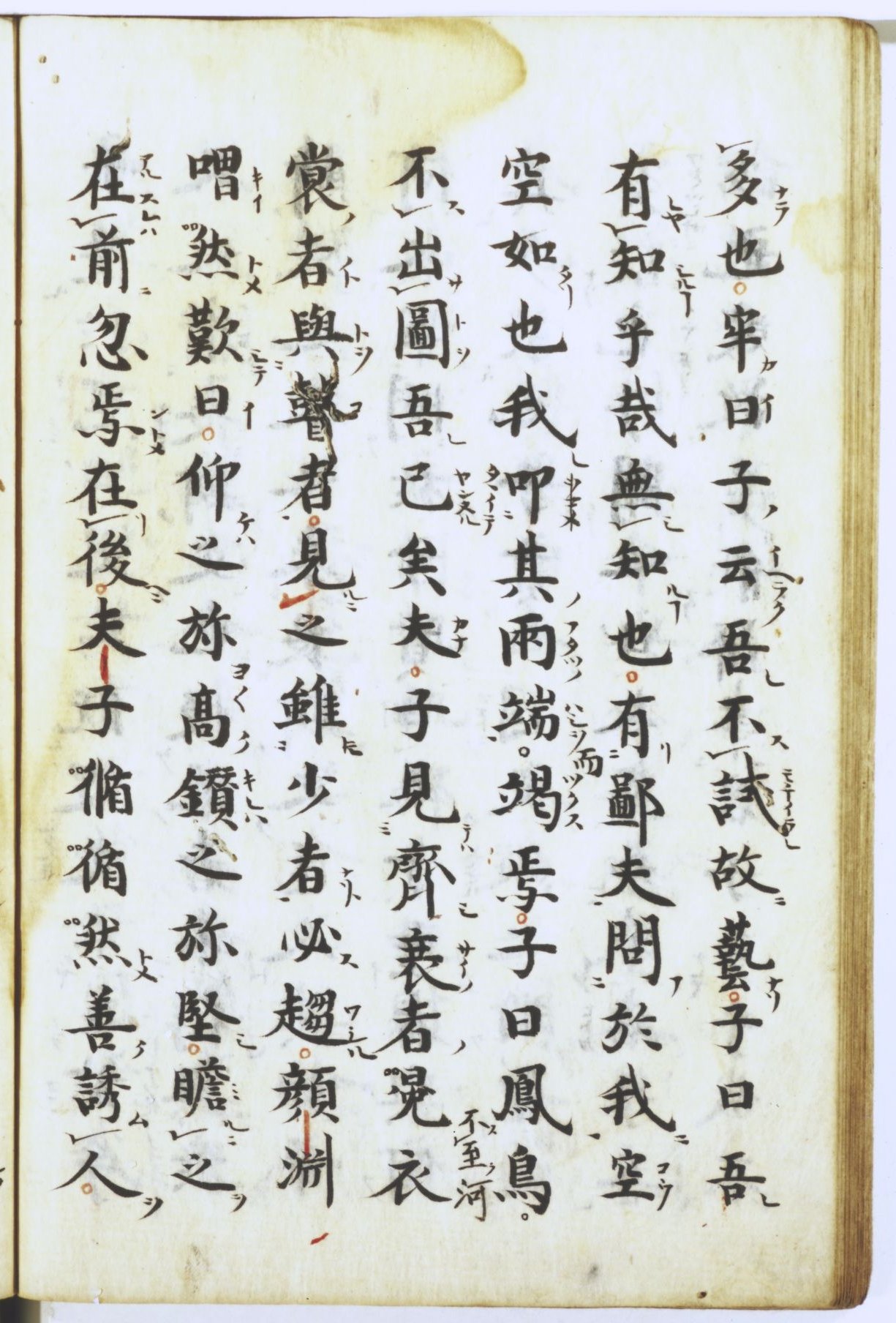
Kyoto University Library RB00007936, IIIF canvas 36, right-hand page: 7 written columns of up to 14 characters, main text only, with Japanese reading marks. Checked on the image: the first column of this book's text on this page begins ‹多也牢›, the last begins ‹在前忽›. 9.6.4 begins inside column 1 (the column opens ‹多也牢›), 2 characters down in the received text. Above it the page finishes 9.6.3, shown in the previous section. 9.10.2 runs on to canvas 36, left-hand page (first column ‹博我以›), where the section ends. The Chinese shown is the received text (Wikisource), not a transcription of this manuscript; Legge's English translates the received text.
6.4牢曰:「子云:『吾不試,故藝。』」
7子曰:「吾有知乎哉?無知也。有鄙夫問於我,空空如也,我扣其兩端而竭焉。」
8子曰:「鳳鳥不至,河不出圖,吾已矣夫!」
9子見齊衰者,冕衣裳者,與瞽者,見之,雖少必作,過之必趨。
10.1顏淵喟然歎曰:「仰之彌高,鑽之彌堅,瞻之在前,忽焉在後!
10.2夫子循循然善誘人:博我以文,約我以禮。
6.4Lao said, 'The Master said, "Having no official employment, I acquired many arts."'
7The Master said, 'Am I indeed possessed of knowledge? I am not knowing. But if a mean person, who appears quite empty-like, ask anything of me, I set it forth from one end to the other, and exhaust it.'
8The Master said, 'The FANG bird does not come; the river sends forth no map:-- it is all over with me!'
9When the Master saw a person in a mourning dress, or any one with the cap and upper and lower garments of full dress, or a blind person, on observing them approaching, though they were younger than himself, he would rise up, and if he had to pass by them, he would do so hastily.
10.1Yen Yuan, in admiration of the Master's doctrines, sighed and said, 'I looked up to them, and they seemed to become more high; I tried to penetrate them, and they seemed to become more firm; I looked at them before me, and suddenly they seemed to be behind.
10.2'The Master, by orderly method, skilfully leads men on. He enlarged my mind with learning, and taught me the restraints of propriety.
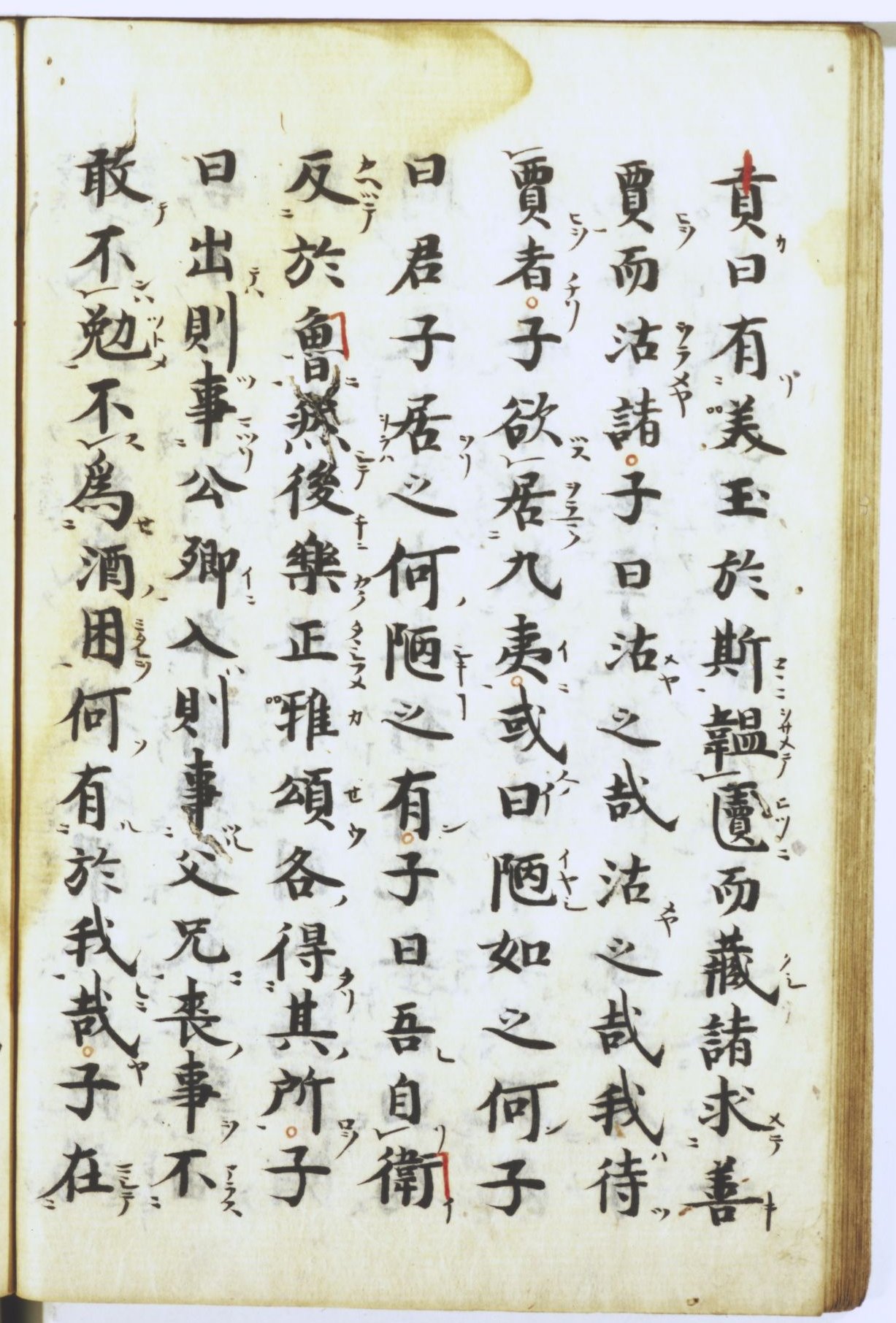
Where on the image
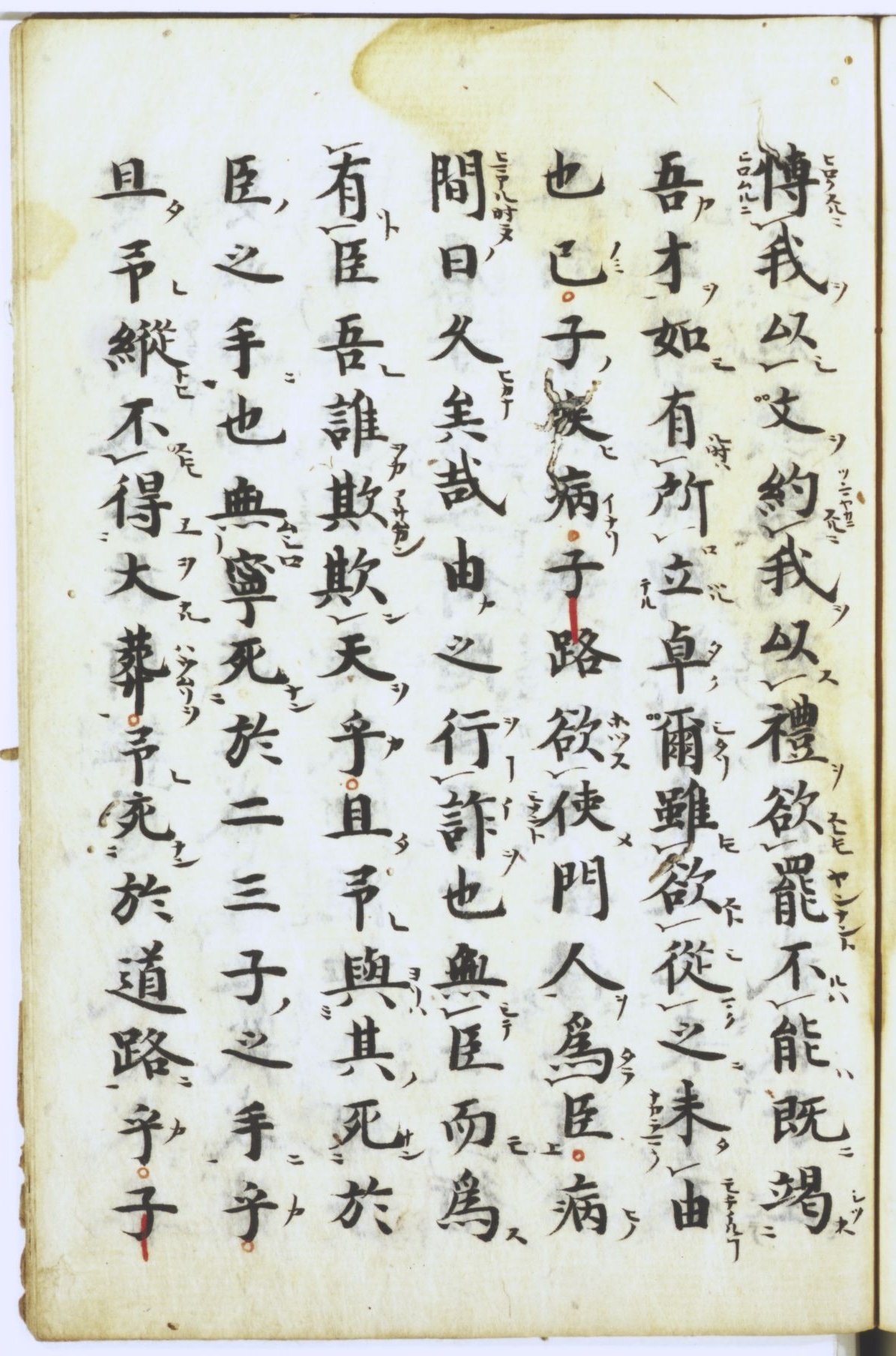
Kyoto University Library RB00007936, IIIF canvas 36, left-hand page: 7 written columns of up to 14 characters, main text only, with Japanese reading marks. Checked on the image: the first column of this book's text on this page begins ‹博我以›, the last begins ‹且予縱›. 9.10.3 begins inside column 1 (the column opens ‹博我以›), 8 characters down in the received text. Above it the page finishes 9.10.2, shown in the previous section. 9.12 runs on to canvas 37, right-hand page (first column ‹貢曰有›), where the section ends. Column openings on these pages that differ from the received text: ‹賈者子› where the received text has ‹賈者也›. The Chinese shown is the received text (Wikisource), not a transcription of this manuscript; Legge's English translates the received text.
10.3欲罷不能,既竭吾才,如有所立卓爾,雖欲從之,末由也已!」
11.1子疾病,子路使門人爲臣。
11.2病間,曰:「久矣哉,由之行詐也!無臣而爲有臣,吾誰欺?欺天乎?
11.3且予與其死於臣之手也,無寧死於二三子之手乎!且予縱不得大葬,予死於道路乎?」
12子貢曰:「有美玉於斯,韞櫝而藏諸?求善賈而沽諸?」子曰:「沽之哉!沽之哉!我待賈者也!」
10.3'When I wish to give over the study of his doctrines, I cannot do so, and having exerted all my ability, there seems something to stand right up before me; but though I wish to follow and lay hold of it, I really find no way to do so.'
11.1The Master being very ill, Tsze-lu wished the disciples to act as ministers to him.
11.2During a remission of his illness, he said, 'Long has the conduct of Yu been deceitful! By pretending to have ministers when I have them not, whom should I impose upon? Should I impose upon Heaven?
11.3'Moreover, than that I should die in the hands of ministers, is it not better that I should die in the hands of you, my disciples? And though I may not get a great burial, shall I die upon the road?'
12Tsze-kung said, 'There is a beautiful gem here. Should I lay it up in a case and keep it? or should I seek for a good price and sell it?' The Master said, 'Sell it! Sell it! But I would wait for one to offer the price.'
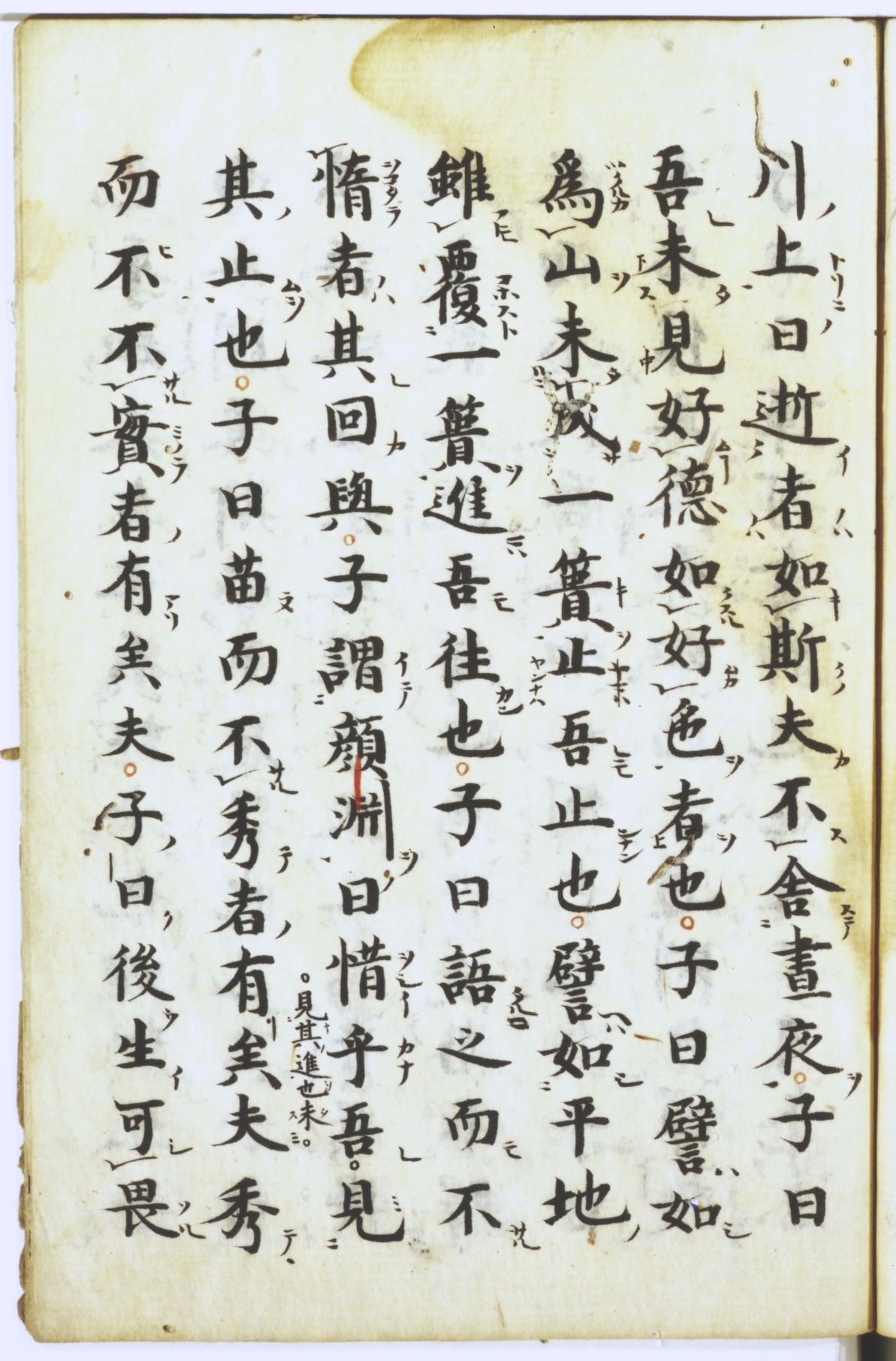
Where on the image
Kyoto University Library RB00007936, IIIF canvas 37, right-hand page: 7 written columns of up to 14 characters, main text only, with Japanese reading marks. Checked on the image: the first column of this book's text on this page begins ‹貢曰有›, the last begins ‹敢不勉›. 9.13.1 begins inside column 3 (the column opens ‹賈者子›), 3 characters down in the received text. Above it the page finishes 9.12, shown in the previous section. 9.16 runs on to canvas 37, left-hand page (first column ‹川上曰›), where the section ends. Column openings on these pages that differ from the received text: ‹反於魯› where the received text has ‹反魯然›. The Chinese shown is the received text (Wikisource), not a transcription of this manuscript; Legge's English translates the received text.
13.1子欲居九夷。
13.2或曰:「陋,如之何?」子曰:「君子居之,何陋之有?」
14子曰:「吾自衞反魯,然後樂正,雅頌各得其所。」
15子曰:「出則事公卿,入則事父兄,喪事不敢不勉,不爲酒困,何有於我哉?」
16子在川上曰:「逝者如斯夫!不舍晝夜。」
13.1The Master was wishing to go and live among the nine wild tribes of the east.
13.2Some one said, 'They are rude. How can you do such a thing?' The Master said, 'If a superior man dwelt among them, what rudeness would there be?'
14The Master said, 'I returned from Wei to Lu, and then the music was reformed, and the pieces in the Royal songs and Praise songs all found their proper places.'
15The Master said, 'Abroad, to serve the high ministers and nobles; at home, to serve one's father and elder brothers; in all duties to the dead, not to dare not to exert one's self; and not to be overcome of wine:-- which one of these things do I attain to?'
16The Master standing by a stream, said, 'It passes on just like this, not ceasing day or night!'
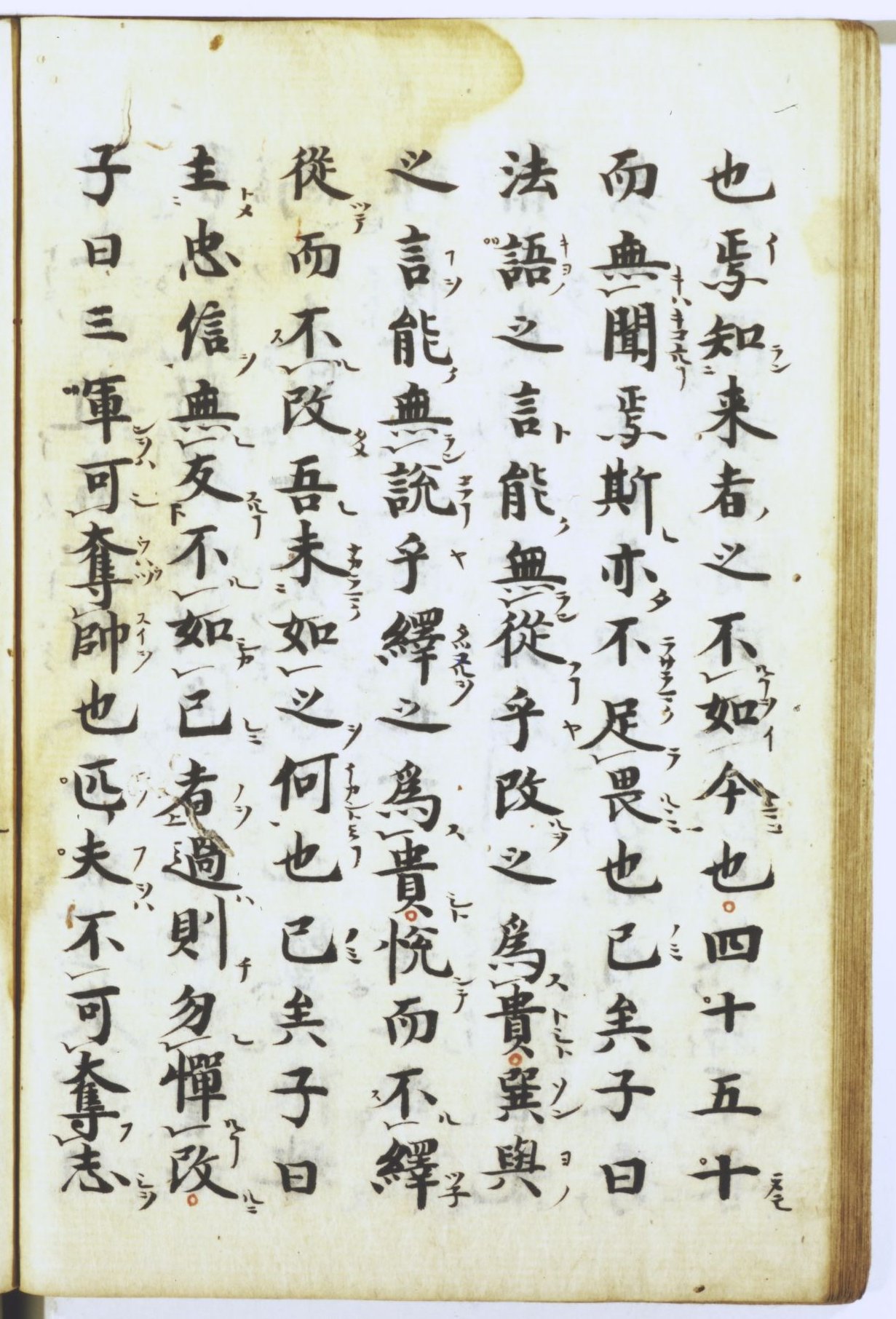
Where on the image
Kyoto University Library RB00007936, IIIF canvas 37, left-hand page: 7 written columns of up to 14 characters, main text only, with Japanese reading marks. Checked on the image: the first column of this book's text on this page begins ‹川上曰›, the last begins ‹而不實›. 9.17 begins inside column 1 (the column opens ‹川上曰›), 12 characters down in the received text. Above it the page finishes 9.16, shown in the previous section. 9.22 runs on to canvas 38, right-hand page (first column ‹也焉知›), where the section ends. Column openings on these pages that differ from the received text: ‹也焉知› where the received text has ‹焉知來›. The Chinese shown is the received text (Wikisource), not a transcription of this manuscript; Legge's English translates the received text.
17子曰:「吾未見好德如好色者也。」
18子曰:「譬如爲山,未成一簣,止,吾止也!譬如平地,雖覆一簣,進,吾往也!」
19子曰:「語之而不惰者,其回也與!」
20子謂顏淵,曰:「惜乎!吾見其進也,未見其止也!」
21子曰:「苗而不秀者,有矣夫!秀而不實者,有矣夫!」
22子曰:「後生可畏,焉知來者之不如今也?四十、五十而無聞焉,斯亦不足畏也已!」
17The Master said, 'I have not seen one who loves virtue as he loves beauty.'
18The Master said, 'The prosecution of learning may be compared to what may happen in raising a mound. If there want but one basket of earth to complete the work, and I stop, the stopping is my own work. It may be compared to throwing down the earth on the level ground. Though but one basketful is thrown at a time, the advancing with it is my own going forward.'
19The Master said, 'Never flagging when I set forth anything to him;-- ah! that is Hui.'
20The Master said of Yen Yuan, 'Alas! I saw his constant advance. I never saw him stop in his progress.'
21The Master said, 'There are cases in which the blade springs, but the plant does not go on to flower! There are cases where it flowers, but no fruit is subsequently produced!'
22The Master said, 'A youth is to be regarded with respect. How do we know that his future will not be equal to our present? If he reach the age of forty or fifty, and has not made himself heard of, then indeed he will not be worth being regarded with respect.'
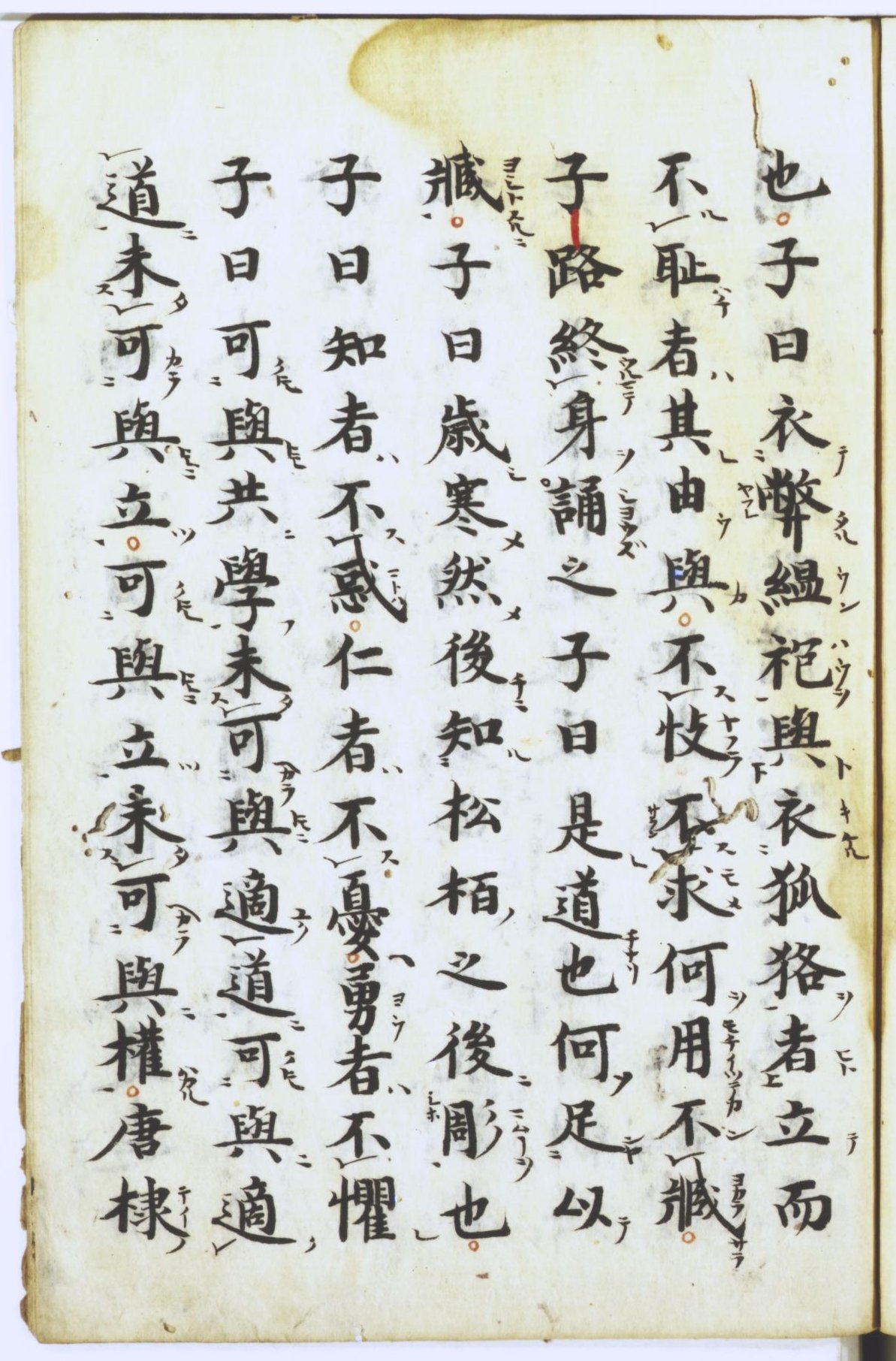
Where on the image
Kyoto University Library RB00007936, IIIF canvas 38, right-hand page: 7 written columns of up to 14 characters, main text only, with Japanese reading marks. Checked on the image: the first column of this book's text on this page begins ‹也焉知›, the last begins ‹子曰三›. 9.23 begins inside column 2 (the column opens ‹而無聞›), 11 characters down in the received text. Above it the page finishes 9.22, shown in the previous section. 9.25 runs on to canvas 38, left-hand page (first column ‹也子曰›), where the section ends. The Chinese shown is the received text (Wikisource), not a transcription of this manuscript; Legge's English translates the received text.
23子曰:「法語之言,能無從乎?改之爲貴。巽與之言,能無說乎?繹之爲貴。說而不繹,從而不改,吾末如之何也已矣!」
24子曰:「主忠信,毋友不如己者,過則勿憚改。」
25子曰:「三軍可奪帥也,匹夫不可奪志也。」
23The Master said, 'Can men refuse to assent to the words of strict admonition? But it is reforming the conduct because of them which is valuable. Can men refuse to be pleased with words of gentle advice? But it is unfolding their aim which is valuable. If a man be pleased with these words, but does not unfold their aim, and assents to those, but does not reform his conduct, I can really do nothing with him.'
24The Master said, 'Hold faithfulness and sincerity as first principles. Have no friends not equal to yourself. When you have faults, do not fear to abandon them.'
25The Master said, 'The commander of the forces of a large state may be carried off, but the will of even a common man cannot be taken from him.'
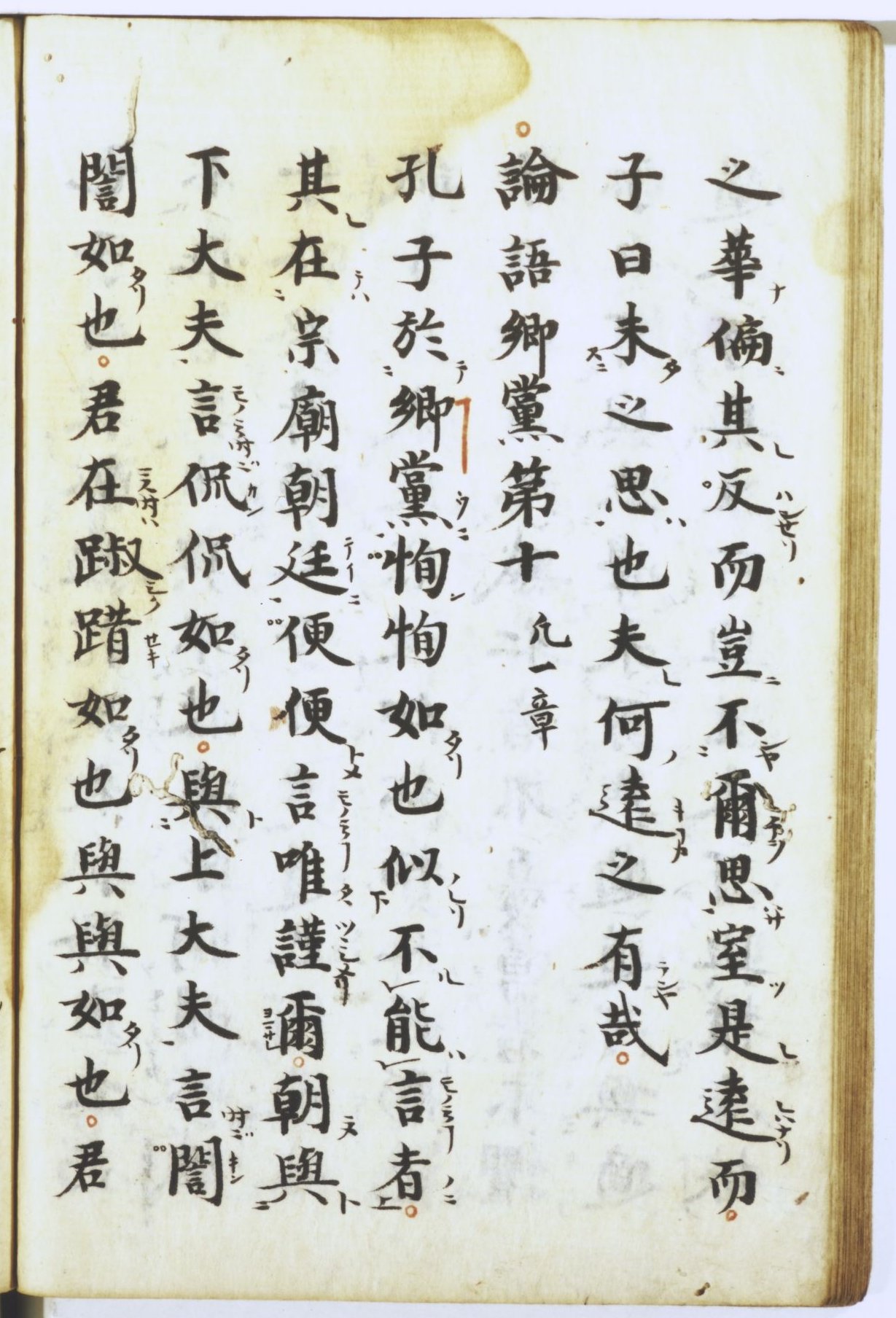
Where on the image
Kyoto University Library RB00007936, IIIF canvas 38, left-hand page: 7 written columns of up to 14 characters, main text only, with Japanese reading marks. Checked on the image: the first column of this book's text on this page begins ‹也子曰›, the last begins ‹道未可›. 9.26.1 begins inside column 1 (the column opens ‹也子曰›), 1 characters down in the received text. Above it the page finishes 9.25, shown in the previous section. 9.30.1 runs on to canvas 39, right-hand page (first column ‹之華偏›), where the section ends. The Chinese shown is the received text (Wikisource), not a transcription of this manuscript; Legge's English translates the received text.
26.1子曰:「衣敝縕袍,與衣狐貉者立,而不恥者,其由也與!
26.2『不忮不求,何用不臧?』
26.3子路終身誦之。子曰:「是道也,何足以臧?」
27子曰:「歲寒,然後知松柏之後凋也。」
28子曰:「知者不惑,仁者不憂,勇者不懼。」
29子曰:「可與共學,未可與適道;可與適道,未可與立;可與立,未可與權。」
30.1「唐棣之華,偏其反而;豈不爾思?室是遠而」。
26.1The Master said, 'Dressed himself in a tattered robe quilted with hemp, yet standing by the side of men dressed in furs, and not ashamed;-- ah! it is Yu who is equal to this!
26.2'"He dislikes none, he covets nothing;-- what can he do but what is good!"'
26.3Tsze-lu kept continually repeating these words of the ode, when the Master said, 'Those things are by no means sufficient to constitute (perfect) excellence.'
27The Master said, 'When the year becomes cold, then we know how the pine and the cypress are the last to lose their leaves.'
28The Master said, 'The wise are free from perplexities; the virtuous from anxiety; and the bold from fear.'
29The Master said, 'There are some with whom we may study in common, but we shall find them unable to go along with us to principles. Perhaps we may go on with them to principles, but we shall find them unable to get established in those along with us. Or if we may get so established along with them, we shall find them unable to weigh occurring events along with us.'
30.1How the flowers of the aspen-plum flutter and turn! Do I not think of you? But your house is distant.
Where on the image
Kyoto University Library RB00007936, IIIF canvas 39, right-hand page: 7 written columns of up to 14 characters, main text only, with Japanese reading marks. Checked on the image: the first column of this book's text on this page begins ‹之華偏›, the last begins ‹子曰未›. Column 3 carries the title 論語鄉黨第十. 9.30.2 opens column 2. Above it the page finishes 9.30.1, shown in the previous section. The section ends on this page. The Chinese shown is the received text (Wikisource), not a transcription of this manuscript; Legge's English translates the received text.
30.2子曰:「未之思也,夫何遠之有?」
30.2The Master said, 'It is the want of thought about it. How is it distant?'
Notes
- English: James Legge, Confucian Analects, The Chinese Classics vol. 1. Legge's chapter and paragraph numbers are kept as superscripts (chapter.paragraph).
- Legge translated the received text. Where this manuscript's wording differs, his English follows the received text shown here.
Cite
Sources
- Source: Kyoto University Library RB00007936 (Analects manuscript attributed to Kiyohara Yoshieda, c. 1300) + Wikisource received text + James Legge's English (Project Gutenberg) (holding institution)
- Critical edition: Received text (Wikisource) in Legge's chapter and paragraph division
← previous · → next · v cycle view · l back to library