Analects, Book 10: Xiang dang 鄉黨 (Kamakura-period manuscript)
Introduction
Book 10 of the Analects (論語 Lunyu), titled 鄉黨 (Xiang dang) after its opening words, 18 chapters in Legge's division. It is shown on a manuscript of the Analects in the Kiyohara family collection (Seike bunko) of Kyoto University Library, two volumes in regular script, seven columns of fourteen characters to the page, main text only, with red and black Japanese reading marks. A colophon by Kiyohara Edakata dated 1550 names the copyist as his ancestor Kiyohara Yoshieda (1253-1331), which places the copy around 1300, in the late Kamakura period; the attribution is traditional. The Kiyohara were hereditary readers of the Confucian classics at the Japanese court, and their text descends from the edition of the Analects with the collected commentary of He Yan (3rd century CE): after each pair of books the scribe copied the character counts of the classic and of the commentary, although only the classic is written out. The manuscript is an Important Cultural Property of Japan.
In this copy Book 10 runs from canvas 39, right-hand page to canvas 42, left-hand page (volume 1). Each section gathers the paragraphs that begin on one page, numbered by chapter and paragraph as in Legge, and links to that page and to any page the last paragraph runs onto. The page boundaries were found by reading the first characters of every column on the photographs. The Chinese shown is the received text, from Wikisource. This manuscript differs from it in places, most often by an added or missing particle (也, 矣, 焉) or a variant character form; the differences seen at column openings are listed in the scan notes. The English is James Legge's translation of the received text.
How was this verified? (Provenance)
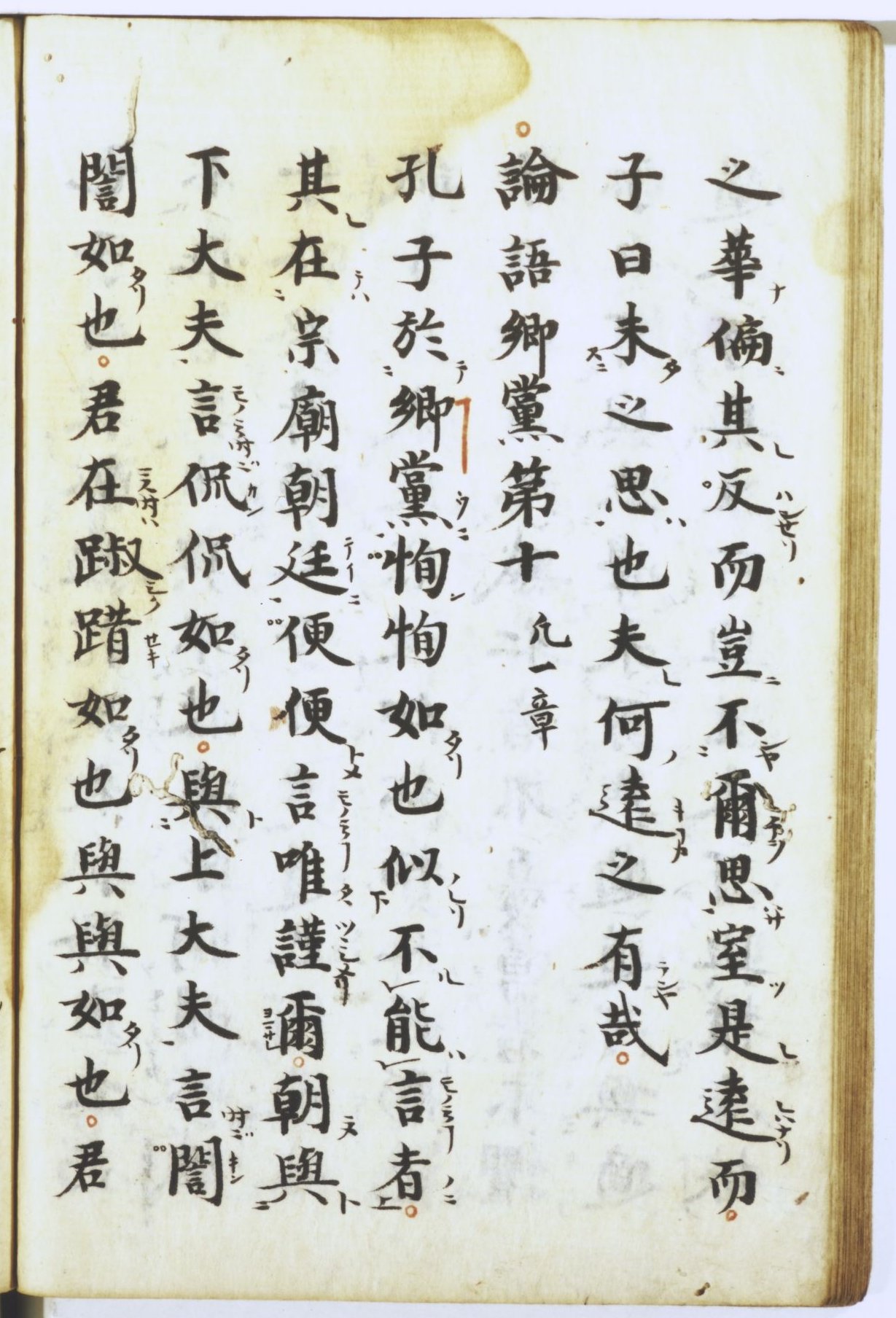
Where on the image
Kyoto University Library RB00007936, IIIF canvas 39, right-hand page: 7 written columns of up to 14 characters, main text only, with Japanese reading marks. Checked on the image: the first column of this book's text on this page begins ‹孔子於›, the last begins ‹誾如也›. Column 3 carries the title 論語鄉黨第十. 10.1.1 opens column 4. 10.3.1 runs on to canvas 39, left-hand page (first column ‹召使擯›), where the section ends. The Chinese shown is the received text (Wikisource), not a transcription of this manuscript; Legge's English translates the received text.
1.1孔子於鄉黨,恂恂如也,似不能言者。
1.2其在宗廟朝廷,便便言,唯謹爾。
2.1朝與下大夫言,侃侃如也;與上大夫言,誾誾如也。
2.2君在,踧踖如也,與與如也。
3.1君召使擯,色勃如也,足躩如也。
1.1Confucius, in his village, looked simple and sincere, and as if he were not able to speak.
1.2When he was in the prince's ancestorial temple, or in the court, he spoke minutely on every point, but cautiously.
2.1When he was waiting at court, in speaking with the great officers of the lower grade, he spake freely, but in a straightforward manner; in speaking with those of the higher grade, he did so blandly, but precisely.
2.2When the ruler was present, his manner displayed respectful uneasiness; it was grave, but self-possessed.
3.1When the prince called him to employ him in the reception of a visitor, his countenance appeared to change, and his legs to move forward with difficulty.
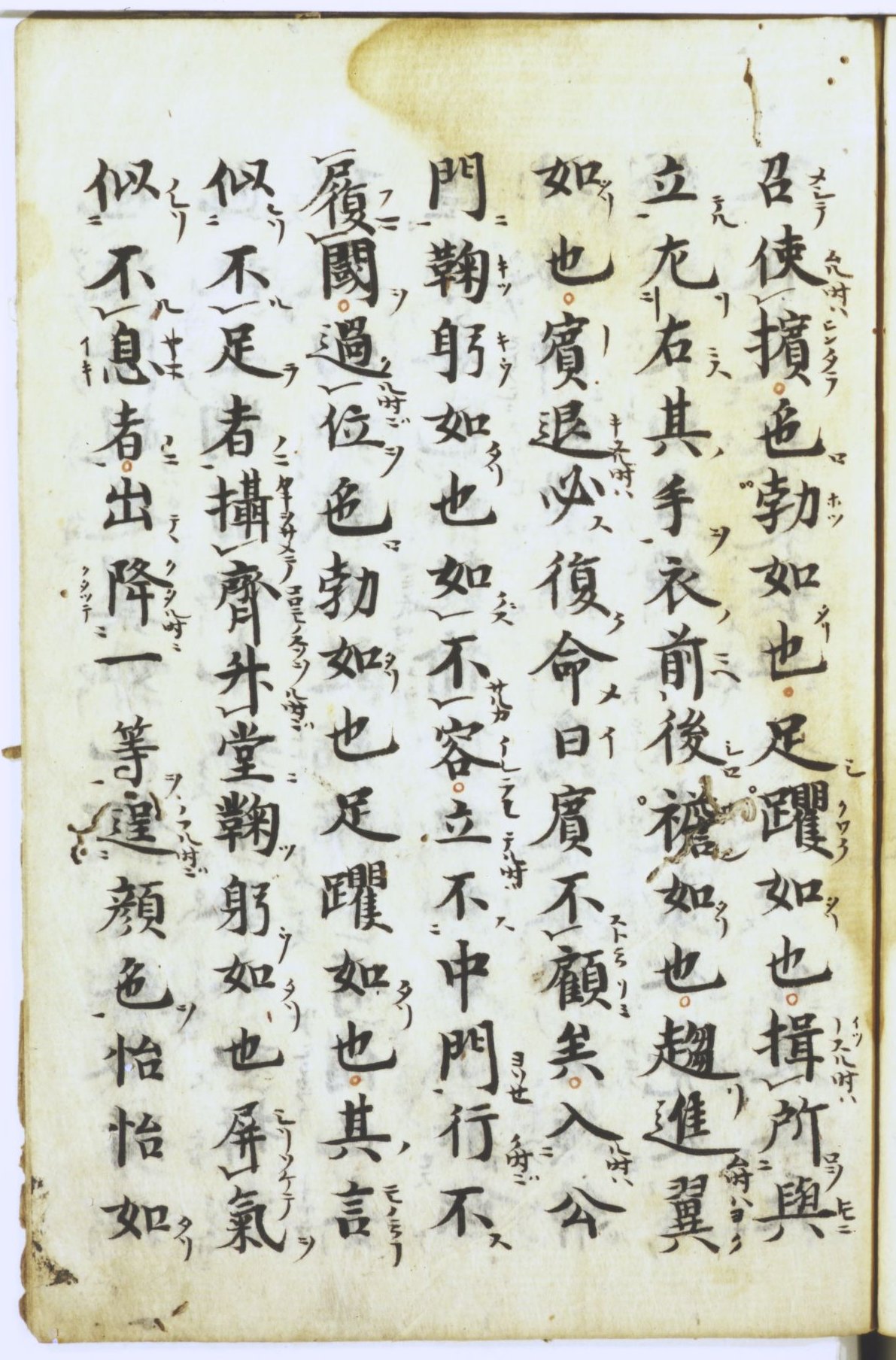
Where on the image
Kyoto University Library RB00007936, IIIF canvas 39, left-hand page: 7 written columns of up to 14 characters, main text only, with Japanese reading marks. Checked on the image: the first column of this book's text on this page begins ‹召使擯›, the last begins ‹似不息›. 10.3.2 begins inside column 1 (the column opens ‹召使擯›), 11 characters down in the received text. Above it the page finishes 10.3.1, shown in the previous section. 10.4.5 runs on to canvas 40, right-hand page (first column ‹也沒階›), where the section ends. The Chinese shown is the received text (Wikisource), not a transcription of this manuscript; Legge's English translates the received text.
3.2揖所與立,左右手,衣前後,襜如也。
3.3趨進,翼如也。
3.4賓退,必復命,曰:「賓不顧矣。」
4.1入公門,鞠躬如也,如不容。
4.2立不中門,行不履閾。
4.3過位,色勃如也,足躩如也,其言似不足者。
4.4攝齊升堂,鞠躬如也,屛氣似不息者。
4.5出,降一等,逞顏色,怡怡如也。沒階趨進,翼如也。復其位,踧踖如也。
3.2He inclined himself to the other officers among whom he stood, moving his left or right arm, as their position required, but keeping the skirts of his robe before and behind evenly adjusted.
3.3He hastened forward, with his arms like the wings of a bird.
3.4When the guest had retired, he would report to the prince, 'The visitor is not turning round any more.'
4.1When he entered the palace gate, he seemed to bend his body, as if it were not sufficient to admit him.
4.2When he was standing, he did not occupy the middle of the gate-way; when he passed in or out, he did not tread upon the threshold.
4.3When he was passing the vacant place of the prince, his countenance appeared to change, and his legs to bend under him, and his words came as if he hardly had breath to utter them.
4.4He ascended the reception hall, holding up his robe with both his hands, and his body bent; holding in his breath also, as if he dared not breathe.
4.5When he came out from the audience, as soon as he had descended one step, he began to relax his countenance, and had a satisfied look. When he had got to the bottom of the steps, he advanced rapidly to his place, with his arms like wings, and on occupying it, his manner still showed respectful uneasiness.
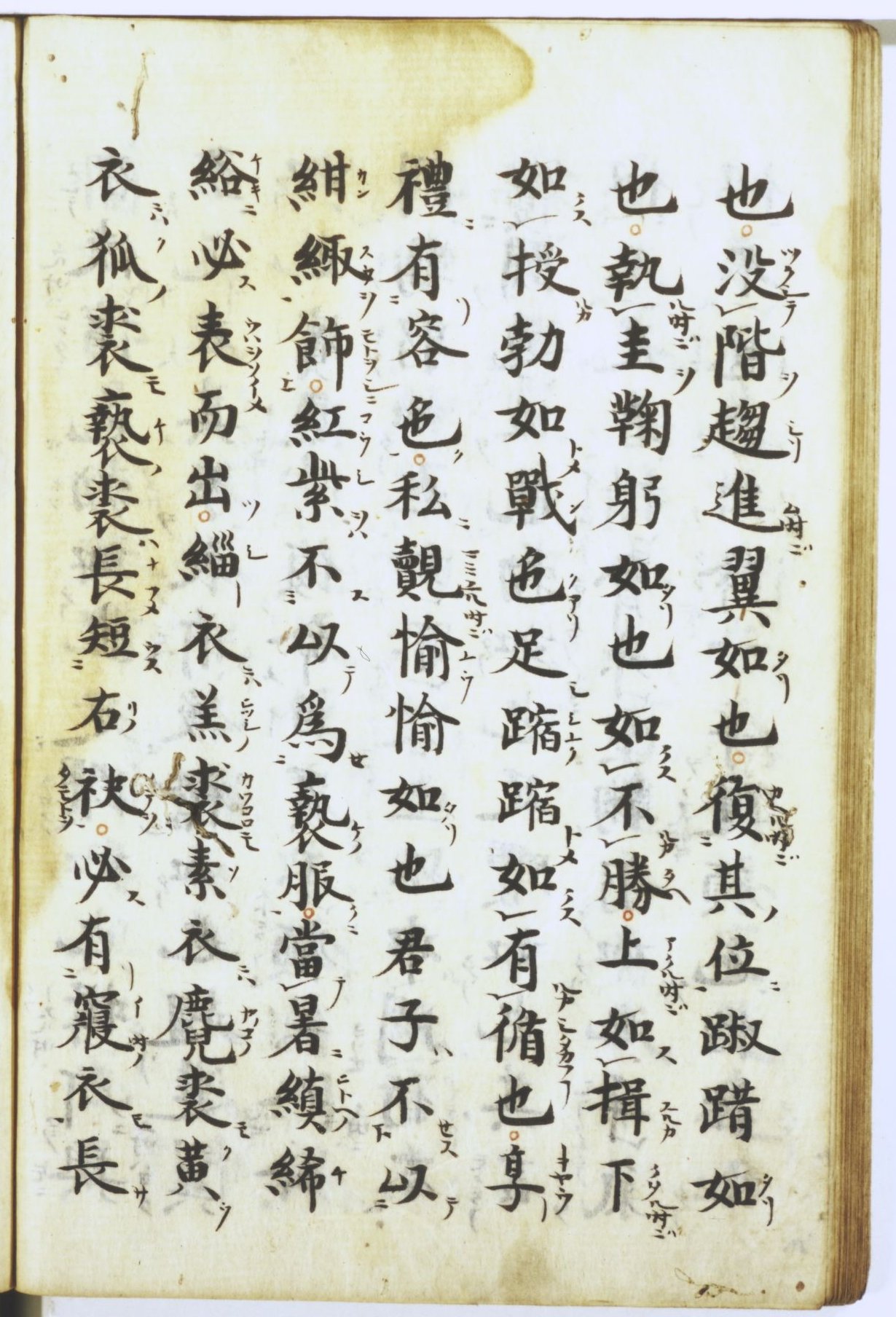
Where on the image
Kyoto University Library RB00007936, IIIF canvas 40, right-hand page: 7 written columns of up to 14 characters, main text only, with Japanese reading marks. Checked on the image: the first column of this book's text on this page begins ‹也沒階›, the last begins ‹衣狐裘›. 10.5.1 begins inside column 2 (the column opens ‹也執圭›), 1 characters down in the received text. Above it the page finishes 10.4.5, shown in the previous section. 10.6.6 runs on to canvas 40, left-hand page (first column ‹一身有›), where the section ends. The Chinese shown is the received text (Wikisource), not a transcription of this manuscript; Legge's English translates the received text.
5.1執圭,鞠躬如也,如不勝。上如揖,下如授,勃如戰色,足蹜蹜如有循。
5.2享禮,有容色。
5.3私覿,愉愉如也。
6.1君子不以紺緅飾,
6.2紅紫不以爲褻服;
6.3當暑,袗絺綌,必表而出之。
6.4緇衣羔裘,素衣麑裘,黃衣狐裘。
6.5褻裘長,短右袂。
6.6必有寢衣,長一身有半。
5.1When he was carrying the scepter of his ruler, he seemed to bend his body, as if he were not able to bear its weight. He did not hold it higher than the position of the hands in making a bow, nor lower than their position in giving anything to another. His countenance seemed to change, and look apprehensive, and he dragged his feet along as if they were held by something to the ground.
5.2In presenting the presents with which he was charged, he wore a placid appearance.
5.3At his private audience, he looked highly pleased.
6.1The superior man did not use a deep purple, or a puce colour, in the ornaments of his dress.
6.2Even in his undress, he did not wear anything of a red or reddish colour.
6.3In warm weather, he had a single garment either of coarse or fine texture, but he wore it displayed over an inner garment.
6.4Over lamb's fur he wore a garment of black; over fawn's fur one of white; and over fox's fur one of yellow.
6.5The fur robe of his undress was long, with the right sleeve short.
6.6He required his sleeping dress to be half as long again as his body.
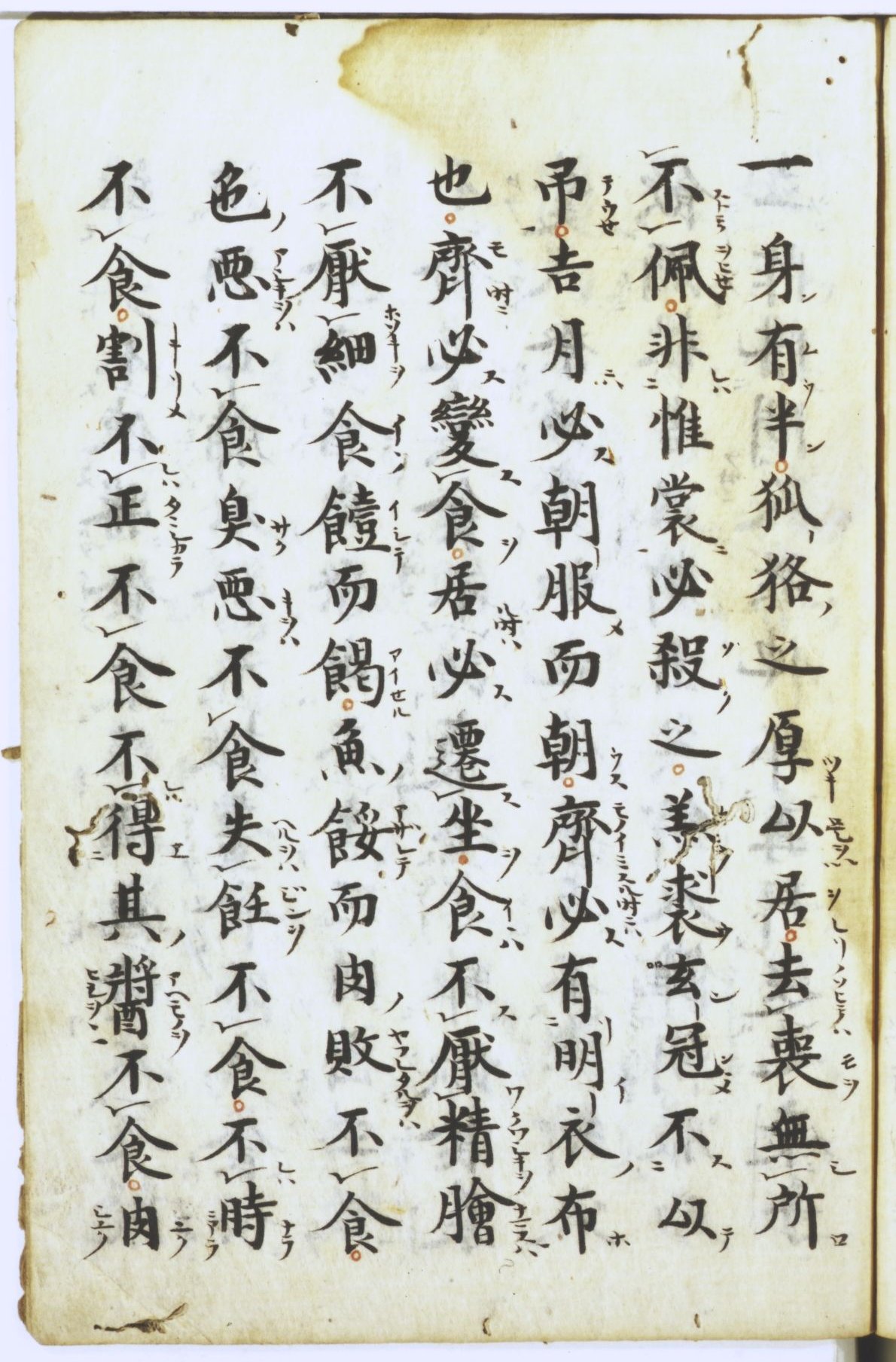
Where on the image
Kyoto University Library RB00007936, IIIF canvas 40, left-hand page: 7 written columns of up to 14 characters, main text only, with Japanese reading marks. Checked on the image: the first column of this book's text on this page begins ‹一身有›, the last begins ‹不食割›. 10.6.7 begins inside column 1 (the column opens ‹一身有›), 4 characters down in the received text. Above it the page finishes 10.6.6, shown in the previous section. 10.8.4 runs on to canvas 41, right-hand page (first column ‹雖多不›), where the section ends. Column openings on these pages that differ from the received text: ‹也齊必› where the received text has ‹齊必變›. The Chinese shown is the received text (Wikisource), not a transcription of this manuscript; Legge's English translates the received text.
6.7狐貉之厚以居。
6.8去喪,無所不佩。
6.9非帷裳,必殺之。
6.10羔裘玄冠,不以弔。
6.11吉月,必朝服而朝。
7.1齊,必有明衣,布。
7.2齊必變食,居必遷坐。
8.1食不厭精,膾不厭細。
8.2食饐而餲,魚餒而肉敗,不食。色惡不食,臭惡不食。失飪不食,不時不食。
8.3割不正不食,不得其醬不食。
8.4肉雖多,不使勝食氣。唯酒無量,不及亂。
6.7When staying at home, he used thick furs of the fox or the badger.
6.8When he put off mourning, he wore all the appendages of the girdle.
6.9His under-garment, except when it was required to be of the curtain shape, was made of silk cut narrow above and wide below.
6.10He did not wear lamb's fur or a black cap, on a visit of condolence.
6.11On the first day of the month he put on his court robes, and presented himself at court.
7.1When fasting, he thought it necessary to have his clothes brightly clean and made of linen cloth.
7.2When fasting, he thought it necessary to change his food, and also to change the place where he commonly sat in the apartment.
8.1He did not dislike to have his rice finely cleaned, nor to have his minced meat cut quite small.
8.2He did not eat rice which had been injured by heat or damp and turned sour, nor fish or flesh which was gone. He did not eat what was discoloured, or what was of a bad flavour, nor anything which was ill-cooked, or was not in season.
8.3He did not eat meat which was not cut properly, nor what was served without its proper sauce.
8.4Though there might be a large quantity of meat, he would not allow what he took to exceed the due proportion for the rice. It was only in wine that he laid down no limit for himself, but he did not allow himself to be confused by it.
Where on the image
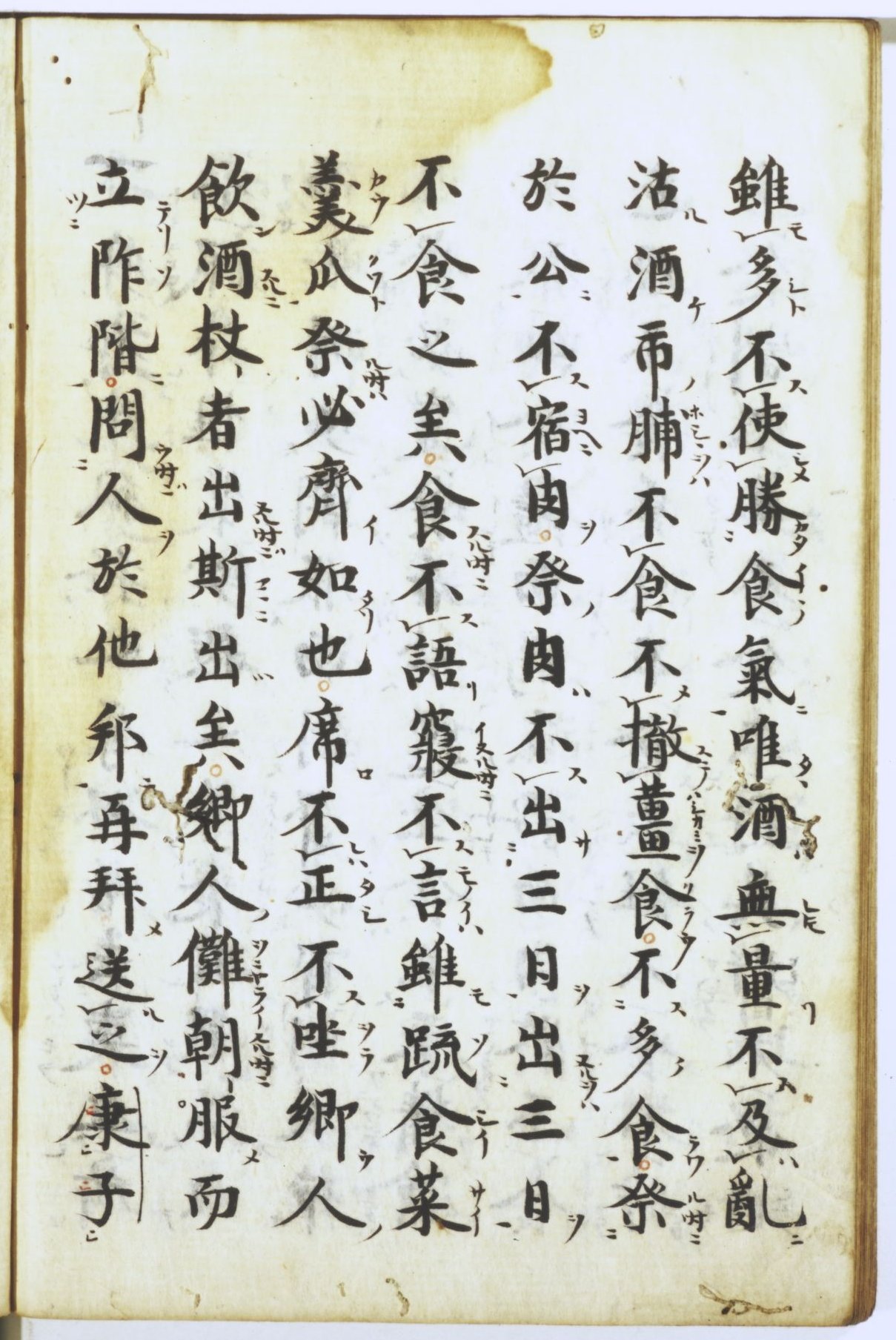
Kyoto University Library RB00007936, IIIF canvas 41, right-hand page: 7 written columns of up to 14 characters, main text only, with Japanese reading marks. Checked on the image: the first column of this book's text on this page begins ‹雖多不›, the last begins ‹立阼階›. 10.8.5 opens column 2. Above it the page finishes 10.8.4, shown in the previous section. 10.11.1 runs on to canvas 41, left-hand page (first column ‹送之康子饋›), where the section ends. Column openings on these pages that differ from the received text: ‹立阼階› where the received text has ‹立於阼›. The Chinese shown is the received text (Wikisource), not a transcription of this manuscript; Legge's English translates the received text.
8.5沽酒市脯不食。
8.6不撤薑食,
8.7不多食。
8.8祭于公,不宿肉。祭肉不出三日,出三日,不食之矣。
8.9食不語,寢不言。
8.10雖疏食菜羹瓜祭,必齊如也。
9席不正不坐。
10.1鄉人飮酒,杖者出,斯出矣。
10.2鄉人儺,朝服而立於阼階。
11.1問人於他邦,再拜而送之。
8.5He did not partake of wine and dried meat bought in the market.
8.6He was never without ginger when he ate.
8.7He did not eat much.
8.8When he had been assisting at the prince's sacrifice, he did not keep the flesh which he received overnight. The flesh of his family sacrifice he did not keep over three days. If kept over three days, people could not eat it.
8.9When eating, he did not converse. When in bed, he did not speak.
8.10Although his food might be coarse rice and vegetable soup, he would offer a little of it in sacrifice with a grave, respectful air.
9If his mat was not straight, he did not sit on it.
10.1When the villagers were drinking together, on those who carried staffs going out, he went out immediately after.
10.2When the villagers were going through their ceremonies to drive away pestilential influences, he put on his court robes and stood on the eastern steps.
11.1When he was sending complimentary inquiries to any one in another State, he bowed twice as he escorted the messenger away.
Where on the image
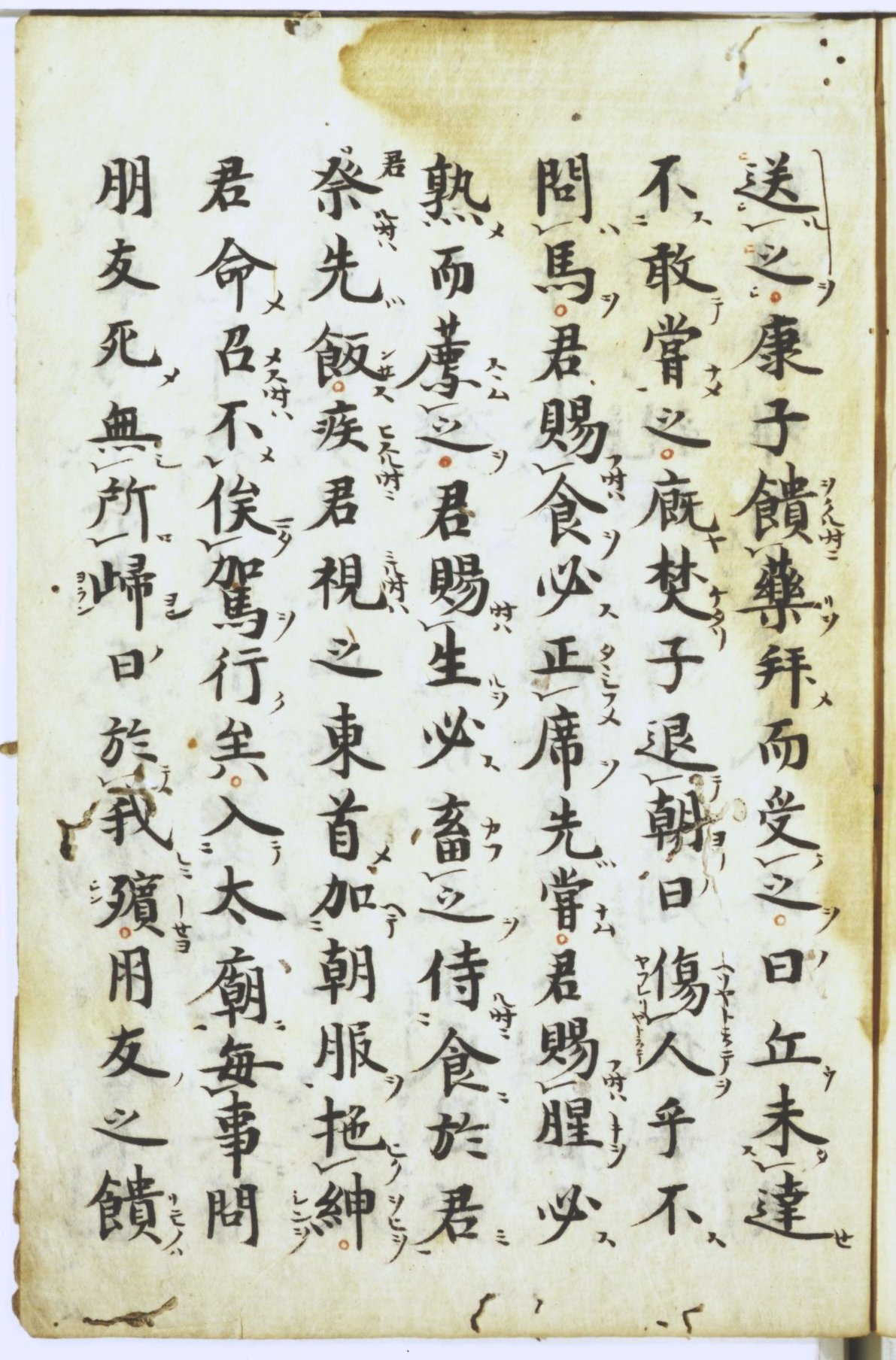
Kyoto University Library RB00007936, IIIF canvas 41, left-hand page: 7 written columns of up to 14 characters, main text only, with Japanese reading marks. Checked on the image: the first column of this book's text on this page begins ‹送之康子饋›, the last begins ‹朋友死›. 10.11.2 begins inside column 1 (the column opens ‹送之康子饋›), 2 characters down in the received text. Above it the page finishes 10.11.1, shown in the previous section. 10.15.2 runs on to canvas 42, right-hand page (first column ‹雖車馬›), where the section ends. The Chinese shown is the received text (Wikisource), not a transcription of this manuscript; Legge's English translates the received text.
11.2康子饋藥,拜而受之,曰:「丘未達,不敢嘗。」
12廄焚,子退朝,曰:「傷人乎?」不問馬。
13.1君賜食,必正席先嘗之。君賜腥,必熟而薦之。君賜生,必畜之。
13.2侍食於君,君祭,先飯。
13.3疾,君視之,東首,加朝服拖紳。
13.4君命召,不俟駕行矣。
14入太廟,每事問。
15.1朋友死,無所歸,曰:「於我殯。」
15.2朋友之饋,雖車馬,
11.2Chi K'ang having sent him a present of physic, he bowed and received it, saying, 'I do not know it. I dare not taste it.'
12The stable being burned down, when he was at court, on his return he said, 'Has any man been hurt?' He did not ask about the horses.
13.1When the prince sent him a gift of cooked meat, he would adjust his mat, first taste it, and then give it away to others. When the prince sent him a gift of undressed meat, he would have it cooked, and offer it to the spirits of his ancestors. When the prince sent him a gift of a living animal, he would keep it alive.
13.2When he was in attendance on the prince and joining in the entertainment, the prince only sacrificed. He first tasted everything.
13.3When he was ill and the prince came to visit him, he had his head to the east, made his court robes be spread over him, and drew his girdle across them.
13.4When the prince's order called him, without waiting for his carriage to be yoked, he went at once.
14When he entered the ancestral temple of the State, he asked about everything.
15.1When any of his friends died, if he had no relations who could be depended on for the necessary offices, he would say, 'I will bury him.'
15.2When a friend sent him a present, though it might be a carriage and horses, he did not bow.
Where on the image
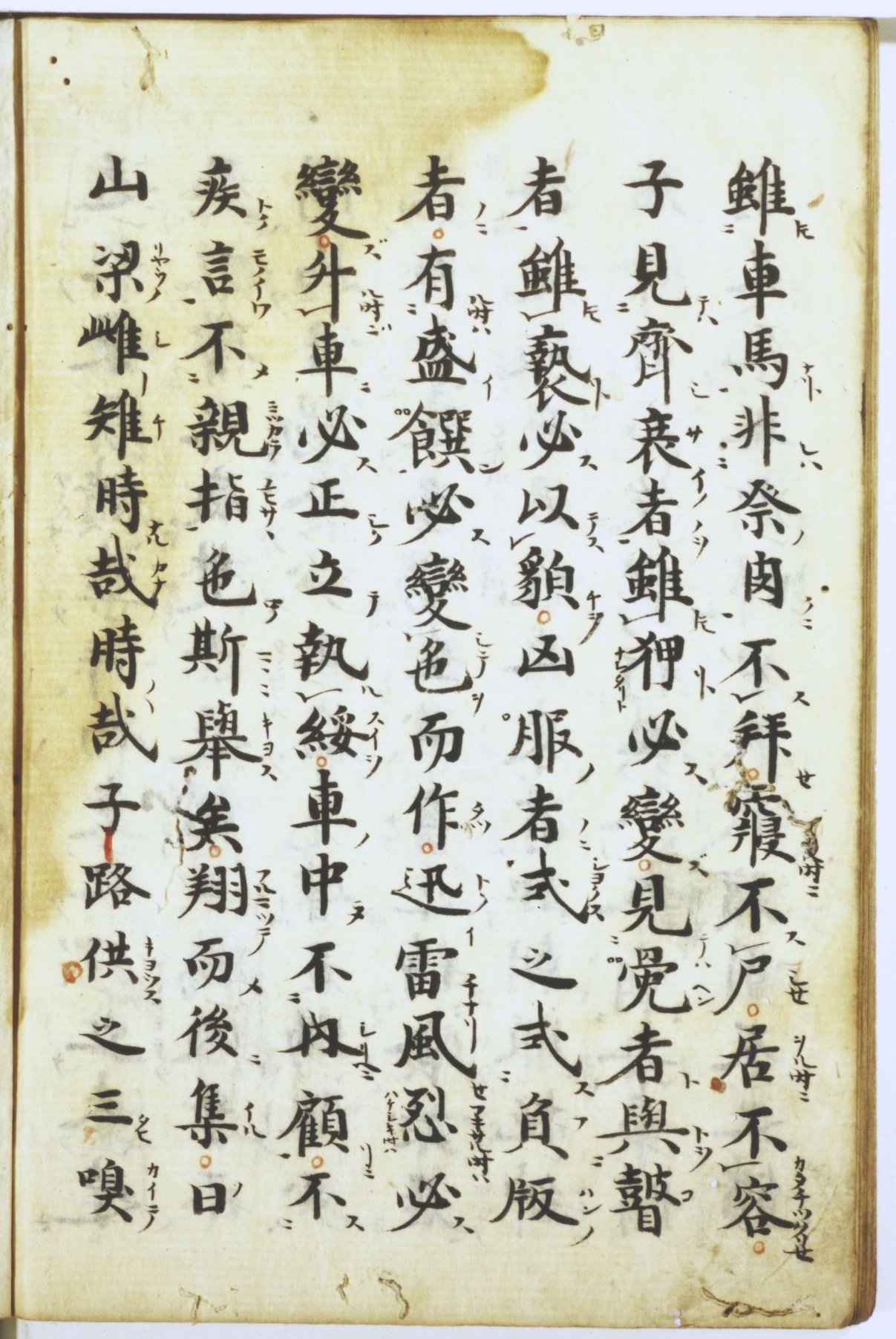
Kyoto University Library RB00007936, IIIF canvas 42, right-hand page: 7 written columns of up to 14 characters, main text only, with Japanese reading marks. Checked on the image: the first column of this book's text on this page begins ‹雖車馬›, the last begins ‹山梁雌›. 10.15.3 begins inside column 1 (the column opens ‹雖車馬›), 3 characters down in the received text. Above it the page finishes 10.15.2, shown in the previous section. 10.18.2 runs on to canvas 42, left-hand page (first column ‹而作›), where the section ends. Column openings on these pages that differ from the received text: ‹子見齊› where the received text has ‹見齊衰›. The Chinese shown is the received text (Wikisource), not a transcription of this manuscript; Legge's English translates the received text.
15.3非祭肉,不拜。
16.1寢不尸,居不容。
16.2見齊衰者,雖狎必變。見冕者與瞽者,雖褻必以貌。
16.3凶服者式之。式負版者。
16.4有盛饌,必變色而作。
16.5迅雷,風烈,必變。
17.1升車,必正立,執綏。
17.2車中不內顧,不疾言,不親指。
18.1色斯擧矣,翔而後集。
18.2曰:「山梁雌雉,時哉時哉!」子路共之,三嗅而作。
15.3The only present for which he bowed was that of the flesh of sacrifice.
16.1In bed, he did not lie like a corpse. At home, he did not put on any formal deportment.
16.2When he saw any one in a mourning dress, though it might be an acquaintance, he would change countenance; when he saw any one wearing the cap of full dress, or a blind person, though he might be in his undress, he would salute them in a ceremonious manner.
16.3To any person in mourning he bowed forward to the crossbar of his carriage; he bowed in the same way to any one bearing the tables of population.
16.4When he was at an entertainment where there was an abundance of provisions set before him, he would change countenance and rise up.
16.5On a sudden clap of thunder, or a violent wind, he would change countenance.
17.1When he was about to mount his carriage, he would stand straight, holding the cord.
17.2When he was in the carriage, he did not turn his head quite round, he did not talk hastily, he did not point with his hands.
18.1Seeing the countenance, it instantly rises. It flies round, and by and by settles.
18.2The Master said, 'There is the hen-pheasant on the hill bridge. At its season! At its season!' Tsze-lu made a motion to it. Thrice it smelt him and then rose.
Notes
- English: James Legge, Confucian Analects, The Chinese Classics vol. 1. Legge's chapter and paragraph numbers are kept as superscripts (chapter.paragraph).
- Legge translated the received text. Where this manuscript's wording differs, his English follows the received text shown here.
Cite
Sources
- Source: Kyoto University Library RB00007936 (Analects manuscript attributed to Kiyohara Yoshieda, c. 1300) + Wikisource received text + James Legge's English (Project Gutenberg) (holding institution)
- Critical edition: Received text (Wikisource) in Legge's chapter and paragraph division
← previous · → next · v cycle view · l back to library