Analects, Book 11: Xian jin 先進 (Kamakura-period manuscript)
Introduction
Book 11 of the Analects (論語 Lunyu), titled 先進 (Xian jin) after its opening words, 25 chapters in Legge's division. It is shown on a manuscript of the Analects in the Kiyohara family collection (Seike bunko) of Kyoto University Library, two volumes in regular script, seven columns of fourteen characters to the page, main text only, with red and black Japanese reading marks. A colophon by Kiyohara Edakata dated 1550 names the copyist as his ancestor Kiyohara Yoshieda (1253-1331), which places the copy around 1300, in the late Kamakura period; the attribution is traditional. The Kiyohara were hereditary readers of the Confucian classics at the Japanese court, and their text descends from the edition of the Analects with the collected commentary of He Yan (3rd century CE): after each pair of books the scribe copied the character counts of the classic and of the commentary, although only the classic is written out. The manuscript is an Important Cultural Property of Japan.
In this copy Book 11 runs from canvas 46, left-hand page to canvas 52, right-hand page (volume 2). Each section gathers the paragraphs that begin on one page, numbered by chapter and paragraph as in Legge, and links to that page and to any page the last paragraph runs onto. The page boundaries were found by reading the first characters of every column on the photographs. The Chinese shown is the received text, from Wikisource. This manuscript differs from it in places, most often by an added or missing particle (也, 矣, 焉) or a variant character form; the differences seen at column openings are listed in the scan notes. The English is James Legge's translation of the received text.
How was this verified? (Provenance)
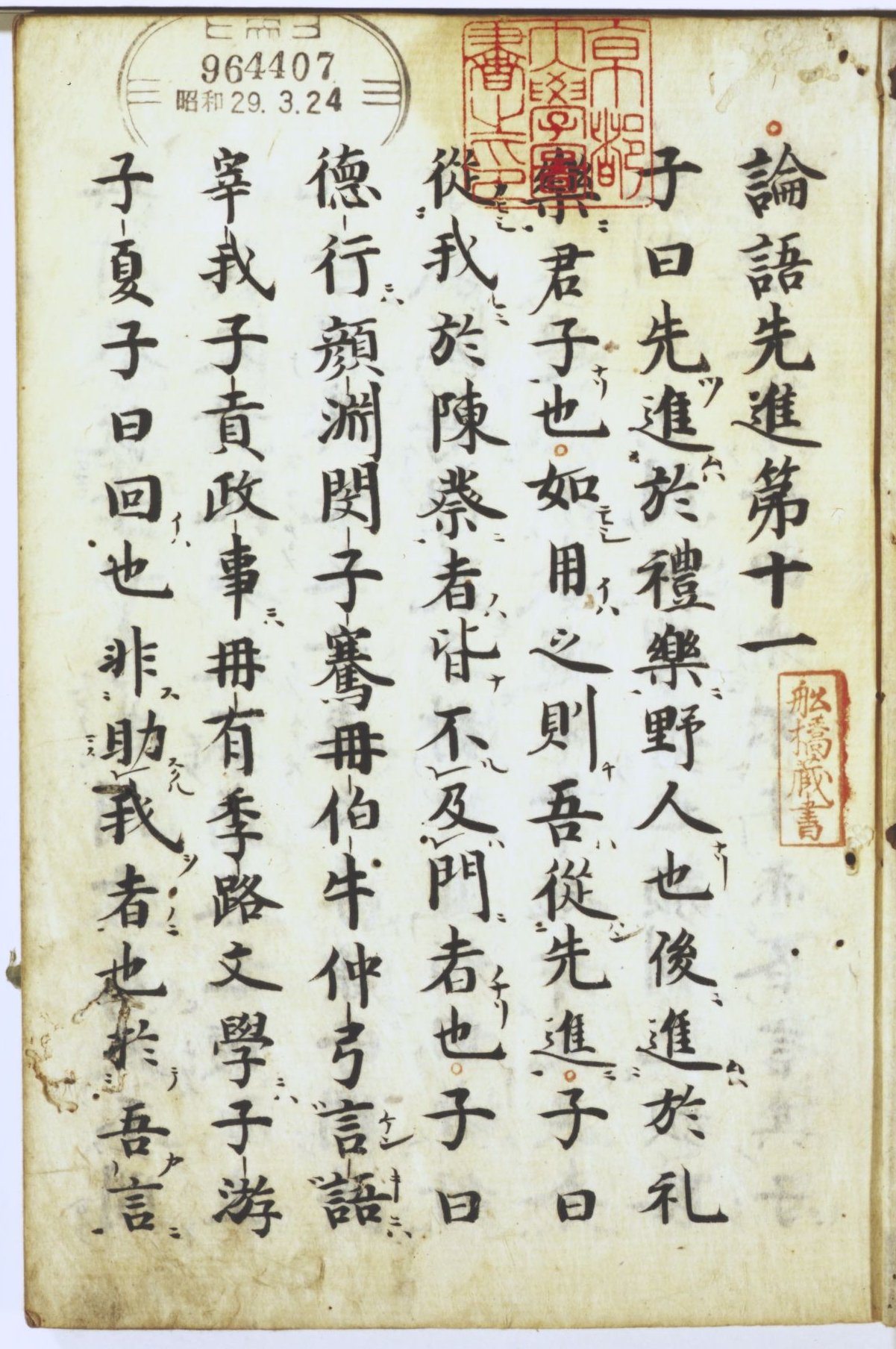
Where on the image
Kyoto University Library RB00007936, IIIF canvas 46, left-hand page: 7 written columns of up to 14 characters, main text only, with Japanese reading marks. Checked on the image: the first column of this book's text on this page begins ‹子曰先›, the last begins ‹子夏子›. Column 1 carries the title 論語先進第十一. 11.1.1 opens column 2. 11.3 runs on to canvas 47, right-hand page (first column ‹無所不›), where the section ends. The Chinese shown is the received text (Wikisource), not a transcription of this manuscript; Legge's English translates the received text.
1.1子曰:「先進於禮樂,野人也;後進於禮樂,君子也。
1.2如用之,則吾從先進。」
2.1子曰:「從我於陳蔡者,皆不及門也。」
2.2德行:顏淵、閔子騫、冉伯牛、仲弓。言語:宰我、子貢。政事:冉有、季路。文學:子游、子夏。
3子曰:「回也,非助我者也!於吾言,無所不說。」
1.1The Master said, 'The men of former times, in the matters of ceremonies and music were rustics, it is said, while the men of these latter times, in ceremonies and music, are accomplished gentlemen.
1.2'If I have occasion to use those things, I follow the men of former times.'
2.1The Master said, 'Of those who were with me in Ch'an and Ts'ai, there are none to be found to enter my door.'
2.2Distinguished for their virtuous principles and practice, there were Yen Yuan, Min Tsze-ch'ien, Zan Po-niu, and Chung-kung; for their ability in speech, Tsai Wo and Tsze-kung; for their adminis- trative talents, Zan Yu and Chi Lu; for their literary acquirements, Tsze-yu and Tsze-hsia.
3The Master said, 'Hui gives me no assistance. There is nothing that I say in which he does not delight.'
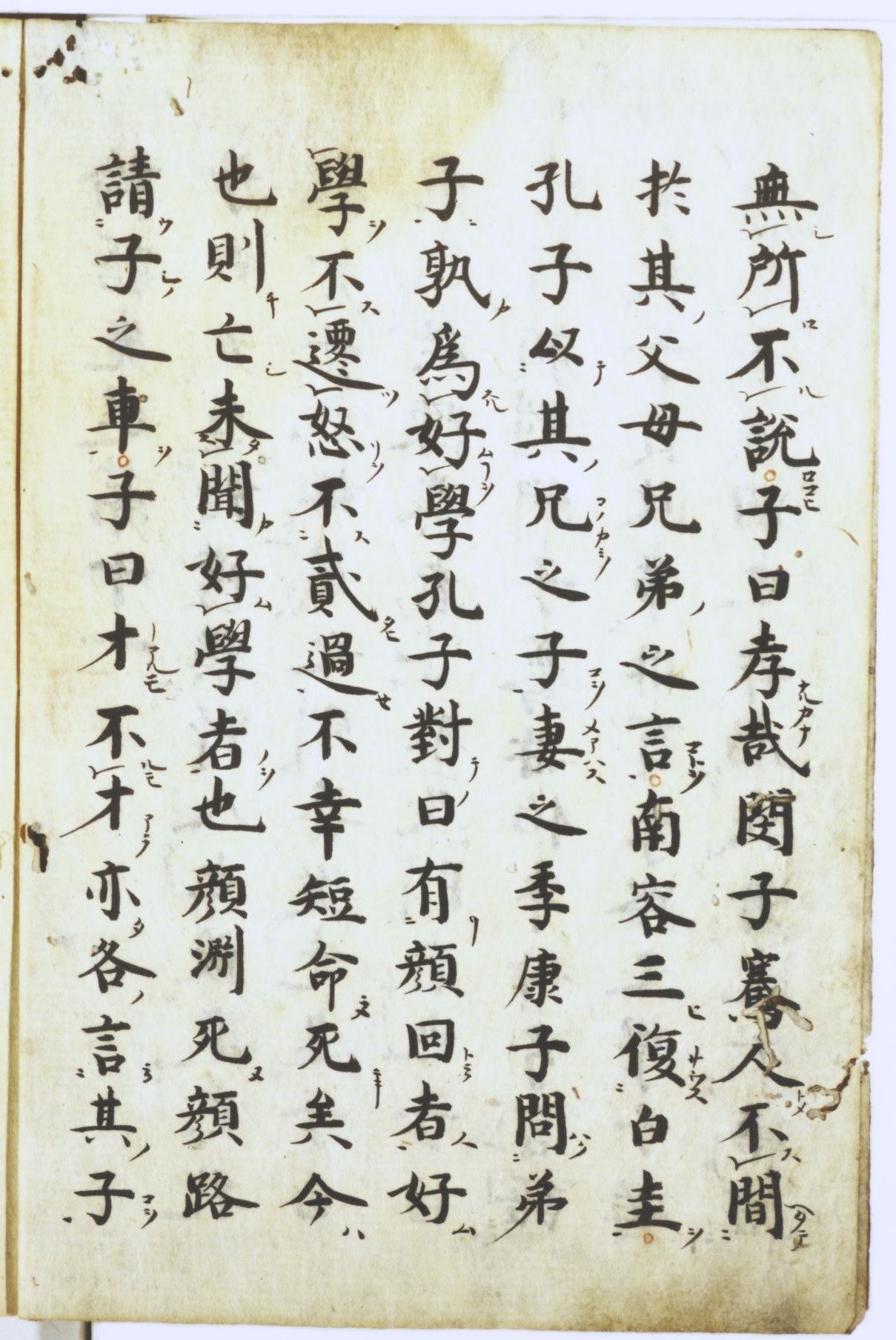
Where on the image
Kyoto University Library RB00007936, IIIF canvas 47, right-hand page: 7 written columns of up to 14 characters, main text only, with Japanese reading marks. Checked on the image: the first column of this book's text on this page begins ‹無所不›, the last begins ‹請子之›. 11.4 begins inside column 1 (the column opens ‹無所不›), 4 characters down in the received text. Above it the page finishes 11.3, shown in the previous section. 11.7.2 runs on to canvas 47, left-hand page (first column ‹也鯉也›), where the section ends. Column openings on these pages that differ from the received text: ‹學不遷› where the received text has ‹學不幸›; ‹為之椁› where the received text has ‹爲之槨›. The Chinese shown is the received text (Wikisource), not a transcription of this manuscript; Legge's English translates the received text.
4子曰:「孝哉,閔子騫!人不間於其父母昆弟之言。」
5南容三復《白圭》,孔子以其兄之子妻之。
6季康子問:「弟子孰爲好學?」孔子對曰:「有顏回者好學,不幸短命死矣。今也則亡。」
7.1顏淵死,顏路請子之車以爲之槨。
7.2子曰:「才不才,亦各言其子也。鯉也死,有棺而無槨。吾不徒行以爲之槨,以吾從大夫之後,不可徒行也。」
4The Master said, 'Filial indeed is Min Tsze-ch'ien! Other people say nothing of him different from the report of his parents and brothers.'
5Nan Yung was frequently repeating the lines about a white scepter stone. Confucius gave him the daughter of his elder brother to wife.
6Chi K'ang asked which of the disciples loved to learn. Confucius replied to him, 'There was Yen Hui; he loved to learn. Unfortunately his appointed time was short, and he died. Now there is no one who loves to learn, as he did.'
7.1When Yen Yuan died, Yen Lu begged the carriage of the Master to sell and get an outer shell for his son's coffin.
7.2The Master said, 'Every one calls his son his son, whether he has talents or has not talents. There was Li; when he died, he had a coffin but no outer shell. I would not walk on foot to get a shell for him, because, having followed in the rear of the great officers, it was not proper that I should walk on foot.'
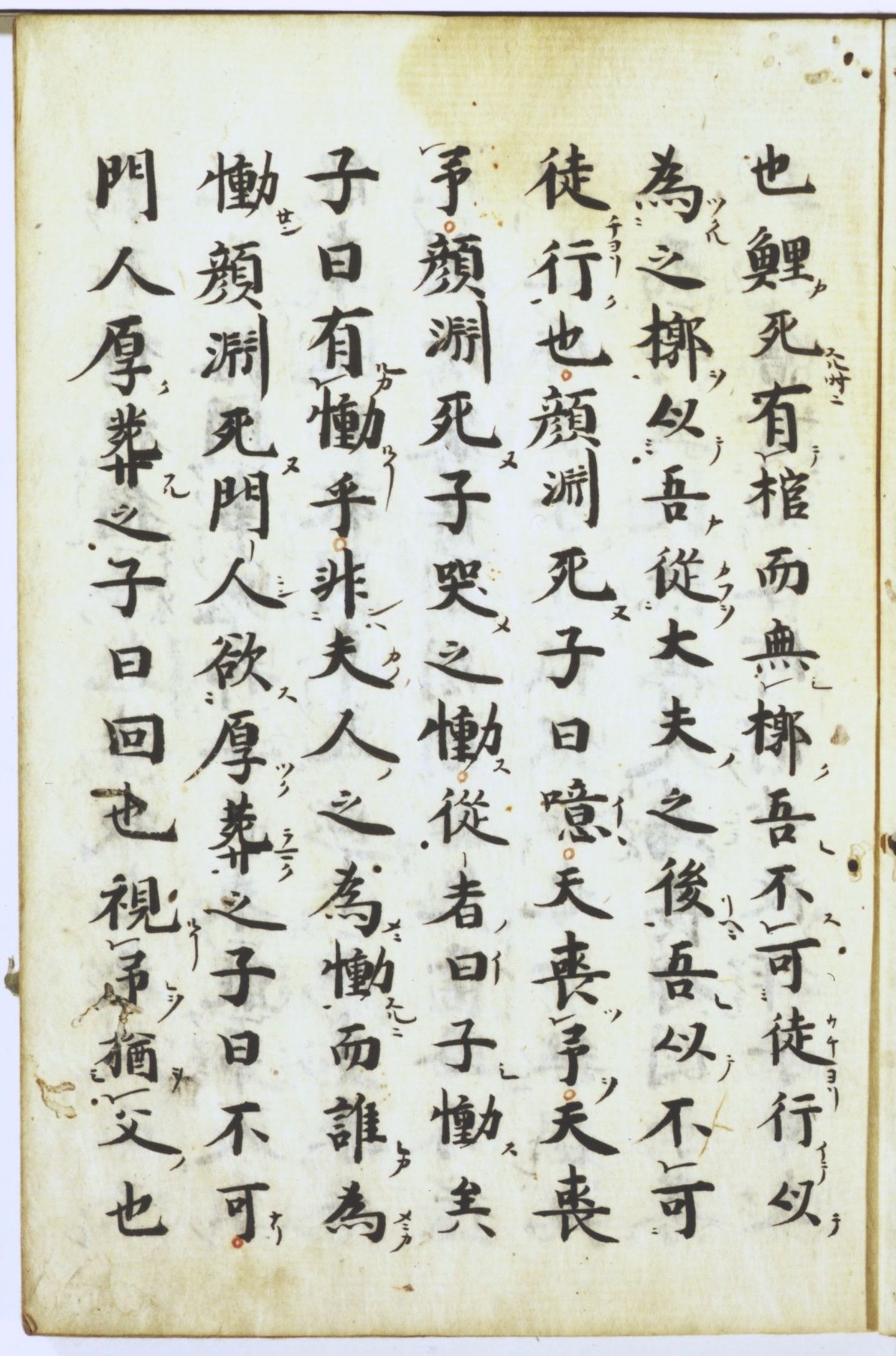
Where on the image
Kyoto University Library RB00007936, IIIF canvas 47, left-hand page: 7 written columns of up to 14 characters, main text only, with Japanese reading marks. Checked on the image: the first column of this book's text on this page begins ‹也鯉也›, the last begins ‹門人厚›. 11.8 begins inside column 3 (the column opens ‹徒行也›), 3 characters down in the received text. Above it the page finishes 11.7.2, shown in the previous section. 11.10.3 runs on to canvas 48, right-hand page (first column ‹予不得›), where the section ends. Column openings on these pages that differ from the received text: ‹子曰有› where the received text has ‹子慟矣›; ‹慟顏淵› where the received text has ‹誰爲顏›. The Chinese shown is the received text (Wikisource), not a transcription of this manuscript; Legge's English translates the received text.
8顏淵死,子曰:「噫!天喪予!天喪予!」
9.1顏淵死,子哭之慟。從者曰:「子慟矣!」
9.2曰:「有慟乎?
9.3非夫人之爲慟而誰爲?」
10.1顏淵死,門人欲厚葬之。子曰:「不可。」
10.2門人厚葬之。
10.3子曰:「回也,視予猶父也,予不得視猶子也;非我也,夫二三子也。」
8When Yen Yuan died, the Master said, 'Alas! Heaven is destroying me! Heaven is destroying me!'
9.1When Yen Yuan died, the Master bewailed him exceedingly, and the disciples who were with him said, 'Master, your grief is excessive?'
9.2'Is it excessive?' said he.
9.3'If I am not to mourn bitterly for this man, for whom should I mourn?'
10.1When Yen Yuan died, the disciples wished to give him a great funeral, and the Master said, 'You may not do so.'
10.2The disciples did bury him in great style.
10.3The Master said, 'Hui behaved towards me as his father. I have not been able to treat him as my son. The fault is not mine; it belongs to you, O disciples.'
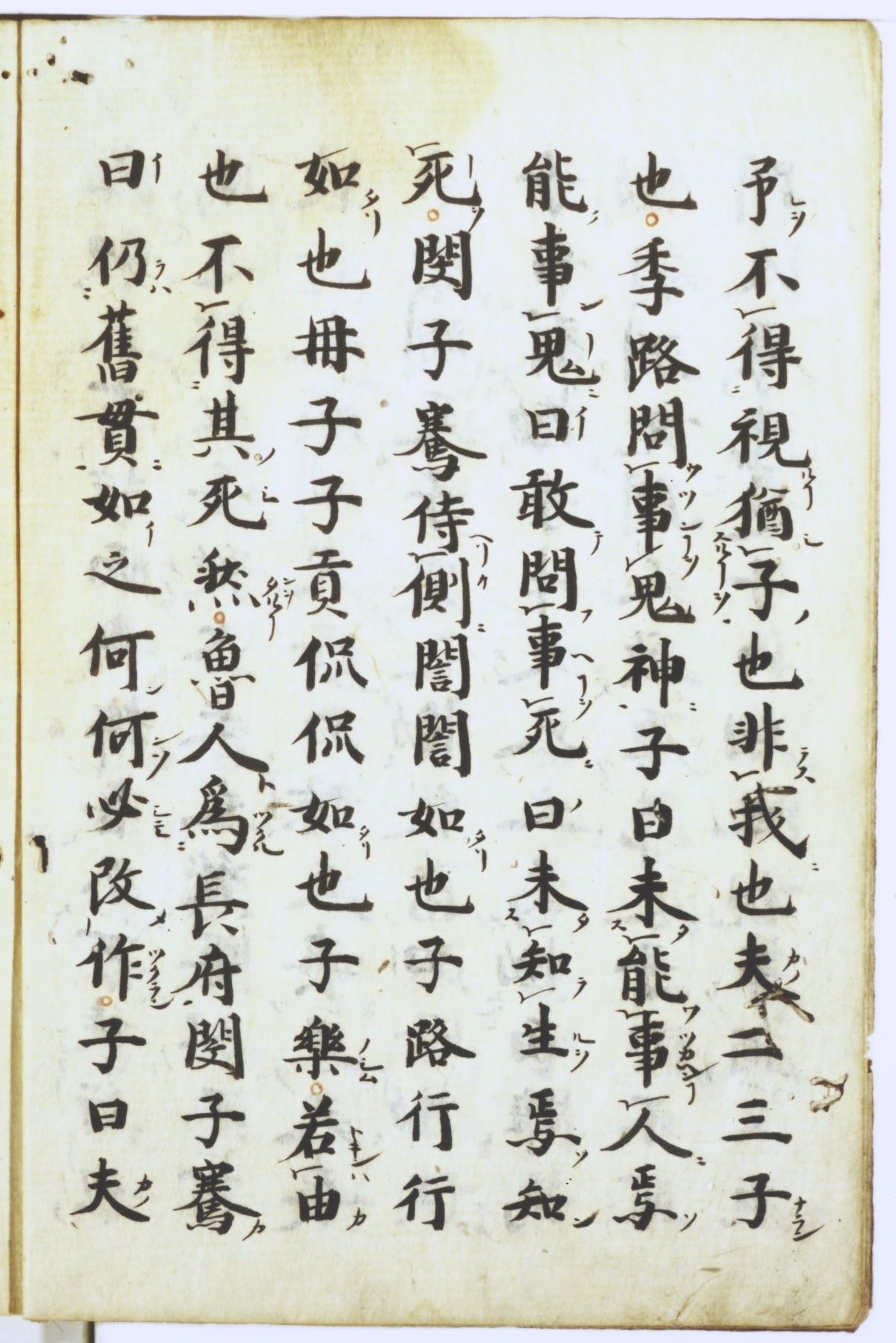
Where on the image
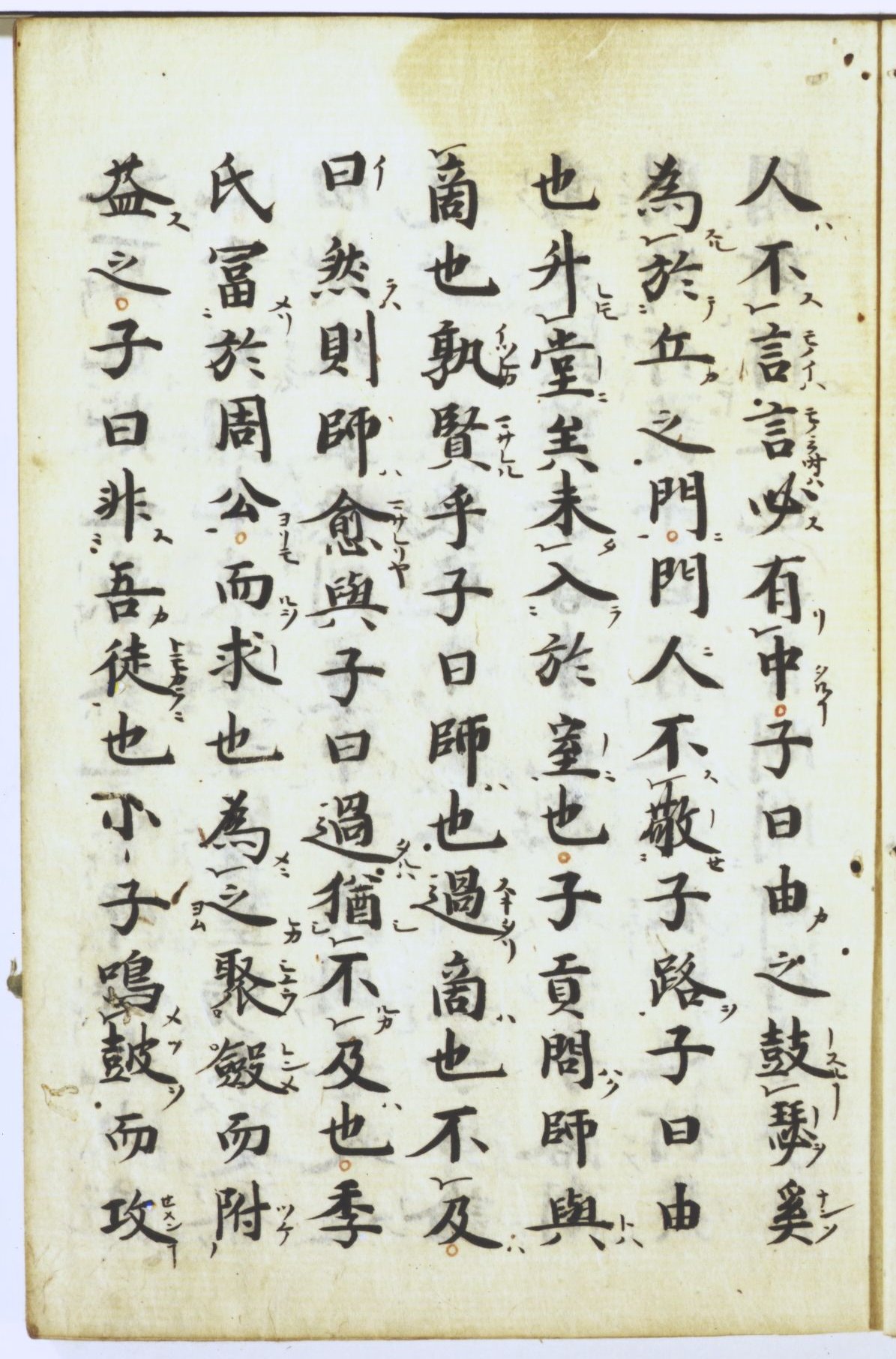
Kyoto University Library RB00007936, IIIF canvas 48, right-hand page: 7 written columns of up to 14 characters, main text only, with Japanese reading marks. Checked on the image: the first column of this book's text on this page begins ‹予不得›, the last begins ‹曰仍舊›. 11.11 begins inside column 2 (the column opens ‹也季路›), 1 characters down in the received text. Above it the page finishes 11.10.3, shown in the previous section. 11.13.3 runs on to canvas 48, left-hand page (first column ‹人不言›), where the section ends. The Chinese shown is the received text (Wikisource), not a transcription of this manuscript; Legge's English translates the received text.
11季路問事鬼神。子曰:「未能事人,焉能事鬼?」曰:「敢問死?」曰:「未知生,焉知死?」
12.1閔子侍側,誾誾如也;子路,行行如也;冉有、子貢,侃侃如也。子樂。
12.2「若由也,不得其死然!」
13.1魯人爲長府。
13.2閔子騫曰:「仍舊貫,如之何?何必改作?」
13.3子曰:「夫人不言,言必有中。」
11Chi Lu asked about serving the spirits of the dead. The Master said, 'While you are not able to serve men, how can you serve their spirits?' Chi Lu added, 'I venture to ask about death?' He was answered, 'While you do not know life, how can you know about death?'
12.1The disciple Min was standing by his side, looking bland and precise; Tsze-lu, looking bold and soldierly; Zan Yu and Tsze-kung, with a free and straightforward manner. The Master was pleased.
12.2He said, 'Yu, there!-- he will not die a natural death.'
13.1Some parties in Lu were going to take down and rebuild the Long Treasury.
13.2Min Tsze-ch'ien said, 'Suppose it were to be repaired after its old style;-- why must it be altered and made anew?'
13.3The Master said, 'This man seldom speaks; when he does, he is sure to hit the point.'
Where on the image
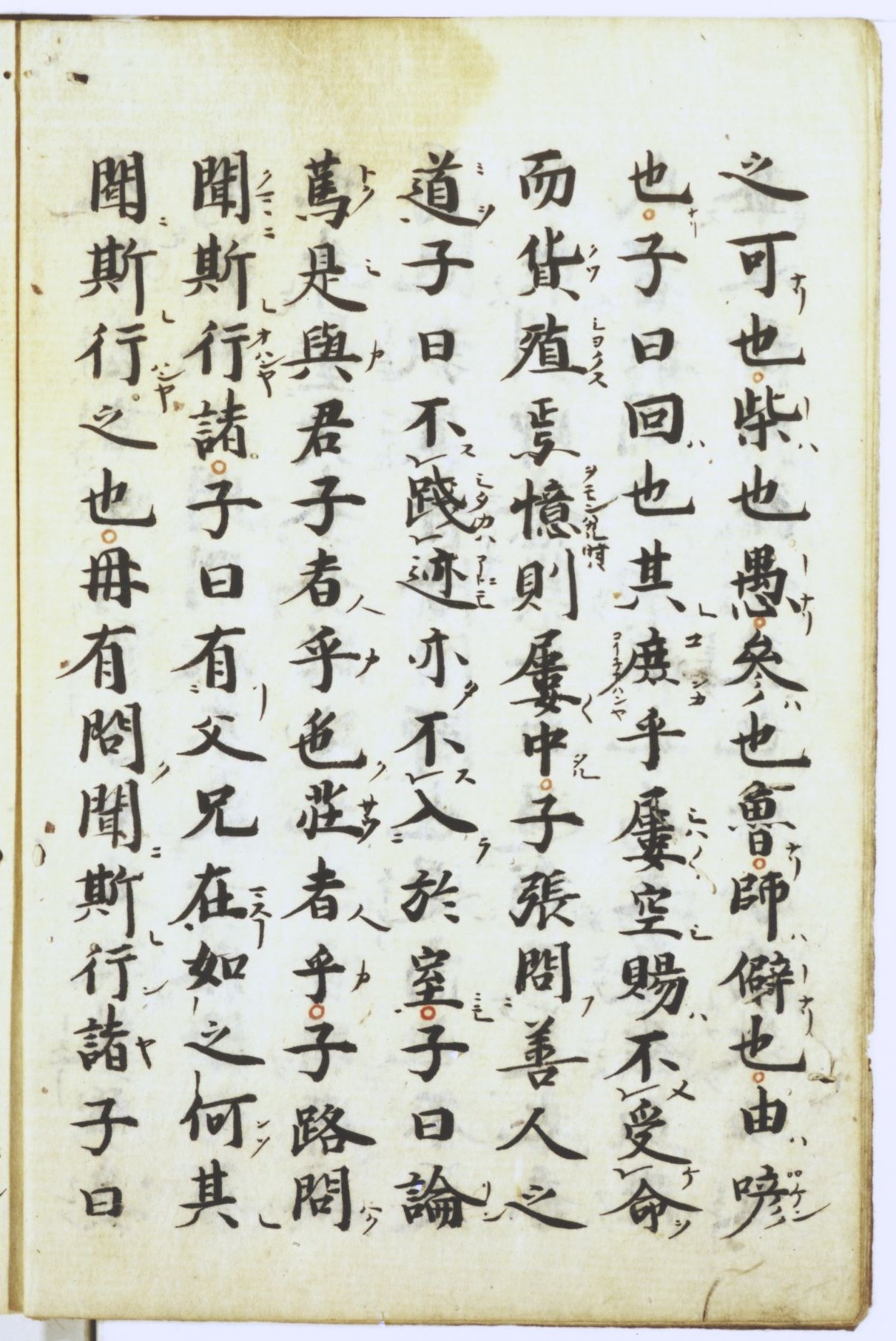
Kyoto University Library RB00007936, IIIF canvas 48, left-hand page: 7 written columns of up to 14 characters, main text only, with Japanese reading marks. Checked on the image: the first column of this book's text on this page begins ‹人不言›, the last begins ‹益之子›. 11.14.1 begins inside column 1 (the column opens ‹人不言›), 7 characters down in the received text. Above it the page finishes 11.13.3, shown in the previous section. 11.16.2 runs on to canvas 49, right-hand page (first column ‹之可也›), where the section ends. The Chinese shown is the received text (Wikisource), not a transcription of this manuscript; Legge's English translates the received text.
14.1子曰:「由之瑟,奚爲於丘之門?」
14.2門人不敬子路。子曰:「由也升堂矣,未入於室也!」
15.1子貢問:「師與商也孰賢?」子曰:「師也過,商也不及。」
15.2曰:「然則師愈與?」
15.3子曰:「過猶不及。」
16.1季氏富於周公,而求也爲之聚斂而附益之。
16.2子曰:「非吾徒也!小子鳴鼓而攻之,可也。」
14.1The Master said, 'What has the lute of Yu to do in my door?'
14.2The other disciples began not to respect Tsze-lu. The Master said, 'Yu has ascended to the hall, though he has not yet passed into the inner apartments.'
15.1Tsze-kung asked which of the two, Shih or Shang, was the superior. The Master said, 'Shih goes beyond the due mean, and Shang does not come up to it.'
15.2'Then,' said Tsze-kung, 'the superiority is with Shih, I suppose.'
15.3The Master said, 'To go beyond is as wrong as to fall short.'
16.1The head of the Chi family was richer than the duke of Chau had been, and yet Ch'iu collected his imposts for him, and increased his wealth.
16.2The Master said, 'He is no disciple of mine. My little children, beat the drum and assail him.'
Where on the image
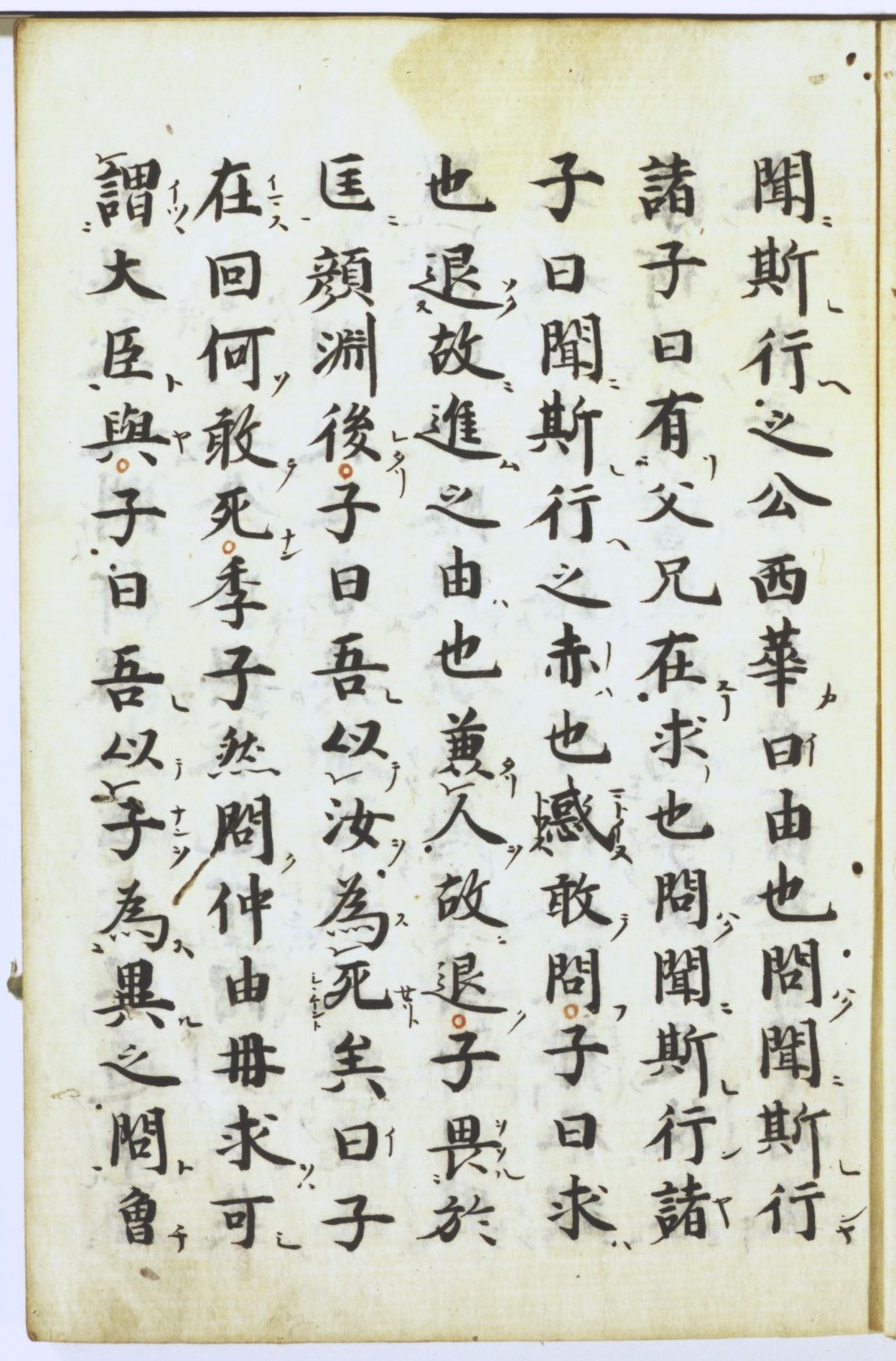
Kyoto University Library RB00007936, IIIF canvas 49, right-hand page: 7 written columns of up to 14 characters, main text only, with Japanese reading marks. Checked on the image: the first column of this book's text on this page begins ‹之可也›, the last begins ‹聞斯行之也冉有›. 11.17.1 begins inside column 1 (the column opens ‹之可也›), 3 characters down in the received text. Above it the page finishes 11.16.2, shown in the previous section. 11.21 runs on to canvas 49, left-hand page (first column ‹聞斯行之公›), where the section ends. Column openings on these pages that differ from the received text: ‹也子曰› where the received text has ‹也喭子›; ‹聞斯行之也冉有› where the received text has ‹聞斯行之冉有問›. The Chinese shown is the received text (Wikisource), not a transcription of this manuscript; Legge's English translates the received text.
17.1柴也愚,
17.2參也魯,
17.3師也辟,
17.4由也喭。
18.1子曰:「回也其庶乎,屢空。
18.2賜不受命,而貨殖焉;億則屢中。」
19子張問「善人」之道。子曰:「不踐跡,亦不入於室。」
20子曰:「論篤是與,君子者乎?色莊者乎?」
21子路問:「聞斯行諸?」子曰:「有父兄在,如之何其聞斯行之?」冉有問:「聞斯行諸?」子曰:「聞斯行之。」公西華曰:「由也問:『聞斯行諸?』子曰:『有父兄在。』求也問:『聞斯行諸?』子曰:『聞斯行之。』赤也惑,敢問。」子曰:「求也退,故進之;由也兼人,故退之。」
17.1Ch'ai is simple.
17.2Shan is dull.
17.3Shih is specious.
17.4Yu is coarse.
18.1The Master said, 'There is Hui! He has nearly attained to perfect virtue. He is often in want.
18.2'Ts'ze does not acquiesce in the appointments of Heaven, and his goods are increased by him. Yet his judgments are often correct.'
19Tsze-chang asked what were the characteristics of the GOOD man. The Master said, 'He does not tread in the footsteps of others, but moreover, he does not enter the chamber of the sage.'
20The Master said, 'If, because a man's discourse appears solid and sincere, we allow him to be a good man, is he really a superior man? or is his gravity only in appearance?'
21Tsze-lu asked whether he should immediately carry into practice what he heard. The Master said, 'There are your father and elder brothers to be consulted;-- why should you act on that principle of immediately carrying into practice what you hear?' Zan Yu asked the same, whether he should immediately carry into practice what he heard, and the Master answered, 'Immediately carry into practice what you hear.' Kung-hsi Hwa said, 'Yu asked whether he should carry immediately into practice what he heard, and you said, "There are your father and elder brothers to be consulted." Ch'iu asked whether he should immediately carry into practice what he heard, and you said, "Carry it immediately into practice." I, Ch'ih, am perplexed, and venture to ask you for an explanation.' The Master said, 'Ch'iu is retiring and slow; therefore, I urged him forward. Yu has more than his own share of energy; therefore I kept him back.'
Where on the image
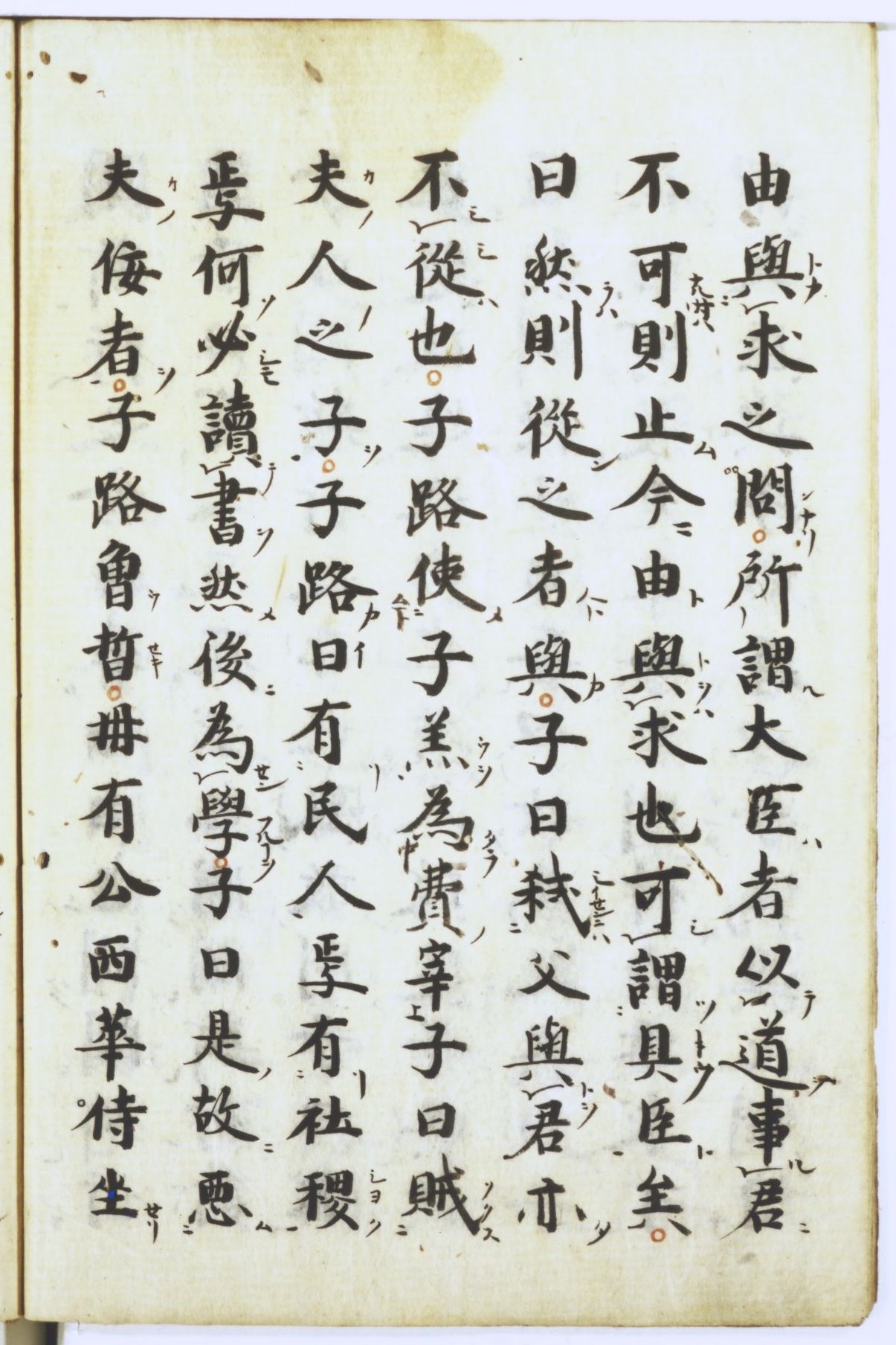
Kyoto University Library RB00007936, IIIF canvas 49, left-hand page: 7 written columns of up to 14 characters, main text only, with Japanese reading marks. Checked on the image: the first column of this book's text on this page begins ‹聞斯行之公›, the last begins ‹謂大臣›. 11.22 begins inside column 4 (the column opens ‹也退故›), 12 characters down in the received text. Above it the page finishes 11.21, shown in the previous section. 11.23.2 runs on to canvas 50, right-hand page (first column ‹由與求›), where the section ends. The Chinese shown is the received text (Wikisource), not a transcription of this manuscript; Legge's English translates the received text.
22子畏於匡,顏淵後。子曰:「吾以女爲死矣!」曰:「子在,回何敢死?」
23.1季子然問:「仲由、冉求可謂大臣與?」
23.2子曰:「吾以子爲異之問,曾由與求之問?
22The Master was put in fear in K'wang and Yen Yuan fell behind. The Master, on his rejoining him, said, 'I thought you had died.' Hui replied, 'While you were alive, how should I presume to die?'
23.1Chi Tsze-zan asked whether Chung Yu and Zan Ch'iu could be called great ministers.
23.2The Master said, 'I thought you would ask about some extraordinary individuals, and you only ask about Yu and Ch'iu!
Where on the image
Kyoto University Library RB00007936, IIIF canvas 50, right-hand page: 7 written columns of up to 14 characters, main text only, with Japanese reading marks. Checked on the image: the first column of this book's text on this page begins ‹由與求›, the last begins ‹夫佞者›. 11.23.3 begins inside column 1 (the column opens ‹由與求›), 5 characters down in the received text. Above it the page finishes 11.23.2, shown in the previous section. The section ends on this page. The Chinese shown is the received text (Wikisource), not a transcription of this manuscript; Legge's English translates the received text.
23.3所謂大臣者,以道事君,不可則止。
23.4今由與求也,可謂具臣矣。」
23.5曰:「然則從之者與?」
23.6子曰:「弒父與君,亦不從也。」
24.1子路使子羔爲費宰。
24.2子曰:「賊夫人之子。」
24.3子路曰:「有民人焉,有社稷焉;何必讀書,然後爲學?」
24.4子曰:「是故惡夫佞者。」
25.1子路、曾皙、冉有、公西華侍坐。
23.3'What is called a great minister, is one who serves his prince according to what is right, and when he finds he cannot do so, retires.
23.4'Now, as to Yu and Ch'iu, they may be called ordinary ministers.'
23.5Tsze-zan said, 'Then they will always follow their chief;-- will they?'
23.6The Master said, 'In an act of parricide or regicide, they would not follow him.'
24.1Tsze-lu got Tsze-kao appointed governor of Pi.
24.2The Master said, 'You are injuring a man's son.'
24.3Tsze-lu said, 'There are (there) common people and officers; there are the altars of the spirits of the land and grain. Why must one read books before he can be considered to have learned?'
24.4The Master said, 'It is on this account that I hate your glib-tongued people.'
25.1Tsze-lu, Tsang Hsi, Zan Yu, and Kung-hsi Hwa were sitting by the Master.
Where on the image
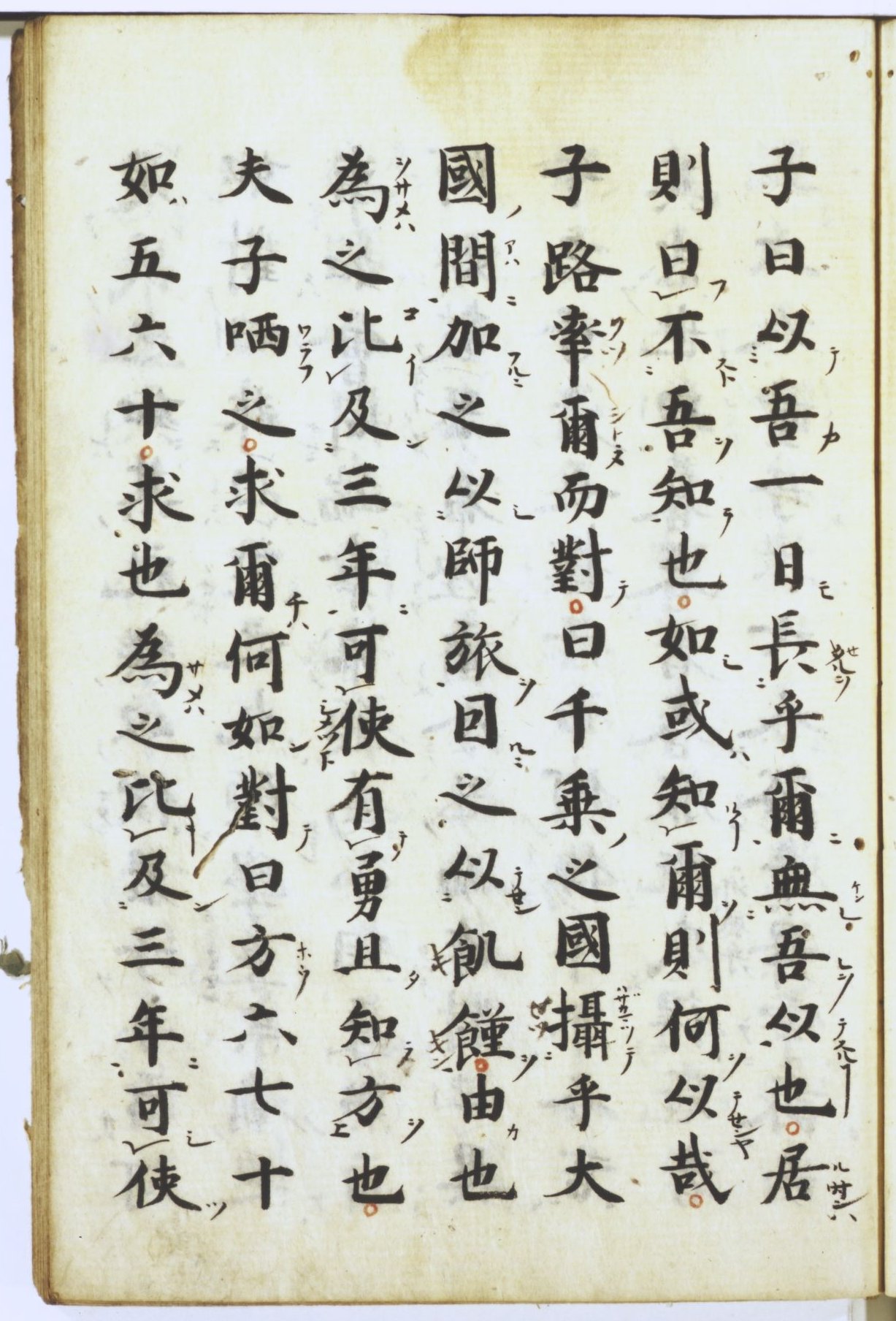
Kyoto University Library RB00007936, IIIF canvas 50, left-hand page: 7 written columns of up to 14 characters, main text only, with Japanese reading marks. Checked on the image: the first column of this book's text on this page begins ‹子曰以›, the last begins ‹如五六›. 11.25.2 opens column 1. 11.25.5 runs on to canvas 51, right-hand page (first column ‹足民也›), where the section ends. Column openings on these pages that differ from the received text: ‹國閒加› where the received text has ‹國之閒›; ‹足民也› where the received text has ‹足民如›. The Chinese shown is the received text (Wikisource), not a transcription of this manuscript; Legge's English translates the received text.
25.2子曰:「以吾一日長乎爾,毋吾以也。
25.3居則曰:『不吾知也。』如或知爾,則何以哉?」
25.4子路率爾而對,曰:「千乘之國,攝乎大國之閒,加之以師旅,因之以饑饉,由也爲之,比及三年,可使有勇,且知方也。」夫子哂之。
25.5「求,爾何如?」對曰:「方六七十,如五六十,求也爲之,比及三年,可使足民;如其禮樂,以俟君子。」
25.2He said to them, 'Though I am a day or so older than you, do not think of that.
25.3'From day to day you are saying, "We are not known." If some ruler were to know you, what would you like to do?'
25.4Tsze-lu hastily and lightly replied, 'Suppose the case of a State of ten thousand chariots; let it be straitened between other large States; let it be suffering from invading armies; and to this let there be added a famine in corn and in all vegetables:-- if I were intrusted with the government of it, in three years' time I could make the people to be bold, and to recognise the rules of righteous conduct.' The Master smiled at him.
25.5Turning to Yen Yu, he said, 'Ch'iu, what are your wishes?' Ch'iu replied, 'Suppose a state of sixty or seventy li square, or one of fifty or sixty, and let me have the government of it;-- in three years' time, I could make plenty to abound among the people. As to teaching them the principles of propriety, and music, I must wait for the rise of a superior man to do that.'
Where on the image
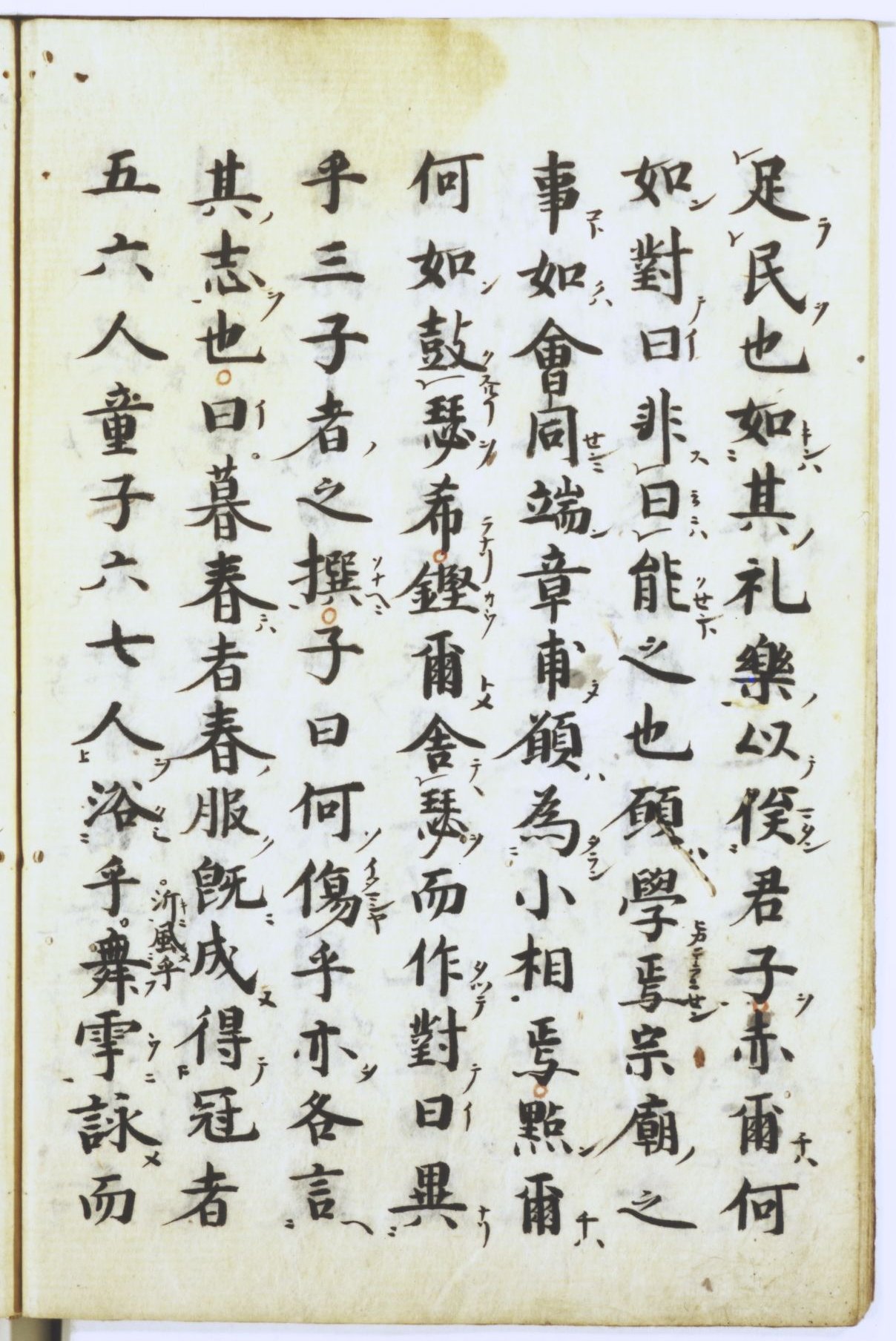
Kyoto University Library RB00007936, IIIF canvas 51, right-hand page: 7 written columns of up to 14 characters, main text only, with Japanese reading marks. Checked on the image: the first column of this book's text on this page begins ‹足民也›, the last begins ‹五六人›. 11.25.6 begins inside column 1 (the column opens ‹足民也›), 10 characters down in the received text. Above it the page finishes 11.25.5, shown in the previous section. 11.25.7 runs on to canvas 51, left-hand page (first column ‹歸夫子›), where the section ends. The Chinese shown is the received text (Wikisource), not a transcription of this manuscript; Legge's English translates the received text.
25.6「赤,爾何如?」對曰:「非曰能之,願學焉!宗廟之事,如會同,端章甫,願爲小相焉。」
25.7「點,爾何如?」鼓瑟希,鏗爾,舍瑟而作;對曰:「異乎三子者之撰。」子曰:「何傷乎?亦各言其志也。」曰:「莫春者,春服既成。冠者五六人,童子六七人。浴乎沂,風乎舞雩,詠而歸。」夫子喟然歎曰:「吾與點也!」
25.6'What are your wishes, Ch'ih,' said the Master next to Kung- hsi Hwa. Ch'ih replied, 'I do not say that my ability extends to these things, but I should wish to learn them. At the services of the ancestral temple, and at the audiences of the princes with the sovereign, I should like, dressed in the dark square-made robe and the black linen cap, to act as a small assistant.'
25.7Last of all, the Master asked Tsang Hsi, 'Tien, what are your wishes?' Tien, pausing as he was playing on his lute, while it was yet twanging, laid the instrument aside, and rose. 'My wishes,' he said, 'are different from the cherished purposes of these three gentlemen.' 'What harm is there in that?' said the Master; 'do you also, as well as they, speak out your wishes.' Tien then said, 'In this, the last month of spring, with the dress of the season all complete, along with five or six young men who have assumed the cap, and six or seven boys, I would wash in the I, enjoy the breeze among the rain altars, and return home singing.' The Master heaved a sigh and said, 'I give my approval to Tien.'
Where on the image
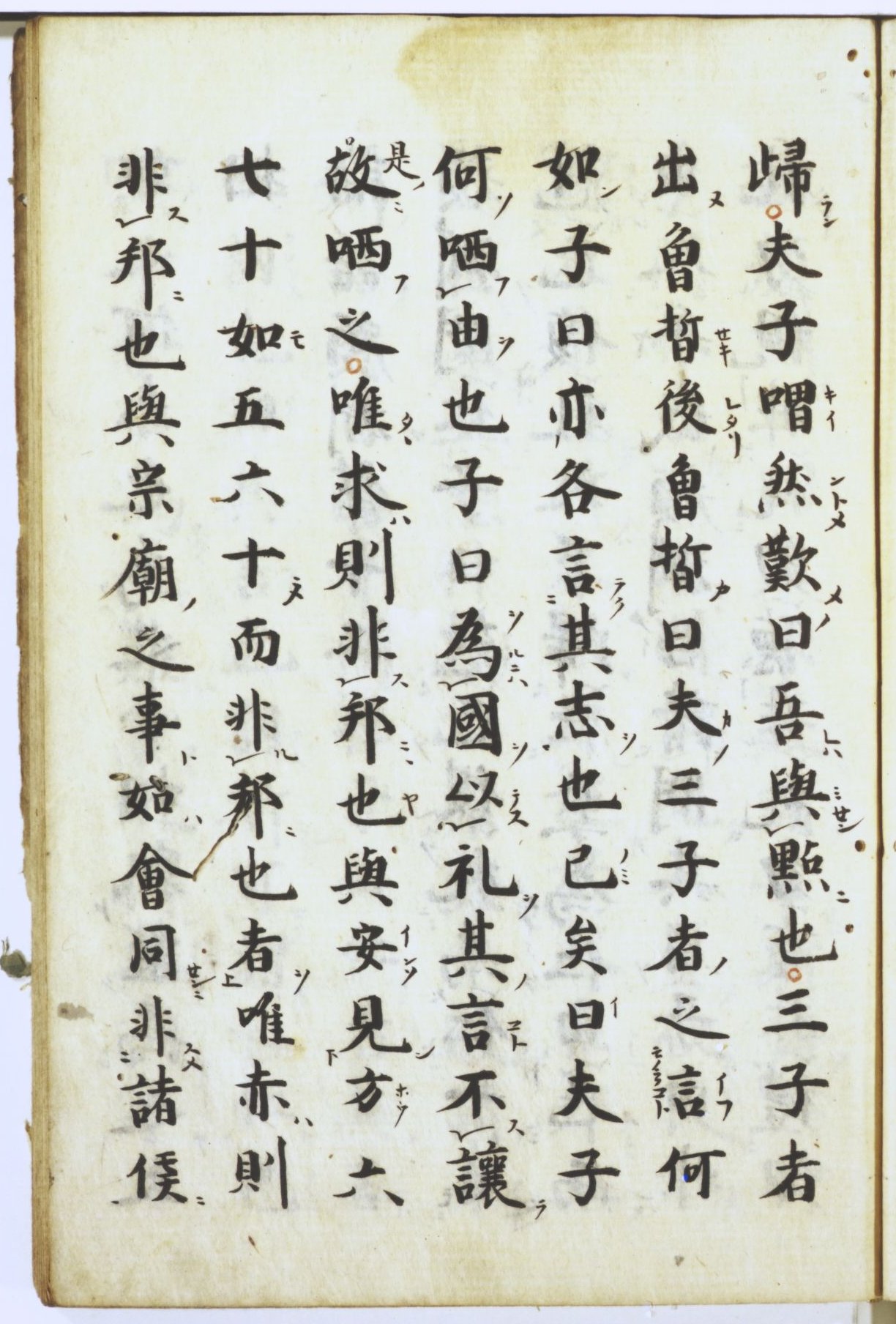
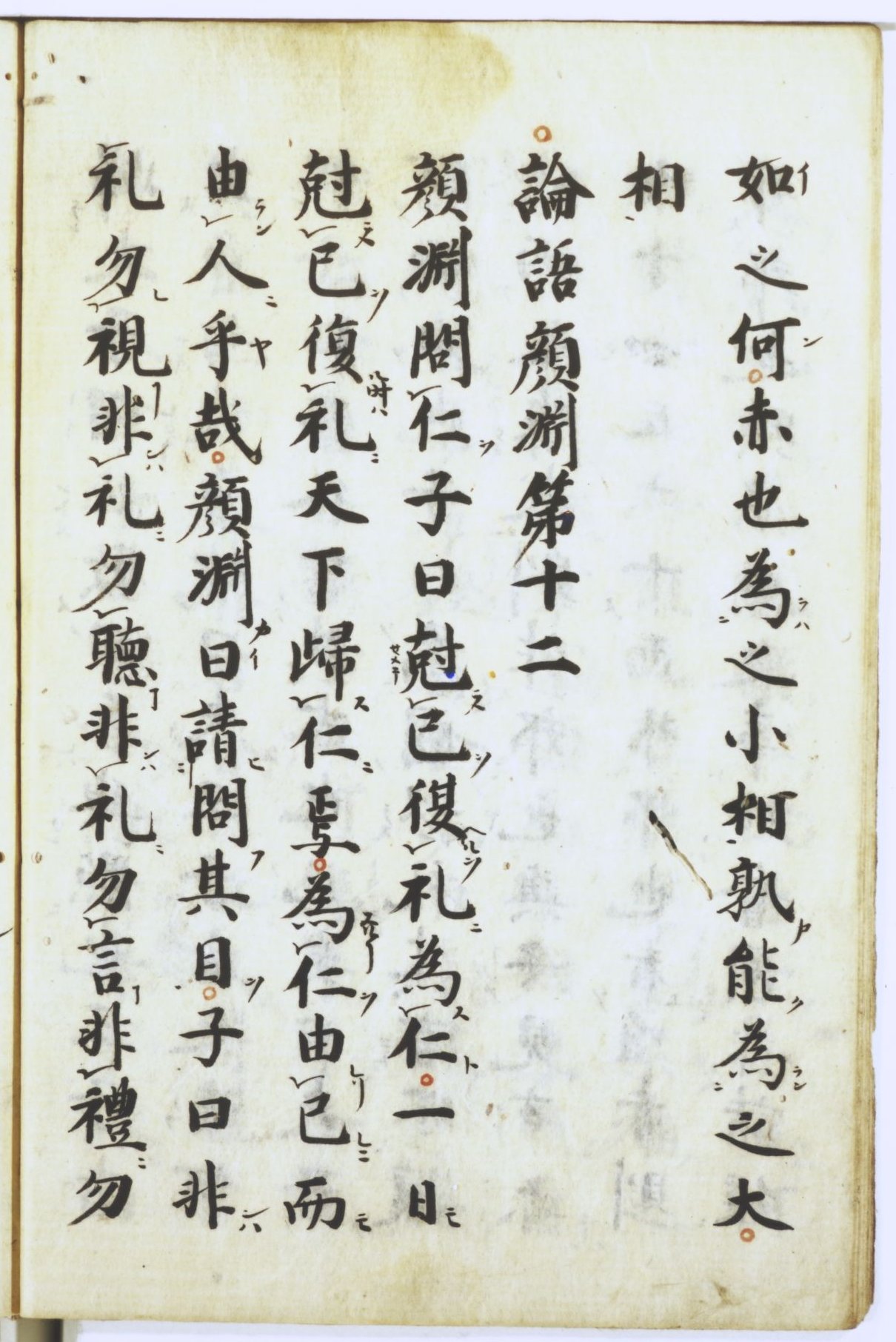
Kyoto University Library RB00007936, IIIF canvas 51, left-hand page: 7 written columns of up to 14 characters, main text only, with Japanese reading marks. Checked on the image: the first column of this book's text on this page begins ‹歸夫子›, the last begins ‹非邦也›. 11.25.8 begins inside column 1 (the column opens ‹歸夫子›), 11 characters down in the received text. Above it the page finishes 11.25.7, shown in the previous section. 11.25.12 runs on to canvas 52, right-hand page (first column ‹如之何赤也為之小›), where the section ends. Column openings on these pages that differ from the received text: ‹如之何赤也為之小› where the received text has ‹何赤也爲之小孰能›. The Chinese shown is the received text (Wikisource), not a transcription of this manuscript; Legge's English translates the received text.
25.8三子者出,曾皙後。曾皙曰:「夫三子者之言何如?」子曰:「亦各言其志也已矣。」
25.9曰:「夫子何哂由也?」
25.10曰:「爲國以禮,其言不讓,是故哂之。」
25.11「唯求則非邦也與?」「安見方六七十,如五六十,而非邦也者?」
25.12「唯赤則非邦也與?」「宗廟會同,非諸侯而何?赤也爲之小,孰能爲之大?」
25.8The three others having gone out, Tsang Hsi remained behind, and said, 'What do you think of the words of these three friends?' The Master replied, 'They simply told each one his wishes.'
25.9Hsi pursued, 'Master, why did you smile at Yu?'
25.10He was answered, 'The management of a State demands the rules of propriety. His words were not humble; therefore I smiled at him.'
25.11Hsi again said, 'But was it not a State which Ch'iu proposed for himself?' The reply was, 'Yes; did you ever see a territory of sixty or seventy li or one of fifty or sixty, which was not a State?'
25.12Once more, Hsi inquired, 'And was it not a State which Ch'ih proposed for himself?' The Master again replied, 'Yes; who but princes have to do with ancestral temples, and with audiences but the sovereign? If Ch'ih were to be a small assistant in these services, who could be a great one?
Notes
- English: James Legge, Confucian Analects, The Chinese Classics vol. 1. Legge's chapter and paragraph numbers are kept as superscripts (chapter.paragraph).
- Legge translated the received text. Where this manuscript's wording differs, his English follows the received text shown here.
Cite
Sources
- Source: Kyoto University Library RB00007936 (Analects manuscript attributed to Kiyohara Yoshieda, c. 1300) + Wikisource received text + James Legge's English (Project Gutenberg) (holding institution)
- Critical edition: Received text (Wikisource) in Legge's chapter and paragraph division
← previous · → next · v cycle view · l back to library