Analects, Book 12: Yan Yuan 顏淵 (Kamakura-period manuscript)
Introduction
Book 12 of the Analects (論語 Lunyu), titled 顏淵 (Yan Yuan) after its opening words, 24 chapters in Legge's division. It is shown on a manuscript of the Analects in the Kiyohara family collection (Seike bunko) of Kyoto University Library, two volumes in regular script, seven columns of fourteen characters to the page, main text only, with red and black Japanese reading marks. A colophon by Kiyohara Edakata dated 1550 names the copyist as his ancestor Kiyohara Yoshieda (1253-1331), which places the copy around 1300, in the late Kamakura period; the attribution is traditional. The Kiyohara were hereditary readers of the Confucian classics at the Japanese court, and their text descends from the edition of the Analects with the collected commentary of He Yan (3rd century CE): after each pair of books the scribe copied the character counts of the classic and of the commentary, although only the classic is written out. The manuscript is an Important Cultural Property of Japan.
In this copy Book 12 runs from canvas 52, right-hand page to canvas 57, right-hand page (volume 2). Each section gathers the paragraphs that begin on one page, numbered by chapter and paragraph as in Legge, and links to that page and to any page the last paragraph runs onto. The page boundaries were found by reading the first characters of every column on the photographs. The Chinese shown is the received text, from Wikisource. This manuscript differs from it in places, most often by an added or missing particle (也, 矣, 焉) or a variant character form; the differences seen at column openings are listed in the scan notes. The English is James Legge's translation of the received text.
How was this verified? (Provenance)
Where on the image
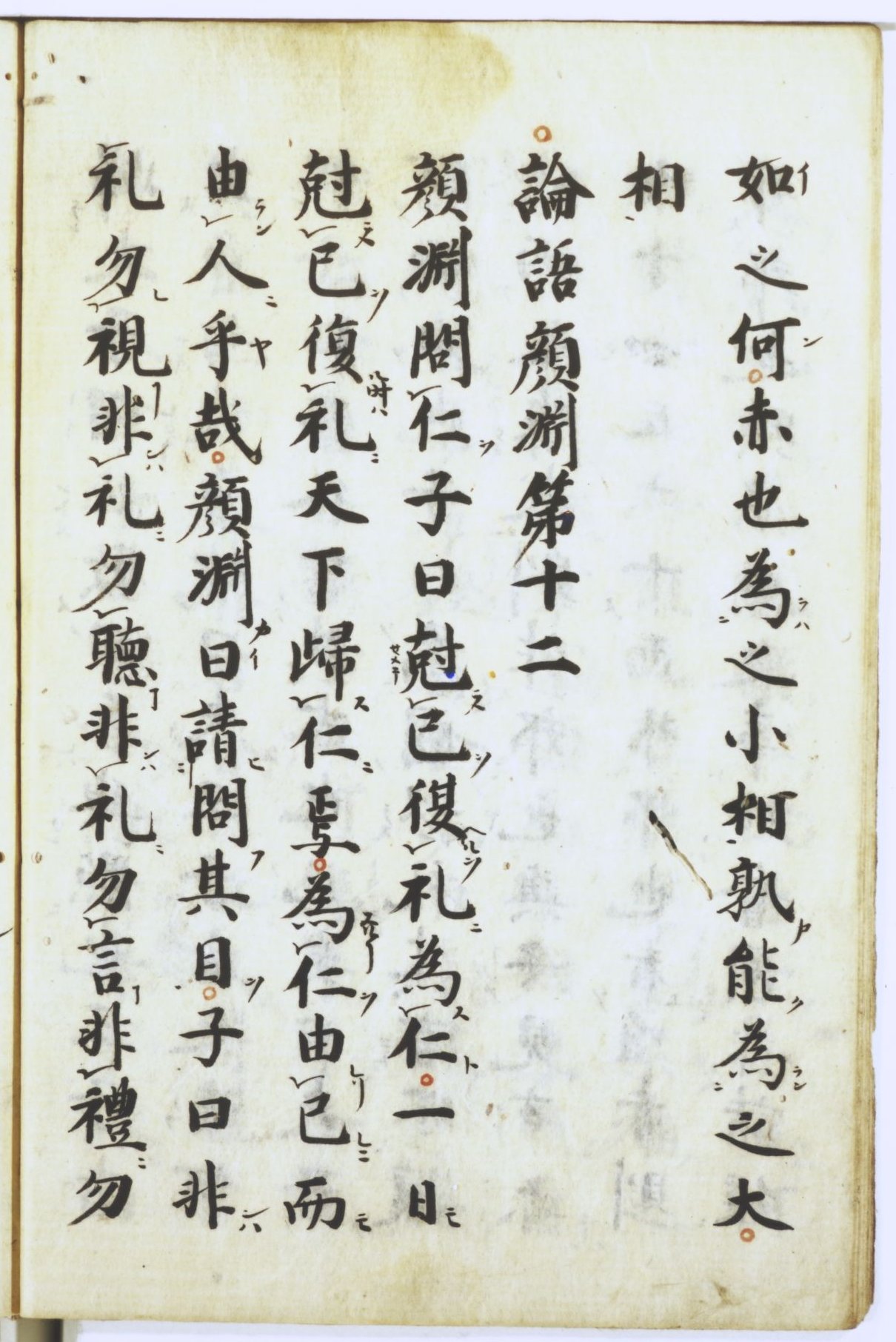
Kyoto University Library RB00007936, IIIF canvas 52, right-hand page: 7 written columns of up to 14 characters, main text only, with Japanese reading marks. Checked on the image: the first column of this book's text on this page begins ‹顏淵問›, the last begins ‹禮勿視›. Column 3 carries the title 論語顏淵第十二. 12.1.1 opens column 4. 12.1.2 runs on to canvas 52, left-hand page (first column ‹動顏淵›), where the section ends. The Chinese shown is the received text (Wikisource), not a transcription of this manuscript; Legge's English translates the received text.
1.1顏淵問「仁」。子曰:「克己復禮爲仁。一日克己復禮,天下歸仁焉,爲仁由己,而由人乎哉?」
1.2顏淵曰:「請問其目。」子曰:「非禮勿視,非禮勿聽,非禮勿言,非禮勿動。」顏淵曰:「回雖不敏,請事斯語矣!」
1.1Yen Yuan asked about perfect virtue. The Master said, 'To subdue one's self and return to propriety, is perfect virtue. If a man can for one day subdue himself and return to propriety, all under heaven will ascribe perfect virtue to him. Is the practice of perfect virtue from a man himself, or is it from others?'
1.2Yen Yuan said, 'I beg to ask the steps of that process.' The Master replied, 'Look not at what is contrary to propriety; listen not to what is contrary to propriety; speak not what is contrary to propriety; make no movement which is contrary to propriety.' Yen Yuan then said, 'Though I am deficient in intelligence and vigour, I will make it my business to practise this lesson.'
Where on the image
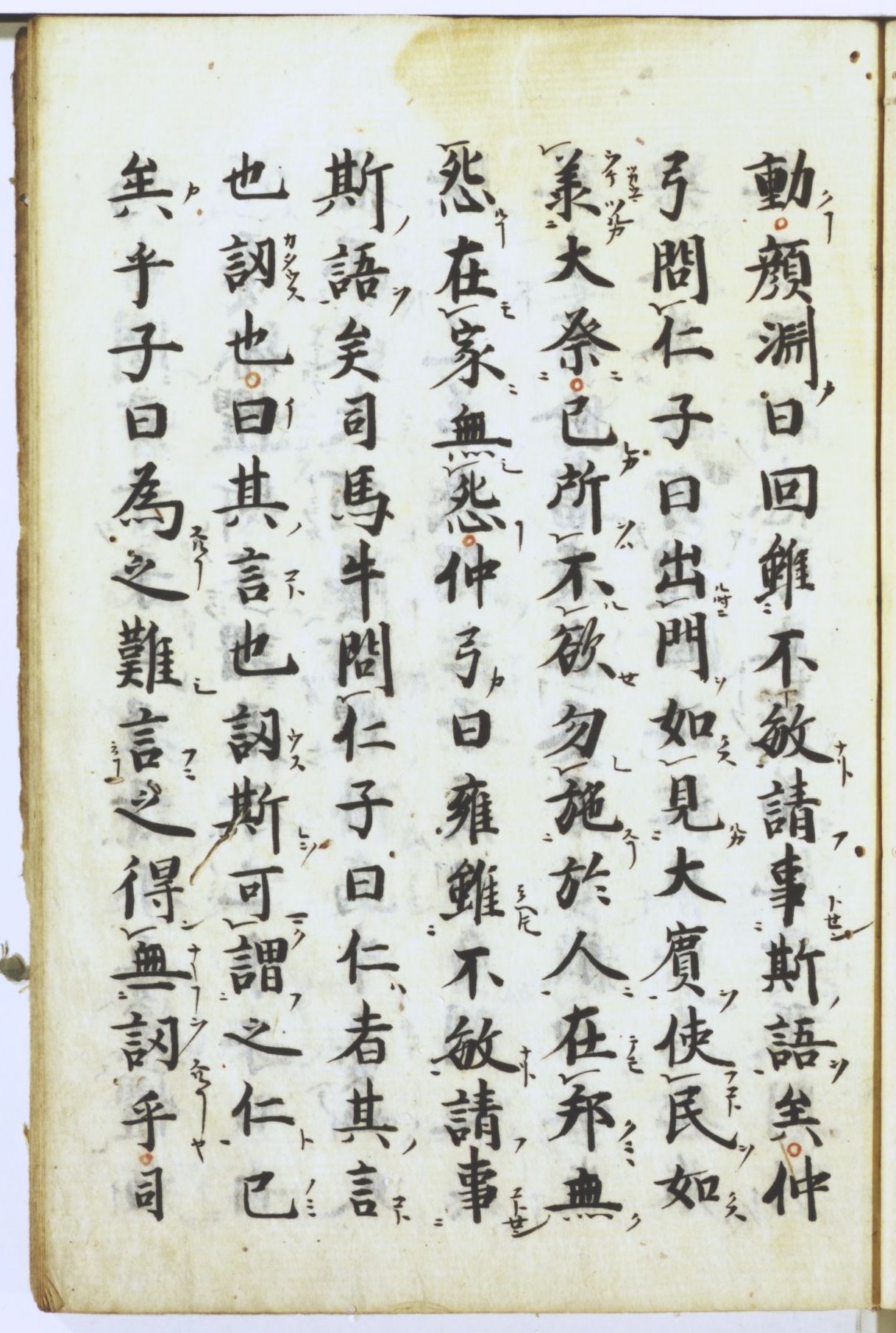
Kyoto University Library RB00007936, IIIF canvas 52, left-hand page: 7 written columns of up to 14 characters, main text only, with Japanese reading marks. Checked on the image: the first column of this book's text on this page begins ‹動顏淵›, the last begins ‹矣乎子›. 12.2 begins inside column 1 (the column opens ‹動顏淵›), 13 characters down in the received text. Above it the page finishes 12.1.2, shown in the previous section. 12.4.1 runs on to canvas 53, right-hand page (first column ‹馬牛問›), where the section ends. Column openings on these pages that differ from the received text: ‹矣乎子› where the received text has ‹乎子曰›. The Chinese shown is the received text (Wikisource), not a transcription of this manuscript; Legge's English translates the received text.
2仲弓問「仁」。子曰:「出門如見大賓,使民如承大祭,己所不欲,勿施於人。在邦無怨,在家無怨。」仲弓曰:「雍雖不敏,請事斯語矣!」
3.1司馬牛問「仁」。
3.2子曰:「仁者,其言也訒。」
3.3曰:「其言也訒,斯謂之『仁』已乎?」子曰:「爲之難,言之得無訒乎!」
4.1司馬牛問「君子」。子曰:「君子不憂不懼。」
2Chung-kung asked about perfect virtue. The Master said, 'It is, when you go abroad, to behave to every one as if you were receiving a great guest; to employ the people as if you were assisting at a great sacrifice; not to do to others as you would not wish done to yourself; to have no murmuring against you in the country, and none in the family.' Chung-kung said, 'Though I am deficient in intelligence and vigour, I will make it my business to practise this lesson.'
3.1Sze-ma Niu asked about perfect virtue.
3.2The Master said, 'The man of perfect virtue is cautious and slow in his speech.'
3.3'Cautious and slow in his speech!' said Niu;-- 'is this what is meant by perfect virtue?' The Master said, 'When a man feels the difficulty of doing, can he be other than cautious and slow in speaking?'
4.1Sze-ma Niu asked about the superior man. The Master said, 'The superior man has neither anxiety nor fear.'
Where on the image
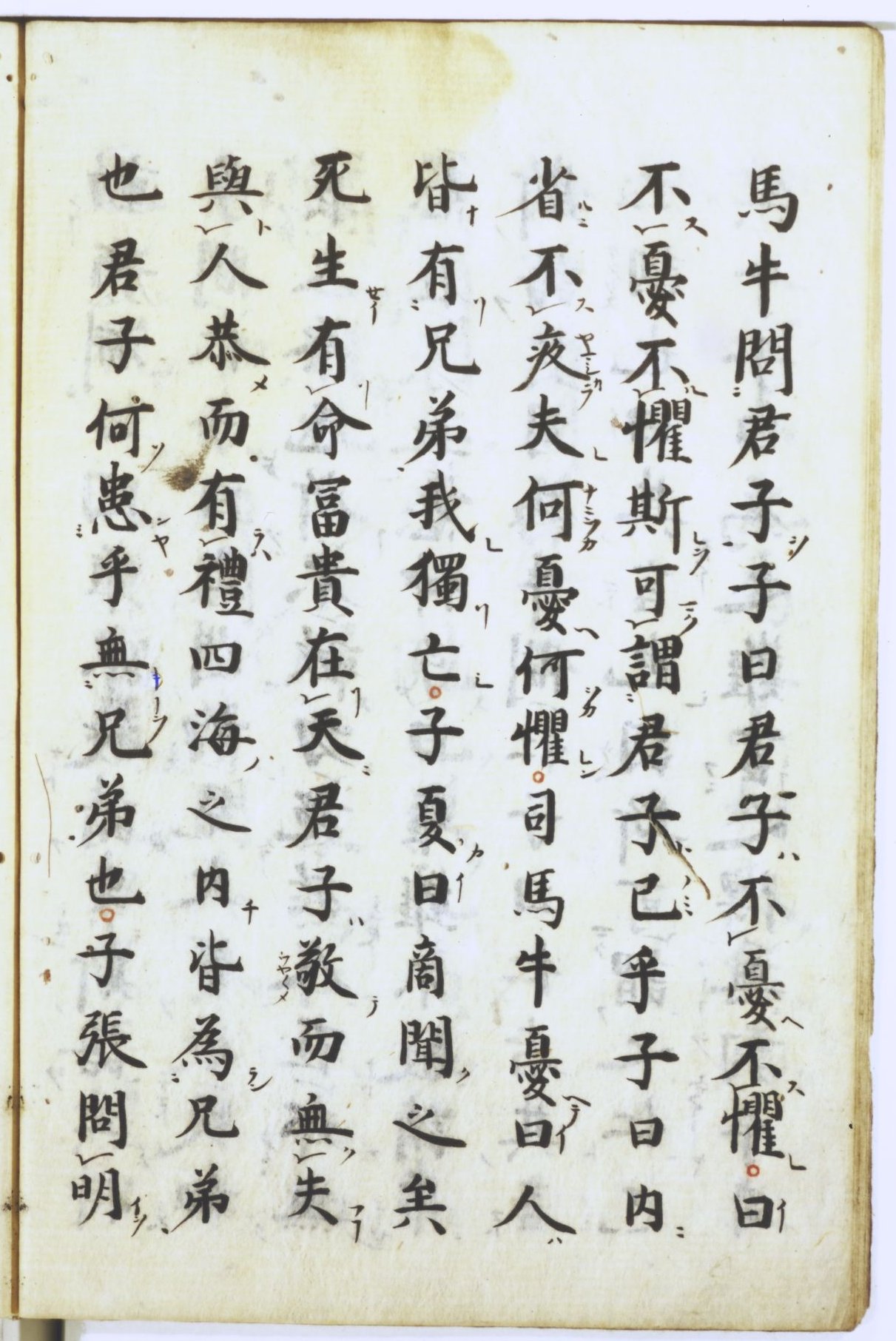
Kyoto University Library RB00007936, IIIF canvas 53, right-hand page: 7 written columns of up to 14 characters, main text only, with Japanese reading marks. Checked on the image: the first column of this book's text on this page begins ‹馬牛問›, the last begins ‹也君子›. 12.4.2 begins inside column 1 (the column opens ‹馬牛問›), 13 characters down in the received text. Above it the page finishes 12.4.1, shown in the previous section. 12.6 runs on to canvas 53, left-hand page (first column ‹子曰浸›), where the section ends. The Chinese shown is the received text (Wikisource), not a transcription of this manuscript; Legge's English translates the received text.
4.2曰:「不憂不懼,斯謂之『君子』已乎?」
4.3子曰:「內省不疚,夫何憂何懼!」
5.1司馬牛憂曰:「人皆有兄弟,我獨亡!」
5.2子夏曰:「商聞之矣:
5.3『死生有命,富貴在天』
5.4君子敬而無失,與人恭而有禮,四海之內,皆兄弟也,君子何患乎無兄弟也!」
6子張問「明」。子曰:「浸潤之譖,膚受之愬,不行焉,可謂明也已矣。浸潤之譖,膚受之愬,不行焉,可謂遠也已矣。」
4.2'Being without anxiety or fear!' said Nui;-- 'does this constitute what we call the superior man?'
4.3The Master said, 'When internal examination discovers nothing wrong, what is there to be anxious about, what is there to fear?'
5.1Sze-ma Niu, full of anxiety, said, 'Other men all have their brothers, I only have not.'
5.2Tsze-hsia said to him, 'There is the following saying which I have heard:--
5.3'"Death and life have their determined appointment; riches and honours depend upon Heaven."
5.4'Let the superior man never fail reverentially to order his own conduct, and let him be respectful to others and observant of propriety:-- then all within the four seas will be his brothers. What has the superior man to do with being distressed because he has no brothers?'
6Tsze-chang asked what constituted intelligence. The Master said, 'He with whom neither slander that gradually soaks into the mind, nor statements that startle like a wound in the flesh, are successful, may be called intelligent indeed. Yea, he with whom neither soaking slander, nor startling statements, are successful, may be called farseeing.'
Where on the image
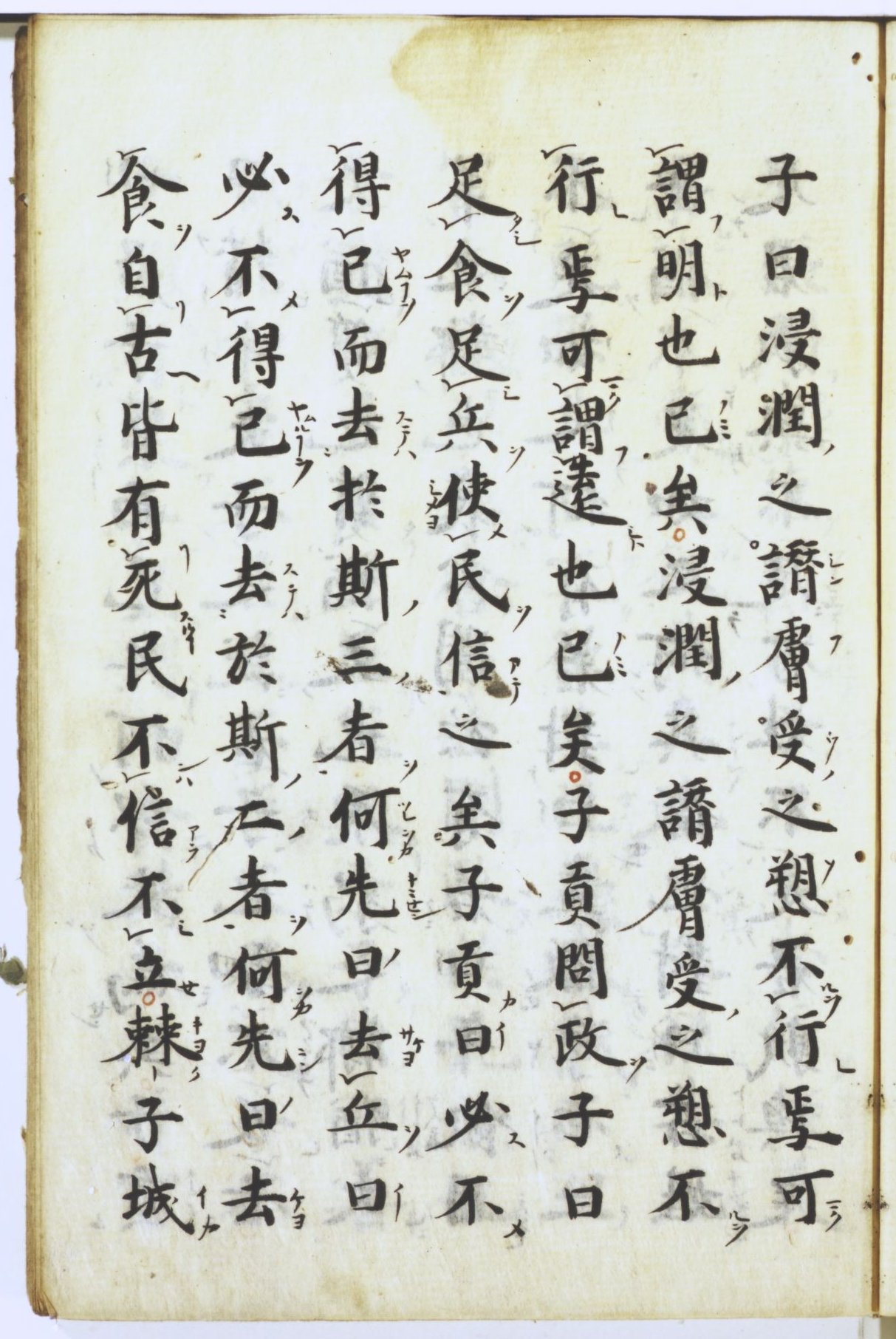
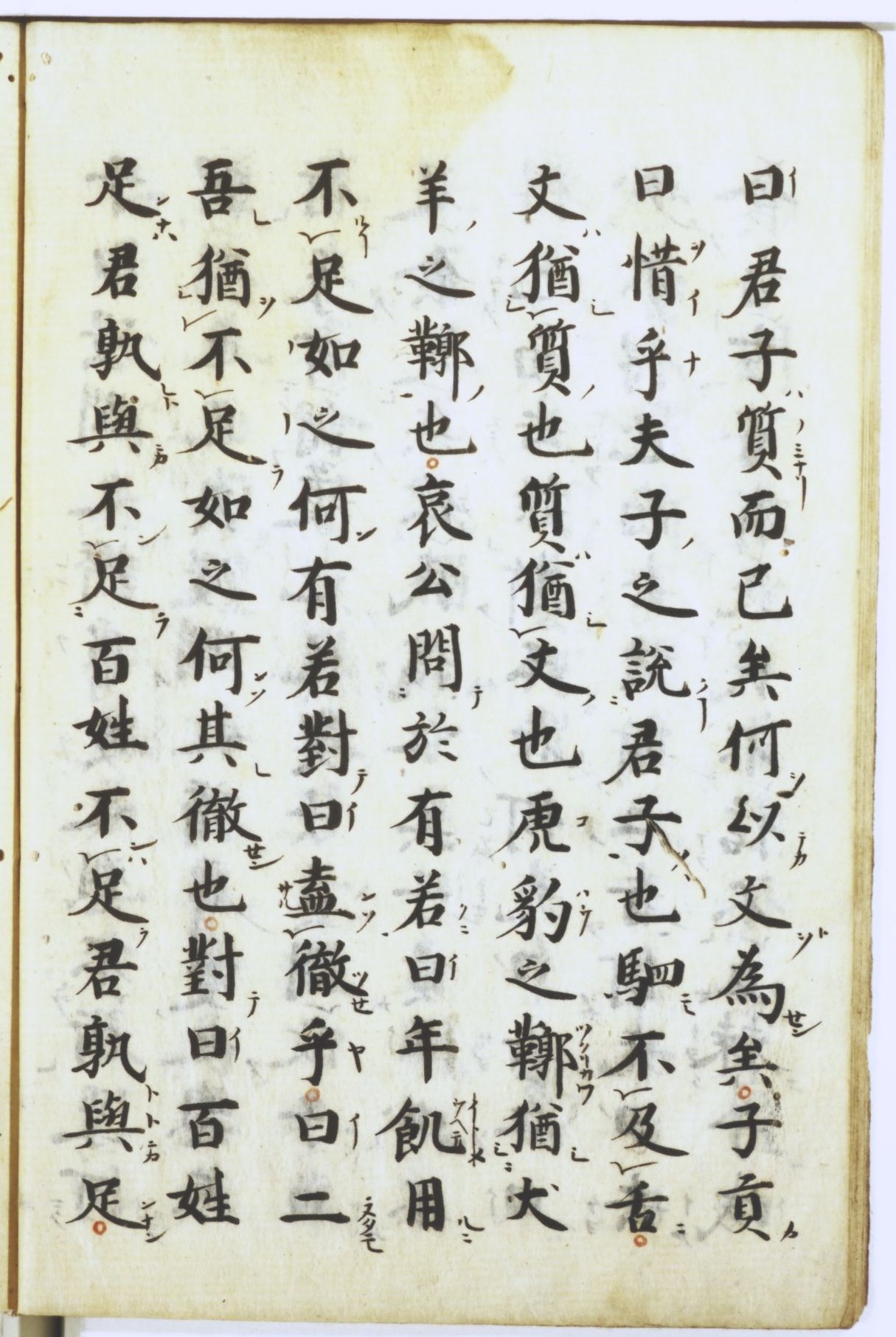
Kyoto University Library RB00007936, IIIF canvas 53, left-hand page: 7 written columns of up to 14 characters, main text only, with Japanese reading marks. Checked on the image: the first column of this book's text on this page begins ‹子曰浸›, the last begins ‹食自古›. 12.7.1 begins inside column 3 (the column opens ‹行焉可›), 8 characters down in the received text. Above it the page finishes 12.6, shown in the previous section. 12.8.1 runs on to canvas 54, right-hand page (first column ‹曰君子›), where the section ends. The Chinese shown is the received text (Wikisource), not a transcription of this manuscript; Legge's English translates the received text.
7.1子貢問「政」。子曰:「足食,足兵,民信之矣。」
7.2子貢曰:「必不得已而去,於斯三者何先?」曰:「去兵。」
7.3子貢曰:「必不得已而去,於斯二者何先?」曰:「去食。自古皆有死,民無信不立。」
8.1棘子成曰:「君子質而已矣,何以文爲?」
7.1Tsze-kung asked about government. The Master said, 'The requisites of government are that there be sufficiency of food, sufficiency of military equipment, and the confidence of the people in their ruler.'
7.2Tsze-kung said, 'If it cannot be helped, and one of these must be dispensed with, which of the three should be foregone first?' 'The military equipment,' said the Master.
7.3Tsze-kung again asked, 'If it cannot be helped, and one of the remaining two must be dispensed with, which of them should be foregone?' The Master answered, 'Part with the food. From of old, death has been the lot of all men; but if the people have no faith in their rulers, there is no standing for the state.'
8.1Chi Tsze-ch'ang said, 'In a superior man it is only the substantial qualities which are wanted;-- why should we seek for ornamental accomplishments?'
Where on the image
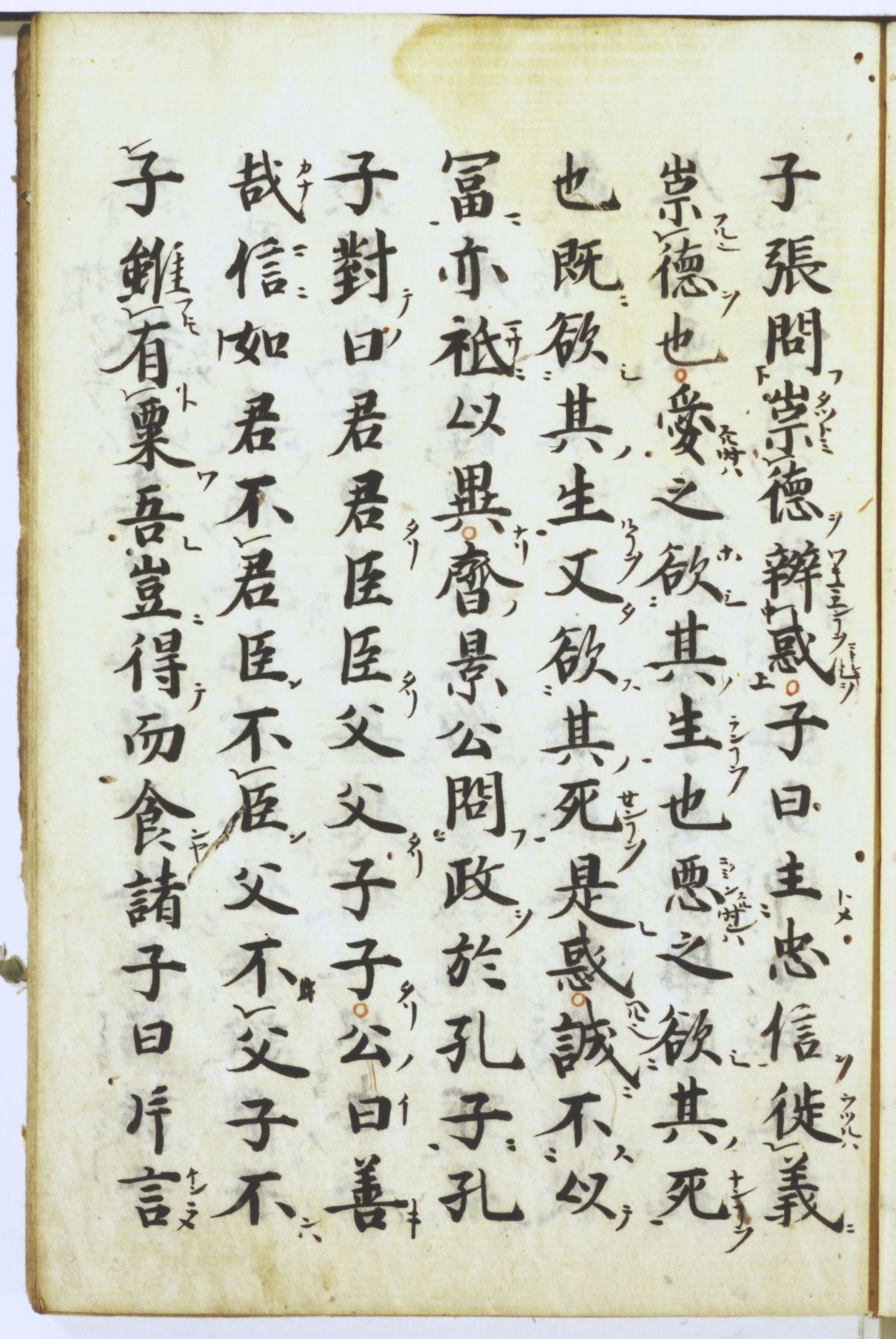
Kyoto University Library RB00007936, IIIF canvas 54, right-hand page: 7 written columns of up to 14 characters, main text only, with Japanese reading marks. Checked on the image: the first column of this book's text on this page begins ‹曰君子›, the last begins ‹足君孰›. 12.8.2 begins inside column 1 (the column opens ‹曰君子›), 11 characters down in the received text. Above it the page finishes 12.8.1, shown in the previous section. The section ends on this page. The Chinese shown is the received text (Wikisource), not a transcription of this manuscript; Legge's English translates the received text.
8.2子貢曰:「惜乎,夫子之說,君子也,駟不及舌!
8.3文猶質也,質猶文也;虎豹之鞹,猶犬羊之鞹。」
9.1哀公問於有若曰:「年饑,用不足,如之何?」
9.2有若對曰:「盍徹乎?」
9.3曰:「二,吾猶不足,如之何其徹也?」
9.4對曰:「百姓足,君孰與不足?百姓不足,君孰與足!」
8.2Tsze-kung said, 'Alas! Your words, sir, show you to be a superior man, but four horses cannot overtake the tongue.
8.3Ornament is as substance; substance is as ornament. The hide of a tiger or a leopard stripped of its hair, is like the hide of a dog or a goat stripped of its hair.'
9.1The Duke Ai inquired of Yu Zo, saying, 'The year is one of scarcity, and the returns for expenditure are not sufficient;-- what is to be done?'
9.2Yu Zo replied to him, 'Why not simply tithe the people?'
9.3'With two tenths, said the duke, 'I find it not enough;-- how could I do with that system of one tenth?'
9.4Yu Zo answered, 'If the people have plenty, their prince will not be left to want alone. If the people are in want, their prince cannot enjoy plenty alone.'
Where on the image
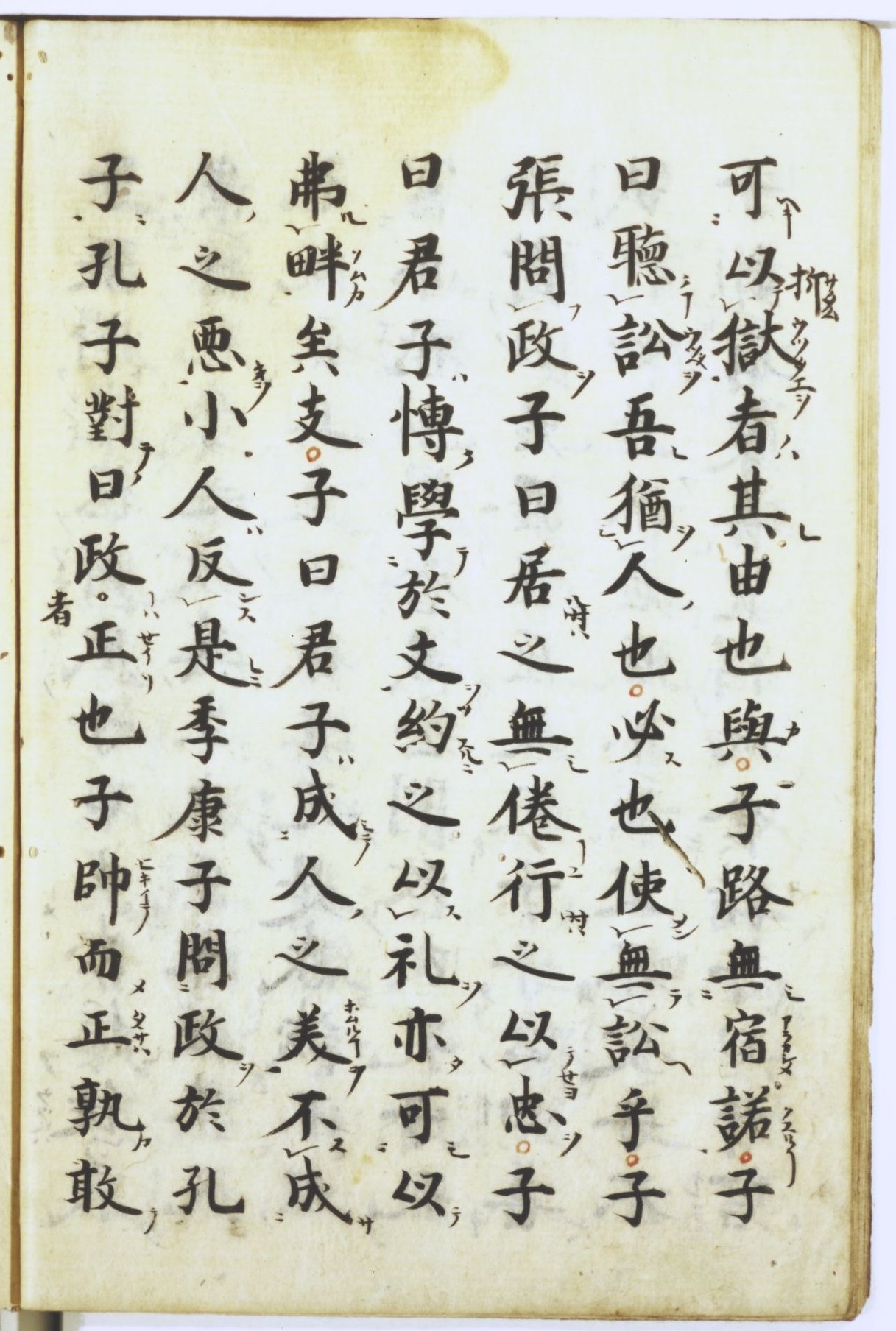
Kyoto University Library RB00007936, IIIF canvas 54, left-hand page: 7 written columns of up to 14 characters, main text only, with Japanese reading marks. Checked on the image: the first column of this book's text on this page begins ‹子張問›, the last begins ‹子雖有›. 12.10.1 opens column 1. 12.12.1 runs on to canvas 55, right-hand page (first column ‹可以折›), where the section ends. Column openings on these pages that differ from the received text: ‹也既欲› where the received text has ‹既欲其›. The Chinese shown is the received text (Wikisource), not a transcription of this manuscript; Legge's English translates the received text.
10.1子張問「崇德,辨惑。」子曰:「主忠信,徙義:崇德也。
10.2愛之欲其生,惡之欲其死;既欲其生,又欲其死:是惑也。」
10.3誠不以富,亦祇以異。
11.1齊景公問「政」於孔子。
11.2孔子對曰:「君君,臣臣,父父,子子。」
11.3公曰:「善哉!信如君不君,臣不臣,父不父,子不子,雖有粟,吾得而食諸?」
12.1子曰:「片言可以折獄者,其由也與!」
10.1Tsze-chang having asked how virtue was to be exalted, and delusions to be discovered, the Master said, 'Hold faithfulness and sincerity as first principles, and be moving continually to what is right;-- this is the way to exalt one's virtue.
10.2'You love a man and wish him to live; you hate him and wish him to die. Having wished him to live, you also wish him to die. This is a case of delusion.
10.3'"It may not be on account of her being rich, yet you come to make a difference."'
11.1The Duke Ching, of Ch'i, asked Confucius about government.
11.2Confucius replied, 'There is government, when the prince is prince, and the minister is minister; when the father is father, and the son is son.'
11.3'Good!' said the duke; 'if, indeed; the prince be not prince, the minister not minister, the father not father, and the son not son, although I have my revenue, can I enjoy it?'
12.1The Master said, 'Ah! it is Yu, who could with half a word settle litigations!'
Where on the image
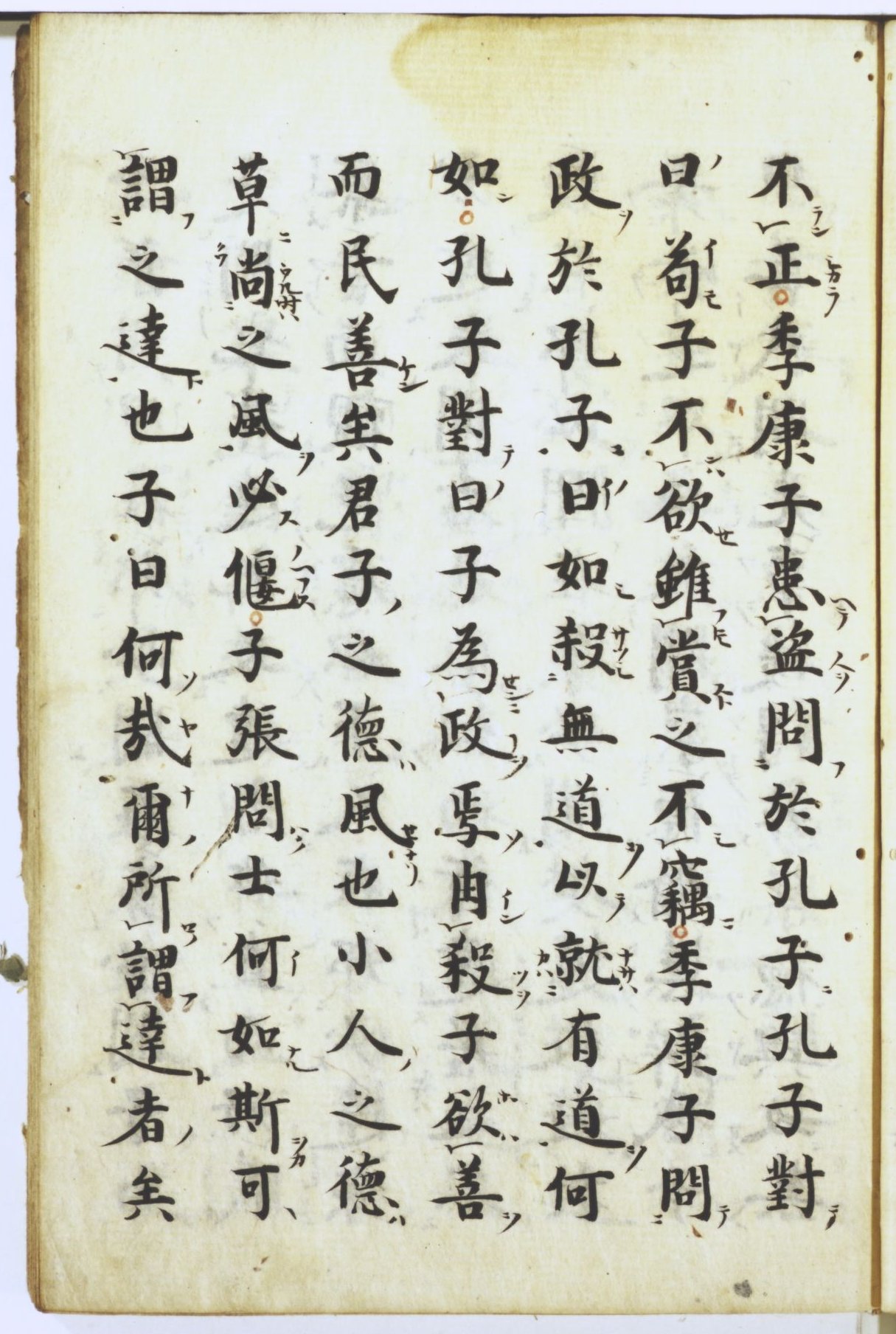
Kyoto University Library RB00007936, IIIF canvas 55, right-hand page: 7 written columns of up to 14 characters, main text only, with Japanese reading marks. Checked on the image: the first column of this book's text on this page begins ‹可以折›, the last begins ‹子孔子›. 12.12.2 begins inside column 1 (the column opens ‹可以折›), 9 characters down in the received text. Above it the page finishes 12.12.1, shown in the previous section. 12.17 runs on to canvas 55, left-hand page (first column ‹不正季›), where the section ends. Column openings on these pages that differ from the received text: ‹曰君子› where the received text has ‹曰博學›. The Chinese shown is the received text (Wikisource), not a transcription of this manuscript; Legge's English translates the received text.
12.2子路無宿諾。
13子曰:「聽訟,吾猶人也;必也使無訟乎!」
14子張問「政」。子曰:「居之無倦,行之以忠。」
15子曰:「博學以文,約之以禮;亦可以弗畔矣夫!」
16子曰:「君子成人之美,不成人之惡。小人反是。」
17季康子問「政」於孔子。孔子對曰:「『政』者,正也。子帥以正,孰敢不正?」
12.2Tsze-lu never slept over a promise.
13The Master said, 'In hearing litigations, I am like any other body. What is necessary, however, is to cause the people to have no litigations.'
14Tsze-chang asked about government. The Master said, 'The art of governing is to keep its affairs before the mind without weariness, and to practise them with undeviating consistency.'
15The Master said, 'By extensively studying all learning, and keeping himself under the restraint of the rules of propriety, one may thus likewise not err from what is right.'
16The Master said, 'The superior man seeks to perfect the admirable qualities of men, and does not seek to perfect their bad qualities. The mean man does the opposite of this.'
17Chi K'ang asked Confucius about government. Confucius replied, 'To govern means to rectify. If you lead on the people with correctness, who will dare not to be correct?'
Where on the image
Kyoto University Library RB00007936, IIIF canvas 55, left-hand page: 7 written columns of up to 14 characters, main text only, with Japanese reading marks. Checked on the image: the first column of this book's text on this page begins ‹不正季›, the last begins ‹謂之達›. 12.18 begins inside column 1 (the column opens ‹不正季›), 2 characters down in the received text. Above it the page finishes 12.17, shown in the previous section. The section ends on this page. Column openings on these pages that differ from the received text: ‹草尚之› where the received text has ‹草上之›. The Chinese shown is the received text (Wikisource), not a transcription of this manuscript; Legge's English translates the received text.
18季康子患盜,問於孔子。孔子對曰:「苟子之不欲,雖賞之不竊。」
19季康子問政於孔子曰:「如殺無道,以就有道,何如?」孔子對曰:「子爲政,焉用殺?子欲善,而民善矣。君子之德,風;小人之德,草;草上之風,必偃。」
20.1子張問:「士何如斯可謂之『達』矣?」
20.2子曰:「何哉,爾所謂『達』者?」
18Chi K'ang, distressed about the number of thieves in the state, inquired of Confucius how to do away with them. Confucius said, 'If you, sir, were not covetous, although you should reward them to do it, they would not steal.'
19Chi K'ang asked Confucius about government, saying, 'What do you say to killing the unprincipled for the good of the principled?' Confucius replied, 'Sir, in carrying on your government, why should you use killing at all? Let your evinced desires be for what is good, and the people will be good. The relation between superiors and inferiors, is like that between the wind and the grass. The grass must bend, when the wind blows across it.'
20.1Tsze-chang asked, 'What must the officer be, who may be said to be distinguished?'
20.2The Master said, 'What is it you call being distinguished?'
Where on the image
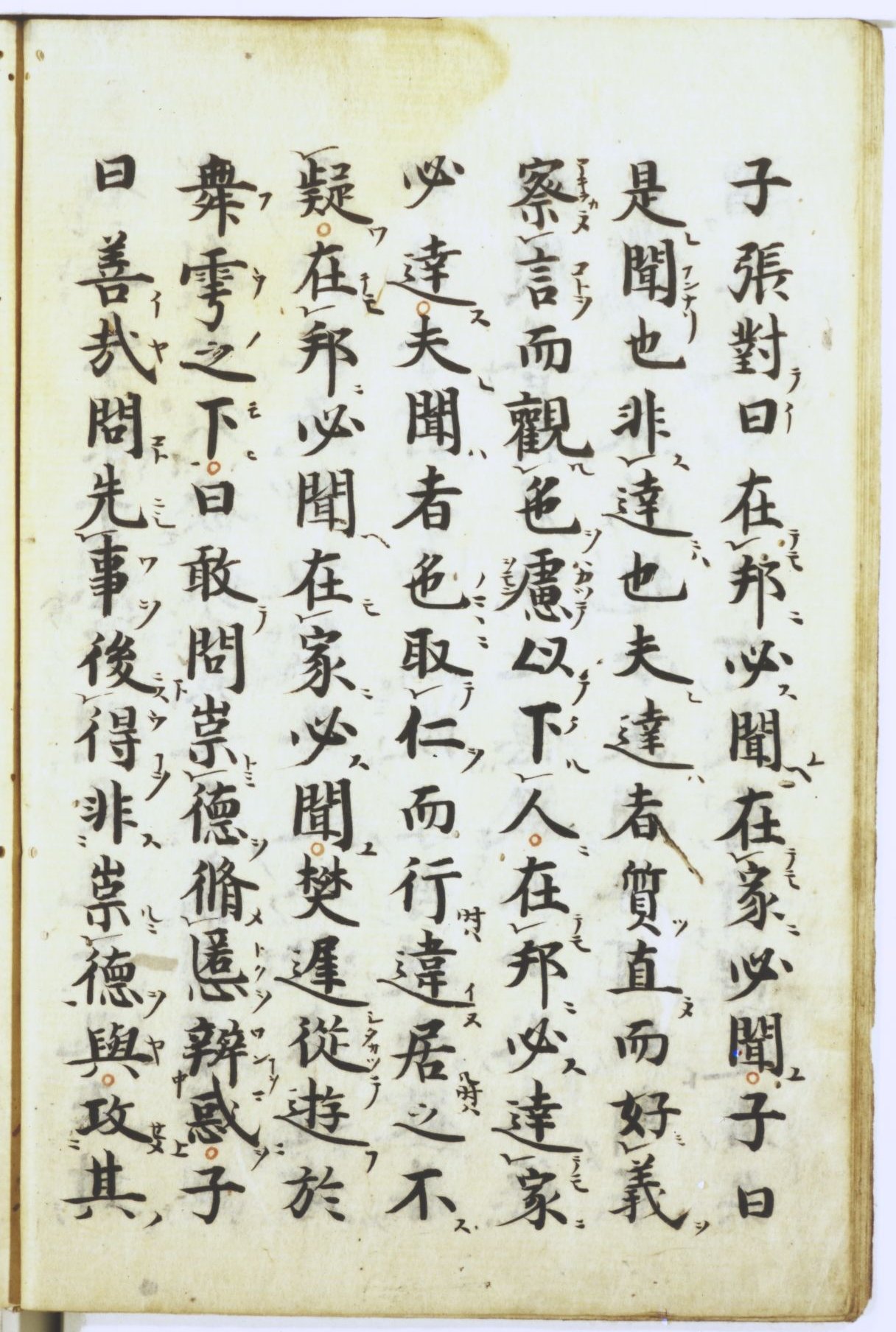
Kyoto University Library RB00007936, IIIF canvas 56, right-hand page: 7 written columns of up to 14 characters, main text only, with Japanese reading marks. Checked on the image: the first column of this book's text on this page begins ‹子張對›, the last begins ‹曰善哉›. 12.20.3 opens column 1. 12.21.3 runs on to canvas 56, left-hand page (first column ‹惡毋攻›), where the section ends. Column openings on these pages that differ from the received text: ‹惡毋攻› where the received text has ‹惡無攻›. The Chinese shown is the received text (Wikisource), not a transcription of this manuscript; Legge's English translates the received text.
20.3子張對曰:「在邦必聞,在家必聞。」
20.4子曰:「是『聞』也,非『達』也。
20.5夫『達』也者,質直而好義,察言而觀色,慮以下人,在邦必達,在家必達。
20.6夫『聞』也者:色取仁而行違,居之不疑。在邦必聞,在家必聞。」
21.1樊遲從遊於舞雩之下曰:「敢問崇德,脩慝,辨惑?」
21.2子曰:「善哉問!
21.3先事後得,非『崇德』與?攻其惡,無攻人之惡,非『脩慝』與?一朝之忿,忘其身以及其親,非『惑』與?」
20.3Tsze-chang replied, 'It is to be heard of through the State, to be heard of throughout his clan.'
20.4The Master said, 'That is notoriety, not distinction.
20.5'Now the man of distinction is solid and straightforward, and loves righteousness. He examines people's words, and looks at their countenances. He is anxious to humble himself to others. Such a man will be distinguished in the country; he will be distinguished in his clan.
20.6'As to the man of notoriety, he assumes the appearance of virtue, but his actions are opposed to it, and he rests in this character without any doubts about himself. Such a man will be heard of in the country; he will be heard of in the clan.'
21.1Fan Ch'ih rambling with the Master under the trees about the rain altars, said, 'I venture to ask how to exalt virtue, to correct cherished evil, and to discover delusions.'
21.2The Master said, 'Truly a good question!
21.3'If doing what is to be done be made the first business, and success a secondary consideration;-- is not this the way to exalt virtue? To assail one's own wickedness and not assail that of others;-- is not this the way to correct cherished evil? For a morning's anger to disregard one's own life, and involve that of his parents;-- is not this a case of delusion?'
Where on the image
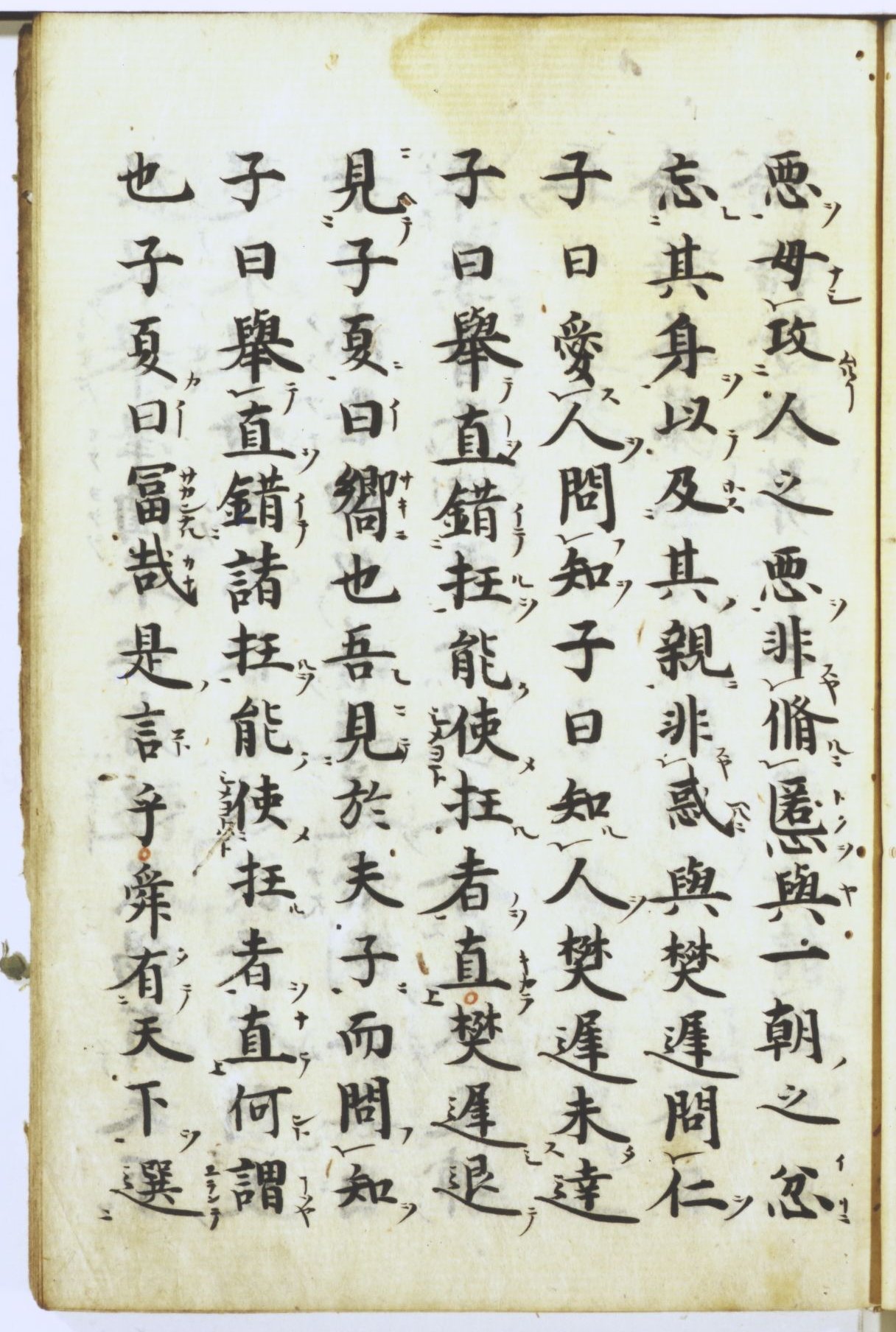
Kyoto University Library RB00007936, IIIF canvas 56, left-hand page: 7 written columns of up to 14 characters, main text only, with Japanese reading marks. Checked on the image: the first column of this book's text on this page begins ‹惡毋攻›, the last begins ‹也子夏›. 12.22.1 begins inside column 2 (the column opens ‹忘其身›), 10 characters down in the received text. Above it the page finishes 12.21.3, shown in the previous section. 12.22.6 runs on to canvas 57, right-hand page (first column ‹於衆舉›), where the section ends. The Chinese shown is the received text (Wikisource), not a transcription of this manuscript; Legge's English translates the received text.
22.1樊遲問「仁」。子曰:「愛人。」問「知」。子曰:「知人。」
22.2樊遲未達,
22.3子曰:「擧直錯諸枉,能使枉者直。」
22.4樊遲退,見子夏曰:「鄉也吾見於夫子而問『知』,子曰:『擧直錯諸枉,能使枉者直』,何謂也?」
22.5子夏曰:「富哉言乎!
22.6舜有天下,選於眾,擧皋陶,不仁者遠矣。湯有天下,選於眾,擧伊尹,不仁者遠矣。」
22.1Fan Ch'ih asked about benevolence. The Master said, 'It is to love all men.' He asked about knowledge. The Master said, 'It is to know all men.'
22.2Fan Ch'ih did not immediately understand these answers.
22.3The Master said, 'Employ the upright and put aside all the crooked;-- in this way the crooked can be made to be upright.'
22.4Fan Ch'ih retired, and, seeing Tsze-hsia, he said to him, 'A Little while ago, I had an interview with our Master, and asked him about knowledge. He said, 'Employ the upright, and put aside all the crooked;-- in this way, the crooked will be made to be upright.' What did he mean?'
22.5Tsze-hsia said, 'Truly rich is his saying!
22.6'Shun, being in possession of the kingdom, selected from among all the people, and employed Kao-yao, on which all who were devoid of virtue disappeared. T'ang, being in possession of the kingdom, selected from among all the people, and employed I Yin, and all who were devoid of virtue disappeared.'
Where on the image
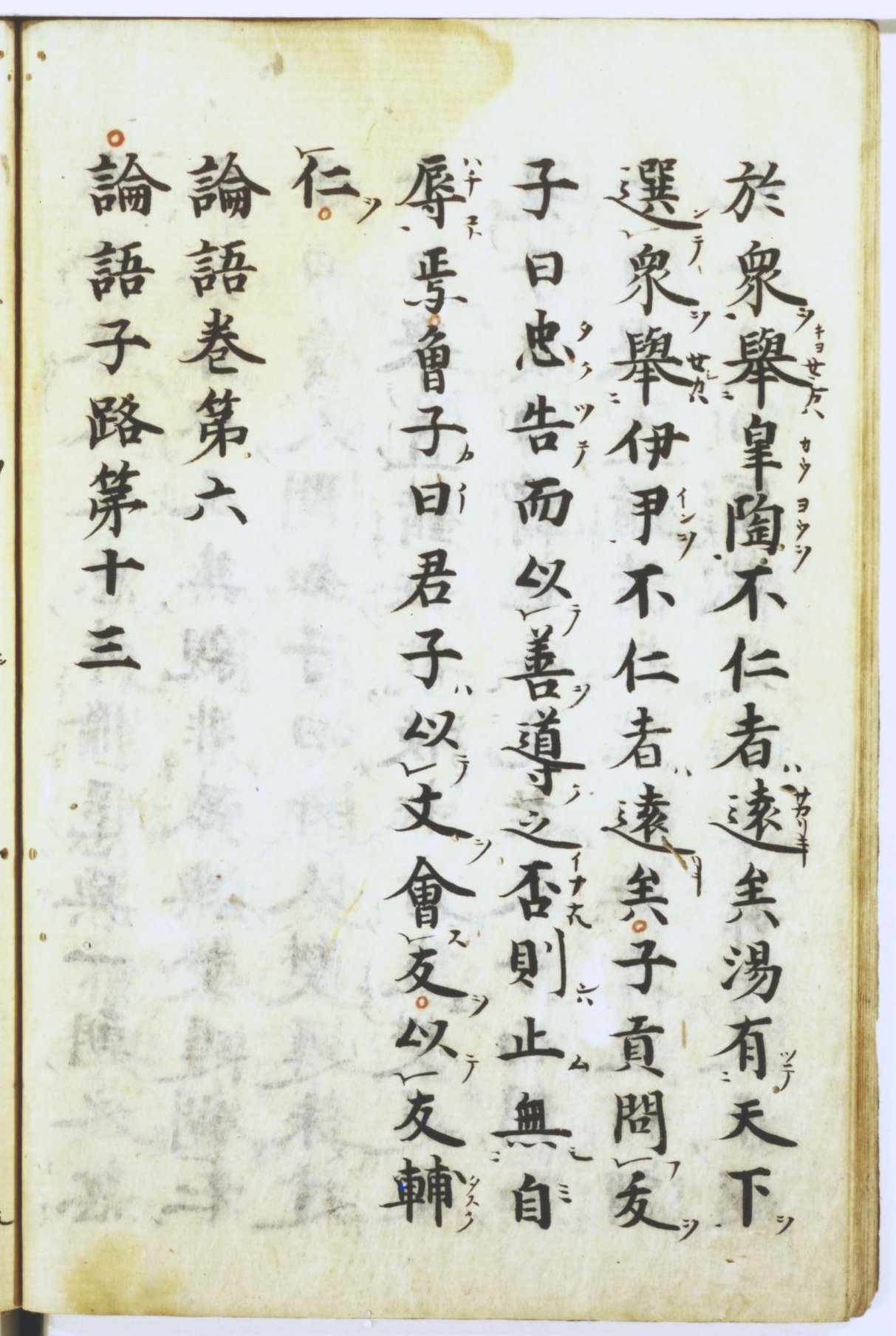
Kyoto University Library RB00007936, IIIF canvas 57, right-hand page: 7 written columns of up to 14 characters, main text only, with Japanese reading marks. Checked on the image: the first column of this book's text on this page begins ‹於衆舉›, the last begins ‹仁›. Column 6 carries the title 論語卷第六. Column 7 carries the title 論語子路第十三. 12.23 begins inside column 2 (the column opens ‹選於衆›), 11 characters down in the received text. Above it the page finishes 12.22.6, shown in the previous section. The section ends on this page. The Chinese shown is the received text (Wikisource), not a transcription of this manuscript; Legge's English translates the received text.
23子貢問「友」。子曰:「忠吿而善道之,不可則止,毋自辱焉。」
24曾子曰:「君子以文會友,以友輔仁。」
23Tsze-kung asked about friendship. The Master said, 'Faithfully admonish your friend, and skillfully lead him on. If you find him impracticable, stop. Do not disgrace yourself.'
24The philosopher Tsang said, 'The superior man on grounds of culture meets with his friends, and by their friendship helps his virtue.'
Notes
- English: James Legge, Confucian Analects, The Chinese Classics vol. 1. Legge's chapter and paragraph numbers are kept as superscripts (chapter.paragraph).
- Legge translated the received text. Where this manuscript's wording differs, his English follows the received text shown here.
Cite
Sources
- Source: Kyoto University Library RB00007936 (Analects manuscript attributed to Kiyohara Yoshieda, c. 1300) + Wikisource received text + James Legge's English (Project Gutenberg) (holding institution)
- Critical edition: Received text (Wikisource) in Legge's chapter and paragraph division
← previous · → next · v cycle view · l back to library