Analects, Book 13: Zilu 子路 (Kamakura-period manuscript)
Introduction
Book 13 of the Analects (論語 Lunyu), titled 子路 (Zilu) after its opening words, 30 chapters in Legge's division. It is shown on a manuscript of the Analects in the Kiyohara family collection (Seike bunko) of Kyoto University Library, two volumes in regular script, seven columns of fourteen characters to the page, main text only, with red and black Japanese reading marks. A colophon by Kiyohara Edakata dated 1550 names the copyist as his ancestor Kiyohara Yoshieda (1253-1331), which places the copy around 1300, in the late Kamakura period; the attribution is traditional. The Kiyohara were hereditary readers of the Confucian classics at the Japanese court, and their text descends from the edition of the Analects with the collected commentary of He Yan (3rd century CE): after each pair of books the scribe copied the character counts of the classic and of the commentary, although only the classic is written out. The manuscript is an Important Cultural Property of Japan.
In this copy Book 13 runs from canvas 57, left-hand page to canvas 62, left-hand page (volume 2). Each section gathers the paragraphs that begin on one page, numbered by chapter and paragraph as in Legge, and links to that page and to any page the last paragraph runs onto. The page boundaries were found by reading the first characters of every column on the photographs. The Chinese shown is the received text, from Wikisource. This manuscript differs from it in places, most often by an added or missing particle (也, 矣, 焉) or a variant character form; the differences seen at column openings are listed in the scan notes. The English is James Legge's translation of the received text.
How was this verified? (Provenance)
Where on the image
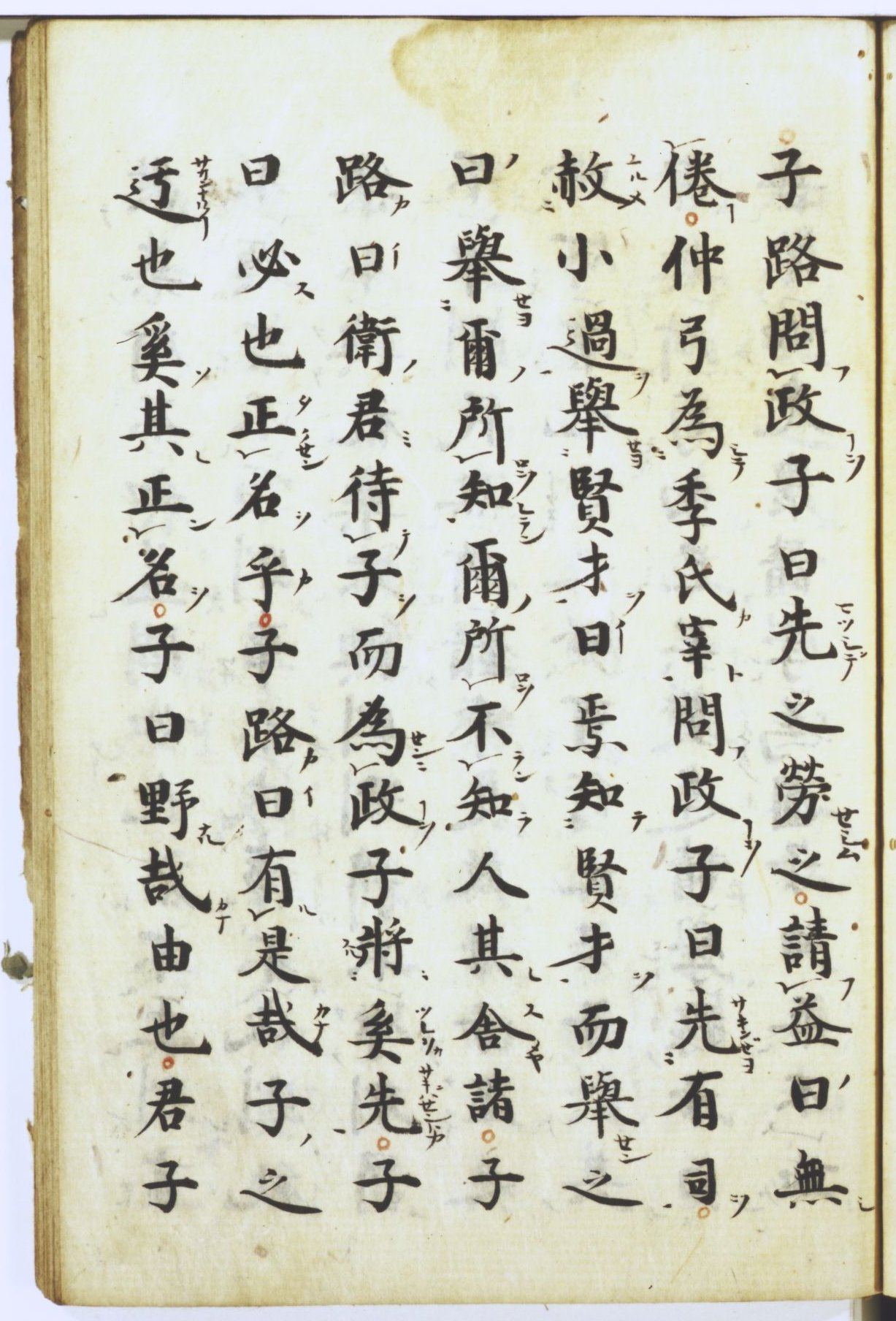
Kyoto University Library RB00007936, IIIF canvas 57, left-hand page: 7 written columns of up to 14 characters, main text only, with Japanese reading marks. Checked on the image: the first column of this book's text on this page begins ‹子路問›, the last begins ‹迂也奚›. The book title stands in the last written column of the facing canvas 57, right-hand page. 13.1.1 opens column 1. 13.3.4 runs on to canvas 58, right-hand page (first column ‹於其所›), where the section ends. The Chinese shown is the received text (Wikisource), not a transcription of this manuscript; Legge's English translates the received text.
1.1子路問政。子曰:「先之,勞之。」
1.2請益,曰:「無倦。」
2.1仲弓爲季氏宰,問政。子曰:「先有司。赦小過。擧賢才。」
2.2曰:「焉知賢才而擧之?」曰:「擧爾所知。爾所不知,人其舍諸?」
3.1子路曰:「衞君待子而爲政,子將奚先?」
3.2子曰:「必也正名乎!」
3.3子路曰:「有是哉?子之迂也!奚其正?」
3.4子曰:「野哉,由也!君子於其所不知,蓋闕如也。
1.1Tsze-lu asked about government. The Master said, 'Go before the people with your example, and be laborious in their affairs.'
1.2He requested further instruction, and was answered, 'Be not weary (in these things).'
2.1Chung-kung, being chief minister to the Head of the Chi family, asked about government. The Master said, 'Employ first the services of your various officers, pardon small faults, and raise to office men of virtue and talents.'
2.2Chung-kung said, 'How shall I know the men of virtue and talent, so that I may raise them to office?' He was answered, 'Raise to office those whom you know. As to those whom you do not know, will others neglect them?'
3.1Tsze-lu said, 'The ruler of Wei has been waiting for you, in order with you to administer the government. What will you consider the first thing to be done?'
3.2The Master replied, 'What is necessary is to rectify names.'
3.3'So, indeed!' said Tsze-lu. 'You are wide of the mark! Why must there be such rectification?'
3.4The Master said, 'How uncultivated you are, Yu! A superior man, in regard to what he does not know, shows a cautious reserve.
Where on the image
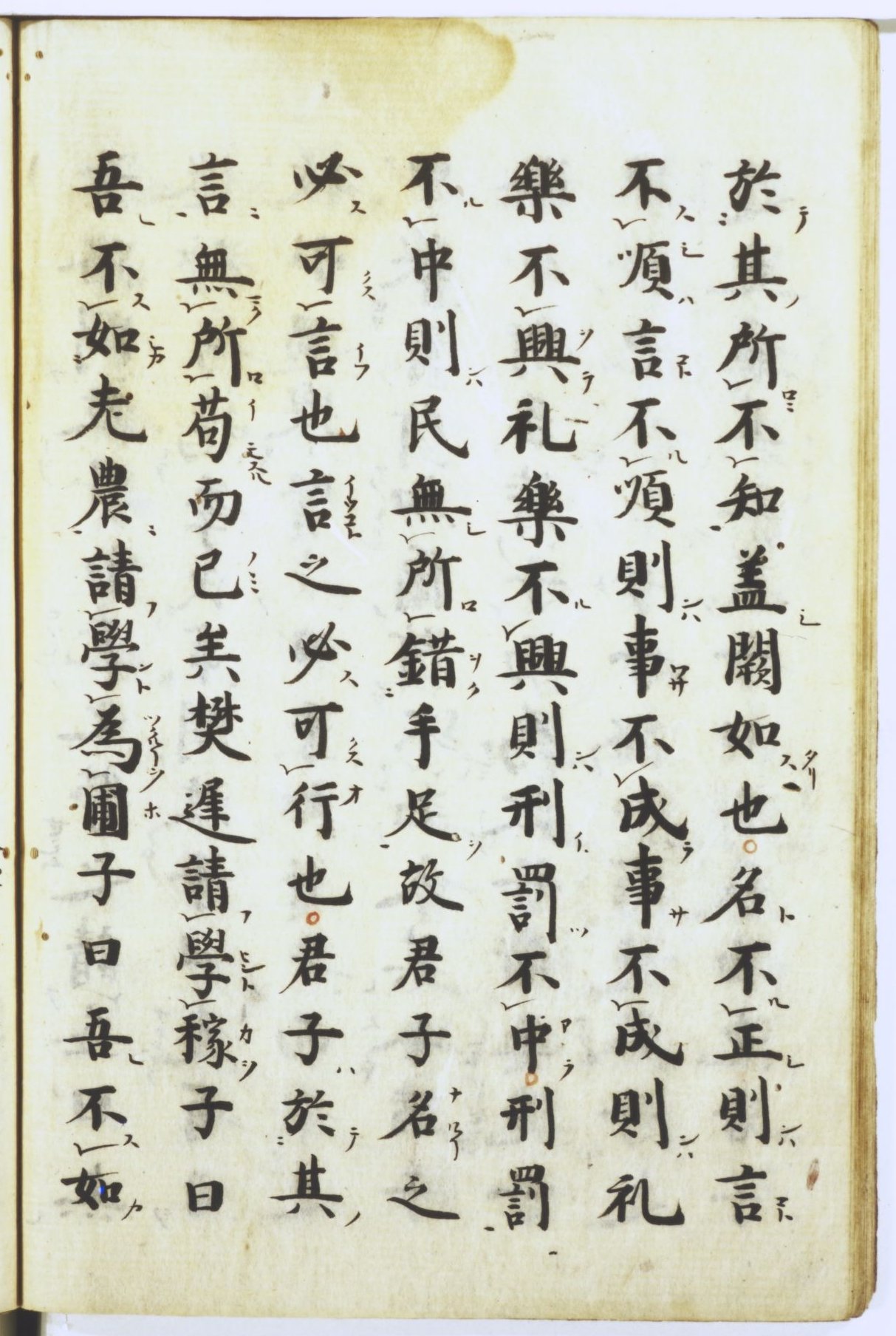
Kyoto University Library RB00007936, IIIF canvas 58, right-hand page: 7 written columns of up to 14 characters, main text only, with Japanese reading marks. Checked on the image: the first column of this book's text on this page begins ‹於其所›, the last begins ‹吾不如›. 13.3.5 begins inside column 1 (the column opens ‹於其所›), 9 characters down in the received text. Above it the page finishes 13.3.4, shown in the previous section. 13.4.1 runs on to canvas 58, left-hand page (first column ‹老圃樊›), where the section ends. The Chinese shown is the received text (Wikisource), not a transcription of this manuscript; Legge's English translates the received text.
3.5名不正,則言不順;言不順,則事不成;
3.6事不成,則禮樂不興;禮樂不興,則刑罰不中;刑罰不中,則民無所措手足。
3.7故君子名之必可言也,言之必可行也。君子於其言,無所苟而已矣。」
4.1樊遲請學稼,子曰:「吾不如老農。」請學爲圃,曰:「吾不如老圃。」
3.5'If names be not correct, language is not in accordance with the truth of things. If language be not in accordance with the truth of things, affairs cannot be carried on to success.
3.6'When affairs cannot be carried on to success, proprieties and music will not flourish. When proprieties and music do not flourish, punishments will not be properly awarded. When punishments are not properly awarded, the people do not know how to move hand or foot.
3.7'Therefore a superior man considers it necessary that the names he uses may be spoken appropriately, and also that what he speaks may be carried out appropriately. What the superior man requires, is just that in his words there may be nothing incorrect.'
4.1Fan Ch'ih requested to be taught husbandry. The Master said, 'I am not so good for that as an old husbandman.' He requested also to be taught gardening, and was answered, 'I am not so good for that as an old gardener.'
Where on the image
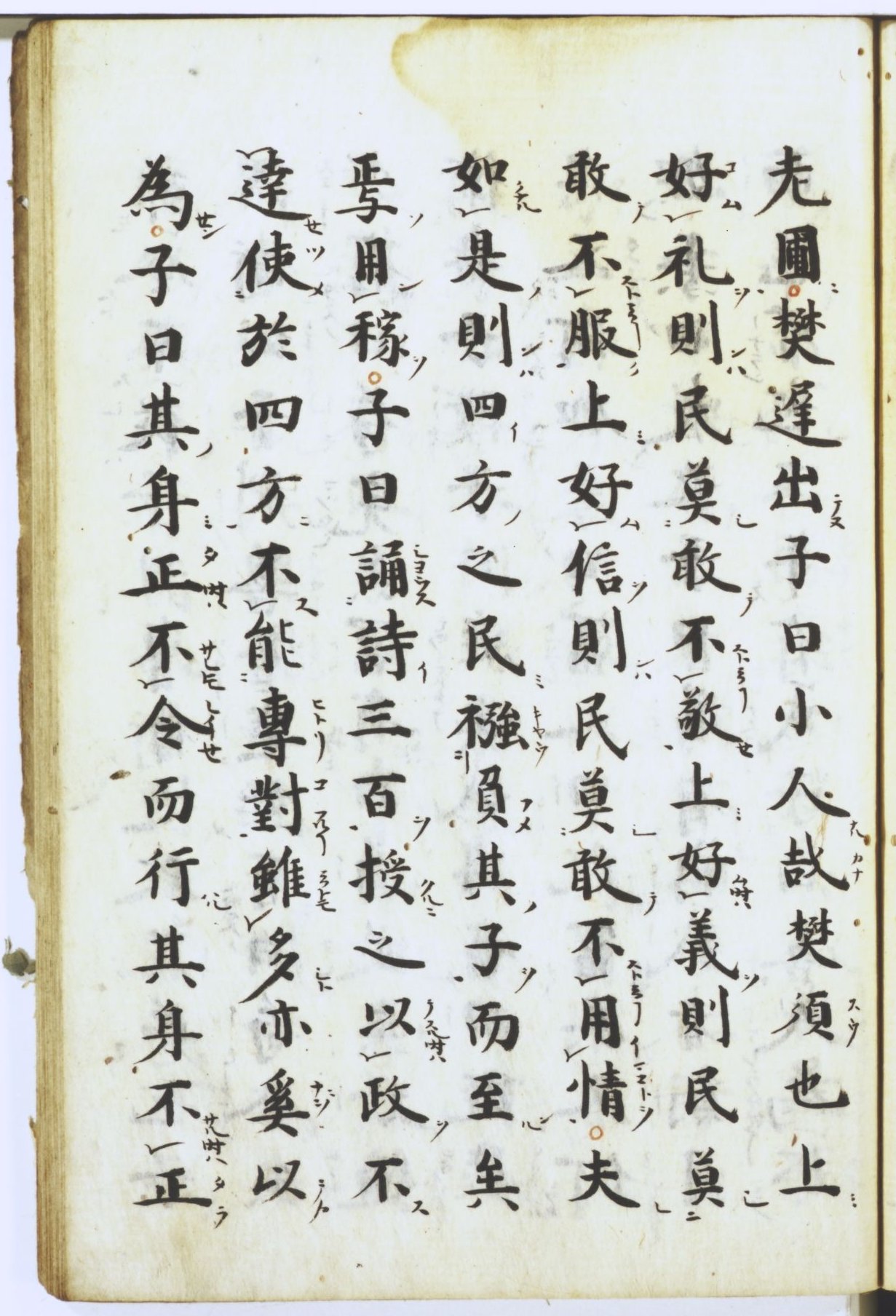
Kyoto University Library RB00007936, IIIF canvas 58, left-hand page: 7 written columns of up to 14 characters, main text only, with Japanese reading marks. Checked on the image: the first column of this book's text on this page begins ‹老圃樊›, the last begins ‹為子曰›. 13.4.2 begins inside column 1 (the column opens ‹老圃樊›), 2 characters down in the received text. Above it the page finishes 13.4.1, shown in the previous section. 13.6 runs on to canvas 59, right-hand page (first column ‹雖令不›), where the section ends. The Chinese shown is the received text (Wikisource), not a transcription of this manuscript; Legge's English translates the received text.
4.2樊遲出,子曰:「小人哉,樊須也!
4.3上好禮,則民莫敢不敬;上好義,則民莫敢不服;上好信,則民莫敢不用情,夫如是,則四方之民,襁負其子而至矣,焉用稼?」
5子曰:「誦詩三百,授之以政,不達。使於四方,不能專對;雖多,亦奚以爲?」
6子曰:「其身正,不令而行;其身不正,雖令不從。」
4.2Fan Ch'ih having gone out, the Master said, 'A small man, indeed, is Fan Hsu!
4.3If a superior love propriety, the people will not dare not to be reverent. If he love righteousness, the people will not dare not to submit to his example. If he love good faith, the people will not dare not to be sincere. Now, when these things obtain, the people from all quarters will come to him, bearing their children on their backs;-- what need has he of a knowledge of husbandry?'
5The Master said, 'Though a man may be able to recite the three hundred odes, yet if, when intrusted with a governmental charge, he knows not how to act, or if, when sent to any quarter on a mission, he cannot give his replies unassisted, notwithstanding the extent of his learning, of what practical use is it?'
6The Master said, 'When a prince's personal conduct is correct, his government is effective without the issuing of orders. If his personal conduct is not correct, he may issue orders, but they will not be followed.'
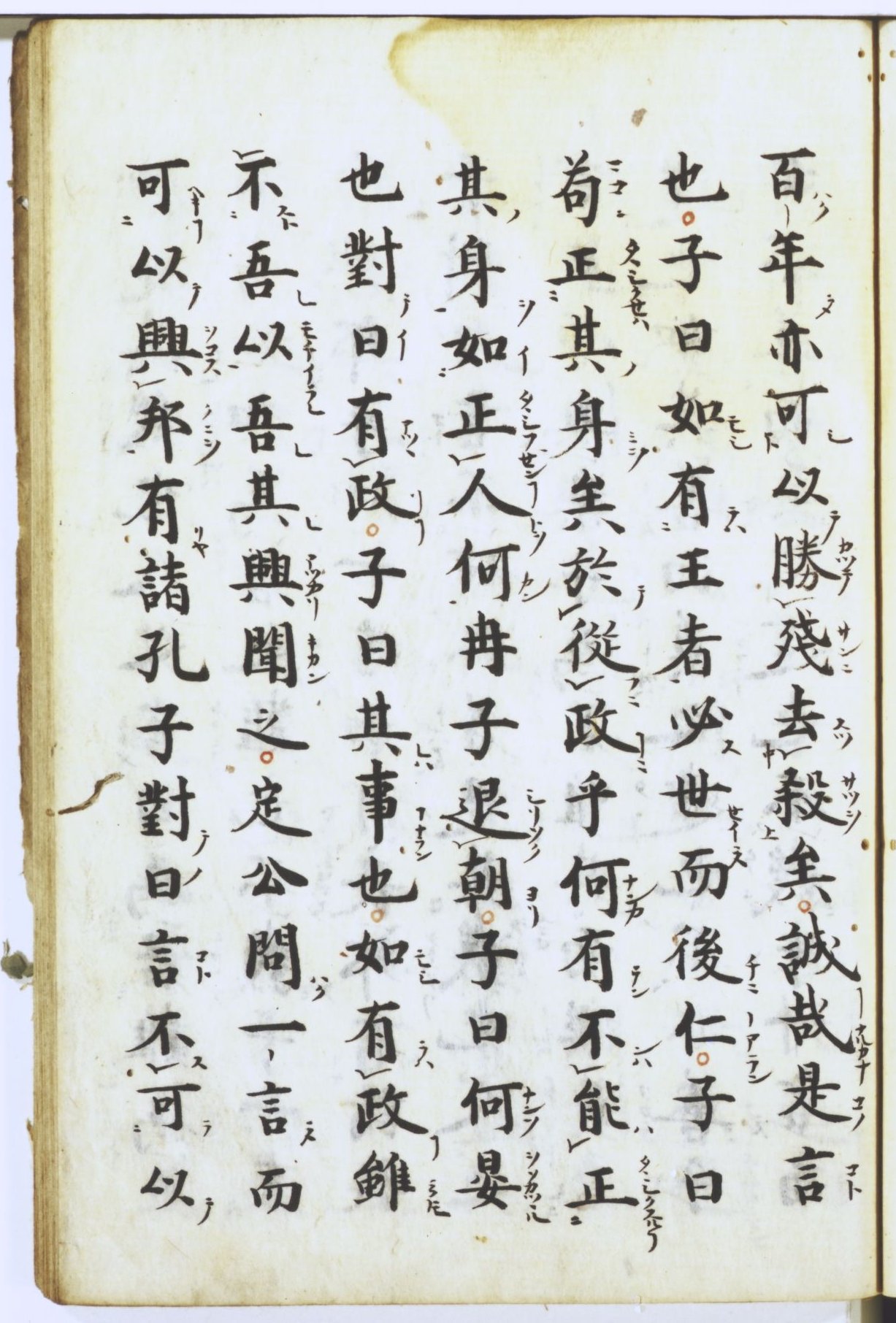
Where on the image
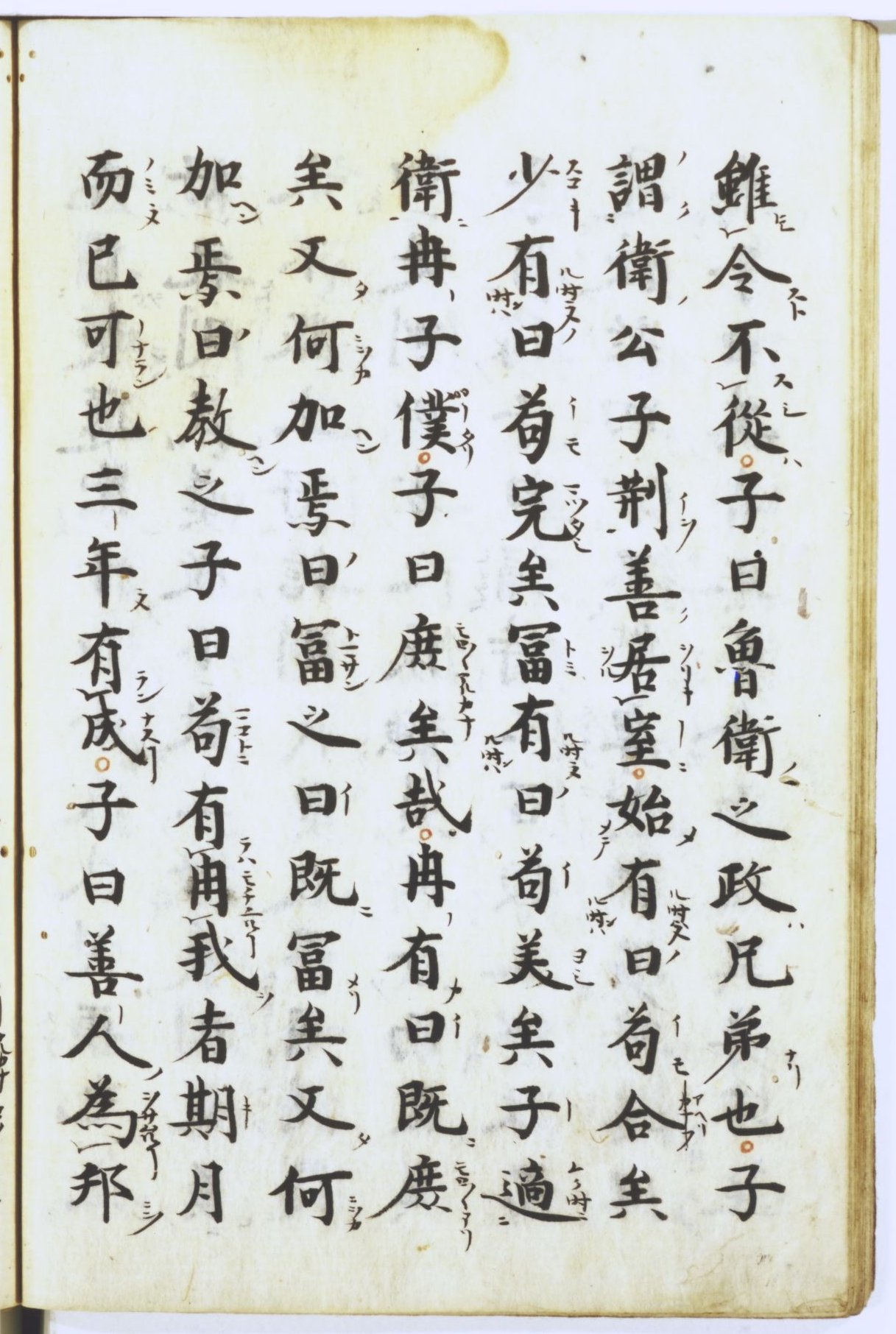
Kyoto University Library RB00007936, IIIF canvas 59, right-hand page: 7 written columns of up to 14 characters, main text only, with Japanese reading marks. Checked on the image: the first column of this book's text on this page begins ‹雖令不›, the last begins ‹而已可›. 13.7 begins inside column 1 (the column opens ‹雖令不›), 4 characters down in the received text. Above it the page finishes 13.6, shown in the previous section. 13.11 runs on to canvas 59, left-hand page (first column ‹百年亦›), where the section ends. Column openings on these pages that differ from the received text: ‹衛冉子› where the received text has ‹衞冉有›. The Chinese shown is the received text (Wikisource), not a transcription of this manuscript; Legge's English translates the received text.
7子曰:「魯衞之政,兄弟也。」
8子謂衞公子荊,「善居室:始有,曰:『苟合矣;』少有,曰:『苟完矣。』富有,曰:『苟美矣。』」
9.1子適衞,冉有僕。
9.2子曰:「庶矣哉!」
9.3冉有曰:「既庶矣,又何加焉?」曰:「富之。」
9.4曰:「既富矣,又何加焉?」曰:「教之。」
10子曰:「苟有用我者,期月而已可也,三年有成。」
11子曰:「『善人爲邦百年,亦可以勝殘去殺矣。』誠哉是言也。」
7The Master said, 'The governments of Lu and Wei are brothers.'
8The Master said of Ching, a scion of the ducal family of Wei, that he knew the economy of a family well. When he began to have means, he said, 'Ha! here is a collection!' When they were a little increased, he said, 'Ha! this is complete!' When he had become rich, he said, 'Ha! this is admirable!'
9.1When the Master went to Wei, Zan Yu acted as driver of his carriage.
9.2The Master observed, 'How numerous are the people!'
9.3Yu said, 'Since they are thus numerous, what more shall be done for them?' 'Enrich them,' was the reply.
9.4'And when they have been enriched, what more shall be done?' The Master said, 'Teach them.'
10The Master said, 'If there were (any of the princes) who would employ me, in the course of twelve months, I should have done something considerable. In three years, the government would be perfected.'
11The Master said, '"If good men were to govern a country in succession for a hundred years, they would be able to transform the violently bad, and dispense with capital punishments." True indeed is this saying!'
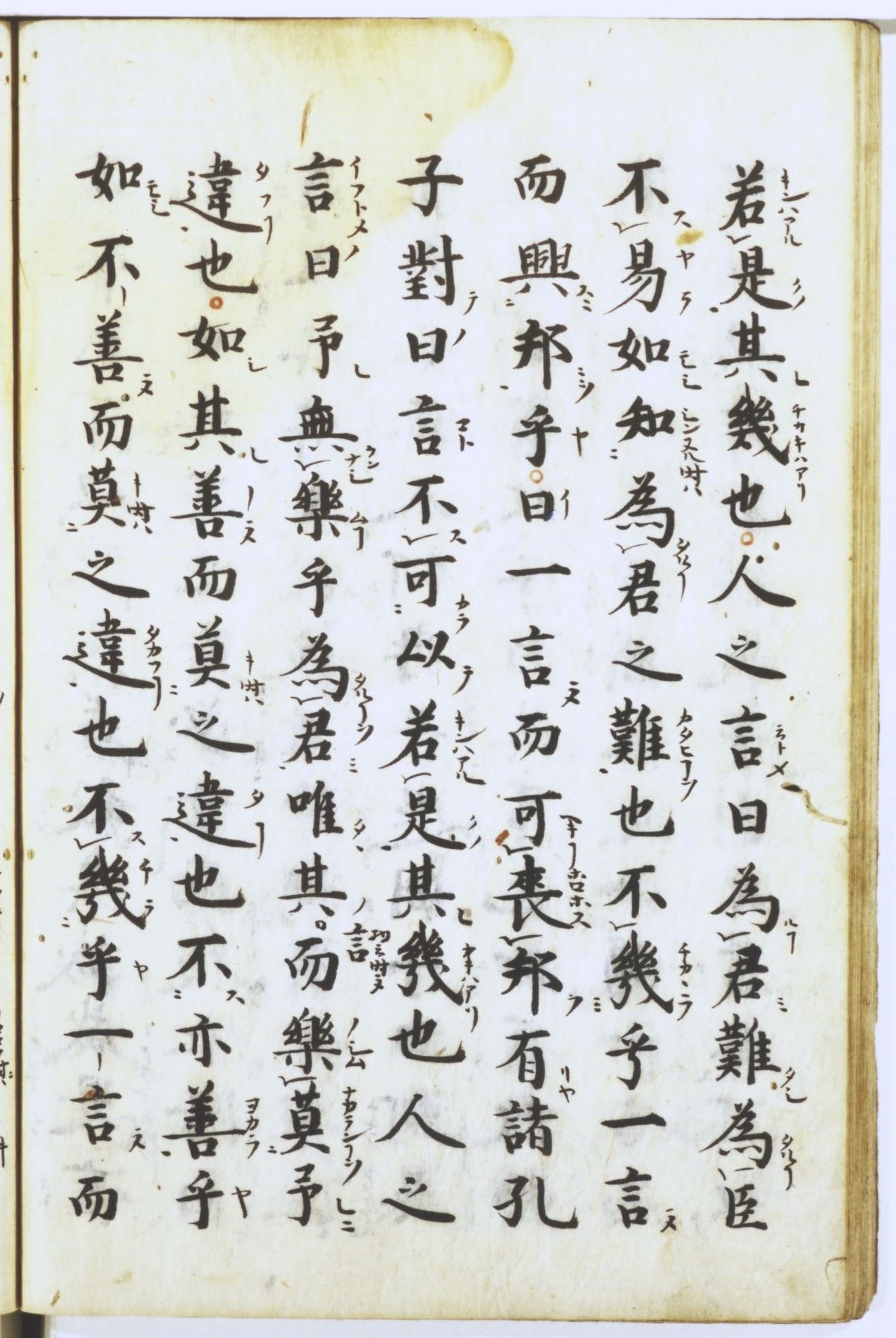
Where on the image
Kyoto University Library RB00007936, IIIF canvas 59, left-hand page: 7 written columns of up to 14 characters, main text only, with Japanese reading marks. Checked on the image: the first column of this book's text on this page begins ‹百年亦›, the last begins ‹可以興›. 13.12 begins inside column 2 (the column opens ‹也子曰›), 1 characters down in the received text. Above it the page finishes 13.11, shown in the previous section. 13.15.1 runs on to canvas 60, right-hand page (first column ‹若是其›), where the section ends. The Chinese shown is the received text (Wikisource), not a transcription of this manuscript; Legge's English translates the received text.
12子曰:「如有王者,必世而後仁。」
13子曰:「苟正其身矣,於從政乎何有?不能正其身,如正人何?」
14冉子退朝,子曰:「何晏也?」對曰:「有政。」子曰:「其事也!如有政,雖不吾以,吾其與聞之!」
15.1定公問:「一言而可以興邦,有諸?」孔子對曰:「言不可以若是其幾也!
12The Master said, 'If a truly royal ruler were to arise, it would still require a generation, and then virtue would prevail.'
13The Master said, 'If a minister make his own conduct correct, what difficulty will he have in assisting in government? If he cannot rectify himself, what has he to do with rectifying others?'
14The disciple Zan returning from the court, the Master said to him, 'How are you so late?' He replied, 'We had government business.' The Master said, 'It must have been family affairs. If there had been government business, though I am not now in office, I should have been consulted about it.'
15.1The Duke Ting asked whether there was a single sentence which could make a country prosperous. Confucius replied, 'Such an effect cannot be expected from one sentence.
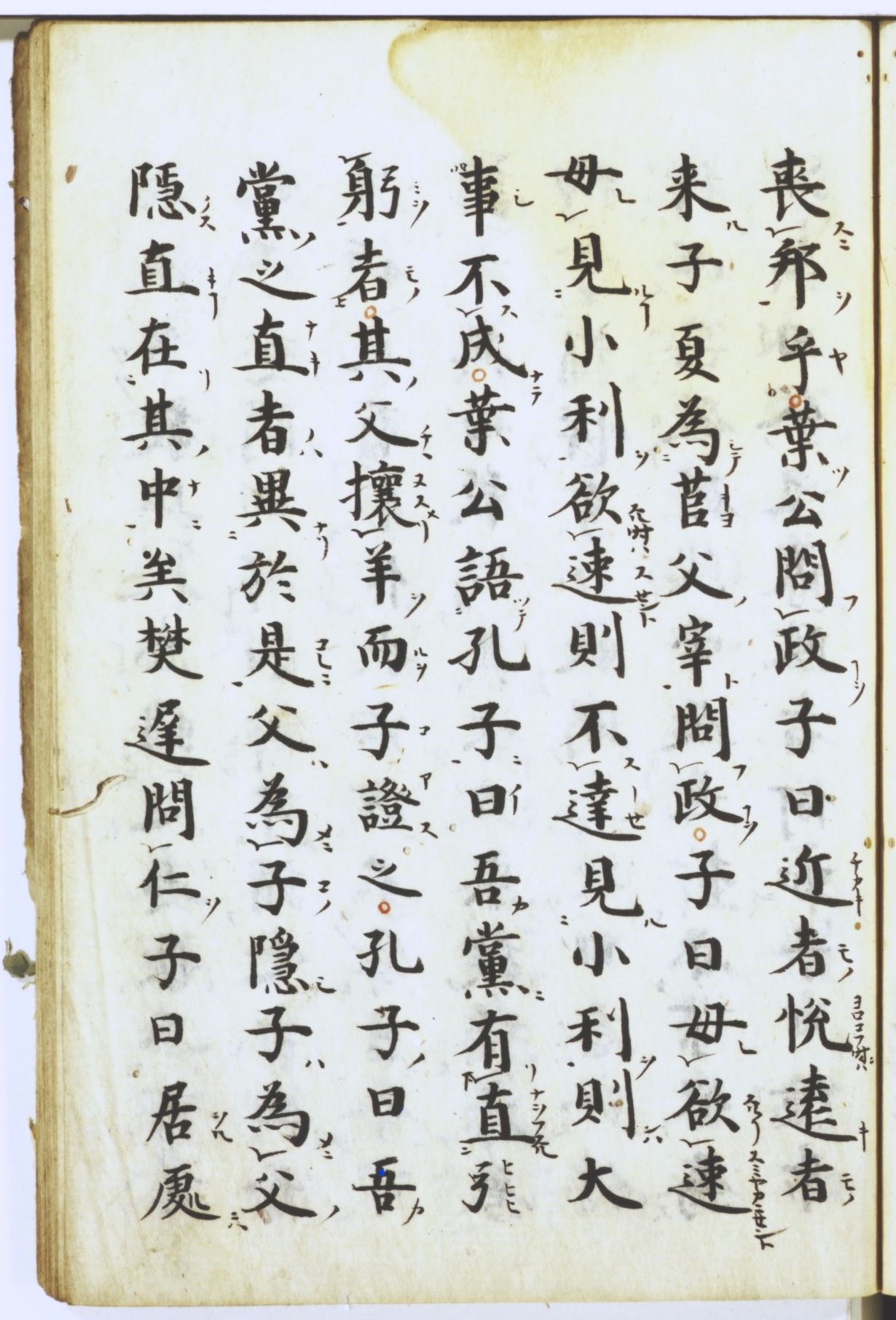
Where on the image
Kyoto University Library RB00007936, IIIF canvas 60, right-hand page: 7 written columns of up to 14 characters, main text only, with Japanese reading marks. Checked on the image: the first column of this book's text on this page begins ‹若是其›, the last begins ‹如不善›. 13.15.2 begins inside column 1 (the column opens ‹若是其›), 5 characters down in the received text. Above it the page finishes 13.15.1, shown in the previous section. 13.15.5 runs on to canvas 60, left-hand page (first column ‹喪邦乎›), where the section ends. The Chinese shown is the received text (Wikisource), not a transcription of this manuscript; Legge's English translates the received text.
15.2人之言曰:『爲君難,爲臣不易』。
15.3如知爲君之難也,不幾乎一言而興邦乎?」
15.4曰:「一言而喪邦,有諸?」孔子對曰:「言不可以若是其幾也!人之言曰:『予無樂乎爲君,唯其言而莫予違也。』
15.5如其善而莫之違也,不亦善乎?如不善而莫之違也,不幾乎一言而喪邦乎?」
15.2'There is a saying, however, which people have-- "To be a prince is difficult; to be a minister is not easy."
15.3'If a ruler knows this,-- the difficulty of being a prince,-- may there not be expected from this one sentence the prosperity of his country?'
15.4The duke then said, 'Is there a single sentence which can ruin a country?' Confucius replied, 'Such an effect as that cannot be expected from one sentence. There is, however, the saying which people have-- "I have no pleasure in being a prince, but only in that no one can offer any opposition to what I say!"
15.5'If a ruler's words be good, is it not also good that no one oppose them? But if they are not good, and no one opposes them, may there not be expected from this one sentence the ruin of his country?'
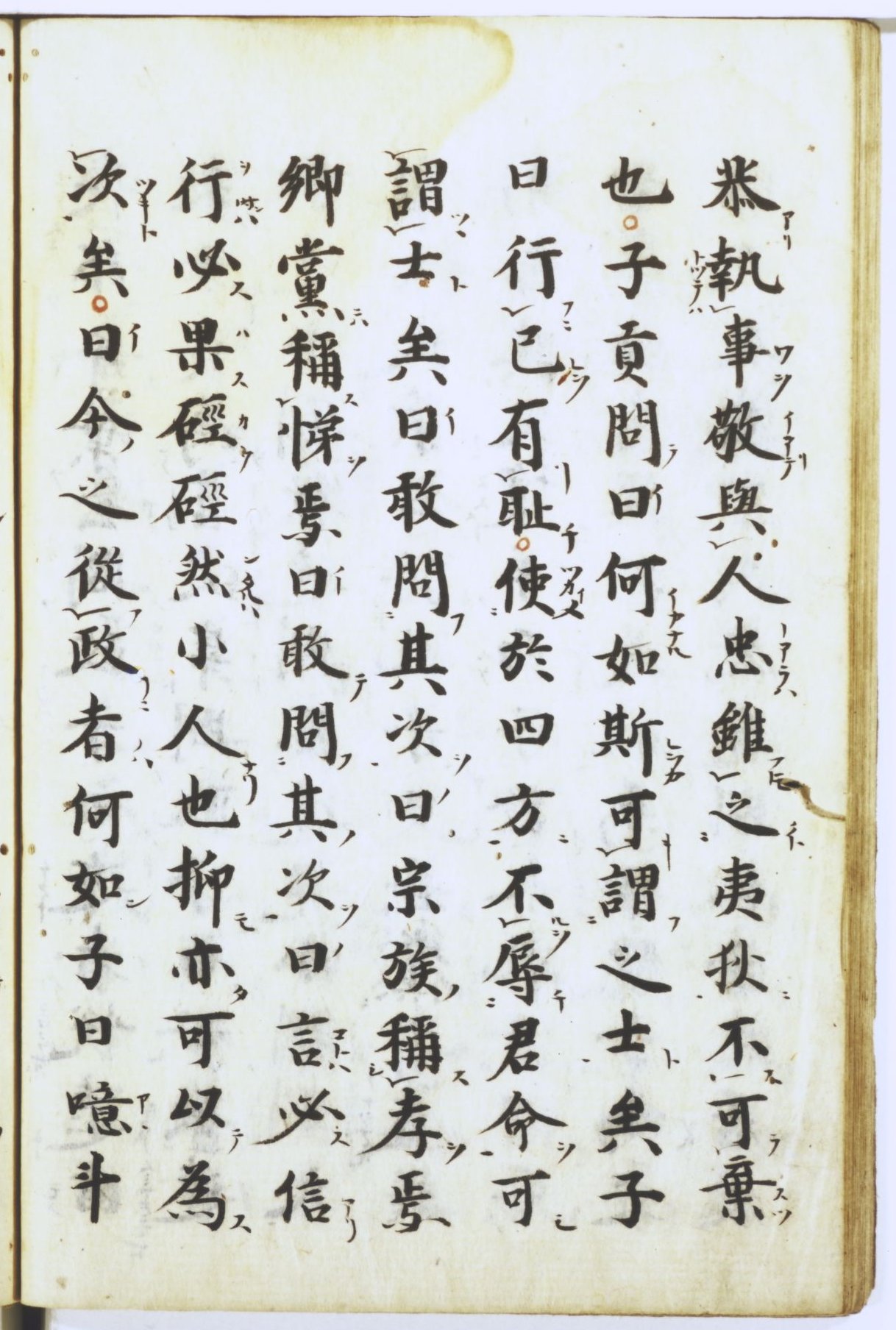
Where on the image
Kyoto University Library RB00007936, IIIF canvas 60, left-hand page: 7 written columns of up to 14 characters, main text only, with Japanese reading marks. Checked on the image: the first column of this book's text on this page begins ‹喪邦乎›, the last begins ‹隱直在›. 13.16.1 begins inside column 1 (the column opens ‹喪邦乎›), 3 characters down in the received text. Above it the page finishes 13.15.5, shown in the previous section. 13.19 runs on to canvas 61, right-hand page (first column ‹恭執事›), where the section ends. Column openings on these pages that differ from the received text: ‹毋見小› where the received text has ‹無見小›. The Chinese shown is the received text (Wikisource), not a transcription of this manuscript; Legge's English translates the received text.
16.1葉公問政。
16.2子曰:「近者說,遠者來。」
17子夏爲莒父宰,問政。子曰:「無欲速,無見小利。欲速,則不達;見小利,則大事不成。」
18.1葉公語孔子曰:「吾黨有直躬者,其父攘羊,而子證之。」
18.2孔子曰:「吾黨之直者異於是,父爲子隱,子爲父隱,直在其中矣。」
19樊遲問仁。子曰:「居處恭,執事敬,與人忠。雖之夷狄,不可棄也。」
16.1The Duke of Sheh asked about government.
16.2The Master said, 'Good government obtains, when those who are near are made happy, and those who are far off are attracted.'
17Tsze-hsia, being governor of Chu-fu, asked about government. The Master said, 'Do not be desirous to have things done quickly; do not look at small advantages. Desire to have things done quickly prevents their being done thoroughly. Looking at small advantages prevents great affairs from being accomplished.'
18.1The Duke of Sheh informed Confucius, saying, 'Among us here there are those who may be styled upright in their conduct. If their father have stolen a sheep, they will bear witness to the fact.'
18.2Confucius said, 'Among us, in our part of the country, those who are upright are different from this. The father conceals the misconduct of the son, and the son conceals the misconduct of the father. Uprightness is to be found in this.'
19Fan Ch'ih asked about perfect virtue. The Master said, 'It is, in retirement, to be sedately grave; in the management of business, to be reverently attentive; in intercourse with others, to be strictly sincere. Though a man go among rude, uncultivated tribes, these qualities may not be neglected.'
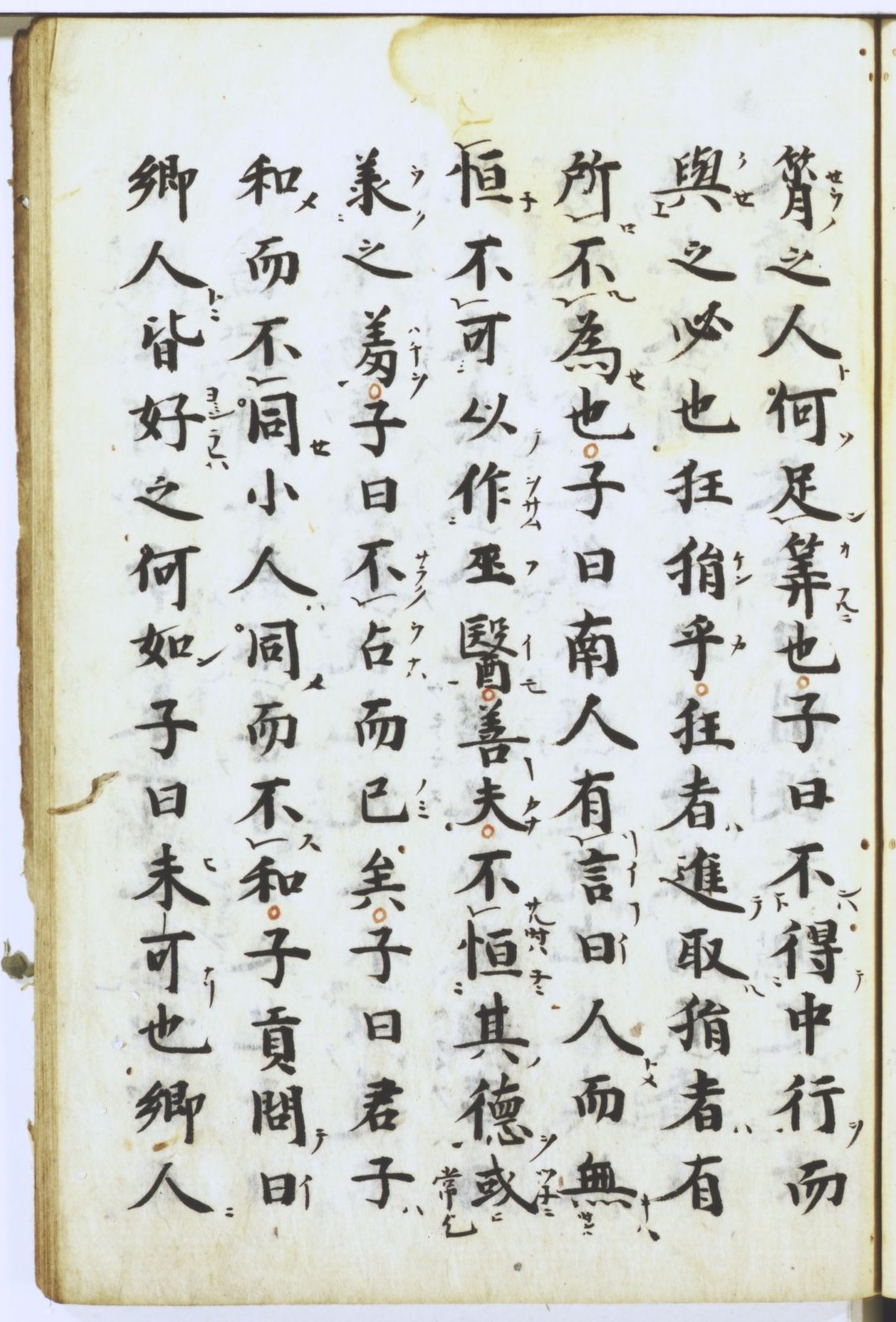
Where on the image
Kyoto University Library RB00007936, IIIF canvas 61, right-hand page: 7 written columns of up to 14 characters, main text only, with Japanese reading marks. Checked on the image: the first column of this book's text on this page begins ‹恭執事›, the last begins ‹次矣曰›. 13.20.1 begins inside column 2 (the column opens ‹也子貢›), 1 characters down in the received text. Above it the page finishes 13.19, shown in the previous section. 13.20.4 runs on to canvas 61, left-hand page (first column ‹筲之人›), where the section ends. The Chinese shown is the received text (Wikisource), not a transcription of this manuscript; Legge's English translates the received text.
20.1子貢問曰:「何如斯可謂之『士』矣?」子曰:「行己有恥,使於四方,不辱君命;可謂『士』矣。」
20.2曰:「敢問其次。」曰:「宗族稱孝焉,鄉黨稱弟焉。」
20.3曰:「敢問其次。」曰:「言必信,行必果,硜硜然,小人哉,抑亦可以爲次矣。」
20.4曰:「今之從政者何如?」子曰:「噫!斗筲之人,何足算也!」
20.1Tsze-kung asked, saying, 'What qualities must a man possess to entitle him to be called an officer? The Master said, 'He who in his conduct of himself maintains a sense of shame, and when sent to any quarter will not disgrace his prince's commission, deserves to be called an officer.'
20.2Tsze-kung pursued, 'I venture to ask who may be placed in the next lower rank?' And he was told, 'He whom the circle of his relatives pronounce to be filial, whom his fellow-villagers and neighbours pronounce to be fraternal.'
20.3Again the disciple asked, 'I venture to ask about the class still next in order.' The Master said, 'They are determined to be sincere in what they say, and to carry out what they do. They are obstinate little men. Yet perhaps they may make the next class.'
20.4Tsze-kung finally inquired, 'Of what sort are those of the present day, who engage in government?' The Master said 'Pooh! they are so many pecks and hampers, not worth being taken into account.'
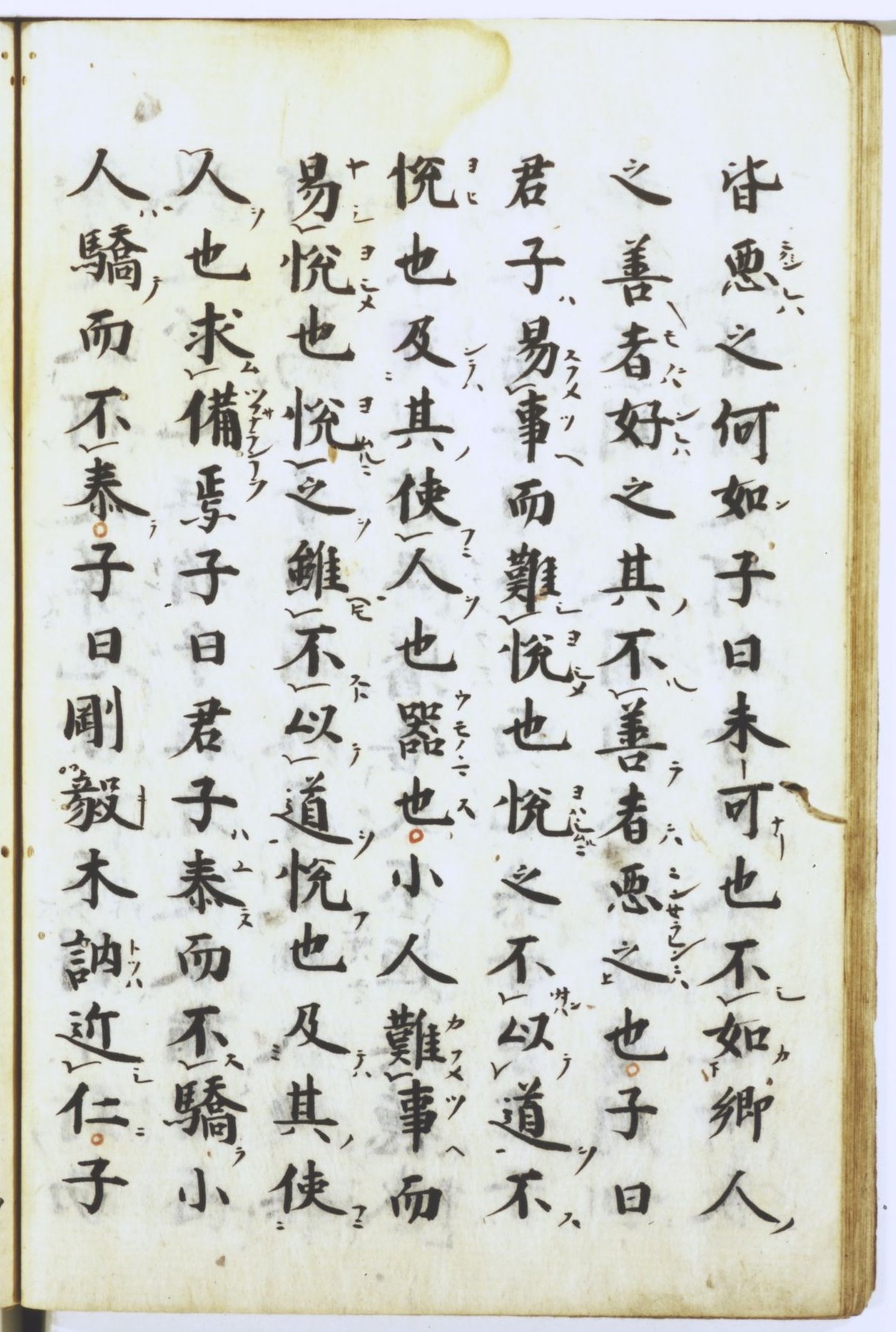
Where on the image
Kyoto University Library RB00007936, IIIF canvas 61, left-hand page: 7 written columns of up to 14 characters, main text only, with Japanese reading marks. Checked on the image: the first column of this book's text on this page begins ‹筲之人›, the last begins ‹鄉人皆›. 13.21 begins inside column 1 (the column opens ‹筲之人›), 7 characters down in the received text. Above it the page finishes 13.20.4, shown in the previous section. 13.24 runs on to canvas 62, right-hand page (first column ‹皆惡之›), where the section ends. The Chinese shown is the received text (Wikisource), not a transcription of this manuscript; Legge's English translates the received text.
21子曰:「不得中行而與之,必也狂狷乎:狂者進取,狷者有所不爲也。」
22.1子曰:「南人有言曰:『人而無恆,不可以作巫醫』。「善夫!
22.2『不恆其德,或承之羞』」
22.3子曰:「不占而已矣。」
23子曰:「君子和而不同,小人同而不和。」
24子貢問曰:「鄉人皆好之,何如?」子曰:「未可也。」「鄉人皆惡之,何如?」子曰:「未可也。不如鄉人之善者好之,其不善者惡之。」
21The Master said, 'Since I cannot get men pursuing the due medium, to whom I might communicate my instructions, I must find the ardent and the cautiously-decided. The ardent will advance and lay hold of truth; the cautiously-decided will keep themselves from what is wrong.'
22.1The Master said, 'The people of the south have a saying-- "A man without constancy cannot be either a wizard or a doctor." Good!
22.2'Inconstant in his virtue, he will be visited with disgrace.'
22.3The Master said, 'This arises simply from not attending to the prognostication.'
23The Master said, 'The superior man is affable, but not adulatory; the mean man is adulatory, but not affable.'
24Tsze-kung asked, saying, 'What do you say of a man who is loved by all the people of his neighborhood?' The Master replied, 'We may not for that accord our approval of him.' 'And what do you say of him who is hated by all the people of his neighborhood?' The Master said, 'We may not for that conclude that he is bad. It is better than either of these cases that the good in the neighborhood love him, and the bad hate him.'
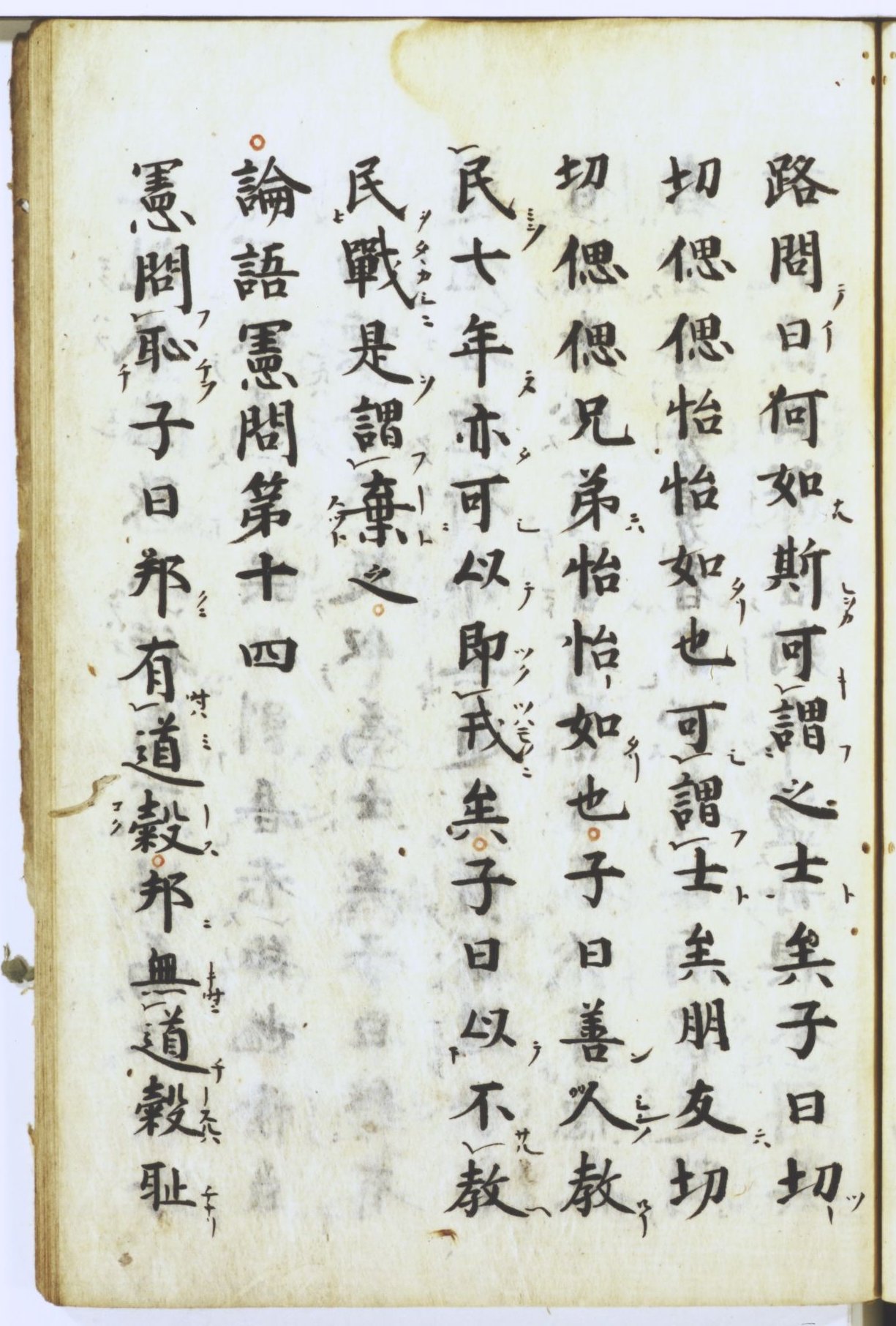
Where on the image
Kyoto University Library RB00007936, IIIF canvas 62, right-hand page: 7 written columns of up to 14 characters, main text only, with Japanese reading marks. Checked on the image: the first column of this book's text on this page begins ‹皆惡之›, the last begins ‹人驕而›. 13.25 begins inside column 2 (the column opens ‹之善者›), 11 characters down in the received text. Above it the page finishes 13.24, shown in the previous section. 13.28 runs on to canvas 62, left-hand page (first column ‹路問曰›), where the section ends. The Chinese shown is the received text (Wikisource), not a transcription of this manuscript; Legge's English translates the received text.
25子曰:「君子易事而難說也;說之不以道,不說也;及其使人也,器之。小人難事而易說也。說之雖不以道,說也;及其使人也,求備焉。」
26子曰:「君子泰而不驕;小人驕而不泰。」
27子曰:「剛毅木訥,近仁。」
28子路問曰:「何如斯可謂之『士』矣?」子曰:「切切偲偲、怡怡如也,可謂『士』矣。朋友切切偲偲,兄弟怡怡。」
25The Master said, 'The superior man is easy to serve and difficult to please. If you try to please him in any way which is not accordant with right, he will not be pleased. But in his employment of men, he uses them according to their capacity. The mean man is difficult to serve, and easy to please. If you try to please him, though it be in a way which is not accordant with right, he may be pleased. But in his employment of men, he wishes them to be equal to everything.'
26The Master said, 'The superior man has a dignified ease without pride. The mean man has pride without a dignified ease.'
27The Master said, 'The firm, the enduring, the simple, and the modest are near to virtue.'
28Tsze-lu asked, saying, 'What qualities must a man possess to entitle him to be called a scholar?' The Master said, 'He must be thus,-- earnest, urgent, and bland:-- among his friends, earnest and urgent; among his brethren, bland.'
Where on the image
Kyoto University Library RB00007936, IIIF canvas 62, left-hand page: 7 written columns of up to 14 characters, main text only, with Japanese reading marks. Checked on the image: the first column of this book's text on this page begins ‹路問曰›, the last begins ‹民戰是›. Column 6 carries the title 論語憲問第十四. 13.29 begins inside column 3 (the column opens ‹切偲偲兄›), 7 characters down in the received text. Above it the page finishes 13.28, shown in the previous section. The section ends on this page. The Chinese shown is the received text (Wikisource), not a transcription of this manuscript; Legge's English translates the received text.
29子曰:「善人教民七年,亦可以卽戎矣。」
30子曰:「以不教民戰,是謂棄之。」
29The Master said, 'Let a good man teach the people seven years, and they may then likewise be employed in war.'
30The Master said, 'To lead an uninstructed people to war, is to throw them away.'
Notes
- English: James Legge, Confucian Analects, The Chinese Classics vol. 1. Legge's chapter and paragraph numbers are kept as superscripts (chapter.paragraph).
- Legge translated the received text. Where this manuscript's wording differs, his English follows the received text shown here.
Cite
Sources
- Source: Kyoto University Library RB00007936 (Analects manuscript attributed to Kiyohara Yoshieda, c. 1300) + Wikisource received text + James Legge's English (Project Gutenberg) (holding institution)
- Critical edition: Received text (Wikisource) in Legge's chapter and paragraph division
← previous · → next · v cycle view · l back to library