Analects, Book 14: Xian wen 憲問 (Kamakura-period manuscript)
Introduction
Book 14 of the Analects (論語 Lunyu), titled 憲問 (Xian wen) after its opening words, 47 chapters in Legge's division. It is shown on a manuscript of the Analects in the Kiyohara family collection (Seike bunko) of Kyoto University Library, two volumes in regular script, seven columns of fourteen characters to the page, main text only, with red and black Japanese reading marks. A colophon by Kiyohara Edakata dated 1550 names the copyist as his ancestor Kiyohara Yoshieda (1253-1331), which places the copy around 1300, in the late Kamakura period; the attribution is traditional. The Kiyohara were hereditary readers of the Confucian classics at the Japanese court, and their text descends from the edition of the Analects with the collected commentary of He Yan (3rd century CE): after each pair of books the scribe copied the character counts of the classic and of the commentary, although only the classic is written out. The manuscript is an Important Cultural Property of Japan.
In this copy Book 14 runs from canvas 62, left-hand page to canvas 69, left-hand page (volume 2). Each section gathers the paragraphs that begin on one page, numbered by chapter and paragraph as in Legge, and links to that page and to any page the last paragraph runs onto. The page boundaries were found by reading the first characters of every column on the photographs. The Chinese shown is the received text, from Wikisource. This manuscript differs from it in places, most often by an added or missing particle (也, 矣, 焉) or a variant character form; the differences seen at column openings are listed in the scan notes. The English is James Legge's translation of the received text.
How was this verified? (Provenance)
Where on the image
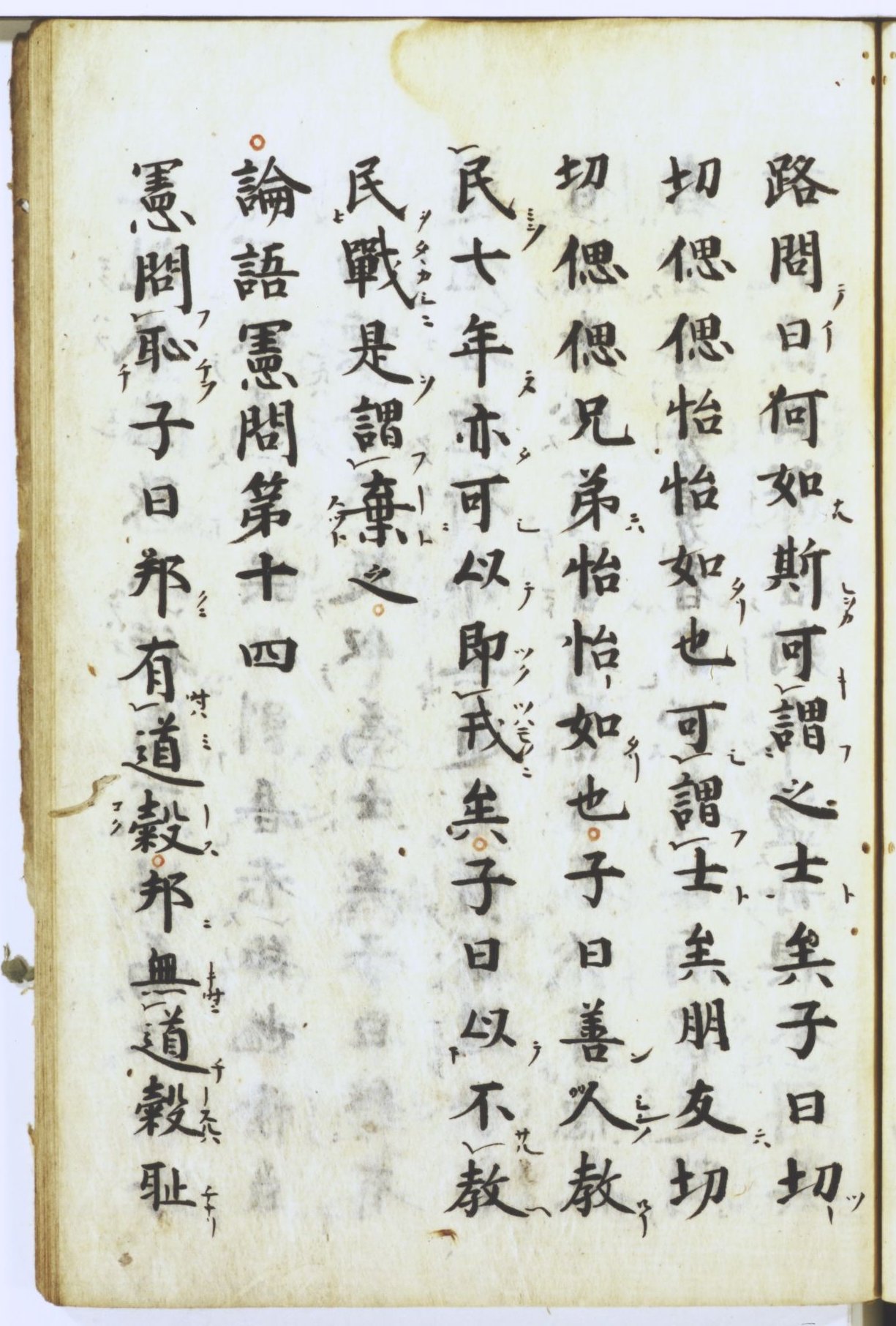
Kyoto University Library RB00007936, IIIF canvas 62, left-hand page: 7 written columns of up to 14 characters, main text only, with Japanese reading marks. Checked on the image: the first column of this book's text on this page begins ‹憲問恥›. Column 6 carries the title 論語憲問第十四. 14.1 opens column 7. 14.1 runs on to canvas 63, right-hand page (first column ‹也克伐›), where the section ends. The Chinese shown is the received text (Wikisource), not a transcription of this manuscript; Legge's English translates the received text.
1憲問「恥」。子曰:「邦有道,穀;邦無道,穀,恥也。」
1Hsien asked what was shameful. The Master said, 'When good government prevails in a state, to be thinking only of salary; and, when bad government prevails, to be thinking, in the same way, only of salary;-- this is shameful.'
Where on the image
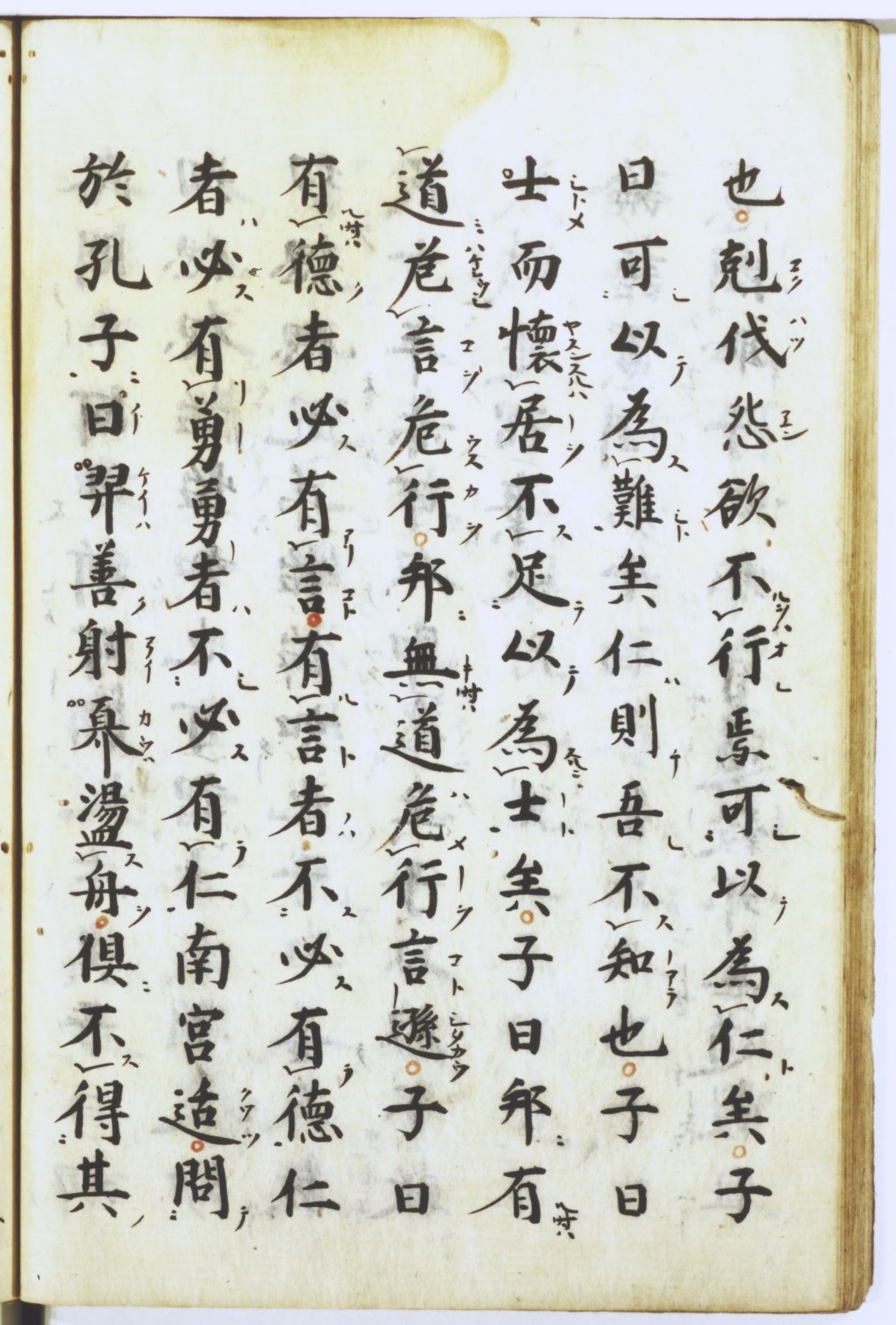
Kyoto University Library RB00007936, IIIF canvas 63, right-hand page: 7 written columns of up to 14 characters, main text only, with Japanese reading marks. Checked on the image: the first column of this book's text on this page begins ‹也克伐›, the last begins ‹於孔子›. 14.2.1 begins inside column 1 (the column opens ‹也克伐›), 1 characters down in the received text. Above it the page finishes 14.1, shown in the previous section. 14.6 runs on to canvas 63, left-hand page (first column ‹死然禹›), where the section ends. The Chinese shown is the received text (Wikisource), not a transcription of this manuscript; Legge's English translates the received text.
2.1「克、伐、怨、欲,不行焉,可以爲仁矣?」
2.2子曰:「可以爲難矣,仁則吾不知也。」
3子曰:「士而懷居,不足以爲士矣!」
4子曰:「邦有道,危言危行;邦無道,危行言孫。」
5子曰:「有德者必有言,有言者不必有德。仁者必有勇,勇者不必有仁。」
6南宮适問於孔子曰:「羿善射,奡盪舟,俱不得其死然。禹稷躬稼而有天下。」夫子不答。南宮适出,子曰:「君子哉若人!尙德哉若人!」
2.1'When the love of superiority, boasting, resentments, and covetousness are repressed, this may be deemed perfect virtue.'
2.2The Master said, 'This may be regarded as the achievement of what is difficult. But I do not know that it is to be deemed perfect virtue.'
3The Master said, 'The scholar who cherishes the love of comfort is not fit to be deemed a scholar.'
4The Master said, 'When good government prevails in a state, language may be lofty and bold, and actions the same. When bad government prevails, the actions may be lofty and bold, but the language may be with some reserve.'
5The Master said, 'The virtuous will be sure to speak correctly, but those whose speech is good may not always be virtuous. Men of principle are sure to be bold, but those who are bold may not always be men of principle.'
6Nan-kung Kwo, submitting an inquiry to Confucius, said, 'I was skillful at archery, and Ao could move a boat along upon the land, but neither of them died a natural death. Yu and Chi personally wrought at the toils of husbandry, and they became possessors of the kingdom.' The Master made no reply; but when Nan-kung Kwo went out, he said, 'A superior man indeed is this! An esteemer of virtue indeed is this!'
Where on the image
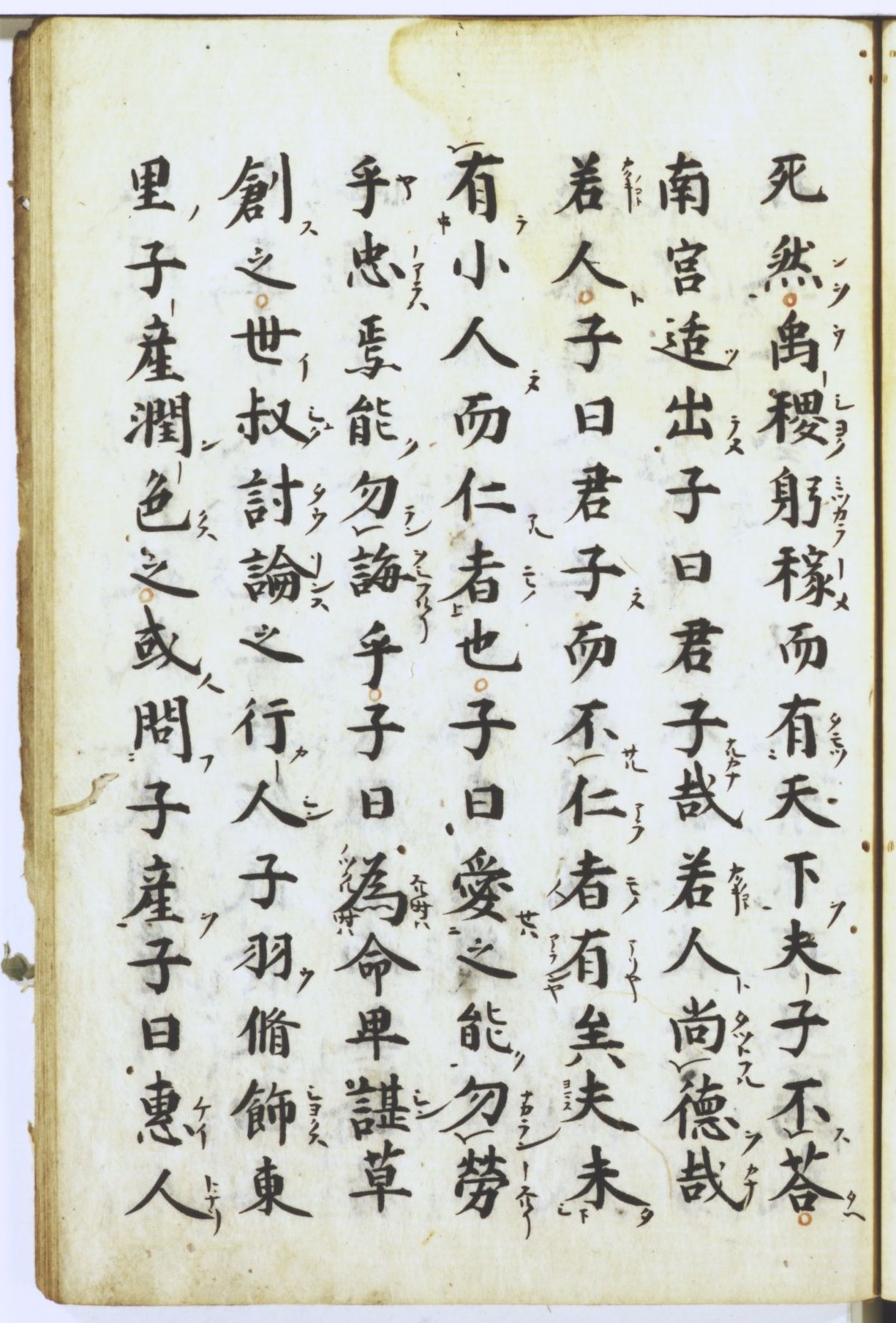
Kyoto University Library RB00007936, IIIF canvas 63, left-hand page: 7 written columns of up to 14 characters, main text only, with Japanese reading marks. Checked on the image: the first column of this book's text on this page begins ‹死然禹›, the last begins ‹里子產›. 14.7 begins inside column 3 (the column opens ‹若人子›), 2 characters down in the received text. Above it the page finishes 14.6, shown in the previous section. 14.10.1 runs on to canvas 64, right-hand page (first column ‹也問子›), where the section ends. The Chinese shown is the received text (Wikisource), not a transcription of this manuscript; Legge's English translates the received text.
7子曰:「君子而不仁者有矣夫!未有小人而仁者也!」
8子曰:「愛之,能勿勞乎?忠焉,能勿誨乎?」
9子曰:「爲命,裨諶草創之,世叔討論之,行人子羽脩飾之,東里子產潤色之。」
10.1或問子產,子曰:「惠人也。」
7The Master said, 'Superior men, and yet not always virtuous, there have been, alas! But there never has been a mean man, and, at the same time, virtuous.'
8The Master said, 'Can there be love which does not lead to strictness with its object? Can there be loyalty which does not lead to the instruction of its object?'
9The Master said, 'In preparing the governmental notifications, P'i Shan first made the rough draft; Shi-shu examined and discussed its contents; Tsze-yu, the manager of Foreign intercourse, then polished the style; and, finally, Tsze-ch'an of Tung-li gave it the proper elegance and finish.'
10.1Some one asked about Tsze-ch'an. The Master said, 'He was a kind man.'
Where on the image
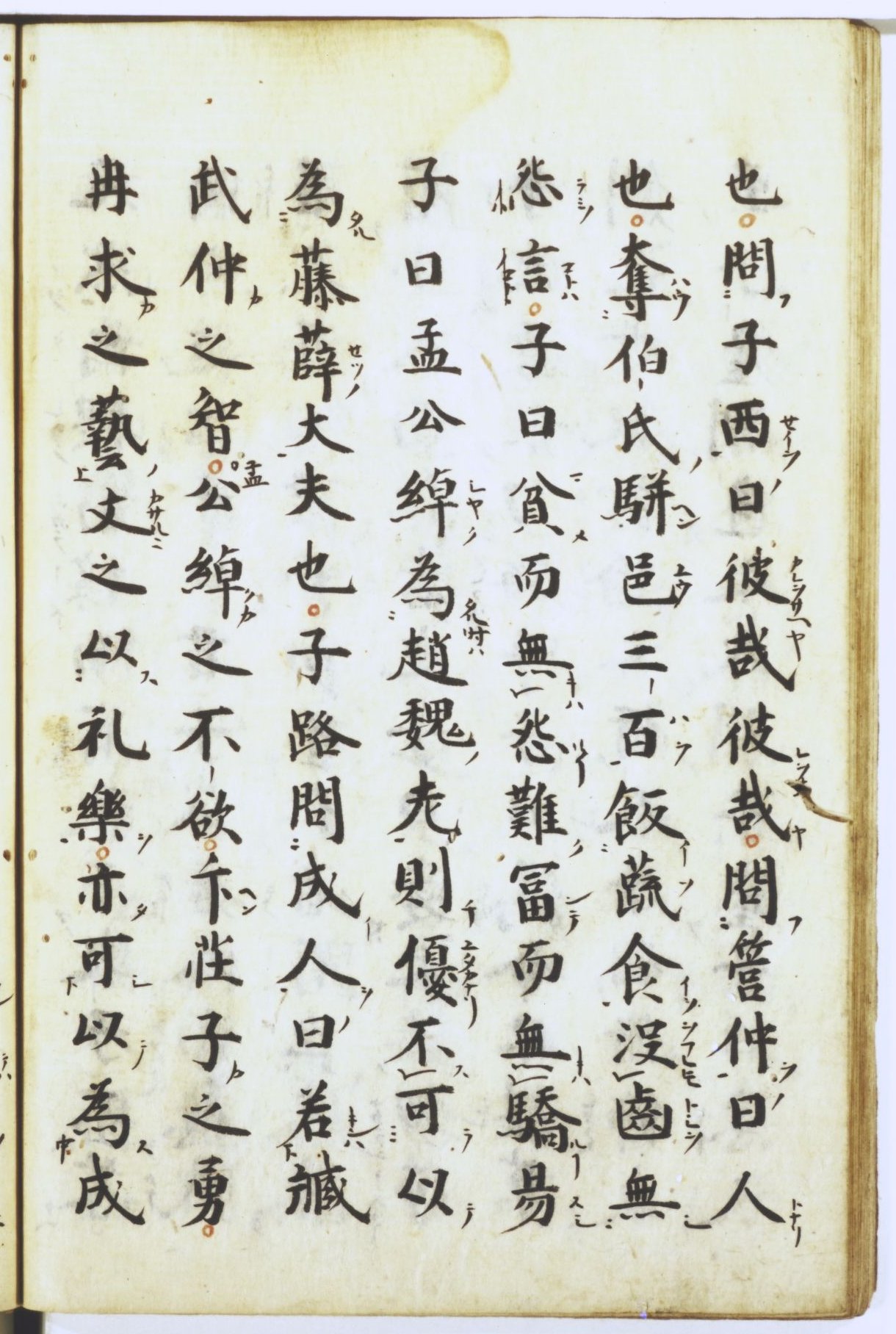
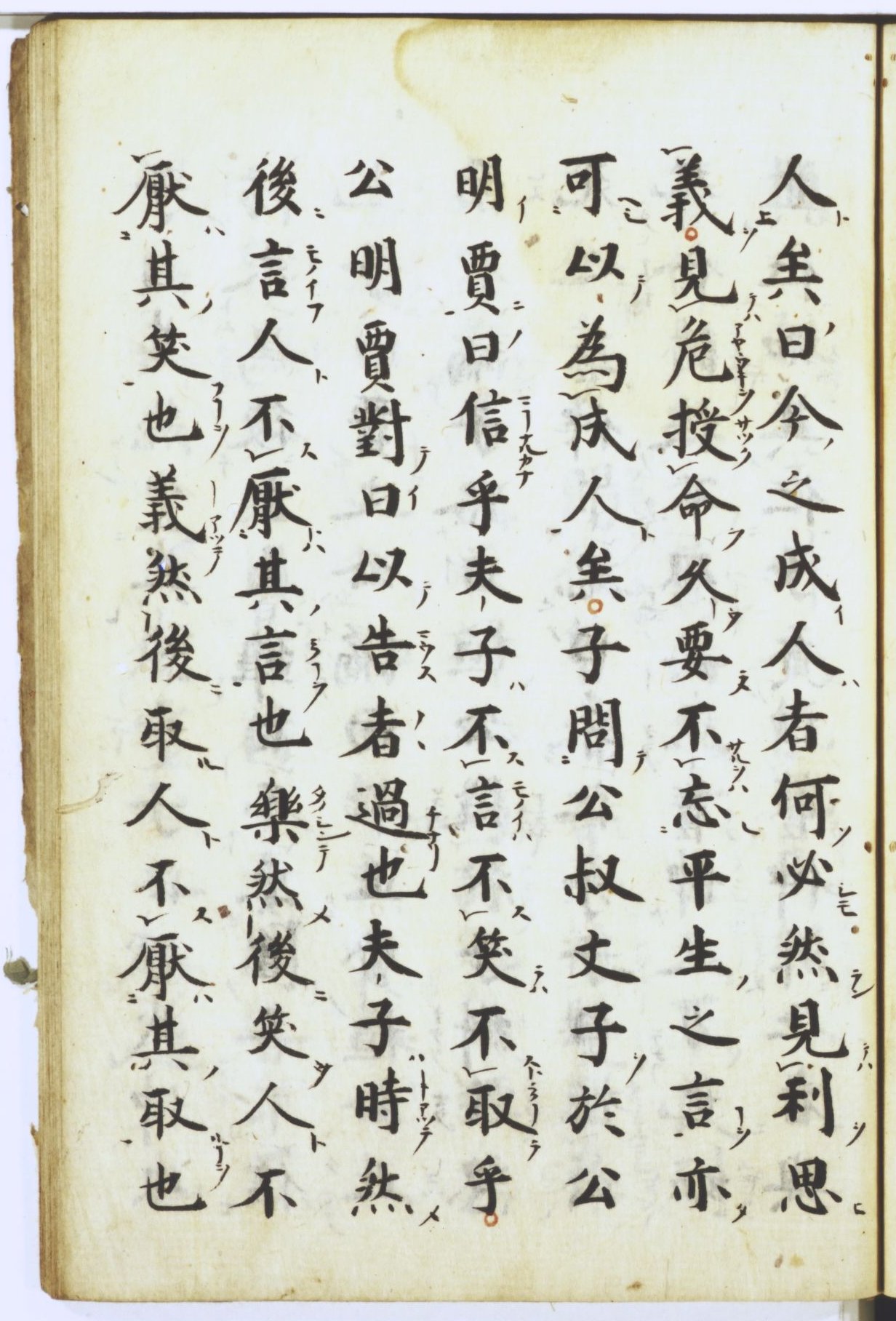
Kyoto University Library RB00007936, IIIF canvas 64, right-hand page: 7 written columns of up to 14 characters, main text only, with Japanese reading marks. Checked on the image: the first column of this book's text on this page begins ‹也問子›, the last begins ‹冉求之›. 14.10.2 begins inside column 1 (the column opens ‹也問子›), 1 characters down in the received text. Above it the page finishes 14.10.1, shown in the previous section. 14.13.1 runs on to canvas 64, left-hand page (first column ‹人矣曰›), where the section ends. The Chinese shown is the received text (Wikisource), not a transcription of this manuscript; Legge's English translates the received text.
10.2問子西。曰:「彼哉彼哉!」
10.3問管仲。曰:「人也,奪伯氏騈邑三百,飯疏食,沒齒,無怨言。」
11子曰:「貧而無怨,難;富而無驕,易。」
12子曰:「孟公綽,爲趙、魏老則優,不可以爲滕、薛大夫。」
13.1子路問成人。子曰:「若臧武仲之知,公綽之不欲,卞莊子之勇,冉求之藝,文之以禮樂,亦可以爲成人矣!」
10.2He asked about Tsze-hsi. The Master said, 'That man! That man!'
10.3He asked about Kwan Chung. 'For him,' said the Master, 'the city of Pien, with three hundred families, was taken from the chief of the Po family, who did not utter a murmuring word, though, to the end of his life, he had only coarse rice to eat.'
11The Master said, 'To be poor without murmuring is difficult. To be rich without being proud is easy.'
12The Master said, 'Mang Kung-ch'o is more than fit to be chief officer in the families of Chao and Wei, but he is not fit to be great officer to either of the States Tang or Hsieh.'
13.1Tsze-lu asked what constituted a COMPLETE man. The Master said, 'Suppose a man with the knowledge of Tsang Wu-chung, the freedom from covetousness of Kung-ch'o, the bravery of Chwang of Pien, and the varied talents of Zan Ch'iu; add to these the accomplishments of the rules of propriety and music:-- such a one might be reckoned a COMPLETE man.'
Where on the image
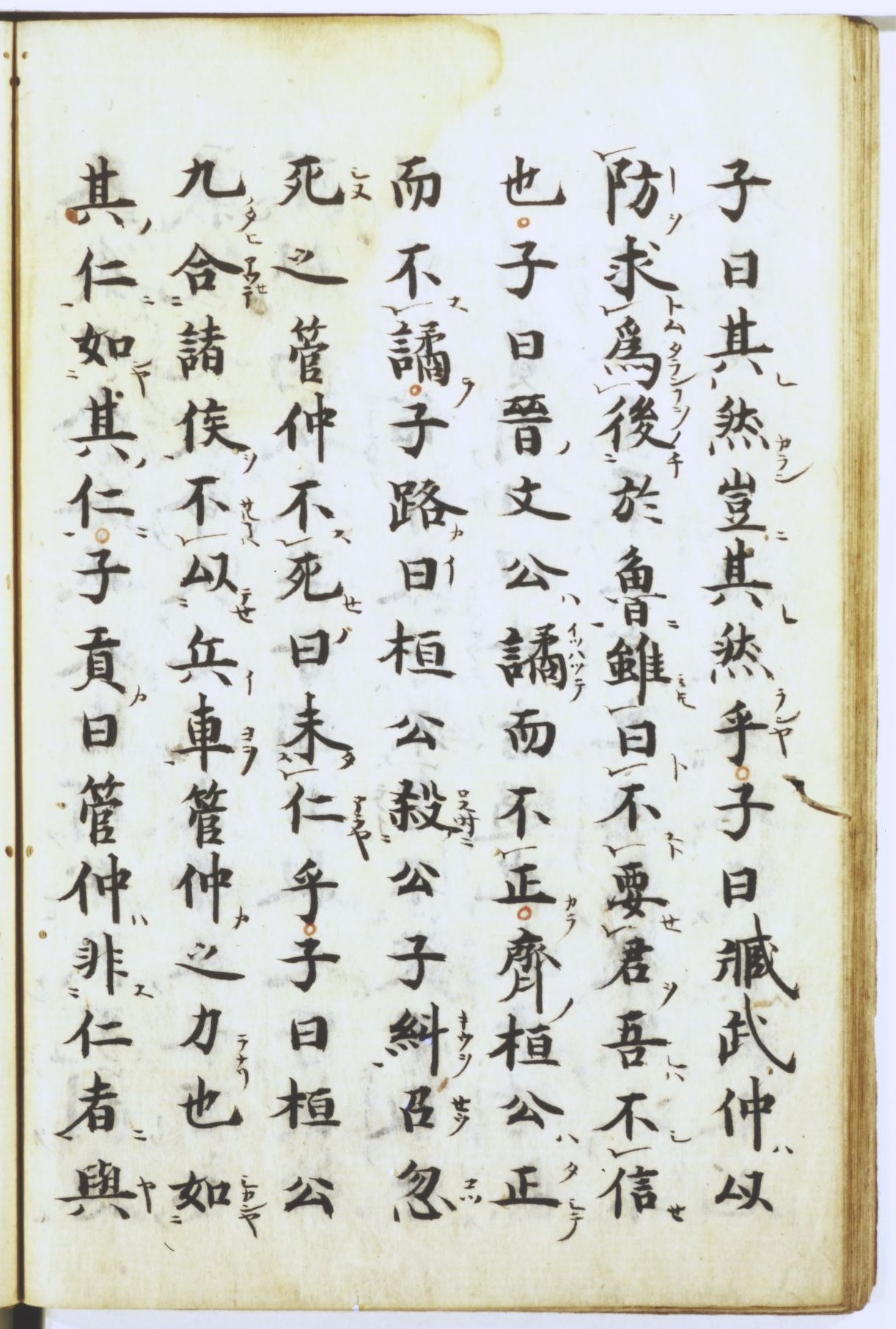
Kyoto University Library RB00007936, IIIF canvas 64, left-hand page: 7 written columns of up to 14 characters, main text only, with Japanese reading marks. Checked on the image: the first column of this book's text on this page begins ‹人矣曰›, the last begins ‹厭其笑›. 14.13.2 begins inside column 1 (the column opens ‹人矣曰›), 2 characters down in the received text. Above it the page finishes 14.13.1, shown in the previous section. 14.14.2 runs on to canvas 65, right-hand page (first column ‹子曰其›), where the section ends. The Chinese shown is the received text (Wikisource), not a transcription of this manuscript; Legge's English translates the received text.
13.2曰:「今之成人者,何必然?見利思義,見危授命,久要不忘平生之言,亦可以爲成人矣!」
14.1子問公叔文子於公明賈,曰:「信乎?夫子不言不笑不取乎?」
14.2公明賈對曰:「以吿者過也!夫子時然後言,人不厭其言;樂然後笑,人不厭其笑;義然後取,人不厭其取。」子曰:「其然!豈其然乎?」
13.2He then added, 'But what is the necessity for a complete man of the present day to have all these things? The man, who in the view of gain, thinks of righteousness; who in the view of danger is prepared to give up his life; and who does not forget an old agreement however far back it extends:-- such a man may be reckoned a COMPLETE man.'
14.1The Master asked Kung-ming Chia about Kung- shu Wan, saying, 'Is it true that your master speaks not, laughs not, and takes not?'
14.2Kung-ming Chia replied, 'This has arisen from the reporters going beyond the truth.-- My master speaks when it is the time to speak, and so men do not get tired of his speaking. He laughs when there is occasion to be joyful, and so men do not get tired of his laughing. He takes when it is consistent with righteousness to do so, and so men do not get tired of his taking.' The Master said, 'So! But is it so with him?'
Where on the image
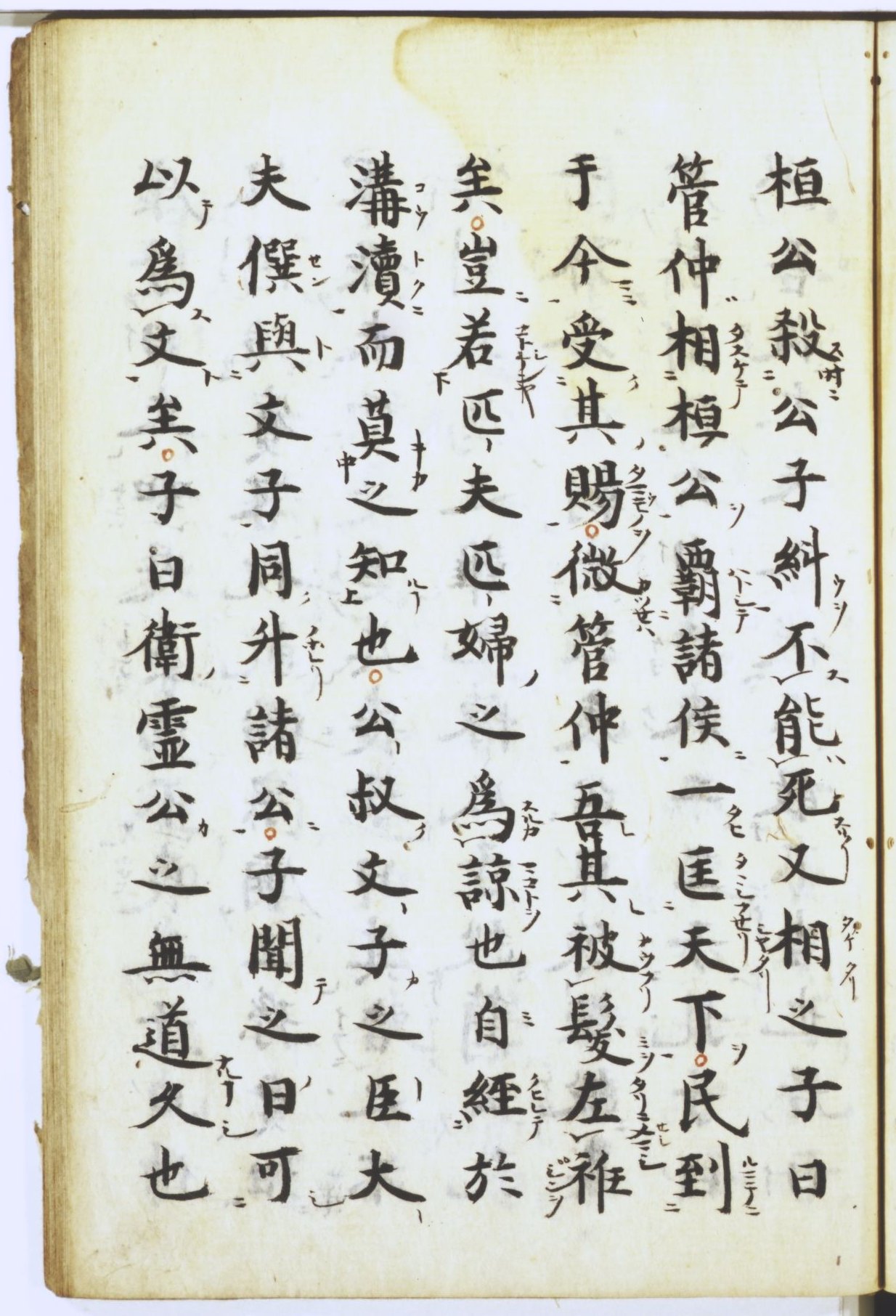
Kyoto University Library RB00007936, IIIF canvas 65, right-hand page: 7 written columns of up to 14 characters, main text only, with Japanese reading marks. Checked on the image: the first column of this book's text on this page begins ‹子曰其›, the last begins ‹其仁如›. 14.15 begins inside column 1 (the column opens ‹子曰其›), 8 characters down in the received text. Above it the page finishes 14.14.2, shown in the previous section. 14.18.1 runs on to canvas 65, left-hand page (first column ‹桓公殺›), where the section ends. The Chinese shown is the received text (Wikisource), not a transcription of this manuscript; Legge's English translates the received text.
15子曰:「臧武仲以防,求爲後於魯,雖曰不要君,吾不信也。」
16子曰:「晉文公譎而不正,齊桓公正而不譎。」
17.1子路曰:「桓公殺公子糾,召忽死之,管仲不死。」曰:「未仁乎?」
17.2子曰:「桓公九合諸侯,不以兵車,管仲之力也。如其仁!如其仁!」
18.1子貢曰:「管仲非仁者與?桓公殺公子糾,不能死,又相之。」
15The Master said, 'Tsang Wu-chung, keeping possession of Fang, asked of the duke of Lu to appoint a successor to him in his family. Although it may be said that he was not using force with his sovereign, I believe he was.'
16The Master said, 'The duke Wan of Tsin was crafty and not upright. The duke Hwan of Ch'i was upright and not crafty.'
17.1Tsze-lu said, 'The Duke Hwan caused his brother Chiu to be killed, when Shao Hu died with his master, but Kwan Chung did not die. May not I say that he was wanting in virtue?'
17.2The Master said, 'The Duke Hwan assembled all the princes together, and that not with weapons of war and chariots:-- it was all through the influence of Kwan Chung. Whose beneficence was like his? Whose beneficence was like his?'
18.1Tsze-kung said, 'Kwan Chung, I apprehend, was wanting in virtue. When the Duke Hwan caused his brother Chiu to be killed, Kwan Chung was not able to die with him. Moreover, he became prime minister to Hwan.'
Where on the image
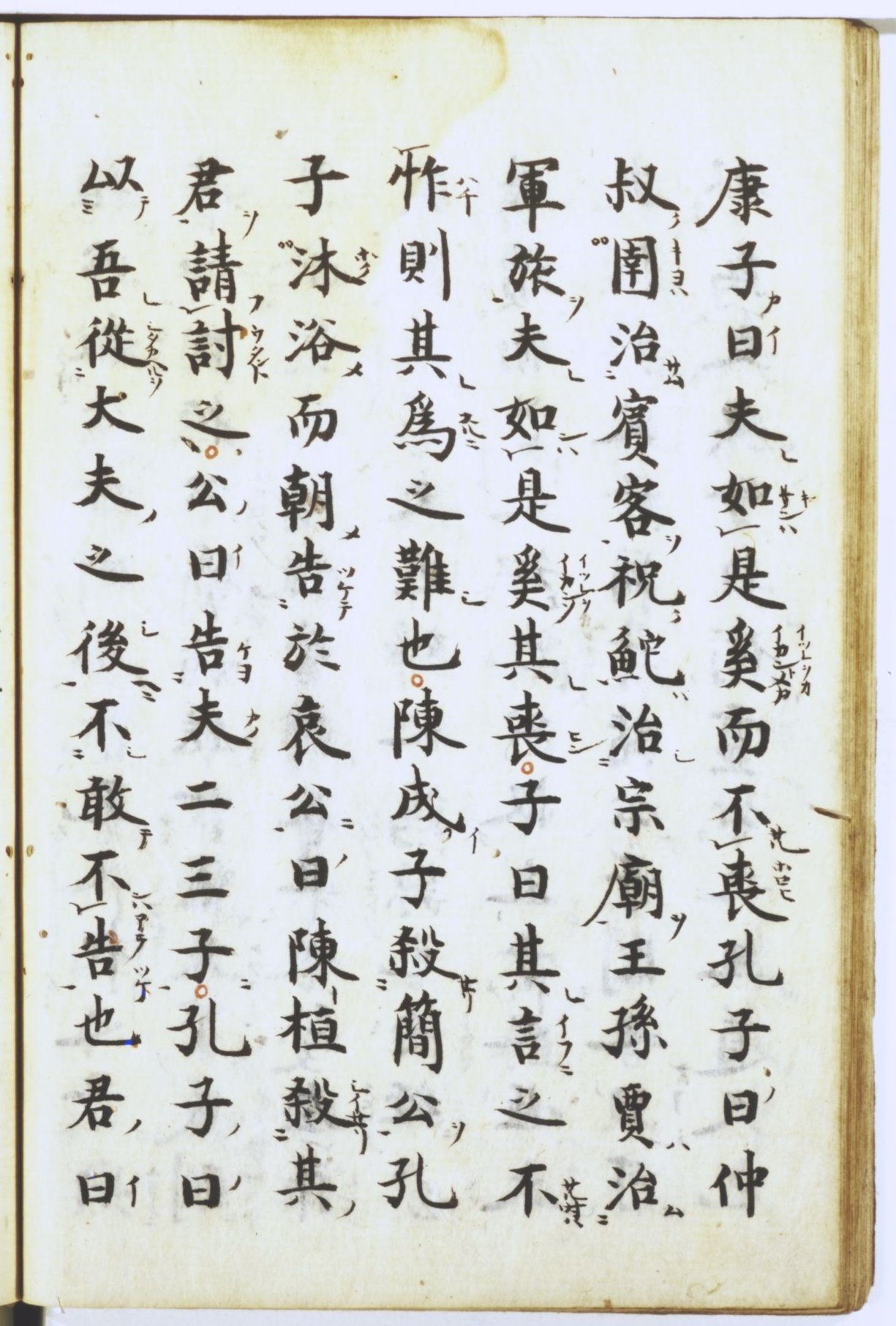
Kyoto University Library RB00007936, IIIF canvas 65, left-hand page: 7 written columns of up to 14 characters, main text only, with Japanese reading marks. Checked on the image: the first column of this book's text on this page begins ‹桓公殺›, the last begins ‹以為文›. 14.18.2 begins inside column 1 (the column opens ‹桓公殺›), 12 characters down in the received text. Above it the page finishes 14.18.1, shown in the previous section. 14.20.1 runs on to canvas 66, right-hand page (first column ‹康子曰›), where the section ends. The Chinese shown is the received text (Wikisource), not a transcription of this manuscript; Legge's English translates the received text.
18.2子曰:「管仲相桓公,霸諸侯,一匡天下,民到于今受其賜;微管仲,吾其被髮左衽矣!
18.3豈若匹夫匹婦之爲諒也,自經於溝瀆,而莫之知也!」
19.1公叔文子之臣大夫僎,與文子同升諸公。
19.2子聞之曰:「可以爲文矣!」
20.1子言衞靈公之無道也。康子曰:「夫如是,奚而不喪?」
18.2The Master said, 'Kwan Chung acted as prime minister to the Duke Hwan, made him leader of all the princes, and united and rectified the whole kingdom. Down to the present day, the people enjoy the gifts which he conferred. But for Kwan Chung, we should now be wearing our hair unbound, and the lappets of our coats buttoning on the left side.
18.3'Will you require from him the small fidelity of common men and common women, who would commit suicide in a stream or ditch, no one knowing anything about them?'
19.1The great officer, Hsien, who had been family- minister to Kung-shu Wan, ascended to the prince's court in company with Wan.
19.2The Master, having heard of it, said, 'He deserved to be considered WAN (the accomplished).'
20.1The Master was speaking about the unprincipled course of the duke Ling of Wei, when Ch'i K'ang said, 'Since he is of such a character, how is it he does not lose his State?'
Where on the image
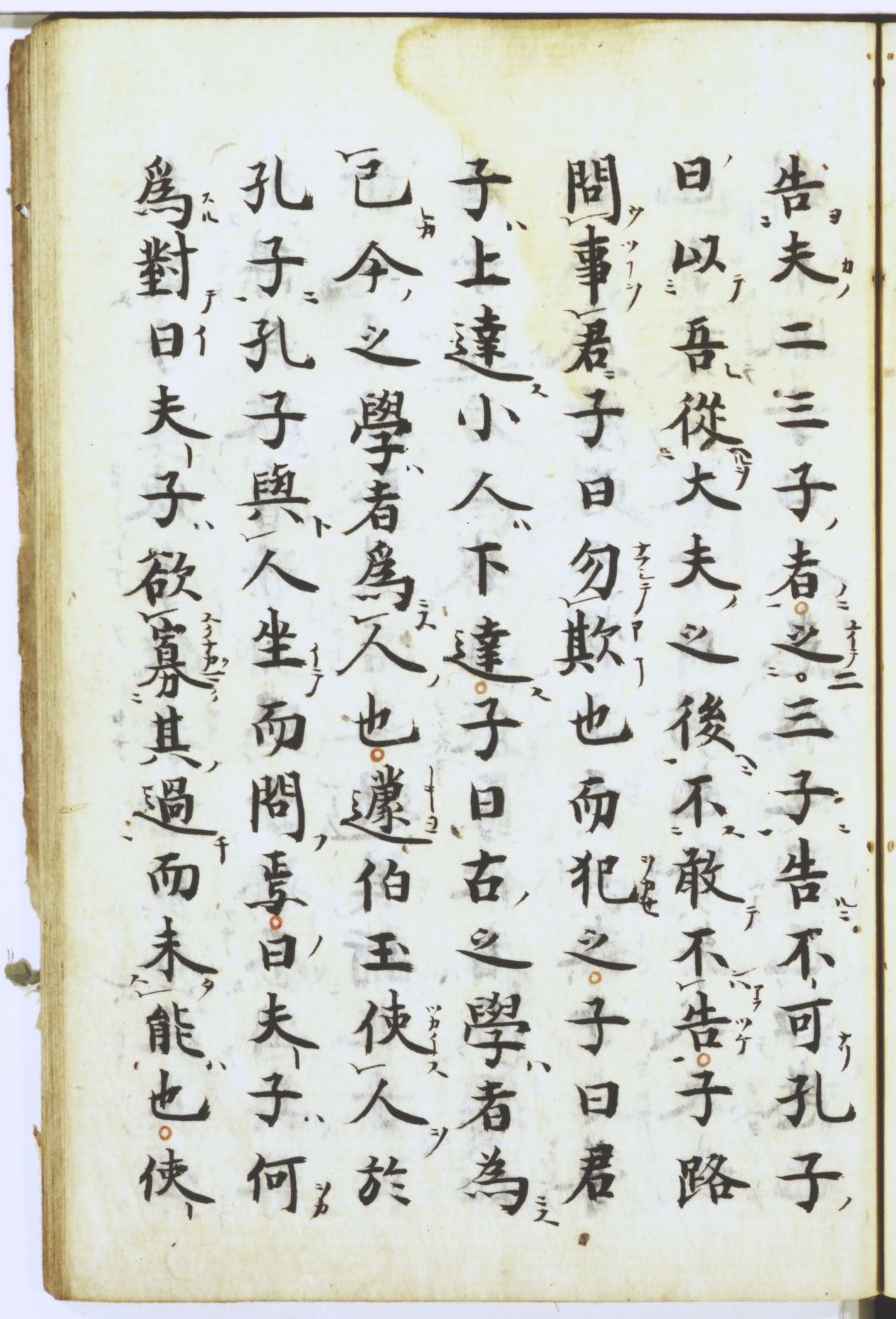
Kyoto University Library RB00007936, IIIF canvas 66, right-hand page: 7 written columns of up to 14 characters, main text only, with Japanese reading marks. Checked on the image: the first column of this book's text on this page begins ‹康子曰›, the last begins ‹以吾從›. 14.20.2 begins inside column 1 (the column opens ‹康子曰›), 10 characters down in the received text. Above it the page finishes 14.20.1, shown in the previous section. 14.22.4 runs on to canvas 66, left-hand page (first column ‹告夫二›), where the section ends. Column openings on these pages that differ from the received text: ‹怍則其› where the received text has ‹怍則爲›; ‹告夫二› where the received text has ‹吿夫三›. The Chinese shown is the received text (Wikisource), not a transcription of this manuscript; Legge's English translates the received text.
20.2孔子曰:「仲叔圉治賓客,祝鮀治宗廟,王孫賈治軍旅。夫如是,奚其喪?」
21子曰:「其言之不怍,則爲之也難!」
22.1陳成子弒簡公。
22.2孔子沐浴而朝,吿於哀公曰:「陳恆弒其君,請討之。」
22.3公曰:「吿夫三子。」
22.4孔子曰:「以吾從大夫之後,不敢不吿也!君曰:『吿夫三子』者!」
20.2Confucius said, 'The Chung-shu Yu has the superintendence of his guests and of strangers; the litanist, T'o, has the management of his ancestral temple; and Wang-sun Chia has the direction of the army and forces:-- with such officers as these, how should he lose his State?'
21The Master said, 'He who speaks without modesty will find it difficult to make his words good.'
22.1Chan Ch'ang murdered the Duke Chien of Ch'i.
22.2Confucius bathed, went to court, and informed the duke Ai, saying, 'Chan Hang has slain his sovereign. I beg that you will undertake to punish him.'
22.3The duke said, 'Inform the chiefs of the three families of it.'
22.4Confucius retired, and said, 'Following in the rear of the great officers, I did not dare not to represent such a matter, and my prince says, "Inform the chiefs of the three families of it."'
Where on the image
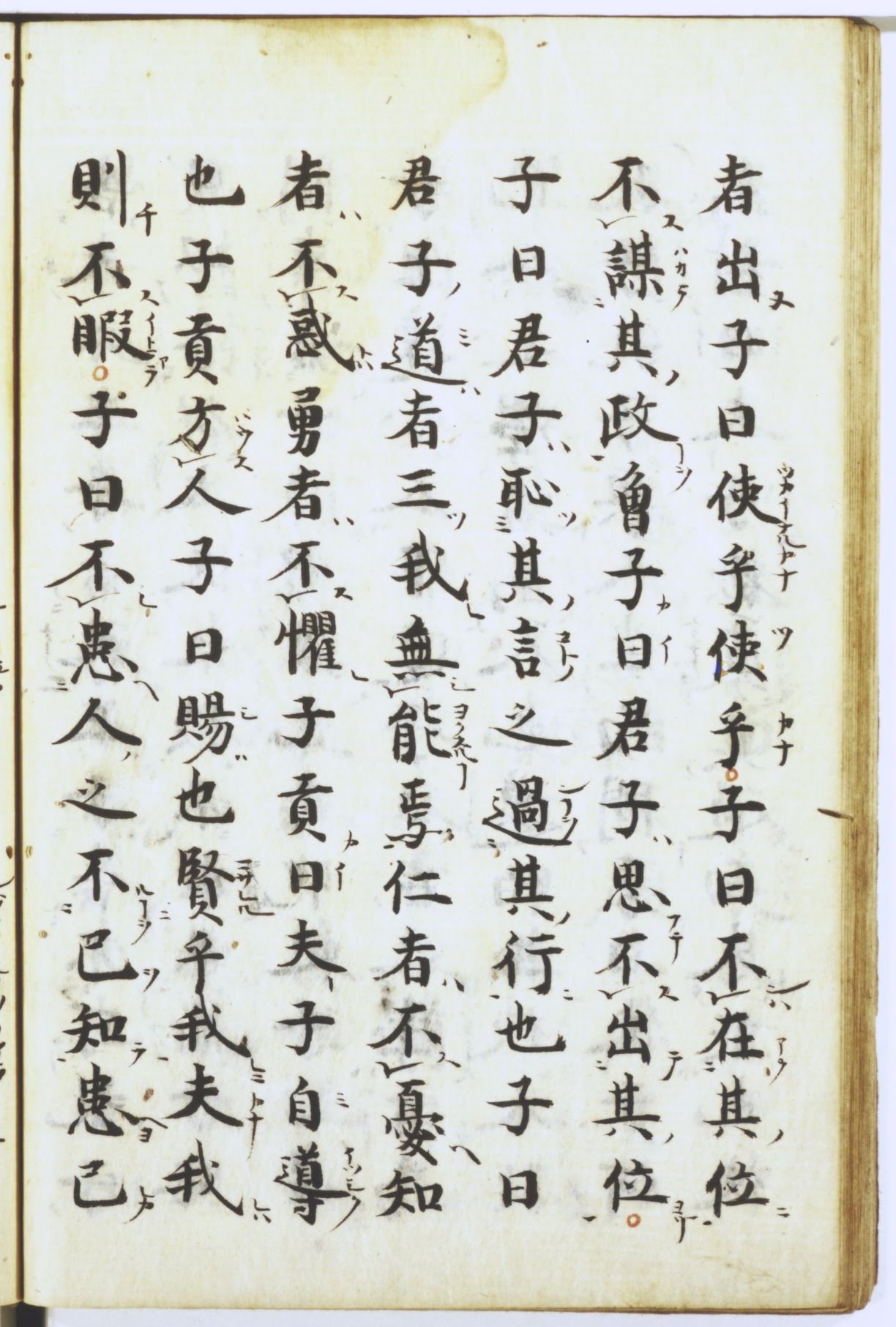
Kyoto University Library RB00007936, IIIF canvas 66, left-hand page: 7 written columns of up to 14 characters, main text only, with Japanese reading marks. Checked on the image: the first column of this book's text on this page begins ‹告夫二›, the last begins ‹為對曰›. 14.22.5 begins inside column 1 (the column opens ‹告夫二›), 5 characters down in the received text. Above it the page finishes 14.22.4, shown in the previous section. 14.26.2 runs on to canvas 67, right-hand page (first column ‹者出子›), where the section ends. The Chinese shown is the received text (Wikisource), not a transcription of this manuscript; Legge's English translates the received text.
22.5之三子吿,不可。孔子曰:「以吾從大夫之後,不敢不吿也!」
23子路問事君,子曰:「勿欺也,而犯之。」
24子曰:「君子上達,小人下達。」
25子曰:「古之學者爲己,今之學者爲人。」
26.1蘧伯玉使人於孔子,
26.2孔子與之坐而問焉。曰:「夫子何爲?」對曰:「夫子欲寡其過而未能也。」使者出。子曰:「使乎!使乎!」
22.5He went to the chiefs, and informed them, but they would not act. Confucius then said, 'Following in the rear of the great officers, I did not dare not to represent such a matter.'
23Tsze-lu asked how a ruler should be served. The Master said, 'Do not impose on him, and, moreover, withstand him to his face.'
24The Master said, 'The progress of the superior man is upwards; the progress of the mean man is downwards.'
25The Master said, 'In ancient times, men learned with a view to their own improvement. Now-a-days, men learn with a view to the approbation of others.'
26.1Chu Po-yu sent a messenger with friendly inquiries to Confucius.
26.2Confucius sat with him, and questioned him. 'What,' said he, 'is your master engaged in?' The messenger replied, 'My master is anxious to make his faults few, but he has not yet succeeded.' He then went out, and the Master said, 'A messenger indeed! A messenger indeed!'
Where on the image
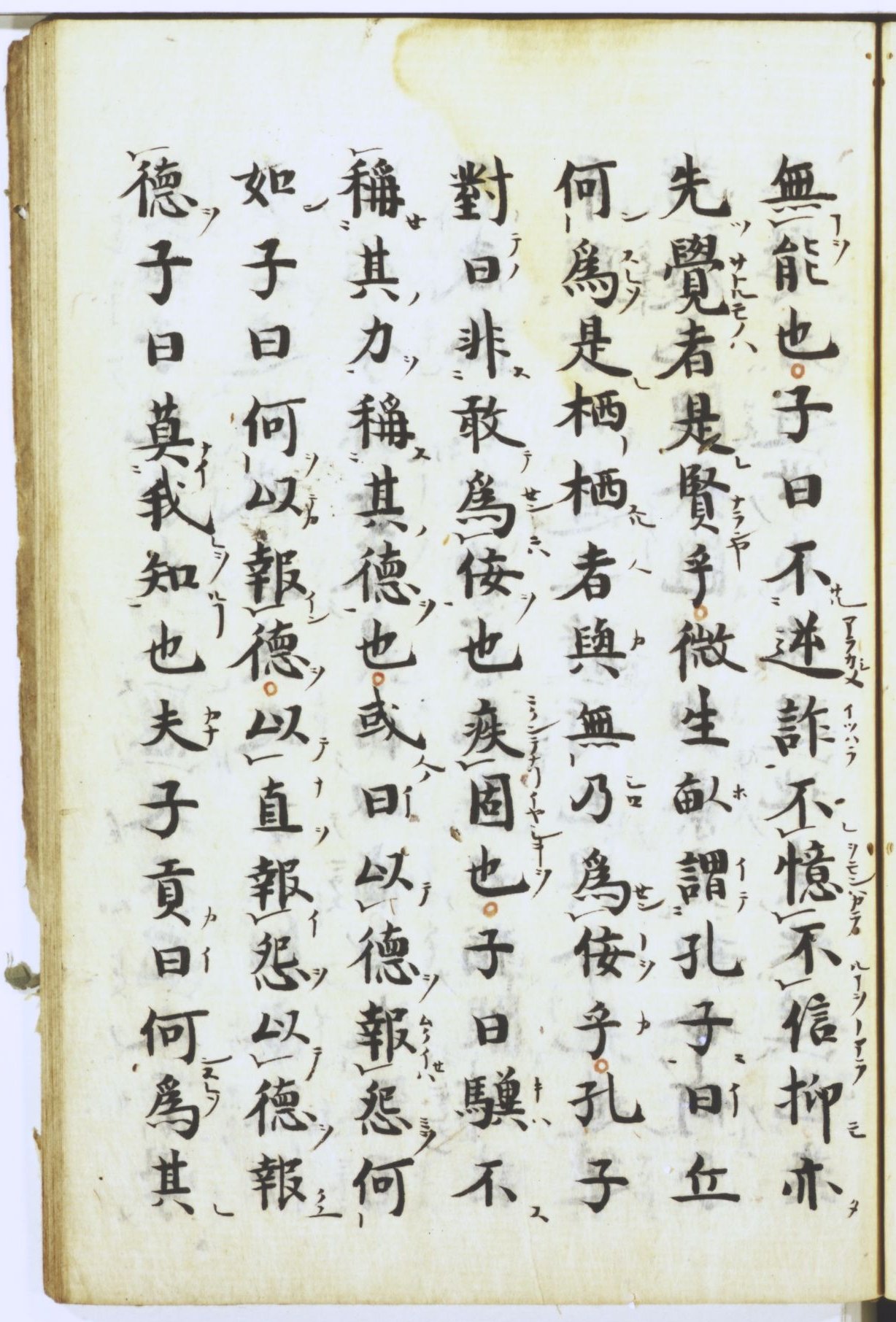
Kyoto University Library RB00007936, IIIF canvas 67, right-hand page: 7 written columns of up to 14 characters, main text only, with Japanese reading marks. Checked on the image: the first column of this book's text on this page begins ‹者出子›, the last begins ‹則不暇›. 14.27 begins inside column 1 (the column opens ‹者出子›), 8 characters down in the received text. Above it the page finishes 14.26.2, shown in the previous section. 14.32 runs on to canvas 67, left-hand page (first column ‹無能也›), where the section ends. Column openings on these pages that differ from the received text: ‹無能也› where the received text has ‹不能也›. The Chinese shown is the received text (Wikisource), not a transcription of this manuscript; Legge's English translates the received text.
27子曰:「不在其位,不謀其政。」
28曾子曰:「君子思不出其位。」
29子曰:「君子恥其言而過其行。」
30.1子曰:「君子道者三,我無能焉:仁者不憂,知者不惑,勇者不懼。」
30.2子貢曰:「夫子自道也!」
31子貢方人。子曰:「賜也,賢乎哉?夫我則不暇!」
32子曰:「不患人之不己知,患其不能也。」
27The Master said, 'He who is not in any particular office, has nothing to do with plans for the administration of its duties.'
28The philosopher Tsang said, 'The superior man, in his thoughts, does not go out of his place.'
29The Master said, 'The superior man is modest in his speech, but exceeds in his actions.'
30.1The Master said, 'The way of the superior man is threefold, but I am not equal to it. Virtuous, he is free from anxieties; wise, he is free from perplexities; bold, he is free from fear.
30.2Tsze-kung said, 'Master, that is what you yourself say.'
31Tsze-kung was in the habit of comparing men together. The Master said, 'Tsze must have reached a high pitch of excellence! Now, I have not leisure for this.'
32The Master said, 'I will not be concerned at men's not knowing me; I will be concerned at my own want of ability.'
Where on the image
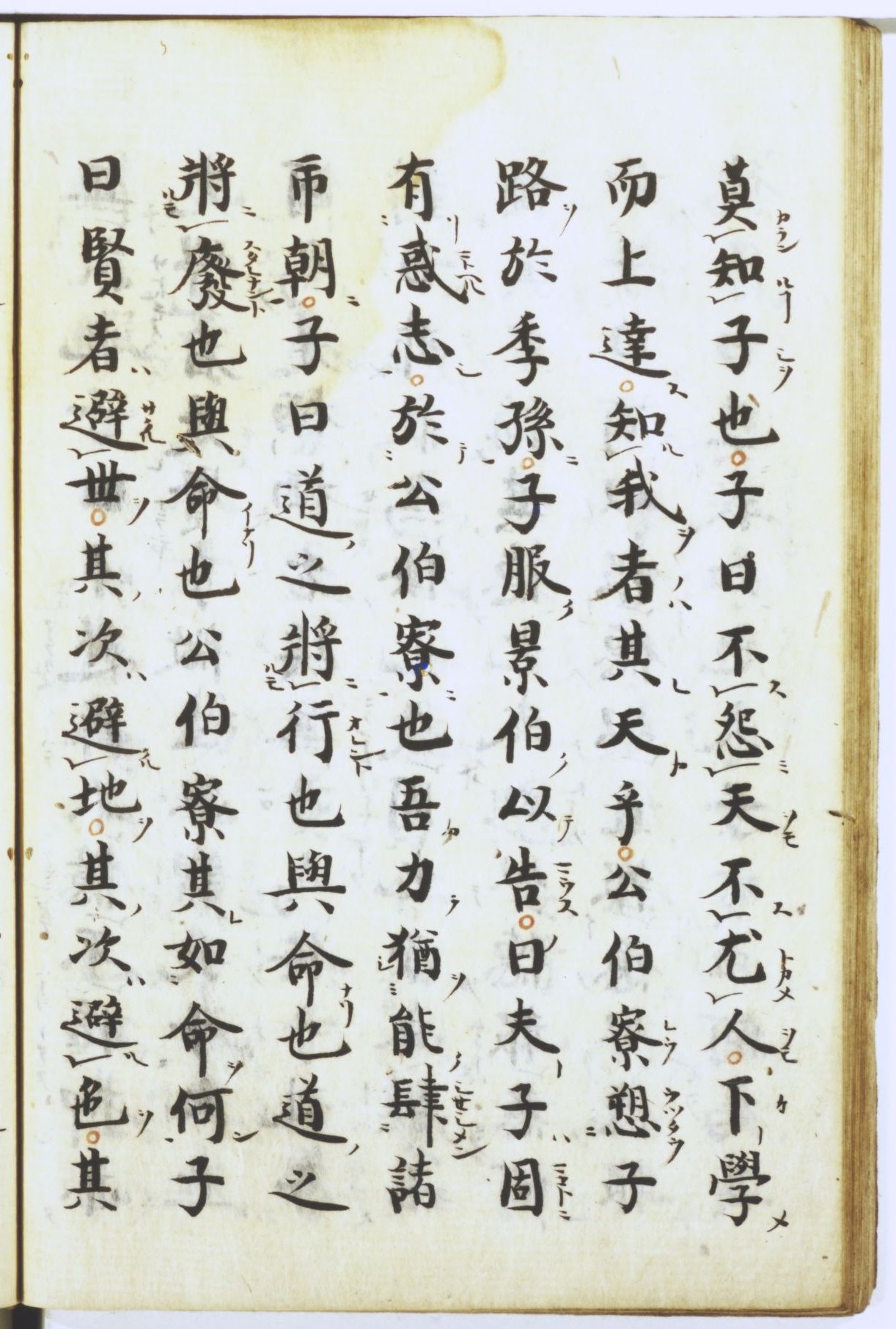
Kyoto University Library RB00007936, IIIF canvas 67, left-hand page: 7 written columns of up to 14 characters, main text only, with Japanese reading marks. Checked on the image: the first column of this book's text on this page begins ‹無能也›, the last begins ‹德子曰›. 14.33 begins inside column 1 (the column opens ‹無能也›), 3 characters down in the received text. Above it the page finishes 14.32, shown in the previous section. 14.37.2 runs on to canvas 68, right-hand page (first column ‹莫知子›), where the section ends. Column openings on these pages that differ from the received text: ‹對曰非› where the received text has ‹曰非敢›. The Chinese shown is the received text (Wikisource), not a transcription of this manuscript; Legge's English translates the received text.
33子曰:「不逆詐,不億不信,抑亦先覺者,是賢乎!」
34.1微生畝謂孔子曰:「丘,何爲是栖栖者與?無乃爲佞乎?」
34.2孔子曰:「非敢爲佞也,疾固也。」
35子曰:「驥不稱其力,稱其德也。」
36.1或曰:「以德報怨,何如?」
36.2子曰:「何以報德?
36.3以直報怨,以德報德。」
37.1子曰:「莫我知也夫!」
37.2子貢曰:「何爲其莫知子也?」子曰:「不怨天,不尤人,下學而上達,知我者,其天乎!」
33The Master said, 'He who does not anticipate attempts to deceive him, nor think beforehand of his not being believed, and yet apprehends these things readily (when they occur);-- is he not a man of superior worth?'
34.1Wei-shang Mau said to Confucius, 'Ch'iu, how is it that you keep roosting about? Is it not that you are an insinuating talker?'
34.2Confucius said, 'I do not dare to play the part of such a talker, but I hate obstinacy.'
35The Master said, 'A horse is called a ch'i, not because of its strength, but because of its other good qualities.'
36.1Some one said, 'What do you say concerning the principle that injury should be recompensed with kindness?'
36.2The Master said, 'With what then will you recompense kindness?
36.3'Recompense injury with justice, and recompense kindness with kindness.'
37.1The Master said, 'Alas! there is no one that knows me.'
37.2Tsze-kung said, 'What do you mean by thus saying-- that no one knows you?' The Master replied, 'I do not murmur against Heaven. I do not grumble against men. My studies lie low, and my penetration rises high. But there is Heaven;-- that knows me!'
Where on the image
Kyoto University Library RB00007936, IIIF canvas 68, right-hand page: 7 written columns of up to 14 characters, main text only, with Japanese reading marks. Checked on the image: the first column of this book's text on this page begins ‹莫知子›, the last begins ‹曰賢者›. 14.38.1 begins inside column 2 (the column opens ‹而上達›), 9 characters down in the received text. Above it the page finishes 14.37.2, shown in the previous section. 14.39.4 runs on to canvas 68, left-hand page (first column ‹次避言›), where the section ends. Column openings on these pages that differ from the received text: ‹次避言› where the received text has ‹次辟言›. The Chinese shown is the received text (Wikisource), not a transcription of this manuscript; Legge's English translates the received text.
38.1公伯寮愬子路於季孫,子服景伯以吿,曰:「夫子固有惑志於公伯寮,吾力猶能肆諸市朝。」
38.2子曰:「道之將行也與,命也;道之將廢也與,命也。公伯寮其如命何?」
39.1子曰:「賢者辟世,
39.2其次辟地,
39.3其次辟色,
39.4其次辟言。」
38.1The Kung-po Liao, having slandered Tsze-lu to Chi-sun, Tsze-fu Ching-po informed Confucius of it, saying, 'Our master is certainly being led astray by the Kung-po Liao, but I have still power enough left to cut Liao off, and expose his corpse in the market and in the court.'
38.2The Master said, 'If my principles are to advance, it is so ordered. If they are to fall to the ground, it is so ordered. What can the Kung-po Liao do where such ordering is concerned?'
39.1The Master said, 'Some men of worth retire from the world.
39.2Some retire from particular states.
39.3Some retire because of disrespectful looks.
39.4Some retire because of contradictory language.'
Where on the image
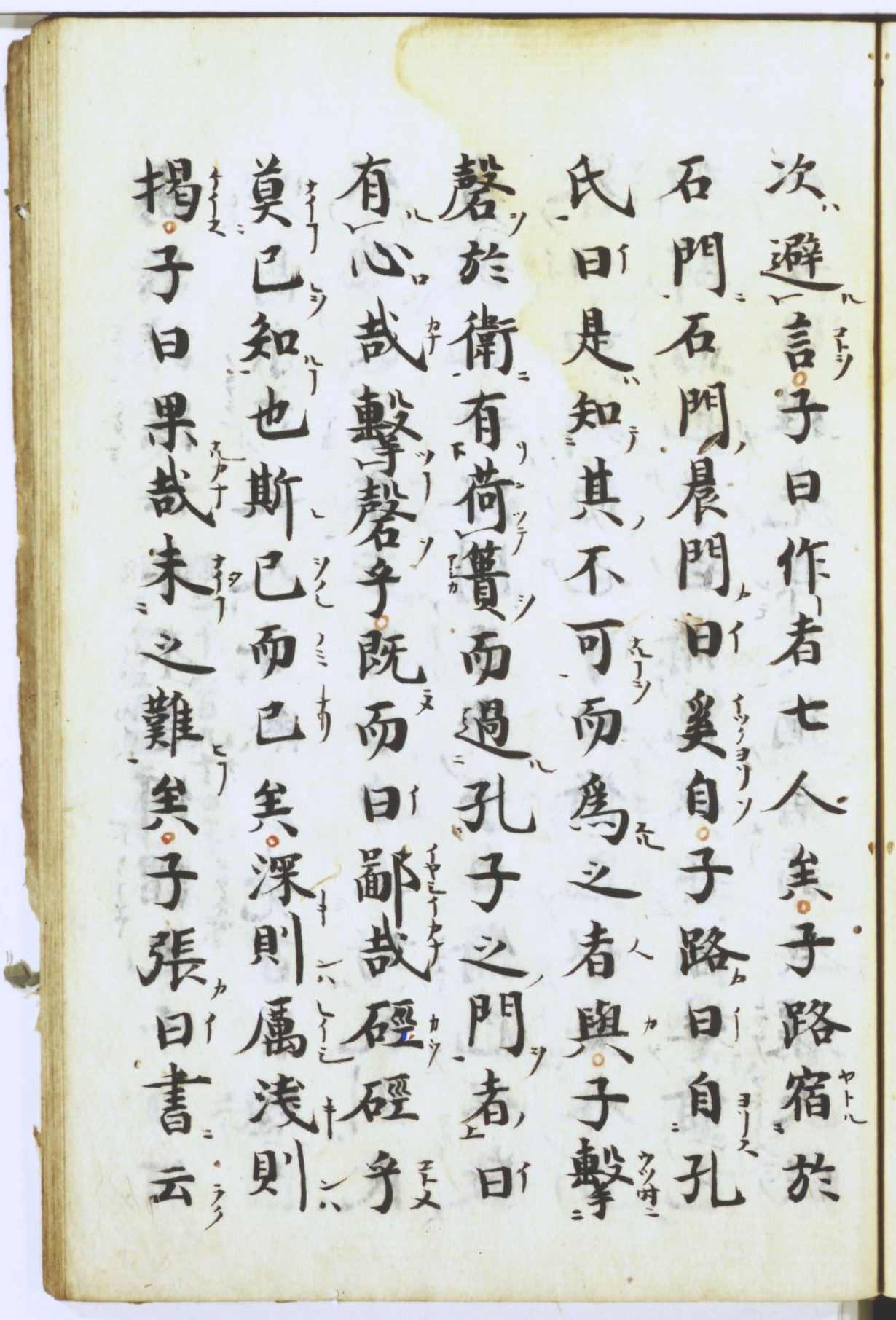
Kyoto University Library RB00007936, IIIF canvas 68, left-hand page: 7 written columns of up to 14 characters, main text only, with Japanese reading marks. Checked on the image: the first column of this book's text on this page begins ‹次避言›, the last begins ‹揭子曰›. 14.40 begins inside column 1 (the column opens ‹次避言›), 3 characters down in the received text. Above it the page finishes 14.39.4, shown in the previous section. 14.43.1 runs on to canvas 69, right-hand page (first column ‹高宗諒›), where the section ends. Column openings on these pages that differ from the received text: ‹石門石› where the received text has ‹石門晨›. The Chinese shown is the received text (Wikisource), not a transcription of this manuscript; Legge's English translates the received text.
40子曰:「作者七人矣。」
41子路宿於石門。晨門曰:「奚自?」子路曰:「自孔氏。」曰:「是知其不可而爲之者與?」
42.1子擊磬於衞。有荷蕢而過孔氏之門者,曰:「有心哉!擊磬乎!」
42.2既而曰:「鄙哉,硜硜乎!莫己知也,斯己而已矣!『深則厲,淺則揭。』」
42.3子曰:「果哉!末之難矣!」
43.1子張曰:「書云:『高宗諒陰,三年不言。』何謂也?」
40The Master said, 'Those who have done this are seven men.'
41Tsze-lu happening to pass the night in Shih-man, the gatekeeper said to him, 'Whom do you come from?' Tsze-lu said, 'From Mr. K'ung.' 'It is he,-- is it not?'-- said the other, 'who knows the impracticable nature of the times and yet will be doing in them.'
42.1The Master was playing, one day, on a musical stone in Wei, when a man, carrying a straw basket, passed the door of the house where Confucius was, and said, 'His heart is full who so beats the musical stone.'
42.2A little while after, he added, 'How contemptible is the one-ideaed obstinacy those sounds display! When one is taken no notice of, he has simply at once to give over his wish for public employment. "Deep water must be crossed with the clothes on; shallow water may be crossed with the clothes held up."'
42.3The Master said, 'How determined is he in his purpose! But this is not difficult!'
43.1Tsze-chang said, 'What is meant when the Shu says that Kao-tsung, while observing the usual imperial mourning, was for three years without speaking?'
Where on the image
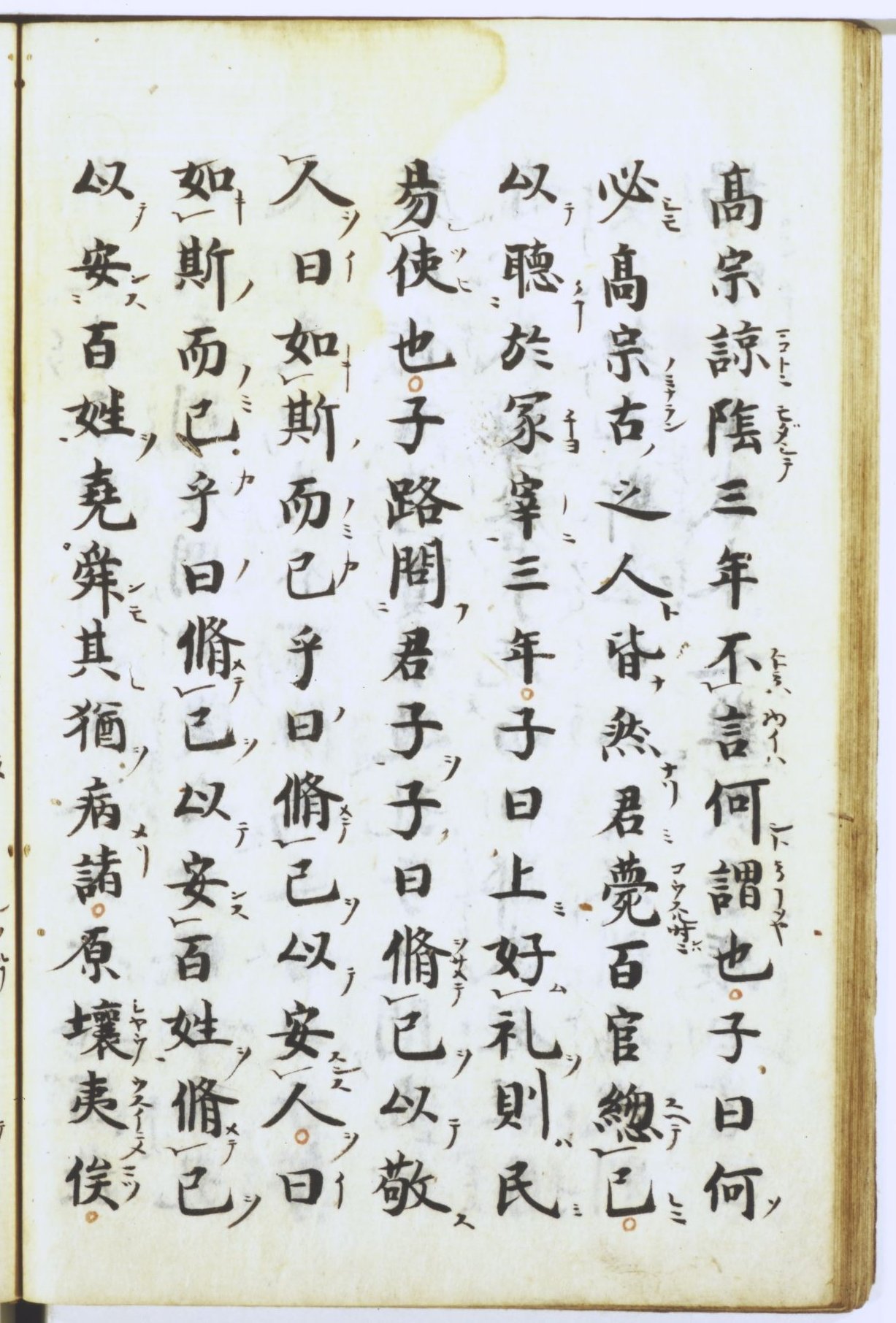
Kyoto University Library RB00007936, IIIF canvas 69, right-hand page: 7 written columns of up to 14 characters, main text only, with Japanese reading marks. Checked on the image: the first column of this book's text on this page begins ‹高宗諒›, the last begins ‹以安百›. 14.43.2 begins inside column 1 (the column opens ‹高宗諒›), 11 characters down in the received text. Above it the page finishes 14.43.1, shown in the previous section. 14.46 runs on to canvas 69, left-hand page (first column ‹子曰幼›), where the section ends. Column openings on these pages that differ from the received text: ‹人曰如› where the received text has ‹曰如斯›. The Chinese shown is the received text (Wikisource), not a transcription of this manuscript; Legge's English translates the received text.
43.2子曰:「何必高宗,古之人皆然。君薨,百官總己以聽於冢宰,三年。」
44子曰:「上好禮,則民易使也。」
45子路問君子。子曰:「脩己以敬。」曰:「如斯而已乎?」曰:「脩己以安人。」曰:「如斯而已乎?」曰:「脩己以安百姓。脩己以安百姓,堯舜其猶病諸!」
46原壤夷俟。子曰:「幼而不孫弟,長而無述焉,老而不死,是爲賊。」以杖叩其脛。
43.2The Master said, 'Why must Kao-tsung be referred to as an example of this? The ancients all did so. When the sovereign died, the officers all attended to their several duties, taking instructions from the prime minister for three years.'
44The Master said, 'When rulers love to observe the rules of propriety, the people respond readily to the calls on them for service.'
45Tsze-lu asked what constituted the superior man. The Master said, 'The cultivation of himself in reverential carefulness.' 'And is this all?' said Tsze-lu. 'He cultivates himself so as to give rest to others,' was the reply. 'And is this all?' again asked Tsze-lu. The Master said, 'He cultivates himself so as to give rest to all the people. He cultivates himself so as to give rest to all the people:-- even Yao and Shun were still solicitous about this.'
46Yuan Zang was squatting on his heels, and so waited the approach of the Master, who said to him, 'In youth not humble as befits a junior; in manhood, doing nothing worthy of being handed down; and living on to old age:-- this is to be a pest.' With this he hit him on the shank with his staff.
Where on the image
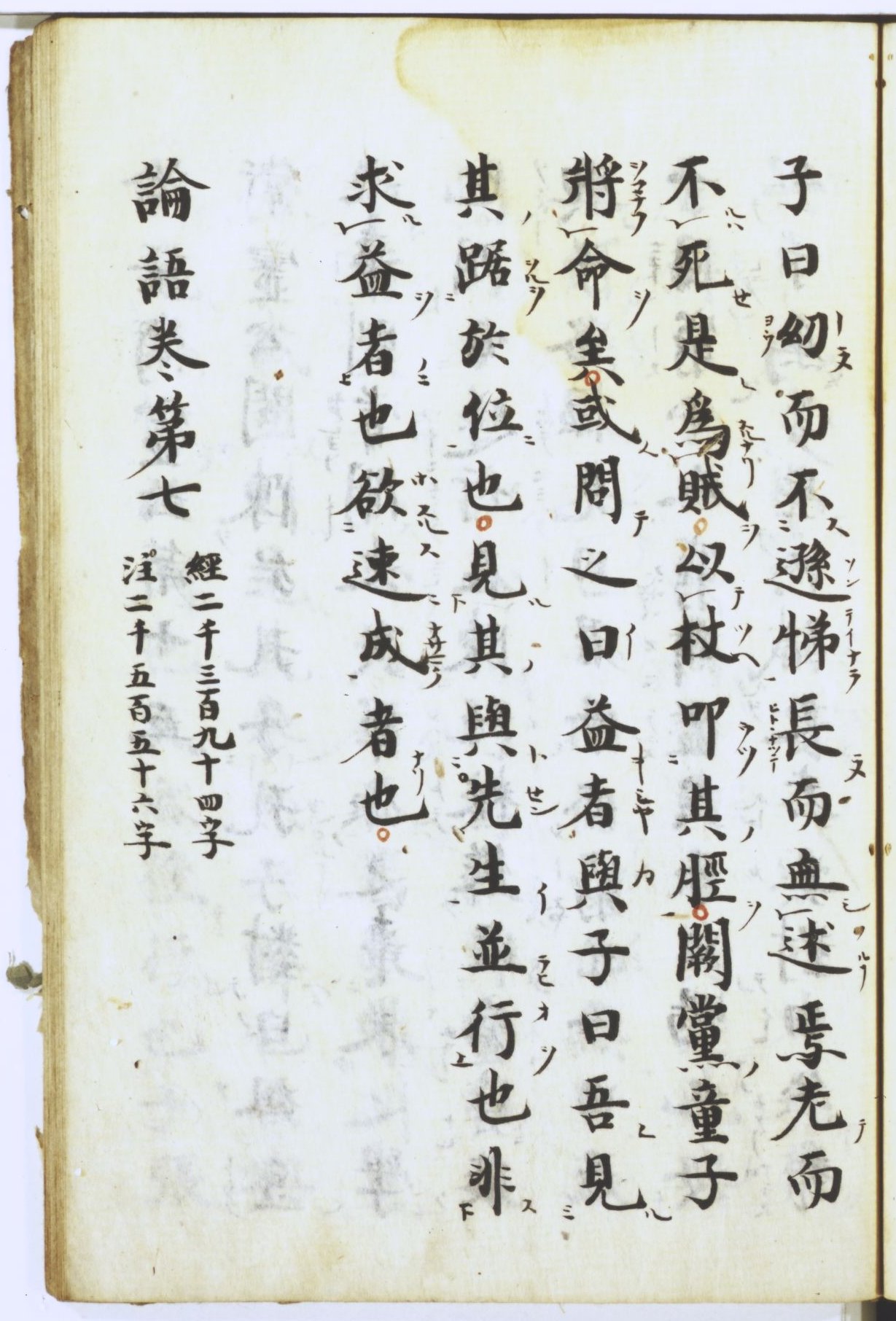
Kyoto University Library RB00007936, IIIF canvas 69, left-hand page: 6 written columns of up to 14 characters, main text only, with Japanese reading marks. Checked on the image: the first column of this book's text on this page begins ‹子曰幼›, the last begins ‹求益者›. Column 7 carries the title 論語卷第七. 14.47.1 begins inside column 2 (the column opens ‹不死是›), 10 characters down in the received text. Above it the page finishes 14.46, shown in the previous section. The section ends on this page. Column openings on these pages that differ from the received text: ‹將命矣› where the received text has ‹將命或›. The Chinese shown is the received text (Wikisource), not a transcription of this manuscript; Legge's English translates the received text.
47.1闕黨童子將命。或問之曰:「益者與?」
47.2子曰:「吾見其居於位也,見其與先生並行也,非求益者也,欲速成者也。」
47.1A youth of the village of Ch'ueh was employed by Confucius to carry the messages between him and his visitors. Some one asked about him, saying, 'I suppose he has made great progress.'
47.2The Master said, 'I observe that he is fond of occupying the seat of a full-grown man; I observe that he walks shoulder to shoulder with his elders. He is not one who is seeking to make progress in learning. He wishes quickly to become a man.'
Notes
- English: James Legge, Confucian Analects, The Chinese Classics vol. 1. Legge's chapter and paragraph numbers are kept as superscripts (chapter.paragraph).
- Legge translated the received text. Where this manuscript's wording differs, his English follows the received text shown here.
Cite
Sources
- Source: Kyoto University Library RB00007936 (Analects manuscript attributed to Kiyohara Yoshieda, c. 1300) + Wikisource received text + James Legge's English (Project Gutenberg) (holding institution)
- Critical edition: Received text (Wikisource) in Legge's chapter and paragraph division
← previous · → next · v cycle view · l back to library