Analects, Book 15: Wei Ling Gong 衞靈公 (Kamakura-period manuscript)
Introduction
Book 15 of the Analects (論語 Lunyu), titled 衞靈公 (Wei Ling Gong) after its opening words, 41 chapters in Legge's division. It is shown on a manuscript of the Analects in the Kiyohara family collection (Seike bunko) of Kyoto University Library, two volumes in regular script, seven columns of fourteen characters to the page, main text only, with red and black Japanese reading marks. A colophon by Kiyohara Edakata dated 1550 names the copyist as his ancestor Kiyohara Yoshieda (1253-1331), which places the copy around 1300, in the late Kamakura period; the attribution is traditional. The Kiyohara were hereditary readers of the Confucian classics at the Japanese court, and their text descends from the edition of the Analects with the collected commentary of He Yan (3rd century CE): after each pair of books the scribe copied the character counts of the classic and of the commentary, although only the classic is written out. The manuscript is an Important Cultural Property of Japan.
In this copy Book 15 runs from canvas 70, right-hand page to canvas 74, left-hand page (volume 2). Each section gathers the paragraphs that begin on one page, numbered by chapter and paragraph as in Legge, and links to that page and to any page the last paragraph runs onto. The page boundaries were found by reading the first characters of every column on the photographs. The Chinese shown is the received text, from Wikisource. This manuscript differs from it in places, most often by an added or missing particle (也, 矣, 焉) or a variant character form; the differences seen at column openings are listed in the scan notes. The English is James Legge's translation of the received text.
How was this verified? (Provenance)
Where on the image
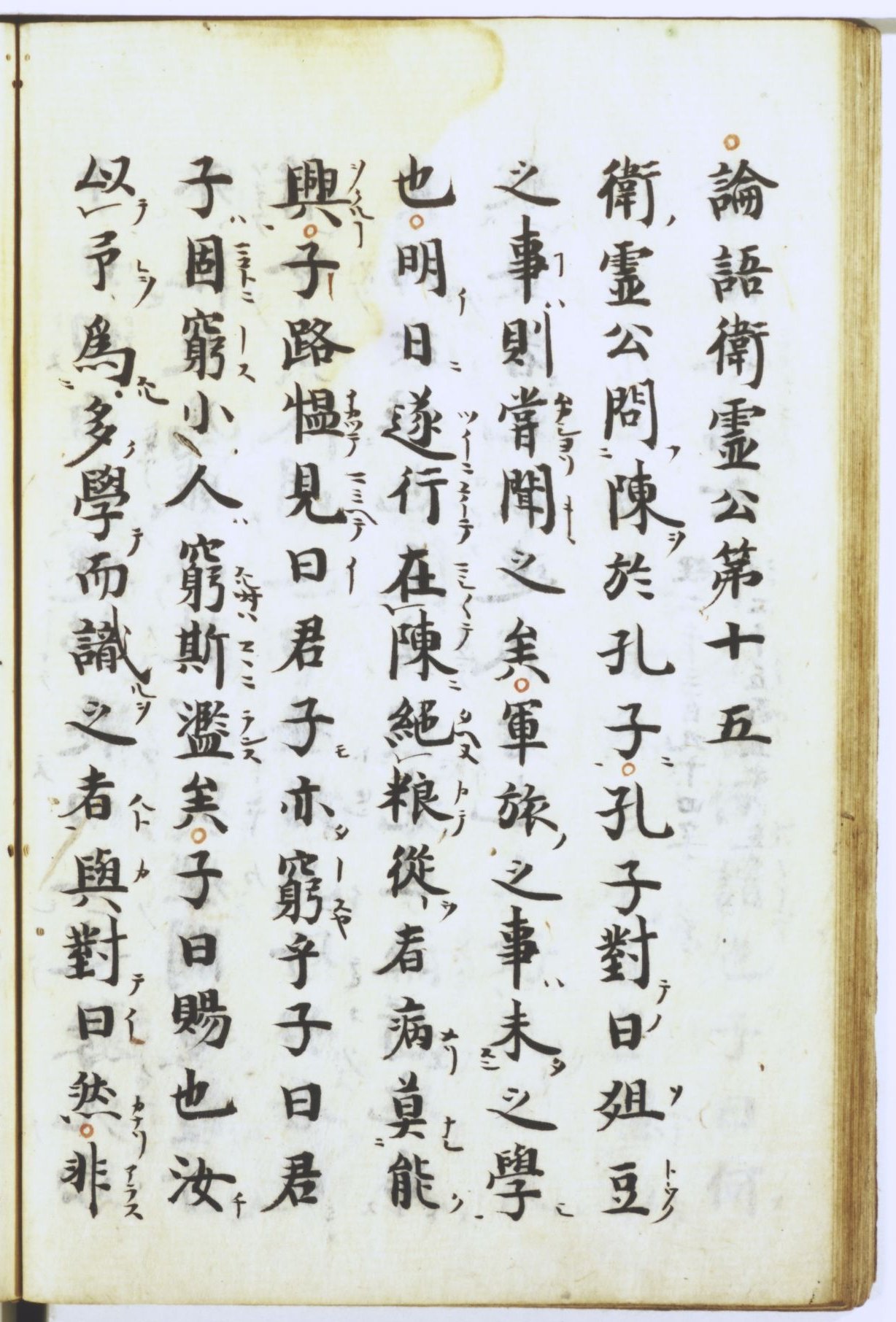
Kyoto University Library RB00007936, IIIF canvas 70, right-hand page: 7 written columns of up to 14 characters, main text only, with Japanese reading marks. Checked on the image: the first column of this book's text on this page begins ‹衛靈公›, the last begins ‹以予為›. Column 1 carries the title 論語衛靈公第十五. 15.1.1 opens column 2. 15.2.2 runs on to canvas 70, left-hand page (first column ‹與曰非›), where the section ends. The Chinese shown is the received text (Wikisource), not a transcription of this manuscript; Legge's English translates the received text.
1.1衞靈公問陳於孔子。孔子對曰:「俎豆之事,則嘗聞之矣;軍旅之事,未之學也。」明日遂行。
1.2在陳絕糧。從者病,莫能興。
1.3子路慍見曰:「君子亦有窮乎?」子曰:「君子固窮,小人窮斯濫矣。」
2.1子曰:「賜也,女以予爲多學而識之者與?」
2.2對曰:「然,非與?」
1.1The Duke Ling of Wei asked Confucius about tactics. Confucius replied, 'I have heard all about sacrificial vessels, but I have not learned military matters.' On this, he took his departure the next day.
1.2When he was in Chan, their provisions were exhausted, and his followers became so ill that they were unable to rise.
1.3Tsze-lu, with evident dissatisfaction, said, 'Has the superior man likewise to endure in this way?' The Master said, 'The superior man may indeed have to endure want, but the mean man, when he is in want, gives way to unbridled license.'
2.1The Master said, 'Ts'ze, you think, I suppose, that I am one who learns many things and keeps them in memory?'
2.2Tsze-kung replied, 'Yes,-- but perhaps it is not so?'
Where on the image
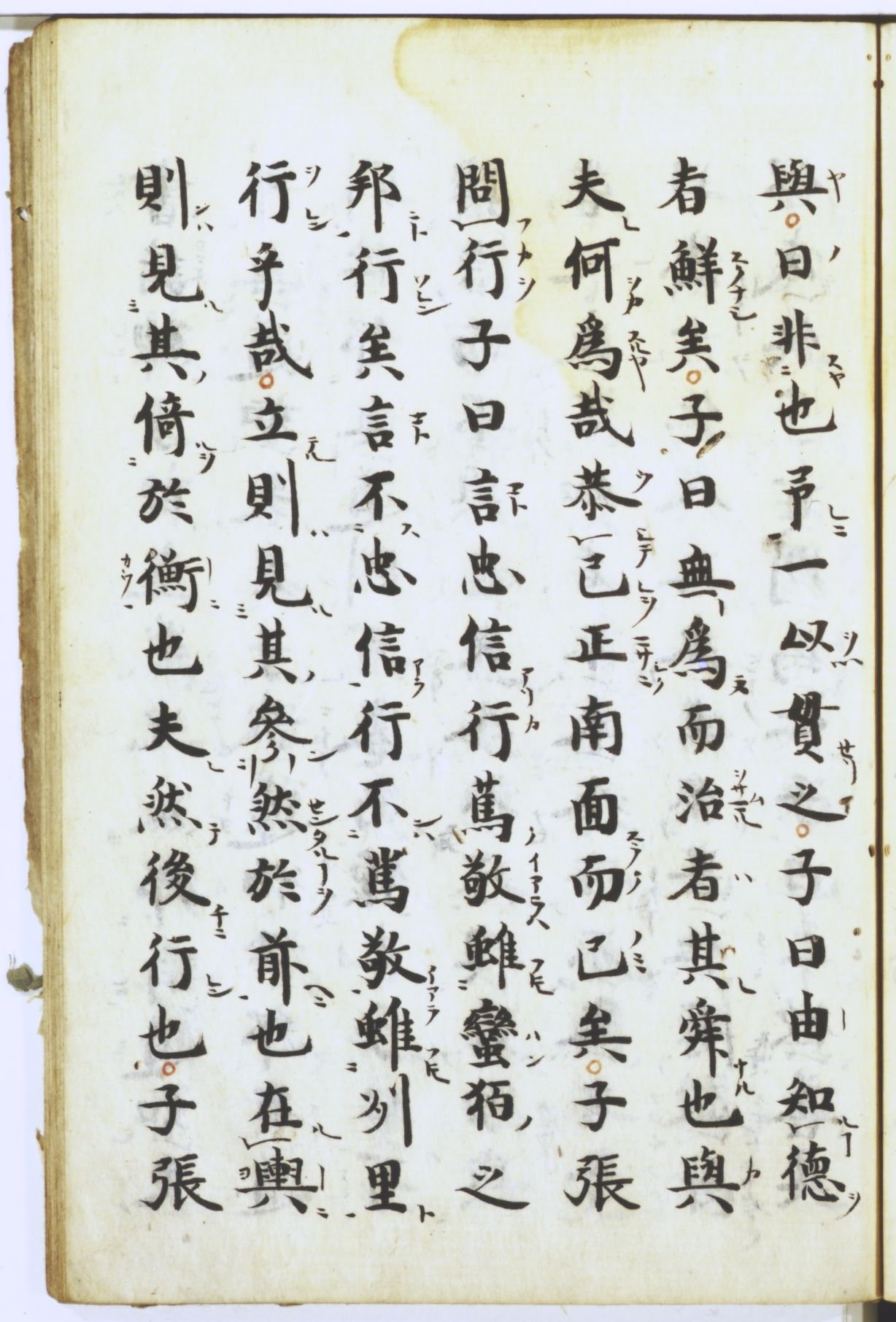
Kyoto University Library RB00007936, IIIF canvas 70, left-hand page: 7 written columns of up to 14 characters, main text only, with Japanese reading marks. Checked on the image: the first column of this book's text on this page begins ‹與曰非›, the last begins ‹則見其›. 15.2.3 begins inside column 1 (the column opens ‹與曰非›), 1 characters down in the received text. Above it the page finishes 15.2.2, shown in the previous section. 15.5.4 runs on to canvas 71, right-hand page (first column ‹書諸紳›), where the section ends. The Chinese shown is the received text (Wikisource), not a transcription of this manuscript; Legge's English translates the received text.
2.3曰:「非也,予一以貫之。」
3子曰:「由,知德者鮮矣!」
4子曰:「無爲而治者,其舜也與!夫何爲哉?恭己正南面而已矣。」
5.1子張問行。
5.2子曰:「言忠信,行篤敬,雖蠻貊之邦行矣。言不忠信,行不篤敬,雖州里行乎哉?
5.3立,則見其參於前也;在輿,則見其倚於衡也。夫然後行。」
5.4子張書諸紳。
2.3'No,' was the answer; 'I seek a unity all-pervading.'
3The Master said, 'Yu, those who know virtue are few.'
4The Master said, 'May not Shun be instanced as having governed efficiently without exertion? What did he do? He did nothing but gravely and reverently occupy his royal seat.'
5.1Tsze-chang asked how a man should conduct himself, so as to be everywhere appreciated.
5.2The Master said, 'Let his words be sincere and truthful, and his actions honourable and careful;-- such conduct may be practised among the rude tribes of the South or the North. If his words be not sincere and truthful and his actions not honourable and careful, will he, with such conduct, be appreciated, even in his neighborhood?
5.3'When he is standing, let him see those two things, as it were, fronting him. When he is in a carriage, let him see them attached to the yoke. Then may he subsequently carry them into practice.'
5.4Tsze-chang wrote these counsels on the end of his sash.
Where on the image
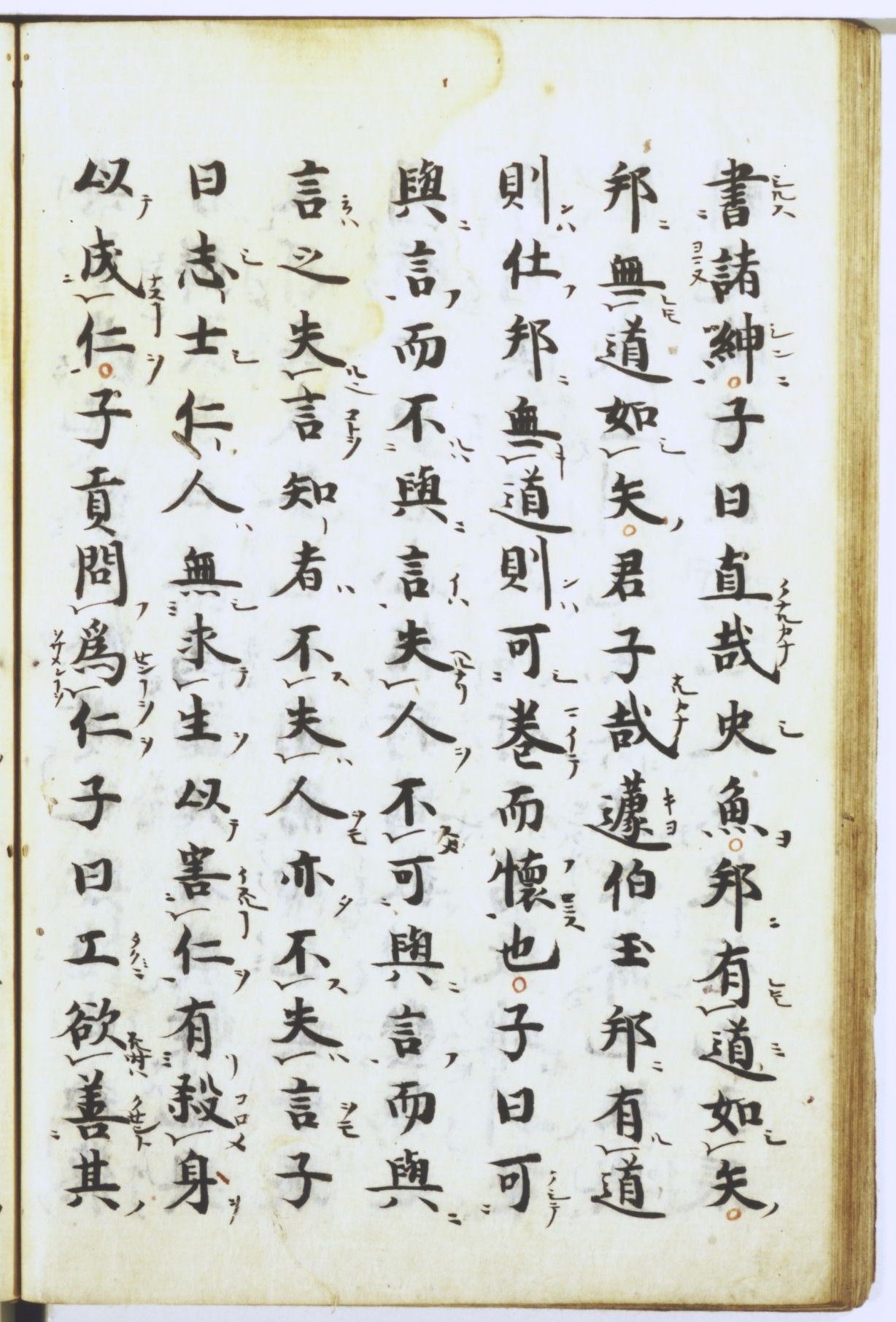
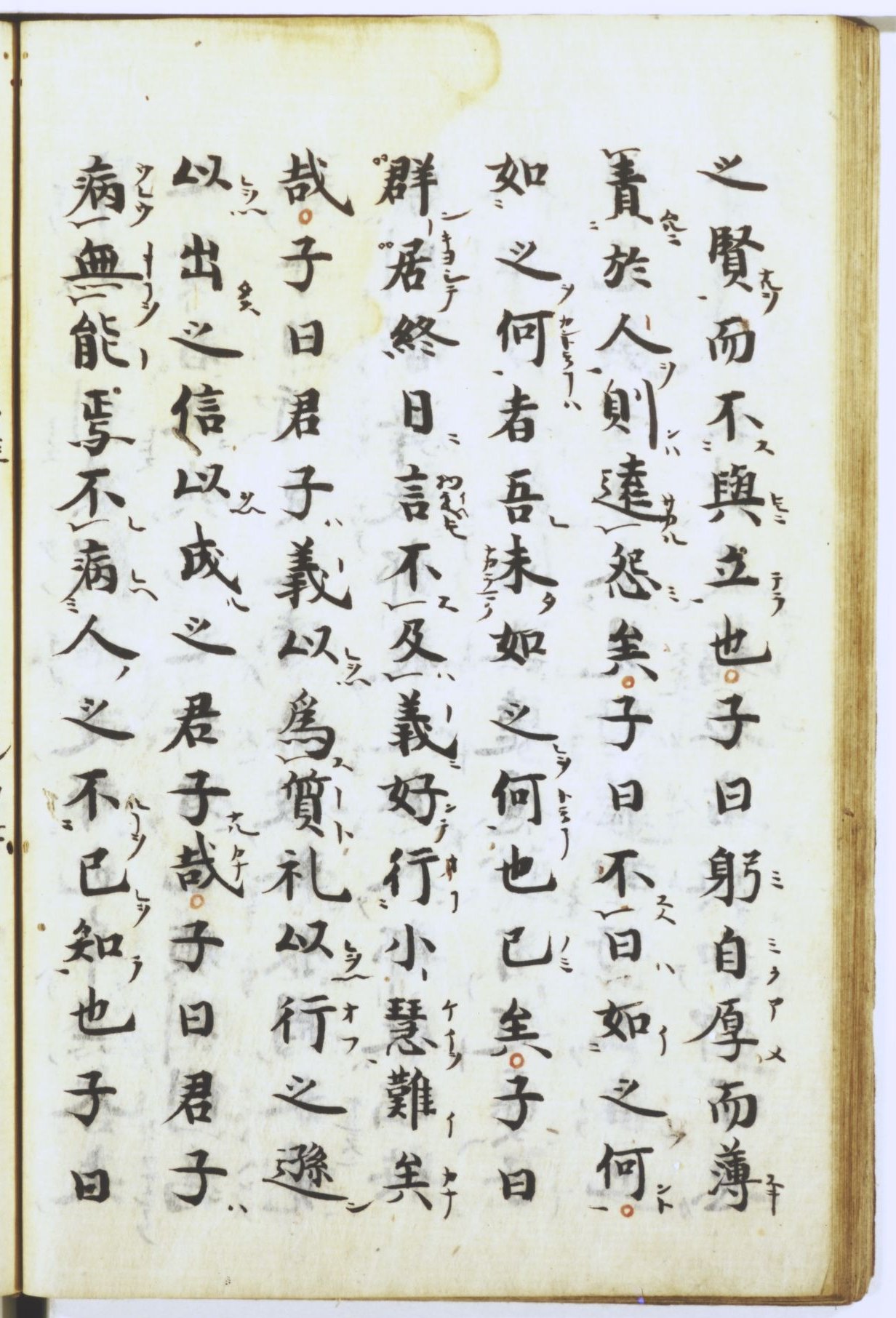
Kyoto University Library RB00007936, IIIF canvas 71, right-hand page: 7 written columns of up to 14 characters, main text only, with Japanese reading marks. Checked on the image: the first column of this book's text on this page begins ‹書諸紳›, the last begins ‹以成仁›. 15.6.1 begins inside column 1 (the column opens ‹書諸紳›), 3 characters down in the received text. Above it the page finishes 15.5.4, shown in the previous section. 15.9 runs on to canvas 71, left-hand page (first column ‹事必先›), where the section ends. Column openings on these pages that differ from the received text: ‹言之失› where the received text has ‹言而與›. The Chinese shown is the received text (Wikisource), not a transcription of this manuscript; Legge's English translates the received text.
6.1子曰:「直哉史魚!邦有道,如矢;邦無道,如矢。
6.2君子哉蘧伯玉!邦有道,則仕;邦無道,則可卷而懷之。」
7子曰:「可與言,而不與之言,失人;不可與言,而與之言,失言。知者不失人,亦不失言。」
8子曰:「志士仁人,無求生以害仁,有殺身以成仁。」
9子貢問爲仁。子曰:「工欲善其事,必先利其器。居是邦也,事其大夫之賢者,友其士之仁者。」
6.1The Master said, 'Truly straightforward was the historiographer Yu. When good government prevailed in his State, he was like an arrow. When bad government prevailed, he was like an arrow.
6.2A superior man indeed is Chu Po-yu! When good government prevails in his state, he is to be found in office. When bad government prevails, he can roll his principles up, and keep them in his breast.'
7The Master said, 'When a man may be spoken with, not to speak to him is to err in reference to the man. When a man may not be spoken with, to speak to him is to err in reference to our words. The wise err neither in regard to their man nor to their words.'
8The Master said, 'The determined scholar and the man of virtue will not seek to live at the expense of injuring their virtue. They will even sacrifice their lives to preserve their virtue complete.'
9Tsze-kung asked about the practice of virtue. The Master said, 'The mechanic, who wishes to do his work well, must first sharpen his tools. When you are living in any state, take service with the most worthy among its great officers, and make friends of the most virtuous among its scholars.'
Where on the image
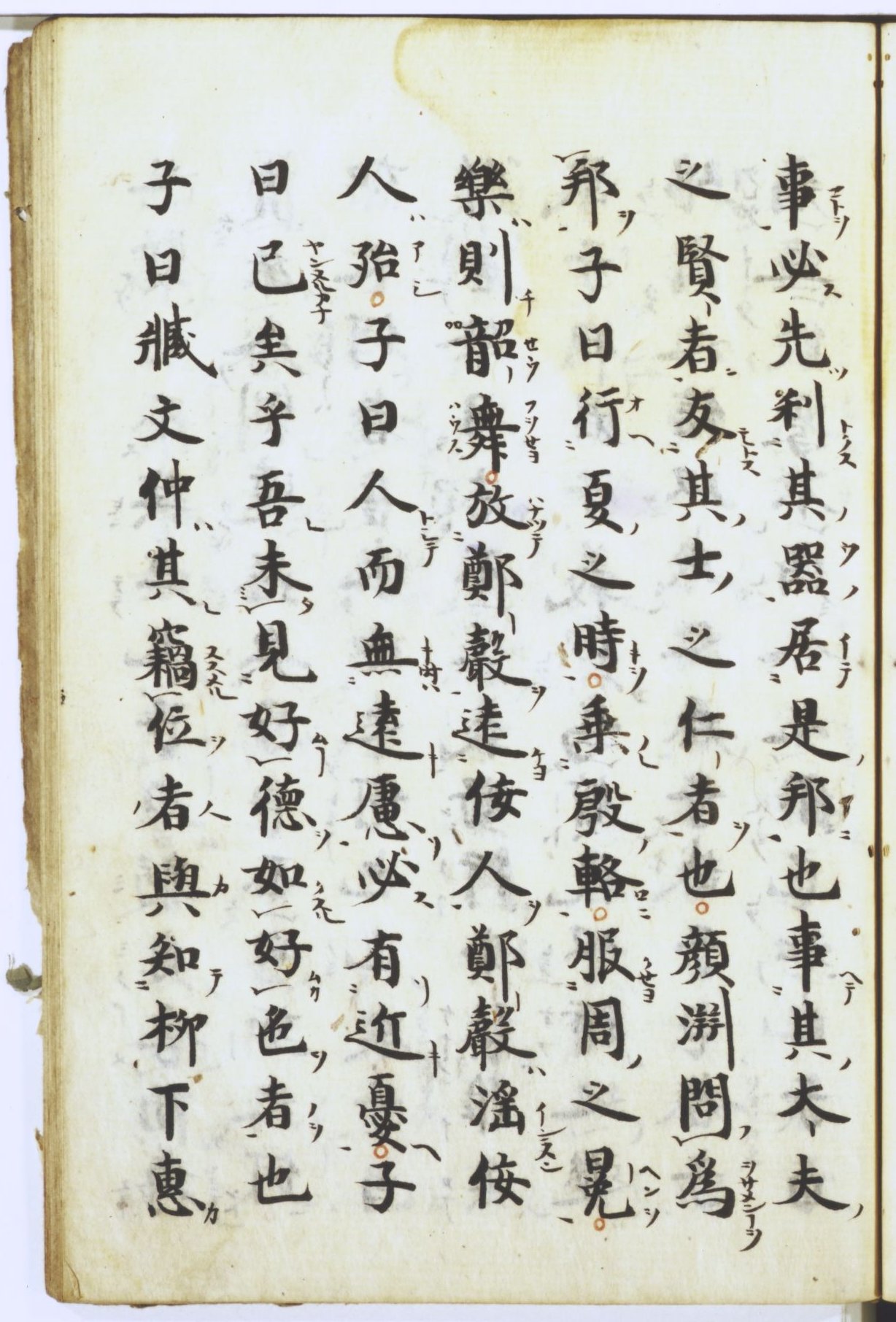
Kyoto University Library RB00007936, IIIF canvas 71, left-hand page: 7 written columns of up to 14 characters, main text only, with Japanese reading marks. Checked on the image: the first column of this book's text on this page begins ‹事必先›, the last begins ‹子曰臧›. 15.10.1 begins inside column 2 (the column opens ‹之賢者›), 9 characters down in the received text. Above it the page finishes 15.9, shown in the previous section. 15.13 runs on to canvas 72, right-hand page (first column ‹之賢而›), where the section ends. The Chinese shown is the received text (Wikisource), not a transcription of this manuscript; Legge's English translates the received text.
10.1顏淵問爲邦。
10.2子曰:「行夏之時,
10.3乘殷之輅,
10.4服周之冕,
10.5樂則韶舞。
10.6放鄭聲,遠佞人。鄭聲淫,佞人殆。」
11子曰:「人無遠慮,必有近憂。」
12子曰:「已矣乎!吾未見好德如好色者也!」
13子曰:「臧文仲,其竊位者與!知柳下惠之賢,而不與立也。」
10.1Yen Yuan asked how the government of a country should be administered.
10.2The Master said, 'Follow the seasons of Hsia.
10.3'Ride in the state carriage of Yin.
10.4'Wear the ceremonial cap of Chau.
10.5'Let the music be the Shao with its pantomimes.
10.6Banish the songs of Chang, and keep far from specious talkers. The songs of Chang are licentious; specious talkers are dangerous.'
11The Master said, 'If a man take no thought about what is distant, he will find sorrow near at hand.'
12The Master said, 'It is all over! I have not seen one who loves virtue as he loves beauty.'
13The Master said, 'Was not Tsang Wan like one who had stolen his situation? He knew the virtue and the talents of Hui of Liu-hsia, and yet did not procure that he should stand with him in court.'
Where on the image
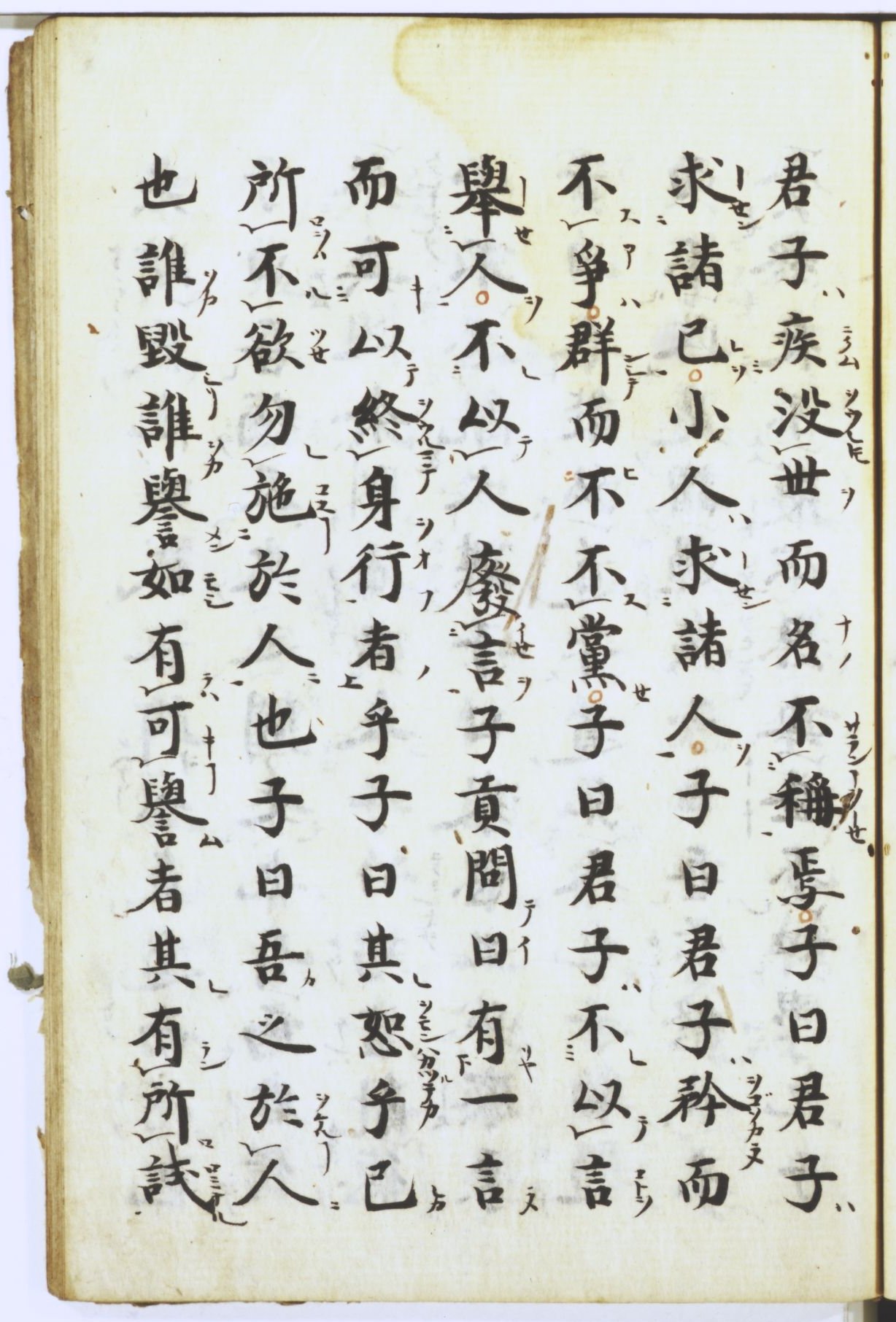
Kyoto University Library RB00007936, IIIF canvas 72, right-hand page: 7 written columns of up to 14 characters, main text only, with Japanese reading marks. Checked on the image: the first column of this book's text on this page begins ‹之賢而›, the last begins ‹病無能›. 15.14 begins inside column 1 (the column opens ‹之賢而›), 7 characters down in the received text. Above it the page finishes 15.13, shown in the previous section. 15.19 runs on to canvas 72, left-hand page (first column ‹君子疾›), where the section ends. The Chinese shown is the received text (Wikisource), not a transcription of this manuscript; Legge's English translates the received text.
14子曰:「躬自厚,而薄責於人,則遠怨矣!」
15子曰:「不曰『如之何,如之何』者,吾末如之何也已矣!」
16子曰:「群居終日,言不及義,好行小慧,難矣哉!」
17子曰:「君子義以爲質,禮以行之,孫以出之,信以成之。君子哉!」
18子曰:「君子病無能焉,不病人之不己知也。」
19子曰:「君子疾沒世而名不稱焉。」
14The Master said, 'He who requires much from himself and little from others, will keep himself from being the object of resentment.'
15The Master said, 'When a man is not in the habit of saying-- "What shall I think of this? What shall I think of this?" I can indeed do nothing with him!'
16The Master said, 'When a number of people are together, for a whole day, without their conversation turning on righteousness, and when they are fond of carrying out the suggestions of a small shrewdness;-- theirs is indeed a hard case.'
17The Master said, 'The superior man in everything considers righteousness to be essential. He performs it according to the rules of propriety. He brings it forth in humility. He completes it with sincerity. This is indeed a superior man.'
18The Master said, 'The superior man is distressed by his want of ability. He is not distressed by men's not knowing him.'
19The Master said, 'The superior man dislikes the thought of his name not being mentioned after his death.'
Where on the image
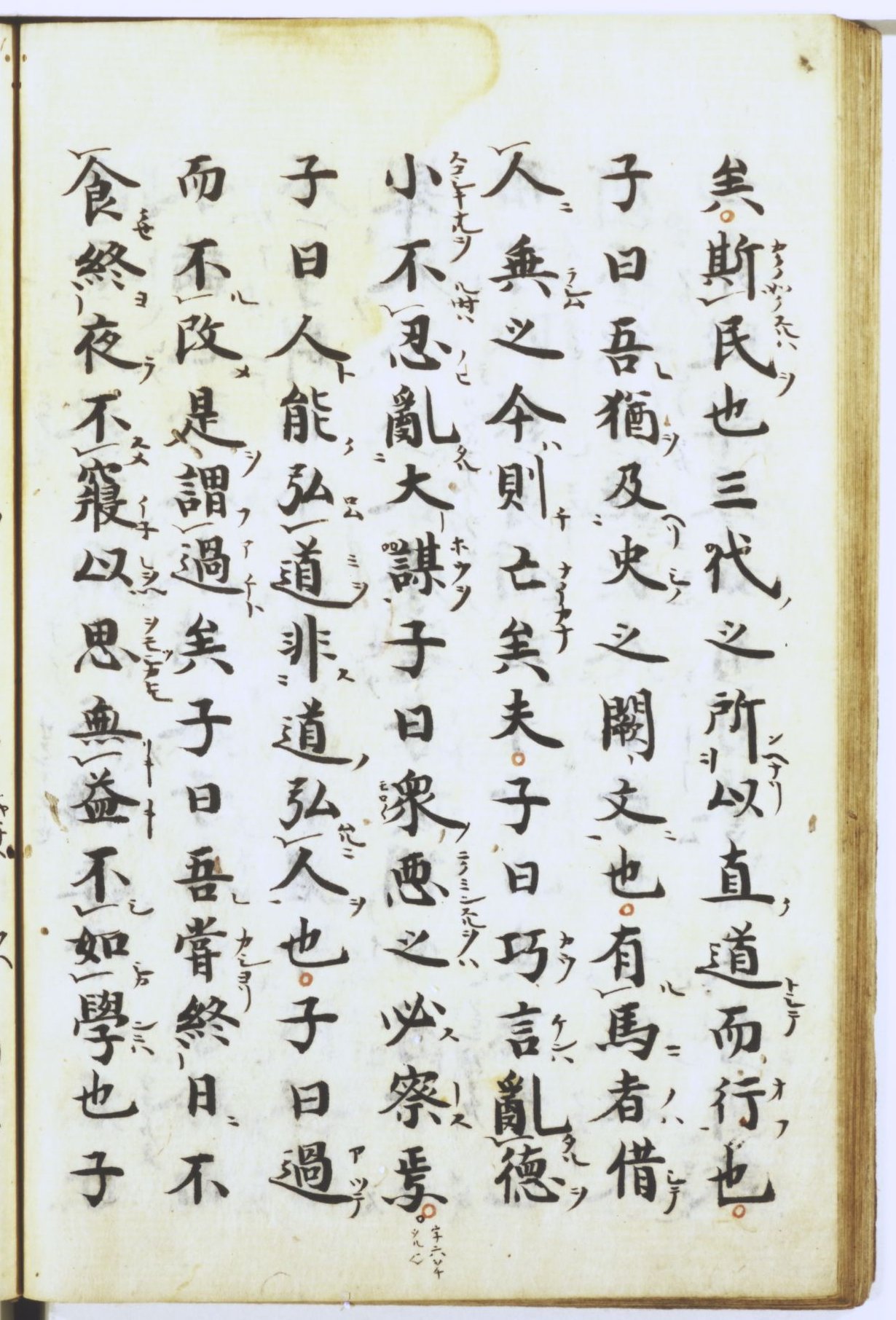
Kyoto University Library RB00007936, IIIF canvas 72, left-hand page: 7 written columns of up to 14 characters, main text only, with Japanese reading marks. Checked on the image: the first column of this book's text on this page begins ‹君子疾›, the last begins ‹也誰毀›. 15.20 begins inside column 1 (the column opens ‹君子疾›), 10 characters down in the received text. Above it the page finishes 15.19, shown in the previous section. 15.24.1 runs on to canvas 73, right-hand page (first column ‹矣斯民›), where the section ends. The Chinese shown is the received text (Wikisource), not a transcription of this manuscript; Legge's English translates the received text.
20子曰:「君子求諸己,小人求諸人。」
21子曰:「君子矜而不爭,群而不黨。」
22子曰:「君子不以言擧人,不以人廢言。」
23子貢問曰:「有一言而可以終身行之者乎?」子曰:「其恕乎!己所不欲,勿施於人。」
24.1子曰:「吾之於人也,誰毀誰譽?如有所譽者,其有所試矣。
20The Master said, 'What the superior man seeks, is in himself. What the mean man seeks, is in others.'
21The Master said, 'The superior man is dignified, but does not wrangle. He is sociable, but not a partizan.'
22The Master said, 'The superior man does not promote a man simply on account of his words, nor does he put aside good words because of the man.'
23Tsze-kung asked, saying, 'Is there one word which may serve as a rule of practice for all one's life?' The Master said, 'Is not RECIPROCITY such a word? What you do not want done to yourself, do not do to others.'
24.1The Master said, 'In my dealings with men, whose evil do I blame, whose goodness do I praise, beyond what is proper? If I do sometimes exceed in praise, there must be ground for it in my examination of the individual.
Where on the image
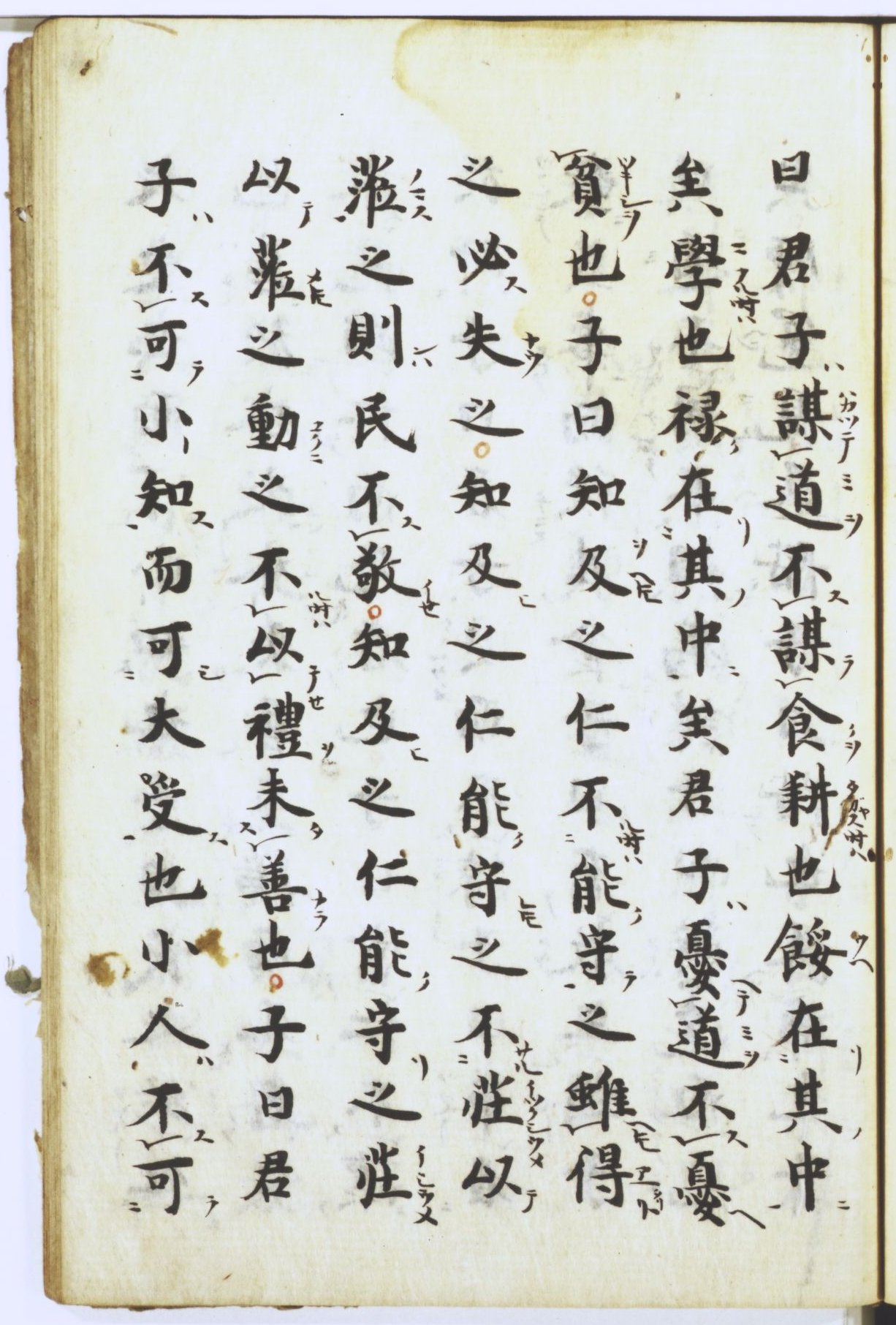
Kyoto University Library RB00007936, IIIF canvas 73, right-hand page: 7 written columns of up to 14 characters, main text only, with Japanese reading marks. Checked on the image: the first column of this book's text on this page begins ‹矣斯民›, the last begins ‹食終夜›. 15.24.2 begins inside column 1 (the column opens ‹矣斯民›), 1 characters down in the received text. Above it the page finishes 15.24.1, shown in the previous section. 15.31 runs on to canvas 73, left-hand page (first column ‹曰君子›), where the section ends. Column openings on these pages that differ from the received text: ‹貧也子› where the received text has ‹貧子曰›. The Chinese shown is the received text (Wikisource), not a transcription of this manuscript; Legge's English translates the received text.
24.2斯民也,三代之所以直道而行也。」
25子曰:「吾猶及史之闕文也,有馬者,借人乘之。今亡矣夫!」
26子曰:「巧言亂德,小不忍,則亂大謀。」
27子曰:「眾惡之,必察焉;眾好之,必察焉。」
28子曰:「人能弘道,非道弘人。」
29子曰:「過而不改,是謂過矣。」
30子曰:「吾嘗終日不食,終夜不寑,以思;無益,不如學也。」
31子曰:「君子謀道不謀食。耕也,餒在其中矣;學也,祿在其中矣。君子憂道不憂貧。」
24.2'This people supplied the ground why the three dynasties pursued the path of straightforwardness.'
25The Master said, 'Even in my early days, a historiographer would leave a blank in his text, and he who had a horse would lend him to another to ride. Now, alas! there are no such things.'
26The Master said, 'Specious words confound virtue. Want of forbearance in small matters confounds great plans.'
27The Master said, 'When the multitude hate a man, it is necessary to examine into the case. When the multitude like a man, it is necessary to examine into the case.'
28The Master said, 'A man can enlarge the principles which he follows; those principles do not enlarge the man.'
29The Master said, 'To have faults and not to reform them,-- this, indeed, should be pronounced having faults.'
30The Master said, 'I have been the whole day without eating, and the whole night without sleeping:-- occupied with thinking. It was of no use. The better plan is to learn.'
31The Master said, 'The object of the superior man is truth. Food is not his object. There is plowing;-- even in that there is sometimes want. So with learning;-- emolument may be found in it. The superior man is anxious lest he should not get truth; he is not anxious lest poverty should come upon him.'
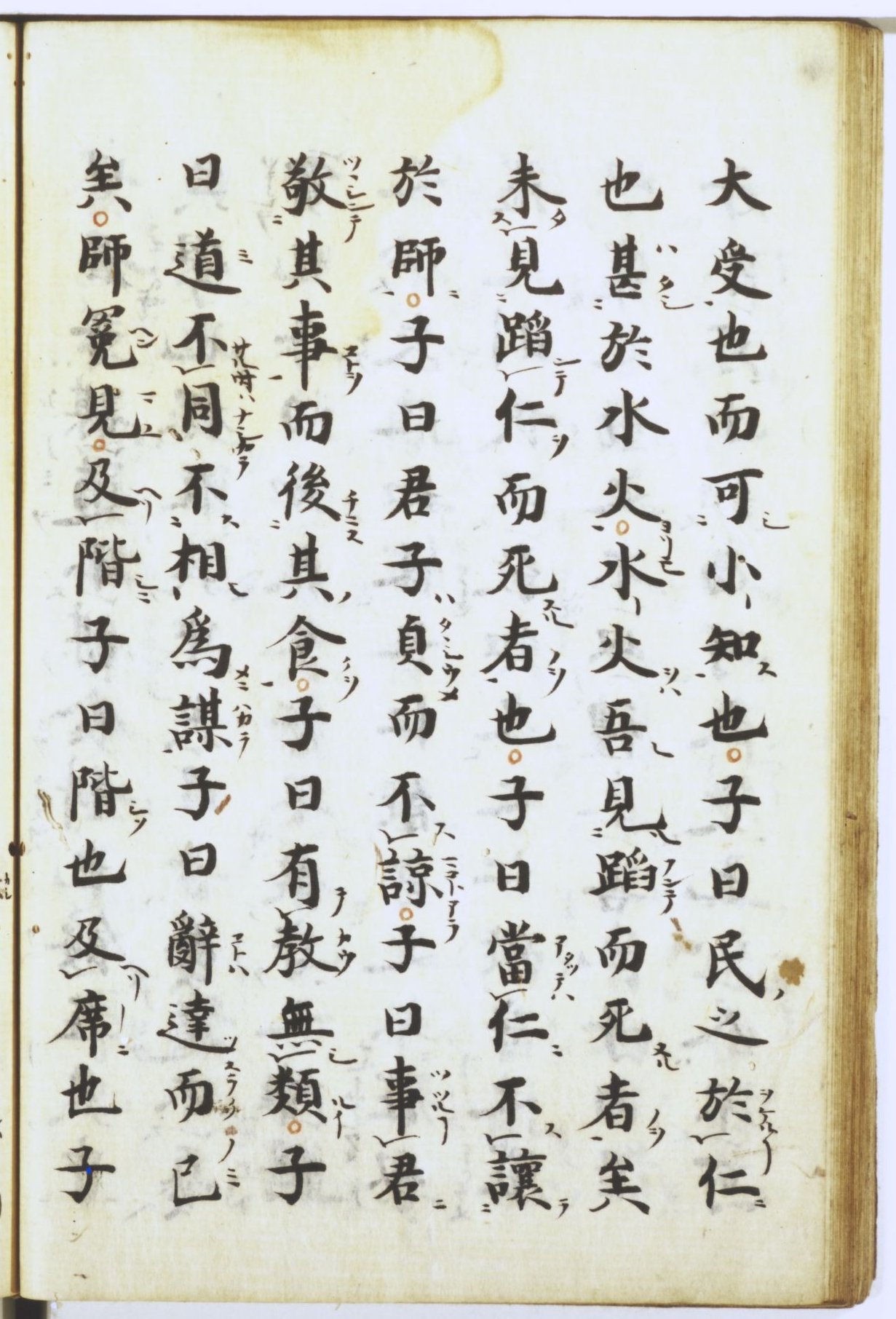
Where on the image
Kyoto University Library RB00007936, IIIF canvas 73, left-hand page: 7 written columns of up to 14 characters, main text only, with Japanese reading marks. Checked on the image: the first column of this book's text on this page begins ‹曰君子›, the last begins ‹子不可›. 15.32.1 begins inside column 3 (the column opens ‹貧也子›), 1 characters down in the received text. Above it the page finishes 15.31, shown in the previous section. 15.33 runs on to canvas 74, right-hand page (first column ‹大受也›), where the section ends. Column openings on these pages that differ from the received text: ‹涖之則› where the received text has ‹蒞之則›; ‹以涖之› where the received text has ‹以蒞之›; ‹大受也› where the received text has ‹大受而›. The Chinese shown is the received text (Wikisource), not a transcription of this manuscript; Legge's English translates the received text.
32.1子曰:「知及之,仁不能守之,雖得之,必失之。
32.2知及之,仁能守之。不莊以蒞之,則民不敬。
32.3知及之,仁能守之,莊以蒞之。動之不以禮,未善也。」
33子曰:「君子不可小知,而可大受也。小人不可大受,而可小知也。」
32.1The Master said, 'When a man's knowledge is sufficient to attain, and his virtue is not sufficient to enable him to hold, whatever he may have gained, he will lose again.
32.2'When his knowledge is sufficient to attain, and he has virtue enough to hold fast, if he cannot govern with dignity, the people will not respect him.
32.3'When his knowledge is sufficient to attain, and he has virtue enough to hold fast; when he governs also with dignity, yet if he try to move the people contrary to the rules of propriety:-- full excellence is not reached.'
33The Master said, 'The superior man cannot be known in little matters; but he may be intrusted with great concerns. The small man may not be intrusted with great concerns, but he may be known in little matters.'
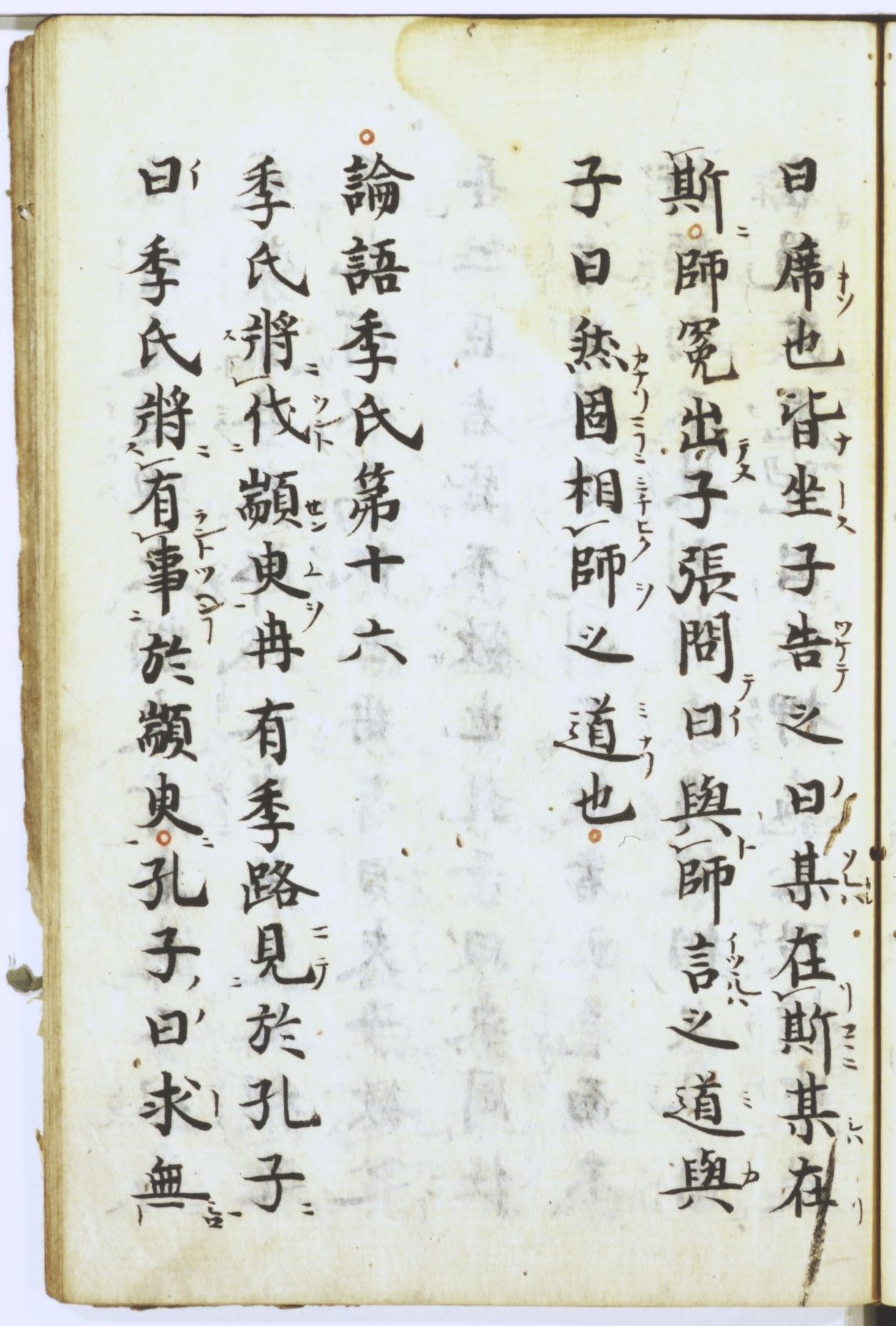
Where on the image
Kyoto University Library RB00007936, IIIF canvas 74, right-hand page: 7 written columns of up to 14 characters, main text only, with Japanese reading marks. Checked on the image: the first column of this book's text on this page begins ‹大受也›, the last begins ‹矣師冕›. 15.34 begins inside column 1 (the column opens ‹大受也›), 7 characters down in the received text. Above it the page finishes 15.33, shown in the previous section. 15.41.1 runs on to canvas 74, left-hand page (first column ‹曰席也›), where the section ends. The Chinese shown is the received text (Wikisource), not a transcription of this manuscript; Legge's English translates the received text.
34子曰:「民之於仁也,甚於水火。水火,吾見蹈而死者矣,未見蹈仁而死者也。」
35子曰:「當仁,不讓於師。」
36子曰:「君子貞而不諒。」
37子曰:「事君,敬其事而後其食。」
38子曰:「有教無類。」
39子曰:「道不同,不相爲謀。」
40子曰:「辭,達而已矣!」
41.1師冕見。及階,子曰:「階也。」及席,子曰:「席也。」皆坐,子吿之曰:「某在斯,某在斯。」
34The Master said, 'Virtue is more to man than either water or fire. I have seen men die from treading on water and fire, but I have never seen a man die from treading the course of virtue.'
35The Master said, 'Let every man consider virtue as what devolves on himself. He may not yield the performance of it even to his teacher.'
36The Master said, 'The superior man is correctly firm, and not firm merely.'
37The Master said, 'A minister, in serving his prince, reverently discharges his duties, and makes his emolument a secondary consideration.'
38The Master said, 'In teaching there should be no distinction of classes.'
39The Master said, 'Those whose courses are different cannot lay plans for one another.'
40The Master said, 'In language it is simply required that it convey the meaning.'
41.1The Music-master, Mien, having called upon him, when they came to the steps, the Master said, 'Here are the steps.' When they came to the mat for the guest to sit upon, he said, 'Here is the mat.' When all were seated, the Master informed him, saying, 'So and so is here; so and so is here.'
Where on the image
Kyoto University Library RB00007936, IIIF canvas 74, left-hand page: 6 written columns of up to 14 characters, main text only, with Japanese reading marks. Checked on the image: the first column of this book's text on this page begins ‹曰席也›, the last begins ‹子曰然›. Column 5 carries the title 論語季氏第十六. 15.41.2 begins inside column 2 (the column opens ‹斯師冕›), 1 characters down in the received text. Above it the page finishes 15.41.1, shown in the previous section. The section ends on this page. The Chinese shown is the received text (Wikisource), not a transcription of this manuscript; Legge's English translates the received text.
41.2師冕出,子張問曰:「與師言之道與?」
41.3子曰:「然,固相師之道也。」
41.2The Music-master, Mien, having gone out, Tsze-chang asked, saying. 'Is it the rule to tell those things to the Music- master?'
41.3The Master said, 'Yes. This is certainly the rule for those who lead the blind.'
Notes
- English: James Legge, Confucian Analects, The Chinese Classics vol. 1. Legge's chapter and paragraph numbers are kept as superscripts (chapter.paragraph).
- Legge translated the received text. Where this manuscript's wording differs, his English follows the received text shown here.
Cite
Sources
- Source: Kyoto University Library RB00007936 (Analects manuscript attributed to Kiyohara Yoshieda, c. 1300) + Wikisource received text + James Legge's English (Project Gutenberg) (holding institution)
- Critical edition: Received text (Wikisource) in Legge's chapter and paragraph division
← previous · → next · v cycle view · l back to library