Analects, Book 16: Ji shi 季氏 (Kamakura-period manuscript)
Introduction
Book 16 of the Analects (論語 Lunyu), titled 季氏 (Ji shi) after its opening words, 14 chapters in Legge's division. It is shown on a manuscript of the Analects in the Kiyohara family collection (Seike bunko) of Kyoto University Library, two volumes in regular script, seven columns of fourteen characters to the page, main text only, with red and black Japanese reading marks. A colophon by Kiyohara Edakata dated 1550 names the copyist as his ancestor Kiyohara Yoshieda (1253-1331), which places the copy around 1300, in the late Kamakura period; the attribution is traditional. The Kiyohara were hereditary readers of the Confucian classics at the Japanese court, and their text descends from the edition of the Analects with the collected commentary of He Yan (3rd century CE): after each pair of books the scribe copied the character counts of the classic and of the commentary, although only the classic is written out. The manuscript is an Important Cultural Property of Japan.
In this copy Book 16 runs from canvas 74, left-hand page to canvas 79, right-hand page (volume 2). Each section gathers the paragraphs that begin on one page, numbered by chapter and paragraph as in Legge, and links to that page and to any page the last paragraph runs onto. The page boundaries were found by reading the first characters of every column on the photographs. The Chinese shown is the received text, from Wikisource. This manuscript differs from it in places, most often by an added or missing particle (也, 矣, 焉) or a variant character form; the differences seen at column openings are listed in the scan notes. The English is James Legge's translation of the received text.
How was this verified? (Provenance)
Where on the image
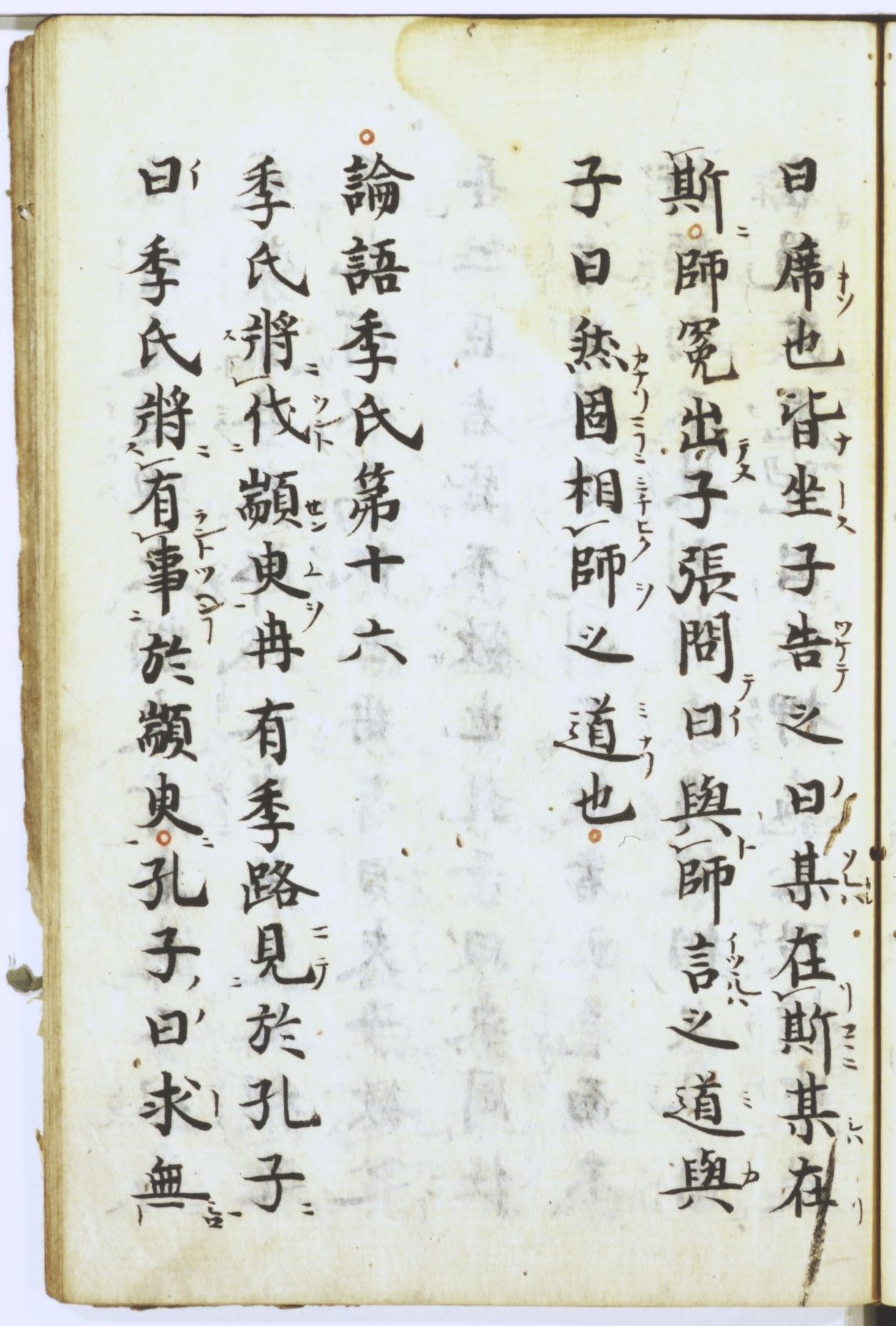
Kyoto University Library RB00007936, IIIF canvas 74, left-hand page: 6 written columns of up to 14 characters, main text only, with Japanese reading marks. Checked on the image: the first column of this book's text on this page begins ‹季氏將›, the last begins ‹曰季氏›. Column 5 carries the title 論語季氏第十六. 16.1.1 opens column 6. 16.1.3 runs on to canvas 75, right-hand page (first column ‹乃爾是›), where the section ends. The Chinese shown is the received text (Wikisource), not a transcription of this manuscript; Legge's English translates the received text.
1.1季氏將伐顓臾。
1.2冉有季路見於孔子曰:「季氏將有事於顓臾。」
1.3孔子曰:「求!無乃爾是過與?
1.1The head of the Chi family was going to attack Chwan-yu.
1.2Zan Yu and Chi-lu had an interview with Confucius, and said, 'Our chief, Chi, is going to commence operations against Chwan-yu.'
1.3Confucius said, 'Ch'iu, is it not you who are in fault here?
Where on the image
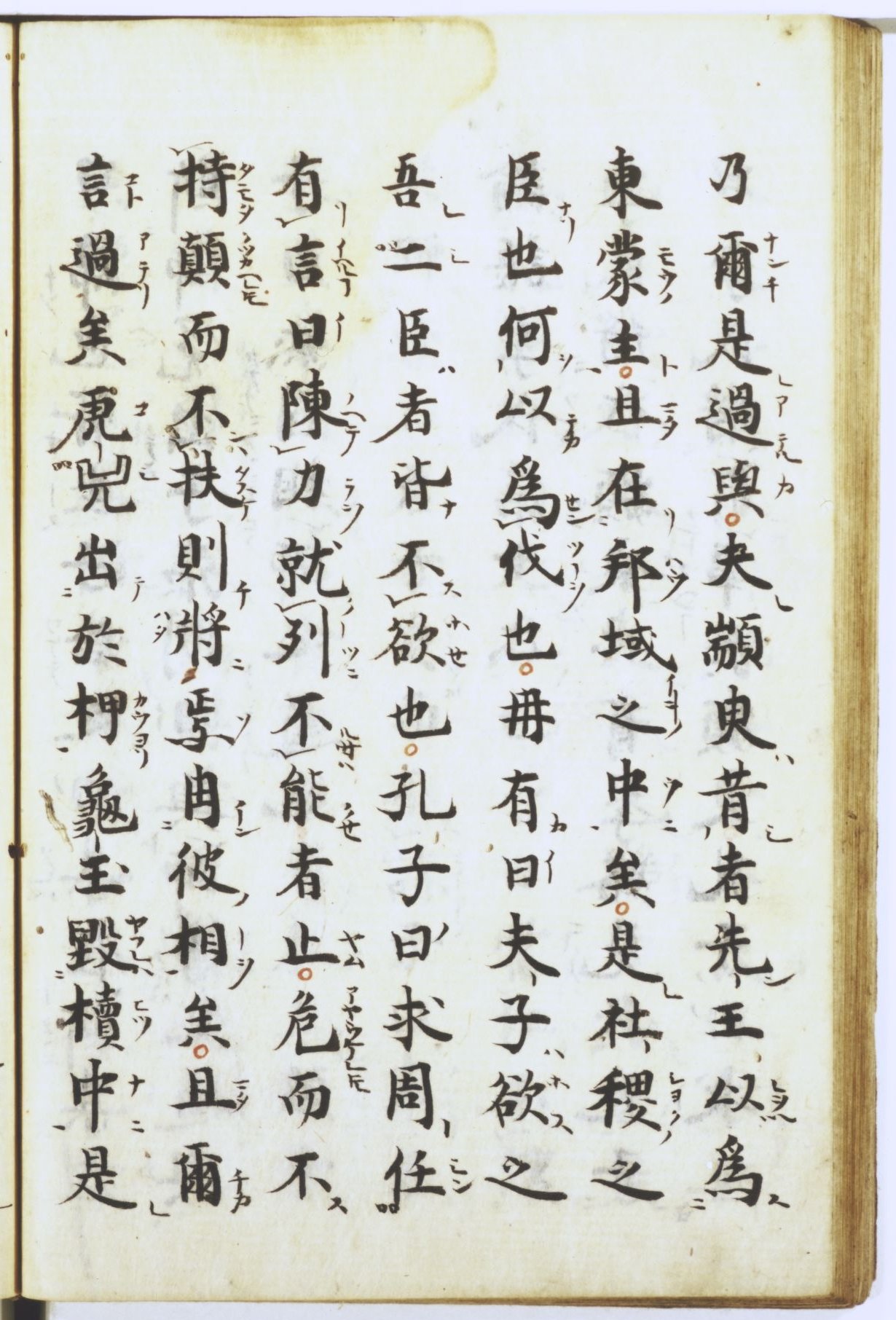
Kyoto University Library RB00007936, IIIF canvas 75, right-hand page: 7 written columns of up to 14 characters, main text only, with Japanese reading marks. Checked on the image: the first column of this book's text on this page begins ‹乃爾是›, the last begins ‹言過矣›. 16.1.4 begins inside column 1 (the column opens ‹乃爾是›), 5 characters down in the received text. Above it the page finishes 16.1.3, shown in the previous section. 16.1.7 runs on to canvas 75, left-hand page (first column ‹誰之過›), where the section ends. The Chinese shown is the received text (Wikisource), not a transcription of this manuscript; Legge's English translates the received text.
1.4夫顓臾,昔者先王以爲東蒙主,且在邦域之中矣,是社稷之臣也。何以伐爲?」
1.5冉有曰:「夫子欲之,吾二臣者,皆不欲也。」
1.6孔子曰:「求!周任有言曰:『陳力就列,不能者止。』危而不持,顚而不扶,則將焉用彼相矣?
1.7且爾言過矣!虎兕出於柙,龜玉毀於櫝中,是誰之過與?」
1.4'Now, in regard to Chwan-yu, long ago, a former king appointed its ruler to preside over the sacrifices to the eastern Mang; moreover, it is in the midst of the territory of our State; and its ruler is a minister in direct connexion with the sovereign:-- What has your chief to do with attacking it?'
1.5Zan Yu said, 'Our master wishes the thing; neither of us two ministers wishes it.'
1.6Confucius said, 'Ch'iu, there are the words of Chau Zan,-- "When he can put forth his ability, he takes his place in the ranks of office; when he finds himself unable to do so, he retires from it. How can he be used as a guide to a blind man, who does not support him when tottering, nor raise him up when fallen?"
1.7'And further, you speak wrongly. When a tiger or rhinoceros escapes from his cage; when a tortoise or piece of jade is injured in its repository:-- whose is the fault?'
Where on the image
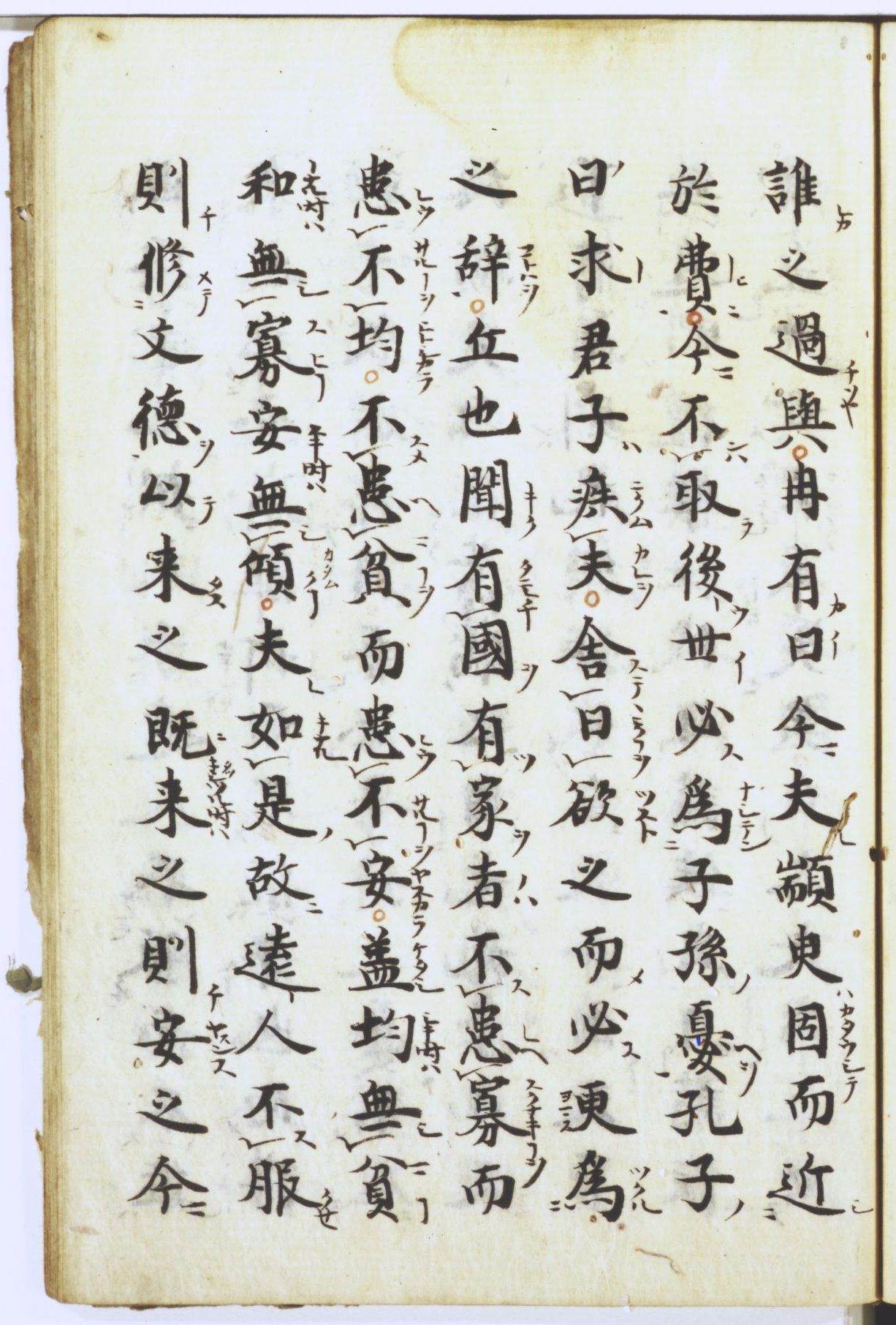
Kyoto University Library RB00007936, IIIF canvas 75, left-hand page: 7 written columns of up to 14 characters, main text only, with Japanese reading marks. Checked on the image: the first column of this book's text on this page begins ‹誰之過›, the last begins ‹則脩文›. 16.1.8 begins inside column 1 (the column opens ‹誰之過›), 4 characters down in the received text. Above it the page finishes 16.1.7, shown in the previous section. 16.1.12 runs on to canvas 76, right-hand page (first column ‹由與求›), where the section ends. The Chinese shown is the received text (Wikisource), not a transcription of this manuscript; Legge's English translates the received text.
1.8冉有曰:「今夫顓臾,固而近於費;今不取,後世必爲子孫憂。」
1.9孔子曰:「求!君子疾夫舍曰欲之,而必爲之辭。
1.10丘也,聞有國有家者,不患寡而患不均,不患貧而患不安。蓋均無貧,和無寡,安無傾。
1.11夫如是,故遠人不服,則修文德以來之。既來之,則安之。
1.12今由與求也,相夫子,遠人不服而不能來也;邦分崩離析而不能守也,
1.8Zan Yu said, 'But at present, Chwan-yu is strong and near to Pi; if our chief do not now take it, it will hereafter be a sorrow to his descendants.'
1.9Confucius said. 'Ch'iu, the superior man hates that declining to say-- "I want such and such a thing," and framing explanations for the conduct.
1.10'I have heard that rulers of States and chiefs of families are not troubled lest their people should be few, but are troubled lest they should not keep their several places; that they are not troubled with fears of poverty, but are troubled with fears of a want of contented repose among the people in their several places. For when the people keep their several places, there will be no poverty; when harmony prevails, there will be no scarcity of people; and when there is such a contented repose, there will be no rebellious upsettings.
1.11'So it is.-- Therefore, if remoter people are not submissive, all the influences of civil culture and virtue are to be cultivated to attract them to be so; and when they have been so attracted, they must be made contented and tranquil.
1.12'Now, here are you, Yu and Ch'iu, assisting your chief. Remoter people are not submissive, and, with your help, he cannot attract them to him. In his own territory there are divisions and downfalls, leavings and separations, and, with your help, he cannot preserve it.
Where on the image
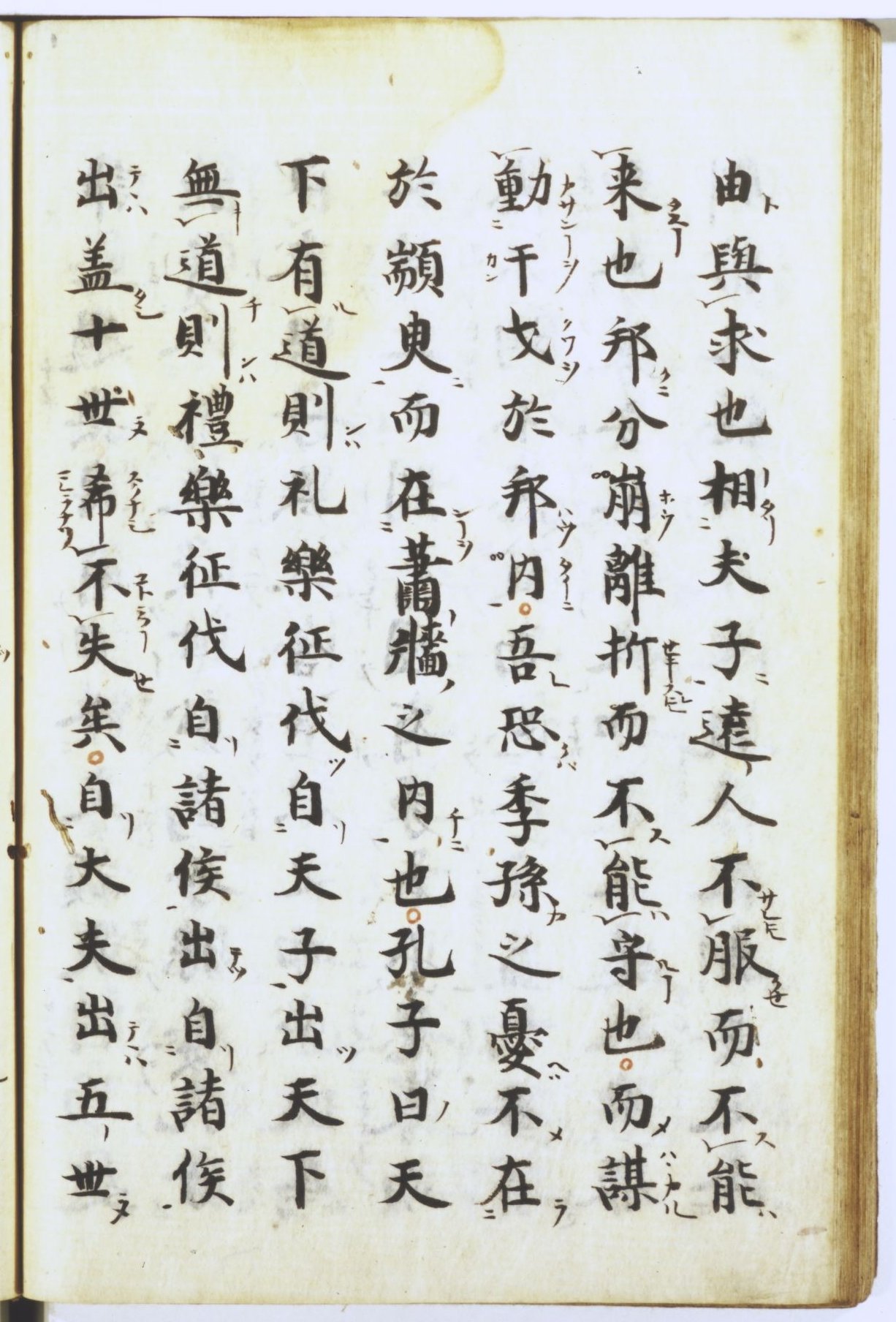
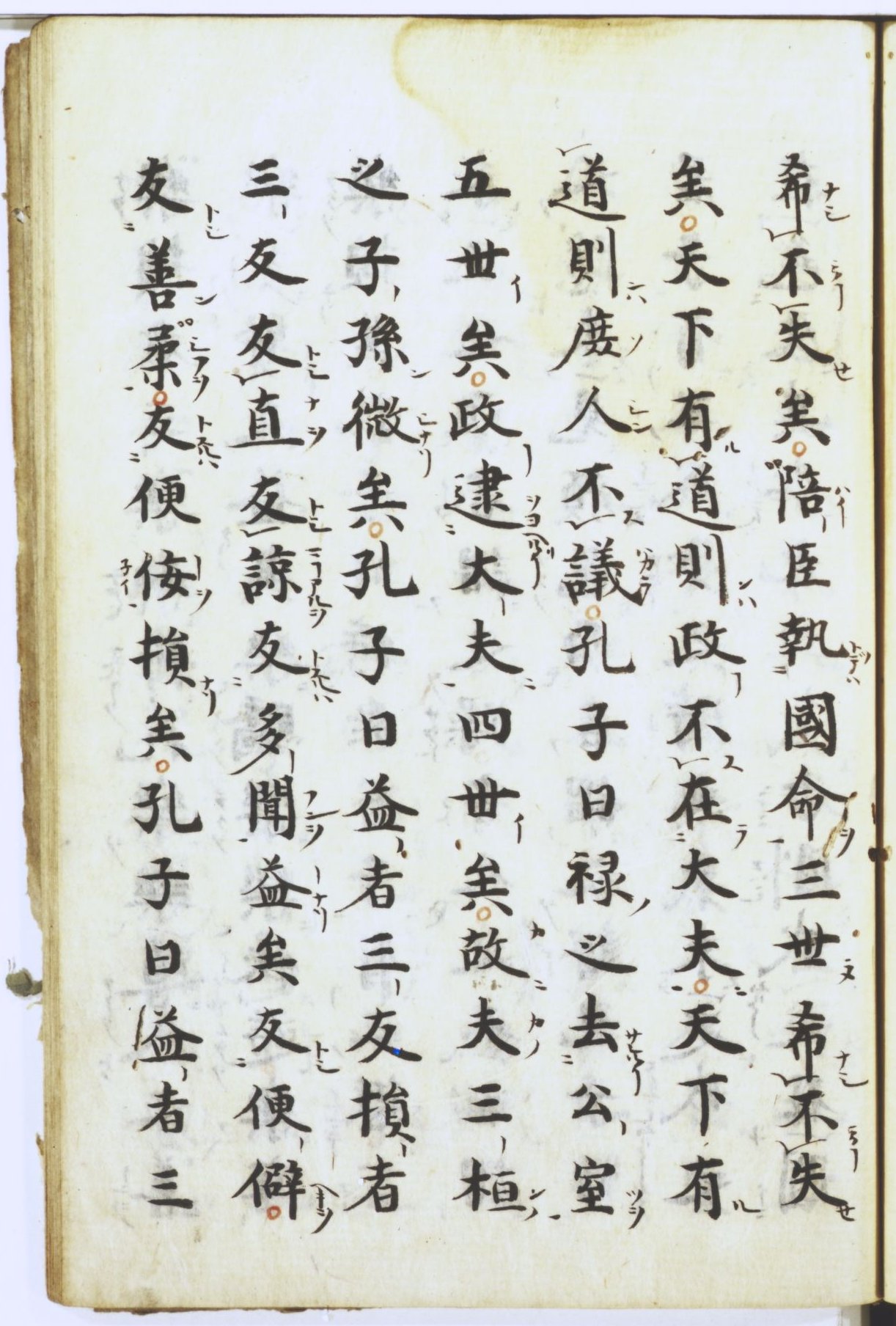
Kyoto University Library RB00007936, IIIF canvas 76, right-hand page: 7 written columns of up to 14 characters, main text only, with Japanese reading marks. Checked on the image: the first column of this book's text on this page begins ‹由與求›, the last begins ‹出蓋十›. 16.1.13 begins inside column 2 (the column opens ‹來也邦›), 12 characters down in the received text. Above it the page finishes 16.1.12, shown in the previous section. 16.2.1 runs on to canvas 76, left-hand page (first column ‹希不失›), where the section ends. Column openings on these pages that differ from the received text: ‹於顓臾› where the received text has ‹顓臾而›. The Chinese shown is the received text (Wikisource), not a transcription of this manuscript; Legge's English translates the received text.
1.13而謀動干戈於邦內。吾恐季孫之憂,不在顓臾,而在蕭牆之內也!」
2.1孔子曰:「天下有道,則禮樂征伐自天子出;天下無道,則禮樂征伐自諸侯出。自諸侯出,蓋十世希不失矣;自大夫出,五世希不失矣;陪臣執國命,三世希不失矣。
1.13'And yet he is planning these hostile movements within the State.-- I am afraid that the sorrow of the Chi-sun family will not be on account of Chwan-yu, but will be found within the screen of their own court.'
2.1Confucius said, 'When good government prevails in the empire, ceremonies, music, and punitive military expeditions proceed from the son of Heaven. When bad government prevails in the empire, ceremonies, music, and punitive military expeditions proceed from the princes. When these things proceed from the princes, as a rule, the cases will be few in which they do not lose their power in ten generations. When they proceed from the Great officers of the princes, as a rule, the cases will be few in which they do not lose their power in five generations. When the subsidiary ministers of the great officers hold in their grasp the orders of the state, as a rule, the cases will be few in which they do not lose their power in three generations.
Where on the image
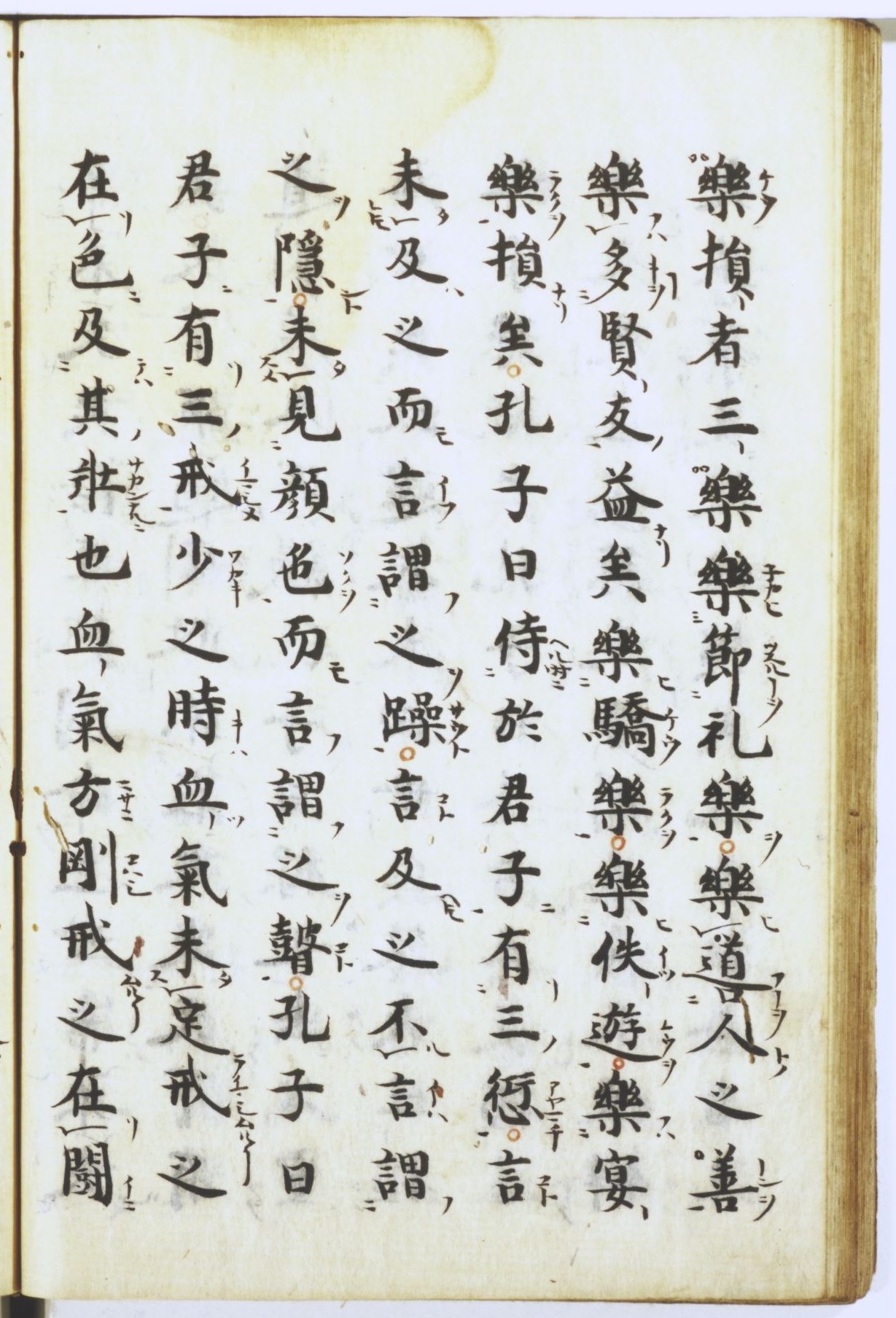
Kyoto University Library RB00007936, IIIF canvas 76, left-hand page: 7 written columns of up to 14 characters, main text only, with Japanese reading marks. Checked on the image: the first column of this book's text on this page begins ‹希不失›, the last begins ‹友善柔›. 16.2.2 begins inside column 2 (the column opens ‹矣天下›), 1 characters down in the received text. Above it the page finishes 16.2.1, shown in the previous section. 16.5 runs on to canvas 77, right-hand page (first column ‹樂損者›), where the section ends. The Chinese shown is the received text (Wikisource), not a transcription of this manuscript; Legge's English translates the received text.
2.2天下有道,則政不在大夫。
2.3天下有道,則庶人不議。」
3孔子曰:「祿之去公室,五世矣。政逮於大夫,四世矣。故夫三桓之子孫,微矣。」
4孔子曰:「益者三友,損者三友:友直,友諒,友多聞,益矣;友便辟,友善柔,友便佞,損矣。」
5孔子曰:「益者三樂,損者三樂:樂節禮樂,樂道人之善,樂多賢友,益矣;樂驕樂,樂佚遊,樂宴樂,損矣。」
2.2'When right principles prevail in the kingdom, government will not be in the hands of the Great officers.
2.3'When right principles prevail in the kingdom, there will be no discussions among the common people.'
3Confucius said, 'The revenue of the state has left the ducal House now for five generations. The government has been in the hands of the Great officers for four generations. On this account, the descendants of the three Hwan are much reduced.'
4Confucius said, 'There are three friendships which are advantageous, and three which are injurious. Friendship with the upright; friendship with the sincere; and friendship with the man of much observation:-- these are advantageous. Friendship with the man of specious airs; friendship with the insinuatingly soft; and friendship with the glib-tongued:-- these are injurious.'
5Confucius said, 'There are three things men find enjoyment in which are advantageous, and three things they find enjoyment in which are injurious. To find enjoyment in the discriminating study of ceremonies and music; to find enjoyment in speaking of the goodness of others; to find enjoyment in having many worthy friends:-- these are advantageous. To find enjoyment in extravagant pleasures; to find enjoyment in idleness and sauntering; to find enjoyment in the pleasures of feasting:-- these are injurious.'
Where on the image
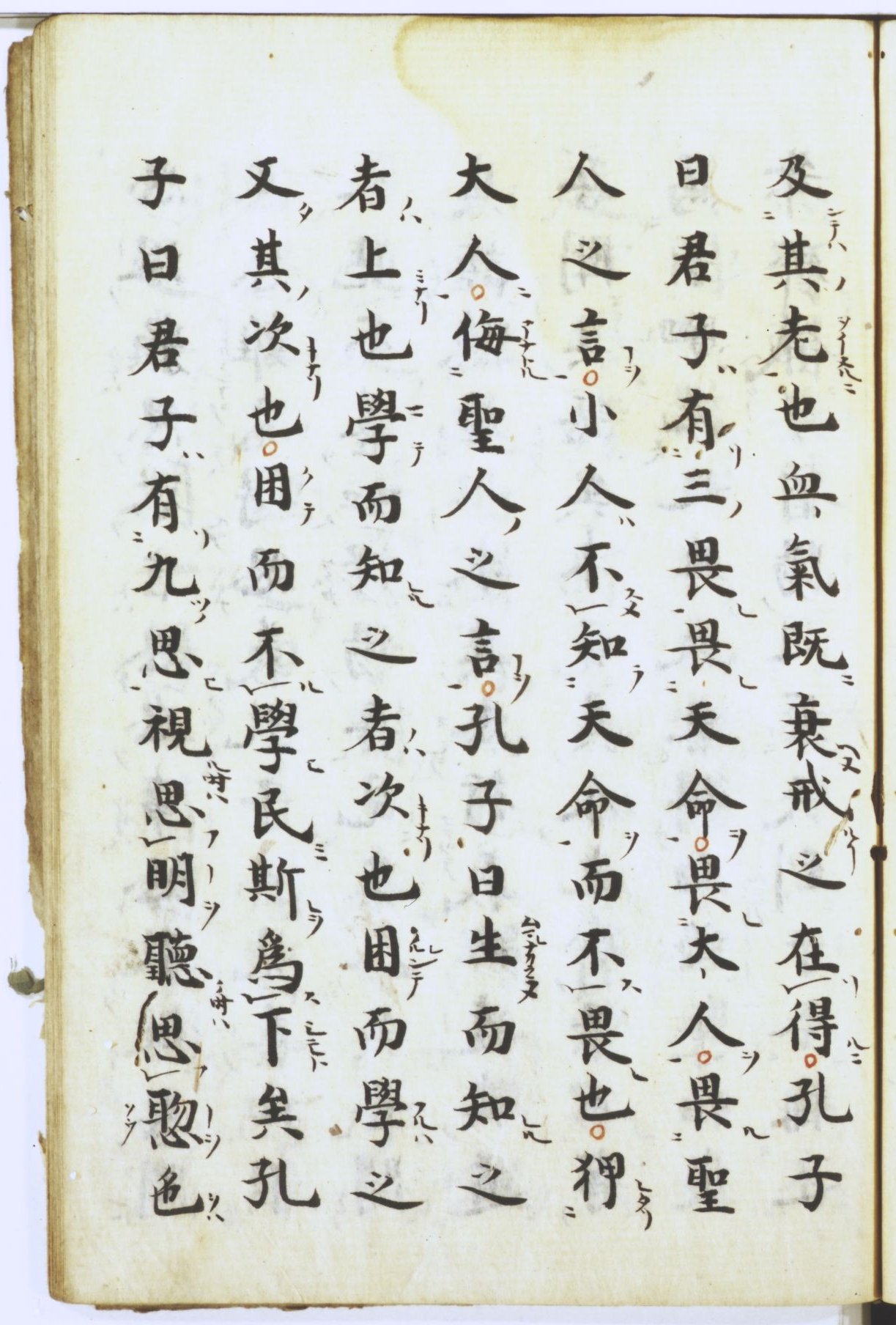
Kyoto University Library RB00007936, IIIF canvas 77, right-hand page: 7 written columns of up to 14 characters, main text only, with Japanese reading marks. Checked on the image: the first column of this book's text on this page begins ‹樂損者›, the last begins ‹在色及›. 16.6 begins inside column 3 (the column opens ‹樂損矣›), 3 characters down in the received text. Above it the page finishes 16.5, shown in the previous section. 16.7 runs on to canvas 77, left-hand page (first column ‹及其老›), where the section ends. The Chinese shown is the received text (Wikisource), not a transcription of this manuscript; Legge's English translates the received text.
6孔子曰:「侍於君子有三愆:言未及之而言,謂之躁;言及之而不言,謂之隱;未見顏色而言,謂之瞽。」
7孔子曰:「君子有三戒:少之時,血氣未定,戒之在色;及其壯也,血氣方剛,戒之在鬭;及其老也,血氣既衰,戒之在得。」
6Confucius said, 'There are three errors to which they who stand in the presence of a man of virtue and station are liable. They may speak when it does not come to them to speak;-- this is called rashness. They may not speak when it comes to them to speak;-- this is called concealment. They may speak without looking at the countenance of their superior;-- this is called blindness.'
7Confucius said, 'There are three things which the superior man guards against. In youth, when the physical powers are not yet settled, he guards against lust. When he is strong and the physical powers are full of vigor, he guards against quarrelsomeness. When he is old, and the animal powers are decayed, he guards against covetousness.'
Where on the image
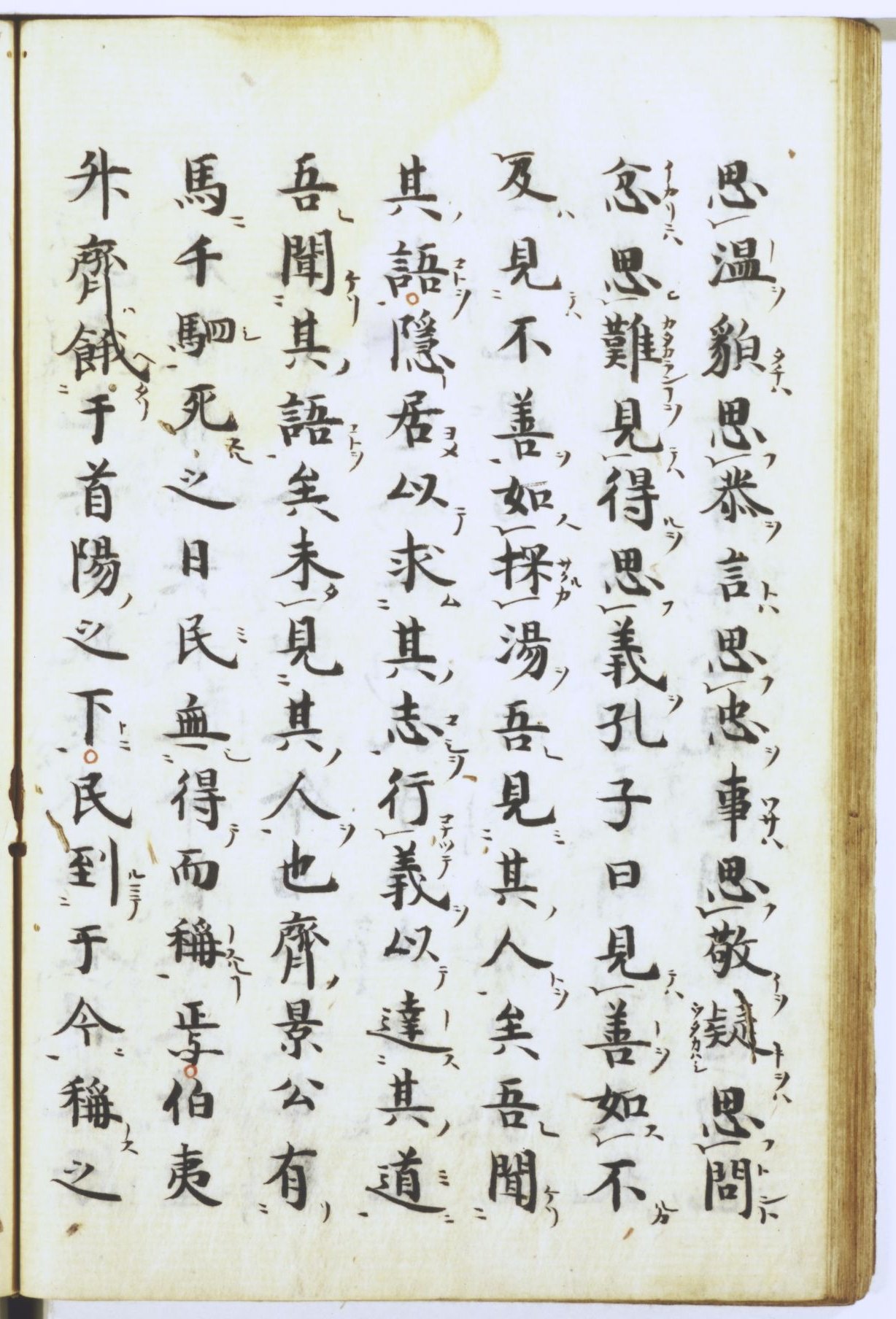
Kyoto University Library RB00007936, IIIF canvas 77, left-hand page: 7 written columns of up to 14 characters, main text only, with Japanese reading marks. Checked on the image: the first column of this book's text on this page begins ‹及其老›, the last begins ‹子曰君›. 16.8.1 begins inside column 1 (the column opens ‹及其老›), 12 characters down in the received text. Above it the page finishes 16.7, shown in the previous section. 16.10 runs on to canvas 78, right-hand page (first column ‹思溫貌›), where the section ends. The Chinese shown is the received text (Wikisource), not a transcription of this manuscript; Legge's English translates the received text.
8.1孔子曰:「君子有三畏:畏天命,畏大人,畏聖人之言。
8.2小人不知天命而不畏也,狎大人,侮聖人之言。」
9孔子曰:「生而知之者,上也;學而知之者,次也;困而學之,又其次也。困而不學,民斯爲下矣!」
10孔子曰:「君子有九思:視思明,聽思聰,色思溫,貌思恭,言思忠,事思敬,疑思問,忿思難,見得思義。」
8.1Confucius said, 'There are three things of which the superior man stands in awe. He stands in awe of the ordinances of Heaven. He stands in awe of great men. He stands in awe of the words of sages.
8.2'The mean man does not know the ordinances of Heaven, and consequently does not stand in awe of them. He is disrespectful to great men. He makes sport of the words of sages.'
9Confucius said, 'Those who are born with the possession of knowledge are the highest class of men. Those who learn, and so, readily, get possession of knowledge, are the next. Those who are dull and stupid, and yet compass the learning, are another class next to these. As to those who are dull and stupid and yet do not learn;-- they are the lowest of the people.'
10Confucius said, 'The superior man has nine things which are subjects with him of thoughtful consideration. In regard to the use of his eyes, he is anxious to see clearly. In regard to the use of his ears, he is anxious to hear distinctly. In regard to his countenance, he is anxious that it should be benign. In regard to his demeanor, he is anxious that it should be respectful. In regard to his speech, he is anxious that it should be sincere. In regard to his doing of business, he is anxious that it should be reverently careful. In regard to what he doubts about, he is anxious to question others. When he is angry, he thinks of the difficulties (his anger may involve him in). When he sees gain to be got, he thinks of righteousness.'
Where on the image
Kyoto University Library RB00007936, IIIF canvas 78, right-hand page: 7 written columns of up to 14 characters, main text only, with Japanese reading marks. Checked on the image: the first column of this book's text on this page begins ‹思溫貌›, the last begins ‹叔齊餓›. 16.11.1 begins inside column 2 (the column opens ‹忿思難›), 7 characters down in the received text. Above it the page finishes 16.10, shown in the previous section. The section ends on this page. Column openings on these pages that differ from the received text: ‹其語隱› where the received text has ‹其語矣›. The Chinese shown is the received text (Wikisource), not a transcription of this manuscript; Legge's English translates the received text.
11.1孔子曰:「『見善如不及,見不善如探湯。』吾見其人矣,吾聞其語矣。
11.2『隱居以求其志,行義以達其道。』吾聞其語矣,未見其人也。」
12.1齊景公有馬千駟,死之日,民無德而稱焉。伯夷叔齊餓於首陽之下,民到于今稱之。
11.1Confucius said, 'Contemplating good, and pursuing it, as if they could not reach it; contemplating evil, and shrinking from it, as they would from thrusting the hand into boiling water:-- I have seen such men, as I have heard such words.
11.2'Living in retirement to study their aims, and practising righteousness to carry out their principles:-- I have heard these words, but I have not seen such men.'
12.1The duke Ching of Ch'i had a thousand teams, each of four horses, but on the day of his death, the people did not praise him for a single virtue. Po-i and Shu-ch'i died of hunger at the foot of the Shau-yang mountain, and the people, down to the present time, praise them.
Where on the image
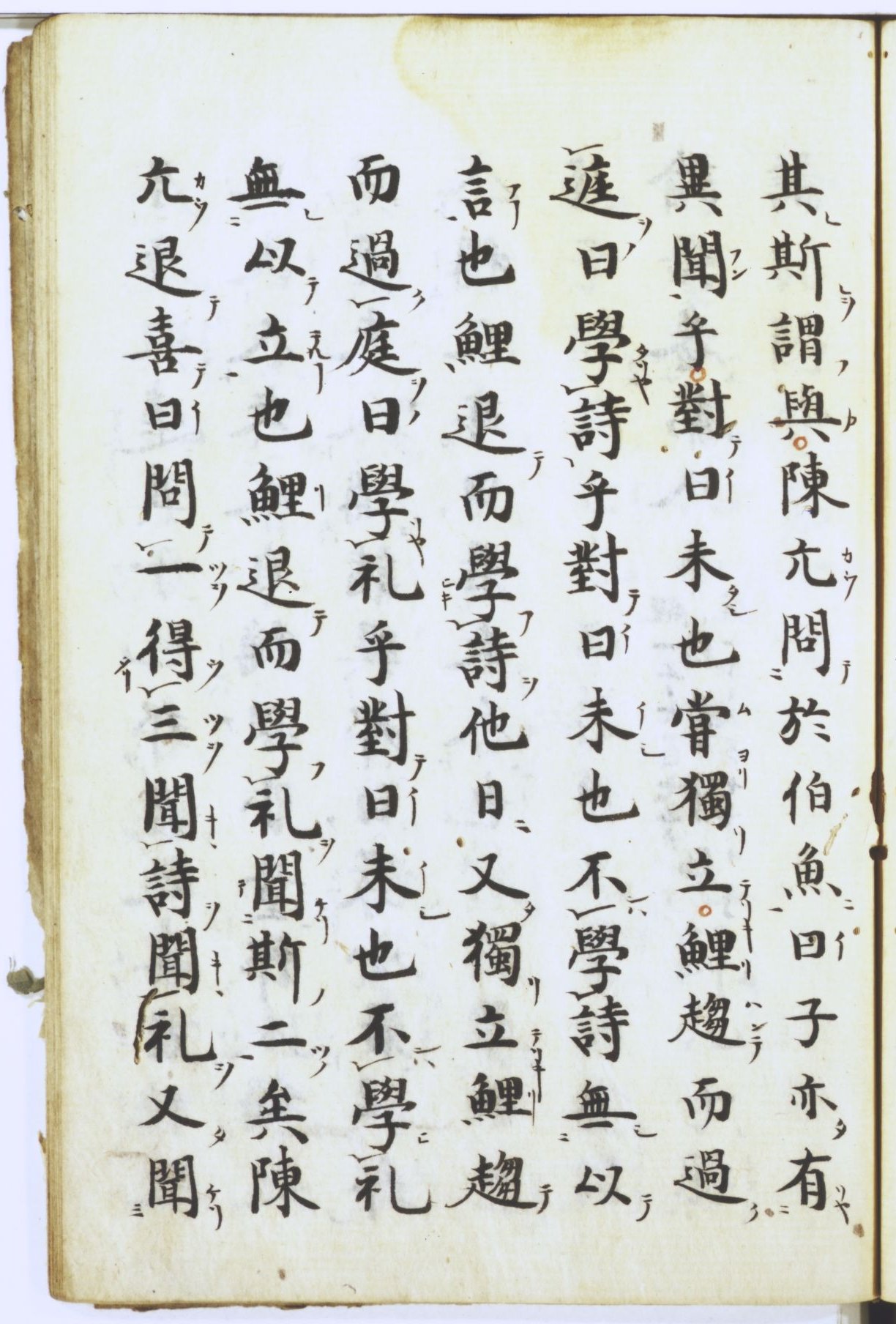
Kyoto University Library RB00007936, IIIF canvas 78, left-hand page: 7 written columns of up to 14 characters, main text only, with Japanese reading marks. Checked on the image: the first column of this book's text on this page begins ‹其斯謂›, the last begins ‹亢退喜›. 16.12.2 opens column 1. 16.13.5 runs on to canvas 79, right-hand page (first column ‹君子之›), where the section ends. Column openings on these pages that differ from the received text: ‹其斯謂› where the received text has ‹其斯之›; ‹言也鯉› where the received text has ‹言鯉退›; ‹亢退喜› where the received text has ‹亢退而›. The Chinese shown is the received text (Wikisource), not a transcription of this manuscript; Legge's English translates the received text.
12.2其斯之謂與?
13.1陳亢問於伯魚曰:「子亦有異聞乎?」
13.2對曰:「未也。嘗獨立,鯉趨而過庭。曰:『學《詩》乎?』對曰:『未也。』『不學《詩》,無以言。』鯉退而學《詩》。
13.3他日,又獨立,鯉趨而過庭。曰:『學禮乎?』對曰:『未也。』『不學禮,無以立!』鯉退而學禮。
13.4聞斯二者。」
13.5陳亢退而喜曰:「問一得三:聞《詩》,聞禮,又聞君子之遠其子也。」
12.2'Is not that saying illustrated by this?'
13.1Ch'an K'ang asked Po-yu, saying, 'Have you heard any lessons from your father different from what we have all heard?'
13.2Po-yu replied, 'No. He was standing alone once, when I passed below the hall with hasty steps, and said to me, "Have you learned the Odes?" On my replying "Not yet," he added, "If you do not learn the Odes, you will not be fit to converse with." I retired and studied the Odes.
13.3'Another day, he was in the same way standing alone, when I passed by below the hall with hasty steps, and said to me, 'Have you learned the rules of Propriety?' On my replying 'Not yet,' he added, 'If you do not learn the rules of Propriety, your character cannot be established.' I then retired, and learned the rules of Propriety.
13.4'I have heard only these two things from him.'
13.5Ch'ang K'ang retired, and, quite delighted, said, 'I asked one thing, and I have got three things. I have heard about the Odes. I have heard about the rules of Propriety. I have also heard that the superior man maintains a distant reserve towards his son.'
Where on the image
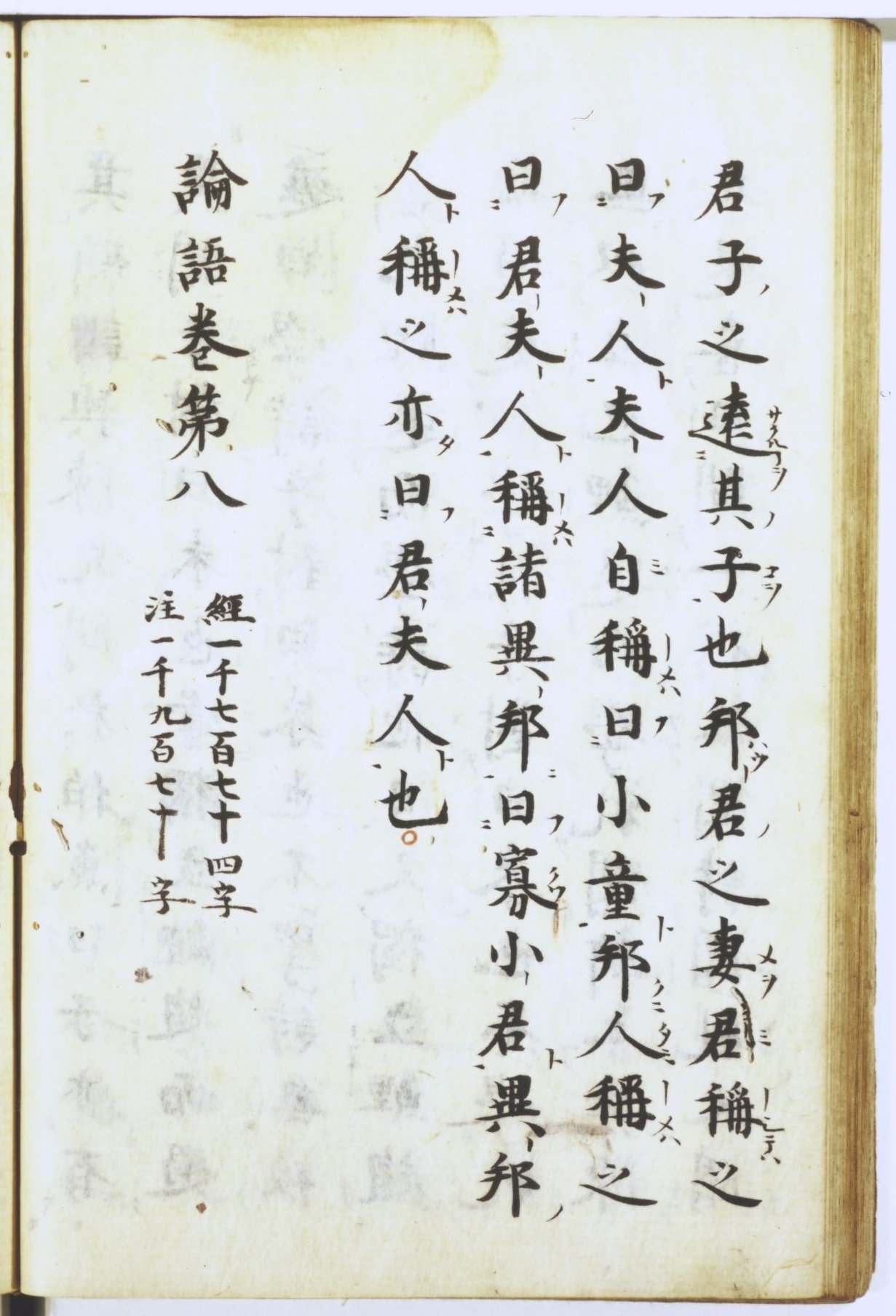
Kyoto University Library RB00007936, IIIF canvas 79, right-hand page: 5 written columns of up to 14 characters, main text only, with Japanese reading marks. Checked on the image: the first column of this book's text on this page begins ‹君子之›, the last begins ‹人稱之›. Column 6 carries the title 論語卷第八. 16.14 begins inside column 1 (the column opens ‹君子之›), 7 characters down in the received text. Above it the page finishes 16.13.5, shown in the previous section. The section ends on this page. The Chinese shown is the received text (Wikisource), not a transcription of this manuscript; Legge's English translates the received text.
14邦君之妻,君稱之曰「夫人」,夫人自稱曰「小童」;邦人稱之曰「君夫人」,稱諸異邦曰「寡小君」;異邦人稱之,亦曰「君夫人」。
14The wife of the prince of a state is called by him FU ZAN. She calls herself HSIAO T'UNG. The people of the State call her CHUN FU ZAN, and, to the people of other States, they call her K'WA HSIAO CHUN. The people of other states also call her CHUN FU ZAN.
Notes
- English: James Legge, Confucian Analects, The Chinese Classics vol. 1. Legge's chapter and paragraph numbers are kept as superscripts (chapter.paragraph).
- Legge translated the received text. Where this manuscript's wording differs, his English follows the received text shown here.
Cite
Sources
- Source: Kyoto University Library RB00007936 (Analects manuscript attributed to Kiyohara Yoshieda, c. 1300) + Wikisource received text + James Legge's English (Project Gutenberg) (holding institution)
- Critical edition: Received text (Wikisource) in Legge's chapter and paragraph division
← previous · → next · v cycle view · l back to library