Analects, Book 17: Yang Huo 陽貨 (Kamakura-period manuscript)
Introduction
Book 17 of the Analects (論語 Lunyu), titled 陽貨 (Yang Huo) after its opening words, 26 chapters in Legge's division. It is shown on a manuscript of the Analects in the Kiyohara family collection (Seike bunko) of Kyoto University Library, two volumes in regular script, seven columns of fourteen characters to the page, main text only, with red and black Japanese reading marks. A colophon by Kiyohara Edakata dated 1550 names the copyist as his ancestor Kiyohara Yoshieda (1253-1331), which places the copy around 1300, in the late Kamakura period; the attribution is traditional. The Kiyohara were hereditary readers of the Confucian classics at the Japanese court, and their text descends from the edition of the Analects with the collected commentary of He Yan (3rd century CE): after each pair of books the scribe copied the character counts of the classic and of the commentary, although only the classic is written out. The manuscript is an Important Cultural Property of Japan.
In this copy Book 17 runs from canvas 79, left-hand page to canvas 84, left-hand page (volume 2). Each section gathers the paragraphs that begin on one page, numbered by chapter and paragraph as in Legge, and links to that page and to any page the last paragraph runs onto. The page boundaries were found by reading the first characters of every column on the photographs. The Chinese shown is the received text, from Wikisource. This manuscript differs from it in places, most often by an added or missing particle (也, 矣, 焉) or a variant character form; the differences seen at column openings are listed in the scan notes. The English is James Legge's translation of the received text.
How was this verified? (Provenance)
Where on the image
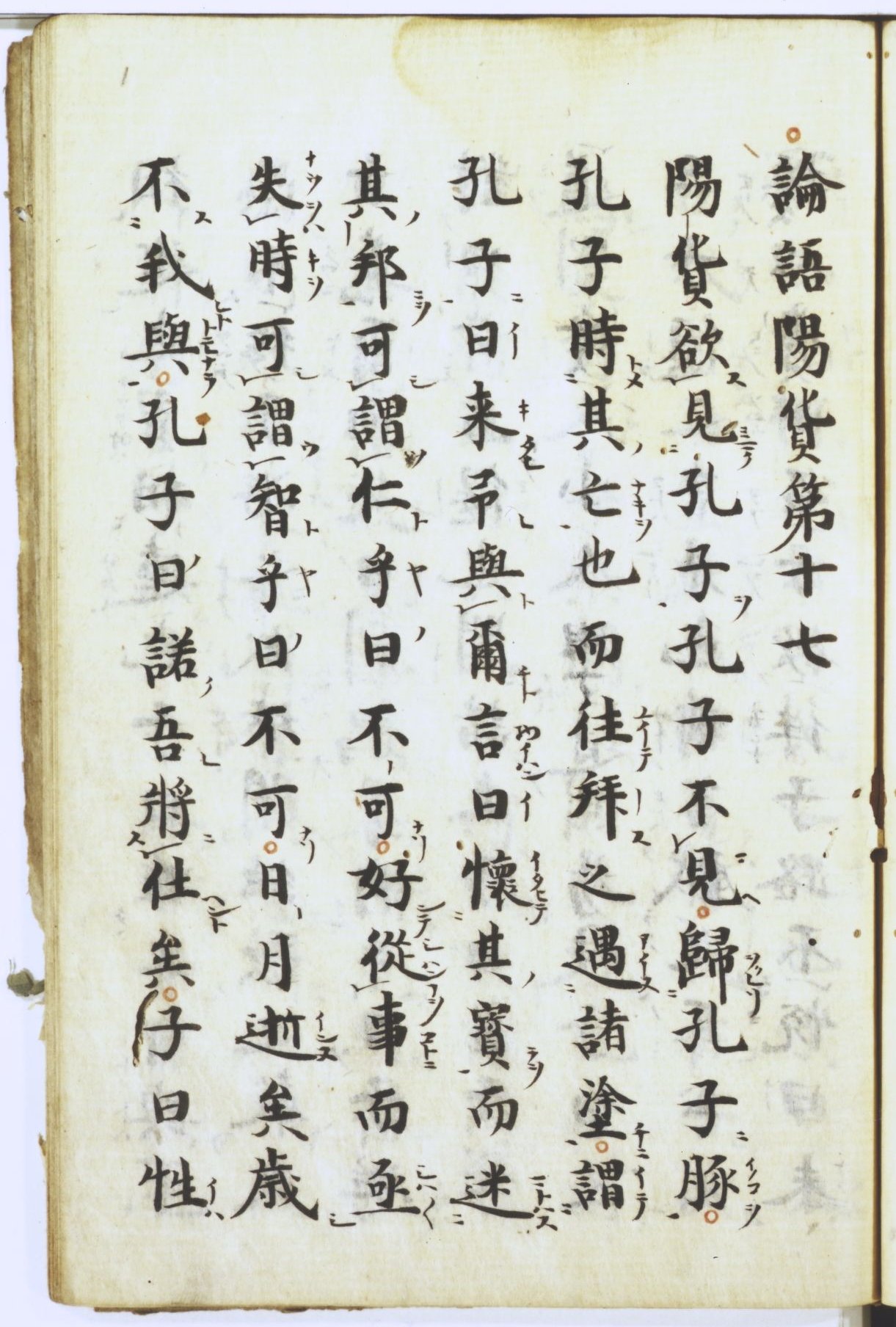
Kyoto University Library RB00007936, IIIF canvas 79, left-hand page: 7 written columns of up to 14 characters, main text only, with Japanese reading marks. Checked on the image: the first column of this book's text on this page begins ‹陽貨欲›, the last begins ‹不我與›. Column 1 carries the title 論語陽貨第十七. 17.1.1 opens column 2. 17.2 runs on to canvas 80, right-hand page (first column ‹相近也›), where the section ends. The Chinese shown is the received text (Wikisource), not a transcription of this manuscript; Legge's English translates the received text.
1.1陽貨欲見孔子,孔子不見,歸孔子豚。孔子時其亡也,而往拜之,遇諸塗。
1.2謂孔子曰:「來,予與爾言。」曰:「懷其寶而迷其邦,可謂仁乎?」曰:「不可。」「好從事而亟失時,可謂知乎?」曰:「不可。」「日月逝矣,歲不我與。」孔子曰:「諾,吾將仕矣。」
2子曰:「性相近也,習相遠也。」
1.1Yang Ho wished to see Confucius, but Confucius would not go to see him. On this, he sent a present of a pig to Confucius, who, having chosen a time when Ho was not at home, went to pay his respects for the gift. He met him, however, on the way.
1.2Ho said to Confucius, 'Come, let me speak with you.' He then asked, 'Can he be called benevolent who keeps his jewel in his bosom, and leaves his country to confusion?' Confucius replied, 'No.' 'Can he be called wise, who is anxious to be engaged in public employment, and yet is constantly losing the opportunity of being so?' Confucius again said, 'No.' 'The days and months are passing away; the years do not wait for us.' Confucius said, 'Right; I will go into office.'
2The Master said, 'By nature, men are nearly alike; by practice, they get to be wide apart.'
Where on the image
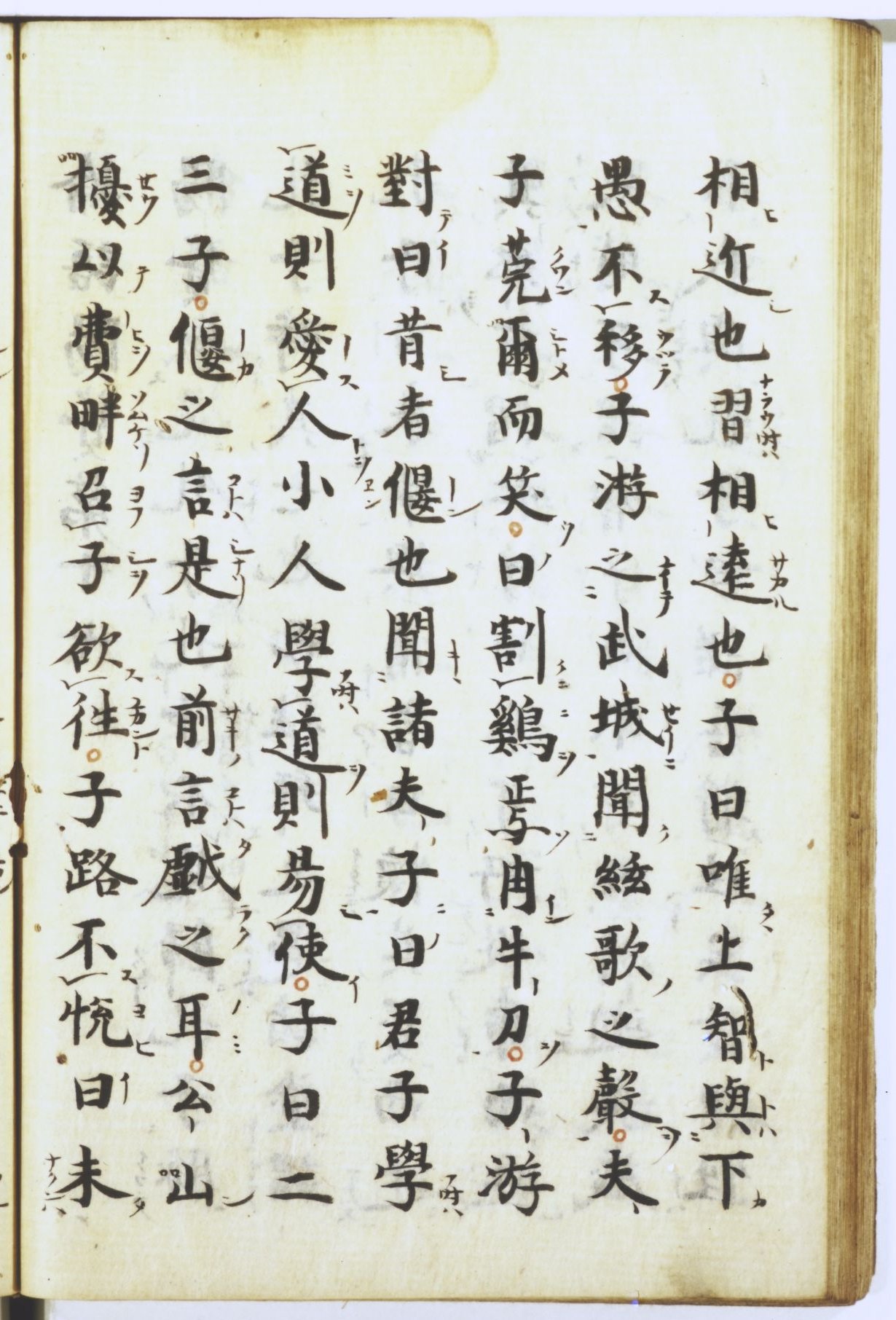
Kyoto University Library RB00007936, IIIF canvas 80, right-hand page: 7 written columns of up to 14 characters, main text only, with Japanese reading marks. Checked on the image: the first column of this book's text on this page begins ‹相近也›, the last begins ‹擾以費›. 17.3 begins inside column 1 (the column opens ‹相近也›), 7 characters down in the received text. Above it the page finishes 17.2, shown in the previous section. 17.5.2 runs on to canvas 80, left-hand page (first column ‹之也已›), where the section ends. The Chinese shown is the received text (Wikisource), not a transcription of this manuscript; Legge's English translates the received text.
3子曰:「唯上知與下愚不移
4.1也。」子之武城,聞弦歌之聲,
4.2夫子莞爾而笑,曰:「割雞焉用牛刀。」
4.3子游對曰:「昔者,偃也聞諸夫子曰:『君子學道則愛人,小人學道則易使也。』」
4.4子曰:「二三子!偃之言是也,前言戲之耳!」
5.1公山弗擾以費畔,召,子欲往。
5.2子路不說,曰:「末之也已,何必公山氏之之也。」
3The Master said, 'There are only the wise of the highest class, and the stupid of the lowest class, who cannot be changed.'
4.1The Master, having come to Wu-ch'ang, heard there the sound of stringed instruments and singing.
4.2Well pleased and smiling, he said, 'Why use an ox knife to kill a fowl?'
4.3Tsze-yu replied, 'Formerly, Master, I heard you say,-- "When the man of high station is well instructed, he loves men; when the man of low station is well instructed, he is easily ruled."'
4.4The Master said, 'My disciples, Yen's words are right. What I said was only in sport.'
5.1Kung-shan Fu-zao, when he was holding Pi, and in an attitude of rebellion, invited the Master to visit him, who was rather inclined to go.
5.2Tsze-lu was displeased, and said, 'Indeed, you cannot go! Why must you think of going to see Kung-shan?'
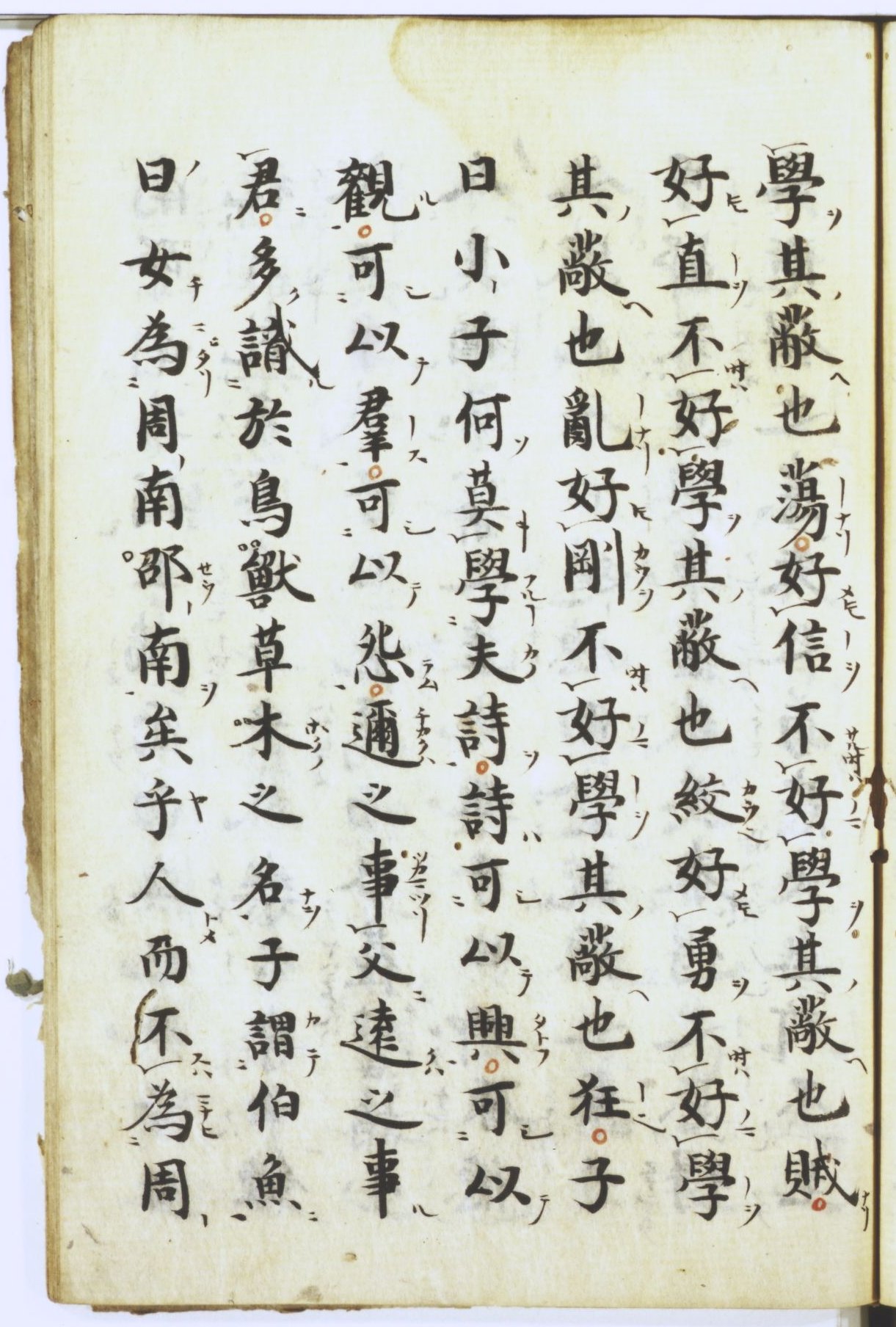
Where on the image
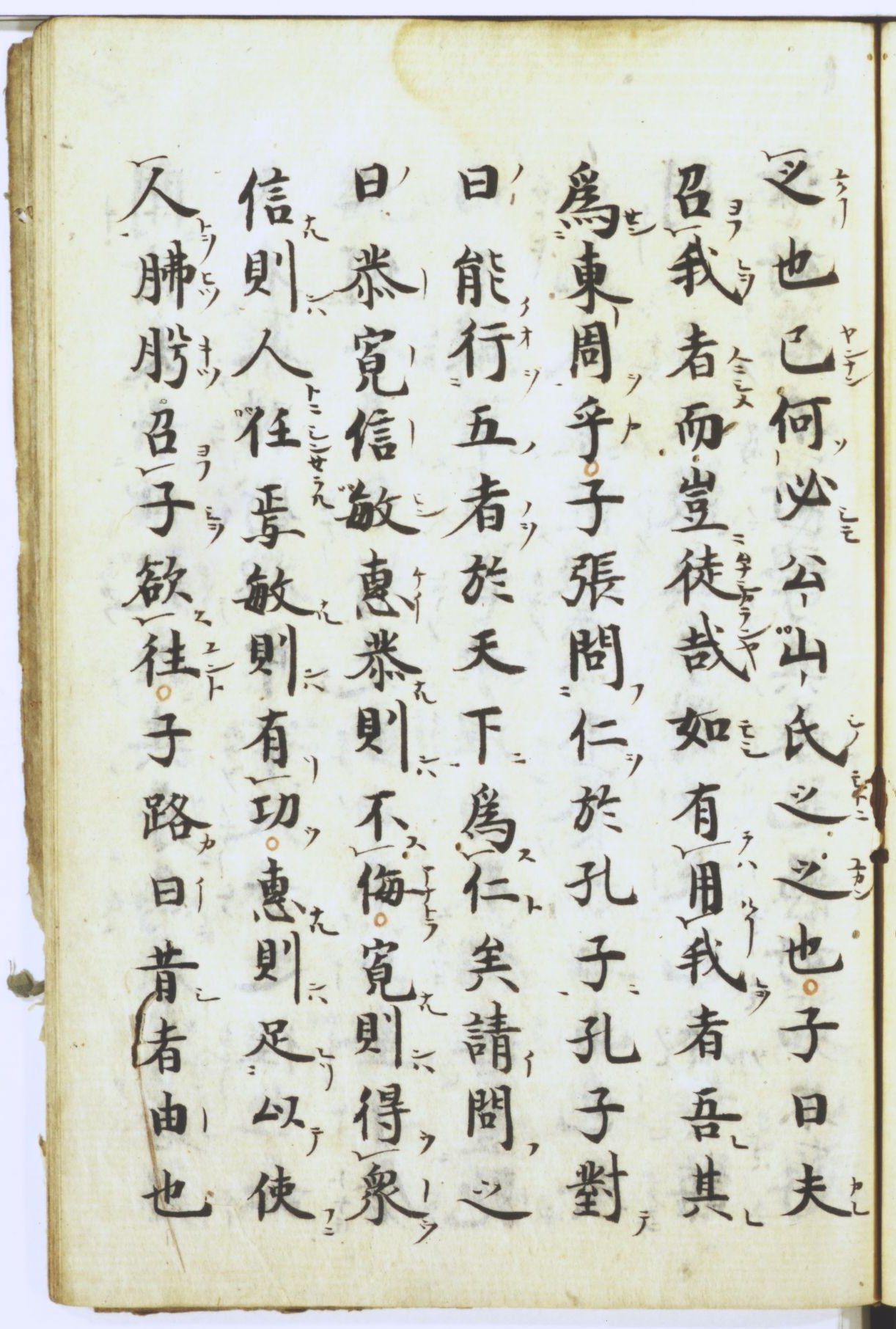
Kyoto University Library RB00007936, IIIF canvas 80, left-hand page: 7 written columns of up to 14 characters, main text only, with Japanese reading marks. Checked on the image: the first column of this book's text on this page begins ‹之也已›, the last begins ‹人佛肸›. 17.5.3 begins inside column 1 (the column opens ‹之也已›), 11 characters down in the received text. Above it the page finishes 17.5.2, shown in the previous section. 17.7.2 runs on to canvas 81, right-hand page (first column ‹聞諸夫›), where the section ends. The Chinese shown is the received text (Wikisource), not a transcription of this manuscript; Legge's English translates the received text.
5.3子曰:「夫召我者,而豈徒哉?如有用我者,吾其爲東周乎!」
6子張問「仁」於孔子。孔子曰:「能行五者於天下,爲仁矣。」「請問之?」曰:「恭、寬、信、敏、惠。恭則不侮,寬則得眾,信則人任焉,敏則有功,惠則足以使人。」
7.1佛肸召,子欲往。
7.2子路曰:「昔者由也聞諸夫子曰:『親於其身爲不善者,君子不入也。』佛肸以中牟畔,子之往也,如之何?」
5.3The Master said, 'Can it be without some reason that he has invited ME? If any one employ me, may I not make an eastern Chau?'
6Tsze-chang asked Confucius about perfect virtue. Confucius said, 'To be able to practise five things everywhere under heaven constitutes perfect virtue.' He begged to ask what they were, and was told, 'Gravity, generosity of soul, sincerity, earnestness, and kindness. If you are grave, you will not be treated with disrespect. If you are generous, you will win all. If you are sincere, people will repose trust in you. If you are earnest, you will accomplish much. If you are kind, this will enable you to employ the services of others.
7.1Pi Hsi inviting him to visit him, the Master was inclined to go.
7.2Tsze-lu said, 'Master, formerly I have heard you say, "When a man in his own person is guilty of doing evil, a superior man will not associate with him." Pi Hsi is in rebellion, holding possession of Chung-mau; if you go to him, what shall be said?'
Where on the image
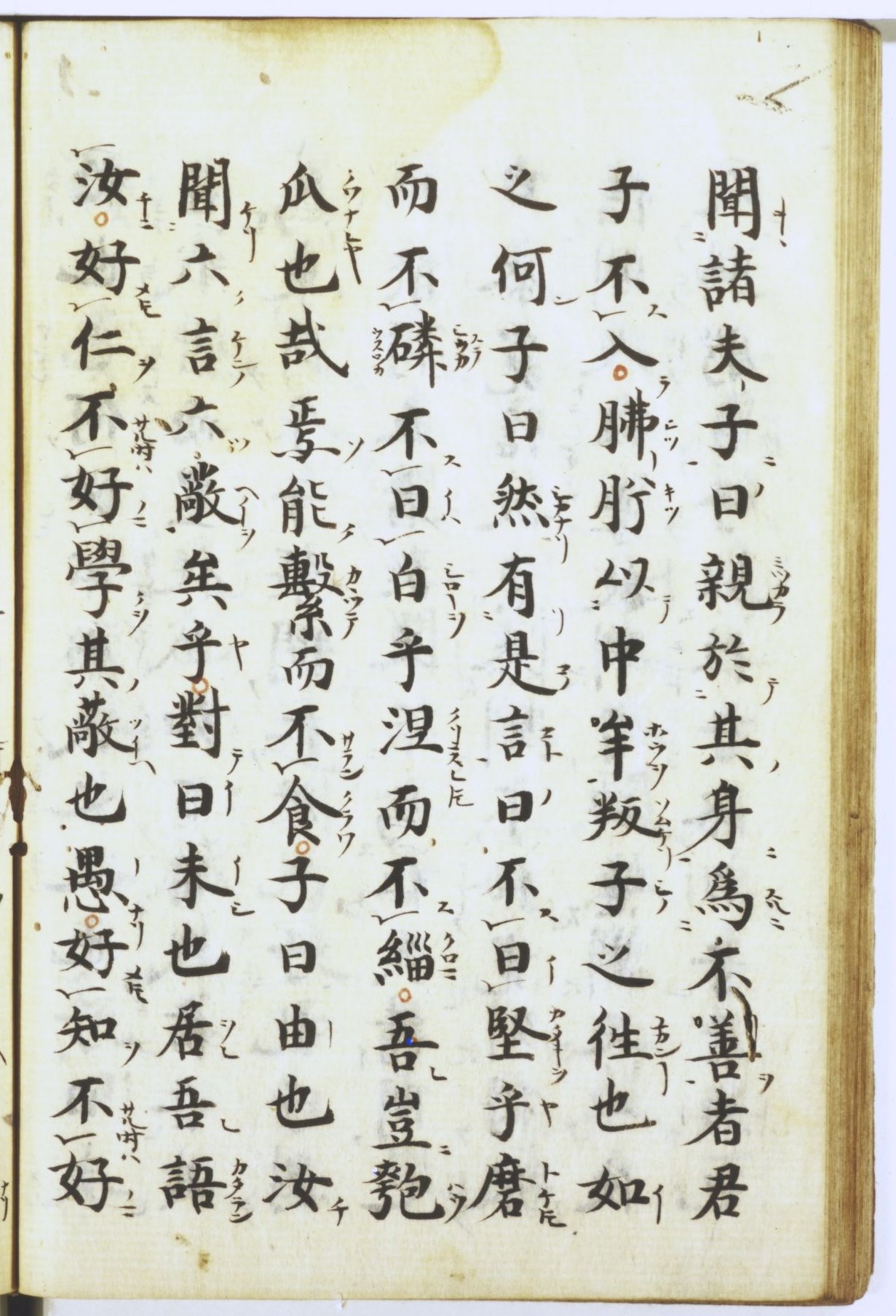
Kyoto University Library RB00007936, IIIF canvas 81, right-hand page: 7 written columns of up to 14 characters, main text only, with Japanese reading marks. Checked on the image: the first column of this book's text on this page begins ‹聞諸夫›, the last begins ‹汝好仁›. 17.7.3 begins inside column 3 (the column opens ‹之何子›), 2 characters down in the received text. Above it the page finishes 17.7.2, shown in the previous section. 17.8.3 runs on to canvas 81, left-hand page (first column ‹學其蔽›), where the section ends. The Chinese shown is the received text (Wikisource), not a transcription of this manuscript; Legge's English translates the received text.
7.3子曰:「然,有是言也。不曰堅乎?磨而不磷。不曰白乎?涅而不緇。
7.4吾豈匏瓜也哉?焉能繫而不食!」
8.1子曰:「由也,女聞『六言六蔽』矣乎?」對曰:「未也。」
8.2「居!吾語女。
8.3好仁不好學,其蔽也愚;好知不好學,其蔽也蕩;好信不好學,其蔽也賊;好直不好學,其蔽也絞;好勇不好學,其蔽也亂;好剛不好學,其蔽也狂。」
7.3The Master said, 'Yes, I did use these words. But is it not said, that, if a thing be really hard, it may be ground without being made thin? Is it not said, that, if a thing be really white, it may be steeped in a dark fluid without being made black?
7.4'Am I a bitter gourd! How can I be hung up out of the way of being eaten?'
8.1The Master said, 'Yu, have you heard the six words to which are attached six becloudings?' Yu replied, 'I have not.'
8.2'Sit down, and I will tell them to you.
8.3'There is the love of being benevolent without the love of learning;-- the beclouding here leads to a foolish simplicity. There is the love of knowing without the love of learning;-- the beclouding here leads to dissipation of mind. There is the love of being sincere without the love of learning;-- the beclouding here leads to an injurious disregard of consequences. There is the love of straightforwardness without the love of learning;-- the beclouding here leads to rudeness. There is the love of boldness without the love of learning;-- the beclouding here leads to insubordination. There is the love of firmness without the love of learning;-- the beclouding here leads to extravagant conduct.'
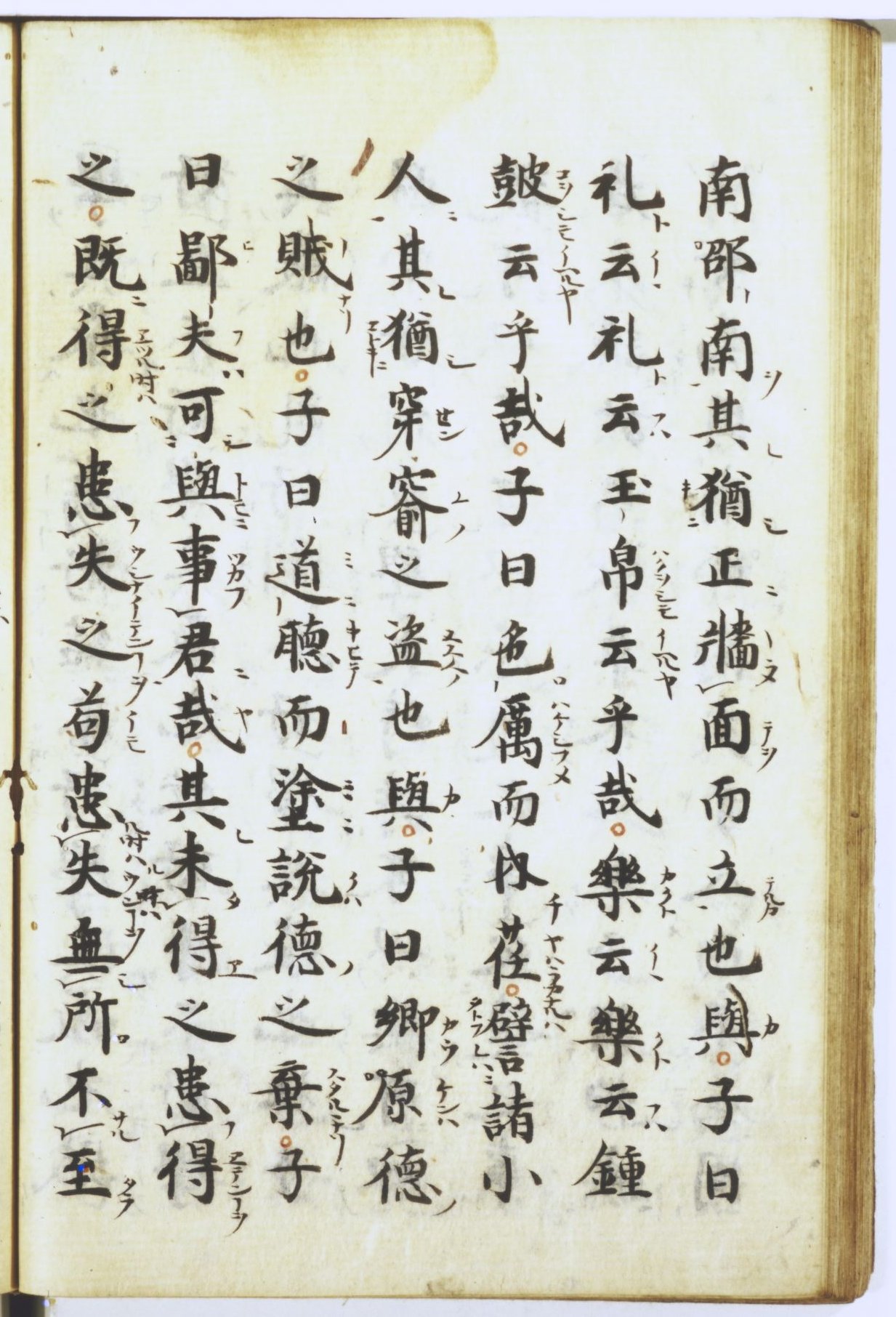
Where on the image
Kyoto University Library RB00007936, IIIF canvas 81, left-hand page: 7 written columns of up to 14 characters, main text only, with Japanese reading marks. Checked on the image: the first column of this book's text on this page begins ‹學其蔽›, the last begins ‹曰女為›. 17.9.1 begins inside column 3 (the column opens ‹其蔽也›), 13 characters down in the received text. Above it the page finishes 17.8.3, shown in the previous section. 17.10 runs on to canvas 82, right-hand page (first column ‹南召南›), where the section ends. The Chinese shown is the received text (Wikisource), not a transcription of this manuscript; Legge's English translates the received text.
9.1子曰:「小子!何莫學夫《詩》?
9.2《詩》可以興,
9.3可以觀,
9.4可以群,
9.5可以怨;
9.6邇之事父,遠之事君;
9.7多識於鳥獸草木之名。」
10子謂伯魚曰:「女爲周南召南矣乎?人而不爲周南召南,其猶正牆面而立也與!」
9.1The Master said, 'My children, why do you not study the Book of Poetry?
9.2'The Odes serve to stimulate the mind.
9.3'They may be used for purposes of self-contemplation.
9.4'They teach the art of sociability.
9.5'They show how to regulate feelings of resentment.
9.6'From them you learn the more immediate duty of serving one's father, and the remoter one of serving one's prince.
9.7'From them we become largely acquainted with the names of birds, beasts, and plants.'
10The Master said to Po-yu, 'Do you give yourself to the Chau-nan and the Shao-nan. The man who has not studied the Chau-nan and the Shao-nan, is like one who stands with his face right against a wall. Is he not so?'
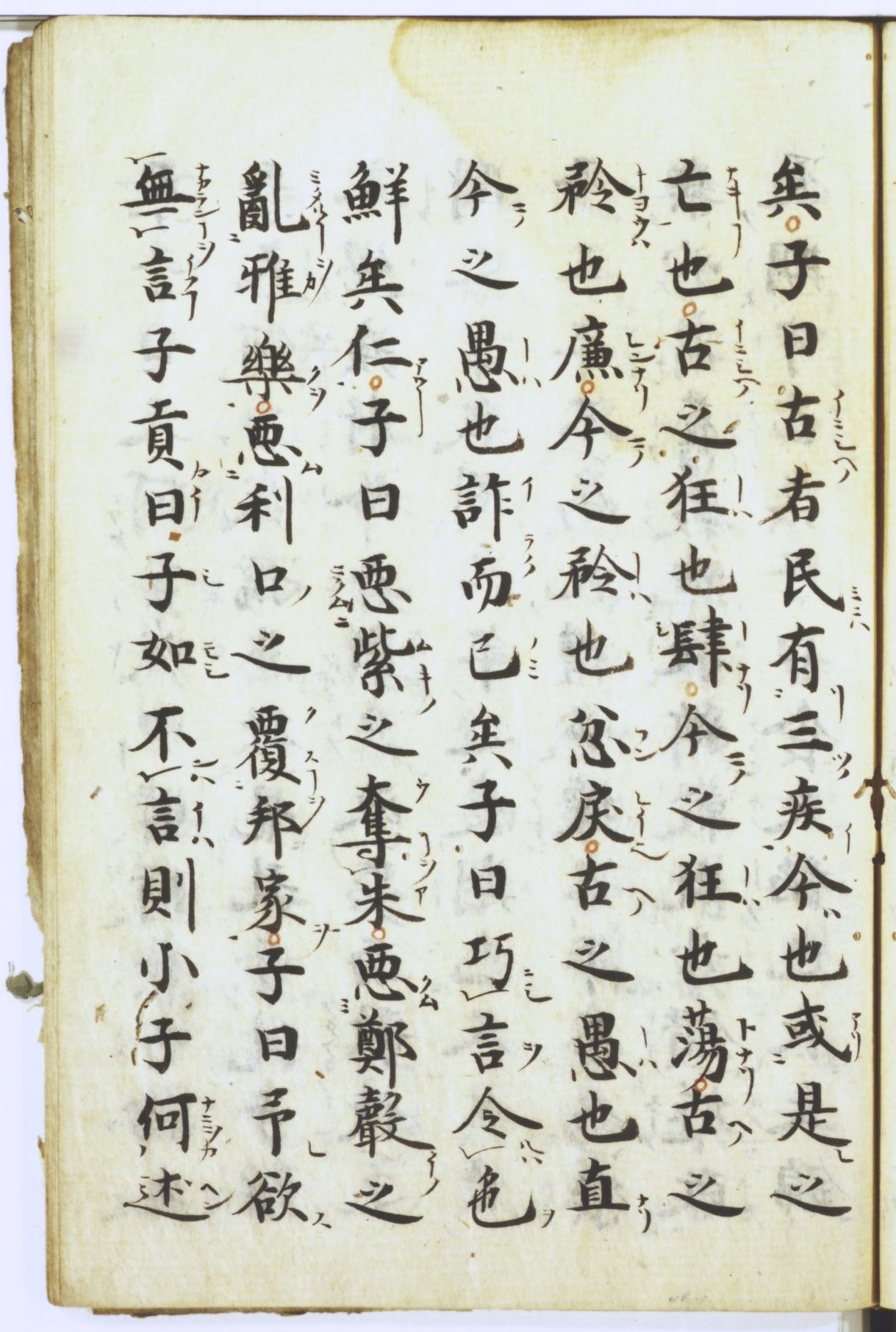
Where on the image
Kyoto University Library RB00007936, IIIF canvas 82, right-hand page: 7 written columns of up to 14 characters, main text only, with Japanese reading marks. Checked on the image: the first column of this book's text on this page begins ‹南召南›, the last begins ‹之既得›. 17.11 begins inside column 1 (the column opens ‹南召南›), 12 characters down in the received text. Above it the page finishes 17.10, shown in the previous section. 17.15.3 runs on to canvas 82, left-hand page (first column ‹矣子曰›), where the section ends. The Chinese shown is the received text (Wikisource), not a transcription of this manuscript; Legge's English translates the received text.
11子曰:「禮云禮云,玉帛云乎哉?樂云樂云!鐘鼓云乎哉?」
12子曰:「色厲而內荏,譬諸小人,其猶穿窬之盜也與?」
13子曰:「鄉原,德之賊也。」
14子曰:「道聽而塗說,德之棄也。」
15.1子曰:「鄙夫!可與事君也與哉?
15.2其未得之也,患得之;既得之,患失之。
15.3苟患失之,無所不至矣!」
11The Master said, '"It is according to the rules of propriety," they say.-- "It is according to the rules of propriety," they say. Are gems and silk all that is meant by propriety? "It is music," they say.-- "It is music," they say. Are bells and drums all that is meant by music?'
12The Master said, 'He who puts on an appearance of stern firmness, while inwardly he is weak, is like one of the small, mean people;-- yea, is he not like the thief who breaks through, or climbs over, a wall?'
13The Master said, 'Your good, careful people of the villages are the thieves of virtue.'
14The Master said, 'To tell, as we go along, what we have heard on the way, is to cast away our virtue.'
15.1The Master said, 'There are those mean creatures! How impossible it is along with them to serve one's prince!
15.2'While they have not got their aims, their anxiety is how to get them. When they have got them, their anxiety is lest they should lose them.
15.3'When they are anxious lest such things should be lost, there is nothing to which they will not proceed.'
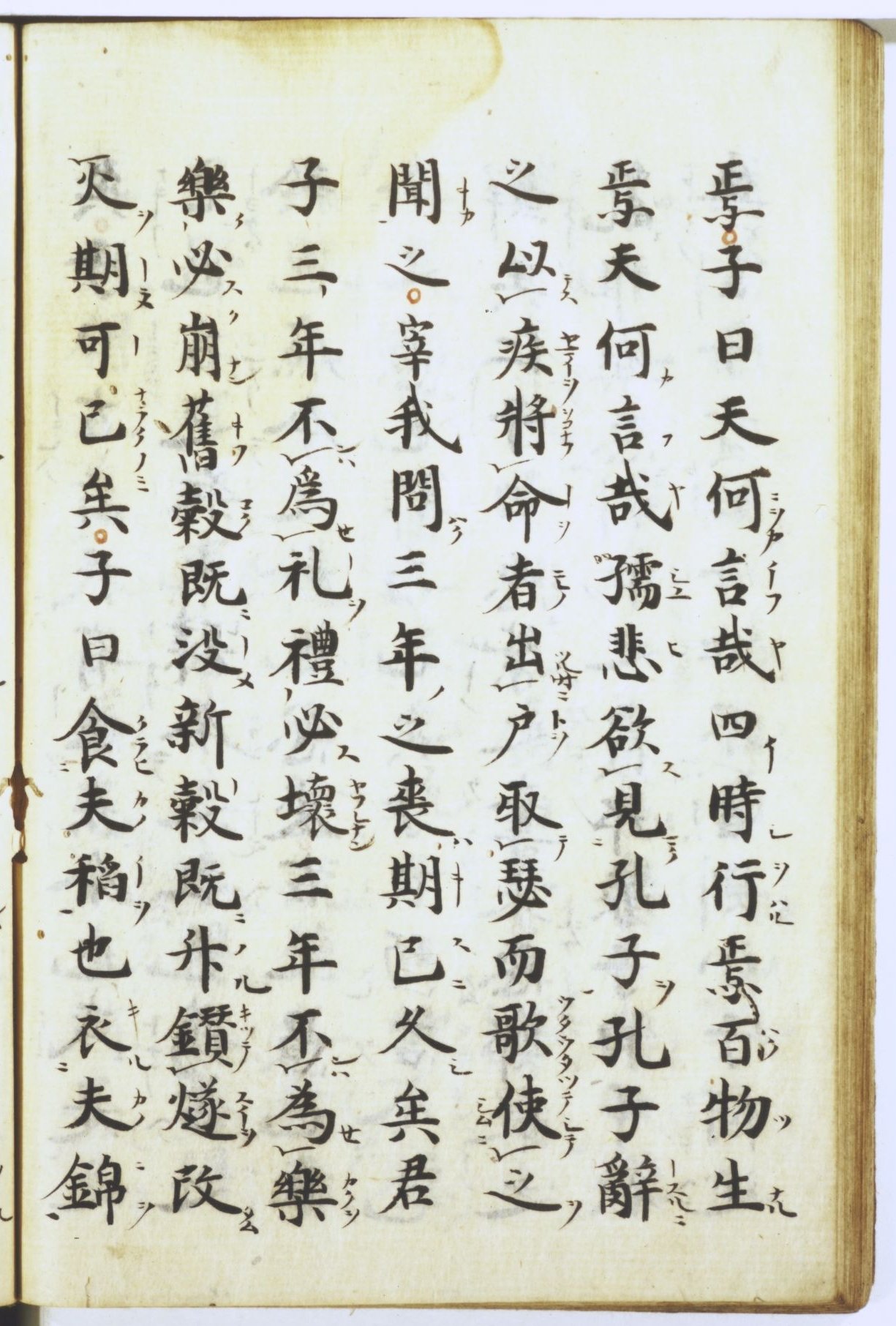
Where on the image
Kyoto University Library RB00007936, IIIF canvas 82, left-hand page: 7 written columns of up to 14 characters, main text only, with Japanese reading marks. Checked on the image: the first column of this book's text on this page begins ‹矣子曰›, the last begins ‹無言子›. 17.16.1 begins inside column 1 (the column opens ‹矣子曰›), 1 characters down in the received text. Above it the page finishes 17.15.3, shown in the previous section. 17.19.2 runs on to canvas 83, right-hand page (first column ‹焉子曰›), where the section ends. The Chinese shown is the received text (Wikisource), not a transcription of this manuscript; Legge's English translates the received text.
16.1子曰:「古者民有三疾,今也或是之亡也。
16.2古之狂也肆,今之狂也蕩;古之矜也廉,今之矜也忿戾;古之愚也直,今之愚也詐而已矣。」
17子曰:「巧言令色,鮮矣仁。」
18子曰:「惡紫之奪朱也,惡鄭聲之亂雅樂也,惡利口之覆邦家者。」
19.1子曰:「予欲無言!」
19.2子貢曰:「子如不言,則小子何述焉?」
16.1The Master said, 'Anciently, men had three failings, which now perhaps are not to be found.
16.2'The high-mindedness of antiquity showed itself in a disregard of small things; the high-mindedness of the present day shows itself in wild license. The stern dignity of antiquity showed itself in grave reserve; the stern dignity of the present day shows itself in quarrelsome perverseness. The stupidity of antiquity showed itself in straightforwardness; the stupidity of the present day shows itself in sheer deceit.'
17The Master said, 'Fine words and an insinuating appearance are seldom associated with virtue.'
18The Master said, 'I hate the manner in which purple takes away the luster of vermilion. I hate the way in which the songs of Chang confound the music of the Ya. I hate those who with their sharp mouths overthrow kingdoms and families.'
19.1The Master said, 'I would prefer not speaking.'
19.2Tsze-kung said, 'If you, Master, do not speak, what shall we, your disciples, have to record?'
Where on the image
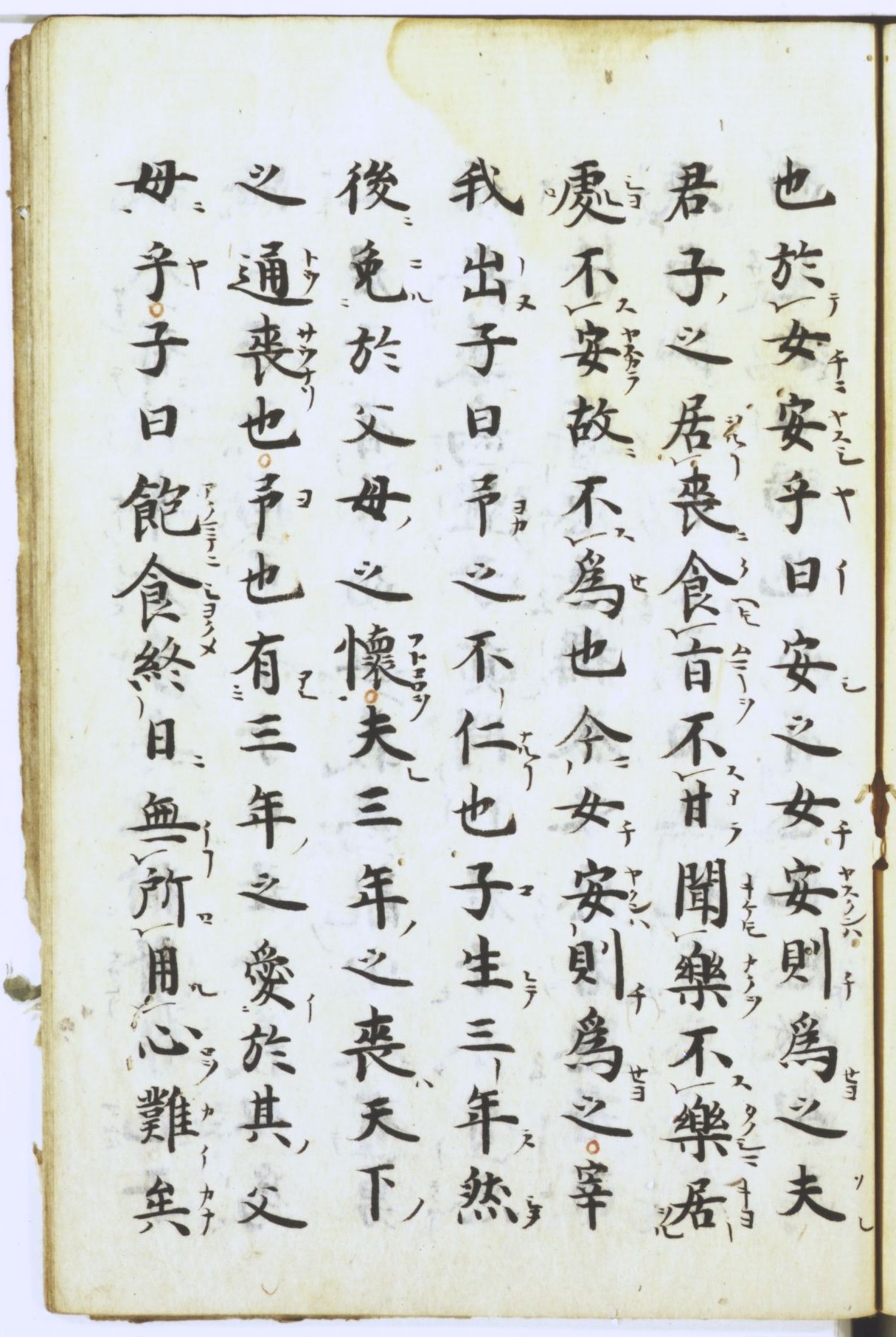
Kyoto University Library RB00007936, IIIF canvas 83, right-hand page: 7 written columns of up to 14 characters, main text only, with Japanese reading marks. Checked on the image: the first column of this book's text on this page begins ‹焉子曰›, the last begins ‹火期可›. 17.19.3 begins inside column 1 (the column opens ‹焉子曰›), 1 characters down in the received text. Above it the page finishes 17.19.2, shown in the previous section. 17.21.4 runs on to canvas 83, left-hand page (first column ‹也於女›), where the section ends. Column openings on these pages that differ from the received text: ‹之以疾› where the received text has ‹以疾將›; ‹也於女› where the received text has ‹於女安›. The Chinese shown is the received text (Wikisource), not a transcription of this manuscript; Legge's English translates the received text.
19.3子曰:「天何言哉?四時行焉,百物生焉,天何言哉?」
20孺悲欲見孔子,孔子辭以疾。將命者出戶,取瑟而歌,使之聞之。
21.1宰我問:「三年之喪,期已久矣!
21.2君子三年不爲禮,禮必壞;三年不爲樂,樂必崩。
21.3舊穀既沒,新穀既升,鑽燧改火,期可已矣。」
21.4子曰:「食夫稻,衣夫錦,於女安乎?」曰:「安!」
19.3The Master said, 'Does Heaven speak? The four seasons pursue their courses, and all things are continually being produced, but does Heaven say anything?'
20Zu Pei wished to see Confucius, but Confucius declined, on the ground of being sick, to see him. When the bearer of this message went out at the door, (the Master) took his lute and sang to it, in order that Pei might hear him.
21.1Tsai Wo asked about the three years' mourning for parents, saying that one year was long enough.
21.2'If the superior man,' said he, 'abstains for three years from the observances of propriety, those observances will be quite lost. If for three years he abstains from music, music will be ruined.
21.3'Within a year the old grain is exhausted, and the new grain has sprung up, and, in procuring fire by friction, we go through all the changes of wood for that purpose. After a complete year, the mourning may stop.'
21.4The Master said, 'If you were, after a year, to eat good rice, and wear embroidered clothes, would you feel at ease?' 'I should,' replied Wo.
Where on the image
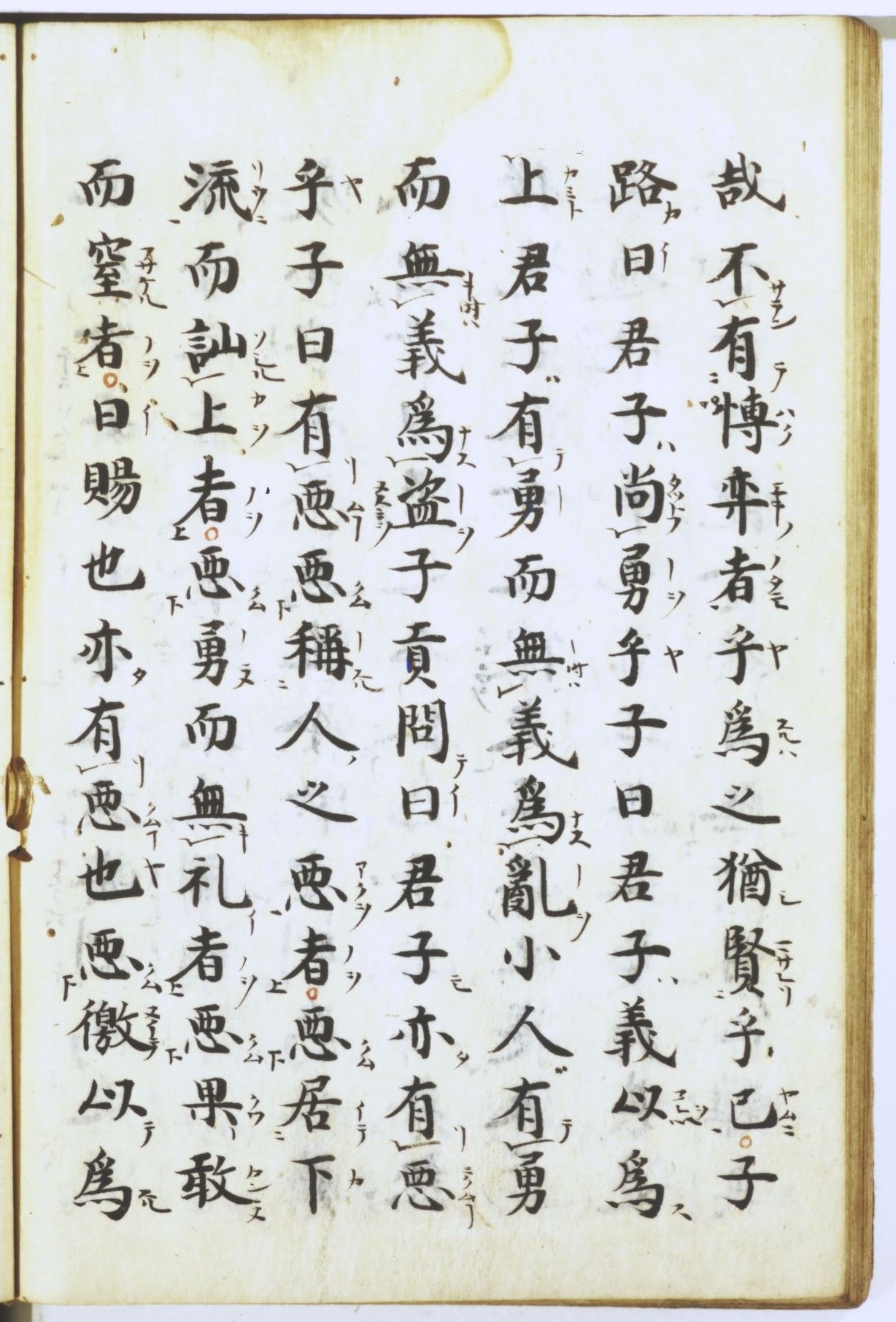
Kyoto University Library RB00007936, IIIF canvas 83, left-hand page: 7 written columns of up to 14 characters, main text only, with Japanese reading marks. Checked on the image: the first column of this book's text on this page begins ‹也於女›, the last begins ‹母乎子›. 17.21.5 begins inside column 1 (the column opens ‹也於女›), 6 characters down in the received text. Above it the page finishes 17.21.4, shown in the previous section. 17.22 runs on to canvas 84, right-hand page (first column ‹哉不有›), where the section ends. The Chinese shown is the received text (Wikisource), not a transcription of this manuscript; Legge's English translates the received text.
21.5「女安,則爲之!夫君子之居喪,食旨不甘,聞樂不樂,居處不安,故不爲也。今女安,則爲之!」
21.6宰我出。子曰:「予之不仁也!子生三年,然後免於父母之懷。夫三年之喪,天下之通喪也。予也,有三年之愛於其父母乎?」
22子曰:「飽食終日,無所用心,難矣哉!不有博弈者乎?爲之,猶賢乎已!」
21.5The Master said, 'If you can feel at ease, do it. But a superior man, during the whole period of mourning, does not enjoy pleasant food which he may eat, nor derive pleasure from music which he may hear. He also does not feel at ease, if he is comfortably lodged. Therefore he does not do what you propose. But now you feel at ease and may do it.'
21.6Tsai Wo then went out, and the Master said, 'This shows Yu's want of virtue. It is not till a child is three years old that it is allowed to leave the arms of its parents. And the three years' mourning is universally observed throughout the empire. Did Yu enjoy the three years' love of his parents?'
22The Master said, 'Hard is it to deal with him, who will stuff himself with food the whole day, without applying his mind to anything good! Are there not gamesters and chess players? To be one of these would still be better than doing nothing at all.'
Where on the image
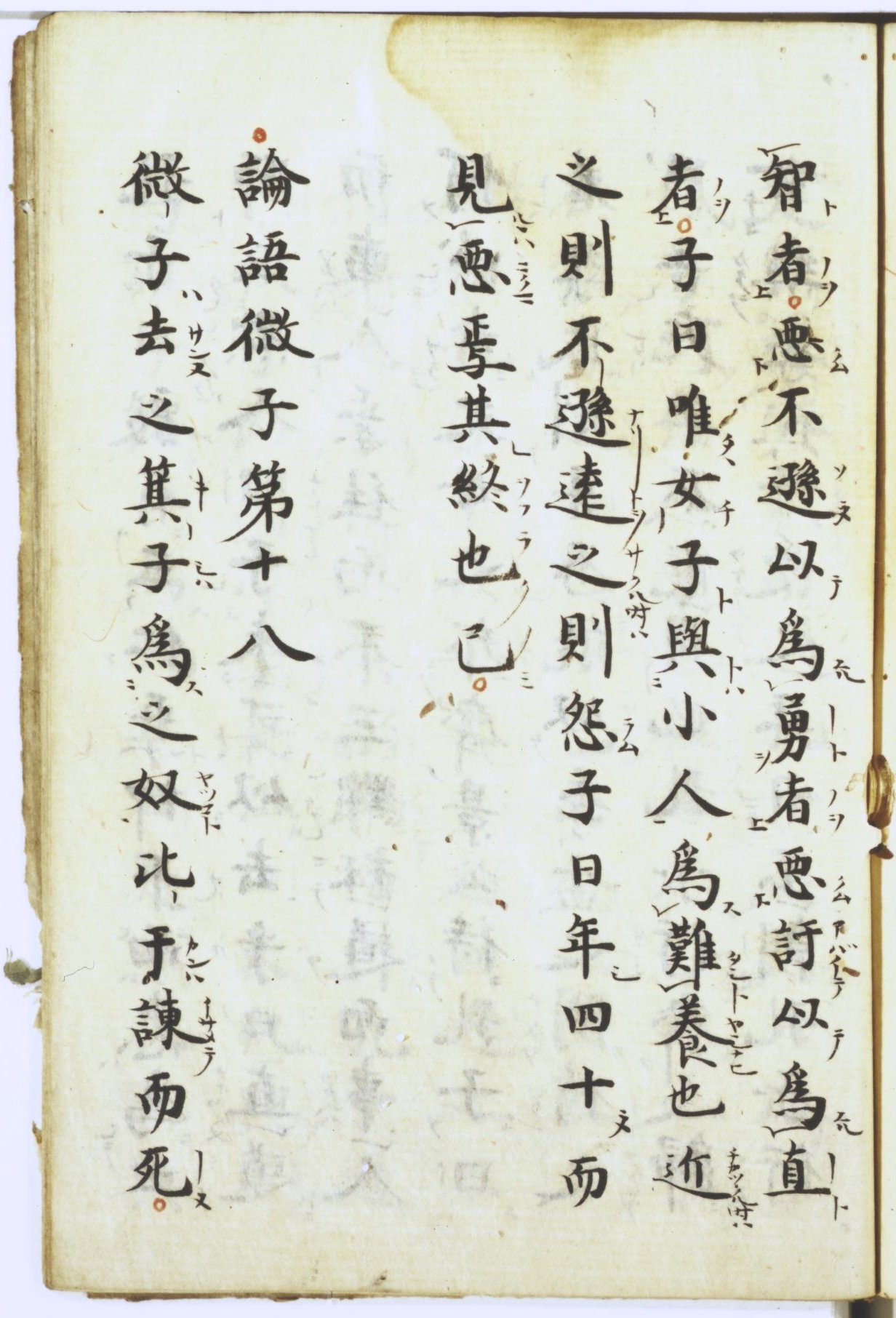
Kyoto University Library RB00007936, IIIF canvas 84, right-hand page: 7 written columns of up to 14 characters, main text only, with Japanese reading marks. Checked on the image: the first column of this book's text on this page begins ‹哉不有›, the last begins ‹而窒者›. 17.23 begins inside column 1 (the column opens ‹哉不有›), 13 characters down in the received text. Above it the page finishes 17.22, shown in the previous section. 17.24.2 runs on to canvas 84, left-hand page (first column ‹智者惡›), where the section ends. The Chinese shown is the received text (Wikisource), not a transcription of this manuscript; Legge's English translates the received text.
23子路曰:「君子尙勇乎?」子曰:「君子義以爲上。君子有勇而無義爲亂,小人有勇而無義爲盜。」
24.1子貢曰:「君子亦有惡乎?」子曰:「有惡,惡稱人之惡者,惡居下流而訕上者,惡勇而無禮者,惡果敢而窒者。」
24.2曰:「賜也亦有惡乎?」「惡徼以爲知者,惡不孫以爲勇者,惡訐以爲直者。」
23Tsze-lu said, 'Does the superior man esteem valour?' The Master said, 'The superior man holds righteousness to be of highest importance. A man in a superior situation, having valour without righteousness, will be guilty of insubordination; one of the lower people having valour without righteousness, will commit robbery.'
24.1Tsze-kung said, 'Has the superior man his hatreds also?' The Master said, 'He has his hatreds. He hates those who proclaim the evil of others. He hates the man who, being in a low station, slanders his superiors. He hates those who have valour merely, and are unobservant of propriety. He hates those who are forward and determined, and, at the same time, of contracted understanding.'
24.2The Master then inquired, 'Ts'ze, have you also your hatreds?' Tsze-kung replied, 'I hate those who pry out matters, and ascribe the knowledge to their wisdom. I hate those who are only not modest, and think that they are valourous. I hate those who make known secrets, and think that they are straightforward.'
Where on the image
Kyoto University Library RB00007936, IIIF canvas 84, left-hand page: 6 written columns of up to 14 characters, main text only, with Japanese reading marks. Checked on the image: the first column of this book's text on this page begins ‹智者惡›, the last begins ‹見惡焉›. Column 6 carries the title 論語微子第十八. 17.25 begins inside column 2 (the column opens ‹者子曰›), 1 characters down in the received text. Above it the page finishes 17.24.2, shown in the previous section. The section ends on this page. The Chinese shown is the received text (Wikisource), not a transcription of this manuscript; Legge's English translates the received text.
25子曰:「唯女子與小人爲難養也!近之則不孫,遠之則怨。」
26子曰:「年四十而見惡焉,其終也已。」
25The Master said, 'Of all people, girls and servants are the most difficult to behave to. If you are familiar with them, they lose their humility. If you maintain a reserve towards them, they are discontented.'
26The Master said, 'When a man at forty is the object of dislike, he will always continue what he is.'
Notes
- English: James Legge, Confucian Analects, The Chinese Classics vol. 1. Legge's chapter and paragraph numbers are kept as superscripts (chapter.paragraph).
- Legge translated the received text. Where this manuscript's wording differs, his English follows the received text shown here.
Cite
Sources
- Source: Kyoto University Library RB00007936 (Analects manuscript attributed to Kiyohara Yoshieda, c. 1300) + Wikisource received text + James Legge's English (Project Gutenberg) (holding institution)
- Critical edition: Received text (Wikisource) in Legge's chapter and paragraph division
← previous · → next · v cycle view · l back to library