Analects, Book 18: Weizi 微子 (Kamakura-period manuscript)
Introduction
Book 18 of the Analects (論語 Lunyu), titled 微子 (Weizi) after its opening words, 11 chapters in Legge's division. It is shown on a manuscript of the Analects in the Kiyohara family collection (Seike bunko) of Kyoto University Library, two volumes in regular script, seven columns of fourteen characters to the page, main text only, with red and black Japanese reading marks. A colophon by Kiyohara Edakata dated 1550 names the copyist as his ancestor Kiyohara Yoshieda (1253-1331), which places the copy around 1300, in the late Kamakura period; the attribution is traditional. The Kiyohara were hereditary readers of the Confucian classics at the Japanese court, and their text descends from the edition of the Analects with the collected commentary of He Yan (3rd century CE): after each pair of books the scribe copied the character counts of the classic and of the commentary, although only the classic is written out. The manuscript is an Important Cultural Property of Japan.
In this copy Book 18 runs from canvas 84, left-hand page to canvas 88, right-hand page (volume 2). Each section gathers the paragraphs that begin on one page, numbered by chapter and paragraph as in Legge, and links to that page and to any page the last paragraph runs onto. The page boundaries were found by reading the first characters of every column on the photographs. The Chinese shown is the received text, from Wikisource. This manuscript differs from it in places, most often by an added or missing particle (也, 矣, 焉) or a variant character form; the differences seen at column openings are listed in the scan notes. The English is James Legge's translation of the received text.
How was this verified? (Provenance)
Where on the image
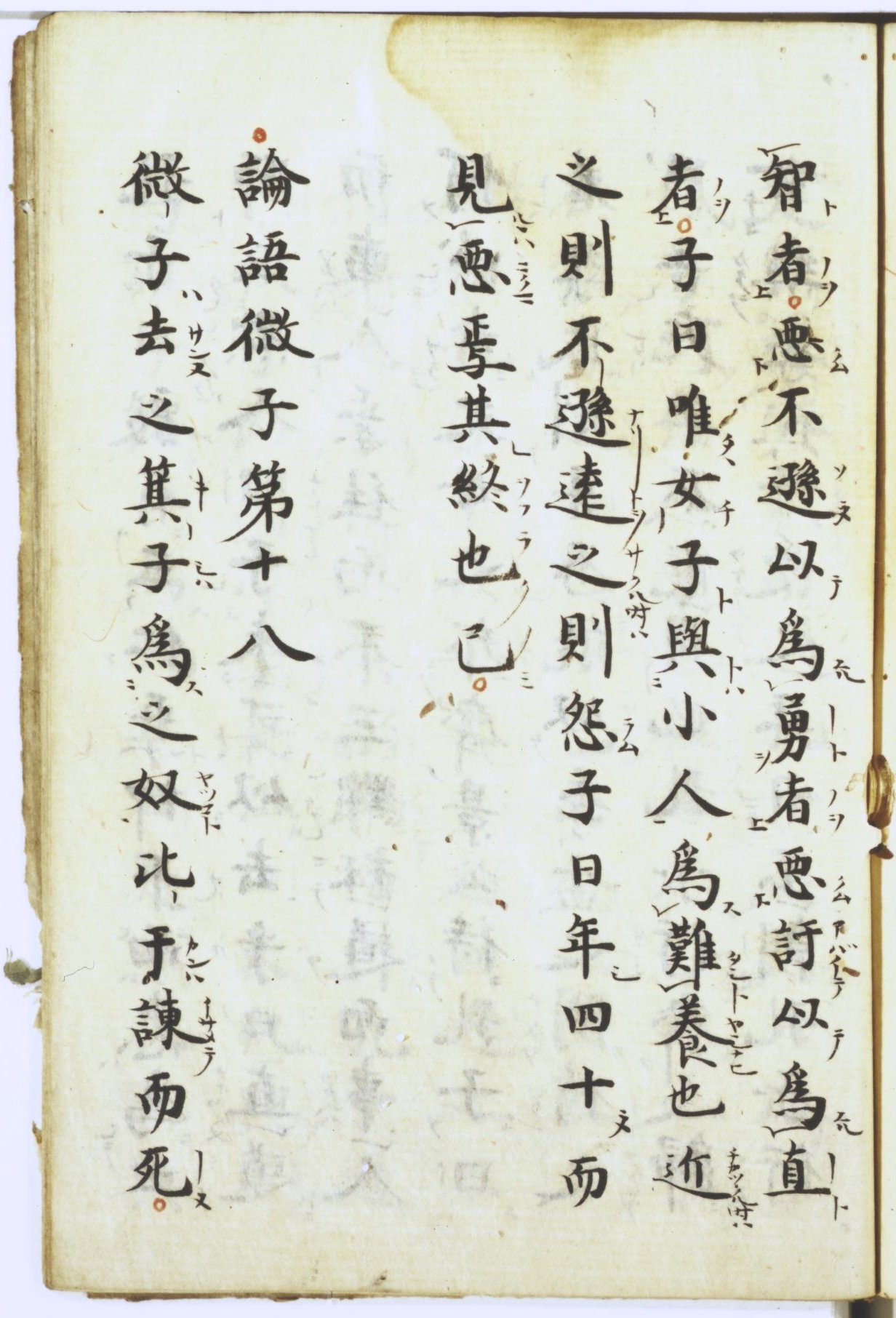
Kyoto University Library RB00007936, IIIF canvas 84, left-hand page: 6 written columns of up to 14 characters, main text only, with Japanese reading marks. Checked on the image: the first column of this book's text on this page begins ‹微子去›. Column 6 carries the title 論語微子第十八. 18.1.1 opens column 7. The section ends on this page. The Chinese shown is the received text (Wikisource), not a transcription of this manuscript; Legge's English translates the received text.
1.1微子去之,箕子爲之奴,比干諫而死。
1.1The Viscount of Wei withdrew from the court. The Viscount of Chi became a slave to Chau. Pi-kan remonstrated with him and died.
Where on the image
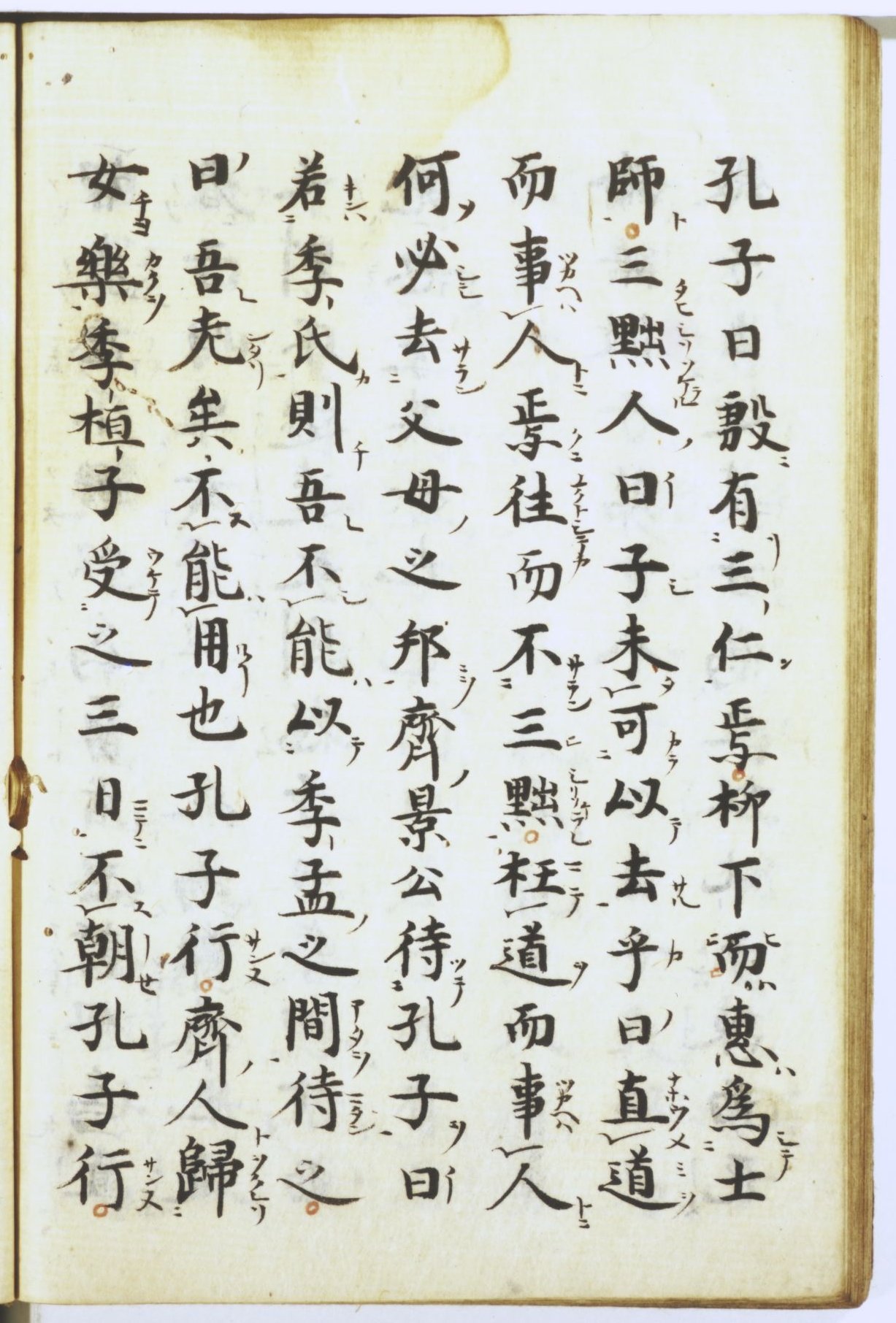
Kyoto University Library RB00007936, IIIF canvas 85, right-hand page: 7 written columns of up to 14 characters, main text only, with Japanese reading marks. Checked on the image: the first column of this book's text on this page begins ‹孔子曰›, the last begins ‹女樂季›. 18.1.2 opens column 1. The section ends on this page. The Chinese shown is the received text (Wikisource), not a transcription of this manuscript; Legge's English translates the received text.
1.2孔子曰:「殷有三仁焉。」
2柳下惠爲士師,三黜。人曰:「子未可以去乎?」曰:「直道而事人,焉往而不三黜?枉道而事人,何必去父母之邦?」
3齊景公待孔子,曰:「若季氏則吾不能,以季、孟之閒待之。」曰:「吾老矣,不能用也。」孔子行。
4齊人歸女樂,季桓子受之,三日不朝。孔子行。
1.2Confucius said, 'The Yin dynasty possessed these three men of virtue.'
2Hui of Liu-hsia being chief criminal judge, was thrice dismissed from his office. Some one said to him, 'Is it not yet time for you, sir, to leave this?' He replied, 'Serving men in an upright way, where shall I go to, and not experience such a thrice- repeated dismissal? If I choose to serve men in a crooked way, what necessity is there for me to leave the country of my parents?'
3The duke Ching of Ch'i, with reference to the manner in which he should treat Confucius, said, 'I cannot treat him as I would the chief of the Chi family. I will treat him in a manner between that accorded to the chief of the Chi, and that given to the chief of the Mang family.' He also said, 'I am old; I cannot use his doctrines.' Confucius took his departure.
4The people of Ch'i sent to Lu a present of female musicians, which Chi Hwan received, and for three days no court was held. Confucius took his departure.
Where on the image
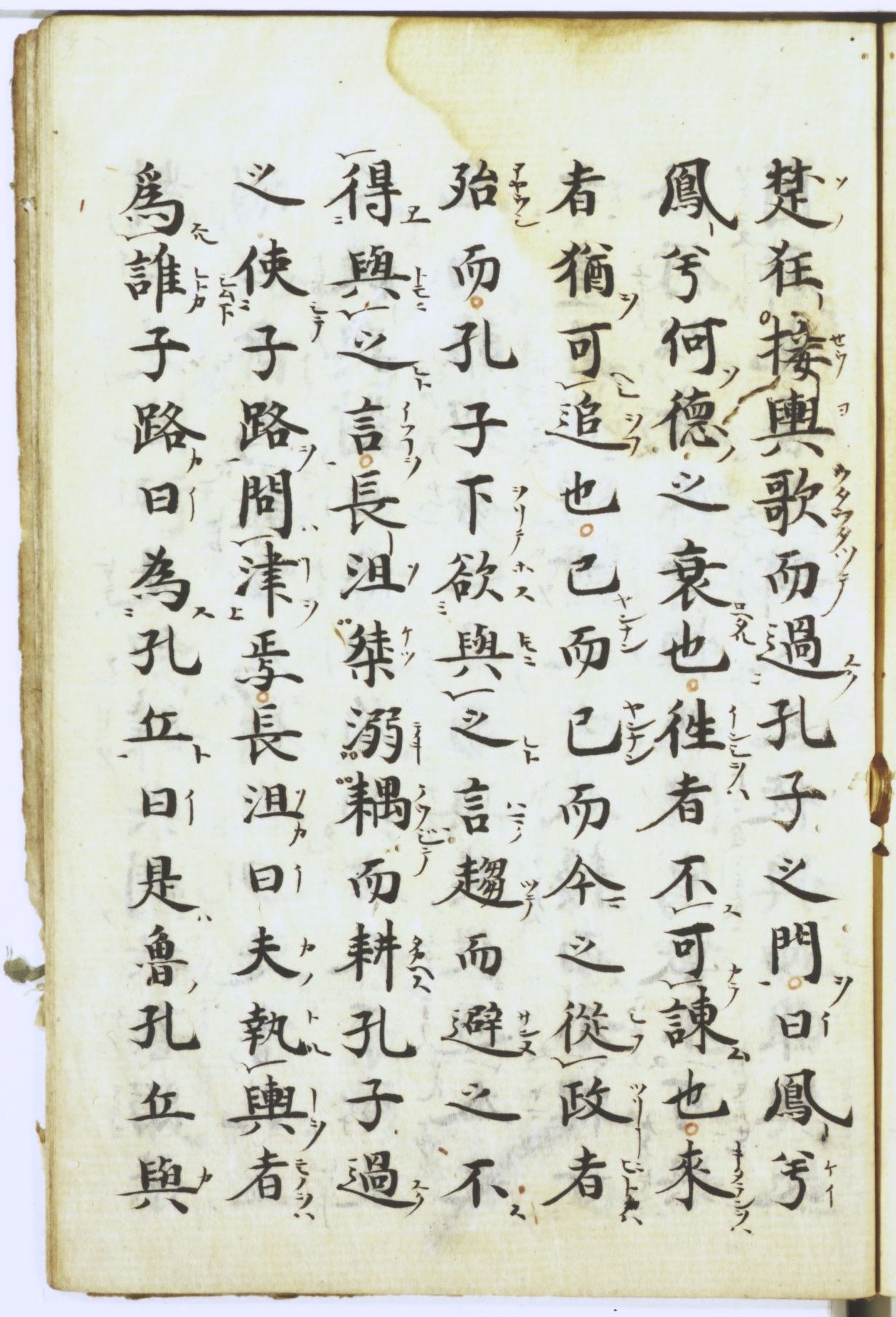
Kyoto University Library RB00007936, IIIF canvas 85, left-hand page: 7 written columns of up to 14 characters, main text only, with Japanese reading marks. Checked on the image: the first column of this book's text on this page begins ‹楚狂接›, the last begins ‹為誰子›. 18.5.1 opens column 1. 18.6.2 runs on to canvas 86, right-hand page (first column ‹對曰是›), where the section ends. Column openings on these pages that differ from the received text: ‹對曰是› where the received text has ‹曰是也›. The Chinese shown is the received text (Wikisource), not a transcription of this manuscript; Legge's English translates the received text.
5.1楚狂接輿,歌而過孔子,曰:「鳳兮!鳳兮!何德之衰?往者不可諫,來者猶可追。已而!已而!今之從政者殆而!」
5.2孔子下,欲與之言。趨而辟之,不得與之言。
6.1長沮、桀溺耦而耕。孔子過之,使子路問津焉。
6.2長沮曰:「夫執輿者爲誰?」子路曰:「爲孔丘。」曰:「是魯孔丘與?」曰:「是也。」曰:「是知津矣!」
5.1The madman of Ch'u, Chieh-yu, passed by Confucius, singing and saying, 'O FANG! O FANG! How is your virtue degenerated! As to the past, reproof is useless; but the future may still be provided against. Give up your vain pursuit. Give up your vain pursuit. Peril awaits those who now engage in affairs of government.'
5.2Confucius alighted and wished to converse with him, but Chieh-yu hastened away, so that he could not talk with him.
6.1Ch'ang-tsu and Chieh-ni were at work in the field together, when Confucius passed by them, and sent Tsze-lu to inquire for the ford.
6.2Ch'ang-tsu said, 'Who is he that holds the reins in the carriage there?' Tsze-lu told him, 'It is K'ung Ch'iu.' 'Is it not K'ung Ch'iu of Lu?' asked he. 'Yes,' was the reply, to which the other rejoined, 'He knows the ford.'
Where on the image
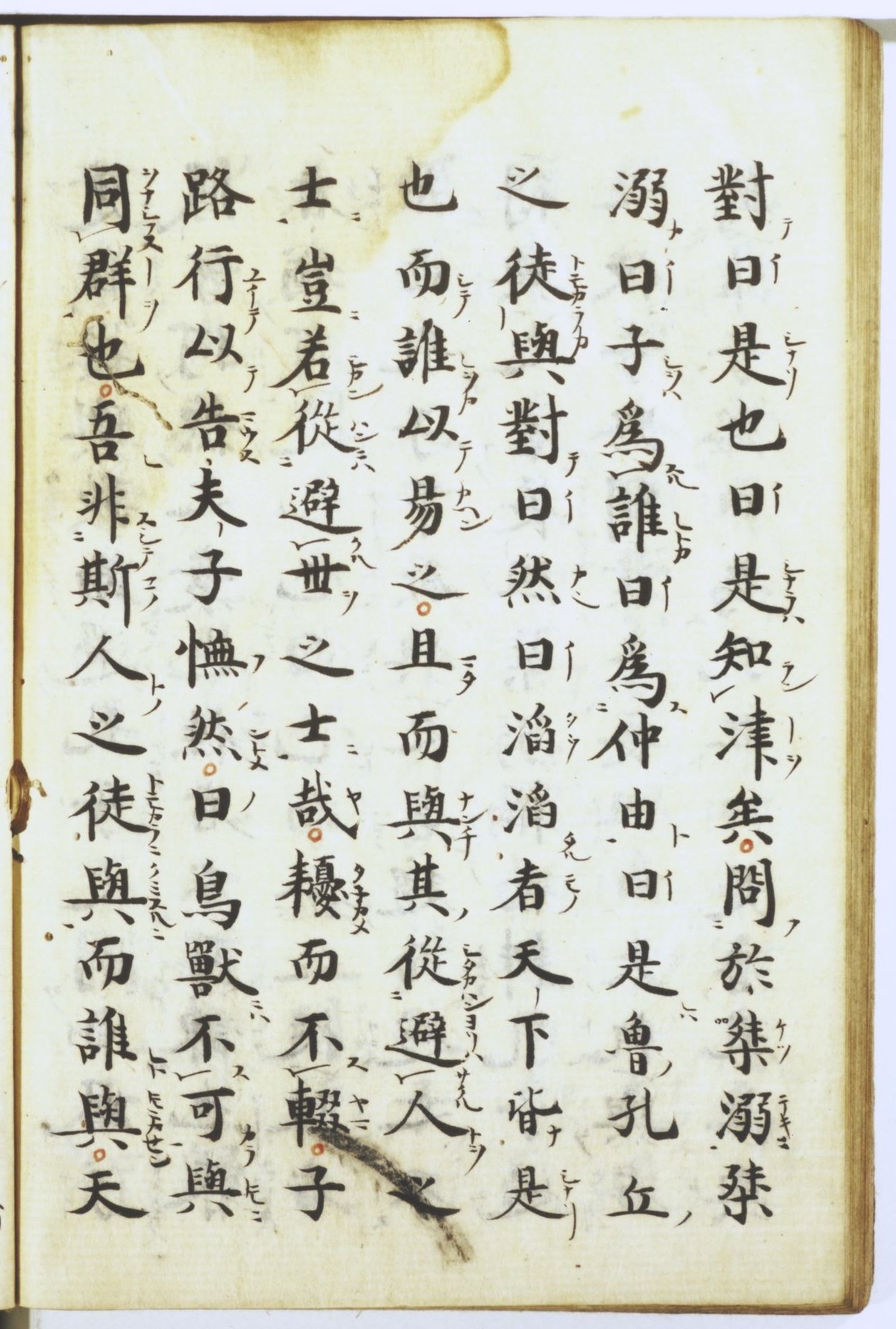
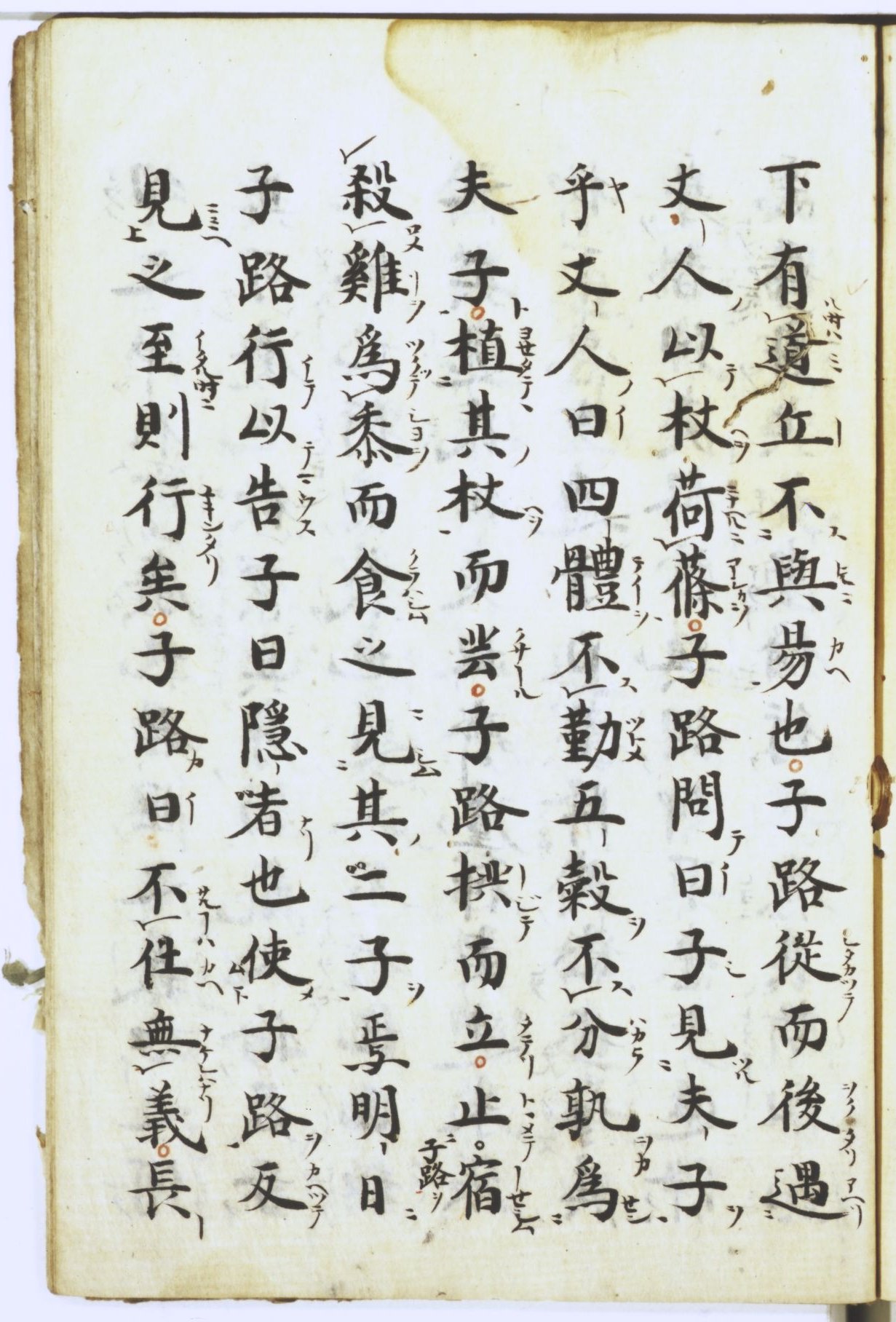
Kyoto University Library RB00007936, IIIF canvas 86, right-hand page: 7 written columns of up to 14 characters, main text only, with Japanese reading marks. Checked on the image: the first column of this book's text on this page begins ‹對曰是›, the last begins ‹同群也›. 18.6.3 begins inside column 1 (the column opens ‹對曰是›), 8 characters down in the received text. Above it the page finishes 18.6.2, shown in the previous section. 18.6.4 runs on to canvas 86, left-hand page (first column ‹下有道›), where the section ends. Column openings on these pages that differ from the received text: ‹士豈若› where the received text has ‹士也豈›; ‹同群也› where the received text has ‹同群吾›. The Chinese shown is the received text (Wikisource), not a transcription of this manuscript; Legge's English translates the received text.
6.3問於桀溺,桀溺曰:「子爲誰?」曰:「爲仲由。」曰:「是魯孔丘之徒與?」對曰:「然。」曰:「滔滔者,天下皆是也,而誰以易之?且而與其從辟人之士也,豈若從辟世之士哉?」耰而不輟。
6.4子路行以吿,夫子憮然曰:「鳥獸不可與同群!吾非斯人之徒與而誰與?天下有道,丘不與易也。」
6.3Tsze-lu then inquired of Chieh-ni, who said to him, 'Who are you, sir?' He answered, 'I am Chung Yu.' 'Are you not the disciple of K'ung Ch'iu of Lu?' asked the other. 'I am,' replied he, and then Chieh-ni said to him, 'Disorder, like a swelling flood, spreads over the whole empire, and who is he that will change its state for you? Than follow one who merely withdraws from this one and that one, had you not better follow those who have withdrawn from the world altogether?' With this he fell to covering up the seed, and proceeded with his work, without stopping.
6.4Tsze-lu went and reported their remarks, when the Master observed with a sigh, 'It is impossible to associate with birds and beasts, as if they were the same with us. If I associate not with these people,-- with mankind,-- with whom shall I associate? If right principles prevailed through the empire, there would be no use for me to change its state.'
Where on the image
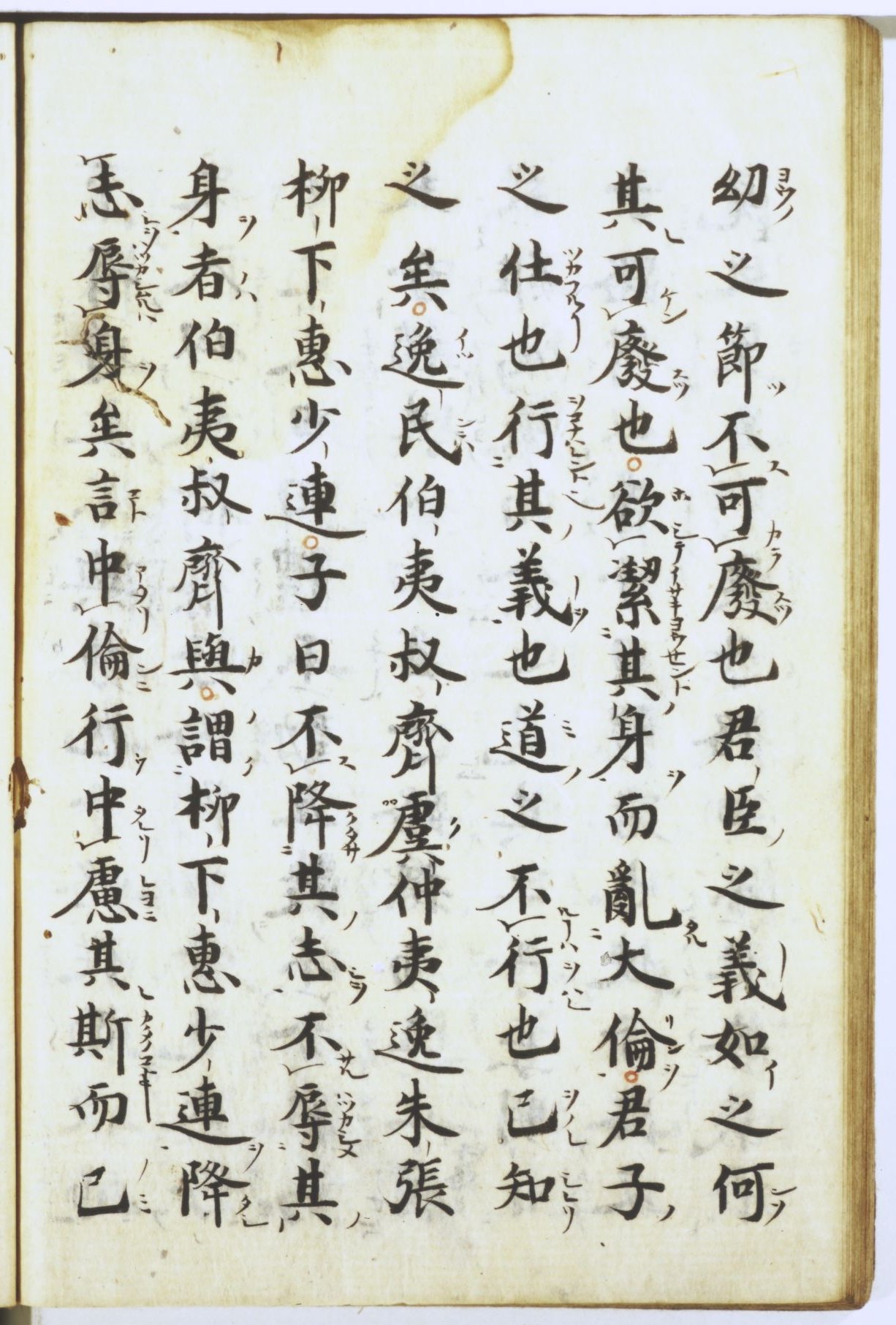
Kyoto University Library RB00007936, IIIF canvas 86, left-hand page: 7 written columns of up to 14 characters, main text only, with Japanese reading marks. Checked on the image: the first column of this book's text on this page begins ‹下有道›, the last begins ‹見之至›. 18.7.1 begins inside column 1 (the column opens ‹下有道›), 8 characters down in the received text. Above it the page finishes 18.6.4, shown in the previous section. 18.7.5 runs on to canvas 87, right-hand page (first column ‹幼之節›), where the section ends. Column openings on these pages that differ from the received text: ‹其可廢› where the received text has ‹其廢之›. The Chinese shown is the received text (Wikisource), not a transcription of this manuscript; Legge's English translates the received text.
7.1子路從而後,遇丈人,以杖荷蓧。子路問曰:「子見夫子乎?」丈人曰:「四體不勤,五穀不分,孰爲夫子?」植其杖而芸。
7.2子路拱而立。
7.3止子路宿,殺雞爲黍而食之,見其二子焉。
7.4明日,子路行以吿。子曰:「隱者也。」使子路反見之。至則行矣。
7.5子路曰:「不仕無義。長幼之節,不可廢也;君臣之義,如之何其廢之?欲潔其身,而亂大倫。君子之仕也,行其義也。道之不行,已知之矣。」
7.1Tsze-lu, following the Master, happened to fall behind, when he met an old man, carrying across his shoulder on a staff a basket for weeds. Tsze-lu said to him, 'Have you seen my master, sir!' The old man replied, 'Your four limbs are unaccustomed to toil; you cannot distinguish the five kinds of grain:-- who is your master?' With this, he planted his staff in the ground, and proceeded to weed.
7.2Tsze-lu joined his hands across his breast, and stood before him.
7.3The old man kept Tsze-lu to pass the night in his house, killed a fowl, prepared millet, and feasted him. He also introduced to him his two sons.
7.4Next day, Tsze-lu went on his way, and reported his adventure. The Master said, 'He is a recluse,' and sent Tsze-lu back to see him again, but when he got to the place, the old man was gone.
7.5Tsze-lu then said to the family, 'Not to take office is not righteous. If the relations between old and young may not be neglected, how is it that he sets aside the duties that should be observed between sovereign and minister? Wishing to maintain his personal purity, he allows that great relation to come to confusion. A superior man takes office, and performs the righteous duties belonging to it. As to the failure of right principles to make progress, he is aware of that.'
Where on the image
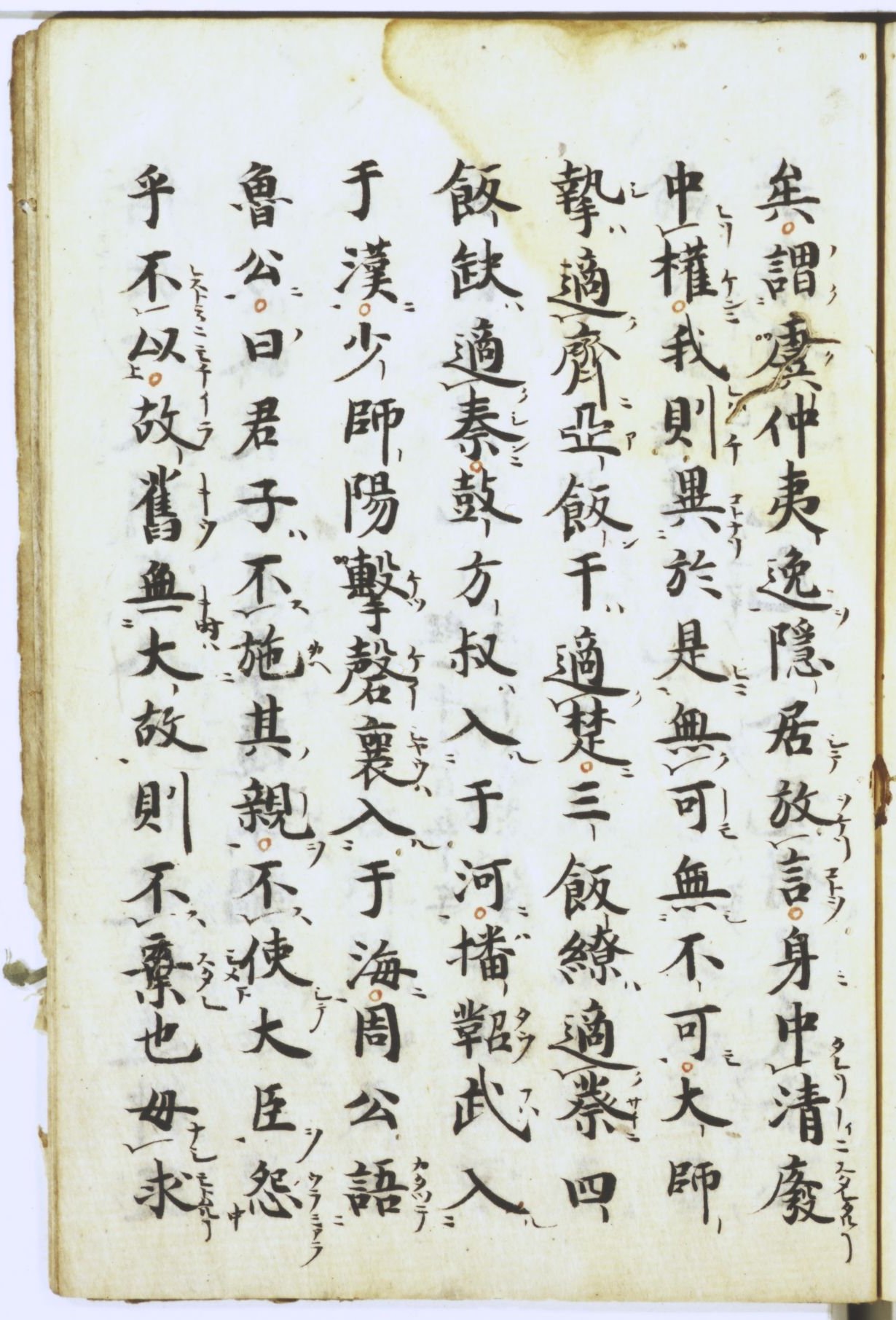
Kyoto University Library RB00007936, IIIF canvas 87, right-hand page: 7 written columns of up to 14 characters, main text only, with Japanese reading marks. Checked on the image: the first column of this book's text on this page begins ‹幼之節›, the last begins ‹志辱身›. 18.8.1 begins inside column 4 (the column opens ‹之矣逸›), 2 characters down in the received text. Above it the page finishes 18.7.5, shown in the previous section. 18.8.3 runs on to canvas 87, left-hand page (first column ‹矣謂虞›), where the section ends. Column openings on these pages that differ from the received text: ‹身者伯› where the received text has ‹身伯夷›. The Chinese shown is the received text (Wikisource), not a transcription of this manuscript; Legge's English translates the received text.
8.1逸民:伯夷、叔齊、虞仲、夷逸、朱張、柳下惠、少連。
8.2子曰:「不降其志,不辱其身,伯夷叔齊與!」
8.3謂柳下惠、少連:「降志辱身矣。言中倫,行中慮,其斯而已矣。」
8.1The men who have retired to privacy from the world have been Po-i, Shu-ch'i, Yu-chung, I-yi, Chu-chang, Hui of Liu-hsia, and Shao-lien.
8.2The Master said, 'Refusing to surrender their wills, or to submit to any taint in their persons;-- such, I think, were Po-i and Shu-ch'i.
8.3'It may be said of Hui of Liu-hsia, and of Shao-lien, that they surrendered their wills, and submitted to taint in their persons, but their words corresponded with reason, and their actions were such as men are anxious to see. This is all that is to be remarked in them.
Where on the image
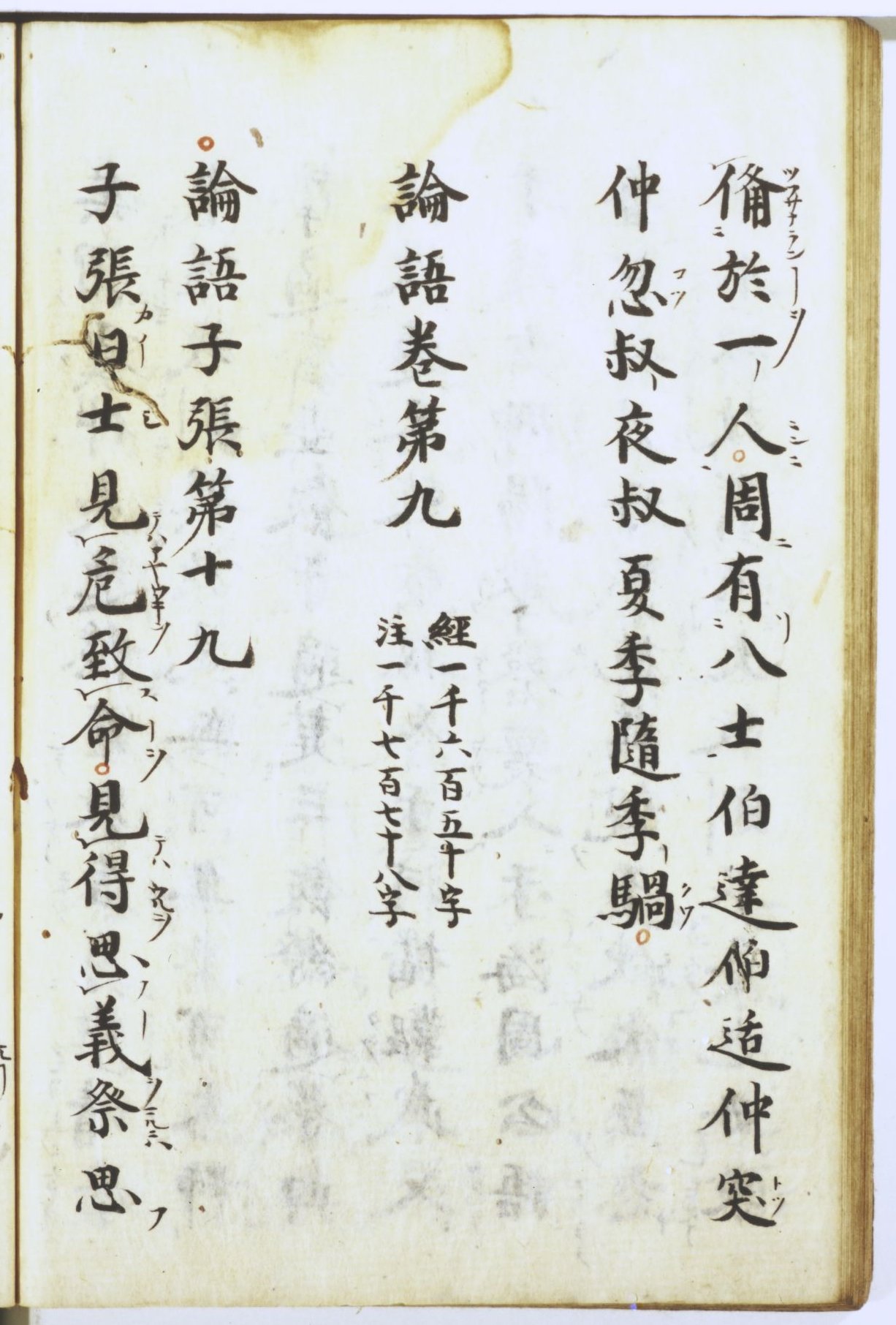
Kyoto University Library RB00007936, IIIF canvas 87, left-hand page: 7 written columns of up to 14 characters, main text only, with Japanese reading marks. Checked on the image: the first column of this book's text on this page begins ‹矣謂虞›, the last begins ‹乎不以›. 18.8.4 begins inside column 1 (the column opens ‹矣謂虞›), 1 characters down in the received text. Above it the page finishes 18.8.3, shown in the previous section. 18.10 runs on to canvas 88, right-hand page (first column ‹備於一›), where the section ends. The Chinese shown is the received text (Wikisource), not a transcription of this manuscript; Legge's English translates the received text.
8.4謂虞仲、夷逸:「隱居放言,身中淸,廢中權。」
8.5我則異於是,無可無不可。」
9.1大師摯適齊,
9.2亞飯干適楚,三飯繚適蔡,四飯缺適秦。
9.3鼓方叔入於河,
9.4播鼗武入於漢,
9.5少師陽、擊磬襄入於海。
10周公謂魯公曰:「君子不施其親,不使大臣怨乎不以。故舊無大故,則不棄也,無求備於一人。」
8.4'It may be said of Yu-chung and I-yi, that, while they hid themselves in their seclusion, they gave a license to their words; but, in their persons, they succeeded in preserving their purity, and, in their retirement, they acted according to the exigency of the times.
8.5'I am different from all these. I have no course for which I am predetermined, and no course against which I am predetermined.'
9.1The grand music master, Chih, went to Ch'i.
9.2Kan, the master of the band at the second meal, went to Ch'u. Liao, the band master at the third meal, went to Ts'ai. Chueh, the band master at the fourth meal, went to Ch'in.
9.3Fang-shu, the drum master, withdrew to the north of the river.
9.4Wu, the master of the hand drum, withdrew to the Han.
9.5Yang, the assistant music master, and Hsiang, master of the musical stone, withdrew to an island in the sea.
10The duke of Chau addressed his son, the duke of Lu, saying, 'The virtuous prince does not neglect his relations. He does not cause the great ministers to repine at his not employing them. Without some great cause, he does not dismiss from their offices the members of old families. He does not seek in one man talents for every employment.'
Where on the image
Kyoto University Library RB00007936, IIIF canvas 88, right-hand page: 5 written columns of up to 14 characters, main text only, with Japanese reading marks. Checked on the image: the first column of this book's text on this page begins ‹備於一›, the last begins ‹仲忽叔›. Column 4 carries the title 論語卷第九. Column 6 carries the title 論語子張第十九. 18.11 begins inside column 1 (the column opens ‹備於一›), 4 characters down in the received text. Above it the page finishes 18.10, shown in the previous section. The section ends on this page. The Chinese shown is the received text (Wikisource), not a transcription of this manuscript; Legge's English translates the received text.
11周有八士:伯達、伯适、仲突、仲忽、叔夜、叔夏、季隨、季騧。
11To Chau belonged the eight officers, Po-ta, Po- kwo, Chung-tu, Chung-hwu, Shu-ya, Shu-hsia, Chi-sui, and Chi-kwa.
Notes
- English: James Legge, Confucian Analects, The Chinese Classics vol. 1. Legge's chapter and paragraph numbers are kept as superscripts (chapter.paragraph).
- Legge translated the received text. Where this manuscript's wording differs, his English follows the received text shown here.
Cite
Sources
- Source: Kyoto University Library RB00007936 (Analects manuscript attributed to Kiyohara Yoshieda, c. 1300) + Wikisource received text + James Legge's English (Project Gutenberg) (holding institution)
- Critical edition: Received text (Wikisource) in Legge's chapter and paragraph division
← previous · → next · v cycle view · l back to library