Edicts of Ashoka at Dhauli: Rock Edicts I-X and XIV and the two Separate Edicts
Introduction
The Dhauli rock stands on a low hill south of Bhubaneswar in Odisha, the ancient Tosali, capital of the province of Kalinga that Ashoka conquered (Rock Edict XIII). Here, and at Jaugada, the series of Major Rock Edicts leaves out XI-XIII, the edict of the Kalinga war among them, and adds two Separate Edicts addressed to the king's officers in the conquered land. Above the inscription the rock is carved into the forepart of an elephant.
The First Separate Edict is addressed to the Mahāmātras of Tosali who are judicial officers of the city: 'All men are my children'; they must judge impartially, avoid anger and haste, and not let anyone be imprisoned or harshly treated without cause; inspectors will come every five years from the capital, and every three years from Ujjayini and Taxila. The Second Separate Edict, to the prince and the Mahāmātras of Tosali, concerns the unconquered peoples on the border: they should not fear the king, who wishes them only happiness and will forgive what can be forgiven. Both edicts are to be read out on the days of the Tishya constellation.
The inscription is cut in three columns: Rock Edicts I-VI in the middle, VII-X and XIV with the Second Separate Edict on the right, and the First Separate Edict on the left. The rock is weathered and many letters are uncertain or lost; Hultzsch marks them with brackets and dots. Hultzsch translates the Rock Edicts II-X and XIV of Dhauli and Jaugada together, after the Jaugada texts; that joint translation is shown for them here. For Rock Edict I, of which only scattered words survive at Dhauli, his translation of the Jaugada version is shown.
Sources. Original text and English: E. Hultzsch, Inscriptions of Asoka. New Edition (Corpus Inscriptionum Indicarum, vol. I), Oxford: Clarendon Press for the Government of India, 1925, transcribed from the page images of the archive.org scan (public domain). Images: Hultzsch's collotype plates of inked impressions (estampages) of the Dhauli rock, taken on the stone for the Archaeological Survey of India. An impression is a contact copy pressed on paper from the inscribed surface itself, not a drawing; each section's image is the part of the plate that carries that text, with the plate's own numerals and line numbers in the margins.
Reading the text. Line numbers are Hultzsch's lines on the stone. Letters in square brackets are damaged or uncertain on the stone; dots mark lost letters. The capital letters in brackets, (A), (B) ..., are Hultzsch's sentence divisions and are the same in the transliteration and the English. Hultzsch's footnotes, which record other scholars' readings and his corrections, are not reproduced.
How was this verified? (Provenance)
Where on the image
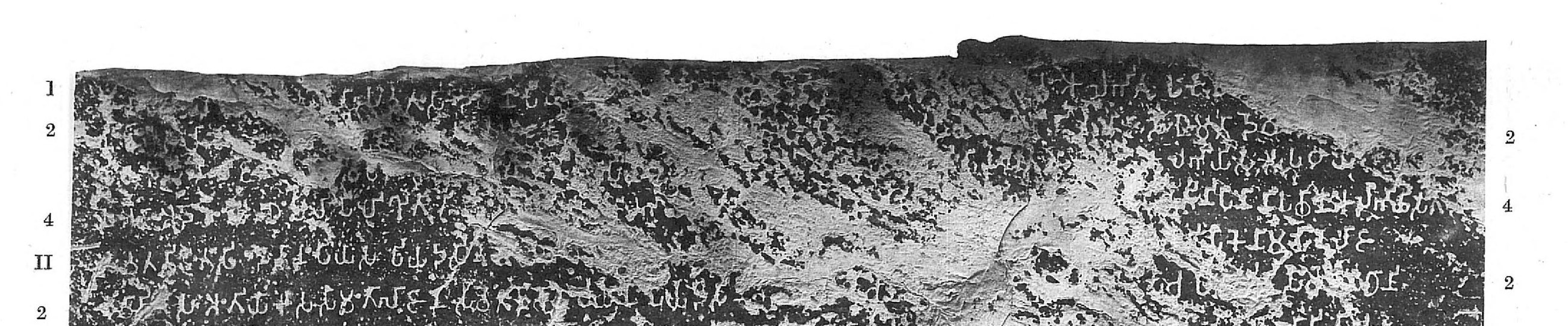
Inked impression (estampage) of the Dhauli rock, not a photograph of the stone: Hultzsch 1925, plate 'Dhauli rock: middle column' (facing p. 88; archive.org leaf 238), cropped to the top of the middle column, marked I in the left margin and numbered 2, 4: 4 lines, the upper part of the rock weathered; a narrow strip of the neighbouring lines is included above and below. Checked on the image against the transcription (lines 1-4). Text: Hultzsch 1925, p. 84 (archive.org leaf 232). Hultzsch prints no English for the Dhauli version of Rock Edict I, of which only scattered words survive. The English shown is his translation of the Jaugada version (Hultzsch 1925, pp. 101-102), which names the Khēpiṅgala mountain; at Dhauli the name of the hill is lost, and most of what the English says is not on this rock.
1(A) . . . . . . . . . . [si pava]tasi [D]e[v]ā[na]ṁp[iy] . . . . . . . . . . [nā lājinā l]i[khā] . . . . . . . . . . [ī]vaṁ ālabhitu pajo[h] . . . . . . .
2(C) [no pi cha sam]ā[je] . . . . . . . . . . [samā]ja . . [d] . . . . . . . . . . (E) . . . . [pi chu] . . . . [t]i[y]ā [sam]ā[jā] s[ā]dhu-matā Dev . . . . . . . . . .
3[Piyadasine lā]j[ine] (F) . . . . . . [mah] . . . . . . . . . . Piy[a] . . . . . . . . . . [n]i [p]āna-[sa]ta . . . . . . . . [ā]labhiyisu sūpaṭhāy[e]
4(G) se a[ja] adā [iyaṁ dha]ṁ[ma]-lipī likhitā tiṁ . . . . . . . . . . [āla]bh[iy] . . . . . . . . . . [t]iṁni pānāni pachhā n[o] āl[aṁ]bhiyisa[ṁ]t[i]
(A) This rescript on morality has been caused to be written on the Khēpiṅgala mountain by king Dēvānāṁpriya Priyadarśin.
(B) Here no living being must be killed and sacrificed.
(C) And also no festival meeting must be held.
(D) For king Dēvānāṁpriya Priyadarśin sees much evil in festival meetings.
(E) But there are also some festival meetings which are considered meritorious by king Dēvānāṁpriya Priyadarśin.
(F) Formerly in the kitchen of king Dēvānāṁpriya Priyadarśin many hundred thousands of animals were killed daily for the sake of curry.
(G) But now, when this rescript on morality is written, only three animals are being killed (daily), (viz.) two peacocks (and) one deer, but even this deer not regularly.
(H) But even these three animals shall not be killed in future.
Where on the image
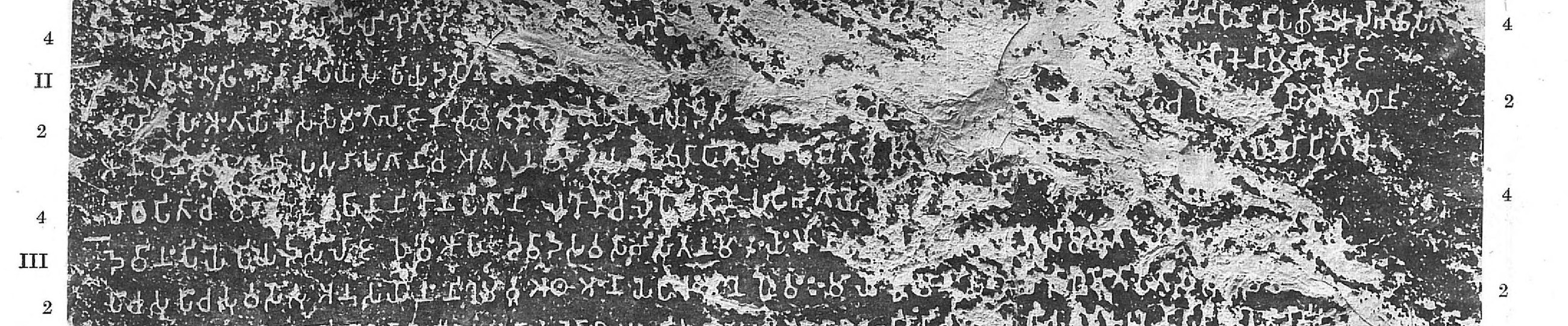
Inked impression (estampage) of the Dhauli rock, not a photograph of the stone: Hultzsch 1925, plate 'Dhauli rock: middle column' (facing p. 88; archive.org leaf 238), cropped to the middle column from the numeral II in the left margin, numbered 2, 4: 4 lines; a narrow strip of the neighbouring lines is included above and below. Checked on the image against the transcription (lines 1-4). Text: Hultzsch 1925, pp. 84-85 (archive.org leaves 232, 234). English: Hultzsch's joint translation of the Dhauli and Jaugada versions ('Translation (Dhauli and Jaugada)'), printed after the Jaugada text (Hultzsch 1925, p. 102); square brackets in it mark words lost in both versions, so words in it without brackets may be lost on this rock and survive only at Jaugada.
1(A) [sa]vata [v]i[ji]tasi [D]e[v]ānaṁpiyasa Piyadasi[ne l] . . . . . . . . . . [athā] . . . . . . . . . . [t]iyoke nāma Yo[na]-lājā
2[e] vā [p]i [ta]sa Aṁtiyo[ka]sa sāmaṁtā lājāne savat[a D]evā[naṁp]i[ye]na P[i]yadasi[nā] . . . . . . . . . . [s]ā cha p[asu-ch]i[k]is[ā] cha (B) . . . . dhāni
3ān[i m]u[nisopa]gāni pasu-opagān[i] cha atata na[thi savata hā]lāpit[ā] cha [lo]pāp[i]tā [cha] (C) mū[l] . . . . . . . . . . v[a]t[a] hālāpitā [cha]
4lo[p]āpitā cha (D) ma[g]e[su udu]pānāni khānāpitāni lukhāni cha lopā[p]itāni p[a]ṭibhogāye . . . . . . . . . . [na]ṁ
(A) Everywhere in the dominions of king Dēvānāṁpriya Priyadarśin, and also (of those) who (are his) borderers, such as the Chōḍas, the Pāṇḍyas, the Satiyaputa, . . . . . . . . . . the Yōna king named Antiyoka, and also the kings who are the neighbours of this Antiyoka,—everywhere [two (kinds of) medical treatment were established] by king Dēvānāṁpriya Priyadarśin, (viz.) medical treatment [for men] and medical treatment for cattle.
(B) Wherever there were no herbs that are beneficial to men and beneficial to cattle, everywhere they were caused to be imported and to be planted.
(C) Wherever there were no roots and [fruits], everywhere they were caused to be imported and to be planted.
(D) On the roads wells were caused to be dug, and trees were caused to be planted for the use of [cattle and men].
Where on the image
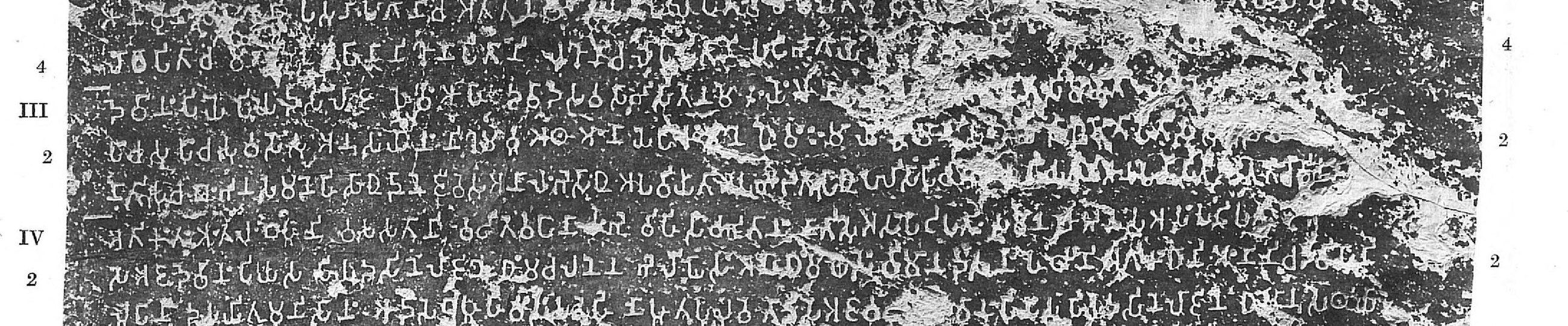
Inked impression (estampage) of the Dhauli rock, not a photograph of the stone: Hultzsch 1925, plate 'Dhauli rock: middle column' (facing p. 88; archive.org leaf 238), cropped to the middle column from the numeral III in the left margin, numbered 2: 3 lines; a narrow strip of the neighbouring lines is included above and below. Checked on the image against the transcription (lines 1-3). Text: Hultzsch 1925, p. 85 (archive.org leaf 234). English: Hultzsch's joint translation of the Dhauli and Jaugada versions ('Translation (Dhauli and Jaugada)'), printed after the Jaugada text (Hultzsch 1925, p. 103); square brackets in it mark words lost in both versions, so words in it without brackets may be lost on this rock and survive only at Jaugada.
1(A) Devānaṁpiye Piyadasī lājā hevaṁ āhā (B) duvādasa-vasābhisitena me iy[a]ṁ ānāp[ay]i . . (C) . . . . [ta v]i[j]it[a]si m[e] yut[ā] la[j]u[k]e . . . . . . . . . .
2paṁchasu paṁchasu vasesu anusayānaṁ nikhamāvū athā aṁnāye pi [ka]ṁ[ma]ne hevaṁ imā[y]e [dhaṁ]mānus[ath]iy[e] (D) [s]ādh[u] māt[ā]-p[i]t[i]su su[s]ūs[ām] . . . . . . . . . .
3nātisu cha baṁbhana-samanehi sādhu dāne jīvesu anālaṁbhe sādhu apa-viy[a]t[ā] apa-bh[aṁ]ḍatā sādhu (E) p[a]lisā pi cha . . . . [nas]i y[u]t[ān]i ā[na]p[ay]is[a]ti [he]tut[e] ch[a] vi[yaṁja] . . . . . .
(A) King Dēvānāṁpriya Priyadarśin speaks thus.
(B) (When I had been) anointed twelve years, the following was ordered by me.
(C) [Everywhere] in my dominions the Yuktas, the Lajuka, and the Prādēśika shall set out on a complete tour (throughout their charges) every five years, just as for other business, even so for the following instruction in morality.
(D) ‘Meritorious is obedience to mother and father, to friends and acquaintances, and to relatives. Liberality to Brāhmaṇas and Śramaṇas is meritorious. Abstention from killing animals is meritorious. Moderation in expenditure (and) moderation in possessions are meritorious.’
(E) And the council (of Mahāmātras) also shall order the Yuktas to register (these rules) both with (the addition of) reasons and according to the letter.
Where on the image
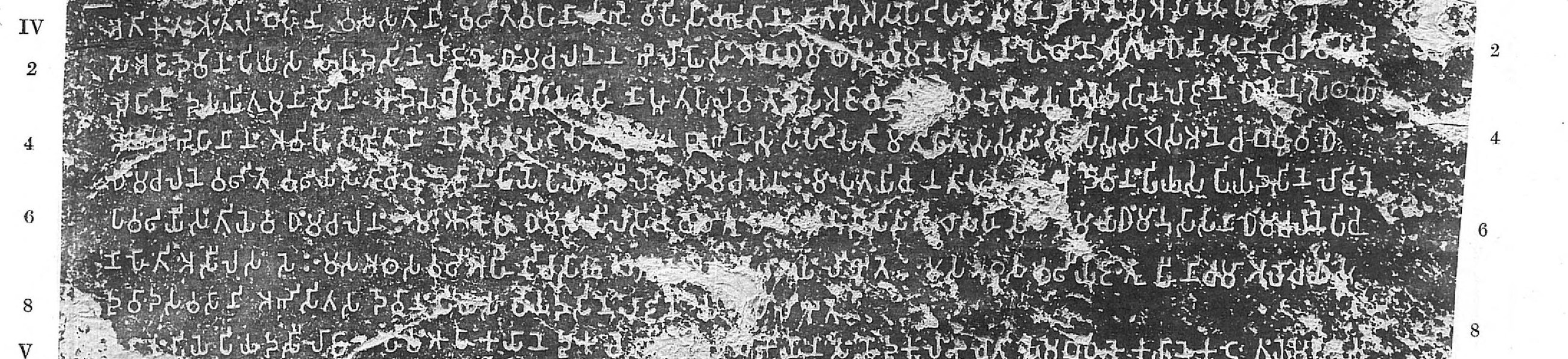
Inked impression (estampage) of the Dhauli rock, not a photograph of the stone: Hultzsch 1925, plate 'Dhauli rock: middle column' (facing p. 88; archive.org leaf 238), cropped to the middle column from the numeral IV in the left margin, numbered 2 to 8: 8 lines. Checked on the image against the transcription (lines 1-8). Text: Hultzsch 1925, p. 86 (archive.org leaf 235). English: Hultzsch's joint translation of the Dhauli and Jaugada versions ('Translation (Dhauli and Jaugada)'), printed after the Jaugada text (Hultzsch 1925, p. 104); square brackets in it mark words lost in both versions, so words in it without brackets may be lost on this rock and survive only at Jaugada.
1(A) atikaṁtaṁ aṁtalaṁ bahūni vasa-satāni vaḍhite va pānā[la]ṁbhe vihisā cha bhūtānaṁ nātisu asaṁpaṭipati samana-bābha[ne]su asaṁpaṭipati
2(B) se aja Devānaṁpiyasa Piyadasine lājine dhaṁma-chalanena bheli-ghosaṁ a[h]o dhaṁma-[gho]saṁ vimāna-dasanaṁ hathīni [a]gi-kaṁdhāni aṁnāni cha [di]vi[y]āni
3lūpān[i] dasayitu munisānaṁ (C) ād[i]se b[a]hūhi vasa-sa[t]ehi no hūta-puluve tādise aja va[ḍhite De]vānaṁpiyasa Piy[a]dasine lājin[e] dhaṁ[m]ānus[a]thi[y]ā
4an[āla]ṁbhe pānānaṁ avihisā bhūtānaṁ nātisu saṁpaṭipat[i sama]na-b[ā]bhanesu saṁpaṭipati m[ā]t[i]-pitu-susūsā vu[ḍha]-susūsā (D) esa aṁne cha ba[h]uvidhe
5dh[a]ṁma-chalane vaḍhite (E) vaḍhayis[a]ti cheva Devānaṁpiye Piyada[s]ī l[ā]jā dhaṁma-chalanaṁ imaṁ (F) putā pi chu nati [panati] . . [cha] Devānaṁpiyasa Piyadasine lājine
6pavaḍhayisaṁti yeva dhaṁma-chalanaṁ imaṁ ā-k[a]paṁ dhaṁmasi [s]īlasi ch[a ch]i[ṭh]itu [dhaṁmaṁ a]nus[ā]sisaṁ[t]i (G) esa h[i] se[ṭhe kaṁ]me yā dhaṁmānusāsanā (H) dhaṁma-chalane pi chu
7no hoti asīlasa (I) se imasa aṭhasa v[a]ḍhī ahīni ch[a] sā[dhū] (J) et[āy]e [aṭhāy]e iyaṁ likhite imasa aṭhasa vaḍhī yujaṁtū hīni cha mā alochayisū
8(K) duvādasa vasāni abhisitasa Devānaṁpi[ya]sa Piyadasine lājine yaṁ [idha] likhite
(A) In times past, for many hundreds of years, there had ever been promoted the killing of animals and the hurting of living beings, discourtesy to relatives, (and) discourtesy to Śramaṇas and Brāhmaṇas.
(B) But now, in consequence of the practice of morality on the part of king Dēvānāṁpriya Priyadarśin, the sound of drums has become the sound of morality, showing the people representations of aerial chariots, elephants, masses of fire, and other divine figures.
(C) Such as they had not existed before for many hundreds of years, thus there are now promoted, through the instruction in morality on the part of king Dēvānāṁpriya Priyadarśin, abstention from killing animals, abstention from hurting living beings, courtesy to relatives, courtesy to Śramaṇas and Brāhmaṇas, obedience to mother and father, (and) obedience to the aged.
(D) In this and many other ways is the practice of morality promoted.
(E) And king Dēvānāṁpriya Priyadarśin will ever promote this practice of morality.
(F) But also the sons, grandsons, and great-grandsons of king Dēvānāṁpriya Priyadarśin will ever promote this practice of morality until the æon (of destruction of the world), (and) will instruct (people) in morality, abiding by morality and by good conduct.
(G) For this is the best work, viz. instruction in morality.
(H) But the practice of morality also is not (possible) for (a person) devoid of good conduct.
(I) Therefore promotion and not neglect of this object is meritorious.
(J) For the following purpose has this been written, (viz. in order that) they should devote themselves to the promotion of this practice, and that they should not approve the neglect (of it).
(K) This has been written here by king Dēvānāṁpriya Priyadarśin (when he had been) anointed twelve years.
Where on the image
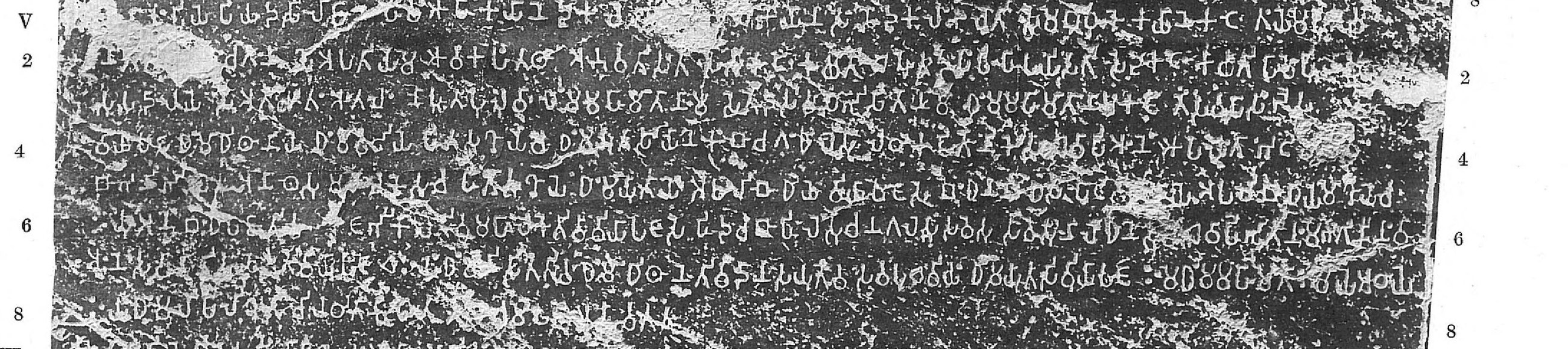
Inked impression (estampage) of the Dhauli rock, not a photograph of the stone: Hultzsch 1925, plate 'Dhauli rock: middle column' (facing p. 88; archive.org leaf 238), cropped to the middle column from the numeral V in the left margin, numbered 2 to 8: 8 lines. Checked on the image against the transcription (lines 1-8). Text: Hultzsch 1925, pp. 86-88 (archive.org leaves 235-237). English: Hultzsch's joint translation of the Dhauli and Jaugada versions ('Translation (Dhauli and Jaugada)'), printed after the Jaugada text (Hultzsch 1925, pp. 105-106); square brackets in it mark words lost in both versions, so words in it without brackets may be lost on this rock and survive only at Jaugada.
1(A) [Dev]ānaṁpiye Piyadasī lājā h[eva]ṁ āhā (B) kayāne dukale (C) . . . . . . . . . . k[a]y[ā]n[a]sa s[e] dukalaṁ kal[e]ti (D) se me b[ah]uke kayāne kaṭe (E) taṁ ye me [p]ut[ā] va
2n[a]t[ī va] . . . . ṁ cha t[e]na ye apatiye me āva-kapaṁ tathā anuvatisaṁti s[e] sukaṭaṁ kachh[aṁ]ti (F) e heta d[esa]ṁ pi hāpayisat[i] se dukaṭaṁ kachhati (G) pā[p]e hi [nāma]
3supadālaye (H) s[e] at[ikaṁ]taṁ aṁtalaṁ no hūta-puluvā dhaṁma-mahāmātā nāma (I) se tedasa-va[sā]bhisitena me dhaṁma-mahāmātā nāma kaṭā (J) te sava-pāsaṁḍe[su]
4v[i]y[āpaṭā] dhaṁmādhithān[ā]ye dhaṁma-[va]ḍhiye hita-sukhāye [cha] dhaṁma-yutas[a] Yona-Kaṁbocha-Gaṁdhālesu Laṭhika-[P]itenikesu e vā pi aṁne āpalaṁtā (K) bhaṭi[mayesu]
5bābha[n]ibhi[yes]u anāthesu ma[hāla]kesu cha h[i]t[a]-sukhāye dhaṁma-yutāye a[pa]libodhāye viyā[pa]ṭā se (L) baṁdhana-[ba]dhas[a] p[a]ṭi[vidhānā]ye apalib[o]dhāye mokhāye cha
6iya[ṁ] anubaṁdh[a] p[aj]ā [t]i [va ka]ṭābhīkā[le] ti va mahālake ti va viyāpaṭā se (M) hida cha bāhilesu cha nagalesu savesu s[a]vesu olodhanes[u me] e vā pi bhāt[ī]naṁ me bhaginīnaṁ va
7aṁnesu vā [nāt]i[su sava]t[a] v[i]yāpaṭā (N) e iyaṁ dhaṁm[a-n]isite ti va dhaṁmādhithāne ti va dāna-sayute va sava-puṭhaviyaṁ dha[ṁ]ma-yutasi viyāpaṭā ime dhaṁma-mahām[ā]tā (O) [i]m[ā]ye aṭhāye
8iyaṁ dhaṁma-lip[ī] li[kh]i[tā] chila-ṭhitīk[ā ho]tu t[athā] cha me pa[jā anu]vatatu
(A) King Dēvānāṁpriya Priyadarśin speaks thus.
(B) It is difficult to perform virtuous deeds.
(C) He [who starts performing] victorious deeds accomplishes something difficult.
(D) Now, by me many virtuous deeds have been performed.
(E) Therefore (among) my sons and grandsons, and (among) my descendants (who shall come) after them until the æon (of the destruction of the world), those who will conform to this (duty) will perform good deeds.
(F) He who will neglect even a portion of this (duty) will perform evil deeds.
(G) For sin indeed steps fast.
(H) Now in times past, (officers) called Mahāmātras of morality did not exist before.
(I) But (the officers) called Mahāmātras of morality were appointed by me (when I had been) anointed thirteen years.
(J) These are occupied with all sects in establishing morality, in promoting morality, and for the welfare and happiness of those who are devoted to morality (even) among the Yōnas, Kambōchas, and Gandhālas, among the Laṭhikas and Pitēnikas, and whatever other western borderers (of mine there are).
(K) They are occupied with servants and masters, with Brāhmaṇas and Ibhyas, with the destitute, and with the aged, for the welfare and happiness of those who are devoted to morality, (and) in releasing (them) from the fetters (of worldly life).
(L) They are occupied in supporting prisoners (with money), in causing (their) fetters to be taken off, and in setting (them) free, if (one has) children, or is bewitched, or aged, respectively.
(M) They are occupied everywhere, both here and in all the outlying towns, in all the harems of myself, of my brothers, and of (my) sisters, and with (my) other relatives.
(N) These Mahāmātras of morality are occupied on the whole earth with those who are devoted to morality, (in order to ascertain) whether one is eager for morality, or established in morality, or furnished with gifts.
(O) For the following purpose has this rescript on morality been written, (viz. that) it may be of long duration, and (that) my descendants may conform to it.
Where on the image
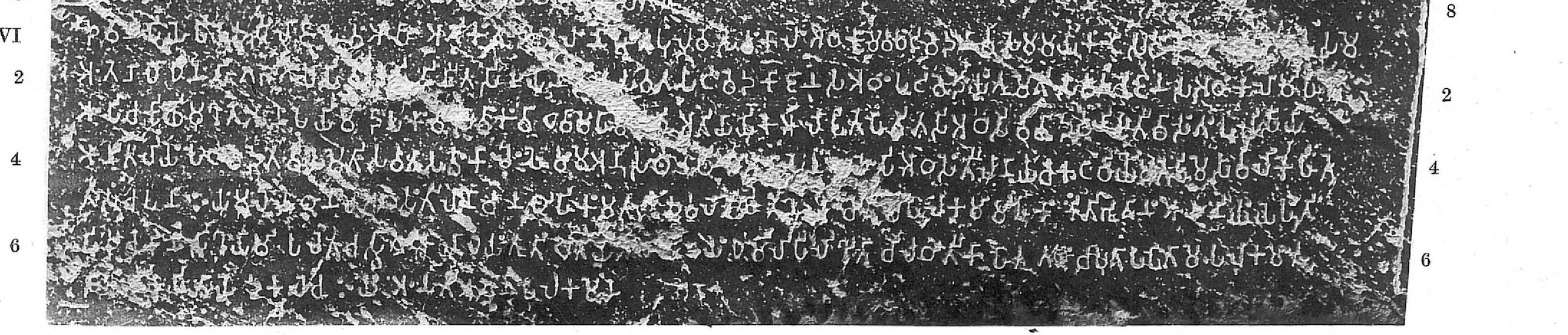
Inked impression (estampage) of the Dhauli rock, not a photograph of the stone: Hultzsch 1925, plate 'Dhauli rock: middle column' (facing p. 88; archive.org leaf 238), cropped to the foot of the middle column, from the numeral VI in the left margin, numbered 2, 4, 6: 7 lines. Checked on the image against the transcription (lines 1-7). Text: Hultzsch 1925, pp. 88-89 (archive.org leaves 237, 239). English: Hultzsch's joint translation of the Dhauli and Jaugada versions ('Translation (Dhauli and Jaugada)'), printed after the Jaugada text (Hultzsch 1925, pp. 106-107); square brackets in it mark words lost in both versions, so words in it without brackets may be lost on this rock and survive only at Jaugada.
1(A) Dev[ānaṁp]iye Pi[yada]sī lājā [he]vaṁ [ā]hā (B) atikaṁ[taṁ a]ṁ[ta]laṁ no [h]ū[ta]-puluve s[a]vaṁ kālaṁ aṭha-ka[ṁ]me va [pa]ṭiveda[n]ā va (C) se mamayā kaṭe (D) sa[va]ṁ [kālaṁ] . . . . [māna]sa me
2aṁte olodh[a]nasi ga[bhā]g[āla]si v[achas]i [v]inītasi [u]y[ā]n[asi cha sa]vata paṭivedakā janasa aṭhaṁ [pa]ṭived[a]yaṁtu m[e] ti (E) sava[ta] ch[a] j[a]nasa aṭhaṁ kalāmi h[aka]ṁ
3(F) aṁ pi cha ki[ṁ]chhi mukh[a]te ānapay[ā]mi dāpakaṁ v[ā sā]v[a]kaṁ vā e vā mahām[āteh]i atiyāyike ālopite hotī tasi aṭhasi v[i]vāde va [n]ijhatī vā saṁtaṁ palisāyā
4āna[ṁ]taliyaṁ paṭi[ve]detav[i]y[e] me ti savata savaṁ kālaṁ (G) heva[ṁ] me anusathe (H) nath[i hi m]e [tos]e u[ṭhāna]si aṭha-saṁtīlanāya cha (I) kaṭaviya-m[at]e hi me sava-loka-hite
5(J) tasa cha pana iyaṁ mūle [u]ṭhān[e cha a]ṭha-saṁtīl[a]n[ā] cha (K) nathi hi kaṁmata . . [sa]va-lo[ka]-hitena (L) [aṁ] ch[a kichhi] p[a]lakamāmi hakaṁ kiṁti bhūtānaṁ ā[na]niyaṁ yeha[ṁ] ti
6[h]i[da] cha [k]ān[i] sukhayāmi pal[a]ta cha svag[aṁ āl]ādhayaṁtū ti (M) et[ā]y[e aṭhāye i]yaṁ dhaṁma-lipī likhitā ch[i]la-ṭh[i]tīkā hotu ta[th]ā cha putā papotā me palakama[ṁ]t[ū]
7[sava-loka]-hitāye (N) dukale chu iyaṁ aṁnat[a] a[g]en[a pa]lakamena
(A) King Dēvānāṁpriya Priyadarśin speaks thus.
(B) In times past neither the disposal of affairs nor the submission of reports at all times did exist before.
(C) But I have made (the following arrangement).
(D) Reporters have to report to me the affairs of the people at any time (and) anywhere, while I am [eating], within the harem, in the inner apartment, at the cowpen, in the palanquin, and in the park.
(E) And everywhere I am disposing of the affairs of the people.
(F) And also, if in the council (of Mahāmātras) a dispute arises, or an amendment is moved, in connexion with any donation or proclamation which I am ordering verbally, or (in connexion with) an emergent matter which has been delegated to the Mahāmātras, it must be reported to me immediately, anywhere, (and) at any time.
(G) Thus I have ordered.
(H) For I am never satisfied in exerting myself and in dispatching business.
(I) For I consider it my duty (to promote) the welfare of all men.
(J) But the root of that (is) this, (viz.) exertion and the dispatch of business.
(K) For no duty is more important than (promoting) the welfare of all men.
(L) And whatever effort I am making, (is made) in order that I may discharge the debt (which I owe) to living beings, (that) I may make them happy in this (world), and (that) they may attain heaven in the other (world).
(M) For the following purpose has this rescript on morality been written, (viz. that) it may be of long duration, and (that) my sons (and) great-grandsons may display the same zeal for the welfare of all men.
(N) But it is difficult to accomplish this without great zeal.
Where on the image
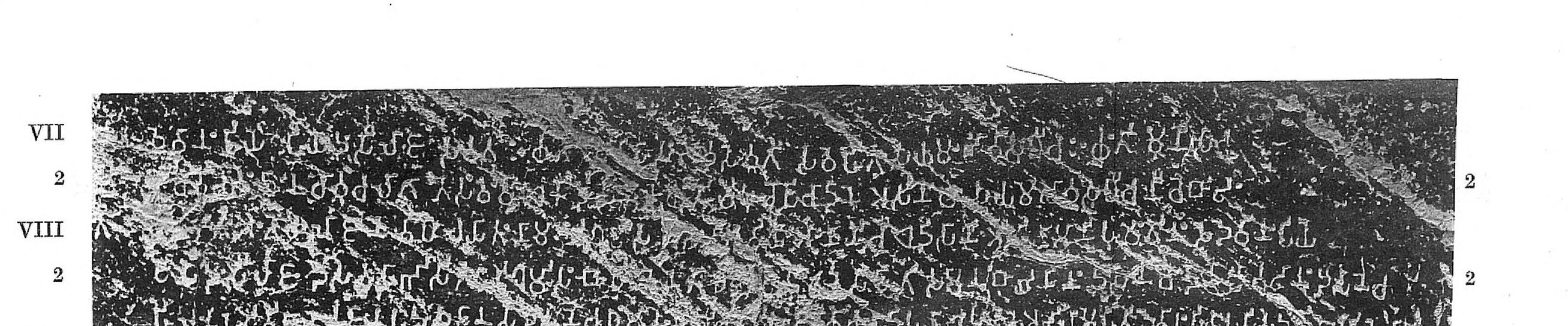
Inked impression (estampage) of the Dhauli rock, not a photograph of the stone: Hultzsch 1925, plate 'Dhauli rock: right column' (facing p. 100; archive.org leaf 252), cropped to the top of the right column, marked VII in the left margin and numbered 2: 2 lines; a narrow strip of the neighbouring lines is included above and below. Checked on the image against the transcription (lines 1-2). Text: Hultzsch 1925, p. 89 (archive.org leaf 239). English: Hultzsch's joint translation of the Dhauli and Jaugada versions ('Translation (Dhauli and Jaugada)'), printed after the Jaugada text (Hultzsch 1925, p. 108); square brackets in it mark words lost in both versions, so words in it without brackets may be lost on this rock and survive only at Jaugada.
1(A) [D]evānaṁ[p]iye Piy[a]dasī lājā savata ichhat[i sava-p]āsaṁ[ḍā va]sevū ti (B) save h[i] t[e sa]yamaṁ [bh]āv[a]-sudhī cha ichhaṁti (C) mun[i]sā ch[a]
2[u]ch[ā]v[u]cha-[chha]ṁ[d]ā uchāvucha-lāgā (D) te savaṁ vā ek[a]-de[saṁ va kachhaṁ]ti (E) vipul[e] pi chā dāne asa n[athi sa]yame [bh]āva-sudhī cha nīche bāḍhaṁ
(A) King Dēvānāṁpriya Priyadarśin desires (that) all sects may reside everywhere.
(B) For all these desire self-control and purity of mind.
(C) And men possess various desires (and) various passions.
(D) They will fulfil either the whole or (only) a portion (of their duties).
(E) And even one who (practises) great liberality, (but) does not possess self-control and purity of mind, is very mean.
Where on the image
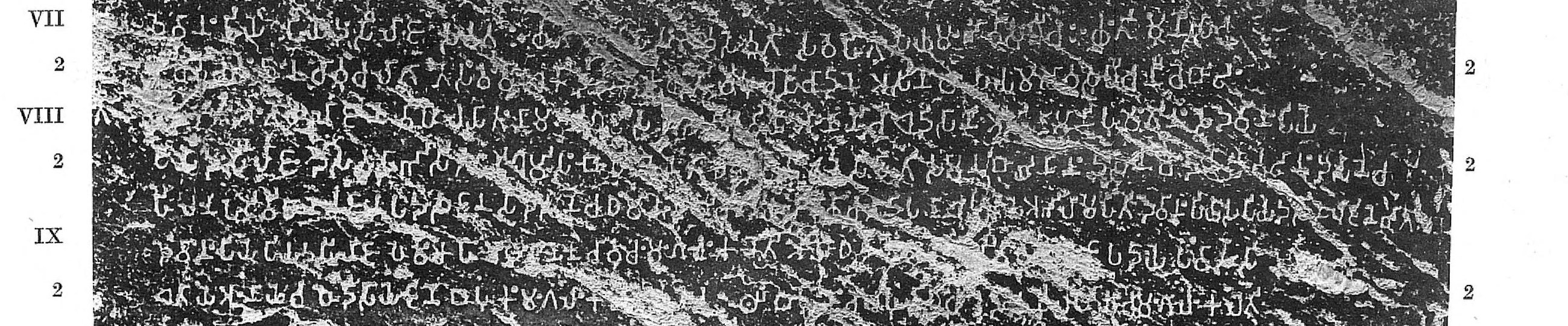
Inked impression (estampage) of the Dhauli rock, not a photograph of the stone: Hultzsch 1925, plate 'Dhauli rock: right column' (facing p. 100; archive.org leaf 252), cropped to the right column from the numeral VIII in the left margin, numbered 2: 3 lines; a narrow strip of the neighbouring lines is included above and below. Checked on the image against the transcription (lines 1-3). Text: Hultzsch 1925, pp. 89-90 (archive.org leaves 239-240). English: Hultzsch's joint translation of the Dhauli and Jaugada versions ('Translation (Dhauli and Jaugada)'), printed after the Jaugada text (Hultzsch 1925, pp. 108-109); square brackets in it mark words lost in both versions, so words in it without brackets may be lost on this rock and survive only at Jaugada.
1(A) [atika]ṁ[ta]ṁ aṁt[ala]ṁ lāj[ā]n[e] v[i]h[ā]la-yātaṁ nāma [n]i[kha]m[i]s[u] (B) . . [ta miga]viy[ā] a[ṁ]nāni ch[a] edisāni a[bh]i[l]āmāni huvaṁti naṁ (C) se Devānaṁpiye
2P[i]y[a]dasī lājā d[a]sa-[vas]ābhisi[t]e [n]ikhami Saṁbodh[i] (D) [t]e[na]tā dha[ṁma-yātā] (E) [tat]esa [ho]ti samana-bābhanānaṁ d[a]s[a]n[e] ch[a] d[āne] cha v[u]ḍhānaṁ dasane cha
3h[i]laṁna-p[a]ṭividhā[ne cha jāna]padasa janasa [dasa]ne cha dhaṁmānu[sath]ī [cha] . . . . . . . . [p]u[chh]ā cha [ta]d[o]payā (F) e[sā bhuy]e abhilāme hoti Devānaṁpiyasa Piyada[s]ine lājine bhāge [aṁ]ne
(A) In times past, kings used to set out on so-called pleasure-tours.
(B) On these (tours) hunting and other such pleasures were (enjoyed).
(C) But when king Dēvānāṁpriya Priyadarśin had been anointed ten years, he went out to Saṁbōdhi.
(D) Therefore tours of morality (were undertaken) here.
(E) On these (tours) the following takes place, (viz.) visiting Śramaṇas and Brāhmaṇas and making gifts (to them), visiting the aged and supporting (them) with gold, visiting the people of the country, instructing (them) in morality, and questioning (them) about morality, as suitable for this (occasion).
(F) This second period (of the reign) of king Dēvānāṁpriya Priyadarśin becomes a pleasure in a higher degree.
Where on the image
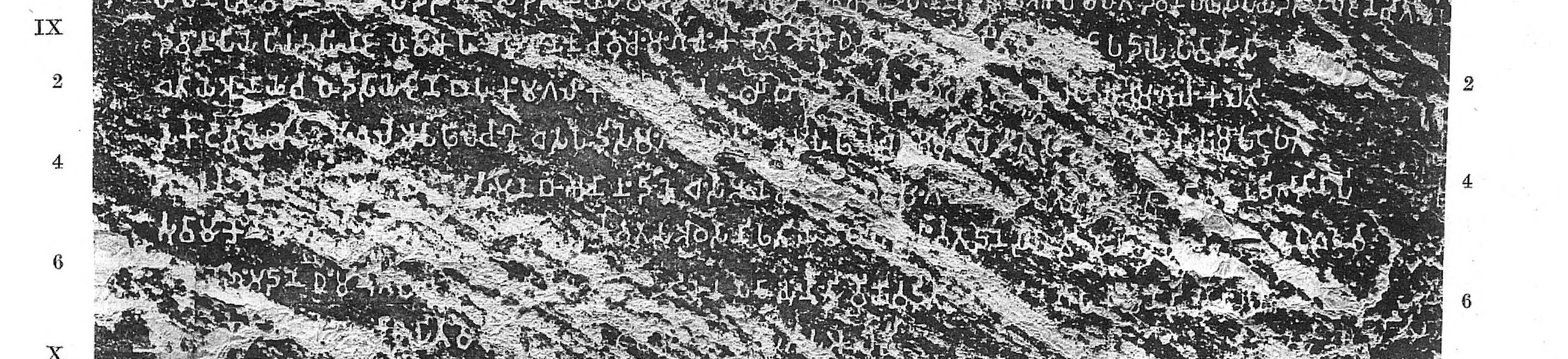
Inked impression (estampage) of the Dhauli rock, not a photograph of the stone: Hultzsch 1925, plate 'Dhauli rock: right column' (facing p. 100; archive.org leaf 252), cropped to the right column from the numeral IX in the left margin, numbered 2, 4, 6: 7 lines, much of the surface weathered (Hultzsch's dots). Checked on the image against the transcription (lines 1-7). Text: Hultzsch 1925, p. 90 (archive.org leaf 240). English: Hultzsch's joint translation of the Dhauli and Jaugada versions ('Translation (Dhauli and Jaugada)'), printed after the Jaugada text (Hultzsch 1925, pp. 109-110); square brackets in it mark words lost in both versions, so words in it without brackets may be lost on this rock and survive only at Jaugada.
1(A) Devānaṁpiye Piyadasī lājā hevaṁ āhā (B) [athi ja]ne uchāvuchaṁ maṁgalaṁ kal[e]ti [āb]ādha . . . . . . . . . . [v]ī[vāha] . . . . [ju]padāye pavās[a]si
2etāye aṁnāye ch[a] hedisāye j[a]n[e] bahukaṁ maṁgalaṁ k[a] . . . . (C) . . . . [chu] ithī b[ahuka]ṁ cha [ba]hu[v]idh[aṁ] ch[a kh]ud[aṁ cha nilaṭhi]yaṁ cha maṁgalaṁ kaleti
3(D) se kaṭ[a]viye che[va kh]o m[a]ṁgale (E) [a]pa-phale chu kho esa h[e]dise maṁ[ga] . . (F) . . [ya]ṁ [ch]u kho mah[ā]-ph[a]le e [dha]ṁma-maṁgale (G) [ta]te[sa d]ā[sa-bhaṭakas]i saṁmyā-paṭipat[i]
4[gulū]naṁ a[pa] . . . . . . . . . . [me] samana-bābhan[ā]naṁ dāne esa aṁne ch[a] . . . . . . [dhaṁma]-maṁga[le nāma] (H) [se] vata[viye p]it[inā pi pute]na pi bhātinā pi
5suvāmike[na p]i . . . . . . . . . . [l]e [ā]va tasa aṭhas[a] niphatiy[ā] (I) [a]thi [cha heva]ṁ v[u]te dāne s[ā]dh[ū] ti (J) [s]e [na]thi . . . . . . . . . . [anu]ga[h]e v[ā]
6[ād]i[se dha]ṁma-dāne dhaṁ[mānugahe] . . (K) . . . . . . [m]i . . . . . . . . . . [t]i[k]ena sahāye[na p]i viyovadita . . . . . . . i [tasi] pak[alana]si [iya]ṁ . . . . . . . . . .
7. . . . . . . . . . [l]ādhayitave (L) . . . . . . . . . . ṭa[v] . . . . . . . . . . [svagasa] āl[adh]ī
(A) King Dēvānāṁpriya Priyadarśin speaks thus.
(B) Men are practising various ceremonies during illness . . . . . . . . . . at the marriage of a daughter, at the birth of a child, (and) when setting out on a journey; on these and other such (occasions) men [are practising] many ceremonies.
(C) But . . . . . women are practising many and various vulgar and useless ceremonies.
(D) Now ceremonies should certainly be practised.
(E) But such ceremonies as these bear little fruit indeed.
(F) But the following bears much fruit indeed, viz. the practice of morality.
(G) Herein the following (are comprised), (viz.) proper courtesy to slaves and servants, reverence to elders, gentleness to animals, (and) liberality to Śramaṇas and Brāhmaṇas; these and other [such] (virtues) are called the practice of morality.
(H) Therefore a father, or a son, or a brother, or a master ought to say:—‘This is meritorious. This [practice] should be observed until the (desired) object is attained.’
(I) And it has been said thus:—‘Gifts are meritorious.’
(J) But there is no [such] gift or benefit as the gift of morality and the benefit of morality.
(K) Therefore a friend . . . . . . . . . . [a relative], and a companion should indeed admonish (another) on such and such an occasion:—‘This . . . . . . . . . . this is meritorious. By this (practice) it is possible to attain heaven.’
(L) For what is more desirable than this, [viz.] the attainment of heaven?
Where on the image
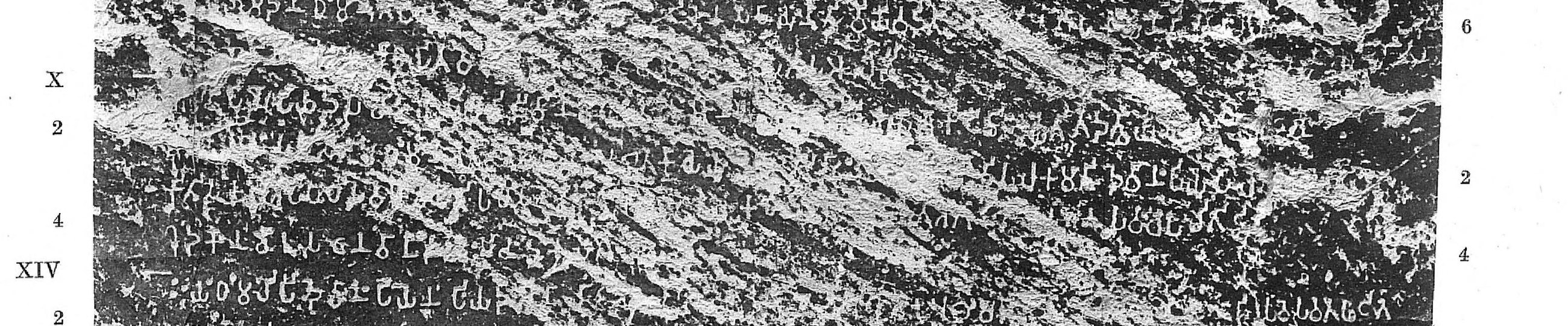
Inked impression (estampage) of the Dhauli rock, not a photograph of the stone: Hultzsch 1925, plate 'Dhauli rock: right column' (facing p. 100; archive.org leaf 252), cropped to the right column from the numeral X in the left margin, numbered 2, 4: 4 lines; a narrow strip of the neighbouring lines is included above and below. Checked on the image against the transcription (lines 1-4). Text: Hultzsch 1925, p. 91 (archive.org leaf 241). English: Hultzsch's joint translation of the Dhauli and Jaugada versions ('Translation (Dhauli and Jaugada)'), printed after the Jaugada text (Hultzsch 1925, p. 110); square brackets in it mark words lost in both versions, so words in it without brackets may be lost on this rock and survive only at Jaugada.
1(A) [Devānaṁ]piye Piyad[a]s[ī lājā yaso v]ā [k]itī vā n . . . . . . . . . [ha]ṁ maṁn[ate] . . . . . . . . . i [yaso] vā k[iṭ]ī [v]ā ichhati tadatvāye [ā] . . . . . . . . [ja]ne
2. . . . . . [sūsa]ṁ [susū]s[at]u [m]e dhaṁma . . . . . . . . . . [me] (B) etakāye [yaso vā kitī v]ā i . . . . . . . . . . i [pa]lakama[t]i Devānaṁpiye pāl[atik]ā[y]e . .
3kiṁti saka[le apa-pal]isave [hu]v[eyā t]i (D) pa[l]isa . . . . . . . . . . (E) [du]ka[le] . . . . . . . . . . t[a agena] . . . . . . . . [na sa]vaṁ cha paliti[j]i[tu]
4khudakena v[ā] usaṭena vā (F) u[saṭena] chu [dukalatale]
(A) King Dēvānāṁpriya Priyadarśin does not think that either glory or fame [conveys much advantage, except whatever] glory or fame he desires (on account of his aim that) at the present time, and in the future, men may (be induced) by him to practise obedience to morality . . . . . . . . . . morality.
(B) On this (account) [he is desiring] glory and fame.
(C) [Whatever] effort Dēvānāṁpriya is making, (is) only for the sake of (merit) in the other (world), (and) in order that all (men) may run little danger.
(D) The danger . . . . . . . . . .
(E) . . . . . . . . . . difficult to accomplish either for a lowly (person) or for a high one [without] great [zeal] and (without) laying aside every (other aim).
(F) But it is more difficult to accomplish for a high (person).
Where on the image
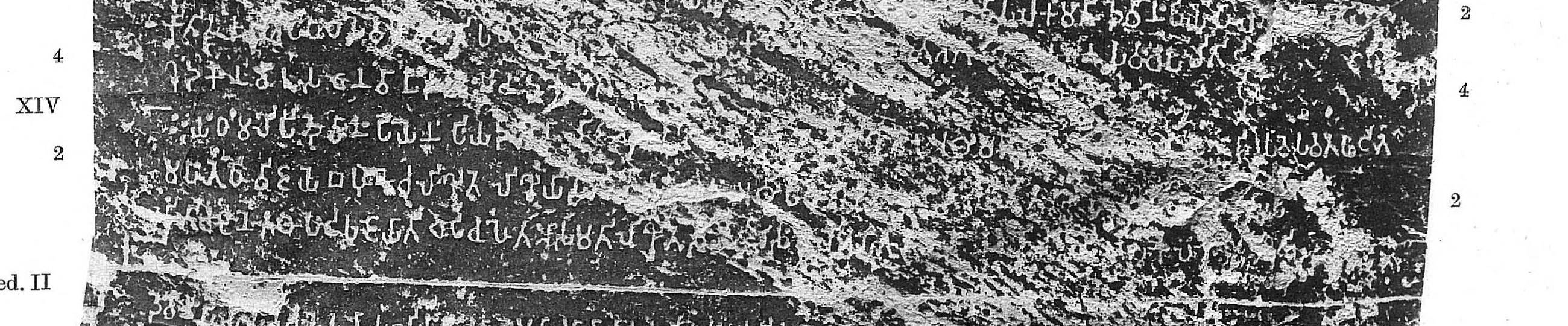
Inked impression (estampage) of the Dhauli rock, not a photograph of the stone: Hultzsch 1925, plate 'Dhauli rock: right column' (facing p. 100; archive.org leaf 252), cropped to the right column from the numeral XIV in the left margin down to the ruled line above the Second Separate Edict, numbered 2: 3 lines; a narrow strip of the neighbouring lines is included above and below. Checked on the image against the transcription (lines 1-3). Text: Hultzsch 1925, p. 91 (archive.org leaf 241). English: Hultzsch's joint translation of the Dhauli and Jaugada versions ('Translation (Dhauli and Jaugada)'), printed after the Jaugada text (Hultzsch 1925, p. 111); square brackets in it mark words lost in both versions, so words in it without brackets may be lost on this rock and survive only at Jaugada.
1(A) iyaṁ dhaṁma-lipī De[v]ānaṁpiyena Piyada[sin]ā lāj[inā likhā] . . . . . . . . . . athi ma[jhimena] . . . . . . . . . . [h]i save sav[a]ta ghaṭite
2(C) mahaṁte hi vijaye bahu[k]e cha likhite likhiyis . . . . . . . . . . (D) [a]thi . . . . . . . . . . [vu]te ta[sa] . . . . . . . . . . [y]āy[e]
3[k]iṁti cha j[a]ne tathā paṭipajeyā ti (E) e pi chu heta asamati likhit[e s] . . . . . . . saṁ . . [lochay]itu . . . . . . . . . . k[a]l[ā] . . . . . . . . [t]i
(A) These rescripts on morality [have been caused] to be written by king Dēvānāṁpriya Priyadarśin . . . . . . . . . . or of middle (size), or at full length.
(B) For the whole was not suitable everywhere.
(C) For (my) dominions are wide, and much has been written, [and I] shall cause [still] (more) to be written.
(D) . . . . . . . . . . has been stated . . . . . . . . . . because of the charm of [certain topics], and in order that men should act accordingly.
(E) But whatever of this is written incompletely . . . . . . . . . .
Where on the image
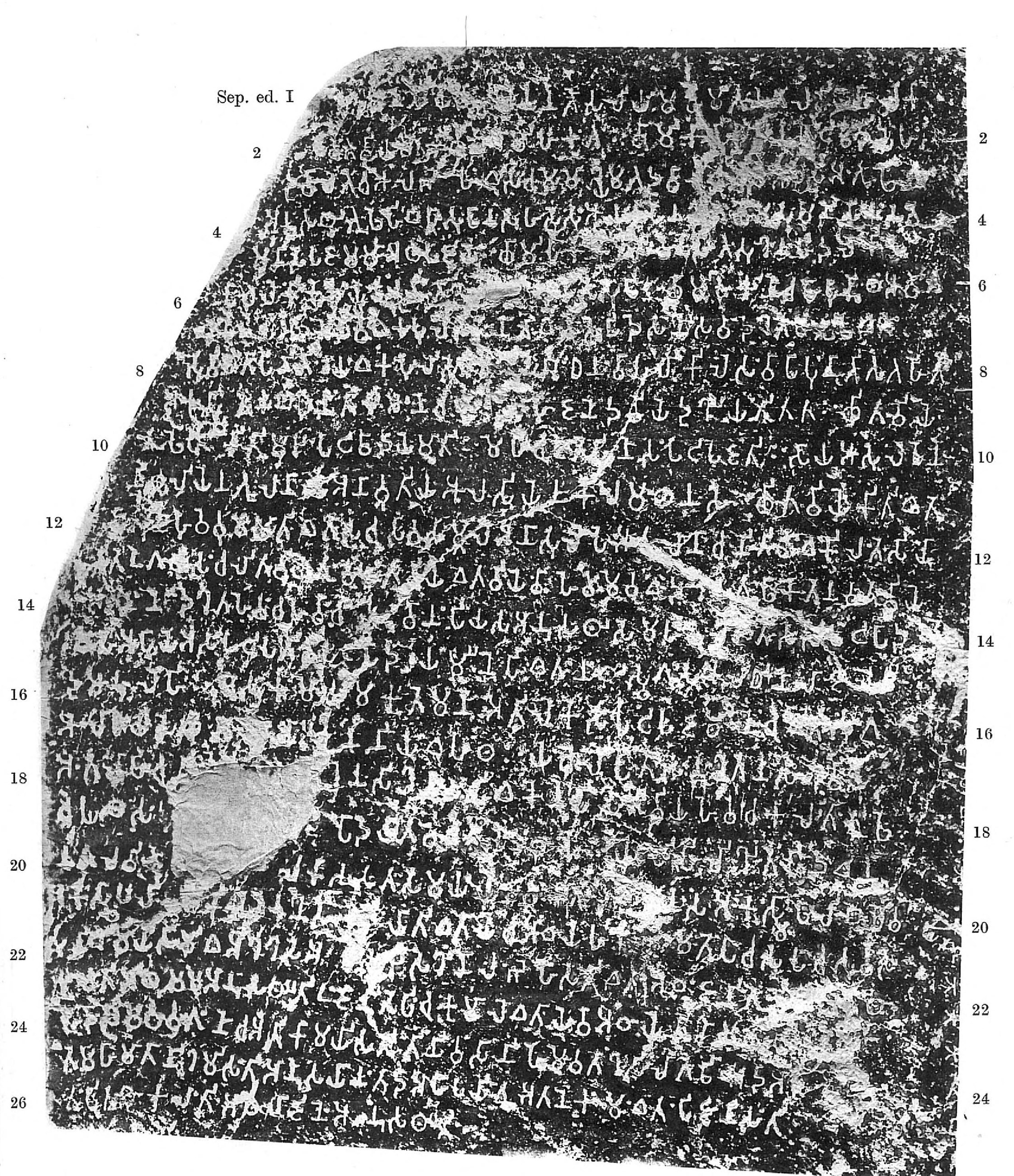
Inked impression (estampage) of the Dhauli rock, not a photograph of the stone: Hultzsch 1925, plate 'Dhauli rock: left column' (facing p. 94; archive.org leaf 245), cropped to the whole left column of the rock, headed 'Sep. ed. I' in the margin and numbered 2 to 26 at the left (2 to 24 at the right): 26 lines. The upper left corner of the rock is broken away, so the first lines begin further right. Checked on the image against the transcription (lines 1-26). Text and English: Hultzsch 1925, pp. 92-97 (archive.org leaves 242-244, 246-248).
1(A) [Devāna]ṁ[pi]y[asa vacha]nena Tosaliyaṁ ma[hā]māta [nagala-v]i[yo]hālak[ā]
2[va]taviya (B) [aṁ kichhi dakhā]mi hakaṁ taṁ ichhāmi k[i]ṁ[t]i kaṁ[mana pa]ṭi[pāday]ehaṁ
3duvālate cha ālabhehaṁ (C) esa cha me mokhya-mata duvā[la etasi aṭha]si aṁ tuph[esu]
4anusathi (D) tuphe hi bahūsu pāna-sahasesuṁ ā[yata] p[a]na[yaṁ ga]chh[e]ma su munisānaṁ (E) save
5munise pajā mamā (F) ath[ā] pajāye ichhāmi h[a]ka[ṁ kiṁti sa]ve[na hi]ta-sukhena hidalo[kika]-
6pālalokike[na] y[ūjev]ū [t]i [tathā . . . . muni]sesu pi [i]chhāmi [ha]ka[ṁ] (G) no cha pāpunātha āv[a]-ga-
7[m]u[k]e [iyaṁ aṭhe] (H) [k]e[chha] v[a] eka-puli[se] . . . . nāti e[ta]ṁ se pi desaṁ no savaṁ (I) de[kha]t[a hi t]u[phe] etaṁ
8suvi[hi]tā pi (J) [n]itiyaṁ eka-pulise [pi athi] y[e] baṁdhanaṁ vā p[a]likilesaṁ vā pāpunāti (K) tata hoti
9akasmā tena badhana[ṁ]tik[a] aṁne cha . . . . . . hu jane da[v]iye dukhīyati (L) tata ichhitaviye
10tuphehi kiṁti m[a]jhaṁ paṭipādayemā ti (M) imeh[i] chu [jāteh]i no saṁpaṭipajati isāya āsulopena
11ni[ṭhū]liyena tūlanā[ya] anāvūtiya ālasiyena k[i]lamathena (N) se ichhitaviye kitiṁ ete
12[jātā no] huvevu ma[m]ā ti (O) etasa cha sava[sa] mūle anāsulope a[tū]l[a]nā cha (P) niti[ya]ṁ e kilaṁte siyā
13[na] te uga[chha] saṁchalitaviy[e] tu va[ṭ]ita[v]iy[e] etaviye vā (Q) hevaṁmeva e da[kheya] t[u]phāk[a] tena vataviye
14ānaṁne dekhata hevaṁ cha hev[a]ṁ cha [D]evānaṁpiyasa anusathi (R) se mah[ā-pha]le [e] t[a]sa [saṁpa]ṭipāda
15mahā-apāye asaṁpaṭipati (S) [vi]paṭ[i]pādayamīne hi etaṁ nathi svagasa [ā]l[a]dhi no lāj[ā]la[dh]i
16(T) duā[ha]le hi i[ma]sa kaṁm[asa] m[e] kute man[o]-atileke (U) sa[ṁ]paṭipajam[ī]n[e] chu [etaṁ] svaga[ṁ]
17ālādha[yi]sa[tha mama cha ā]naniyaṁ ehatha (V) iyaṁ cha l[i]p[i] t[i]sa-na[kha]tena so[ta]viy[ā]
18(W) aṁta[l]ā [p]i cha [t]i[s]e[na kha]nasi kha[nas]i ekena pi sotaviya (X) hevaṁ cha kalaṁtaṁ tuphe
19chaghatha saṁpa[ṭi]pād[a]y[i]tave (Y) [e]t[ā]ye aṭhāye iya[ṁ l]i[p]i likhit[a h]ida ena
20nagala-vi[y]o[hā]lakā sas[v]ataṁ samayaṁ yūjevū t[i] . . . . . . [na]sa akasmā [pa]libodhe va
21[a]k[a]smā paliki[l]e[s]e va no siyā ti (Z) etāye cha aṭhāye haka[ṁ] . . . . mate p[a]ṁchasu paṁchasu [va]se-
22su [n]i[khā]may[i]sāmi e akhakhase a[chaṁ]ḍ[e] s[a]khinālaṁbhe hosati etaṁ aṭhaṁ jānitu . . . . . . [ta]thā
23kala[ṁ]ti atha mama anusathī ti (AA) Ujenite pi chu kumāle etāye v[a] aṭhāye [ni]khāma[yisa] . . . . . .
24hedisameva vagaṁ no cha atikāmayisati tiṁni vasāni (BB) hemeva T[a]kha[s]ilāte pi (CC) [a]dā a . . . . . .
25te mahāmātā nikhamisaṁti anusayānaṁ tadā ahāpayitu atane kaṁmaṁ etaṁ pi jānisaṁti
26taṁ pi ta[th]ā kalaṁti a[tha] lājine anusathī ti
(A) At the word of Dēvānāṁpriya, the Mahāmātras at Tōsali, (who are) the judicial officers of the city, have to be told (thus).
(B) Whatever I recognize (to be right), that I strive to carry out by deeds, and to accomplish by (various) means.
(C) And this is considered by me the principal means for this object, viz. (to give) instruction to you.
(D) For you are occupied with many thousands of men, with the object of gaining the affection of men.
(E) All men are my children.
(F) As on behalf of (my own) children I desire that they may be provided with complete welfare and happiness in this world and in the other world, the same I desire also on behalf of [all] men.
(G) And you do not learn how far this (my) object reaches.
(H) Some single person only learns this, (and) even he (only) a portion, (but) not the whole.
(I) Now you must pay attention to this, although you are well provided for.
(J) It happens in the administration (of justice) that a single person suffers either imprisonment or harsh treatment.
(K) In this case (an order) cancelling the imprisonment is (obtained) by him accidentally, while [many] other people continue to suffer.
(L) In this case you must strive to deal (with all of them) impartially.
(M) But one fails to act (thus) on account of the following dispositions: envy, anger, cruelty, hurry, want of practice, laziness, (and) fatigue.
(N) (You) must strive for this, that these dispositions may not arise to you.
(O) And the root of all this is the absence of anger and the avoidance of hurry.
(P) He who is fatigued in the administration (of justice), will not rise; but one ought to move, to walk, and to advance.
(Q) He who will pay attention to this, must tell you: ‘See that (you) discharge the debt (which you owe to the king); such and such is the instruction of Dēvānāṁpriya.’
(R) The observance of this produces great fruit, (but its) non-observance (becomes) a great evil.
(S) For if one fails to observe this, there will be neither attainment of heaven nor satisfaction of the king.
(T) For how (could) my mind be pleased if one badly fulfils this duty?
(U) But if (you) observe this, you will attain heaven, and you will discharge the debt (which you owe) to me.
(V) And this edict must be listened to (by all) on (every day of) the constellation Tishya.
(W) And it may be listened to even by a single (person) also on frequent (other) occasions between (the days of) Tishya.
(X) And if (you) act thus, you will be able to fulfil (this duty).
(Y) For the following purpose has this rescript been written here, (viz.) in order that the judicial officers of the city may strive at all times (for this), [that] neither undeserved fettering nor undeserved harsh treatment are happening to [men].
(Z) And for the following purpose I shall send out every five years [a Mahāmātra] who will be neither harsh nor fierce, (but) of gentle actions, (viz. in order to ascertain) whether (the judicial officers), paying attention to this object, . . . . . are acting thus, as my instruction (implies).
(AA) But from Ujjayinī also the prince (governor) will send out for the same purpose . . . . . a person of the same description, and he will not allow (more than) three years to pass (without such a deputation).
(BB) In the same way (an officer will be deputed) from Takshaśilā also.
(CC) When . . . . . these Mahāmātras will set out on tour, then, without neglecting their own duties, they will ascertain this as well, (viz.) whether (the judicial officers) are carrying out this also thus, as the instruction of the king (implies).
Where on the image
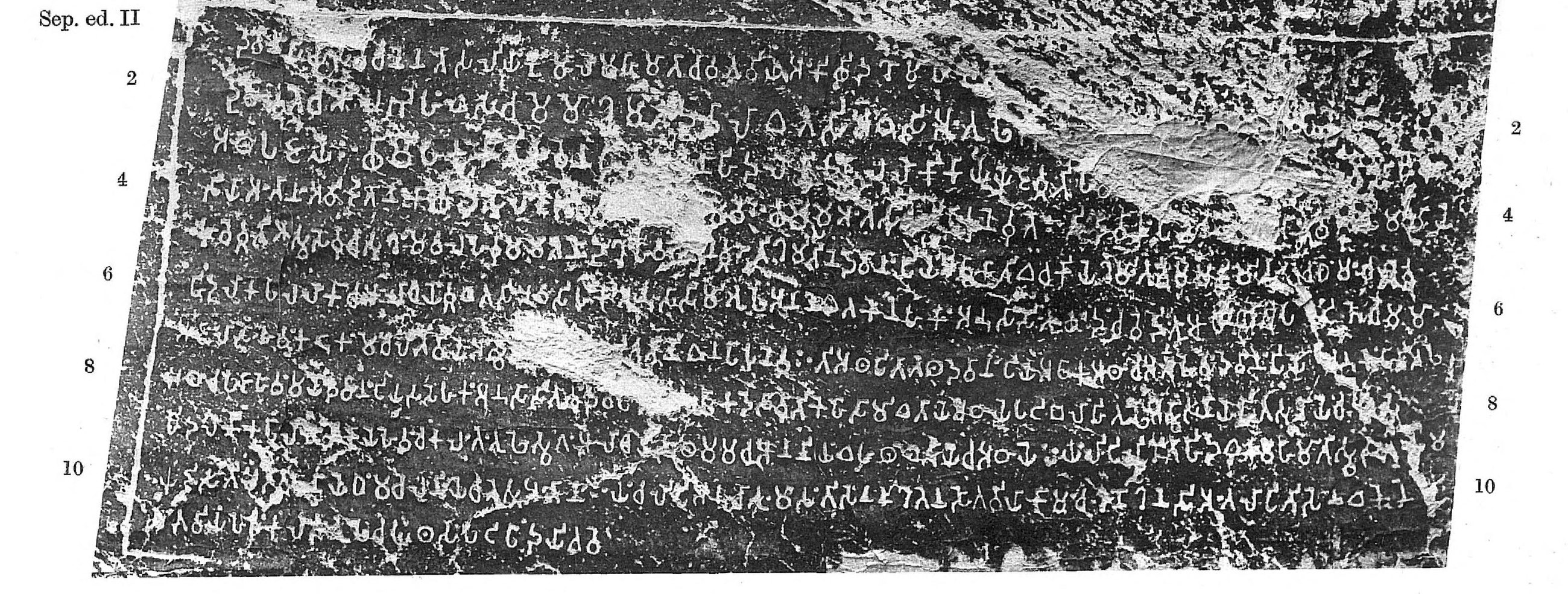
Inked impression (estampage) of the Dhauli rock, not a photograph of the stone: Hultzsch 1925, plate 'Dhauli rock: right column' (facing p. 100; archive.org leaf 252), cropped to the lower part of the right column, from the label 'Sep. ed. II' in the left margin to the last line, numbered 2 to 10 in both margins: 11 lines. Above it on the plate are the ends of Rock Edicts VII-X and XIV. Checked on the image against the transcription (lines 1-11). Text and English: Hultzsch 1925, pp. 98-100 (archive.org leaves 249-251).
1(A) Devānaṁpiyas[a] vachanena Tosaliyaṁ kumāle mahāmātā cha vataviya (B) aṁ kichhi dakhām[i] h[akaṁ taṁ i] . . . . . . . . . .
2duvālate cha ālabhehaṁ (C) esa cha me mokhya-mata duvālā etasi aṭhasi aṁ tuphe[s]u . . . . . . . . . . mama
3(E) ath[a] pajāye ichhāmi hakaṁ ki[ṁ]ti savena hi[ta-sukhe]na hidalokika-pālalokikāye yujevū ti h[e]v[aṁ] . . . . . . . . . .
4(F) siyā aṁtānaṁ avijitānaṁ ki-chha[ṁde] su lāja [aphesu] . . (G) . . . . . m[a]va ichha mama aṁtesu . . . i [p]ā[p]unevu te iti Devānaṁp[iy] . . . . . . . [anu]v[i]g[ina] mamāye
5huvevū ti asvasevu cha sukhaṁmeva lahevu mamat[e] no dukha[ṁ] h[e]va[ṁ] . . . un[e]vū iti khamisati ne Devānaṁpiye [aph]ākā ti e chakiye khamitave mama nimitaṁ [va] cha dhaṁmaṁ chalevū
6hidaloka palaloka[ṁ] cha ālādhayevū (H) etasi aṭhasi haka[ṁ] anusāsāmi tuphe ana[n]e [e]takena hakaṁ anusāsitu chhaṁdaṁ cha veditu ā [hi] dhi[t]i paṭiṁñā cha mamā
7[a]jalā (I) s[e] hevaṁ kaṭu kaṁme chal[i]t[a]v[i]ye asv[āsa] . . . . . i [cha] tāni ena pāpunevū iti atha pitā tatha Devānaṁpiy[e] aphāka athā cha atānaṁ hevaṁ Devānaṁpiye [a]nukaṁpati aphe
8athā cha pajā hevaṁ may[e] D[e]vānaṁpiyasa (J) se hakaṁ anusāsitu [chha]ṁda[ṁ] ch[a veditu tu]phāk[a] desāvutike hosāmi etāye aṭhāye (K) paṭibalā hi tuph[e] asvāsanāye hita-sukhāye cha [tesa]
9hidalokika-pālalo[ki]kāye (L) hevaṁ cha kalaṁtaṁ tuphe svagaṁ ālādha[yi]satha mama ch[a] ānaniyaṁ ehatha (M) etāye cha aṭhāye iyaṁ lipi likhitā hida e[na ma]hāmātā svasata[ṁ sa]ma
10yujisaṁti as[vā]s[a]nāye dhaṁma-chala[n]āye cha tes[a] aṁtānaṁ (N) iyaṁ cha lipi [anu]chātuṁmāsaṁ tisena nakhatena sotaviyā (O) kāmaṁ chu [kha]ṇas[i] khanasi aṁtalā pi tisena ekena [p]i
11[so]taviya (P) hevaṁ kala[ṁ]taṁ [t]uphe chaghatha saṁpaṭipādayitave
(A) At the word of Dēvānāṁpriya, the prince (governor) and the Mahāmātras at Tōsali have to be told (thus).
(B) Whatever I recognize (to be right), that . . . . . . . . . . and to accomplish by (various) means.
(C) And this is considered by me the principal means for this object, viz. . . . . . . . . . . to you.
(D) . . . . . . . . . . my . . . . .
(E) As on behalf of (my own) children I desire that they may be provided with complete welfare and happiness in this world and in the other world, thus . . . . . . . . . .
(F) It might occur to (my) unconquered borderers (to ask): ‘What does the king desire with reference to us?’
(G) [This] alone is my wish with reference to the borderers, that they may learn that Dēvānāṁpriya . . . . . . . . . . that they may not be afraid of me, but may have confidence (in me); that they may obtain only happiness from me, not misery; that they may [learn] this, that Dēvānāṁpriya will forgive them what can be forgiven; that they may (be induced) by me (to) practise morality; (and) that they may attain (happiness in) this world and (in) the other world.
(H) For the following purpose I am instructing you, (viz. that) I may discharge the debt (which I owe to them) by this, that I instruct (you) and inform (you) of (my) will, i. e. my unshakable resolution and vow.
(I) Therefore, acting thus, (you) must fulfil (your) duty and must inspire confidence to them, in order that they may learn that Dēvānāṁpriya is to them like a father, that Dēvānāṁpriya loves them like himself, and that they are to Dēvānāṁpriya like (his own) children.
(J) Therefore, having instructed (you), and having informed you of (my) will, I shall have (i. e. entertain) officers in (all) provinces for this object.
(K) For you are able to inspire confidence to those (borderers) and (to secure their) welfare and happiness in this world and in the other world.
(L) And if (you) act thus, you will attain heaven, and will discharge the debt (which you owe) to me.
(M) And for the following purpose has this rescript been written here, (viz.) in order that the Mahāmātras may strive at all times to inspire confidence to those borderers (of mine) and (to induce them) to practise morality.
(N) And this rescript must be listened to (by all) every four months on (the day of) the constellation Tishya.
(O) But if desired, it may be listened to even by a single (person) also on frequent (other) occasions between (the days of) Tishya.
(P) If (you) act thus, you will be able to carry out (my orders).
Notes
- Hultzsch translates dhamma as 'morality'; other translators use 'Dharma' or 'righteousness'.
- Words in round brackets in the English are Hultzsch's additions for sense; words in square brackets render damaged letters.
Cite
Sources
- Source: Dhauli, near Bhubaneswar (Odisha), rock inscription of Ashoka; Hultzsch's collotype plates of inked impressions (1925); Hultzsch's transliteration and English (CII I, 1925), read from the archive.org scan (holding institution)
- Critical edition: E. Hultzsch, Inscriptions of Asoka (CII I, 1925), transliteration read from the scan
← previous · → next · v cycle view · l back to library