Edicts of Ashoka at Mansehra: the fourteen Major Rock Edicts in Kharoshthi
Introduction
Mansehra lies in the Hazara country of Khyber Pakhtunkhwa (Pakistan), north-east of Shahbazgarhi, on the road towards Kashmir. Its version of Ashoka's fourteen Major Rock Edicts is the second one written in the Kharoshthi script, which runs from right to left and does not mark long vowels. The text is cut on boulders: edicts I-VIII on the first rock (37 lines), IX-XI on the north face of a second rock, XII on its south face, and XIII and XIV on its west face. The wording follows Shahbazgarhi closely. Many letters are worn; Hultzsch marks damaged letters with square brackets and lost ones with dots, and edict XIII, on the Kalinga war and the Greek kings, survives only in part.
Hultzsch's plates do not mark the edicts, only the lines, so each section shows the whole plate that carries it, and its note gives the lines to look for. Edict VIII (lines 34-37 of the first rock) is not included: in the scan used here the plate of the first rock ends below line 34.
The English. Hultzsch prints no translation of the Mansehra text, since it agrees with Shahbazgarhi edict by edict and section by section. Each section shows his Shahbazgarhi translation of the same edict. Where the Mansehra rock has lost words (dots in the transliteration, much of edict XIII), the English renders the Shahbazgarhi text, and each section's note says so.
Sources. Original text and English: E. Hultzsch, Inscriptions of Asoka. New Edition (Corpus Inscriptionum Indicarum, vol. I), Oxford: Clarendon Press for the Government of India, 1925, transcribed from the page images of the archive.org scan (public domain). Images: Hultzsch's collotype plates of inked impressions (estampages) of the Mansehra rock, taken on the stone for the Archaeological Survey of India. An impression is a contact copy pressed on paper from the inscribed surface itself, not a drawing; each section's image is the part of the plate that carries that text, with the plate's own numerals and line numbers in the margins.
Reading the text. Line numbers are Hultzsch's lines on the stone. Letters in square brackets are damaged or uncertain on the stone; dots mark lost letters. The capital letters in brackets, (A), (B) ..., are Hultzsch's sentence divisions and are the same in the transliteration and the English. Hultzsch's footnotes, which record other scholars' readings and his corrections, are not reproduced.
How was this verified? (Provenance)
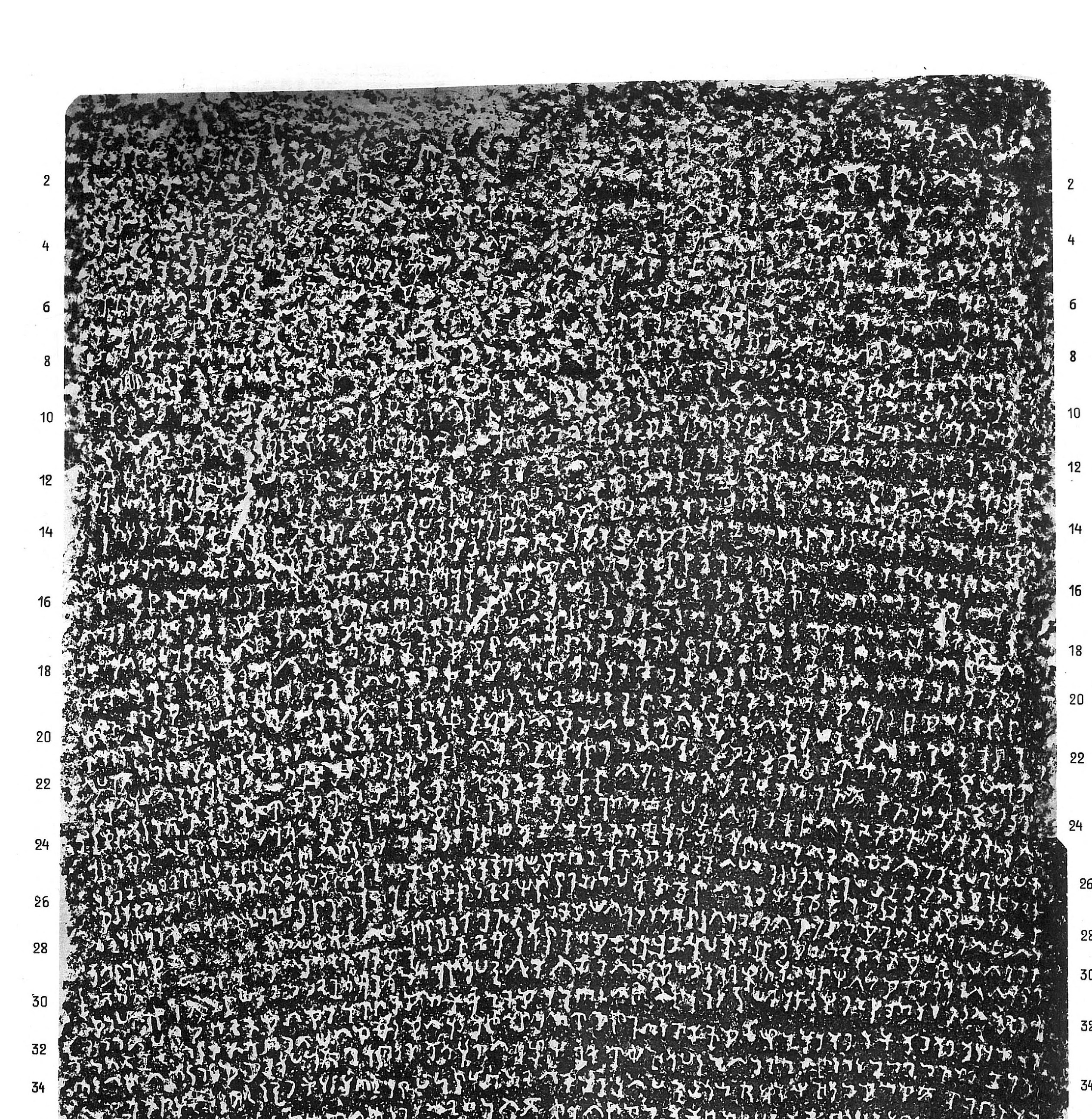
Where on the image
Inked impression (estampage) of the Mansehra rock, not a photograph of the stone: Hultzsch 1925, plate 'First to eighth rock-edicts: Mansehra' (facing p. 78; archive.org leaf 224), cropped to the whole plate of the first rock (edicts I-VIII, 37 lines), which Hultzsch prints sideways; it is turned here a quarter turn clockwise so that the lines run across, line 1 at the top, with his line numbers 2 to 34 in both margins (the scan of the plate ends below line 34, so lines 35-37 are not on it). Edict I is lines 1-5; the edicts are not marked on the plate. Checked on the image against the transcription (lines 1-5). Text: Hultzsch 1925, p. 72 (archive.org leaf 217). Hultzsch prints no English for the Mansehra version. The English shown is his translation of the Shahbazgarhi version of the same edict, the whole edict (Hultzsch 1925, p. 51); it renders that text, so where this version differs in wording or has lost letters (dots in the transliteration), the English goes beyond what this stone shows.
1(A) ayi dhra[ma]-dip[i] Devanaṁ[priye]na Priya[draśina rajina li]khapita (B) hi[da] no kichhi ji[ve] ara[bhitu] pra[johi]-
2taviye (C) no pi [cha] samaj[e] kaṭaviye (D) bahu[ka] hi [dosha samajasa Devanaṁpriye] Priyadraśi raja [da]kha[ti] (E) asti [pi chu]
3[eka]tiya samaja sa[dhu]-mata Devanapriyasa Priyadraśi[sa] rajine (F) pura maha[nasa]si [Devana]pri[ya]sa Pri[yadra]śisa ra-
4jine anudiva[sa ba]huni praṇa-śa[ta]-sahas[r]ani [arabh]isu supa[ṭhra]ye (G) s[e] . . . . . . . . [da] ayi dhrama-dipi likhi[ta] ta[da] ti[ni] y[eva] pra[ṇa]ni [ara]bh[iyaṁti] du[v]e [2] maju-
5ra [e]k[e] m[r]ig[e] s[e] p[i chu] mrig[e] no dhruvaṁ (H) [e]tani pi chu [tini] praṇani pacha no ara[bhi] . . . . .
(A) This rescript on morality has been caused to be written by king Dēvānāṁpriya.
(B) Here no living being must be killed and sacrificed.
(C) And also no festival meetings must be held.
(D) For king Dēvānāṁpriya Priyadarśin sees much evil in festival meetings.
(E) But there are also some festival meetings which are considered meritorious by king Dēvānāṁpriya Priyadarśin.
(F) Formerly in the kitchen of king Dēvānāṁpriya Priyadarśin many hundred thousands of animals were killed daily for the sake of curry.
(G) But now, when this rescript on morality is written, then only three animals are being killed (daily), (viz.) two—2—peacocks (and) 1 deer, (but) even this deer not regularly.
(H) Even these three animals shall not be killed in future.
Where on the image
Inked impression (estampage) of the Mansehra rock, not a photograph of the stone: Hultzsch 1925, plate 'First to eighth rock-edicts: Mansehra' (facing p. 78; archive.org leaf 224), cropped to the whole plate of the first rock (edicts I-VIII, 37 lines), which Hultzsch prints sideways; it is turned here a quarter turn clockwise so that the lines run across, line 1 at the top, with his line numbers 2 to 34 in both margins (the scan of the plate ends below line 34, so lines 35-37 are not on it). Edict II is lines 5-8; the edicts are not marked on the plate. Checked on the image against the transcription (lines 5-8). Text: Hultzsch 1925, p. 72 (archive.org leaf 217). Hultzsch prints no English for the Mansehra version. The English shown is his translation of the Shahbazgarhi version of the same edict, the whole edict (Hultzsch 1925, pp. 51-52); it renders that text, so where this version differs in wording or has lost letters (dots in the transliteration), the English goes beyond what this stone shows.
5(A) sa[vatra vi]jitasi Devanapriyasa Priyadraśisa rajine ye cha ata atha
6[Choḍa] Pa[ṁḍi]ya Sa[ti]ya[p]u[tra] Keralaputra [Taṁ]bapaṇi [A]tiyoge nama Yona-[raja] ye cha [a] . . . . sa . . . . . . [gasa] samata ra[jane sa]vratra . . . . . . priyasa Priyadraśisa rajine
7[duve 2] chikisa [ka]ṭa manuśa-chik[isa cha] paśu-[chi]kisa cha (B) osha[ḍha]ni manu . . . . ka[ni cha] pa . . . . [kani cha atra atra nasti savra]tra [ha]rapi[ta cha] ropa[pita] cha
8(C) e[va]meva mulani [cha] phalani [cha] a[tra a]tra [na]sti [savra]tra harapita cha ro[pa]pita cha (D) ma[geshu] ruchhani [ropa]pi[tani] . . . . . . . . . . [pi]tani paṭibhogaye paśu-m[uni]śanaṁ
(A) Everywhere in the dominions of Dēvānāṁpriya Priyadarśin, and (of those) who (are his) borderers, such as the Chōḍas, the Pāṇḍyas, the Satiyaputra, the Kēraḍaputra, Tāmraparṇī, the Yōna king named Antiyoka, and the other kings who are the neighbours of this Antiyoka,—everywhere two—2—(kinds of) medical treatment were established by king Dēvānāṁpriya Priyadarśin, (viz.) medical treatment for men and medical treatment for cattle.
(B) Wherever there were no herbs beneficial to men and beneficial to cattle, everywhere they were caused to be imported and planted.
(C) And wells were caused to be dug for the use of cattle and men.
Where on the image
Inked impression (estampage) of the Mansehra rock, not a photograph of the stone: Hultzsch 1925, plate 'First to eighth rock-edicts: Mansehra' (facing p. 78; archive.org leaf 224), cropped to the whole plate of the first rock (edicts I-VIII, 37 lines), which Hultzsch prints sideways; it is turned here a quarter turn clockwise so that the lines run across, line 1 at the top, with his line numbers 2 to 34 in both margins (the scan of the plate ends below line 34, so lines 35-37 are not on it). Edict III is lines 9-12; the edicts are not marked on the plate. Checked on the image against the transcription (lines 9-12). Text: Hultzsch 1925, p. 73 (archive.org leaf 218). Hultzsch prints no English for the Mansehra version. The English shown is his translation of the Shahbazgarhi version of the same edict, the whole edict (Hultzsch 1925, pp. 52-53); it renders that text, so where this version differs in wording or has lost letters (dots in the transliteration), the English goes beyond what this stone shows.
9(A) Devanapriye Priyadraśi raja eva a[ha] (B) duva[.a]śa-vashabhisetena me iyaṁ [aṇapayit]e (C) savrat[r]a vijitasi . . . . . . ta [ra]ju . . pradeśike [paṁ]chashu paṁ[chashu] 5 vashesh[u]
10anusa[ṁ]yana[ṁ] nikramatu etaye va athraye imaye dhramanuśastiye ya[tha] añaye pi krama[ṇe] (D) [sadhu mata]-pi[tu]shu [s]u[śrusha mitra]-sa[ṁ]stuta-
11ñatikanaṁ cha bra[ma]ṇa-śramaṇana[ṁ] sadhu dane praṇana [anara]bhe sadhu apa-[va]yata apa-bha[ḍata] sadhu (E) parisha pi cha yutani ga[ṇa]nasi [aṇapa]yiśa[ti] he[tute] cha vi[yaṁja]-
12nate cha
(A) King Dēvānāṁpriya Priyadarśin speaks (thus).
(B) (When I had been) anointed twelve years, [the following] was ordered [by me].
(C) Everywhere in my dominions the Yuktas, the Rajuka, (and) the Prādēsika shall set out on a complete tour (throughout their charges) every five—5—years for this very purpose, (viz.) for the following instruction in morality as well as for other business.
(D) ‘Meritorious is obedience to mother and father. [Liberality] to friends, acquaintances, and relatives, to Brāhmaṇas and Śramaṇas [is meritorious]. Abstention from killing animals is meritorious. Moderation in expenditure (and) moderation in possessions are meritorious.’
(E) The councils (of Mahāmātras) also shall order the Yuktas to register (these rules) both with (the addition of) reasons and according to the letter.
Where on the image
Inked impression (estampage) of the Mansehra rock, not a photograph of the stone: Hultzsch 1925, plate 'First to eighth rock-edicts: Mansehra' (facing p. 78; archive.org leaf 224), cropped to the whole plate of the first rock (edicts I-VIII, 37 lines), which Hultzsch prints sideways; it is turned here a quarter turn clockwise so that the lines run across, line 1 at the top, with his line numbers 2 to 34 in both margins (the scan of the plate ends below line 34, so lines 35-37 are not on it). Edict IV is lines 12-18; the edicts are not marked on the plate. Checked on the image against the transcription (lines 12-18). Text: Hultzsch 1925, p. 74 (archive.org leaf 219). Hultzsch prints no English for the Mansehra version. The English shown is his translation of the Shahbazgarhi version of the same edict, the whole edict (Hultzsch 1925, pp. 53-54); it renders that text, so where this version differs in wording or has lost letters (dots in the transliteration), the English goes beyond what this stone shows.
12(A) atikrataṁ ata[raṁ] bahuni vasha-śa[ta]ni vaḍhite vo praṇaraṁ[bh]e vihi[sa] cha bhutanaṁ ñatina asapa[ṭ]ipati śrama[ṇa]-bramaṇana asa[ṁ]paṭipati
13(B) se aja [De]vanapriyasa Priyadraśine rajine dhrama-[cha]ra[ṇe]na bheri-ghoshe aho dhama-ghoshe vimana-draśana asti[ne] agi-kaṁdhan[i] aña[ni cha] di[vani] rupani draśeti janasa
14(C) [a]diśe bahuhi vasha-śa[tehi] na [hu]ta-pr[u]ve tadiśe [a]ja vaḍhite [De]vanapriyasa Priyadraśine rajine dhramanuśastiya anarabhe praṇana avihisa bhutana ñatina
15saṁpaṭipati bamaṇa-śramaṇana sa[ṁ]paṭipati mata-pitushu suśru[sha] vudhrana [su]śrusha (D) eshe añ[e] cha bahuvidhe dhrama-charaṇe vadhrite (E) vadhrayiśati yeva Devanapriye
16Priyadraśi raja dhama-[cha]raṇa ima[ṁ] (F) [putra] pi cha ka natare cha paṇatika De[va]napriyasa Priyadaśine rajine pavaḍhayiśaṁti yo dhrama-charaṇa imaṁ [a]va-kapaṁ dhrame śile cha
17[chi]ṭhitu dhra[maṁ] anu[śa]śiśaṁti (G) eshe hi sreṭhe a[ṁ] dhramanuśaśana (H) dhrama-[cha]ra[ṇe] pi [cha] na hoti aśi[la]sa (I) se imasa athrasa vadhri ahi[ni cha] sadhu (J) etaye
18athraye i[yaṁ] li[khi]te e[ta]sa [athra]sa vadhra yu[jaṁ]tu hini cha ma [alo]chay[i]su (K) duva[da]śa-vashabhisitena Devanapriyena Priyadraśina rajina iya[ṁ] likhapite
(A) In times past, for many hundreds of years, there had ever been promoted the killing of animals and the hurting of living beings, discourtesy to relatives, (and) discourtesy to Śramaṇas and Brāhmaṇas.
(B) But now, in consequence of the practice of morality on the part of king Dēvānāṁpriya Priyadarśin, the sound of drums has become the sound of morality, showing the people representations of aerial chariots, elephants, masses of light, and other divine figures.
(C) Such as they had not existed before for many hundreds of years, thus there are now promoted, through the instruction in morality on the part of king Dēvānāṁpriya Priyadarśin, abstention from killing animals, abstention from hurting living beings, courtesy to relatives, courtesy to Brāhmaṇas and Śramaṇas, obedience to mother and father, (and) to the aged.
(D) In this and many other ways is the practice of morality promoted.
(E) And this practice of morality will be ever promoted by king Dēvānāṁpriya Priyadarśin.
(F) And also the sons, grandsons, and great-grandsons of king Dēvānāṁpriya Priyadarśin will ever promote this practice of morality until the æon (of destruction of the world), (and) will instruct (people) in morality, abiding by morality and by good conduct.
(G) For this is the best work, viz. instruction in morality.
(H) And the practice of morality also is not (possible) for (a person) devoid of good conduct.
(I) Therefore promotion and not neglect of this object is meritorious.
(J) For the following purpose has this been written, (viz. in order that) they should devote themselves to the promotion of this practice, and that they should not approve the neglect (of it).
(K) (This) conception (jñāna) was caused to be written here by king Dēvānāṁpriya Priyadarśin (when he had been) anointed twelve years.
Where on the image
Inked impression (estampage) of the Mansehra rock, not a photograph of the stone: Hultzsch 1925, plate 'First to eighth rock-edicts: Mansehra' (facing p. 78; archive.org leaf 224), cropped to the whole plate of the first rock (edicts I-VIII, 37 lines), which Hultzsch prints sideways; it is turned here a quarter turn clockwise so that the lines run across, line 1 at the top, with his line numbers 2 to 34 in both margins (the scan of the plate ends below line 34, so lines 35-37 are not on it). Edict V is lines 19-26; the edicts are not marked on the plate. Checked on the image against the transcription (lines 19-26). Text: Hultzsch 1925, p. 75 (archive.org leaf 220). Hultzsch prints no English for the Mansehra version. The English shown is his translation of the Shahbazgarhi version of the same edict, the whole edict (Hultzsch 1925, pp. 55-57); it renders that text, so where this version differs in wording or has lost letters (dots in the transliteration), the English goes beyond what this stone shows.
19(A) De[vanaṁ]priyena Priyadraśi raja eva[ṁ] aha (B) kalaṇa[ṁ] dukara[ṁ] (C) ye adikare kayaṇasa se dukaraṁ karoti (D) taṁ maya bahu [ka]yaṇe [ka]ṭe (E) [ta]ṁ ma[a] putra [cha]
20natar[e] cha para cha t[e]na ye apatiye me [a]va-[ka]paṁ tatha anuvaṭiśati se sukaṭa ka[sha]ti (F) ye [chu] atra deśa pi hapeśati se dukaṭa kashati
21(G) pape hi nama supadarave (H) s[e] atikrata[ṁ] a[ṁ]tara[ṁ] na bhuta-pruva dhrama-[ma]hamatra nama (I) se treḍaśa-va[sha]bhisitena maya dhrama-mahamatra kaṭa (J) te savra-pa[sha]ḍesha
22vapuṭa dhramadhitha[na]ye cha dhrama-vadhriya hida-sukhaye cha dh[r]ama-yutasa Yona-Kaṁboja-Gadharana Raṭhika-Pitinikana ye va pi añe aparata (K) bha[ṭa]maye-
23shu bramaṇibhyeshu anatheshu vudhreshu hida-su[khaye] dhrama-yuta-apalibodhaye viya[p]uṭa te (L) badhana-badha[sa] paṭivi[dhanay]e apalibodhaye mokshay[e cha iyaṁ]
24anubadha p[r]aja t[i] va kaṭrabhikara ti va mahalake ti va viyapraṭa te (M) hida bahireshu cha nagaresh[u] savreshu [o]rodhaneshu bhatana cha spas[u]na [cha]
25ye va pi añe ñatike savratra viyapaṭa (N) [e] iyaṁ dhrama-niśito to va dhramadhithane ti va dana-saṁyute ti va savratra vijitasi maa dhrama-yutasi vapuṭa [te]
26dhrama-mahamatra (O) etaye athraye ayi dhrama-dipi likhita chira-ṭhitika hotu tatha cha me praja anuvaṭatu
(A) King Dēvānāṁpriya Priyadarśin speaks thus.
(B) It is difficult to perform virtuous deeds.
(C) He who starts performing virtuous deeds accomplishes something difficult.
(D) Now, by me many virtuous deeds have been performed.
(E) Therefore (among) my sons and grandsons, and (among) my descendants who shall come after them until the æon (of destruction of the world), those who will conform to this (duty) will perform good deeds.
(F) But he who will neglect even one (portion) of this (duty) will perform evil deeds.
(G) For sin is easily committed.
(H) Now, in times past (officers) called Mahāmātras of morality did not exist before.
(I) But Mahāmātras of morality were appointed by me (when I had been) anointed thirteen years.
(J) These are occupied with all sects in establishing morality, in promoting morality, and for the welfare and happiness of those who are devoted to morality (even) among the Yōnas, Kambōyas, and Gandhāras, among the Raṭhikas, among the Pitinikas, and whatever (other) western borderers (of mine there are).
(K) They are occupied with servants and masters, with Brāhmaṇas and Ibhyas, with the destitute, (and) with the aged, for the welfare and happiness of those who are devoted to morality, (and) in freeing (them) from desire (for worldly life).
(L) They are occupied in supporting prisoners (with money), in causing (their) fetters to be taken off, (and) in setting (them) free, (if) one has children, or is bewitched, or aged, respectively.
(M) They are occupied everywhere, here and in all the outlying towns, in the harems of my brothers, of (my) sisters, and (of) whatever other relatives (of mine there are).
(N) These Mahāmātras of morality are occupied everywhere in my dominions with those who are devoted to morality, (in order to ascertain) whether one is eager for morality, or established in morality, or furnished with gifts.
(O) For the following purpose has this rescript on morality been written, (viz. that) it may be of long duration, and (that) my descendants may conform to it.
Where on the image
Inked impression (estampage) of the Mansehra rock, not a photograph of the stone: Hultzsch 1925, plate 'First to eighth rock-edicts: Mansehra' (facing p. 78; archive.org leaf 224), cropped to the whole plate of the first rock (edicts I-VIII, 37 lines), which Hultzsch prints sideways; it is turned here a quarter turn clockwise so that the lines run across, line 1 at the top, with his line numbers 2 to 34 in both margins (the scan of the plate ends below line 34, so lines 35-37 are not on it). Edict VI is lines 26-32; the edicts are not marked on the plate. Checked on the image against the transcription (lines 26-32). Text: Hultzsch 1925, pp. 76-77 (archive.org leaves 221-222). Hultzsch prints no English for the Mansehra version. The English shown is his translation of the Shahbazgarhi version of the same edict, the whole edict (Hultzsch 1925, pp. 57-59); it renders that text, so where this version differs in wording or has lost letters (dots in the transliteration), the English goes beyond what this stone shows.
26(A) Devanapriye Priyadraśi raja [e]va[ṁ] aa (B) atikrataṁ ataraṁ
27na huta-pruve [sa]vraṁ kala athra-[kraṁa] va [pa]ṭivedana va (C) ta maya evaṁ kiṭaṁ (D) savra kalaṁ aśatasa me orodhane grabhagarasi vrachaspi vinitaspi uyanaspi savratra pa[ṭ]i[ve]da[ka] athra janasa
28paṭivedetu me (E) savratra cha janasa athra kar[o]mi ahaṁ (F) yaṁ pi cha kichhi mukhato aṇapemi ahaṁ dapakaṁ va śravakaṁ va ye va puna mahamatrehi achayike aropite hoti
29taye athraye vivade nijati va saṁta par[isha]ye a[ṇa]taliyena paṭivedetaviye me savratra savra kala (G) evaṁ aṇapita maya (H) nasti hi me toshe [uṭhanasi] ath[r]a-sa[ṁ]tiraṇaye cha
30(I) kaṭaviya-mate hi me savra-loka-h[i]te (J) [ta]sa chu puna eshe mule uṭhane athra-satiraṇa cha (K) nasti hi kramatara savra-loka-hitena (L) ya[ṁ] cha [kichhi] pa[rakra]mami aaṁ k[i]t[i] bh[u]tanaṁ
31aṇaṇiyaṁ ye[haṁ] ia cha she sukhayami paratra cha spagra a[ra]dhetu ti (M) se etaye athraye iyaṁ dhrama-dipi likhita chira-ṭhitika hotu ta[tha cha] me pu[tra nata]re para[kra]mate sa[vra]-
32[lo]ka-hitaye (N) dukare cha kho [a]ñatra a[g]rena para[kra]mena
(A) King Dēvānāṁpriya Priyadarśin speaks thus.
(B) In times past neither the disposal of affairs nor the submission of reports at any time did exist before.
(C) But I have made the following (arrangement).
(D) Reporters have to report to me the affairs of the people at any time (and) anywhere, while I am eating, in the harem, in the inner apartment, at the cowpen, in the palanquin, (and) in the park.
(E) And everywhere I am disposing of the affairs of the people.
(F) And also, if in the council (of Mahāmātras) a dispute arises, or an amendment is moved, in connexion with any donation or proclamation which I am ordering verbally, or (in connexion with) an emergent matter which has been delegated to the Mahāmātras, it must be reported to me immediately, anywhere, (and) at any time.
(G) Thus I have ordered.
(H) For I am never content in exerting myself and in dispatching business.
(I) For I consider it my duty (to promote) the welfare of all men.
(J) And the root of that (consists) in this, (viz.) exertion and the dispatch of business.
(K) For no duty is more important than (promoting) the welfare of all men.
(L) And whatever effort I am making, (is made) in order that I may discharge the debt (which I owe) to living beings, (that) I may make them happy in this (world), and (that) they may attain heaven in the other (world).
(M) For the following purpose has this [rescript on] morality been written, (viz. that) it may be of long duration, and (that) my sons (and) grandsons may display the same zeal for the welfare of all men.
(N) But it is indeed difficult to accomplish this without great zeal.
Where on the image
Inked impression (estampage) of the Mansehra rock, not a photograph of the stone: Hultzsch 1925, plate 'First to eighth rock-edicts: Mansehra' (facing p. 78; archive.org leaf 224), cropped to the whole plate of the first rock (edicts I-VIII, 37 lines), which Hultzsch prints sideways; it is turned here a quarter turn clockwise so that the lines run across, line 1 at the top, with his line numbers 2 to 34 in both margins (the scan of the plate ends below line 34, so lines 35-37 are not on it). Edict VII is lines 32-34; the edicts are not marked on the plate. Checked on the image against the transcription (lines 32-34). Text: Hultzsch 1925, p. 77 (archive.org leaf 222). Hultzsch prints no English for the Mansehra version. The English shown is his translation of the Shahbazgarhi version of the same edict, the whole edict (Hultzsch 1925, p. 59); it renders that text, so where this version differs in wording or has lost letters (dots in the transliteration), the English goes beyond what this stone shows.
32(A) Devanapriyo Priyadraśi raja savratra ichhati savra-pashaḍa vaśeyu (B) savre hi te sa[ya]ma [bha]va-śu[dh]i [cha]
33[ichhaṁ]ti (C) jane chu uchavucha-chhade uchavucha-rage (D) te savraṁ eka-deśaṁ va pi kashati (E) [v]ipule pi ch[u] dane yasa nasti sayeme bhava-śuti kiṭanata driḍha-bhatita cha
34niche baḍhaṁ
(A) King Dēvānāṁpriya Priyadarśin desires (that) all sects may reside everywhere.
(B) For all these desire self-control and purity of mind.
(C) But men possess various desires (and) various passions.
(D) They will fulfil either the whole or only a portion (of their duties).
(E) But even one who (practises) great liberality, (but) does not possess self-control, purity of mind, gratitude, (and) firm devotion, is very mean.
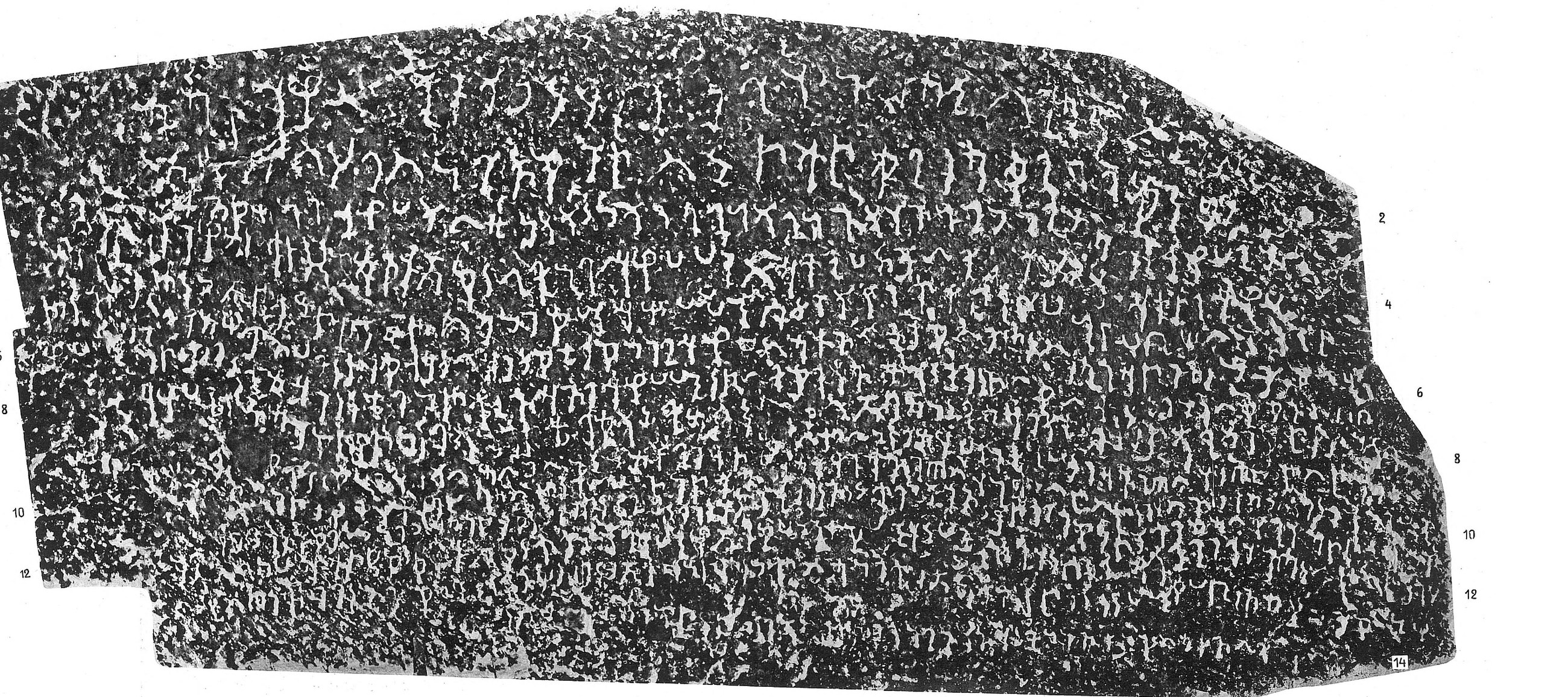
Where on the image
Inked impression (estampage) of the Mansehra rock, not a photograph of the stone: Hultzsch 1925, plate 'Ninth to eleventh rock-edicts: Mansehra' (facing p. 80; archive.org leaf 227), cropped to the whole plate of the north face of the second rock (edicts IX-XI, 14 lines), numbered 2 to 12 in the right margin, where the lines begin (Kharoshthi runs from right to left), 10 and 12 at the left, and 14 boxed at the lower right. Edict IX is lines 1-8; the edicts are not marked on the plate. Checked on the image against the transcription (lines 1-8). Text: Hultzsch 1925, pp. 78-79 (archive.org leaves 223, 225). Hultzsch prints no English for the Mansehra version. The English shown is his translation of the Shahbazgarhi version of the same edict, the whole edict (Hultzsch 1925, pp. 61-62); it renders that text, so where this version differs in wording or has lost letters (dots in the transliteration), the English goes beyond what this stone shows.
1(A) Devanapriye Priyadraśi raja evaṁ aha (B) jane uchavucha[ṁ ma]gala[ṁ] karoti
2abadhasi a[va]hasi vi[va]hasi prajopadaye pravasaspi etaye añaye [cha ed]iśa[ye jane]
3bahu maṁga[laṁ ka]ro[t]i (C) atra tu abaka-janika bahu cha bahuvidha cha khuda cha nirathriya cha magalaṁ karoti (D) se ka[ṭaviye ch]eva kho
4magale (E) apa-phale chu [kho e]she (F) iyaṁ chu kho maha-phale ye dhrama-magale (G) atra iyaṁ dasa-bhaṭakasi samya-paṭipati guruna a[pachit]i
5pra[ṇa]na [sa]yame śramaṇa-bramaṇana [dane] eshe aṇe cha ediśe dhrama-magale nama (H) se vataviye pi[tu]na pi putrena pi bhratuna pi spamikena pi
6mitra-sa[ṁ]stutena [a]va paṭiveśiyena pi iyaṁ sadhu iyaṁ kaṭaviye magale ava tasa athrasa nivuṭiya nivuṭasi va puna ima [ka]shami ti (I) e hi [i]tare maga[le]
7śa[śa]yike se (J) s[i]ya va taṁ athraṁ nivaṭeya s[i]ya pana no (K) hidal[o]kike cheva se (L) iyaṁ puna dhrama-magale akalike (M) [ha]che pi taṁ athraṁ no nivaṭeti [hi]da a[tha] paratra
8anata puṇa prasavati (N) hache puna ta[ṁ] athraṁ nivaṭ[e]ti hida tato ubhayesaṁ [ara]dhe hoti hida cha se athre paratra cha anata puṇaṁ prasavati tena dhramagalena
(A) King Dēvānāṁpriya Priyadarśin speaks thus.
(B) Men are practising various ceremonies during illness, at the marriage of a son or a daughter, at the birth of a child, (and) when setting out on a journey; on these and other such (occasions) men are practising many ceremonies.
(C) But in such (cases) women are practising many and various offensive and useless ceremonies.
(D) Now, ceremonies should certainly be practised.
(E) But these (ceremonies) bear little fruit indeed.
(F) But the following bears much fruit indeed, viz. the practice of morality.
(G) Herein the following (are comprised), (viz.) proper courtesy to slaves and servants, reverence to elders, gentleness to animals, (and) liberality to Śramaṇas and Brāhmaṇas; these and other (virtues) are called the practice of morality.
(H) Therefore a father, or a son, or a brother, or a master, (or) a friend or an acquaintance, (or) even a (mere) neighbour ought to say: ‘This is meritorious. This practice should be observed until the (desired) object is attained, (thinking): After it is actually attained, I shall observe this again’.
(I) For such ceremonies are of doubtful (effect).
(J) One may attain his object (by them), but he may not (do so).
(K) And they (bear fruit) in this world only.
(L) But that practice of morality is not restricted to time.
(M) But if one does not attain (by it) his object in this (world), then endless merit is produced in the other (world).
(N) But if one attains (by it) his object (in this world), the gain of both (results) arises from it; (viz.) the (desired) object (is attained) in this (world), and endless merit is produced in the other (world) by that practice of morality.
Where on the image
Inked impression (estampage) of the Mansehra rock, not a photograph of the stone: Hultzsch 1925, plate 'Ninth to eleventh rock-edicts: Mansehra' (facing p. 80; archive.org leaf 227), cropped to the whole plate of the north face of the second rock (edicts IX-XI, 14 lines), numbered 2 to 12 in the right margin, where the lines begin (Kharoshthi runs from right to left), 10 and 12 at the left, and 14 boxed at the lower right. Edict X is lines 9-11; the edicts are not marked on the plate. Checked on the image against the transcription (lines 9-11). Text: Hultzsch 1925, p. 79 (archive.org leaf 225). Hultzsch prints no English for the Mansehra version. The English shown is his translation of the Shahbazgarhi version of the same edict, the whole edict (Hultzsch 1925, pp. 62-63); it renders that text, so where this version differs in wording or has lost letters (dots in the transliteration), the English goes beyond what this stone shows.
9(A) [Devana]priye Priyadraśi raja yaśo va kiṭi va no mahathravahaṁ mañati aṇatra yaṁ pi ya[śo va] kiṭi va ichhati tadatvaye ayatiya cha jane [dhra]ma-suśrusha suśrushatu me ti
10dhrama-[vutaṁ cha] anuvidhiyatu ti (B) etakaye Devanapriye Priya[dra]śi raja yaśo va kiṭi va i[chha]ti (C) . . . . [k]ichhi parak[r]ama[ti] Devanapriye Priyadraśi raja taṁ savraṁ parat[r]ikay[e va k]i[ti]
11sa[kale apa]-pa[r]isav[e] siyati ti (D) eshe chu pa[ri]save e apu[ṇe] (E) dukare chu kho eshe khudakena [va va]gr[e]na [u]saṭena va ana[tra] a[gre]na para[krame]na sav[raṁ] pariti[ji]tu (F) atra tu [kho] usaṭeneva du[ka]re
(A) King Dēvānāṁpriya Priyadarśin does not think that either glory or fame conveys much advantage, except whatever glory or fame he desires (on account of his aim) that in the present time, and in the future, men may (be induced) by him to practise obedience to morality, and that they may conform to the duties of morality.
(B) On this (account) king Dēvānāṁpriya Priyadarśin is desiring glory and fame.
(C) But whatever effort king Dēvānāṁpriya Priyadarśin is making, all that (is) only for the sake of (merit) in the other (world), (and) in order that all (men) may be free of danger.
(D) But the danger is this, viz. demerit.
(E) But it is indeed difficult for a lowly person or for a high one to accomplish this without great zeal (and without) laying aside every (other aim).
(F) But among these (two) . . . . . . . . . . a high (person).
Where on the image
Inked impression (estampage) of the Mansehra rock, not a photograph of the stone: Hultzsch 1925, plate 'Ninth to eleventh rock-edicts: Mansehra' (facing p. 80; archive.org leaf 227), cropped to the whole plate of the north face of the second rock (edicts IX-XI, 14 lines), numbered 2 to 12 in the right margin, where the lines begin (Kharoshthi runs from right to left), 10 and 12 at the left, and 14 boxed at the lower right. Edict XI is lines 12-14; the edicts are not marked on the plate. Checked on the image against the transcription (lines 12-14). Text: Hultzsch 1925, p. 80 (archive.org leaf 226). Hultzsch prints no English for the Mansehra version. The English shown is his translation of the Shahbazgarhi version of the same edict, the whole edict (Hultzsch 1925, p. 63); it renders that text, so where this version differs in wording or has lost letters (dots in the transliteration), the English goes beyond what this stone shows.
12(A) Devanapri[y]e Priyadraśi raja evaṁ aha (B) nasti ediśe dane [a]diśe dhrama-dane dhrama-saṁtha[v]e dhrama-saṁvibhaga dhrama-sa[ṁ]ba[ṁ]dh[e] (C) tatra eshe dasa-bhaṭa[ka]si samya-paṭipati mata-[pitu]shu su[śru]sha
13mitra-saṁ[stuta]-ñatikana śramaṇa-bramaṇana dan[e] praṇana [aṇa]rabhe (D) [e]she vataviye pituna pi putrena pi bhratuna pi spamike[na] pi mitra-saṁ[stu]t[e]na ava paṭiveśiyena
14iyaṁ sa[dhu] iyaṁ kaṭaviye (E) se tatha karata[ṁ] hi[dalo]ke [cha] kaṁ aradhe ho[ti pa]ra[tra] cha ana[ṁ]taṁ puṇaṁ p[r]asavati te[na dhra]ma-danena
(A) King Dēvānāṁpriya Priyadarśin speaks thus.
(B) There is no such gift as the gift of morality, acquaintance through morality, the distribution of morality, (and) kinship through morality.
(C) Herein the following (are comprised), (viz.) proper courtesy to slaves and servants, obedience to mother and father, liberality to friends, acquaintances, and relatives, to Śramaṇas and Brāhmaṇas, (and) abstention from killing animals.
(D) Concerning this a father, or a son, or a brother, or a master, (or) a friend or an acquaintance, (or) even a (mere) neighbour, ought to say: ‘This is meritorious. This ought to be done’.
(E) If one is acting thus, he attains (happiness in) this world, and endless merit is produced in the other (world) by that gift of morality.
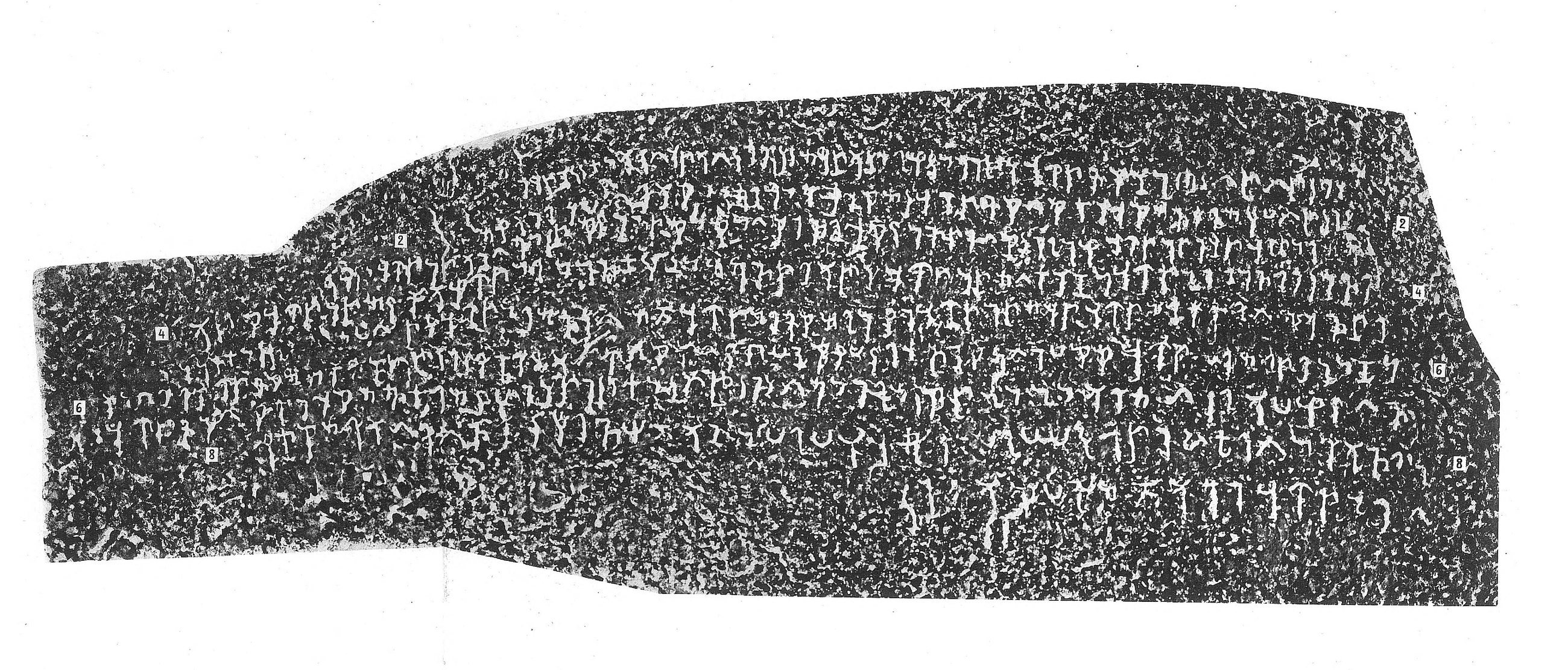
Where on the image
Inked impression (estampage) of the Mansehra rock, not a photograph of the stone: Hultzsch 1925, plate 'Twelfth rock-edict: Mansehra' (facing p. 81; archive.org leaf 229), cropped to the whole plate of the south face of the second rock, which carries edict XII alone: lines 1-9, numbered in the margins. Checked on the image against the transcription (lines 1-9). Text: Hultzsch 1925, p. 81 (archive.org leaf 228). Hultzsch prints no English for the Mansehra version. The English shown is his translation of the Shahbazgarhi version of the same edict, the whole edict (Hultzsch 1925, pp. 64-66); it renders that text, so where this version differs in wording or has lost letters (dots in the transliteration), the English goes beyond what this stone shows.
1(A) Devanapriye Priyadraśi raja savra-pashaḍani [p]rava[ji]tani gehathani cha pujeti danena vividhaye cha pujaye (B) no chu tatha dana va puja va
2[De]vana[ṁ]priye mañati atha kiti sala-vaḍhi siya savra-pashaḍana ti (C) sala-vruḍhi t[u] bahuvidha (D) tasa chu iyaṁ mule aṁ vacha-guti
3kiti ata-prashaḍa-puja va para-pashaḍa-garaha va no siya apakaraṇasi lahuka va siya tasi tasi pakaraṇasi (E) pujetaviya va chu para-p[r]ashaḍa tena tena
4akarena (F) evaṁ karataṁ atva-pashaḍa baḍhaṁ vaḍhayati para-pashaḍasa pi cha upakaroti (G) tad-aṁñatha karataṁ ata-pashaḍa cha chhaṇati para-pashaḍasa pi cha
5apakaroti (H) ye hi kechhi atva-pashaḍa pujeti para-pashaḍa va garahati savre atva-pashaḍa-bhatiya va kiti atva-pashaḍa dipayama ti . . . . puna tatha karataṁ
6baḍhataraṁ upahaṁti atva-pasha[ḍa] (I) se samavaye vo sadhu ki[ti] aṇamaṇasa dhramaṁ śruṇ[e]y[u cha] suśrushe[yu] cha ti (J) evaṁ hi Devanapriyasa ichha kiti savra-pashaḍa bahu-śruta cha
7kayaṇagama cha [hu]veyu ti (K) e cha tatra tatra prasana tehi vataviye (L) Devanapriye no tatha danaṁ va puja[ṁ] va maṇati atha kiti sala-vaḍhi siya savra-pashaḍa[na]
8(M) [ba]huka cha etaye athraye vapuṭa dhrama-mahamatra istrijaksha-mahamatra vracha-bh[u]mika aṇe cha nikay[e] (N) iyaṁ cha etisa phale
9yaṁ atva-pashaḍa-vaḍhi cha bh[o]t[i] dhramasa cha [di]pana
(A) King Dēvānāṁpriya Priyadarśin is honouring all sects: (both) ascetics and householders, with gifts and with honours of various kinds.
(B) But Dēvānāṁpriya does not value either gifts or honours so (highly) as (this), (viz.) that a promotion of the essentials of all sects should take place.
(C) But the promotion of the essentials (is possible) in many ways.
(D) But its root is this, viz. guarding (one's) speech, (i.e.) that neither praising one's own sect nor blaming other sects should take place on improper occasions, or (that) it should be moderate in every case.
(E) But other sects ought to be duly honoured in every way.
(F) If one is acting thus, he is promoting his own sect and is benefiting other sects as well.
(G) If one is acting otherwise than thus, he is hurting his own sect and wronging other sects.
(H) For whosoever praises his own sect (or) blames other sects,—all (this) out of pure devotion to his own sect, (i.e.) with the view of glorifying his own sect,—if he is acting thus, he rather injures his own sect very severely.
(I) Therefore self-control alone is meritorious, (i.e.) that they should both hear and obey each other's morals.
(J) For this is the desire of Dēvānāṁpriya, (viz.) that all sects should be both full of learning and pure in doctrine.
(K) And those who are attached to their respective (sects), ought to be spoken to (as follows).
(L) Dēvānāṁpriya does not value either gifts or honours so (highly) as (this), (viz.) that a promotion of the essentials of all sects should take place.
(M) And many (officers) are occupied for this purpose, (viz.) the Mahāmātras of morality, the Mahāmātras controlling women, the inspectors of cowpens, and other classes (of officials).
(N) And this is the fruit of it, (viz.) that the promotion of one's own sect takes place, and the glorification of morality.
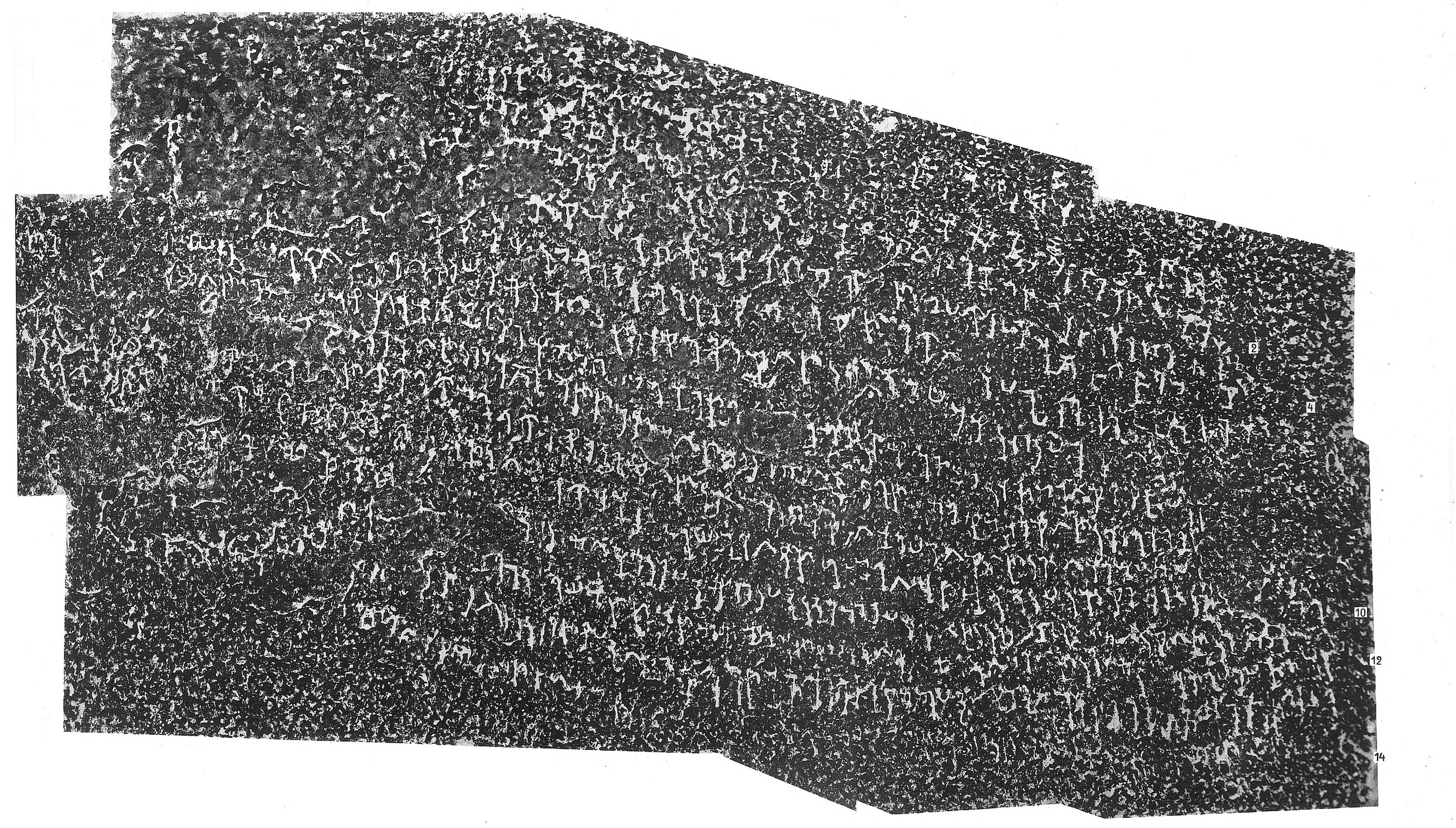
Where on the image
Inked impression (estampage) of the Mansehra rock, not a photograph of the stone: Hultzsch 1925, plate 'Thirteenth and fourteenth rock-edicts: Mansehra' (facing p. 84; archive.org leaf 233), cropped to the whole plate of the west face of the second rock (edicts XIII and XIV, 14 lines), numbered in the margins. Edict XIII is lines 1-13; edict XIV begins in line 13. Checked on the image against the transcription (lines 1-13). Text: Hultzsch 1925, pp. 82-83 (archive.org leaves 230-231). Hultzsch prints no English for the Mansehra version. The English shown is his translation of the Shahbazgarhi version of the same edict, the whole edict (Hultzsch 1925, pp. 67-70); it renders that text, so where this version differs in wording or has lost letters (dots in the transliteration), the English goes beyond what this stone shows.
1(A) [aṭha]-vashabhisita[sa] De[va]na[priyasa] Priyadraśine rajine [Ka]liga [v]i[jita] (B) [di]ya[ḍha]-mat[r]e praṇa-[śata-sa] . . . . . . . . . .
2[ma]ṭe (C) [tato] pacha adhuna la[dhe]shu Kaligeshu ti[vr]e dhrama[va]ye . . . . . . . . . . [dhra]manu[śa]sti [cha De]vana[pri] . . . . (D) . . . . . . . . . .
3[maraṇe va apavahe va janasa] se [baḍhaṁ] vedaniya-mate guru-mate [cha Devanapriyasa] (F) [i]yaṁ [pi] chu tato . . . . . . . . . .
4[ye]su [vihi]ta esha [a]grabhu[ṭi]-suśrusha mata-pi[tu]sh[u] su[śru]sha guru-suśrusha mit[r]a-sa[ṁ]stu . . . . . . . . . .
5[va]dh[e] va abh[iratanaṁ] va vini[k]ramaṇi (H) yesha[ṁ] va pi s[u]vih[itanaṁ] si[ne]he avipahin[e e] ta[naṁ] mitra-[saṁ] . . . . . . . . . .
6(I) . . . . . . . . . . [esha] savra-manuśanaṁ guru-mate cha Devanaṁpriyasa (J) nasti cha se janapade yatra nasti ime ni[ka]ya a[ña]tra Yoneshu [bramaṇe cha] śra[maṇe] . . . . . . . . . . pi [janapada]si ya[t]ra . . . . . . . . . .
7na nama prasade (K) se yavatake jane tada Kaligesh[u] hate cha . . . . . . apavuḍhe cha ta[to] śata-bhage va sahasra-bhage va aja guru-ma[te va] Devanapriya[sa] (L) . . . . . . . . pa[ka] . . . . . . . . [mi]tavi . . . . . . . . . .
8(M) . . [pi cha] aṭavi Devanapriyasa vijitasi hoti [ta] pi a[nuna]ya[ti a]nu[nijha]paya[ti] (N) [anu]tape pi cha prabhave Devanapriyasa vuchati [te]sha [ki] . . . . . . . . . . (O) . . chha . . . . . . vanapri[y .] . . . . . . . . . .
9(P) . . . . . . [mukha]-mute v[i]jaye D[e]vanapriyasa ye dhrama-vijaye (Q) se cha [puna] la[dh]e [Deva]napri[ya]sa hida cha sa[vr]eshu cha aṁteshu a shashu pi y[o]ja[na-śa]t[e]shu . . . . . . tiyo[ge] nama Yo[na-raja] . . . . . . . . . .
10Aṁt[e] . . . . [nama Ma]ka na[ma] Alikasudare nama nicha Choḍa-Paṁḍiya a Taṁbapa[ṁ]ṇiya (R) evameva [hida] raja-vishava[si] Y[o]na-Kaṁ[bojeshu] Nabhaka-[Na]bhapa[ṁ]tishu [Bh]o[ja-Pi]tini[ke]shu Adha-[Pa] . . . . . . . . . .
11(S) [yatra pi du]ta [De]vanapriyasa na yaṁti te pi śrutu Devanapriyasa dhrama-vuta vidhana[ṁ] dhramanuśasti dhra[ṁ]ma[ṁ] anuvidhiyaṁti [a]nuvidhiy[iśaṁti cha] (T) [ye se] ladhe e[ta]ke[na ho]ti savra[tra] vi[jaye] . . . . . . . . . .
12(W) paratrikameva maha-phala [ma]ṇati De[va]napri[ye] (X) e[ta]ye cha [a]thray[e] iyaṁ dhraṁma-dipi li[khi]ta kiti putra prap[o]tra me a[su] nava[ṁ] v[i] . . . . . . . . . . [tavi]yaṁ maṇ[ishu saya] . . . . . . . . . .
13(Y) . . hidaloke paralokike (Z) sava cha [ka] nirati hotu ya dhrama-rati (AA) sa hi [i]aloki[ka] paraloki[ka]
(A) When king Dēvānāṁpriya Priyadarśin had been anointed eight years, (the country of) the Kaliṅgas was conquered by (him).
(B) One hundred and fifty thousand in number were the men who were deported thence, one hundred thousand in number were those who were slain there, and many times as many those who died.
(C) After that, now that (the country of) the Kaliṅgas has been taken, Dēvānāṁpriya (is devoted) to a zealous study of morality, to the love of morality, and to the instruction (of people) in morality.
(D) This is the repentance of Dēvānāṁpriya on account of his conquest of (the country of) the Kaliṅgas.
(E) For, this is considered very painful and deplorable by Dēvānāṁpriya, that, while one is conquering an unconquered (country), slaughter, death, and deportation of people (are taking place) there.
(F) But the following is considered even more deplorable than this by Dēvānāṁpriya.
(G) (To) the Brāhmaṇas or Śramaṇas, or other sects or householders, who are living there, (and) among whom the following are practised: obedience to those who receive high pay, obedience to mother and father, obedience to elders, proper courtesy to friends, acquaintances, companions, and relatives, to slaves and servants, (and) firm devotion,—to these then happen injury or slaughter or deportation of (their) beloved ones.
(H) Or, if there are then incurring misfortune the friends, acquaintances, companions, and relatives of those whose affection (for the latter) is undiminished, although they are (themselves) well provided for, this (misfortune) as well becomes an injury to those (persons) themselves.
(I) This is shared by all men and is considered deplorable by Dēvānāṁpriya.
(J) And there is no (place where men) are not indeed attached to some sect.
(K) Therefore even the hundredth part or the thousandth part of all those people who were slain, who died, and who were deported at that time in Kaliṅga, (would) now be considered very deplorable by Dēvānāṁpriya.
(L) And Dēvānāṁpriya thinks that even (to one) who should wrong (him), what can be forgiven is to be forgiven.
(M) And even (the inhabitants of) the forests which are (included) in the dominions of Dēvānāṁpriya, even those he pacifies (and) converts.
(N) And they are told of the power (to punish them) which Dēvānāṁpriya (possesses) in spite of (his) repentance, in order that they may be ashamed (of their crimes) and may not be killed.
(O) For Dēvānāṁpriya desires towards all beings abstention from hurting, self-control, (and) impartiality in (case of) violence.
(P) And this conquest is considered the principal one by Dēvānāṁpriya, viz. the conquest by morality.
(Q) And this (conquest) has been won repeatedly by Dēvānāṁpriya both here and among all (his) borderers, even as far as at (the distance of) six hundred yōjanas, where the Yōna king named Antiyoka (is ruling), and beyond this Antiyoka, (where) four—4—kings (are ruling), (viz. the king) named Turamaya, (the king) named Antikini, (the king) named Maka, (and the king) named Alikasudara, (and) towards the south, (where) the Chōḍas and Pāṇḍyas (are ruling), as far as Tāmraparṇī.
(R) Likewise here in the king's territory, among the Yōnas and Kambōyas, among the Nabhakas and Nabhitis, among the Bhōjas and Pitinikas, among the Andhras and Palidas,—everywhere (people) are conforming to Dēvānāṁpriya's instruction in morality.
(S) Even those to whom the envoys of Dēvānāṁpriya do not go, having heard of the duties of morality, the ordinances, (and) the instruction in morality of Dēvānāṁpriya, are conforming to morality and will conform to (it).
(T) This conquest, which has been won by this everywhere,—a conquest (won) everywhere (and) repeatedly,—causes the feeling of satisfaction.
(U) Satisfaction has been obtained (by me) at the conquest by morality.
(V) But this satisfaction is indeed of little (consequence).
(W) Dēvānāṁpriya thinks that only the fruits in the other (world) are of great (value).
(X) And for the following purpose has this rescript on morality been written, (viz.) in order that the sons (and) great-grandsons (who) may be (born) to me, should not think that a fresh conquest ought to be made, (that), if a conquest does please them, they should take pleasure in mercy and light punishments, and (that) they should regard the conquest by morality as the only (true) conquest.
(Y) This (conquest bears fruit) in this world (and) in the other world.
(Z) And let there be (to them) pleasure in the abandonment of all (other aims), which is pleasure in morality.
(AA) For this (bears fruit) in this world (and) in the other world.
Where on the image
Inked impression (estampage) of the Mansehra rock, not a photograph of the stone: Hultzsch 1925, plate 'Thirteenth and fourteenth rock-edicts: Mansehra' (facing p. 84; archive.org leaf 233), cropped to the whole plate of the west face of the second rock (edicts XIII and XIV, 14 lines), numbered in the margins. Edict XIV is lines 13-14; edict XIV begins in line 13. Checked on the image against the transcription (lines 13-14). Text: Hultzsch 1925, p. 84 (archive.org leaf 232). Hultzsch prints no English for the Mansehra version. The English shown is his translation of the Shahbazgarhi version of the same edict, the whole edict (Hultzsch 1925, p. 71); it renders that text, so where this version differs in wording or has lost letters (dots in the transliteration), the English goes beyond what this stone shows.
13(A) [i]yaṁ dhrama-dipi De[va]napriyena Pri[ya] . . . . . . . . [jina likhapita] . . . . . . . . . .
14[likhite likha]pe[śa]mi che[va] ni . . (D) [asti chu a]tra puna puna la[pite] tasa ta[sa] a[thra]sa [madhu]riyaye [ye]na jane ta[tha] paṭipaje[ya]ti (E) se [si]ya atra ki[chhi] . . . . . . [t]i likhi[t .] . . . . va [saṁkha]ya . . . . . . . . . .
(A) These rescripts on morality have been caused to be written by king Dēvānāṁpriya Priyadarśin either in an abridged (form) or at full length.
(B) For the whole was not suitable everywhere.
(C) For (my) dominions are wide, and much has been written, and I shall cause still (more) to be written.
(D) But (some) of this has been stated again and again because of the charm of certain topics, (and) in order that men should act accordingly.
(E) But some of this may have been written incompletely, either on account of the locality, or because (my) motive was not liked, or by the fault of the writer.
Notes
- Hultzsch translates dhamma as 'morality'; other translators use 'Dharma' or 'righteousness'.
- Words in round brackets in the English are Hultzsch's additions for sense; words in square brackets render damaged letters.
Cite
Sources
- Source: Mansehra, Mansehra district (Khyber Pakhtunkhwa, Pakistan), rock inscription of Ashoka; Hultzsch's collotype plates of inked impressions (1925); Hultzsch's transliteration and English (CII I, 1925), read from the archive.org scan (holding institution)
- Critical edition: E. Hultzsch, Inscriptions of Asoka (CII I, 1925), transliteration read from the scan
← previous · → next · v cycle view · l back to library