Edicts of Ashoka at Jaugada: Rock Edicts I-X and XIV and the two Separate Edicts
Introduction
The Jaugada rock lies inside the ruined earthen fort of Jaugada on the Rushikulya river in the Ganjam district of Odisha, in the south of the ancient province of Kalinga. Like Dhauli it carries Ashoka's Major Rock Edicts I-X and XIV, without XI-XIII (the edict on the Kalinga war among them), and two Separate Edicts in their place. Its first edict names the place as the Khepingala mountain; the Separate Edicts are addressed to the Mahāmātras at Samāpā, the local seat of government.
The text is cut in three columns. The first holds edicts I-V, the second VI-X and XIV, the third the two Separate Edicts, the second of them above the first. Much of the surface of the first two columns has flaked away, so many lines survive only in part; Hultzsch marks the losses with dots and damaged letters with square brackets. Hultzsch translates the Rock Edicts II-X and XIV of Dhauli and Jaugada together ('Translation (Dhauli and Jaugada)'), using square brackets only where words are lost in both versions; that joint translation is shown here, so some of its words survive only at Dhauli. Edict I and the two Separate Edicts have Hultzsch's own translations of the Jaugada text. The First Separate Edict tells the city judges that all men are the king's children and that no one should suffer imprisonment or harsh treatment without cause; the Second asks the officers to win the trust of the unconquered peoples on the border.
Sources. Original text and English: E. Hultzsch, Inscriptions of Asoka. New Edition (Corpus Inscriptionum Indicarum, vol. I), Oxford: Clarendon Press for the Government of India, 1925, transcribed from the page images of the archive.org scan (public domain). Images: Hultzsch's collotype plates of inked impressions (estampages) of the Jaugada rock, taken on the stone for the Archaeological Survey of India. An impression is a contact copy pressed on paper from the inscribed surface itself, not a drawing; each section's image is the part of the plate that carries that text, with the plate's own numerals and line numbers in the margins.
Reading the text. Line numbers are Hultzsch's lines on the stone. Letters in square brackets are damaged or uncertain on the stone; dots mark lost letters. The capital letters in brackets, (A), (B) ..., are Hultzsch's sentence divisions and are the same in the transliteration and the English. Hultzsch's footnotes, which record other scholars' readings and his corrections, are not reproduced.
How was this verified? (Provenance)
Where on the image
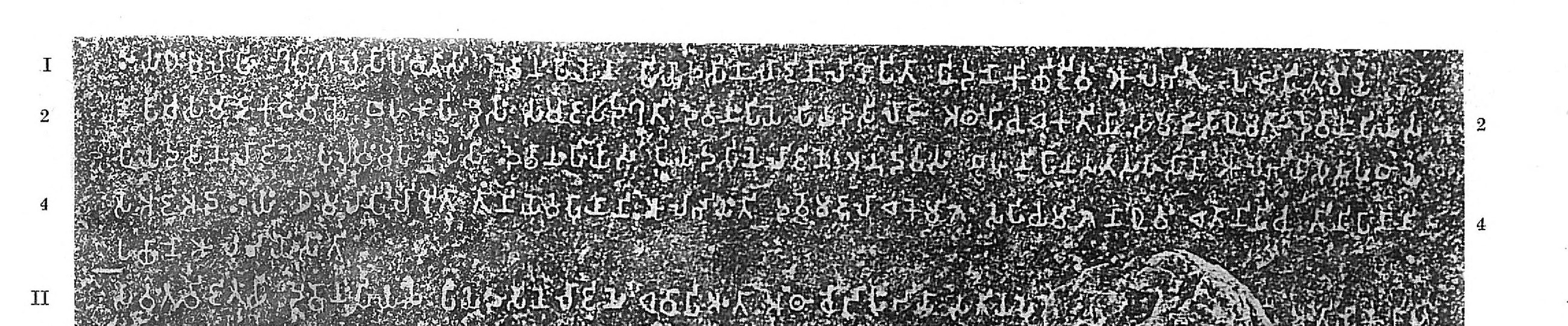
Inked impression (estampage) of the Jaugada rock, not a photograph of the stone: Hultzsch 1925, plate 'Jaugada rock: first column' (facing p. 104; archive.org leaf 257), cropped to the top of the first column, marked I in the left margin and numbered 2, 4: 5 lines; a narrow strip of the neighbouring lines is included above and below. Checked on the image against the transcription (lines 1-5). Text and English: Hultzsch 1925, pp. 101-102 (archive.org leaves 253-254).
1(A) iyaṁ dhaṁma-lipī Khepi[ṁ]galasi pavatasi Devānaṁpiyena Piyadasinā lājinā likhāpitā (B) hida no kichhi jīvaṁ ālabhi[t]u pajohitaviye
2(C) no pi cha samāje kaṭaviye (D) bahukaṁ hi dosaṁ samājasa drakhati Devānaṁpiye Piyadasī lājā (E) athi pi chu ekatiyā samājā sādhu-matā Devānaṁpiyasa
3Piyadrasine lājine (F) puluvaṁ mahā[nasa]si Devānaṁpiyasa Piyadasine lājine anudivasaṁ bah[ū]ni pāna-sata-sah[a]sāni ālabhiyisu sūpa[ṭh]āye
4(G) se aja adā iyaṁ dhaṁma-lipī likhitā tiṁni yeva pānāni āla[ṁ]bhiyaṁti duve majūlā eke mige se pi chu mige no dhuvaṁ (H) etāni pi chu tiṁni pānāni
5pachhā no āla[bh]iyisaṁti
(A) This rescript on morality has been caused to be written on the Khēpiṅgala mountain by king Dēvānāṁpriya Priyadarśin.
(B) Here no living being must be killed and sacrificed.
(C) And also no festival meeting must be held.
(D) For king Dēvānāṁpriya Priyadarśin sees much evil in festival meetings.
(E) But there are also some festival meetings which are considered meritorious by king Dēvānāṁpriya Priyadarśin.
(F) Formerly in the kitchen of king Dēvānāṁpriya Priyadarśin many hundred thousands of animals were killed daily for the sake of curry.
(G) But now, when this rescript on morality is written, only three animals are being killed (daily), (viz.) two peacocks (and) one deer, but even this deer not regularly.
(H) But even these three animals shall not be killed in future.
Where on the image
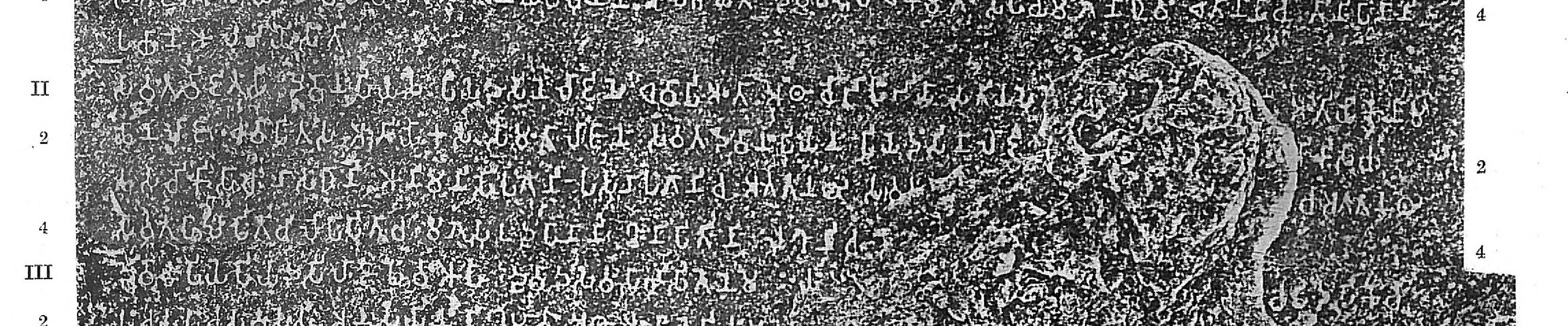
Inked impression (estampage) of the Jaugada rock, not a photograph of the stone: Hultzsch 1925, plate 'Jaugada rock: first column' (facing p. 104; archive.org leaf 257), cropped to the first column from the numeral II in the left margin, numbered 2, 4: 4 lines; a narrow strip of the neighbouring lines is included above and below. Checked on the image against the transcription (lines 1-4). Text and English: Hultzsch 1925, p. 102 (archive.org leaf 254). English: Hultzsch's joint translation of the Dhauli and Jaugada versions ('Translation (Dhauli and Jaugada)', Hultzsch 1925, p. 102); square brackets in it mark only words lost in both versions, so words without brackets may be lost at Jaugada (dots in the transliteration) and survive only at Dhauli.
1(A) savata vijitasi Devānaṁpiyasa Piyadasine lājine e vā pi aṁtā athā Choḍā Paṁḍiyā Satiyapu[t]e . . . . . . . . . . ī Aṁtiyoke nāma
2Yona-lājā [e] vā pi tasa Aṁtiyokasa sāmaṁtā lājāne savata Devānaṁpiyena Piyadasinā lāji . . . . . . . . . . [ch]ikisā cha
3pasu-chikisā cha (B) osadhāni āni munisopagāni pasu-opagāni cha atata nathi sava[ta] . . . . . . . . . . cha atata nathi
4s[a]vatra hālāpitā cha lopāpitā cha (D) magesu udupānāni khānāpitāni lukhāni cha . . . . . . . . . .
(A) Everywhere in the dominions of king Dēvānāṁpriya Priyadarśin, and also (of those) who (are his) borderers, such as the Chōḍas, the Pāṇḍyas, the Satiyaputa, . . . . . . . . . . the Yōna king named Antiyoka, and also the kings who are the neighbours of this Antiyoka,—everywhere [two (kinds of) medical treatment were established] by king Dēvānāṁpriya Priyadarśin, (viz.) medical treatment [for men] and medical treatment for cattle.
(B) Wherever there were no herbs that are beneficial to men and beneficial to cattle, everywhere they were caused to be imported and to be planted.
(C) Wherever there were no roots and [fruits], everywhere they were caused to be imported and to be planted.
(D) On the roads wells were caused to be dug, and trees were caused to be planted for the use of [cattle and men].
Where on the image
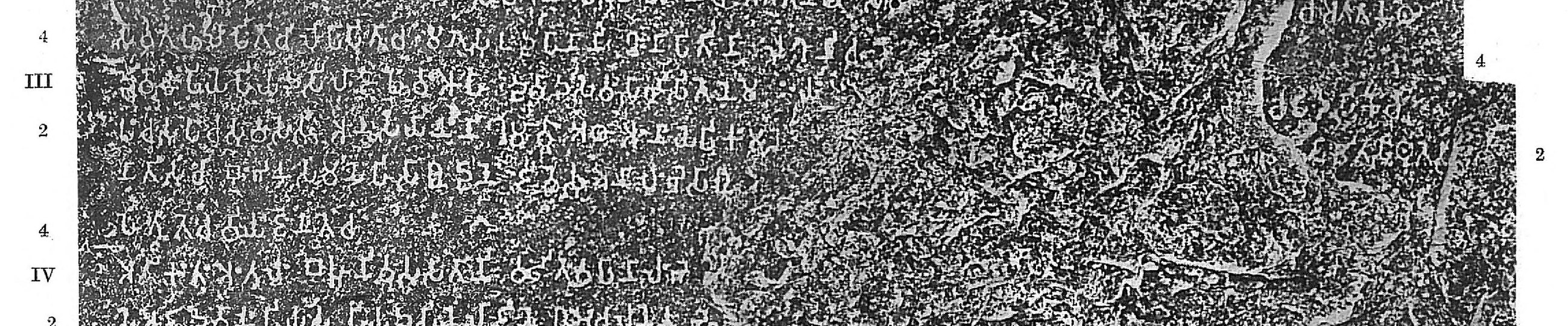
Inked impression (estampage) of the Jaugada rock, not a photograph of the stone: Hultzsch 1925, plate 'Jaugada rock: first column' (facing p. 104; archive.org leaf 257), cropped to the first column from the numeral III in the left margin, numbered 2, 4: 4 lines, their right ends lost where the surface has flaked away; a narrow strip of the neighbouring lines is included above and below. Checked on the image against the transcription (lines 1-4). Text and English: Hultzsch 1925, p. 103 (archive.org leaf 255). English: Hultzsch's joint translation of the Dhauli and Jaugada versions ('Translation (Dhauli and Jaugada)', Hultzsch 1925, p. 103); square brackets in it mark only words lost in both versions, so words without brackets may be lost at Jaugada (dots in the transliteration) and survive only at Dhauli.
1(A) Devā[na]ṁpiye Piyadasī lājā hevaṁ āhā (B) duvādasa-vasābhisitena me iyaṁ [ā] . . . . . . . . . . cha pād[e]sike cha
2paṁchasu paṁchasu vasesu anusayānaṁ nikhamāvū athā aṁnāye pi kaṁma[n]e . . . . . . . . . . [s]ā mita-saṁthute[s] . . .
3nātisu ch[a] baṁbhana-samanehi sādhu dāne jīvesu [a]nālaṁbhe sādhu . . . . . . . . . . [y]i . . . .
4hetute cha viyaṁjanate cha
(A) King Dēvānāṁpriya Priyadarśin speaks thus.
(B) (When I had been) anointed twelve years, the following was ordered by me.
(C) [Everywhere] in my dominions the Yuktas, the Lajuka, and the Prādēśika shall set out on a complete tour (throughout their charges) every five years, just as for other business, even so for the following instruction in morality.
(D) ‘Meritorious is obedience to mother and father, to friends and acquaintances, and to relatives. Liberality to Brāhmaṇas and Śramaṇas is meritorious. Abstention from killing animals is meritorious. Moderation in expenditure (and) moderation in possessions are meritorious.’
(E) And the council (of Mahāmātras) also shall order the Yuktas to register (these rules) both with (the addition of) reasons and according to the letter.
Where on the image
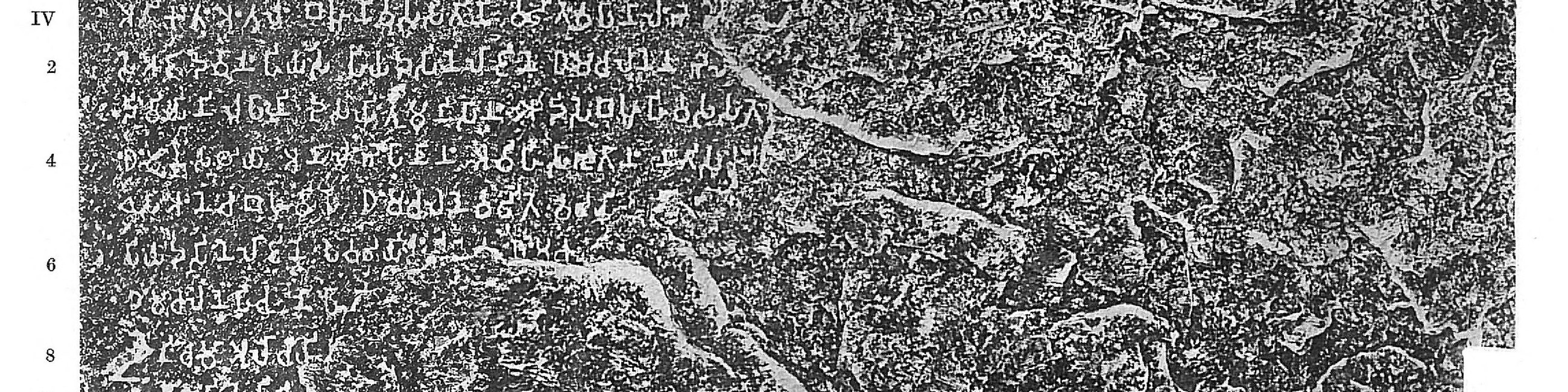
Inked impression (estampage) of the Jaugada rock, not a photograph of the stone: Hultzsch 1925, plate 'Jaugada rock: first column' (facing p. 104; archive.org leaf 257), cropped to the first column from the numeral IV in the left margin, numbered 2 to 8: 8 lines, of which only the left ends survive (the rest of the surface is broken, Hultzsch's dots). Checked on the image against the transcription (lines 1-8). Text and English: Hultzsch 1925, p. 104 (archive.org leaf 256). English: Hultzsch's joint translation of the Dhauli and Jaugada versions ('Translation (Dhauli and Jaugada)', Hultzsch 1925, p. 104); square brackets in it mark only words lost in both versions, so words without brackets may be lost at Jaugada (dots in the transliteration) and survive only at Dhauli.
1(A) a[t]ikaṁtaṁ aṁtalaṁ bahūni vasa-satāni vaḍhite va pānālaṁbhe . . . . . . . . . .
2(B) se aja Devānaṁpiyasa Piyadasine lājine dhaṁma-chalanena bhe[l] . . . . . . . . . .
3divi[y]āni lūpāni drasayitu munisānaṁ (C) ādise bahūhi vasa-sate . . . . . . . . . .
4dhaṁmānusathiyā anālaṁbhe pānānaṁ avihisā bhūtānaṁ nātisu [saṁpa] . . . . . . . . . .
5(D) esa aṁne cha bahuvidhe dhaṁma-chalane vaḍhite (E) va[ḍhay]i . . . . . . . . . .
6Piyadasine lājine pavaḍhayi[sa]ṁ[t]i [y]e[va] dhaṁma-cha[la] . . . . . . . . . .
7(H) dhaṁma-chalane pi chu no ho[t]i . . . . . . . . . .
8[hī]ni cha mā aloch[ay]i . . . . . . . . . .
(A) In times past, for many hundreds of years, there had ever been promoted the killing of animals and the hurting of living beings, discourtesy to relatives, (and) discourtesy to Śramaṇas and Brāhmaṇas.
(B) But now, in consequence of the practice of morality on the part of king Dēvānāṁpriya Priyadarśin, the sound of drums has become the sound of morality, showing the people representations of aerial chariots, elephants, masses of fire, and other divine figures.
(C) Such as they had not existed before for many hundreds of years, thus there are now promoted, through the instruction in morality on the part of king Dēvānāṁpriya Priyadarśin, abstention from killing animals, abstention from hurting living beings, courtesy to relatives, courtesy to Śramaṇas and Brāhmaṇas, obedience to mother and father, (and) obedience to the aged.
(D) In this and many other ways is the practice of morality promoted.
(E) And king Dēvānāṁpriya Priyadarśin will ever promote this practice of morality.
(F) But also the sons, grandsons, and great-grandsons of king Dēvānāṁpriya Priyadarśin will ever promote this practice of morality until the æon (of destruction of the world), (and) will instruct (people) in morality, abiding by morality and by good conduct.
(G) For this is the best work, viz. instruction in morality.
(H) But the practice of morality also is not (possible) for (a person) devoid of good conduct.
(I) Therefore promotion and not neglect of this object is meritorious.
(J) For the following purpose has this been written, (viz. in order that) they should devote themselves to the promotion of this practice, and that they should not approve the neglect (of it).
(K) This has been written here by king Dēvānāṁpriya Priyadarśin (when he had been) anointed twelve years.
Where on the image
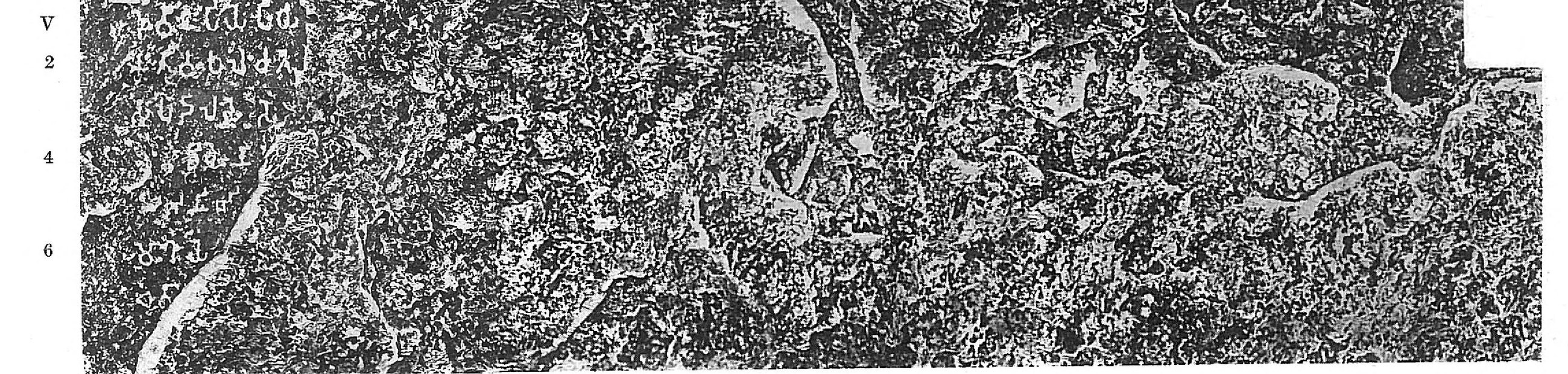
Inked impression (estampage) of the Jaugada rock, not a photograph of the stone: Hultzsch 1925, plate 'Jaugada rock: first column' (facing p. 104; archive.org leaf 257), cropped to the foot of the first column, from the numeral V in the left margin, numbered 2, 4, 6: 8 lines, of which only a few letters at the left ends survive. Checked on the image against the transcription (lines 1-8). Text and English: Hultzsch 1925, pp. 105-106 (archive.org leaves 258-259). English: Hultzsch's joint translation of the Dhauli and Jaugada versions ('Translation (Dhauli and Jaugada)', Hultzsch 1925, pp. 105-106); square brackets in it mark only words lost in both versions, so words without brackets may be lost at Jaugada (dots in the transliteration) and survive only at Dhauli.
1(A) Devā[na]ṁpiye Piya[da] . . . . . . . . . .
2nat[ī] va palaṁ cha te . . . . . . . . . .
3s[u]padālaye (H) se [a] . . . . . . . . . .
4[dha]ṁ[m]ā[dh]i[th]ānā . . . . . . . . . .
5. . bhanibhi . . . . . . . . . .
6mokhāye . . . . . . . . . .
7e [v]ā . . . . . . . . . .
8. . . . . . . . . .
(A) King Dēvānāṁpriya Priyadarśin speaks thus.
(B) It is difficult to perform virtuous deeds.
(C) He [who starts performing] victorious deeds accomplishes something difficult.
(D) Now, by me many virtuous deeds have been performed.
(E) Therefore (among) my sons and grandsons, and (among) my descendants (who shall come) after them until the æon (of the destruction of the world), those who will conform to this (duty) will perform good deeds.
(F) He who will neglect even a portion of this (duty) will perform evil deeds.
(G) For sin indeed steps fast.
(H) Now in times past, (officers) called Mahāmātras of morality did not exist before.
(I) But (the officers) called Mahāmātras of morality were appointed by me (when I had been) anointed thirteen years.
(J) These are occupied with all sects in establishing morality, in promoting morality, and for the welfare and happiness of those who are devoted to morality (even) among the Yōnas, Kambōchas, and Gandhālas, among the Laṭhikas and Pitēnikas, and whatever other western borderers (of mine there are).
(K) They are occupied with servants and masters, with Brāhmaṇas and Ibhyas, with the destitute, and with the aged, for the welfare and happiness of those who are devoted to morality, (and) in releasing (them) from the fetters (of worldly life).
(L) They are occupied in supporting prisoners (with money), in causing (their) fetters to be taken off, and in setting (them) free, if (one has) children, or is bewitched, or aged, respectively.
(M) They are occupied everywhere, both here and in all the outlying towns, in all the harems of myself, of my brothers, and of (my) sisters, and with (my) other relatives.
(N) These Mahāmātras of morality are occupied on the whole earth with those who are devoted to morality, (in order to ascertain) whether one is eager for morality, or established in morality, or furnished with gifts.
(O) For the following purpose has this rescript on morality been written, (viz. that) it may be of long duration, and (that) my descendants may conform to it.
Where on the image
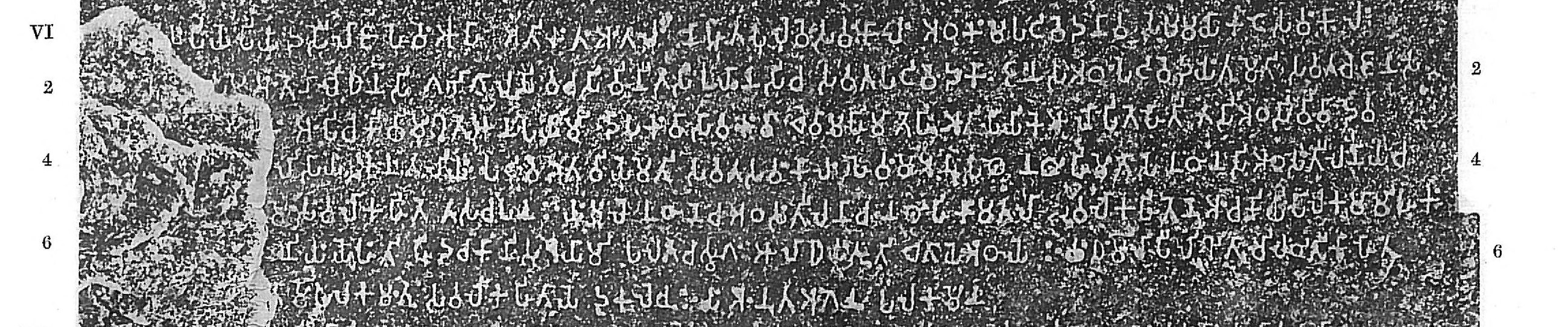
Inked impression (estampage) of the Jaugada rock, not a photograph of the stone: Hultzsch 1925, plate 'Jaugada rock: second column' (facing p. 110; archive.org leaf 264), cropped to the top of the second column, marked VI in the left margin and numbered 2, 4, 6: 7 lines; the left ends of the lines are broken away (Hultzsch's dots). Checked on the image against the transcription (lines 1-7). Text and English: Hultzsch 1925, pp. 106-107 (archive.org leaves 259-260). English: Hultzsch's joint translation of the Dhauli and Jaugada versions ('Translation (Dhauli and Jaugada)', Hultzsch 1925, pp. 106-107); square brackets in it mark only words lost in both versions, so words without brackets may be lost at Jaugada (dots in the transliteration) and survive only at Dhauli.
1(A) . . . . [na]ṁpiye Piyadasī lājā hevaṁ āhā (B) atikaṁtaṁ aṁtalaṁ no hūta-puluve savaṁ kālaṁ aṭha-kaṁm[e] paṭivedanā va (C) se mamayā kaṭe (D) savaṁ kālaṁ
2. . . . . . [sa m]e aṁte olodhanasi gabhāgālasi vachasi vinītas[i] uyānasi cha savata paṭivedakā janasa aṭhaṁ praṭivedayaṁtu me ti (E) savata cha janasa
3. . . . . . . . . . [ka]ṁ (F) aṁ pi cha kiṁchhi mukhate ānapayāmi dāpakaṁ vā sāvakaṁ vā e v[ā] mah[ā]mātehi a[t]i[yā]yike [ā]lopite hoti tasi aṭhasi vivāde va
4. . . . . . . . . . lisāy[aṁ ā]naṁ[ta]liyaṁ paṭivedetaviye me ti savata savaṁ kālaṁ (G) hevaṁ me anusathe (H) nathi hi me tose uṭhānasi aṭha-saṁtīlan[ā]y[a] cha
5(I) . . . . . . . . . . me sava-loka-hite (J) tasa cha pana iyaṁ mūle uṭhāne cha aṭha-saṁtīlanā cha (K) nathi hi k[aṁ]matalā sava-loka-hiten[a] (L) aṁ cha kichhi p[a]lakamāmi hakaṁ
6. . . . . . . . . . [n]iyaṁ yehaṁ ti hida cha kāni su[kha]yāmi palata cha svagaṁ ālādhayaṁtū ti (M) etāye aṭhāye i[ya]ṁ dhaṁma-lipī likhitā chila-ṭhitīkā hotu
7. . . . . . . . . . [t]ā me [pa]lakamaṁtu sava-loka-hitāye (N) dukale chu i[ya]ṁ aṁnata agena palakamena
(A) King Dēvānāṁpriya Priyadarśin speaks thus.
(B) In times past neither the disposal of affairs nor the submission of reports at all times did exist before.
(C) But I have made (the following arrangement).
(D) Reporters have to report to me the affairs of the people at any time (and) anywhere, while I am [eating], within the harem, in the inner apartment, at the cowpen, in the palanquin, and in the park.
(E) And everywhere I am disposing of the affairs of the people.
(F) And also, if in the council (of Mahāmātras) a dispute arises, or an amendment is moved, in connexion with any donation or proclamation which I am ordering verbally, or (in connexion with) an emergent matter which has been delegated to the Mahāmātras, it must be reported to me immediately, anywhere, (and) at any time.
(G) Thus I have ordered.
(H) For I am never satisfied in exerting myself and in dispatching business.
(I) For I consider it my duty (to promote) the welfare of all men.
(J) But the root of that (is) this, (viz.) exertion and the dispatch of business.
(K) For no duty is more important than (promoting) the welfare of all men.
(L) And whatever effort I am making, (is made) in order that I may discharge the debt (which I owe) to living beings, (that) I may make them happy in this (world), and (that) they may attain heaven in the other (world).
(M) For the following purpose has this rescript on morality been written, (viz. that) it may be of long duration, and (that) my sons (and) great-grandsons may display the same zeal for the welfare of all men.
(N) But it is difficult to accomplish this without great zeal.
Where on the image
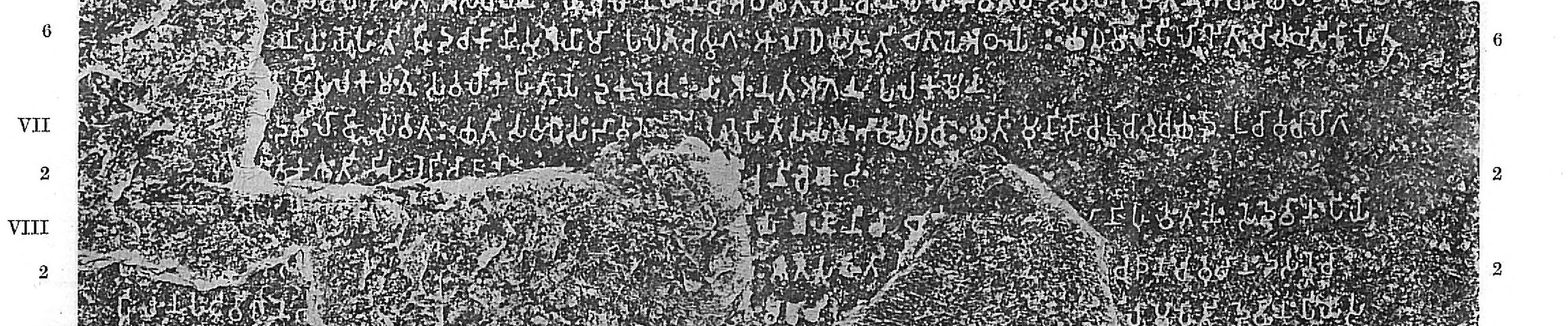
Inked impression (estampage) of the Jaugada rock, not a photograph of the stone: Hultzsch 1925, plate 'Jaugada rock: second column' (facing p. 110; archive.org leaf 264), cropped to the second column from the numeral VII in the left margin, numbered 2: 2 lines, their left ends broken away; a narrow strip of the neighbouring lines is included above and below. Checked on the image against the transcription (lines 1-2). Text and English: Hultzsch 1925, p. 108 (archive.org leaf 261). English: Hultzsch's joint translation of the Dhauli and Jaugada versions ('Translation (Dhauli and Jaugada)', Hultzsch 1925, p. 108); square brackets in it mark only words lost in both versions, so words without brackets may be lost at Jaugada (dots in the transliteration) and survive only at Dhauli.
1(A) . . . . . . . . . . da[sī] lājā savata ichhati sava-p[ā]saṁḍā va[s]e . . [t]i (B) [sav]e hi te sa[yama]ṁ bhāva-[su]dhī cha ichhaṁti (C) munisā cha uchāvucha-chhaṁdā uchāvuch[a]-lāgā
2(D) . . . . . . . . . . [sa]ṁ va kachhaṁti (E) [v]i[pul]e [p]i chā [d]ā[ne] . . . . . . . . . . [dhī] cha nīche [b]āḍhaṁ
(A) King Dēvānāṁpriya Priyadarśin desires (that) all sects may reside everywhere.
(B) For all these desire self-control and purity of mind.
(C) And men possess various desires (and) various passions.
(D) They will fulfil either the whole or (only) a portion (of their duties).
(E) And even one who (practises) great liberality, (but) does not possess self-control and purity of mind, is very mean.
Where on the image
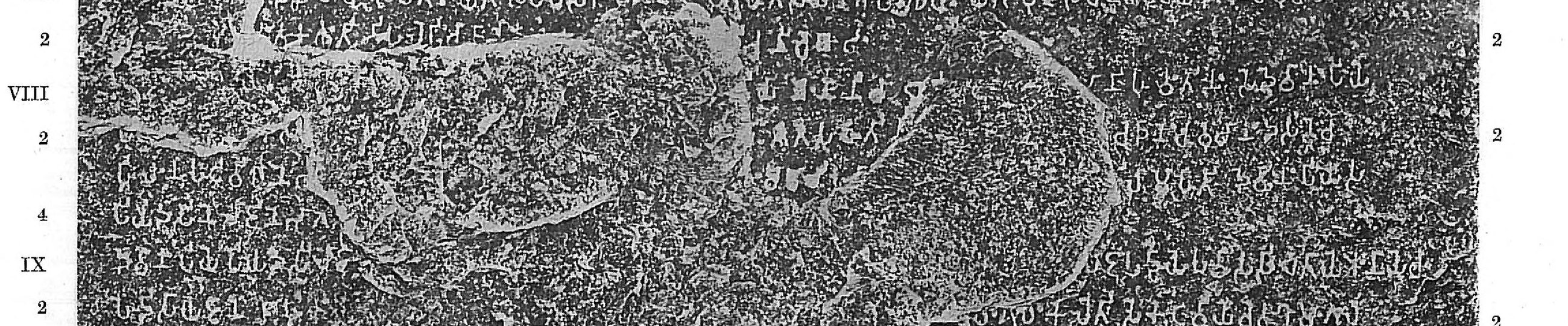
Inked impression (estampage) of the Jaugada rock, not a photograph of the stone: Hultzsch 1925, plate 'Jaugada rock: second column' (facing p. 110; archive.org leaf 264), cropped to the second column from the numeral VIII in the left margin, numbered 2, 4: 4 lines, much of them lost in the broken middle of the rock; a narrow strip of the neighbouring lines is included above and below. Checked on the image against the transcription (lines 1-4). Text and English: Hultzsch 1925, pp. 108-109 (archive.org leaves 261-262). English: Hultzsch's joint translation of the Dhauli and Jaugada versions ('Translation (Dhauli and Jaugada)', Hultzsch 1925, pp. 108-109); square brackets in it mark only words lost in both versions, so words without brackets may be lost at Jaugada (dots in the transliteration) and survive only at Dhauli.
1. . . . . . . . . . [v]i[y]ā [a]ṁnāni cha e[d]i . . . . . . . . . . [m]āni huvaṁti naṁ (C) se Devānaṁpiye
2[Piya] . . . . . . . . [dasa] . . . . . . . . . . [tā] (E) [ta]tesa hoti [sa] . . . . . . . . . . cha dāne cha vuḍhānaṁ dasane cha
3hilaṁna-paṭiv[i]dh[ā]ne [cha] . . . . . . . . . . [dha]ṁma-p[al]i[puchh]ā . . . . . . . . . . ilāme hoti De[v]ānaṁpiyasa
4Piyadasine lājine bhāge [a] . . .
(A) In times past, kings used to set out on so-called pleasure-tours.
(B) On these (tours) hunting and other such pleasures were (enjoyed).
(C) But when king Dēvānāṁpriya Priyadarśin had been anointed ten years, he went out to Saṁbōdhi.
(D) Therefore tours of morality (were undertaken) here.
(E) On these (tours) the following takes place, (viz.) visiting Śramaṇas and Brāhmaṇas and making gifts (to them), visiting the aged and supporting (them) with gold, visiting the people of the country, instructing (them) in morality, and questioning (them) about morality, as suitable for this (occasion).
(F) This second period (of the reign) of king Dēvānāṁpriya Priyadarśin becomes a pleasure in a higher degree.
Where on the image
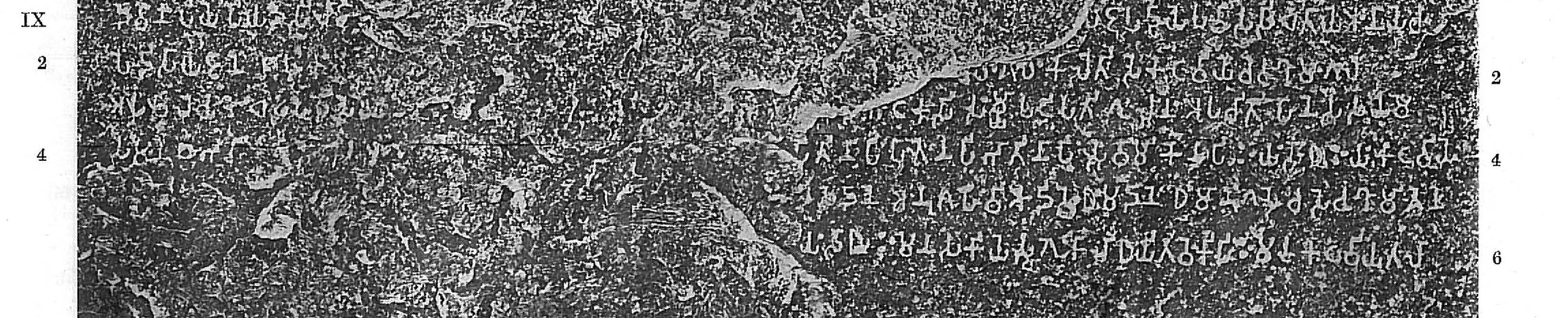
Inked impression (estampage) of the Jaugada rock, not a photograph of the stone: Hultzsch 1925, plate 'Jaugada rock: second column' (facing p. 110; archive.org leaf 264), cropped to the second column from the numeral IX in the left margin, numbered 2, 4, 6: 7 lines; the left part of the lower lines is broken away. Checked on the image against the transcription (lines 1-7). Text and English: Hultzsch 1925, pp. 109-110 (archive.org leaves 262-263). English: Hultzsch's joint translation of the Dhauli and Jaugada versions ('Translation (Dhauli and Jaugada)', Hultzsch 1925, pp. 109-110); square brackets in it mark only words lost in both versions, so words without brackets may be lost at Jaugada (dots in the transliteration) and survive only at Dhauli.
1(A) Devān[aṁ]piye Piyadasī lā[jā] . . . . . . . . . . [pa]jupadāye pavāsasi etāye aṁnāye cha
2hedisāye jane [ba]hu[ka]ṁ . . . . . . . . . . [cha ma]ṁ[gala]ṁ k[a]leti (D) se kaṭaviye cheva kho maṁgale
3(E) apa-[pha]le chu [kh]o e[sa] he[d]ise ma . . . . . (F) i[ya]ṁ [chu] . . . . . . . . . . [sa-bha]ṭakasi saṁmyā-paṭipati gulūnaṁ apachiti pānesu say[a]me
4saman[a]-bābha[n]ā[naṁ d]ā[n]e [esa a]ṁ[n]e . . . . . . . . . . [pi]tinā pi putena pi bhātinā pi suvāmike[na] pi iyaṁ sādhu iyaṁ kaṭaviye
5. . . . . . . . . . [s]e dāne anugah[e] vā ādi[s]e dhaṁma-dāne dhaṁmānugahe cha (K) se chu kho mitena
6. . . . . . . . . . yaṁ sādh[ū] imena sakiye svage ālādhayitave (L) kiṁ hi imena kaṭaviyatalā
7. . . . . . . . . .
(A) King Dēvānāṁpriya Priyadarśin speaks thus.
(B) Men are practising various ceremonies during illness . . . . . . . . . . at the marriage of a daughter, at the birth of a child, (and) when setting out on a journey; on these and other such (occasions) men [are practising] many ceremonies.
(C) But . . . . . women are practising many and various vulgar and useless ceremonies.
(D) Now ceremonies should certainly be practised.
(E) But such ceremonies as these bear little fruit indeed.
(F) But the following bears much fruit indeed, viz. the practice of morality.
(G) Herein the following (are comprised), (viz.) proper courtesy to slaves and servants, reverence to elders, gentleness to animals, (and) liberality to Śramaṇas and Brāhmaṇas; these and other [such] (virtues) are called the practice of morality.
(H) Therefore a father, or a son, or a brother, or a master ought to say:—‘This is meritorious. This [practice] should be observed until the (desired) object is attained.’
(I) And it has been said thus:—‘Gifts are meritorious.’
(J) But there is no [such] gift or benefit as the gift of morality and the benefit of morality.
(K) Therefore a friend . . . . . . . . . . [a relative], and a companion should indeed admonish (another) on such and such an occasion:—‘This . . . . . . . . . . this is meritorious. By this (practice) it is possible to attain heaven.’
(L) For what is more desirable than this, [viz.] the attainment of heaven?
Where on the image
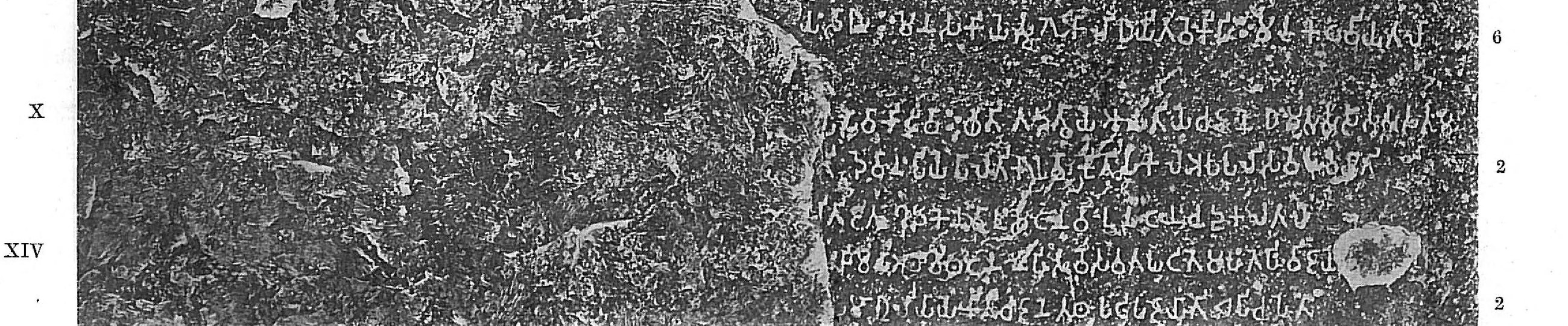
Inked impression (estampage) of the Jaugada rock, not a photograph of the stone: Hultzsch 1925, plate 'Jaugada rock: second column' (facing p. 110; archive.org leaf 264), cropped to the second column from the numeral X in the left margin, numbered 2: 3 lines; only the right halves survive; a narrow strip of the neighbouring lines is included above and below. Checked on the image against the transcription (lines 1-3). Text and English: Hultzsch 1925, p. 110 (archive.org leaf 263). English: Hultzsch's joint translation of the Dhauli and Jaugada versions ('Translation (Dhauli and Jaugada)', Hultzsch 1925, p. 110); square brackets in it mark only words lost in both versions, so words without brackets may be lost at Jaugada (dots in the transliteration) and survive only at Dhauli.
1(A) . . . . . . . . . . [ya]so vā ki[ṭ]ī vā ichh[a]ti tadatvāye ā[ya]tiye cha jane dhaṁma-susūsaṁ susūsatu me
2. . . . . . . . . . [t]i Devānaṁpiye pālatikāye vā ki[ṁ]ti [sa]kale apa-palisave [h]uveyā ti
3(D) . . . . . . . . . . [l]itijit[u] khudakena [v]ā u[sa]ṭena vā (F) usaṭena chu dukalatale
(A) King Dēvānāṁpriya Priyadarśin does not think that either glory or fame [conveys much advantage, except whatever] glory or fame he desires (on account of his aim that) at the present time, and in the future, men may (be induced) by him to practise obedience to morality . . . . . . . . . . morality.
(B) On this (account) [he is desiring] glory and fame.
(C) [Whatever] effort Dēvānāṁpriya is making, (is) only for the sake of (merit) in the other (world), (and) in order that all (men) may run little danger.
(D) The danger . . . . . . . . . .
(E) . . . . . . . . . . difficult to accomplish either for a lowly (person) or for a high one [without] great [zeal] and (without) laying aside every (other aim).
(F) But it is more difficult to accomplish for a high (person).
Where on the image
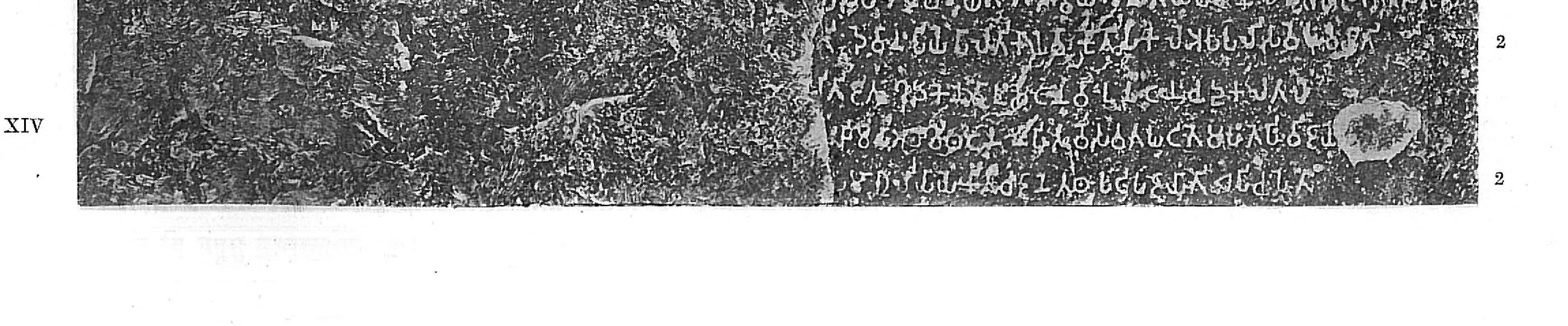
Inked impression (estampage) of the Jaugada rock, not a photograph of the stone: Hultzsch 1925, plate 'Jaugada rock: second column' (facing p. 110; archive.org leaf 264), cropped to the foot of the second column, from the numeral XIV in the left margin, numbered 2: the right halves of lines 1 and 2 (line 3 is lost); a narrow strip of the neighbouring lines is included above and below. Checked on the image against the transcription (lines 1-3). Text and English: Hultzsch 1925, p. 111 (archive.org leaf 265). English: Hultzsch's joint translation of the Dhauli and Jaugada versions ('Translation (Dhauli and Jaugada)', Hultzsch 1925, p. 111); square brackets in it mark only words lost in both versions, so words without brackets may be lost at Jaugada (dots in the transliteration) and survive only at Dhauli.
1(A) . . . . . . . . . . [ma]jhime[na] ath[i] vithaṭena (B) [no] hi save savata ghaṭite (C) mahaṁte hi vijaye
2. . . . . . . . . . [sa] mādhuliyāye kiṁt[i] cha jane tathā paṭipajeyā ti (E) e pi chu heta
3. . . . . . . . . .
(A) These rescripts on morality [have been caused] to be written by king Dēvānāṁpriya Priyadarśin . . . . . . . . . . or of middle (size), or at full length.
(B) For the whole was not suitable everywhere.
(C) For (my) dominions are wide, and much has been written, [and I] shall cause [still] (more) to be written.
(D) . . . . . . . . . . has been stated . . . . . . . . . . because of the charm of [certain topics], and in order that men should act accordingly.
(E) But whatever of this is written incompletely . . . . . . . . . .
Where on the image
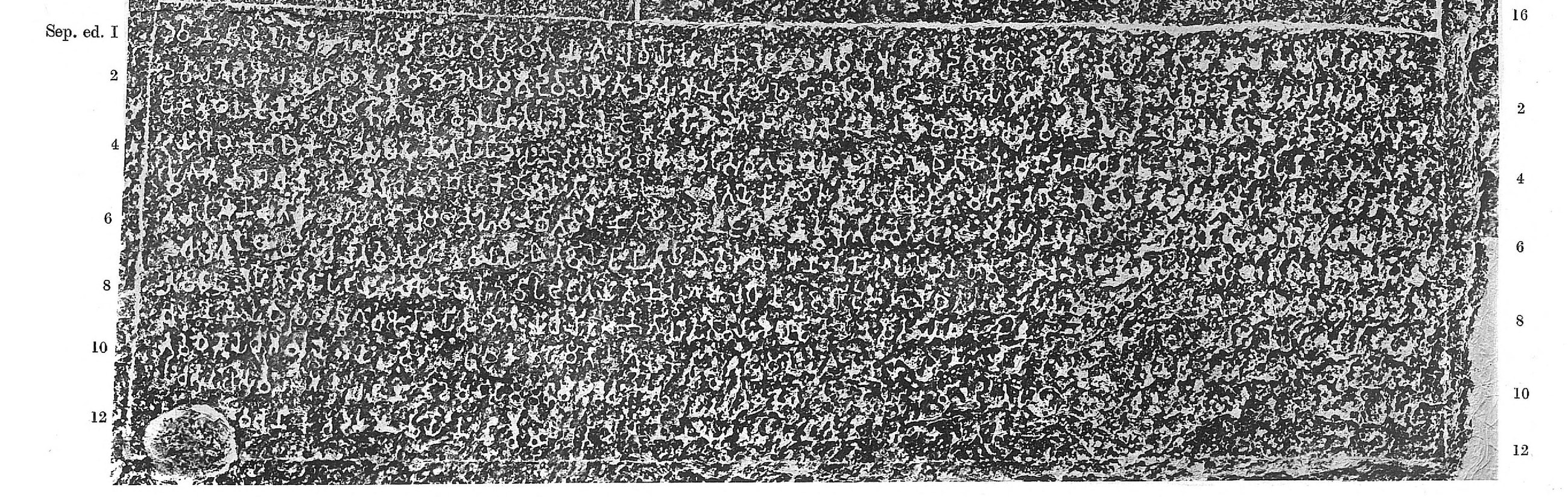
Inked impression (estampage) of the Jaugada rock, not a photograph of the stone: Hultzsch 1925, plate 'Jaugada rock: third column' (facing p. 116; archive.org leaf 271), cropped to the lower part of the third column, below the long ruled line, labelled 'Sep. ed. I' in the left margin and numbered 2 to 12 in both margins: 12 lines; the two symbols above the ruled line at the left are not part of the text. Checked on the image against the transcription (lines 1-12). Text and English: Hultzsch 1925, pp. 112-115 (archive.org leaves 266-269).
1(A) Dev[ā]naṁpiye he[va]ṁ [ā]hā (B) Sam[ā]pāyaṁ mahāmātā [na]gala-viyohālaka he[vaṁ va]tav[i]y[ā] (C) aṁ kichhi dakhāmi ha[ka]ṁ [taṁ] ichhām[i k]iṁt[i kaṁ kamana pa]ṭipātayehaṁ
2duvālate cha ālabhehaṁ (D) es[a] cha me mokhiya-mata duvālaṁ a[ṁ] tuphesu anusathi (E) phe hi bahūsu pāna-sahasesu [ā]ya[ta] p[a]na[yaṁ] gachhema [su] m[u]n[i]s[ā]na[ṁ] (F) sava-mu[n]ā me
3pajā (G) atha pa[jā]ye ichhām[i kiṁ]t[i] me savena hita-sukhena y[ū]jeyū ti hi[dal]o[g]ik[a]-pālalokikena [he]meva me ichha sava-munis[e]su (H) no chu tu[phe e]taṁ [p]ā[p]unātha āva-gamu[k]e
4[i]yaṁ aṭh[e] (I) kechā eka-[muni]s[e] pā[p]unāti se pi desaṁ no savaṁ (J) dakhatha hi [tuphe] pi suvitā [p]i (K) bahuka aṭhi ye eti eka-munise ba[ṁ]dhanaṁ pali[kile]saṁ [p]i pāpunāti (L) tata [ho]t[i aka]-
5sm[ā] ti ten[a] badhana[ṁ]ti[ka anye] cha [va]ge bahuke vedayati (M) tata tuphe[hi ichhi]taye kiṁti majhaṁ [pa]ṭipātayem[a] (N) imehi jāte[hi] no [pa]ṭipa[ja]ti i[s]ā[ya] āsulopena [ni]ṭhū[li]ye[na]
6t[ul]āya [a]nā[v]uti[ya āla]s[y]e[na ki]lamath[e]na (O) hevaṁ ichhit[a]vi[y]e kiṁti me et[ā]ni jātā[ni n]o hveyū ti (P) savasa chu iyaṁ mū[le] a[n]ā[s]u[lo]p[e atulanā] cha (Q) ni[tiya]ṁ [e]y[aṁ k]il[aṁt]e [siya] . . . .
7saṁchalitu uthāy[ā] saṁchalitavye tu v[a]ṭitaviya [pi] etaviye pi nīt[i]yaṁ (R) eve dakh[e]yā āna[ṁ]ne nijhap[e]ta[vi]ye heva[ṁ hevaṁ] cha Devānaṁ[p]i[ya]sa an[u]sa[thi ti] (S) [eta]ṁ [saṁpaṭipā]ta[yaṁ]-
8taṁ mahā-phale hoti asaṁpaṭipati mahāpāy[e] hoti (T) vipaṭipātayaṁtaṁ no svag[a]-āladhi no lājādhi (U) du[ā]hale etasa [kaṁ]masa sa me k[u]t[e ma]n[o-ati]le[ke] (V) [etaṁ saṁpaṭipajamīne mama]
9cha ānaneyaṁ esatha svagaṁ cha ālā[dha]yisa[th]ā (W) iyaṁ chā li[p]ī anutisaṁ sot[a]v[i]yā (X) [a]lā [p]i kha[ne]na sota[vi]yā ek[a]k[e]na pi (Y) . . . . . . . . . . m[ī]ne ch[aghatha] . . . . . . . . . .
10tave (Z) etāye cha aṭh[ā]ye iyaṁ [li]khitā [l]ipī ena mahāmātā nagalaka sa[s]vata[ṁ] sama[ya]ṁ [etaṁ] yu[j]ey[u] t[i] ena [muni]s[ā]naṁ [a] . . . . . . . . ne [pal]i[k]i . . . . . . . . . . ye
11[pa]ṁchasu paṁchasu va[sesu] anu[sa]yānaṁ nikhāma[y]isāmi mahāmāta[ṁ] achaṁḍa[ṁ] aphal[usa]ṁ ta . . . . . . . . . . pi kumāle [v]i . . ta . . . . . . . . . . m[ayi] . . . . . . . . . . [lā]t[e] . . . . . .
12. . . . . . . . . . vachanik[a] ada [anusa]yānaṁ n[ikha]mi[saṁ]ti a[ta]ne ka[ṁma]ṁ . . . . . . [yitu taṁ pi tathā] kalaṁti [athā] . . . . . . . . . .
(A) Dēvānāṁpriya speaks thus.
(B) The Mahāmātras at Samāpā, (who are) the judicial officers of the city, have to be told this.
(C) Whatever I recognize (to be right), that I strive to carry out by deeds, and to accomplish by (various) means.
(D) And this is considered by me the principal means, viz. (to give) instruction to you.
(E) For you are occupied with many thousands of men, with the object of gaining the affection of men.
(F) All men are my children.
(G) As on behalf of (my own) children I desire that they may be provided by me with complete welfare and happiness in this world and in the other world, even so is my desire on behalf of all men.
(H) But you do not learn this, (viz.) how far this (my) object reaches.
(I) Some single person (only) learns (this), (and) even he (only) a portion, (but) not the whole.
(J) Now you must also pay attention (to this), although you are in prosperous circumstances.
(K) It happens frequently that a single person undergoes imprisonment and suffers harsh treatment.
(L) In this case (an order) cancelling the imprisonment is (obtained) by him accidentally, while many other people (continue to) suffer.
(M) In this case you must strive to deal (with all of them) impartially.
(N) One fails to act (thus) on account of the following dispositions: envy, anger, cruelty, hurry, want of practice, laziness, (and) fatigue.
(O) (You) must strive for this, that these dispositions may not arise in you.
(P) But the root of all is this: the absence of anger and the avoidance of hurry.
(Q) Whoever is fatigued in the administration (of justice), will [not] move and rise; but one ought to move, to walk, and to advance in the administration (of justice).
(R) He who will pay attention to this, must exhort (you) to discharge (your) debt (to the king), (by telling you): ‘Such and such is the instruction of Dēvānāṁpriya.’
(S) If one observes this, great gain results, (but its) non-observance becomes a great evil.
(T) If one fails to observe (this), (there will be) neither attainment of heaven nor satisfaction of the king.
(U) How (could) my mind be pleased if one fulfils this duty badly?
(V) If (you) observe this, you will discharge the debt (which you owe) to me, and you will attain heaven.
(W) And this rescript must be listened to (by all) on every (day of) Tishya.
(X) It may be listened to even by a single (person) also on (other) occasions between (the days of Tishya).
(Y) . . . . . . . . . . you will be able to . . . . . . . . . .
(Z) And for the following purpose has this rescript been written, (viz.) in order that the Mahāmātras (who are) city-judges may strive at all times for this, that to men [undeserved imprisonment or harsh treatment] . . . . . . . . . .
(AA) . . . . . . . . . . I shall send out every five years on a complete tour (throughout his charge) a Mahāmātra who is neither fierce nor harsh . . . . . . . . . .
(BB) . . . . . . . . . . also the prince (governor) [will send out] . . . . . . . . . .
(CC) . . . . . . . . . . from [Takshaśi]lā.
(DD) When, at the word [of the king], they will set out on tour, (then), [without neglecting] their own duties, (they will ascertain whether the judicial officers) are carrying out this also just, as . . . . . . . . . .
Where on the image
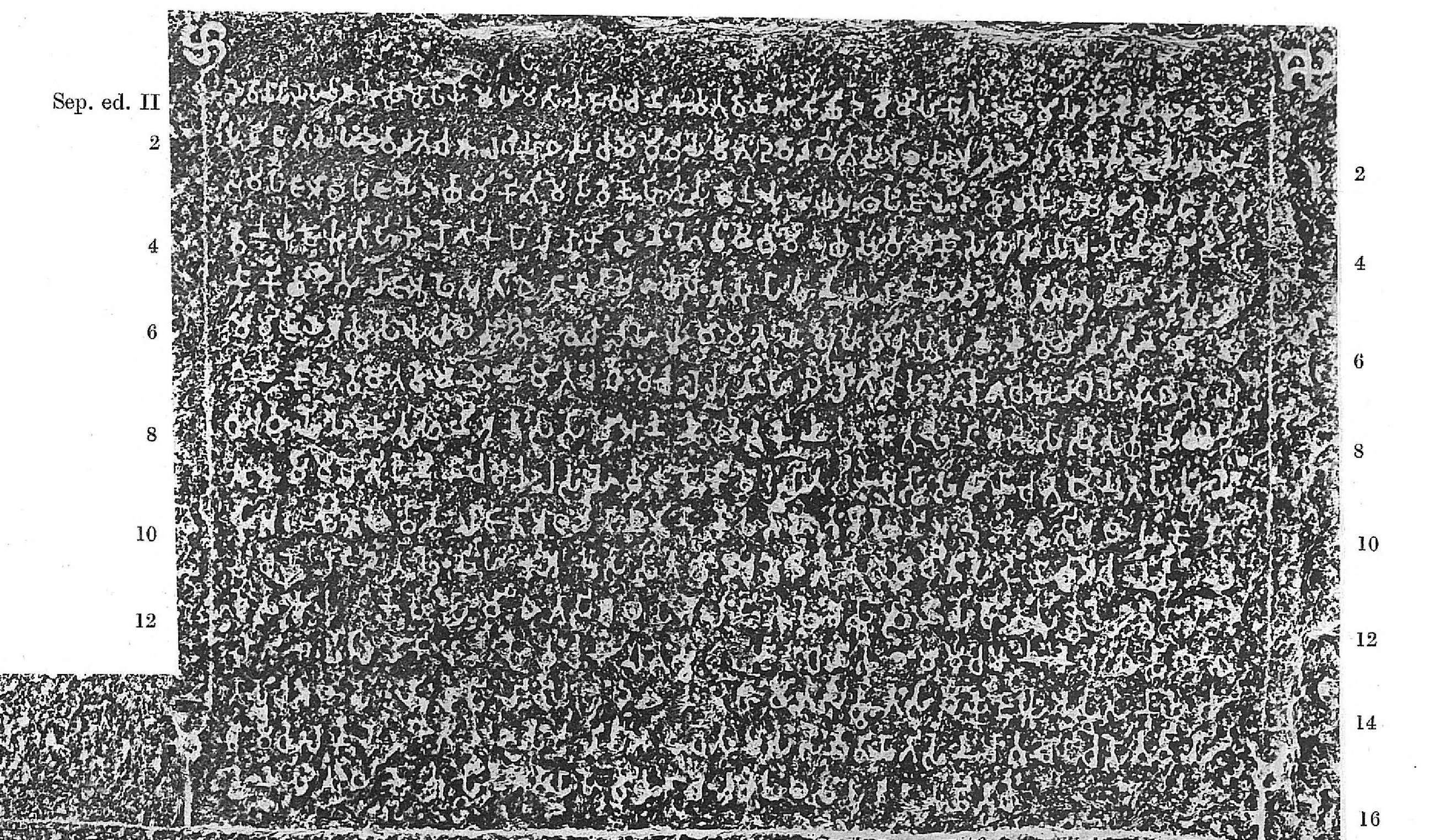
Inked impression (estampage) of the Jaugada rock, not a photograph of the stone: Hultzsch 1925, plate 'Jaugada rock: third column' (facing p. 116; archive.org leaf 271), cropped to the upper part of the third column, labelled 'Sep. ed. II' in the left margin and numbered 2 to 16 at the right (2 to 12 at the left): 16 lines, down to the ruled line above the First Separate Edict. Checked on the image against the transcription (lines 1-16). Text and English: Hultzsch 1925, pp. 116-118 (archive.org leaves 270, 272-273).
1(A) Devānaṁpiye hevaṁ ā[ha] (B) Samāpāyaṁ mahamatā l[ā]ja-vachanik[a] vataviyā (C) aṁ kichhi dakh[ā]mi hakaṁ taṁ i[chh]āmi hakaṁ k[iṁ]ti kaṁ kamana
2paṭipātayehaṁ duvā[la]te cha ālabhehaṁ (D) esa cha me mokhiya-mat[a] duvāl[a] etasa a[tha]sa a[ṁ] t[uph]esu anusa[thi] (E) sava-muni-
3sā me pajā (F) atha pajāy[e] ichhāmi kiṁti me saveṇā hita-su[kh]ena yu[je]yū [a]tha pajāye ichhāmi kiṁ[ti] m[e] savena hita-su-
4kh[e]na yujeyū ti hidalogika-pālaloki[k]e[ṇa] hevaṁmeva me ichha sava-munisesu (G) siyā aṁtānaṁ [a]vijitā-
5naṁ kiṁ-chhaṁde su lājā aphesū ti (H) etākā [vā] me ichha [a]ṁtesu pāpuneyu lājā hevaṁ ichh[a]ti anu[v]i[g]ina hve[yū]
6mamiyāye [a]svaseyu cha me sukhaṁ[m]ev[a] cha lahey[ū] mamate [n]o kha[ṁ] hevaṁ cha pāpuneyu kha[m]i[sa]ti ne lājā
7e s[a]kiye khamitave mamaṁ nimitaṁ cha dhaṁma[ṁ] chaley[ū] ti hidalog[aṁ] cha palalogaṁ cha ālādhayey[ū] (I) etāye
8cha aṭhāye hakaṁ tupheni anusāsāmi ana[ne eta]kena [ha]kaṁ tupheni a[nu]sāsitu chhaṁda[ṁ cha] vedi-
9[t]u ā mama dhiti paṭiṁnā cha achala (J) sa hevaṁ [ka]ṭū k[aṁ]me [cha]litaviye asvāsa[n]iyā ch[a] te en[a] te pāpune-
10yu a[th]ā pita [h]evaṁ [n]e lājā ti atha [a]tānaṁ anukaṁpat[i he]vaṁ a[ph]eni anuka[ṁpa]ti athā pajā he-
11vaṁ [may]e lā[j]ine (K) tupheni hakaṁ anusāsita [chh]āṁdaṁ [cha v]e[di]ta [ā ma]ma dhiti paṭi[ṁ]nā chā achala [saka]la-
12desā-āy[ut]ike hosāmī et[a]si [a]thas[i] (L) [a]laṁ [h]i tuphe asvāsa[nā]ye hi[ta]-sukhāye [cha te]sa[ṁ] hida-
13logi[ka]-p[ā]lal[o]ki[k]ā[y]e (M) hevaṁ cha kalaṁtaṁ svaga[ṁ cha ā]lādhayisa[tha] mama cha āna[n]eyaṁ es[a]tha (N) e-
14tāye cha a[th]āye i[ya]ṁ lipī li[kh]i[ta hi]da e[na ma]h[ā]mātā sāsvataṁ samaṁ yujeyū asvāsanāye cha
15dhaṁma-chala[nā]ye [cha] aṁtā[na]ṁ (O) iyaṁ cha lipī a[nu]ch[ā]tuṁ[m]āsaṁ s[ota]viyā tisena (P) aṁta[lā] pi cha sotaviyā
16(Q) khane saṁtaṁ eke[na] pi [sota]v[i]yā (R) heva[ṁ] cha [ka]laṁ[ta]ṁ chaghatha saṁpaṭipātayit[av]e
(A) Dēvānāṁpriya speaks thus.
(B) The Mahāmātras at Samāpā have to be told (this) at the word of the king.
(C) Whatever I recognize (to be right), that I strive to carry out by deeds and to accomplish by (various) means.
(D) And this is considered by me the principal means for this object, viz. (to give) instruction to you.
(E) All men are my children.
(F) As on behalf of (my own) children I desire that they may be provided by me with complete welfare and happiness in this world and in the other world, even so is my desire on behalf of all men.
(G) It might occur to (my) unconquered borderers (to ask): ‘What does the king desire with reference to us?’
(H) This alone is my wish with reference to the borderers, (that) they may learn (that) the king desires this, (that) they may not be afraid of me, but may have confidence in me; (that) they may obtain only happiness from me, not misery; (that) they may learn this, (that) the king will forgive them what can be forgiven; that they may (be induced) by me (to) practise morality; (and that) they may attain (happiness) both (in) this world and (in) the other world.
(I) And for the following purpose I am instructing you, (viz. that) I may discharge the debt (which I owe to them) by this, that I instruct you and inform (you) of (my) will, i. e. (of) my unshakable resolution and vow.
(J) Therefore, acting thus, (you) must fulfil (your) duty and must inspire them with confidence, in order that they may learn that the king is to them like a father, (that) he loves them as he loves himself, (and that) they are to the king like (his own) children.
(K) Having instructed you and having informed (you) of (my) will, i. e. (of) my unshakable resolution and vow, I shall have (i. e. maintain) officers in all provinces for this object.
(L) For you are able to inspire those (borderers) with confidence and (to secure their) welfare and happiness in this world and in the other world.
(M) And if (you) act thus, you will attain heaven, and you will discharge the debt (which you owe) to me.
(N) And for the following purpose has this rescript been written here, (viz.) in order that the Mahāmātras may strive at all times to inspire (my) borderers with confidence and (to induce them) to practise morality.
(O) And this rescript must be listened to (by all) every four months on (the day of) Tishya.
(P) And it may be listened to also between (the days of Tishya).
(Q) It may be listened to even by a single (person) when an occasion offers.
(R) And if (you) act thus, you will be able to carry out (my orders).
Notes
- Hultzsch translates dhamma as 'morality'; other translators use 'Dharma' or 'righteousness'.
- Words in round brackets in the English are Hultzsch's additions for sense; words in square brackets render damaged letters.
Cite
Sources
- Source: Jaugada, Ganjam district (Odisha), rock inscription of Ashoka; Hultzsch's collotype plates of inked impressions (1925); Hultzsch's transliteration and English (CII I, 1925), read from the archive.org scan (holding institution)
- Critical edition: E. Hultzsch, Inscriptions of Asoka (CII I, 1925), transliteration read from the scan
← previous · → next · v cycle view · l back to library