Edicts of Ashoka at Shahbazgarhi: the fourteen Major Rock Edicts in Kharoshthi
Introduction
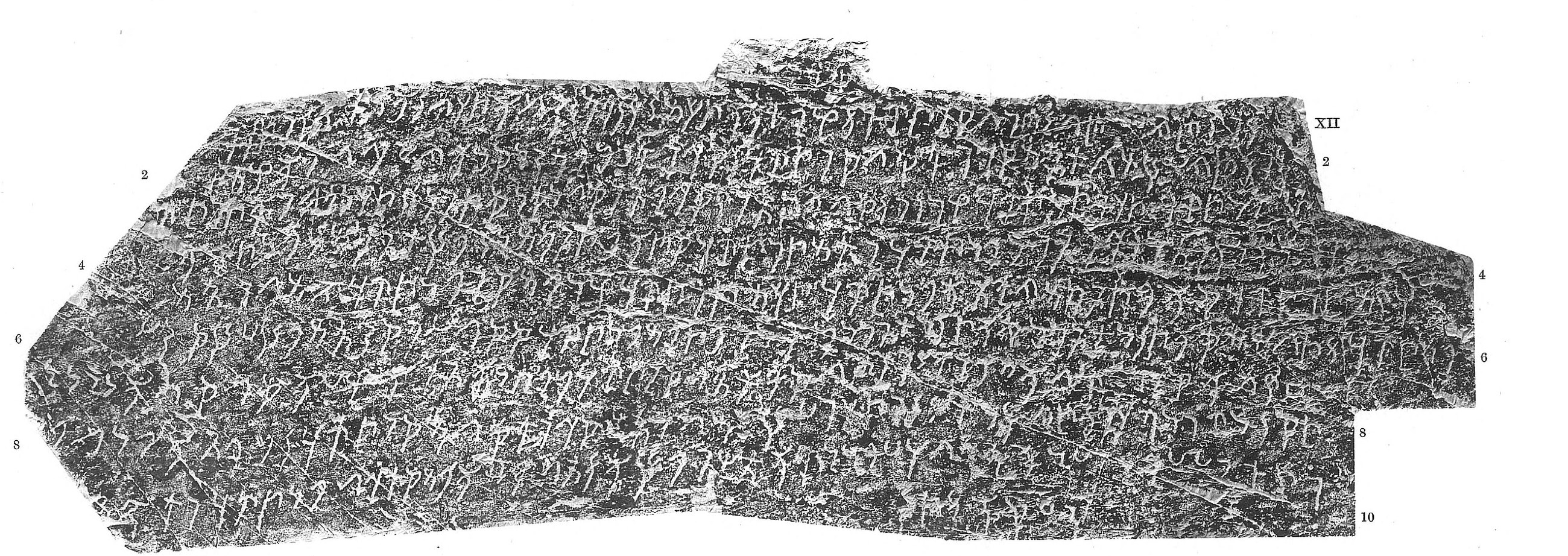
Shahbazgarhi lies near Mardan in Khyber Pakhtunkhwa (Pakistan), in ancient Gandhara, the north-western region where edict V names the Yonas, Kambojas and Gandharas. Here, and at Mansehra, Ashoka's fourteen Major Rock Edicts are written in Kharoshthi, a script derived from Aramaic that runs from right to left, instead of the Brahmi of the other sites. Edicts I-XI and XIII-XIV are cut on a large rock, XII on a separate boulder. The language is the north-western Prakrit of the region: it keeps r and groups like pr and dhr (dhrama, Priyadraśi), and Kharoshthi does not mark long vowels, so Hultzsch's transliteration has none.
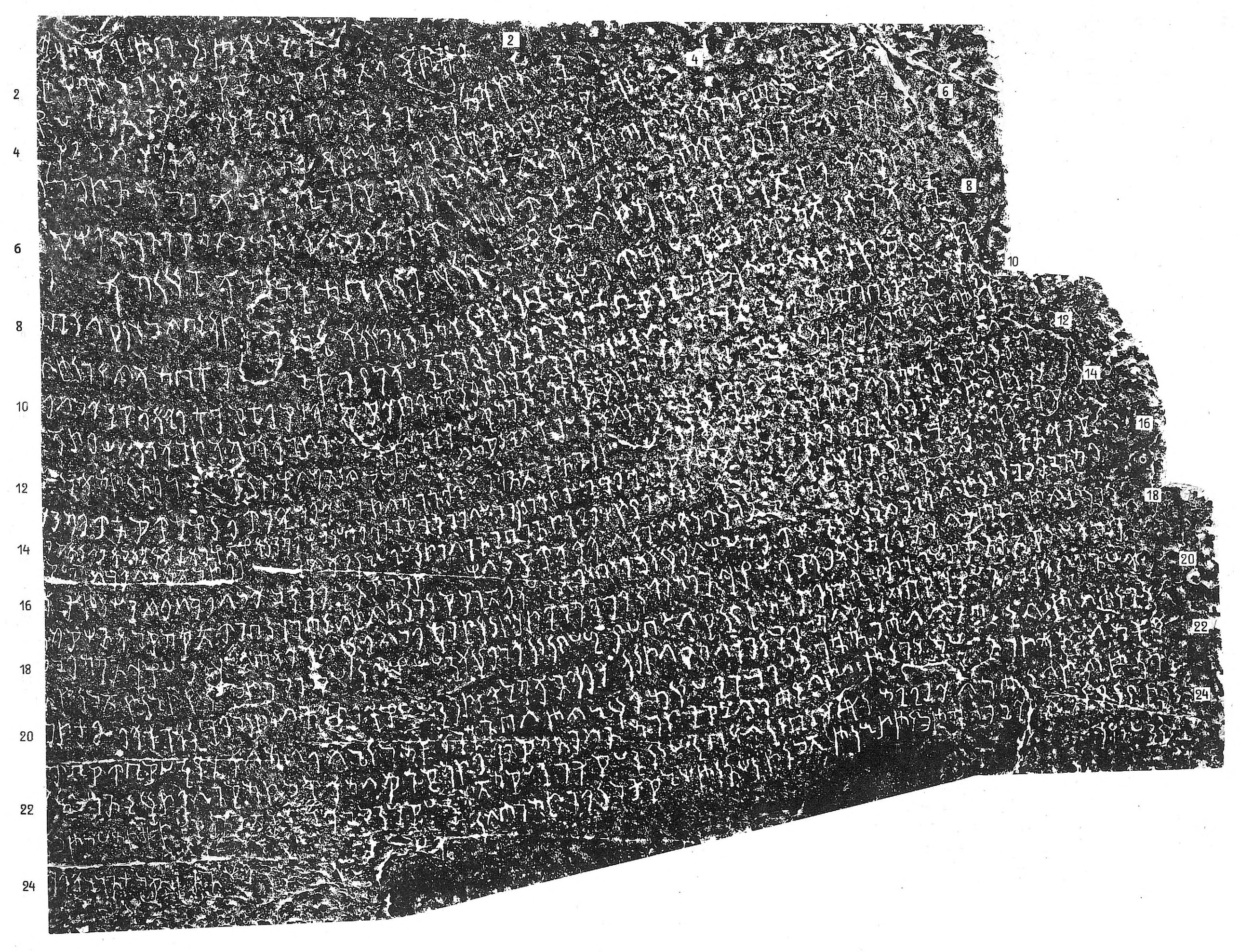
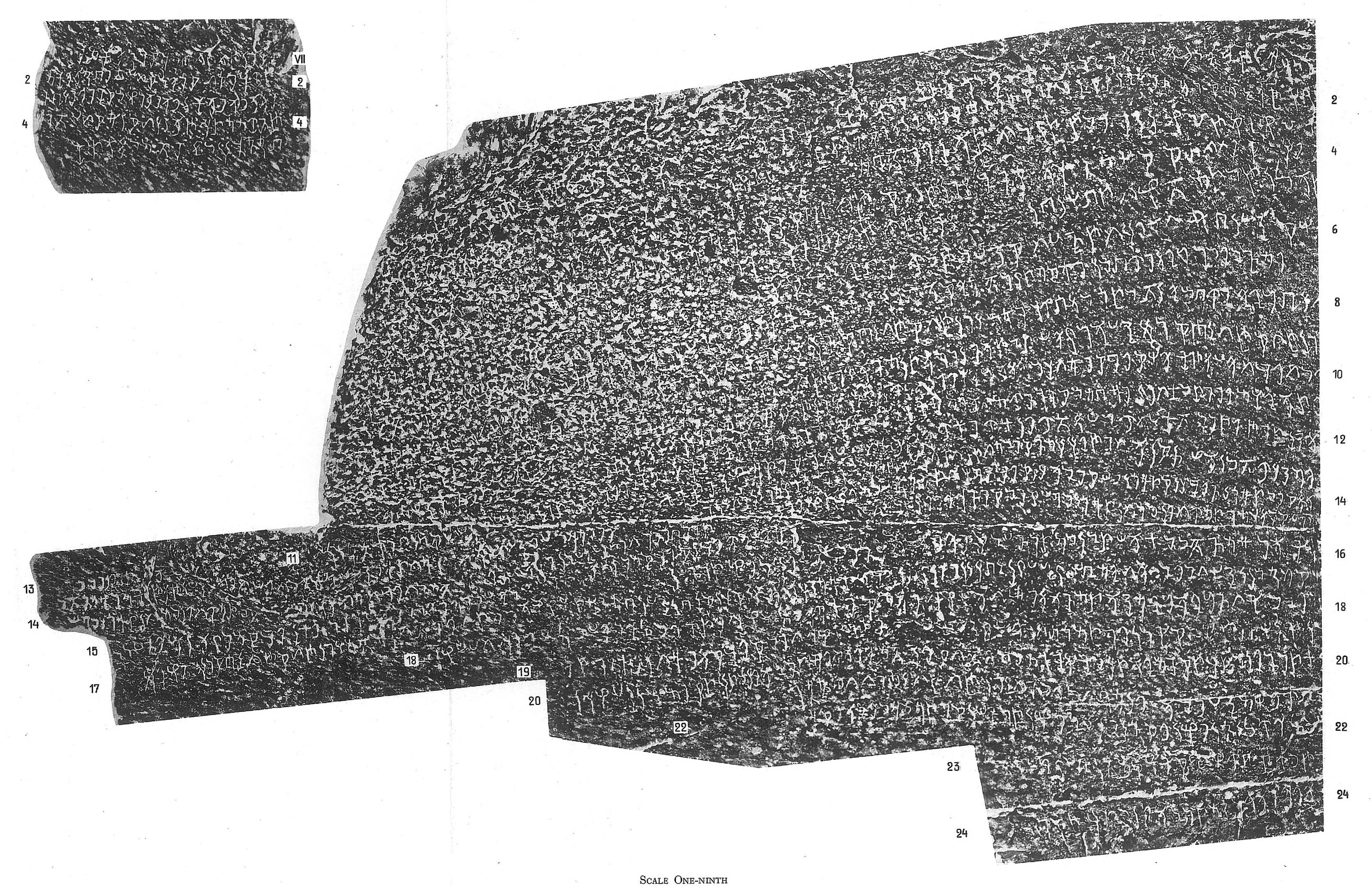
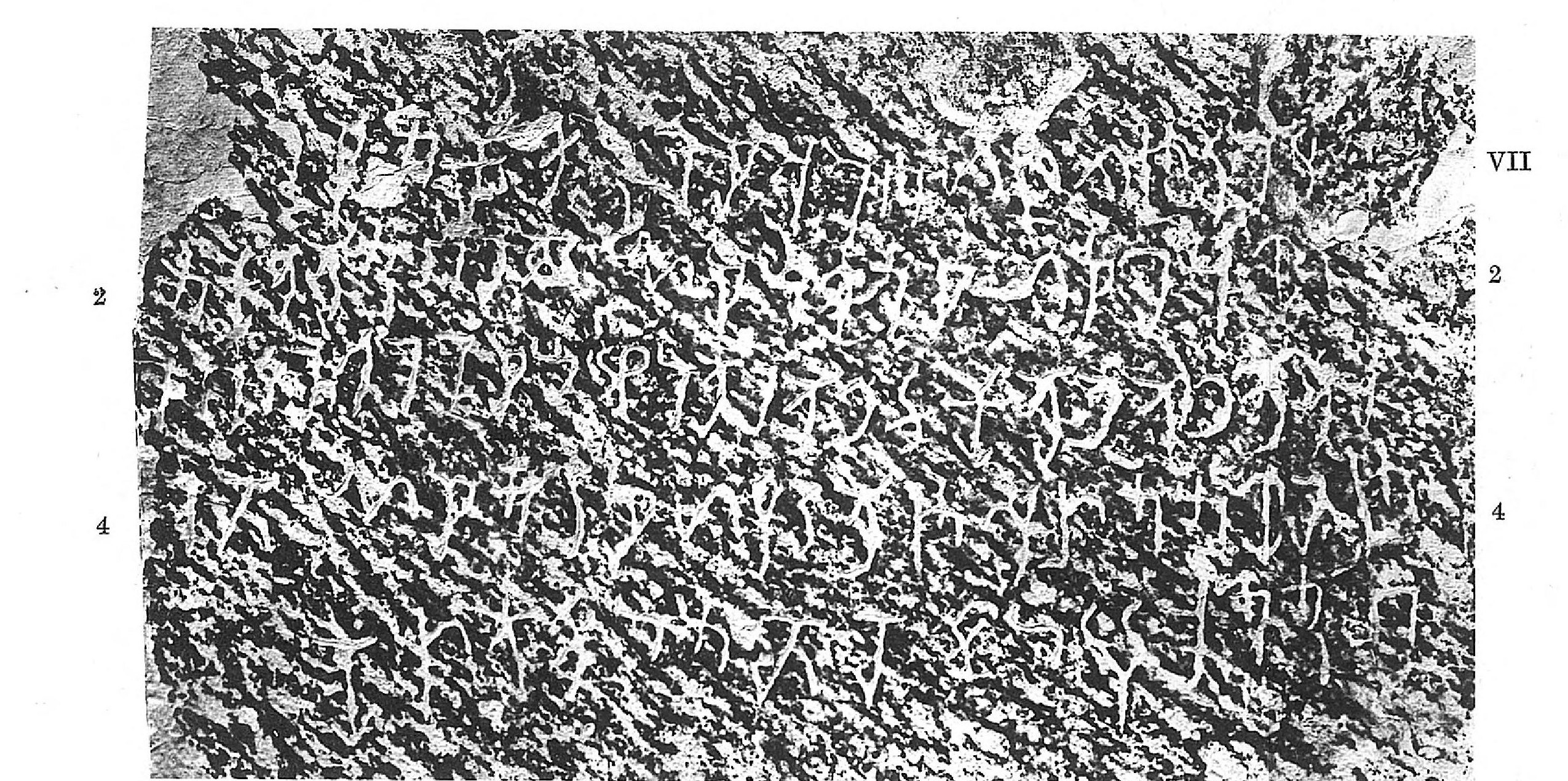
Edicts I-XI fill the east face of the rock in 25 long lines (VII is cut apart, at the top of the face); XIII and XIV are on the west face. Edict XIII tells of the conquest of Kalinga and names the Greek kings Amtiyoka (Antiochus II), Turamaya (Ptolemy II), Amtikini (Antigonus Gonatas), Maka (Magas) and Alikasudara (Alexander). Hultzsch prints the long faces in two plates each, a right half with the beginnings of the lines and a left half with their ends; the sections of edicts I-XI therefore show both whole halves, and each note gives the lines to look for by Hultzsch's line numbers.
Sources. Original text and English: E. Hultzsch, Inscriptions of Asoka. New Edition (Corpus Inscriptionum Indicarum, vol. I), Oxford: Clarendon Press for the Government of India, 1925, transcribed from the page images of the archive.org scan (public domain). Images: Hultzsch's collotype plates of inked impressions (estampages) of the Shahbazgarhi rock, taken on the stone for the Archaeological Survey of India. An impression is a contact copy pressed on paper from the inscribed surface itself, not a drawing; each section's image is the part of the plate that carries that text, with the plate's own numerals and line numbers in the margins.
Reading the text. Line numbers are Hultzsch's lines on the stone. Letters in square brackets are damaged or uncertain on the stone; dots mark lost letters. The capital letters in brackets, (A), (B) ..., are Hultzsch's sentence divisions and are the same in the transliteration and the English. Hultzsch's footnotes, which record other scholars' readings and his corrections, are not reproduced.
How was this verified? (Provenance)
Where on the image
Inked impression (estampage) of the Shahbazgarhi rock, not a photograph of the stone: Hultzsch 1925, plate 'First to eleventh rock-edicts: Shahbazgarhi, right half' (between pp. 56 and 57; archive.org leaf 198), cropped to the whole right half of the east face, which holds the beginnings of the lines (Kharoshthi runs from right to left): Hultzsch's line numbers 2 to 24 stand in the left margin and, boxed, at the right edge where each even line begins; edict I is lines 1-3. Second image, also an inked impression: Hultzsch 1925, plate 'First to eleventh rock-edicts: Shahbazgarhi, left half' (between pp. 56 and 57; archive.org leaf 197), cropped to the whole left half, which holds the ends of the same lines (numbered 2 to 24 in the right margin; towards the left the lines bend downwards, and the line numbers set beside the lower left part of the impression mark where they end); edict I is lines 1-3. The small separate impression at the upper left is edict VII. Checked on the image against the transcription (lines 1-3). Text and English: Hultzsch 1925, p. 51 (archive.org leaf 191).
1(A) [aya] dhrama-dipi Devanapriasa raño likhapitu (B) hida no kich[i] jive ara[bhitu p]rayuhotave (C) no pi ch[a] sama[ja] kaṭava (D) ba[hu]ka [hi] dosha sa[maya]spi Devaṇapriy[e] Priadraśi ray[a da]khati
2(E) [a]sti pi chu ekatia samaye sasu-mate Devanapiasa Priadraśisa raño (F) pura mahana[sas]i [Devana]pr[i]asa Priadraśisa raño anudivaso bahuni pra[ṇa]-śata-sahasani [arabhi]yis[u] supaṭhay[e] (G) s[o i]dani yada aya
3dhrama-dipi likhita tada trayo vo praṇa haṁñaṁt[i] majura duv[i] 2 mrugo 1 so pi mrugo no dhruva[ṁ] (H) eta pi praṇa trayo pacha na arabhiśaṁti
(A) This rescript on morality has been caused to be written by king Dēvānāṁpriya.
(B) Here no living being must be killed and sacrificed.
(C) And also no festival meetings must be held.
(D) For king Dēvānāṁpriya Priyadarśin sees much evil in festival meetings.
(E) But there are also some festival meetings which are considered meritorious by king Dēvānāṁpriya Priyadarśin.
(F) Formerly in the kitchen of king Dēvānāṁpriya Priyadarśin many hundred thousands of animals were killed daily for the sake of curry.
(G) But now, when this rescript on morality is written, then only three animals are being killed (daily), (viz.) two—2—peacocks (and) 1 deer, (but) even this deer not regularly.
(H) Even these three animals shall not be killed in future.
Where on the image
Inked impression (estampage) of the Shahbazgarhi rock, not a photograph of the stone: Hultzsch 1925, plate 'First to eleventh rock-edicts: Shahbazgarhi, right half' (between pp. 56 and 57; archive.org leaf 198), cropped to the whole right half of the east face, which holds the beginnings of the lines (Kharoshthi runs from right to left): Hultzsch's line numbers 2 to 24 stand in the left margin and, boxed, at the right edge where each even line begins; edict II is lines 3-5. Second image, also an inked impression: Hultzsch 1925, plate 'First to eleventh rock-edicts: Shahbazgarhi, left half' (between pp. 56 and 57; archive.org leaf 197), cropped to the whole left half, which holds the ends of the same lines (numbered 2 to 24 in the right margin; towards the left the lines bend downwards, and the line numbers set beside the lower left part of the impression mark where they end); edict II is lines 3-5. The small separate impression at the upper left is edict VII. Checked on the image against the transcription (lines 3-5). Text and English: Hultzsch 1925, pp. 51-52 (archive.org leaves 191-192).
3(A) sav[r]atra vijite [De]va[naṁ]priyasa Priyadraśisa y[e] cha [a]ṁta yatha [Choḍa]
4Paṁḍiya Satiyaputro Keraḍaputro Taṁbapaṁṇi Aṁtiyo[k]o nama Yona-raja ye cha aṁñe tasa Aṁtiyokasa samaṁta rajano savratra Devanaṁpriyasa Priyadraśisa raño du[vi] 2 chik[i]sa [kr]i[ṭa] manuśa-chikisa . . pa[śu-ch]ikisa [cha]
5(B) [o]sha[dha]ni manuśopakani cha paśopakani cha yat[r]a yatra nasti savatra harapita cha vuta cha (C) kupa cha khanapita pratibh[o]gaye paśu-manuśanaṁ
(A) Everywhere in the dominions of Dēvānāṁpriya Priyadarśin, and (of those) who (are his) borderers, such as the Chōḍas, the Pāṇḍyas, the Satiyaputra, the Kēraḍaputra, Tāmraparṇī, the Yōna king named Antiyoka, and the other kings who are the neighbours of this Antiyoka,—everywhere two—2—(kinds of) medical treatment were established by king Dēvānāṁpriya Priyadarśin, (viz.) medical treatment for men and medical treatment for cattle.
(B) Wherever there were no herbs beneficial to men and beneficial to cattle, everywhere they were caused to be imported and planted.
(C) And wells were caused to be dug for the use of cattle and men.
Where on the image
Inked impression (estampage) of the Shahbazgarhi rock, not a photograph of the stone: Hultzsch 1925, plate 'First to eleventh rock-edicts: Shahbazgarhi, right half' (between pp. 56 and 57; archive.org leaf 198), cropped to the whole right half of the east face, which holds the beginnings of the lines (Kharoshthi runs from right to left): Hultzsch's line numbers 2 to 24 stand in the left margin and, boxed, at the right edge where each even line begins; edict III is lines 5-7. Second image, also an inked impression: Hultzsch 1925, plate 'First to eleventh rock-edicts: Shahbazgarhi, left half' (between pp. 56 and 57; archive.org leaf 197), cropped to the whole left half, which holds the ends of the same lines (numbered 2 to 24 in the right margin; towards the left the lines bend downwards, and the line numbers set beside the lower left part of the impression mark where they end); edict III is lines 5-7. The small separate impression at the upper left is edict VII. Checked on the image against the transcription (lines 5-7). Text and English: Hultzsch 1925, pp. 52-53 (archive.org leaves 192-193).
5(A) Devanaṁpriyo Priyadraśi raja ahati (B) badaya-vashabh[i]si[tena] . . . . . . [a]ṇapi[taṁ] (C) savatra ma[a]
6vijite yuta rajuko pradeśi[ka paṁcha]shu paṁchashu 5 vasheshu anusaṁyanaṁ nik[r]amatu etisa vo karaṇa imisa dhraṁmanuśastiye [tha] añaye pi kraṁmaye (D) sadhu mata-pitushu suśrusha mitra-saṁst[u]ta-ñatikanaṁ bramaṇa-[śra]maṇa[naṁ] . . . . . . . . [pra]ṇanaṁ [anaraṁ]bho sadhu
7apa-vayata apa-bhaṁḍata sadhu (E) pari [pi] yutani [ga]ṇanasi aṇapeśaṁti hetuto cha vaṁñanato cha
(A) King Dēvānāṁpriya Priyadarśin speaks (thus).
(B) (When I had been) anointed twelve years, [the following] was ordered [by me].
(C) Everywhere in my dominions the Yuktas, the Rajuka, (and) the Prādēsika shall set out on a complete tour (throughout their charges) every five—5—years for this very purpose, (viz.) for the following instruction in morality as well as for other business.
(D) ‘Meritorious is obedience to mother and father. [Liberality] to friends, acquaintances, and relatives, to Brāhmaṇas and Śramaṇas [is meritorious]. Abstention from killing animals is meritorious. Moderation in expenditure (and) moderation in possessions are meritorious.’
(E) The councils (of Mahāmātras) also shall order the Yuktas to register (these rules) both with (the addition of) reasons and according to the letter.
Where on the image
Inked impression (estampage) of the Shahbazgarhi rock, not a photograph of the stone: Hultzsch 1925, plate 'First to eleventh rock-edicts: Shahbazgarhi, right half' (between pp. 56 and 57; archive.org leaf 198), cropped to the whole right half of the east face, which holds the beginnings of the lines (Kharoshthi runs from right to left): Hultzsch's line numbers 2 to 24 stand in the left margin and, boxed, at the right edge where each even line begins; edict IV is lines 7-10. Second image, also an inked impression: Hultzsch 1925, plate 'First to eleventh rock-edicts: Shahbazgarhi, left half' (between pp. 56 and 57; archive.org leaf 197), cropped to the whole left half, which holds the ends of the same lines (numbered 2 to 24 in the right margin; towards the left the lines bend downwards, and the line numbers set beside the lower left part of the impression mark where they end); edict IV is lines 7-10. The small separate impression at the upper left is edict VII. Checked on the image against the transcription (lines 7-10). Text and English: Hultzsch 1925, pp. 53-54 (archive.org leaves 193-194).
7(A) atikrataṁ aṁtaraṁ bahuni vasha-śatani vaḍhito vo praṇaraṁbho vihisa cha bhuta[na]ṁ ñatina asaṁpaṭipati śramaṇa-bramaṇana[ṁ] a[saṁ]paṭipati (B) [so aja Devana]ṁpriyasa Priyadraśisa [raño]
8dhrama-charaṇena bheri-ghosha aho dhrama-ghosha vimanana[ṁ] draśanaṁ [a]stina joti-kaṁdhani añani cha divani rupani draśayitu janasa (C) yadiśaṁ bahuhi vasha-śatehi na bhuta-pruve tadiśe aja vaḍhite Devanaṁpriyasa Priyadraśisa raño dhraṁmanuśa[sti]ya anaraṁbho praṇa[naṁ] avihisa bhutanaṁ ñatina[ṁ] saṁpa[ṭi]pati [bra]maṇa-
9śramaṇana saṁpaṭipati mata-pitushu vuḍhana[ṁ] suśrusha (D) e[ta] añaṁ cha bahuvidhaṁ dhrama-charaṇaṁ vaḍhitaṁ (E) vaḍhiśati cha yo Devanaṁpriyasa Priyadraśisa raño dhrama-charaṇaṁ ima[ṁ] (F) putra pi cha kaṁ nataro cha pranatika cha Devanaṁpriya[sa] Priyadraśisa raño pra[va]ḍh[e]śaṁti [yo] dhrama-charaṇaṁ ima[ṁ ava]-kapa dhrame śile cha
10tiṭhiti dhramaṁ anuśaśiśaṁti (G) eta h[i s]reṭhaṁ k[r]ama[ṁ] yaṁ dhraman[u]śaśana[ṁ] (H) dhrama-charaṇa[ṁ] pi cha na bhoti aśilasa (I) so imisa athrasa vaḍhi ahini cha sadhu (J) etaye aṭhaye ima[ṁ] nipistaṁ imisa aṭhasa vaḍhi yujaṁtu hini cha ma lo[ch]e[sh]u (K) badaya-vashabhisitena Devanaṁpriyena Priyadraśina raña ñanaṁ hi[da] nipesitaṁ
(A) In times past, for many hundreds of years, there had ever been promoted the killing of animals and the hurting of living beings, discourtesy to relatives, (and) discourtesy to Śramaṇas and Brāhmaṇas.
(B) But now, in consequence of the practice of morality on the part of king Dēvānāṁpriya Priyadarśin, the sound of drums has become the sound of morality, showing the people representations of aerial chariots, elephants, masses of light, and other divine figures.
(C) Such as they had not existed before for many hundreds of years, thus there are now promoted, through the instruction in morality on the part of king Dēvānāṁpriya Priyadarśin, abstention from killing animals, abstention from hurting living beings, courtesy to relatives, courtesy to Brāhmaṇas and Śramaṇas, obedience to mother and father, (and) to the aged.
(D) In this and many other ways is the practice of morality promoted.
(E) And this practice of morality will be ever promoted by king Dēvānāṁpriya Priyadarśin.
(F) And also the sons, grandsons, and great-grandsons of king Dēvānāṁpriya Priyadarśin will ever promote this practice of morality until the æon (of destruction of the world), (and) will instruct (people) in morality, abiding by morality and by good conduct.
(G) For this is the best work, viz. instruction in morality.
(H) And the practice of morality also is not (possible) for (a person) devoid of good conduct.
(I) Therefore promotion and not neglect of this object is meritorious.
(J) For the following purpose has this been written, (viz. in order that) they should devote themselves to the promotion of this practice, and that they should not approve the neglect (of it).
(K) (This) conception (jñāna) was caused to be written here by king Dēvānāṁpriya Priyadarśin (when he had been) anointed twelve years.
Where on the image
Inked impression (estampage) of the Shahbazgarhi rock, not a photograph of the stone: Hultzsch 1925, plate 'First to eleventh rock-edicts: Shahbazgarhi, right half' (between pp. 56 and 57; archive.org leaf 198), cropped to the whole right half of the east face, which holds the beginnings of the lines (Kharoshthi runs from right to left): Hultzsch's line numbers 2 to 24 stand in the left margin and, boxed, at the right edge where each even line begins; edict V is lines 11-13. Second image, also an inked impression: Hultzsch 1925, plate 'First to eleventh rock-edicts: Shahbazgarhi, left half' (between pp. 56 and 57; archive.org leaf 197), cropped to the whole left half, which holds the ends of the same lines (numbered 2 to 24 in the right margin; towards the left the lines bend downwards, and the line numbers set beside the lower left part of the impression mark where they end); edict V is lines 11-13. The small separate impression at the upper left is edict VII. Checked on the image against the transcription (lines 11-13). Text and English: Hultzsch 1925, pp. 55-57 (archive.org leaves 195-196, 199).
11(A) Devanapriyo Priyadraśi raya eva[ṁ] hahati (B) ka[la]ṇa[ṁ] dukara[ṁ] (C) [yo] a[dikaro kala]ṇasa so du[ka]raṁ karoti (D) so maya bahu kalaṁ ki[ṭ]raṁ (E) taṁ maa putra cha nataro cha para[ṁ] cha [tena y]e me apacha vrakshaṁti ava-kapaṁ tatha ye an[u]vaṭiśaṁti te s[u]kiṭa[ṁ] kashaṁti (F) yo chu ato . . kaṁ pi hapeśadi so dukaṭaṁ kashati (G) papaṁ h[i] sukaraṁ (H) sa atikrataṁ atara no bhuta-pruva dhraṁma-ma[ha]ma[tra] nama (I) so todaśa-vashabhisitena
12maya dhrama-mahamatra kiṭa (J) te savra-prashaṁḍesh[u] vapaṭa dhraṁmadhithanaye cha dhrama-vaḍhiya hida-sukhaye cha dhrama-yutasa Yona-Kaṁboya-Gaṁdharanaṁ Raṭhikanaṁ Pitinikanaṁ ye va pi aparaṁta (K) bhaṭamayeshu bramaṇibheshu anatheshu vuḍheshu [hita]-sukhaye [dhraṁ]ma-yutasa apalig[o]dha vap[a]ṭa te
13(L) badhana-badhasa paṭividhanay[e] apalibodhaye mo[kshaye] ayi anuba . . prajava kiṭabhikaro va mahalake va viyapaṭa [t]e (M) ia bahireshu cha nagareshu savreshu orodhaneshu bhratuna cha me spasana cha ye va pi aṁñe ñatika savatra viyapuṭa (N) y[e] ayaṁ dh[r]ama-niśite ti va dhrama[dhitha]ne ti va dana-s[a]yute ti va savata vijite maa dhrama-yu[ta]si viyapaṭa te dhrama-mahamatra (O) etaye aṭhaye [a]yi dhrama-dipi nipista ch[i]ra-thitika bhot[u] ta[tha] cha [m]e p[r]aja anuvatatu
(A) King Dēvānāṁpriya Priyadarśin speaks thus.
(B) It is difficult to perform virtuous deeds.
(C) He who starts performing virtuous deeds accomplishes something difficult.
(D) Now, by me many virtuous deeds have been performed.
(E) Therefore (among) my sons and grandsons, and (among) my descendants who shall come after them until the æon (of destruction of the world), those who will conform to this (duty) will perform good deeds.
(F) But he who will neglect even one (portion) of this (duty) will perform evil deeds.
(G) For sin is easily committed.
(H) Now, in times past (officers) called Mahāmātras of morality did not exist before.
(I) But Mahāmātras of morality were appointed by me (when I had been) anointed thirteen years.
(J) These are occupied with all sects in establishing morality, in promoting morality, and for the welfare and happiness of those who are devoted to morality (even) among the Yōnas, Kambōyas, and Gandhāras, among the Raṭhikas, among the Pitinikas, and whatever (other) western borderers (of mine there are).
(K) They are occupied with servants and masters, with Brāhmaṇas and Ibhyas, with the destitute, (and) with the aged, for the welfare and happiness of those who are devoted to morality, (and) in freeing (them) from desire (for worldly life).
(L) They are occupied in supporting prisoners (with money), in causing (their) fetters to be taken off, (and) in setting (them) free, (if) one has children, or is bewitched, or aged, respectively.
(M) They are occupied everywhere, here and in all the outlying towns, in the harems of my brothers, of (my) sisters, and (of) whatever other relatives (of mine there are).
(N) These Mahāmātras of morality are occupied everywhere in my dominions with those who are devoted to morality, (in order to ascertain) whether one is eager for morality, or established in morality, or furnished with gifts.
(O) For the following purpose has this rescript on morality been written, (viz. that) it may be of long duration, and (that) my descendants may conform to it.
Where on the image
Inked impression (estampage) of the Shahbazgarhi rock, not a photograph of the stone: Hultzsch 1925, plate 'First to eleventh rock-edicts: Shahbazgarhi, right half' (between pp. 56 and 57; archive.org leaf 198), cropped to the whole right half of the east face, which holds the beginnings of the lines (Kharoshthi runs from right to left): Hultzsch's line numbers 2 to 24 stand in the left margin and, boxed, at the right edge where each even line begins; edict VI is lines 14-16. Second image, also an inked impression: Hultzsch 1925, plate 'First to eleventh rock-edicts: Shahbazgarhi, left half' (between pp. 56 and 57; archive.org leaf 197), cropped to the whole left half, which holds the ends of the same lines (numbered 2 to 24 in the right margin; towards the left the lines bend downwards, and the line numbers set beside the lower left part of the impression mark where they end); edict VI is lines 14-16. The small separate impression at the upper left is edict VII. Checked on the image against the transcription (lines 14-16). Text and English: Hultzsch 1925, pp. 57-59 (archive.org leaves 199-201).
14(A) Devanaṁpriyo Priyadraśi raya eva ahati (B) atikrataṁ aṁtara na bhuta-pruvaṁ sava[ṁ] kala[ṁ] aṭha-kramaṁ va paṭivedana va (C) ta[ṁ] maya eva[ṁ] kiṭa[ṁ] (D) savraṁ kalaṁ aśamanasa me orodhanaspi grabhagaraspi vrachaspi vinitaspi uyanaspi savatra paṭivedaka aṭhaṁ janasa paṭivedetu me (E) savatra cha ja[na]sa aṭh[r]a karomi (F) ya[ṁ] pi cha ki[chi] mukhato aṇapayami a[haṁ] dapa[ka] va śravaka va ye va p[a]na mahamatrana a[cha]yika a[ro]pitaṁ bhoti taye aṭhaye viva[de] nijha[t]i va sataṁ parishaye anaṁtariyena praṭivedetavo me
15(E) savatra cha aṭhaṁ janasa karomi a[haṁ] (F) yaṁ cha kichi mukhato aṇapemi ahaṁ dapaka[ṁ] va śravaka va ye va pana mahamatranaṁ achayi[k]aṁ aropita[ṁ] bhoti t[a]ye aṭhaye [v]ivade sa[ṁ]taṁ nijati va parishaye anaṁtariyena paṭivedetavo me savatra savaṁ kala[ṁ] (G) eva aṇapita[ṁ] maya (H) [na]sti hi me tosho uṭhanas[i] aṭha-sa[ṁ]tiraṇaye [cha] (I) kaṭava-mataṁ hi me sava-loka-hitaṁ (J) ta[sa cha] mulaṁ etra uṭhanaṁ aṭha-saṁtiraṇa cha (K) na[sti] hi k[r]amatara[ṁ]
16sava-loka-hite[na] (L) yaṁ cha kichi parak[r]amami kiti bhutanaṁ anaṇiyaṁ v[r]acheyaṁ ia cha sha sukhayami paratra cha spagraṁ aradhetu (M) etaye aṭhaye ayi dhrama nipista chira-thitika bhotu tatha cha me putra nataro parakramaṁtu sava-lo[ka-hita]ye (N) [du]kara tu [kh]o imaṁ añat[r]a agre parakramena
(A) King Dēvānāṁpriya Priyadarśin speaks thus.
(B) In times past neither the disposal of affairs nor the submission of reports at any time did exist before.
(C) But I have made the following (arrangement).
(D) Reporters have to report to me the affairs of the people at any time (and) anywhere, while I am eating, in the harem, in the inner apartment, at the cowpen, in the palanquin, (and) in the park.
(E) And everywhere I am disposing of the affairs of the people.
(F) And also, if in the council (of Mahāmātras) a dispute arises, or an amendment is moved, in connexion with any donation or proclamation which I am ordering verbally, or (in connexion with) an emergent matter which has been delegated to the Mahāmātras, it must be reported to me immediately, anywhere, (and) at any time.
(G) Thus I have ordered.
(H) For I am never content in exerting myself and in dispatching business.
(I) For I consider it my duty (to promote) the welfare of all men.
(J) And the root of that (consists) in this, (viz.) exertion and the dispatch of business.
(K) For no duty is more important than (promoting) the welfare of all men.
(L) And whatever effort I am making, (is made) in order that I may discharge the debt (which I owe) to living beings, (that) I may make them happy in this (world), and (that) they may attain heaven in the other (world).
(M) For the following purpose has this [rescript on] morality been written, (viz. that) it may be of long duration, and (that) my sons (and) grandsons may display the same zeal for the welfare of all men.
(N) But it is indeed difficult to accomplish this without great zeal.
Where on the image
Inked impression (estampage) of the Shahbazgarhi rock, not a photograph of the stone: Hultzsch 1925, plate 'Seventh and twelfth rock-edicts: Shahbazgarhi' (facing p. 64; archive.org leaf 207), cropped to the upper figure of the plate (scale one-fourth), marked VII in the right margin and numbered 2, 4: five lines, cut separately at the top of the left part of the east face. Checked on the image against the transcription (lines 1-5). Text and English: Hultzsch 1925, p. 59 (archive.org leaf 201).
1(A) Devanaṁpriyo Priyaśi raja savatra ichhati savra-
2[p]rashaṁḍa vaseyu (B) save hi te sayame bhava-śudhi cha ichhaṁti
3(C) jano chu uchavucha-chhaṁdo uchavucha-rago (D) te savraṁ va eka-deśaṁ va
4pi kashaṁti (E) vipule pi chu dane yasa nasti sayama bhava-
5śudhi kiṭrañata driḍha-bhatita niche paḍhaṁ
(A) King Dēvānāṁpriya Priyadarśin desires (that) all sects may reside everywhere.
(B) For all these desire self-control and purity of mind.
(C) But men possess various desires (and) various passions.
(D) They will fulfil either the whole or only a portion (of their duties).
(E) But even one who (practises) great liberality, (but) does not possess self-control, purity of mind, gratitude, (and) firm devotion, is very mean.
Where on the image
Inked impression (estampage) of the Shahbazgarhi rock, not a photograph of the stone: Hultzsch 1925, plate 'First to eleventh rock-edicts: Shahbazgarhi, right half' (between pp. 56 and 57; archive.org leaf 198), cropped to the whole right half of the east face, which holds the beginnings of the lines (Kharoshthi runs from right to left): Hultzsch's line numbers 2 to 24 stand in the left margin and, boxed, at the right edge where each even line begins; edict VIII is line 17. Second image, also an inked impression: Hultzsch 1925, plate 'First to eleventh rock-edicts: Shahbazgarhi, left half' (between pp. 56 and 57; archive.org leaf 197), cropped to the whole left half, which holds the ends of the same lines (numbered 2 to 24 in the right margin; towards the left the lines bend downwards, and the line numbers set beside the lower left part of the impression mark where they end); edict VIII is line 17. The small separate impression at the upper left is edict VII. Checked on the image against the transcription (line 17). Text and English: Hultzsch 1925, p. 60 (archive.org leaf 202).
17(A) atikrataṁ ataraṁ Devanaṁpriya vihara-yatra nama nikramishu (B) atra mrugaya añani cha ediśani abhiramani abhuvasu (C) so Devanaṁpriyo Priyadraśi raja daśa-vashabhisito sataṁ nikrami Sabodhi (D) tenada dhraṁma-yatra (E) atra iyaṁ hoti śramaṇa-bramaṇanaṁ draśane danaṁ vuḍhana[ṁ] daśana hiraña-p[r]aṭividhane cha [jana]padasa janasa draśana dhramanuśasti dhrama-pa[ri]p[ru]chha cha tatopayaṁ (F) eshe bhuy[e ra]ti bhoti Devanaṁpriyasa Priyadraśisa raño bhago aṁñi
(A) In times past the Dēvānāṁpriyas used to set out on so-called pleasure-tours.
(B) On these (tours) hunting and other such pleasures were (enjoyed).
(C) But when king Dēvānāṁpriya Priyadarśin had been anointed ten years, he went out to Saṁbōdhi.
(D) Therefore tours of morality (were undertaken) here.
(E) On these (tours) the following takes place, (viz.) visiting Śramaṇas and Brāhmaṇas (and) making gifts (to them), visiting the aged and supporting (them) with gold, visiting the people of the country, instructing (them) in morality, and questioning (them) about morality, as suitable for this (occasion).
(F) This second period (of the reign) of king Dēvānāṁpriya Priyadarśin becomes a pleasure in a higher degree.
Where on the image
Inked impression (estampage) of the Shahbazgarhi rock, not a photograph of the stone: Hultzsch 1925, plate 'First to eleventh rock-edicts: Shahbazgarhi, right half' (between pp. 56 and 57; archive.org leaf 198), cropped to the whole right half of the east face, which holds the beginnings of the lines (Kharoshthi runs from right to left): Hultzsch's line numbers 2 to 24 stand in the left margin and, boxed, at the right edge where each even line begins; edict IX is lines 18-20. Second image, also an inked impression: Hultzsch 1925, plate 'First to eleventh rock-edicts: Shahbazgarhi, left half' (between pp. 56 and 57; archive.org leaf 197), cropped to the whole left half, which holds the ends of the same lines (numbered 2 to 24 in the right margin; towards the left the lines bend downwards, and the line numbers set beside the lower left part of the impression mark where they end); edict IX is lines 18-20. The small separate impression at the upper left is edict VII. Checked on the image against the transcription (lines 18-20). Text and English: Hultzsch 1925, pp. 61-62 (archive.org leaves 203-204).
18(A) Devanaṁpriyo Priyadraśi r[a]ya evaṁ ahati (B) jano uchavuchaṁ maṁgalaṁ karoti abadhe avahe vivahe pajupadane pravase ataye añaye cha ediśiy[e] jano ba maṁgalaṁ karoti (C) atra tu striyaka bahu cha bahuvidhaṁ cha putika cha niraṭhiyaṁ cha maṁgalaṁ karo[ti] (D) so kaṭavo cha [va] kho maṁgala (E) apa-phala[ṁ] tu kho eta (F) imaṁ [t]u kho maha-phala ye ma-maṁgala
19(G) [a]tra ima dasa-bhaṭakasa samma-paṭipati garuna apachiti praṇanaṁ sa[ṁ]yamo śamaṇa-bramaṇana dana etaṁ añaṁ cha dhrama-maṁga[laṁ] nama (H) [s]o vatavo pituna pi putrena pi bhratana pi spamik[e]na pi mitra-sastutena ava prativeśiyena imaṁ sadhu [imaṁ] kaṭa[vo] maṁgala[ṁ] yava tasa aṭhrasa nivuṭiya nivuṭaspi va p[u]na
20imaṁ kashaṁ (I) ye hi etake magale saśayike taṁ (J) siya vo taṁ aṭhaṁ nivaṭeyati siya puna no (K) ialoka cha vo taṁ (L) ida puna dhrama-magalaṁ akalikaṁ (M) yadi puna taṁ aṭhaṁ na nivaṭ[e] ia atha paratra anaṁtaṁ puñaṁ prasavati (N) haṁche puna taṁ ṭhaṁ nivaṭeti tato u[bha]y[e]sa ladhaṁ bhoti ia cha so aṭho paratra cha anaṁtaṁ puñaṁ prasavati tena dhramaṁgalena
(A) King Dēvānāṁpriya Priyadarśin speaks thus.
(B) Men are practising various ceremonies during illness, at the marriage of a son or a daughter, at the birth of a child, (and) when setting out on a journey; on these and other such (occasions) men are practising many ceremonies.
(C) But in such (cases) women are practising many and various offensive and useless ceremonies.
(D) Now, ceremonies should certainly be practised.
(E) But these (ceremonies) bear little fruit indeed.
(F) But the following bears much fruit indeed, viz. the practice of morality.
(G) Herein the following (are comprised), (viz.) proper courtesy to slaves and servants, reverence to elders, gentleness to animals, (and) liberality to Śramaṇas and Brāhmaṇas; these and other (virtues) are called the practice of morality.
(H) Therefore a father, or a son, or a brother, or a master, (or) a friend or an acquaintance, (or) even a (mere) neighbour ought to say: ‘This is meritorious. This practice should be observed until the (desired) object is attained, (thinking): After it is actually attained, I shall observe this again’.
(I) For such ceremonies are of doubtful (effect).
(J) One may attain his object (by them), but he may not (do so).
(K) And they (bear fruit) in this world only.
(L) But that practice of morality is not restricted to time.
(M) But if one does not attain (by it) his object in this (world), then endless merit is produced in the other (world).
(N) But if one attains (by it) his object (in this world), the gain of both (results) arises from it; (viz.) the (desired) object (is attained) in this (world), and endless merit is produced in the other (world) by that practice of morality.
Where on the image
Inked impression (estampage) of the Shahbazgarhi rock, not a photograph of the stone: Hultzsch 1925, plate 'First to eleventh rock-edicts: Shahbazgarhi, right half' (between pp. 56 and 57; archive.org leaf 198), cropped to the whole right half of the east face, which holds the beginnings of the lines (Kharoshthi runs from right to left): Hultzsch's line numbers 2 to 24 stand in the left margin and, boxed, at the right edge where each even line begins; edict X is lines 21-22. Second image, also an inked impression: Hultzsch 1925, plate 'First to eleventh rock-edicts: Shahbazgarhi, left half' (between pp. 56 and 57; archive.org leaf 197), cropped to the whole left half, which holds the ends of the same lines (numbered 2 to 24 in the right margin; towards the left the lines bend downwards, and the line numbers set beside the lower left part of the impression mark where they end); edict X is lines 21-22. The small separate impression at the upper left is edict VII. Checked on the image against the transcription (lines 21-22). Text and English: Hultzsch 1925, pp. 62-63 (archive.org leaves 204-205).
21(A) Devanapriye Priyadraśi raya yaśo va kiṭri va no mahaṭhavaha mañati añatra yo pi yaśo kiṭri va ichhati tadatvaye ayatiya cha jane dhrama-suśrasha suśrushatu me ti dhraṁma-vutaṁ cha anuvi[dhi]yatu (B) etakaye Devanapriye Priyadraśi raya yaśo kiṭri va
22ichhati (C) ya[ṁ] tu kichi parakramati Devanaṁpriyo Priyadraśi raya taṁ sav[r]aṁ paratrikaye va kiti sakale aparisrave siyati (D) eshe tu parisrave yaṁ apuñaṁ (E) dukare [tu] kho eshe khudrakena vagrena usaṭena va añatra agrena parakramena sava[ṁ] paritijitu (F) at[r]a chu usaṭe . . . . . . . .
(A) King Dēvānāṁpriya Priyadarśin does not think that either glory or fame conveys much advantage, except whatever glory or fame he desires (on account of his aim) that in the present time, and in the future, men may (be induced) by him to practise obedience to morality, and that they may conform to the duties of morality.
(B) On this (account) king Dēvānāṁpriya Priyadarśin is desiring glory and fame.
(C) But whatever effort king Dēvānāṁpriya Priyadarśin is making, all that (is) only for the sake of (merit) in the other (world), (and) in order that all (men) may be free of danger.
(D) But the danger is this, viz. demerit.
(E) But it is indeed difficult for a lowly person or for a high one to accomplish this without great zeal (and without) laying aside every (other aim).
(F) But among these (two) . . . . . . . . . . a high (person).
Where on the image
Inked impression (estampage) of the Shahbazgarhi rock, not a photograph of the stone: Hultzsch 1925, plate 'First to eleventh rock-edicts: Shahbazgarhi, right half' (between pp. 56 and 57; archive.org leaf 198), cropped to the whole right half of the east face, which holds the beginnings of the lines (Kharoshthi runs from right to left): Hultzsch's line numbers 2 to 24 stand in the left margin and, boxed, at the right edge where each even line begins; edict XI is lines 23-25. Second image, also an inked impression: Hultzsch 1925, plate 'First to eleventh rock-edicts: Shahbazgarhi, left half' (between pp. 56 and 57; archive.org leaf 197), cropped to the whole left half, which holds the ends of the same lines (numbered 2 to 24 in the right margin; towards the left the lines bend downwards, and the line numbers set beside the lower left part of the impression mark where they end); edict XI is lines 23-25. The small separate impression at the upper left is edict VII. Checked on the image against the transcription (lines 23-25). Text and English: Hultzsch 1925, p. 63 (archive.org leaf 205).
23(A) Devana[ṁ]priyo Priyadraśi raya evaṁ hahati (B) nasti ed[i]śaṁ danaṁ yadiśaṁ dhrama-dana dhrama-saṁstav[e] dh[r]ama-saṁvibhago dh[r]ama-saṁba[ṁ]dha (C) tatra etaṁ dasa-bhaṭakanaṁ saṁmma-paṭipati mata-pitushu suśrusha mi[t]ra-saṁstuta-ñatikanaṁ śramaṇa-bramaṇana
24dana praṇana anara[ṁ]bho (D) etaṁ vatavo pituna pi putrena pi bhratuna pi [spa]mikena pi mitra-saṁstutana ava prativeśiyena [i]ma[ṁ] sadhu imaṁ kaṭavo (E) so tatha karata[ṁ] ialoka cha a[ra]dheti paratra cha anataṁ puña prasavati
25[te]na dhrama-danena
(A) King Dēvānāṁpriya Priyadarśin speaks thus.
(B) There is no such gift as the gift of morality, acquaintance through morality, the distribution of morality, (and) kinship through morality.
(C) Herein the following (are comprised), (viz.) proper courtesy to slaves and servants, obedience to mother and father, liberality to friends, acquaintances, and relatives, to Śramaṇas and Brāhmaṇas, (and) abstention from killing animals.
(D) Concerning this a father, or a son, or a brother, or a master, (or) a friend or an acquaintance, (or) even a (mere) neighbour, ought to say: ‘This is meritorious. This ought to be done’.
(E) If one is acting thus, he attains (happiness in) this world, and endless merit is produced in the other (world) by that gift of morality.
Where on the image
Inked impression (estampage) of the Shahbazgarhi rock, not a photograph of the stone: Hultzsch 1925, plate 'Seventh and twelfth rock-edicts: Shahbazgarhi' (facing p. 64; archive.org leaf 207), cropped to the lower figure of the plate, the separate boulder, marked XII in the right margin and numbered 2 to 10 in both margins: 10 lines, the last short. Checked on the image against the transcription (lines 1-10). Text and English: Hultzsch 1925, pp. 64-66 (archive.org leaves 206, 208-209).
1(A) Devanaṁpriyo Priyadraśi raya savra-prashaṁḍani pravrajita[ni] grahathani cha pujeti danena vividhaye cha pujaye (B) no chu tatha [da]na va puja va
2Devanaṁpriyo mañati yatha kiti sa[la]-vaḍhi siya savra-prashaṁḍanaṁ (C) sala-vaḍhi tu bahuvidha (D) tasa tu iyo mula yaṁ vacha-guti
3kiti ata-prashaṁḍa-puja va pa[ra]-pashaṁḍa-garaṇa va no siya [a]pakaraṇasi lahuka va siya tasi tasi prakara[ṇ]e (E) pujetaviya va chu para-prasha[ṁ]-
4[ḍa] tena tena akarena (F) e[v]aṁ karataṁ ata-p[r]ashaṁḍaṁ vaḍheti para-prashaṁḍaṁsa pi cha upakaroti (G) tada añatha ka[ra]min[o] ata-p[rashaṁḍa]
5kshaṇati para-[pra]shaḍasa cha apakaroti (H) yo hi kachi ata-prashaḍaṁ pujeti [para]-p[r]ashaḍa[ṁ] garahati savre ata-prashaḍa-bhatiya va kiti
6ata-prashaṁḍaṁ dipayami ti so cha puna tatha karaṁtaṁ so cha puna tatha karataṁ ba[ḍhata]raṁ upahaṁti ata-prashaḍaṁ (I) so sayamo vo sadhu kiti añamañasa dhramo
7śruṇeyu cha suśrusheyu cha ti (J) evaṁ hi Devanaṁpriyasa ichha kiti savra-prashaṁḍa bahu-śruta ch[a] kal[aṇa]gama cha siyasu (K) ye cha tatra tatra
8prasana tesha[ṁ] vatavo (L) Devanaṁpriy[o] na [tatha da]na[ṁ va] p[u]ja va mañati ya[tha] kiti sala-vaḍhi siyati savra-prashaḍanaṁ (M) bahuka cha etaye a[ṭha] . .
9vap[a]ṭa dh[ra]ma-ma[ha]matra i[stridhi]yaksha-ma[ha]matra [vra]cha-bhumika añe cha nikaye (N) imaṁ cha etisa [pha]laṁ yaṁ ata-pashaḍa-vaḍhi [bh]o[ti]
10dhramasa cha di[pana]
(A) King Dēvānāṁpriya Priyadarśin is honouring all sects: (both) ascetics and householders, with gifts and with honours of various kinds.
(B) But Dēvānāṁpriya does not value either gifts or honours so (highly) as (this), (viz.) that a promotion of the essentials of all sects should take place.
(C) But the promotion of the essentials (is possible) in many ways.
(D) But its root is this, viz. guarding (one's) speech, (i.e.) that neither praising one's own sect nor blaming other sects should take place on improper occasions, or (that) it should be moderate in every case.
(E) But other sects ought to be duly honoured in every way.
(F) If one is acting thus, he is promoting his own sect and is benefiting other sects as well.
(G) If one is acting otherwise than thus, he is hurting his own sect and wronging other sects.
(H) For whosoever praises his own sect (or) blames other sects,—all (this) out of pure devotion to his own sect, (i.e.) with the view of glorifying his own sect,—if he is acting thus, he rather injures his own sect very severely.
(I) Therefore self-control alone is meritorious, (i.e.) that they should both hear and obey each other's morals.
(J) For this is the desire of Dēvānāṁpriya, (viz.) that all sects should be both full of learning and pure in doctrine.
(K) And those who are attached to their respective (sects), ought to be spoken to (as follows).
(L) Dēvānāṁpriya does not value either gifts or honours so (highly) as (this), (viz.) that a promotion of the essentials of all sects should take place.
(M) And many (officers) are occupied for this purpose, (viz.) the Mahāmātras of morality, the Mahāmātras controlling women, the inspectors of cowpens, and other classes (of officials).
(N) And this is the fruit of it, (viz.) that the promotion of one's own sect takes place, and the glorification of morality.
Where on the image
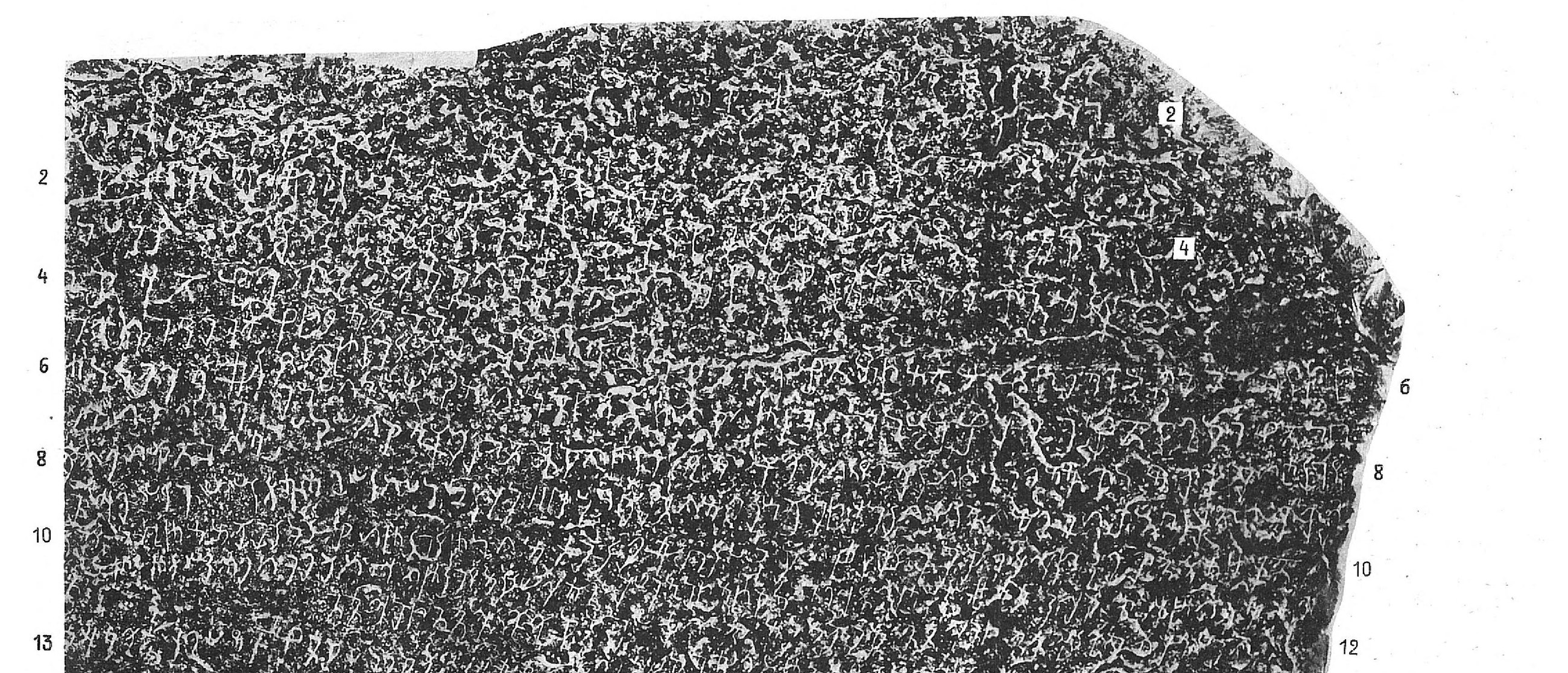
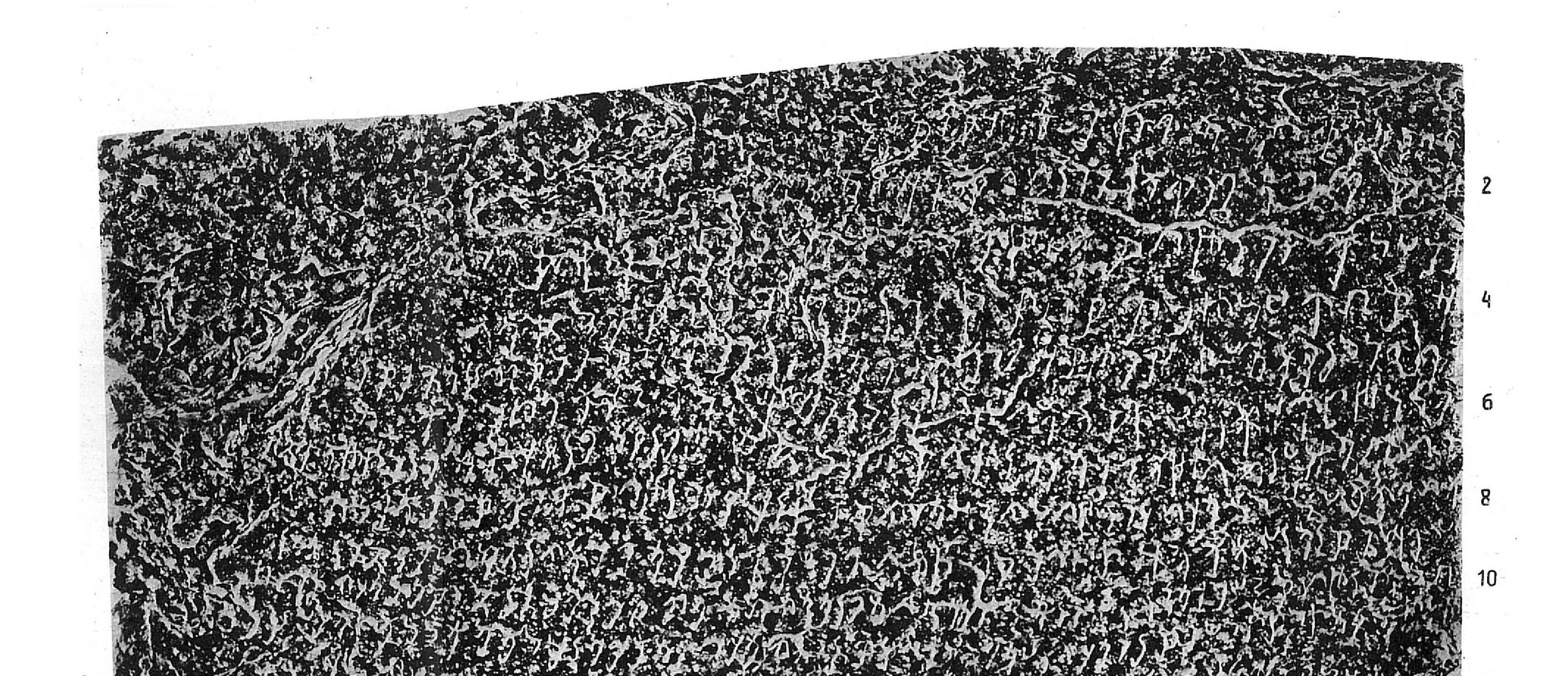
Inked impression (estampage) of the Shahbazgarhi rock, not a photograph of the stone: Hultzsch 1925, plate 'Thirteenth and fourteenth rock-edicts: Shahbazgarhi, right half' (between pp. 68 and 69; archive.org leaf 213), cropped to the right half of the west face (beginnings of the lines), from the top down to line 12: numbered 2 to 12 at the right edge where the even lines begin and 2 to 10 in the left margin; the lines slope down towards the right. Second image, also an inked impression: Hultzsch 1925, plate 'Thirteenth and fourteenth rock-edicts: Shahbazgarhi, left half' (between pp. 68 and 69; archive.org leaf 212), cropped to the left half (ends of the same lines), numbered 2 to 10 in the right margin, down to line 12. Checked on the image against the transcription (lines 1-12). Text and English: Hultzsch 1925, pp. 67-70 (archive.org leaves 210-211, 214-215).
1(A) [aṭha]-vasha-a[bhis]ita[sa Devana]pri[a]sa Pri[a]draśisa ra[ño] Ka[liga] vi[j]ita (B) diaḍha-mat[r]e praṇa-śata-[saha]sre y[e] tato apavuḍhe śata-sahasra-matre tatra hate bahu-tavata[ke va] m[uṭe]
2(C) tato [pa]cha a[dhu]na ladh[e]shu [Kaligeshu tivre dhrama-śilana] dhra[ma-ka]mata dhramanuśasti cha Devanapriyasa (D) so [a]sti anusochana Devanap[ria]sa vijiniti Kaliga[ni]
3(E) avijitaṁ [hi vi]jinamano yo tat[r]a vadha va maraṇaṁ va apavaho va janasa taṁ baḍhaṁ v[e]dani[ya]-ma[taṁ] guru-mata[ṁ] cha Devanaṁpriyasa (F) idaṁ pi chu [tato] guru-matataraṁ [Devanaṁ]priyasa (G) ye tatra
4vasati bramaṇa va śrama[ṇa] va a[ṁ]ñe va prashaṁḍa gra[ha]tha va yesu vihita esha agrabhuṭi-suśrusha mata-pitushu suśrusha guruna suśrusha mitra-saṁstuta-sahaya-
5ñatikeshu dasa-bhaṭakanaṁ samma-pratipa[ti] driḍha-bhatita tesha tatra bhoti [a]pag[r]atho va vadho va abhiratana va nikramaṇaṁ (H) yesha va pi suvihitanaṁ [si]ho aviprahino [e te]sha mitra-saṁstuta-sahaya-ñatika vasana
6prapuṇati [ta]tra taṁ pi tesha vo apaghratho bhoti (I) pratibhagaṁ cha [e]taṁ savra-manuśanaṁ guru-mataṁ cha Devanaṁpriya[sa] (J) nasti cha ekatare pi prashaḍaspi na nama prasado (K) so yamatro [ja]no tada Kalige [ha]to cha muṭ[o] cha apav[uḍha] cha tato
7śata-bhage va sahasra-bhagaṁ va [a]ja guru-mataṁ v[o] Devanaṁpriyasa (L) yo pi cha apakareyati kshamitaviya-mate va Devanaṁp[r]iyasa yaṁ śako kshamanaye (M) ya pi cha aṭavi Devanaṁpriyasa vijite bhoti ta pi anuneti anunijapeti (N) anutape pi cha prabhave
8Devanaṁpriyasa vuchati tesha kiti avatrapeyu na cha [ha]ṁñeyasu (O) ichhati hi D[e]vanaṁpriyo savra-bhutana akshati sa[ṁ]yamaṁ sama[cha]riyaṁ rabhasiye (P) ayi cha mukha-mut[a] vijaye Devanaṁpriya[sa] yo dhrama-vijayo (Q) so cha puna ladho Devanaṁpriyasa iha cha saveshu cha aṁteshu
9[a] shashu pi yojana-śa[t]eshu yatra Aṁtiyoko nama Y[o]na-raja paraṁ cha tena Atiyok[e]na chature 4 rajani Turamaye nama Aṁtikini nama Maka nama Alikasudaro nama nicha Choḍa-Paṁḍa ava Ta[ṁ]bapaṁ[ṇi]ya (R) [e]vameva [hi]da raja-vishavaspi Yona-Ka[ṁ]boyeshu Nabhaka-Nabhitina
10Bhoja-Pitinikeshu Aṁdhra-Palideshu savatra Devanaṁpriyasa dhramanuśasti anuvaṭaṁti (S) yatra pi Devanaṁpriyasa duta na vrachaṁti te pi śrutu Devanaṁpriyasa dhrama-vutaṁ vidh[a]naṁ dhramanuśasti dhramaṁ [a]nuvidhiyaṁti anuvidhiyiśaṁ[ti] cha (T) yo [sa] ladhe etakena bho[ti] savatra vijayo sava[tra] pu[na]
11vijayo priti-raso so (U) ladha bh[oti] priti dhrama-vijayaspi (V) lahuka tu kho sa priti (W) paratri[ka]meva maha-phala meñati Devana[ṁ]priyo (X) etaye cha aṭhaye ayi dhrama-dipi nipi[sta] kiti putra papotra me asu navaṁ vijayaṁ ma vijetav[i]a mañishu spa[kaspi] yo vijay[e ksham]ti cha lahu-da[ṁ]ḍata cha rochetu taṁ cha yo vija maña[tu]
12yo dhrama-vijayo (Y) so hidalokiko paralokiko (Z) sava-chati-rati bhotu ya [dh]raṁma-rati (AA) sa hi hidalokika paralokika
(A) When king Dēvānāṁpriya Priyadarśin had been anointed eight years, (the country of) the Kaliṅgas was conquered by (him).
(B) One hundred and fifty thousand in number were the men who were deported thence, one hundred thousand in number were those who were slain there, and many times as many those who died.
(C) After that, now that (the country of) the Kaliṅgas has been taken, Dēvānāṁpriya (is devoted) to a zealous study of morality, to the love of morality, and to the instruction (of people) in morality.
(D) This is the repentance of Dēvānāṁpriya on account of his conquest of (the country of) the Kaliṅgas.
(E) For, this is considered very painful and deplorable by Dēvānāṁpriya, that, while one is conquering an unconquered (country), slaughter, death, and deportation of people (are taking place) there.
(F) But the following is considered even more deplorable than this by Dēvānāṁpriya.
(G) (To) the Brāhmaṇas or Śramaṇas, or other sects or householders, who are living there, (and) among whom the following are practised: obedience to those who receive high pay, obedience to mother and father, obedience to elders, proper courtesy to friends, acquaintances, companions, and relatives, to slaves and servants, (and) firm devotion,—to these then happen injury or slaughter or deportation of (their) beloved ones.
(H) Or, if there are then incurring misfortune the friends, acquaintances, companions, and relatives of those whose affection (for the latter) is undiminished, although they are (themselves) well provided for, this (misfortune) as well becomes an injury to those (persons) themselves.
(I) This is shared by all men and is considered deplorable by Dēvānāṁpriya.
(J) And there is no (place where men) are not indeed attached to some sect.
(K) Therefore even the hundredth part or the thousandth part of all those people who were slain, who died, and who were deported at that time in Kaliṅga, (would) now be considered very deplorable by Dēvānāṁpriya.
(L) And Dēvānāṁpriya thinks that even (to one) who should wrong (him), what can be forgiven is to be forgiven.
(M) And even (the inhabitants of) the forests which are (included) in the dominions of Dēvānāṁpriya, even those he pacifies (and) converts.
(N) And they are told of the power (to punish them) which Dēvānāṁpriya (possesses) in spite of (his) repentance, in order that they may be ashamed (of their crimes) and may not be killed.
(O) For Dēvānāṁpriya desires towards all beings abstention from hurting, self-control, (and) impartiality in (case of) violence.
(P) And this conquest is considered the principal one by Dēvānāṁpriya, viz. the conquest by morality.
(Q) And this (conquest) has been won repeatedly by Dēvānāṁpriya both here and among all (his) borderers, even as far as at (the distance of) six hundred yōjanas, where the Yōna king named Antiyoka (is ruling), and beyond this Antiyoka, (where) four—4—kings (are ruling), (viz. the king) named Turamaya, (the king) named Antikini, (the king) named Maka, (and the king) named Alikasudara, (and) towards the south, (where) the Chōḍas and Pāṇḍyas (are ruling), as far as Tāmraparṇī.
(R) Likewise here in the king's territory, among the Yōnas and Kambōyas, among the Nabhakas and Nabhitis, among the Bhōjas and Pitinikas, among the Andhras and Palidas,—everywhere (people) are conforming to Dēvānāṁpriya's instruction in morality.
(S) Even those to whom the envoys of Dēvānāṁpriya do not go, having heard of the duties of morality, the ordinances, (and) the instruction in morality of Dēvānāṁpriya, are conforming to morality and will conform to (it).
(T) This conquest, which has been won by this everywhere,—a conquest (won) everywhere (and) repeatedly,—causes the feeling of satisfaction.
(U) Satisfaction has been obtained (by me) at the conquest by morality.
(V) But this satisfaction is indeed of little (consequence).
(W) Dēvānāṁpriya thinks that only the fruits in the other (world) are of great (value).
(X) And for the following purpose has this rescript on morality been written, (viz.) in order that the sons (and) great-grandsons (who) may be (born) to me, should not think that a fresh conquest ought to be made, (that), if a conquest does please them, they should take pleasure in mercy and light punishments, and (that) they should regard the conquest by morality as the only (true) conquest.
(Y) This (conquest bears fruit) in this world (and) in the other world.
(Z) And let there be (to them) pleasure in the abandonment of all (other aims), which is pleasure in morality.
(AA) For this (bears fruit) in this world (and) in the other world.
Where on the image
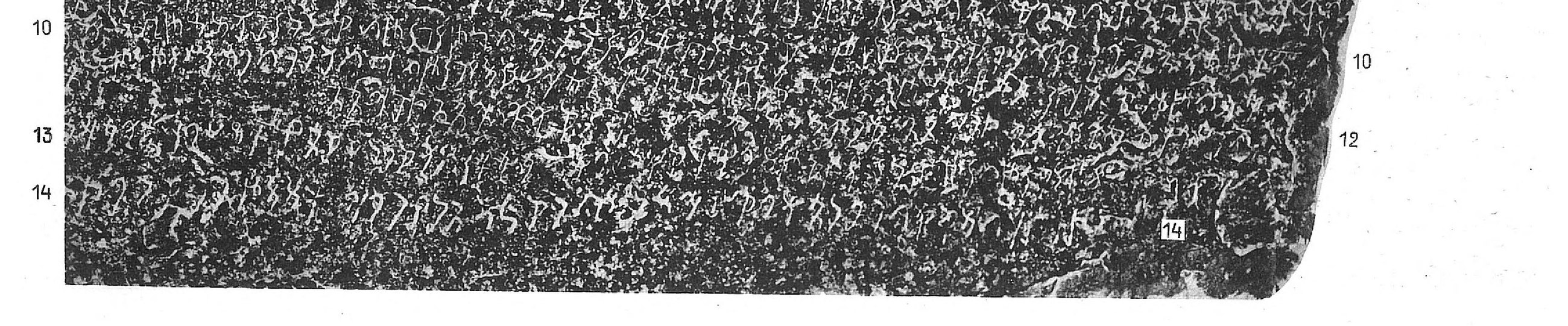
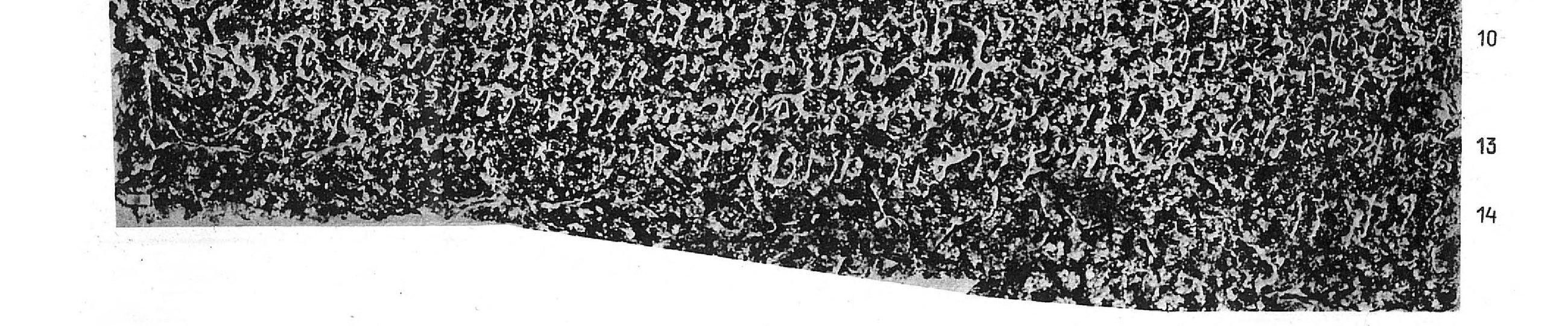
Inked impression (estampage) of the Shahbazgarhi rock, not a photograph of the stone: Hultzsch 1925, plate 'Thirteenth and fourteenth rock-edicts: Shahbazgarhi, right half' (between pp. 68 and 69; archive.org leaf 213), cropped to the foot of the right half, lines 13 and 14 (numbered 13 and 14 in the left margin; line 14 begins at the boxed 14 at the lower right); the last line of edict XIII shows above; a narrow strip of the neighbouring lines is included above and below. Second image, also an inked impression: Hultzsch 1925, plate 'Thirteenth and fourteenth rock-edicts: Shahbazgarhi, left half' (between pp. 68 and 69; archive.org leaf 212), cropped to the foot of the left half, the ends of lines 13 and 14 (numbered 13 and 14 in the right margin); a narrow strip of the neighbouring lines is included above and below. Checked on the image against the transcription (lines 13-14). Text and English: Hultzsch 1925, p. 71 (archive.org leaf 216).
13(A) ayi dhrama-dipi Devanaṁpriyena Priśi[na] raña nipesapita asti vo saṁkshitena asti yo vistriṭena (B) na hi savatra sasavre gaṭite (C) mahalake hi vijite bahu cha likhite likha[p]eśami cheva (D) asti chu atra puna puna [la]pitaṁ tasa tasa [a]ṭhasa madhuriyaye ye[na] jana tatha
14paṭipajeyati (E) so siya va atra kiche asamataṁ likhitaṁ deśaṁ va saṁkhay[a] karaṇa va alocheti dipikarasa va aparadhena
(A) These rescripts on morality have been caused to be written by king Dēvānāṁpriya Priyadarśin either in an abridged (form) or at full length.
(B) For the whole was not suitable everywhere.
(C) For (my) dominions are wide, and much has been written, and I shall cause still (more) to be written.
(D) But (some) of this has been stated again and again because of the charm of certain topics, (and) in order that men should act accordingly.
(E) But some of this may have been written incompletely, either on account of the locality, or because (my) motive was not liked, or by the fault of the writer.
Notes
- Hultzsch translates dhamma as 'morality'; other translators use 'Dharma' or 'righteousness'.
- Words in round brackets in the English are Hultzsch's additions for sense; words in square brackets render damaged letters.
Cite
Sources
- Source: Shahbazgarhi, Mardan district (Khyber Pakhtunkhwa, Pakistan), rock inscription of Ashoka; Hultzsch's collotype plates of inked impressions (1925); Hultzsch's transliteration and English (CII I, 1925), read from the archive.org scan (holding institution)
- Critical edition: E. Hultzsch, Inscriptions of Asoka (CII I, 1925), transliteration read from the scan
← previous · → next · v cycle view · l back to library