Pliny the Elder, Natural History 2.205: lands taken by the sea, 'if we believe Plato' in the Atlantic
Introduction
In book 2 of the Natural History (77 AD) Pliny lists changes of land and sea. At 2.205 he writes that the sea has taken whole lands, 'first of all, if we believe Plato, over an immense space where the Atlantic sea now is', then nearer home Acarnania, Achaea and the shores of the Propontis and Pontus, and that the earth also swallows itself. It is the only reference to Plato's Atlantis in Pliny, who names neither the island nor the war.
The manuscript is Leiden, Universiteitsbibliotheek, VLF 4, the 8th-century Northumbrian copy that is the oldest witness for this part of the work (Pliny siglum A). 2.205 runs from fol. 4v col. b line 28 to fol. 5r col. a line 9; the Atlantis sentence is fol. 4v col. b lines 30-32, opening with an enlarged I.
The Latin is Mayhoff's Teubner text (Perseus). The English is Bostock and Riley (1855): the end of their chapter 91 and their chapters 92-93, which together render 2.205.
How was this verified? (Provenance)
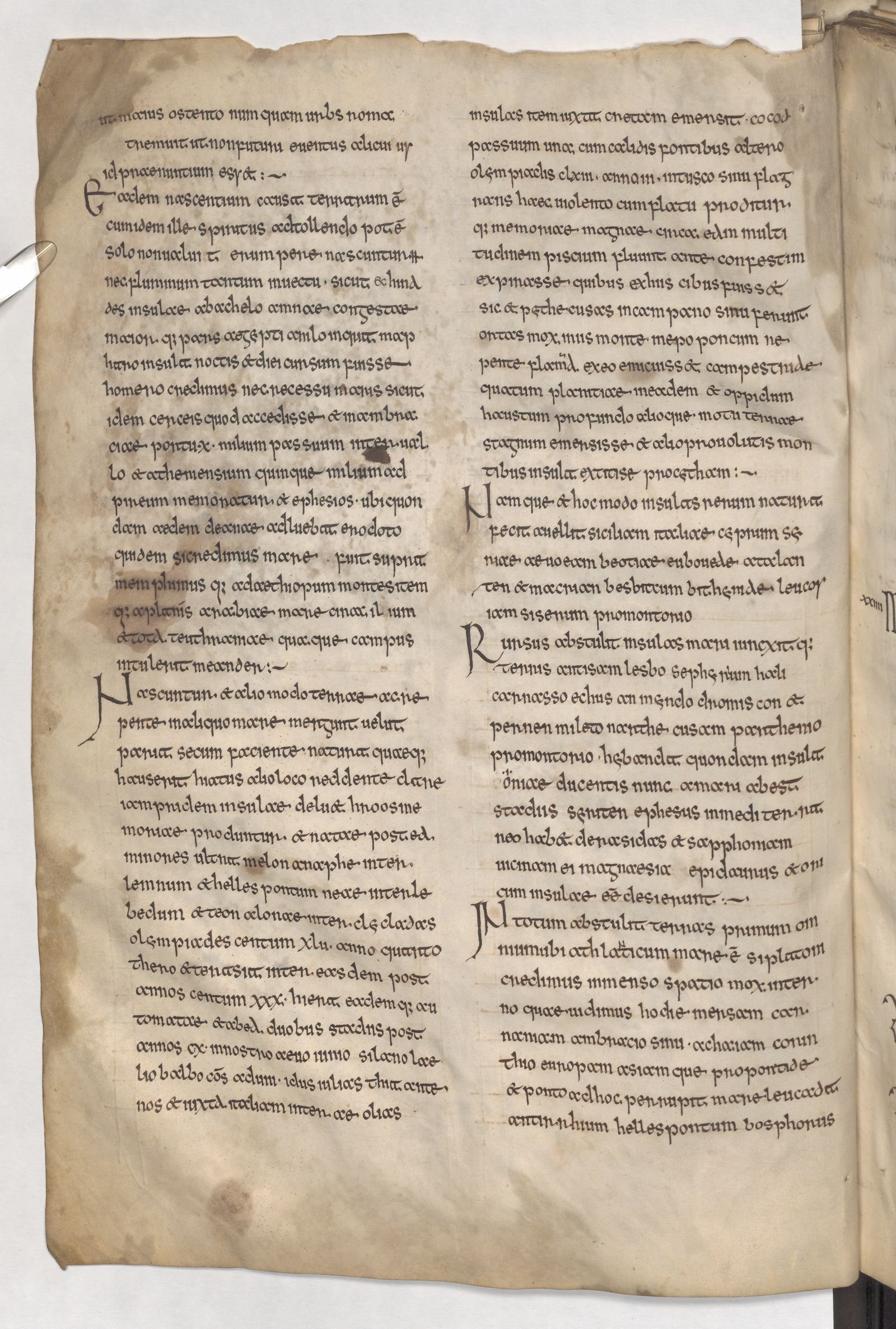
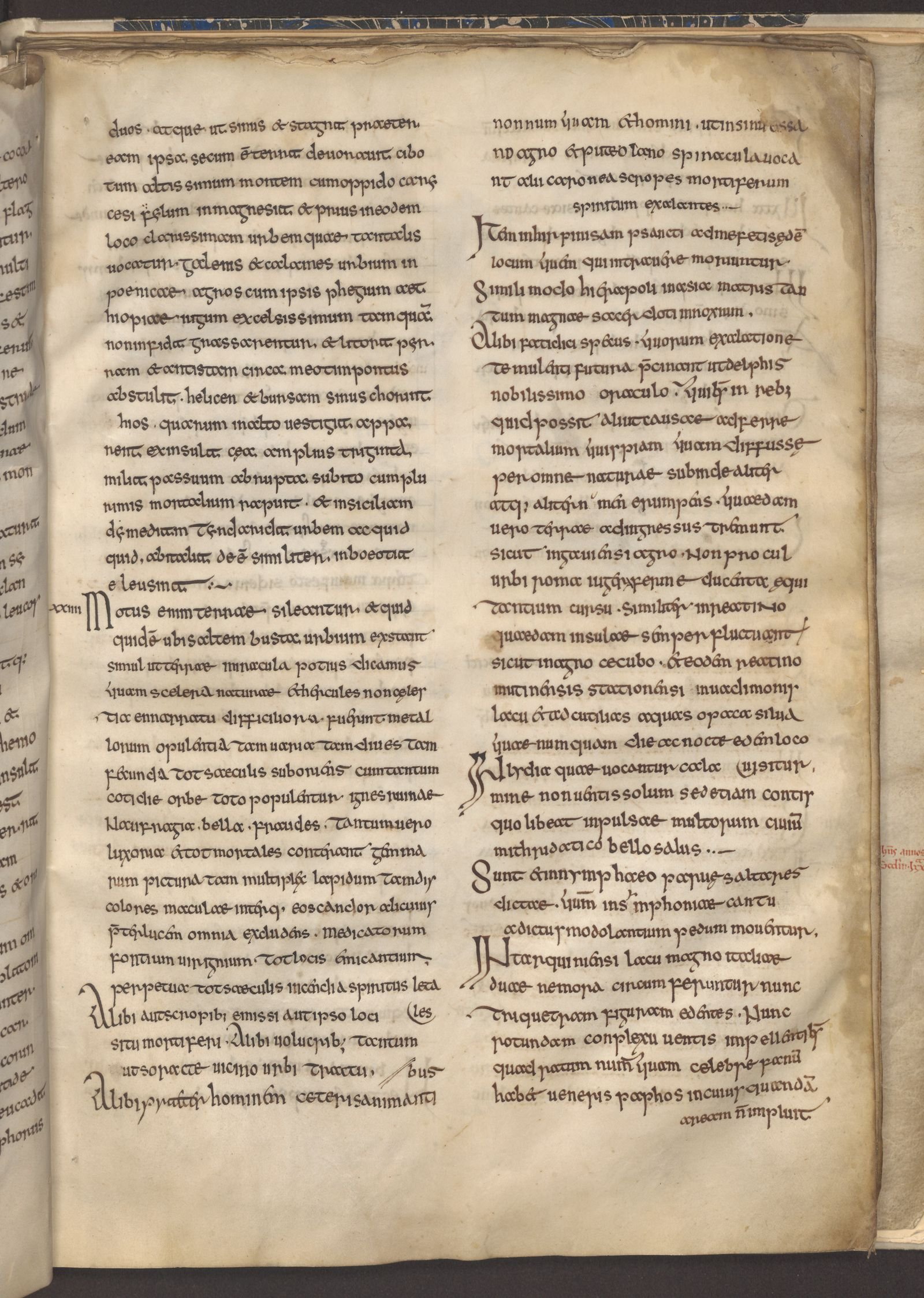
Where on the image
2.205 begins mid-line at fol. 4v col. b line 28, after ‹vicinam ei magnesia›, with ‹epidaurus et ori-› (line 29 ‹cum insulae esse desierunt›). The Atlantis sentence is lines 30-32, with an enlarged I: ‹In totum abstulit terras primum om- / nium ubi athlanticum mare est si platoni / credimus immenso spatio mox inter-›. Col. b ends (line 37) ‹antirrhium hellespontum bosphorus›; fol. 5r col. a begins ‹duos atque ut sinus et stagna praeteri-›, and the section ends at line 9 with ‹non infida grassarentur et litora›, followed by 2.206 ‹pyrram et antissam›. Read on the Leiden images (full pages and column crops).
Epidaurus et Oricum insulae' esse desierunt. in totum abstulit terras primum omnium ubi Atlanticum mare est, si Platoni credimus, inmenso spatio, mox interno quoque: videmus hodie mersam Acarnaniam Ambracio sinu, Achaiam Corinthio , Europam Asiamque Propontide et Ponto. ad hoc perrupit mare Leucada, Antirrhium, Hellespontum, Bosporos duos. Atque ut sinus et stagna praeteream, ipsa se comest terra. devoravit Cibotum altissimum montem cum oppido Cariae, Sipylum in Magnesia et prius in eodem loco clarissimam urbem, quae Tantalis vocabatur, Galenes et Gamales urbium in Phoenice agros cum ipsis, Phegium, Aethiopiae iugum excelsissimum, tamquam non infida grassarentur et litora.
while Epidaurus and Oricum are no longer islands. The sea has totally carried off certain lands, and first of all, if we are to believe Plato, for an immense space where the Atlantic ocean is now extended. More lately we see what has been produced by our inland sea; Acarnania has been overwhelmed by the Ambracian gulf, Achaia by the Corinthian, Europe and Asia by the Propontis and Pontus. And besides these, the sea has rent asunder Leucas, Antirrhium, the Hellespont, and the two Bosphori. And not to speak of bays and gulfs, the earth feeds on itself; it has devoured the very high mountain of Cybotus, with the town of Curites; also Sipylus in Magnesia, and formerly, in the same place, a very celebrated city, which was called Tantalis; also the land belonging to the cities Galanis and Gamales in Phœnicia, together with the cities themselves; also Phegium, the most lofty ridge in Æthiopia. Nor are the shores of the sea more to be depended upon.
Notes
- Bostock and Riley's footnotes are omitted. Their chapter heading for the Atlantis sentence is 'Lands which have been totally changed into seas'.
Cite
Sources
- Source: Leiden, UB, VLF 4 (Pliny A, 8th c.) fol. 4v-5r + Mayhoff's Latin (Perseus) + Bostock and Riley's English (1855, Perseus) (holding institution)
- Critical edition: Perseus editions named per passage
← previous · → next · v cycle view · l back to library