Plutarch, Solon 26 and 31-32: Solon in Egypt and his unfinished poem on Atlantis
Introduction
Plutarch of Chaeronea (c. 46-120 AD) wrote his Life of Solon in the early 2nd century AD. Two passages concern Atlantis. In chapter 26 Solon, after his legislation, travels to Egypt and studies with the priests Psenophis of Heliopolis and Sonchis of Saïs; from them, 'as Plato says', he heard the Atlantic story and tried to bring it to the Greeks in a poem. The rest of the chapter tells of his stay with Philocyprus in Cyprus. In chapters 31-32, after Peisistratus has made himself tyrant, Plutarch says that Solon gave up the poem because of his age, not for lack of leisure as Plato has it (Timaeus 21c), and that Plato, taking up the subject, began it on a grand scale but died before he finished it: like the temple of Olympian Zeus at Athens, the Atlantis story was the one unfinished work among his many fine ones. The chapters close with Solon's death.
Plato names no priest; Plutarch names Sonchis of Saïs as Solon's teacher again in On Isis and Osiris 10. No line of a poem by Solon on Atlantis survives.
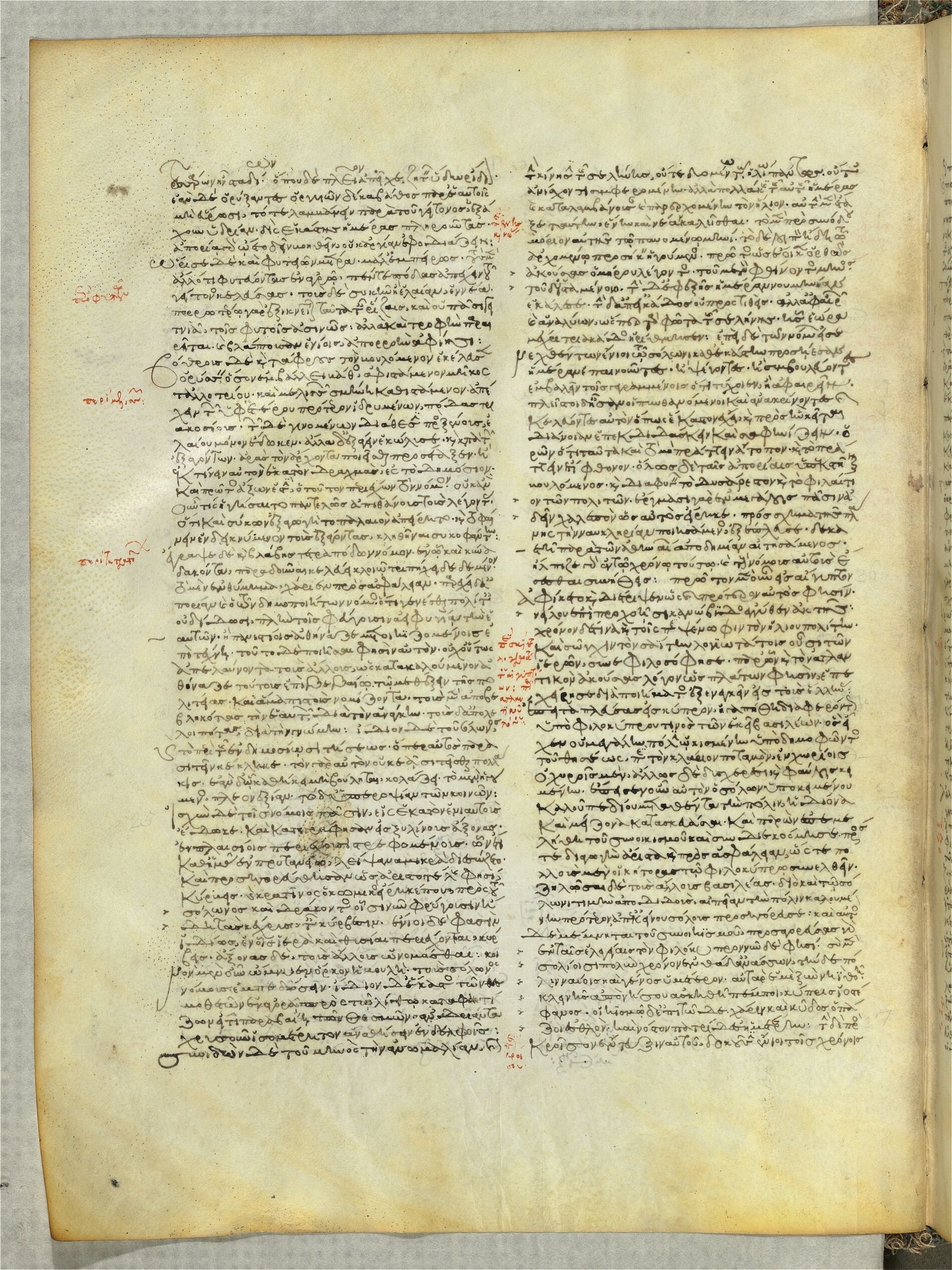
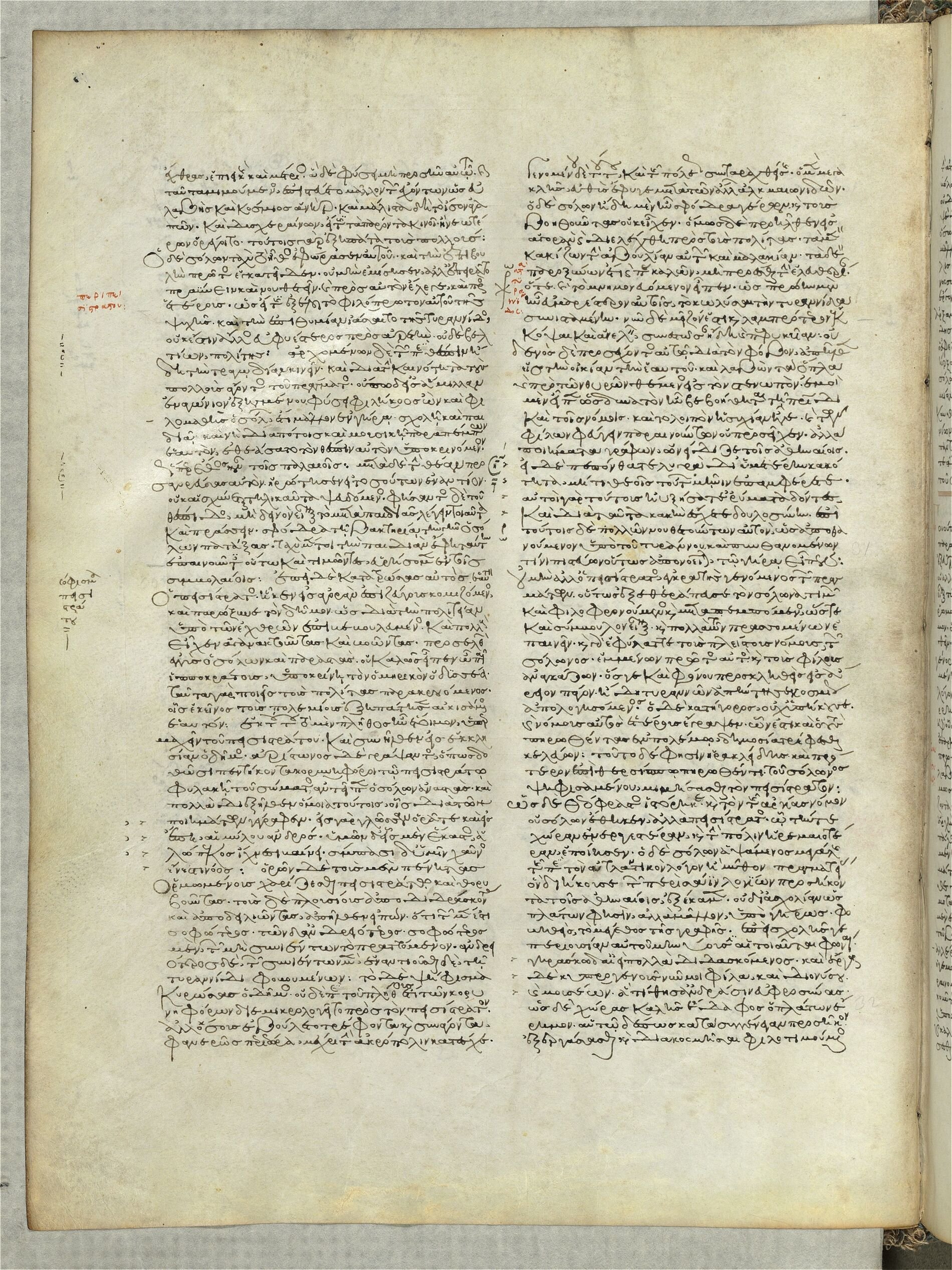
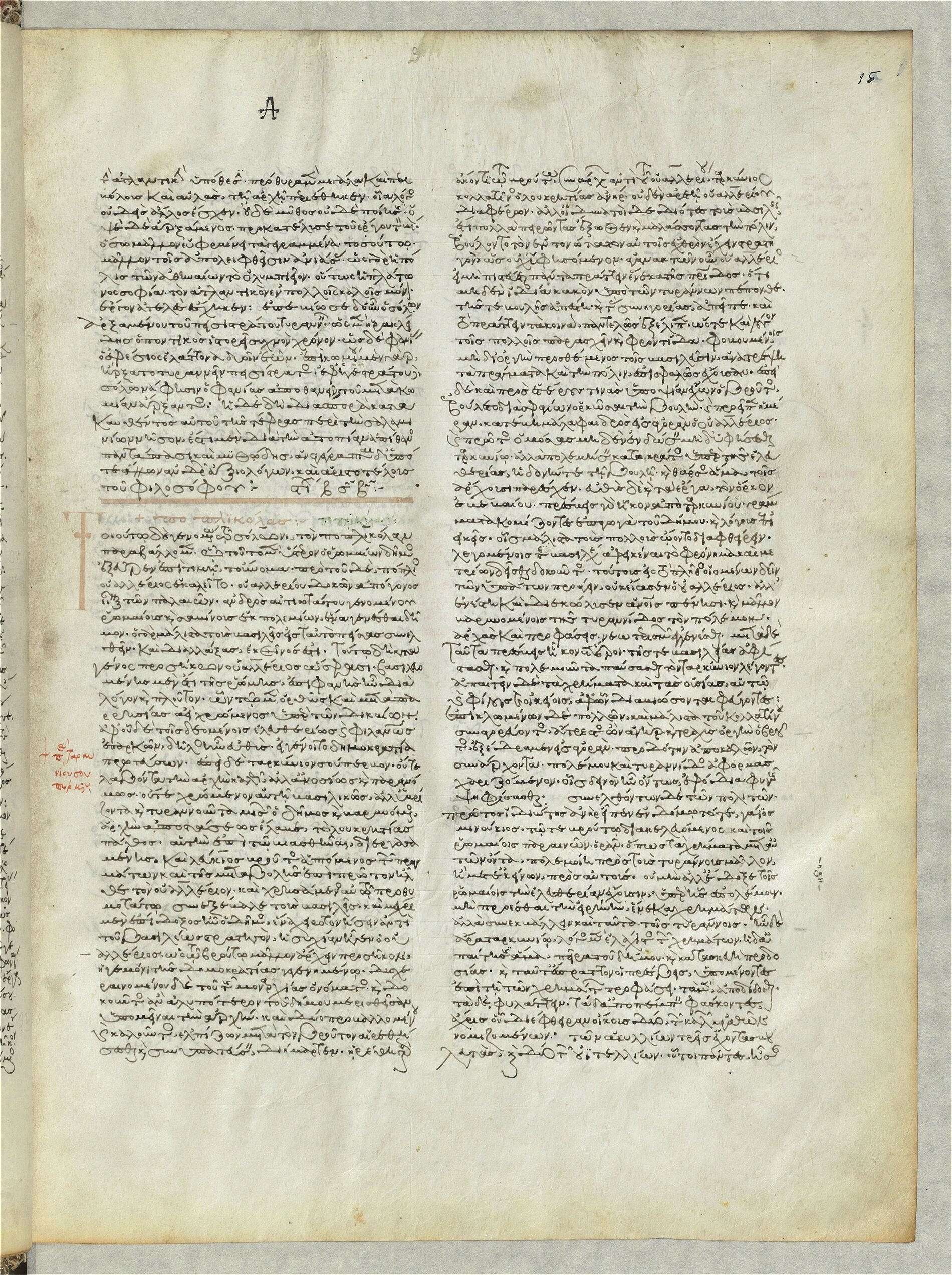
The manuscript is Paris, Bibliothèque nationale de France, grec 1671 (siglum A in the editions of the Lives), copied in 1296, which holds all the Parallel Lives and many of the Moralia in two large volumes. Each page has two columns. Chapter 26 stands in the lower half of the second column of fol. 13v; chapters 31-32 begin in the second column of fol. 14v and end at the top of the first column of fol. 15r, where the Life of Publicola follows.
The Greek is Perrin's Loeb text of 1914 (via Perseus), not a transcription of the manuscript. The English is Bernadotte Perrin's Loeb translation of 1914, which renders Plutarch's 'Atlantic story' as 'the story of the lost Atlantis'.
How was this verified? (Provenance)
Where on the image
26.1 begins in fol. 13v col. b line 26, after the end of 25.6 ‹τοὺς νόμους αὐτοῖς ἐσεσθαι συνέθετο›: ‹πρῶτον μὲν οὖν εἰς αἴγυπτον›; line 28 is the verse ‹νείλου ἐπὶ προχοῇσι κανωβίδος ἐγγύθεν ἀκτῆς› (marked by a sign in the margin); the words ‹τὸν ἀτλαν|τικὸν ἀκούσας λόγον ὡς πλάτων φησὶν› run over lines 31-32, beside a note in red in the left margin; the section ends in line 33, ‹ἐξενεγκεῖν ἐς τοὺς ἕλληνας›. Read on the BnF colour images (full page and full-resolution crops of the column).
πρῶτον μὲν οὖν εἰς Αἴγυπτον ἀφίκετο καὶ διέτριψεν, ὡς αὐτός φησι,
Νείλου ἐπὶ προχοῇσι Κανωβίδος ἐγγύθεν ἀκτῆς.
χρόνον δέ τινα καὶ τοῖς περὶ Ψένωφιν τὸν Ἡλιουπολίτην καὶ Σῶγχιν τὸν Σαΐτην, λογιωτάτοις οὖσι τῶν ἱερέων, συνεφιλοσόφησε· παρʼ ὧν καὶ τὸν Ἀτλαντικὸν ἀκούσας λόγον, ὡς Πλάτων φησίν, ἐπεχείρησε διὰ ποιήματος ἐξενεγκεῖν εἰς τοὺς Ἕλληνας.
In the first place, then, he went to Egypt, and lived, as he himself says,
“Where Nile pours forth his floods, near the Canobic shore.”
He also spent some time in studies with Psenophis of Heliopolis and Sonchis of Saïs, who were very learned priests. From these, as Plato says, he heard the story of the lost Atlantis, and tried to introduce it in a poetical form to the Greeks.
Where on the image
26.2 begins at the start of fol. 13v col. b line 34, ‹ἔπειτα πλεύσας εἰς κύπρον ἠγαπήθη διαφερόντως›, and ends in line 41, ‹καὶ μείζονα κατασκευάσαι›. Read on the BnF colour images (full page and full-resolution crops of the column).
ἔπειτα πλεύσας εἰς Κύπρον ἠγαπήθη διαφερόντως ὑπὸ Φιλοκύπρου τινὸς τῶν ἐκεῖ βασιλέων, ὃς εἶχεν οὐ μεγάλην πόλιν, ᾠκισμένην ὑπὸ Δημοφῶντος τοῦ Θησέως, περὶ τὸν Κλάριον ποταμὸν ἐν χωρίοις ὀχυροῖς μέν, ἄλλως δὲ δυσχερέσι καὶ φαύλοις κειμένην. ἔπεισεν οὖν αὐτὸν ὁ Σόλων ὑποκειμένου καλοῦ πεδίου μεταθέντα τὴν πόλιν ἡδίονα καὶ μείζονα κατασκευάσαι.
Next he sailed to Cyprus, and was greatly beloved of Philocyprus, one of the kings of the island. This prince had a small city, founded by Demophon, the son of Theseus, and lying near the river Clarius, in a position which was strong, but otherwise incommodious and sorry. Solon therefore persuaded him to remove the city to the fair plain which lay below it, and make it more spacious and pleasant.
Where on the image
26.3 begins in fol. 13v col. b line 41, ‹καὶ παρὼν ἐπεμε|λήθη τοῦ συνοικισμοῦ›, and ends in line 47, ‹σόλους προσηγόρευσε›. Read on the BnF colour images (full page and full-resolution crops of the column).
καὶ παρὼν ἐπεμελήθη τοῦ συνοικισμοῦ, καὶ συνδιεκόσμησε πρός τε διαγωγὴν ἄριστα καὶ πρὸς ἀσφάλειαν, ὥστε πολλοὺς μὲν οἰκήτορας τῷ Φιλοκύπρῳ συνελθεῖν, ζηλῶσαι δὲ τοὺς ἄλλους βασιλέας· διὸ καὶ τῷ Σόλωνι τιμὴν ἀποδιδοὺς Αἰπεῖαν τὴν πόλιν καλουμένην πρότερον ἀπʼ ἐκείνου Σόλους προσηγόρευσε.
He also remained and took charge of the new city’s consolidation, and helped to arrange it in the best possible manner both for convenience of living and for safety. The result was that many colonists flocked to Philocyprus, and he was the envy of the other kings. He therefore paid Solon the honour of naming the new city after him, and called it Soli; its name had been Aipeia.
Where on the image
26.4 begins in fol. 13v col. b line 47, ‹καὶ αὐτὸς | δὲ μέμνηται τοῦ συνοικισμοῦ›; Solon's elegiac lines (‹νῦν δέ φησι σὺ μὲν | σολίοισι πολὺν χρόνον›, lines 49-54) are written as prose, with a sign in the margin beside each line; the section ends in line 54, ‹πατρίδ' ἐς ἡμετέρην›, followed in the same line by 27.1 ‹τὴν δὲ πρὸς›; line 55, the last of the column, begins ‹κροῖσον›. Read on the BnF colour images (full page and full-resolution crops of the column).
καὶ αὐτὸς δὲ μέμνηται τοῦ συνοικισμοῦ· προσαγορεύσας γὰρ ἐν ταῖς ἐλεγείαις τὸν Φιλόκυπρον,
νῦν δὲ (φησί) σὺ μὲν Σολίοισι πολὺν χρόνον ἐνθάδʼ ἀνάσσων
τήνδε πόλιν ναίοις καὶ γένος ὑμέτερον·
αὐτὰρ ἐμὲ ξὺν νηῒ θοῇ κλεινῆς ἀπὸ νήσου
ἀσκηθῆ πέμποι Κύπρις ἰοστέφανος·
οἰκισμῷ δʼ ἐπὶ τῷδε χάριν καὶ κῦδος ὀπάζοι
ἐσθλὸν καὶ νόστον πατρίδʼ ἐς ἡμετέρην.
Solon himself also makes mention of this consolidation. In his elegies, namely, he addresses Philocyprus, and says:—
“Now mayest thou long time be lord and master for the Solii here,
Dwelling in this city thyself, and thy family after thee;
But may I and my swift ship, as we leave this storied isle,
Be brought upon our way in safety by Cypris of the violet crown.
Upon this settlement of thine may she bestow favour and glory;
And upon me an auspicious return to my fatherland.”
Where on the image
31.1 begins at the end of fol. 14v col. b line 22, after the verse ‹καὶ διὰ ταῦτα κακὴν ἔσχετε δουλοσύνην›: ‹ἐπὶ›; line 23 reads ‹τούτοις δὲ πολλῶν νουθετούντων αὐτὸν ὡς ἀποθα-›, line 25 ends with Solon's answer ‹τῷ γήρᾳ εἶπεν›; the section ends in line 32, ‹καὶ τοὺς φίλους | ἀναγκάζων›. Read on the BnF colour images (full page and full-resolution crops of the column).
ἐπὶ τούτοις δὲ πολλῶν νουθετούντων αὐτὸν ὡς ἀποθανούμενον ὑπὸ τοῦ τυράννου, καὶ πυνθανομένων τίνι πιστεύων οὕτως ἀπονοεῖται, τῷ γήρᾳ, εἶπεν. οὐ μὴν ἀλλʼ ὁ Πεισίστρατος ἐγκρατὴς γενόμενος τῶν πραγμάτων οὕτως ἐξεθεράπευσε τὸν Σόλωνα, τιμῶν καὶ φιλοφρονούμενος καὶ μεταπεμπόμενος, ὥστε καὶ σύμβουλον εἶναι καὶ πολλὰ τῶν πρασσομένων ἐπαινεῖν. καὶ γὰρ ἐφύλαττε τοὺς πλείστους νόμους τοῦ Σόλωνος, ἐμμένων πρῶτος αὐτὸς καὶ τοὺς φίλους ἀναγκάζων·
In view of this, many warned him that the tyrant would put him to death, and asked him on what he relied that he was so lost to all sense, to which he answered, “My old age.” However, when Peisistratus had become master of the situation, he paid such court to Solon by honouring him, showing him kindness, and inviting him to his palace, that Solon actually became his counsellor and approved of many of his acts. For he retained most of Solon’s laws, observing them first himself, and compelling his friends to do so.
Where on the image
31.2 begins in fol. 14v col. b line 32, ‹ὅς γε καὶ φόνου προσκληθεὶς εἰς ἄ|ρειον πάγον›; line 40 begins with an enlarged ‹ὡς δὲ θεόφραστος ἱστόρηκε›; the section ends in line 43, ‹ἠρεμαιοτέ|ραν ἐποίησεν›. Read on the BnF colour images (full page and full-resolution crops of the column).
ὅς γε καὶ φόνου προσκληθεὶς εἰς Ἀρειον πάγον, ἤδη τυραννῶν, ἀπήντησε κοσμίως ἀπολογησόμενος, ὁ δὲ κατήγορος οὐχ ὑπήκουσε· καὶ νόμους αὐτὸς ἑτέρους ἔγραψεν, ὧν ἐστι καὶ ὁ τοὺς πηρωθέντας ἐν πολέμῳ δημοσίᾳ τρέφεσθαι κελεύων. τοῦτο δέ φησιν Ἡρακλείδης καὶ πρότερον ἐπὶ Θερσίππῳ πηρωθέντι τοῦ Σόλωνος ψηφισαμένου μιμήσασθαι τὸν Πεισίστρατον. ὡς δὲ Θεόφραστος ἱστόρηκε, καὶ τὸν τῆς ἀργίας νόμον οὐ Σόλων ἔθηκεν, ἀλλὰ Πεισίστρατος, ᾧ τήν τε χώραν ἐνεργοτέραν καὶ τὴν πόλιν ἠρεμαιοτέραν ἐποίησεν.
For instance, he was summoned before the Areiopagus on a charge of murder, when he was already tyrant, and presented himself there to make his defence in due form, but his accuser did not put in an appearance. He also made other laws himself, one of which provides that those who are maimed in war shall be maintained at the public charge. But Heracleides says that even before that Solon had caused a decree to be passed to this effect in the case of Thersippus, who had been so maimed, and that Peisistratus was following his example. Moreover, Theophrastus writes that the law against idleness, in consequence of which the country became more productive and the city more tranquil, was not made by Solon, but by Peisistratus.
Where on the image
31.3 begins in fol. 14v col. b line 43, ‹ὁ δὲ σόλων ἁψάμενος μεγάλης›; line 44 reads ‹τῆς περὶ τὸν ἀτλαντικὸν λόγον ἢ μῦθον πραγματεί-›; the two verse quotations (lines 50-52) carry signs in the margin; the section ends in line 52, ‹ἃ τίθησ' ἀνδράσιν εὐφροσύνας›. Read on the BnF colour images (full page and full-resolution crops of the column).
ὁ δὲ Σόλων ἁψάμενος μεγάλης τῆς περὶ τὸν Ἀτλαντικὸν λόγον ἢ μῦθον πραγματείας, ὃν διήκουσε τῶν περὶ Σάϊν λογίων προσήκοντα τοῖς Ἀθηναίοις, ἐξέκαμεν, οὐ διʼ ἀσχολίαν, ὡς Πλάτων φησίν, ἀλλὰ μᾶλλον ὑπὸ γήρως, φοβηθεὶς τὸ μέγεθος τῆς γραφῆς. ἐπεὶ σχολῆς γε περιουσίαν αὐτοῦ μηνύουσιν αἱ τοιαῦται φωναί·
γηράσκω δʼ αἰεὶ πολλὰ διδασκόμενος·
καί,
ἔργα δὲ Κυπρογενοῦς νῦν μοι φίλα καὶ Διονύσου
καὶ Μουσέων, ἃ τίθησʼ ἀνδράσιν εὐφροσύνας.
Now Solon, after beginning his great work on the story or fable of the lost Atlantis, which, as he had heard from the learned men of Saïs, particularly concerned the Athenians, abandoned it, not for lack of leisure, as Plato says, but rather because of his old age, fearing the magnitude of the task. For that he had abundant leisure, such verses as these testify:—
“But I grow old ever learning many things;”
and again,
“But now the works of the Cyprus-born goddess are dear to my soul,
Of Dionysus, too, and the Muses, which impart delights to men.”
Where on the image
32.1 begins at the start of fol. 14v col. b line 53, ‹ὡς δὲ χώρας καλῆς ἔδαφος ὁ πλάτων ἔ|ρημον›; the column ends in line 55 with ‹ἐξεργάσασθαι καὶ διακοσμῆσαι φιλοτιμούμενος›; fol. 15r col. a (folio number 15 read) begins ‹τὴν ἀτλαντικὴν ὑπόθεσιν›, and the section ends in line 3, ‹οὐδὲ μῦθος οὐδὲ ποίησις›. Read on the BnF colour images (full page and full-resolution crops of the column).
ὡς δὲ χώρας καλῆς ἔδαφος ὁ Πλάτων ἔρημον, αὐτῷ δέ πως κατὰ συγγένειαν προσῆκον, ἐξεργάσασθαι καὶ διακοσμῆσαι φιλοτιμούμενος τὴν Ἀτλαντικὴν ὑπόθεσιν, πρόθυρα μὲν μεγάλα καὶ περιβόλους καὶ αὐλὰς τῇ ἀρχῇ περιέθηκεν, οἷα λόγος οὐδεὶς ἄλλος ἔσχεν οὐδὲ μῦθος οὐδὲ ποίησις,
Plato, ambitious to elaborate and adorn the subject of the lost Atlantis, as if it were the soil of a fair estate unoccupied, but appropriately his by virtue of some kinship with Solon, began the work by laying out great porches, enclosures, and courtyards, such as no story, tale, or poesy ever had before.
Where on the image
32.2 begins at the end of fol. 15r col. a line 3, ‹ὀ|ψὲ δὲ ἀρξάμενος›; lines 7-8 read ‹οὕτως ἡ πλάτω|νος σοφία τὸν ἀτλαντικὸν ἐν πολλοῖς καλοῖς›; the section ends in line 9, ‹ἔργον ἀτελὲς ἔσχηκεν›. Read on the BnF colour images (full page and full-resolution crops of the column).
ὀψὲ δὲ ἀρξάμενος προκατέλυσε τοῦ ἔργου τὸν βίον, ὅσῳ μᾶλλον εὐφραίνει τὰ γεγραμμένα, τοσούτῳ μᾶλλον τοῖς ἀπολειφθεῖσιν ἀνιάσας. ὡς γὰρ ἡ πόλις τῶν Ἀθηναίων τὸ Ὀλυμπιεῖον, οὕτως ἡ Πλάτωνος σοφία τὸν Ἀτλαντικὸν ἐν πολλοῖς καλοῖς μόνον ἔργον ἀτελὲς ἔσχηκεν.
But he was late in beginning, and ended his life before his work. Therefore the greater our delight in what he actually wrote, the greater is our distress in view of what he left undone. For as the Olympieium in the city of Athens, so the tale of the lost Atlantis in the wisdom of Plato is the only one among many beautiful works to remain unfinished.
Where on the image
32.3 begins in fol. 15r col. a line 9, ‹ἐπεβίωσε δ' οὖν ὁ σόλων›, and ends in line 15, ‹τοῦ μετὰ κω|μίαν ἄρξαντος›. Read on the BnF colour images (full page and full-resolution crops of the column).
ἐπεβίωσε δʼ οὖν ὁ Σόλων ἀρξαμένου τοῦ Πεισιστράτου τυραννεῖν, ὡς μὲν Ἡρακλείδης ὁ Ποντικὸς ἱστορεῖ, συχνὸν χρόνον, ὡς δὲ Φανίας ὁ Ἐρέσιος, ἐλάττονα δυοῖν ἐτῶν. ἐπὶ Κωμίου μὲν γὰρ ἤρξατο τυραννεῖν Πεισιστρατος, ἐφʼ Ἡγεστράτου δὲ Σόλωνά φησιν ὁ Φανίας ἀποθανεῖν τοῦ μετὰ Κωμίαν ἄρξαντος.
Well, then, Solon lived on after Peisistratus had made himself tyrant, as Heracleides Ponticus states, a long time; but as Phanias of Eresos says, less than two years. For it was in the archonship of Comeas that Peisistratus began his tyranny, and Phanias says that Solon died in the archonship of Hegestratus, the successor of Comeas.
Where on the image
32.4 begins in fol. 15r col. a line 15, ‹ἡ δὲ διασπορὰ κατα|καυθέντος αὐτοῦ›, and ends in line 20, ‹τοῦ φιλοσόφου›, the last words of the Life, followed by a stichometric note; below a rule the Life of Publicola begins with a large initial and a title in red. Read on the BnF colour images (full page and full-resolution crops of the column).
ἡ δὲ διασπορὰ κατακαυθέντος αὐτοῦ τῆς τέφρας περὶ τὴν Σαλαμινίων νῆσον ἔστι μὲν διὰ τὴν ἀτοπίαν ἀπίθανος παντάπασι καὶ μυθώδης, ἀναγέγραπται δʼ ὑπό τε ἄλλων ἀνδρῶν ἀξιολόγων καὶ Ἀριστοτέλους τοῦ φιλοσόφου.
The story that his body was burned and his ashes scattered on the island of Salamis is strange enough to be altogether incredible and fabulous, and yet it is given by noteworthy authors, and even by Aristotle the philosopher.
Notes
- Greek: Perrin's Loeb text (1914) via Perseus, not a transcription of the manuscript; the manuscript writes the verse quotations as prose.
- English: Perrin's footnotes are omitted. Perseus' digital English of the same translation was not used: it drops the quotation marks and changes some spellings.
- Chapters 27-30 (Croesus, Thespis, Peisistratus' rise) are not included; the chapters shown are the two passages on Atlantis and the close of the Life.
Cite
Sources
- Source: Paris, BnF, grec 1671 (Plutarch A, 1296) fol. 13v, 14v, 15r via Gallica (BnF IIIF) + Perrin's Greek (Perseus) + Perrin's English (Loeb 1914) (holding institution)
- Critical edition: Perseus editions named per passage
← previous · → next · v cycle view · l back to library