Berossus in Abydenus: the kings of the Chaldeans and the flood of Sisithros (George Syncellus)
Introduction
Berossus was a priest of Bel at Babylon who, around 290-278 BCE, wrote a history of his country in Greek for the Seleucid king Antiochus I. His three books ran from the creation of the world through the ten kings who reigned before the flood to the Neo-Babylonian kings. The work is lost. Its fullest remains reached the Byzantine chronicler George Syncellus (c. 800 AD) through a chain of excerpts: Alexander Polyhistor (1st c. BCE) summarized Berossus, Eusebius of Caesarea quoted Polyhistor, and Syncellus copied Eusebius into his Ecloga chronographica.
The manuscript shown is Paris, Bibliothèque nationale de France, grec 1711, an 11th-century copy of Syncellus' chronicle, the oldest and principal witness to the text. The images are the library's black-and-white microfilm, published on Gallica. Each section points at the page that carries it; the line numbers in the notes were counted on the images.
The third version in Syncellus is that of Abydenus, who retold Berossus' account of the ten kings and the flood in Ionic Greek. His Sisithros is Berossus' Xisouthros.
Not included: the summaries of Berossus that survive only in the Armenian translation of Eusebius' Chronicle (no Greek), Syncellus' own remarks on Berossus' chronology (no public-domain English translation), and the short testimonia in other authors.
How was this verified? (Provenance)
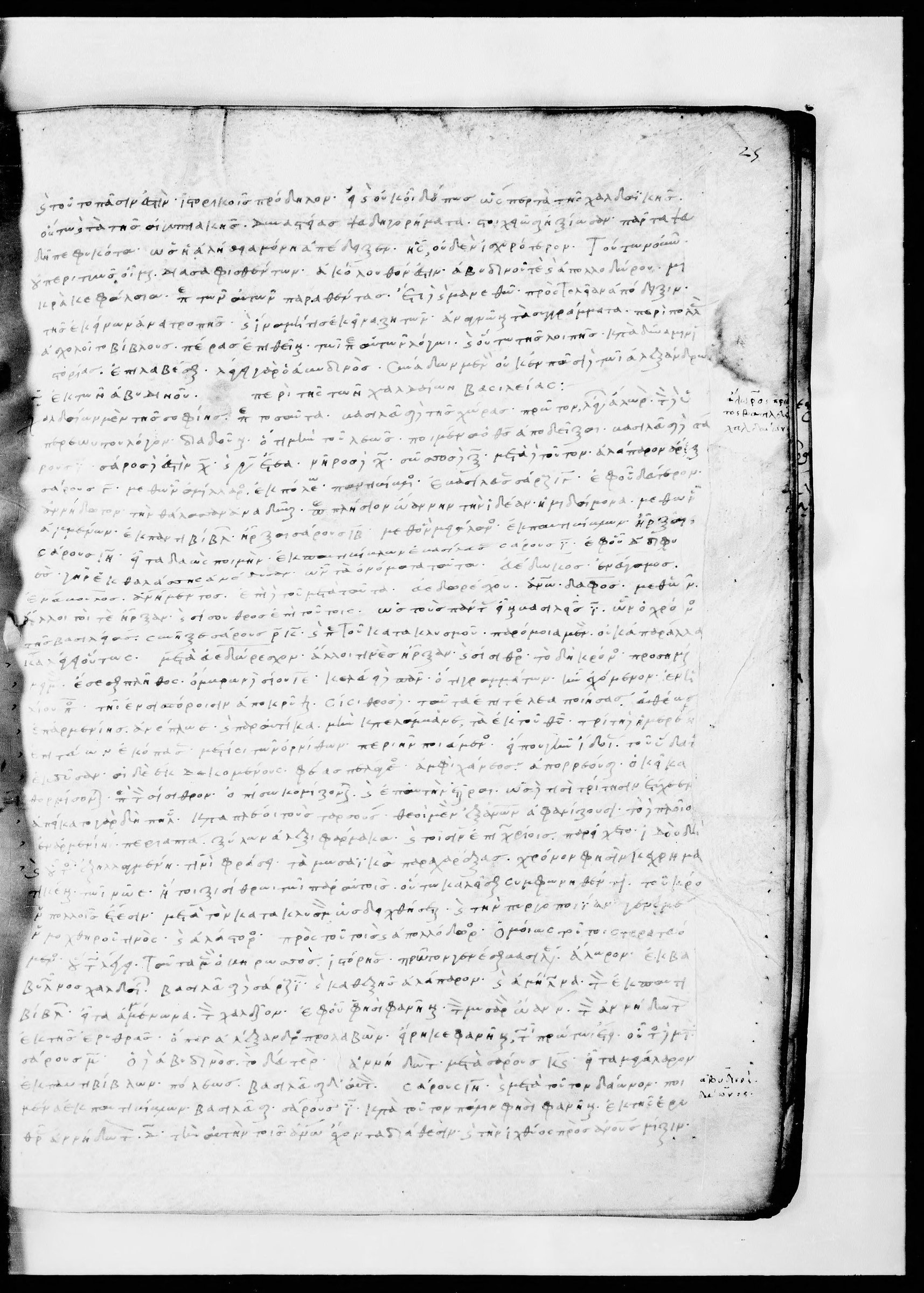
Where on the image
Paris gr. 1711, p. 25 (Gallica image f26, right page of the opening; microfilm). Line 9 is the heading 'Ἐκ τῶν Ἀβυδηνοῦ. Περὶ τῆς τῶν Χαλδαίων βασιλείας', followed on line 10 by 'Χαλδαίων μὲν τῆς σοφίης πέρι τοσαῦτα' (the margin beside it notes 'Ἄλωρος πρῶτος βασιλεὺς Χαλδαίων'); the list of kings ends on line 20 'συνῆξε σάρους ρκ´'. Checked on the image. Viewer: https://gallica.bnf.fr/ark:/12148/btv1b10723005g/f26.item The Greek shown is Müller's edited text; the copyist's wording on the page differs in places (for example the manuscript reads Κορκυραίων where Müller prints Κορδυαίων).
Ἐκ τῶν Ἀβυδηνοῦ Περὶ τῆς τῶν Χαλδαίων βασιλείας. Χαλδαίων μὲν τῆς σοφίης πέρι τοσαῦτα. Βασιλεῦσαι δὲ τῆς χώρας πρῶτον λέγεται Ἄλωρον, τὸν δὲ ὑπὲρ ἑωυτοῦ λόγον διαδοῦναι ὅτι μιν τοῦ λεῶ ποιμένα ὁ θεὸς ἀποδεῖξαι. Βασιλεῦσαι δὲ σάρους δέκα. Σάρος δέ ἐστιν ἑξακόσια καὶ τρισχίλια ἔτεα, νῆρος δὲ ἑξακόσια, σῶσσος δὲ ἑξήκοντα. Μετὰ δὲ τοῦτον Ἀλάπαρον ἄρξαι σάρους τρεῖς, μεθ’ ὃν Ἀμίλλαρος ἐκ πόλεως Παντιβίβλιος ἐβασίλευσε σάρους ιγʹ. Ἐφ’ οὗ δεύτερον Ἀννήδωτον τὴν θάλασσαν ἀναδῦναι παραπλήσιον Ὠάννῃ τὴν ἰδέαν ἡμιδαίμονα. Μεθ’ ὃν Ἀμμένων ἐκ Παντιβίβλων ἦρξε σάρους ιβʹ. Μεθ’ ὃν Μεγάλαρος ἐκ Παντιβίβλων ἦρξε σάρους ὀκτωκαίδεκα· εἶτα Δαὼς ποιμὴν ἐκ Παντιβίβλων ἐβασίλευσε σάρους δέκα, ἐφ’ οὗ δʹ διφυεῖς γῆν ἐκ θαλάσσης ἀνέδυσαν, ὧν τὰ ὀνόματα ταῦτα, Εὐέδωκος, Ἐνεύγαμος, Ἐνεύβουλος, Ἀνήμεντος. Ἐπὶ δὲ τοῦ μετὰ ταῦτα Εὐεδωρέσχου Ἀνώδαφος. Μεθ’ ὃν ἄλλοι τε ἦρξαν καὶ Σίσουθρος ἐπὶ τούτοις, ὡς τοὺς πάντας εἶναι βασιλεῖς δέκα, ὧν ὁ χρόνος τῆς βασιλείας συνῆξε σάρους ἑκατὸν εἴκοσι.
BEROSSUS: FROM ABYDENUS. OF THE CHALDÆAN KINGS AND THE DELUGE. So much concerning the wisdom of the Chaldæans. It is said that the first king of the country was Alorus, and that he gave out a report that God had appointed him to be the Shepherd of the people: he reigned ten sari: now a sarus is esteemed to be three thousand six hundred years; a neros six hundred; and a sossus sixty. After him Alaparus reigned three sari: to him succeeded Amillarus from the city of Pantibiblon, who reigned thirteen sari; in his time came up from the sea a second Annedotus, a semi-dæmon very similar in his form to Oannes: after Amillarus reigned Ammenon twelve sari, who was of the city of Pantibiblon: then Megalarus of the same place reigned eighteen sari: then Daos, the shepherd, governed for the space of ten sari; he was of Pantibiblon; in his time four double-shaped personages came up out of the sea to land, whose names were Euedocus, Eneugamus, Eneuboulus, and Anementus: afterwards in the time of Euedoreschus appeared another Anodaphus. After these reigned other kings, and last of all Sisithrus: so that in the whole, the number amounted to ten kings, and the term of their reigns to an hundred and twenty sari.
Where on the image
Paris gr. 1711, p. 25 (Gallica image f26, right page of the opening; microfilm). The flood begins on line 20 'καὶ περὶ τοῦ κατακλυσμοῦ παρόμοια μέν, οὐκ ἀπαράλλα-|κτα' and ends on line 29 '...τοῖσιν ἐπιχωρίοισι παρείχετο'. Checked on the image. Viewer: https://gallica.bnf.fr/ark:/12148/btv1b10723005g/f26.item The Greek shown is Müller's edited text; the copyist's wording on the page differs in places (for example the manuscript reads Κορκυραίων where Müller prints Κορδυαίων).
Καὶ περὶ τοῦ κατακλυσμοῦ παρόμοια μὲν, οὐκ ἀπαράλλακτα λέγει οὕτως· «Μετὰ Εὐεδώρεσχον ἄλλοι τινὲς ἦρξαν καὶ Σίσιθρος, ᾧ δὴ Κρόνος προσημαίνει μὲν ἔσεσθαι πλῆθος ὄμβρων Δαισίου ιεʹ· κελεύει δὲ πᾶν ὅ τι γραμμάτων ἦν ἐχόμενον ἐν Ἡλιουπόλει τῇ ἐν Σισπόροισιν ἀποκρύψαι. Σίσιθρος δὲ ταῦτα ἐπιτελέα ποιήσας, εὐθέως ἐπ’ Ἀρμενίης ἀνέπλωε· καὶ παραυτίκα μὲν κατελάμβανε τὰ ἐκ τοῦ θεοῦ· τρίτῃ δὲ ἡμερέῃ ἐπεὶ ὕων ἐκόπασε, μετίει τῶν ὀρνίθων, πείρην ποιεύμενος εἴ κου γῆν ἴδοιεν τοῦ ὕδατος ἐκδῦσαν. Αἱ δὲ ἐκδεκομένου σφέας πελάγεος ἀμφιχανέος, ἀπορέουσαι ὅκη καθορμίσονται, παρὰ τὸν Σίσιθρον ὀπίσω κομίζονται· καὶ ἐπ’ αὐτῇσιν ἕτεραι. Ὡς δὲ τῇσι τρίτῃσιν εὐτύχεεν (ἀπίκατο γὰρ δὴ πηλοῦ κατάπλεοι τοὺς ταρσούς), θεοί μιν ἐξ ἀνθρώπων ἀφανίζουσι, τὸ δὲ πλοῖον ἐν Ἀρμενίῃ περίαπτα ξύλων ἀλεξιφάρμακα (καὶ) τοῖσιν ἐπιχωρίοις παρείχετο.»
(And among other things not irrelative to the subject, he continues thus concerning the deluge:) After Euedoreschus some others reigned, and then Sisithrus. To him the deity Cronus foretold that on the fifteenth day of the month Desius there would be a deluge of rain: and he commanded him to deposit all the writings whatever which were in his possession, in the city of the Sun in Sippara. Sisithrus, when he had complied with commands, sailed immediately to Armenia, and was presently inspired by God. Upon the third day after the cessation of the rain Sisithrus sent out birds, by way of experiment, that he might judge whether the flood had subsided. But the birds passing over an unbounded sea, without finding any place of rest, returned again to Sisithrus. This he repeated with other birds. And when upon the third trial he succeeded, for the birds then returned with their feet stained with mud, the gods translated him from among men. With respect to the vessel, which yet remains in Armenia, it is a custom of the inhabitants to form bracelets and amulets of its wood.
Notes
- Greek: C. Müller, Fragmenta Historicorum Graecorum (1848-1851), text taken from the Digital Fragmenta Historicorum Graecorum and proofread against Müller's printed pages. Müller's notes on variant readings, printed in parentheses inside the text, are left out; his square brackets mark words he took to be additions by the excerptors.
- English: I. P. Cory, Ancient Fragments (2nd ed., 1832). Cory sometimes follows readings of the Armenian translation of Eusebius or older editors rather than the Greek printed here, so a few phrases differ from the Greek. His footnotes and source references are omitted. The capitalized heading at the start of the English is Cory's own heading; Syncellus' Greek heading is not translated by Cory.
- The manuscript's wording differs from Müller's edited text in small details. The Greek is the edition, not a transcription of the page.
- Abydenus (2nd c. AD?) wrote in the Ionic dialect of Herodotus and drew on Berossus through Polyhistor; his king list differs in several names and reign lengths from Apollodorus' version.
Cite
Sources
- Source: Paris gr. 1711 (George Syncellus, 11th c.) via Gallica + Greek of C. Müller, FHG (DFHG, proofread) + English of I. P. Cory, Ancient Fragments (1832) (holding institution)
- Critical edition: C. Müller, FHG II and IV (via DFHG, proofread); B. Niese 1889 (Perseus)
← previous · → next · v cycle view · l back to library